Summary
Table of Content

Small Arms Market
Get a free sample of this report
Form submitted successfully!
Error submitting form. Please try again.
Thank you!
Your inquiry has been received. Our team will reach out to you with the required details via email. To ensure that you don't miss their response, kindly remember to check your spam folder as well!
Request Sectional Data
Thank you!
Your inquiry has been received. Our team will reach out to you with the required details via email. To ensure that you don't miss their response, kindly remember to check your spam folder as well!
Form submitted successfully!
Error submitting form. Please try again.
Small Arms Market Size
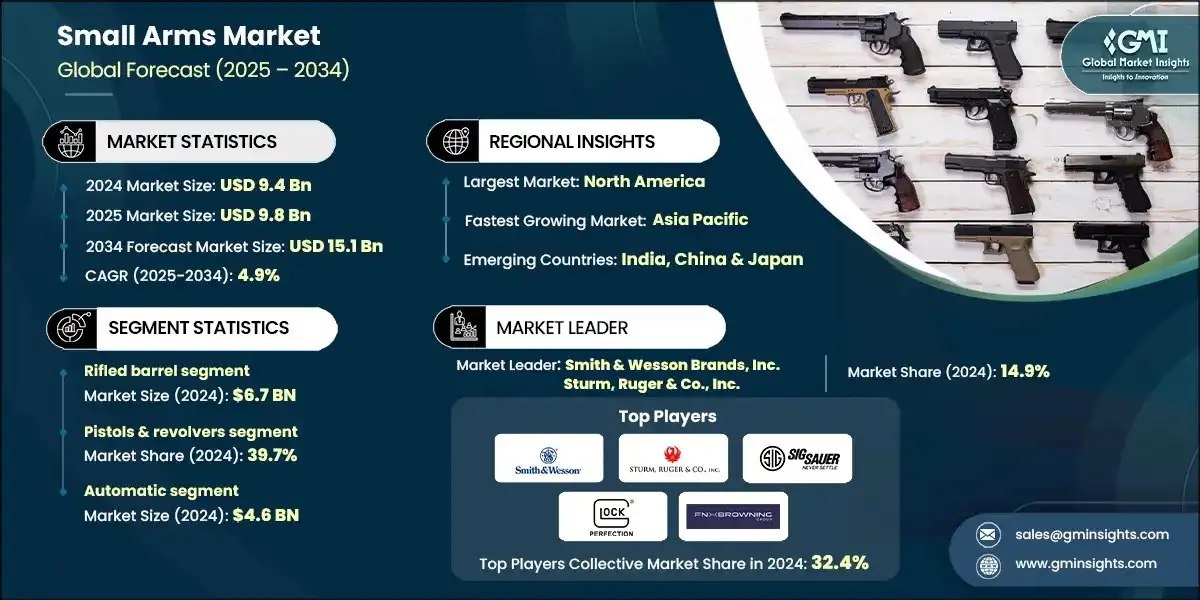
The global small arms market was valued at USD 9.4 billion with a volume of 21,707.7 thousand units in 2024 and is projected to reach USD 9.8 billion by 2025 and USD 15.1 billion by 2034 with a volume of 34,022 thousand units, growing at a value CAGR of 4.9% and volume CAGR of 4.7% during the forecast period of 2025–2034, according to Global Market Insights Inc.
Small Arms Market Key Takeaways
Market Size & Growth
- 2024 Market Size: USD 9.4 Billion
- 2025 Market Size: USD 9.8 Billion
- 2034 Forecast Market Size: USD 15.1 Billion
- CAGR (2025–2034): 4.9%
Regional Dominance
- Largest Market: North America
- Fastest Growing Region: Asia Pacific
Key Market Drivers
- Smith & Wesson Brands, Inc..
- Sturm, Ruger & Co., Inc..
- Smith & Wesson Brands, Inc..
- Sturm, Ruger & Co., Inc..
- SIG SAUER, Inc..
- GLOCK Ges.m.b.H..
- FN Herstal (FN Browning Group).
- Smith & Wesson Brands, Inc. offers a wide range of pistols and rifles with strong global presence..
- Sturm, Ruger & Co., Inc. provides reliable firearms for civilian and defense markets..
- SIG SAUER, Inc. delivers precision pistols and rifles for military, law enforcement, and commercial use..
- GLOCK Ges.m.b.H. produces durable polymer-framed pistols adopted worldwide by military and police..
- FN Herstal (FN Browning Group) focuses on military-grade small arms and tactical firearms..
Challenges
- Strict firearm regulations and licensing requirements.
- High cost of advanced small arms.
Opportunity
- Integration of smart gun technologies.
- Rising demand from emerging markets.
- Integration of smart gun technologies.
Key Players
- Market Leader: Smith & Wesson Brands, Inc. led with over 14.9% market share in 2024.
- Leading Players: Top 5 players in this market include Smith & Wesson Brands, Inc., Sturm, Ruger & Co., Inc., SIG SAUER, Inc., GLOCK Ges.m.b.H., FN Herstal (FN Browning Group), which collectively held a market share of 32.4% in 2024.
Get Market Insights & Growth Opportunities
- The growth in the market is driven by increase in investment in military & defense sector, rising geopolitical tension worldwide, technological advancements in small arms, and the rise in civilian demand for personal security and recreational shooting.
- The rising investment in the global military sector drives the small arms market. According to World Bank, military expenditure will grow significantly in the coming years, military expenditures have increased from USD 1.75 trillion in 2013 to USD 2.39 trillion in 2023. Such rising defense expenditure often translates into greater demand for small arms, adding to market demand in both developed and developing regions.
- The increase in the global crime rate, including higher risk of personal security, theft, and burglary, has led to an increase in civilian and private-sector security industry investment in small arms. Countries such as Sweden, Australia, Denmark, France, Canada, and Germany have seen 2023 with rising crime rates, subsequently increasing the demand for firearms. The Small Arms Survey reports that approximately 857 million civilian-held firearms were in circulation throughout the world by 2017, accounting for approximately 85% of the estimated 1.013 billion total firearms. This statistic suggests that firearms are significant contributor to personal security
- In 2024, North America accounted for 43% of the global small arms market, driven primarily by bans and strong civilian demand, coupled with strong defense procurement. In 2024, in the United States, alone there are projections that over 16 million firearms have been sold in that year. This record reflects not just the cultural acceptance of small arms but the institutional acceptance of the use of firearms for personal security, stability, and ultimately defense.
To get key market trends
Small Arms Market Trends
- A notable trend in the small arms sector is the modernisation of infantry weapons due to growing global defence budgets. Global military spending has been reported at USD 2.4 trillion in 2023 and USD 2.7 trillion in 2024 according to SIPRI. The continuation of military spending empowers armed forces to replace older systems with newer, lighter, modular, and more accurate systems. The modernization of weaponry will peak in the 2020s and represent NATO and Asia-Pacific countries that seek to increase lethality and versatility in future wars.
- The advancement of optics, sensors, and fire control systems is migrating small arms to networked and smart platforms. In the example of the U.S. FY2025 defence request, USD 311 billion is for acquisition; of this, USD 143 billion is allocated for RDT&E. Investments to develop and procure next-generation soldier systems with the potential for smart optics, AI-augmented target acquisition systems, and data-link functionality continues. Convergence began in the 2010s and the adoption of apex is expected in the early 2030s with the capabilities of digitizing small arms.
- The increase in civilian firearms is not coincidentally correlated to global demand in small arms. For example, in the United States in 2024, it is estimated that there will be more than 16 million civilian firearms in circulation, per the Small Arms Survey. Such a stockpile translates into container demand, parts, upgrades, and a driving incentive for more regulation. Trends in firearms ownership have been stable for decades and will continue into the 2030s. Consequently, the small arms marketplace will continue to be significant economically for consistent product demand as well as politically with ongoing discussions for regulation and ownership of civilian firearms.
Small Arms Market Analysis
Learn more about the key segments shaping this market
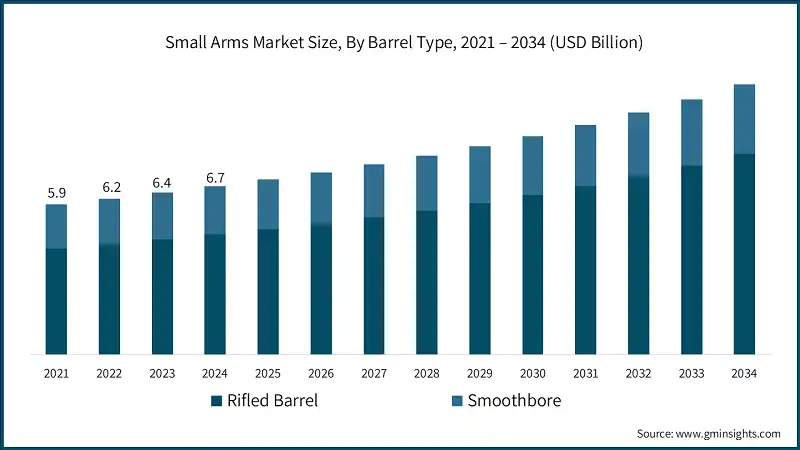
- The rifled barrel segment was the largest market and was valued at USD 6.7 billion in 2024.This type of barrel is superior due to its accuracy, longer effective range, and precision, ideal for use in a military, law enforcement, or specialized civilian application, and the introduction of modular rifles and carbines that use rifled barrels, helps to keep this market segment strong.
- Companies should focus on development of lightweight and corrosion-free rifled barrels integrated with advanced optics and accessories in collaboration with defense and police to fulfill the changing operational requirements and gain enduring contractual partnerships ought to be emphasized.
- The smoothbore segment captured 28.7% of market share in 2024 and will continue to expand. Its reliability and low maintenance will enable its growth, especially in the law enforcement, security, and civilian sports markets.
- Companies should focus should be placed on modifying smoothbore designs for tactical and non-lethal configurations, as well as tailored user options based on target user demographics.
Learn more about the key segments shaping this market
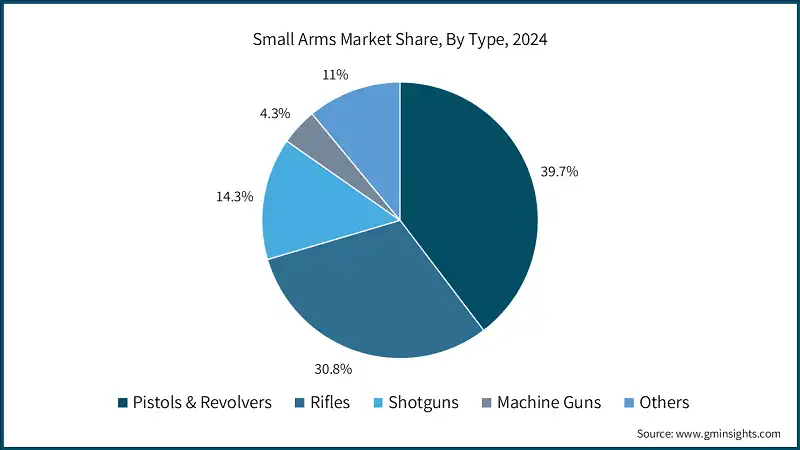
Based on the type, the small arms market is categorized into pistols & revolvers, rifles, shotguns, machine guns, and others.
- The pistols & revolvers segment led the market with a 39.7% share in 2024. The ongoing growth is based on the popularity of its ease of use & portability options for law enforcement, personal defense (e.g. concealed carry), and even recreational (civilian) use.
- Manufacturers must focus on developing modular features and safety, but customization options should also be integrated based on a variety of end-user functionalities, thus providing manufacturers with a continuous leadership position given market demand.
- The rifles category segment is the fastest growing market and is anticipated to grow with a CAGR of 6.2% during the forecast period of 2025 – 2034. The growth is primarily attributable to increasing adoption in military modernization programs, tactical operations, and competitive shooting sports.
- It is essential for firms in this sector to focus on lightweight, optic ready small arms, and simultaneously, to pursue collaborations with defense and sporting organizations to promote faster integrations.
Based on operation mode, the small arms market is divided into manual, semi-automatic, and automatic.
- Automatic segment was the largest market and was valued at USD 4.6 billion in 2024. Automatic weapons that have rapid rates of fire, have proven reliability in action, and can be used for tactical functions as preferred for military and specialty law enforcement.
- Weapons manufacturers should be about automated weapon technologies to increase both the rate of fire and rates of overall reliability and adaptations. Investment in precision engineering, durability, and ergonomics for military or law enforcement use will meet the market demand. The use of lightweight materials and cost-effective manufacturing will help capture the market niche while both modern operational demands are met.
- The semi-automatic is anticipated to grow with a CAGR of 4.3% during the forecast period of 2025 – 2034. The expansion of this segment is driven by the demand for effective, reliable firearms delivering moderate firepower while allowing users to maintain control and precision. The rise in demand for semi-automatic firearms in civilian segments, enhancements in the firearm technology and regulation, and solid trends across geographic regions will also promote continued growth.
- Manufacturers should focus on higher performance semi-automatic weapons with more accuracy, reliability, and usability. Investment in applying the latest materials with added durability and ergonomics, with rate of output does not compromise both civilian personal defense and law enforcement use. Incorporating new technologies for safety integration, along with being modular to meet consumer demand, along with regulatory requirements of manufacture will reinforce markets of both civilian personal self defence and law enforcement use.
Looking for region specific data?
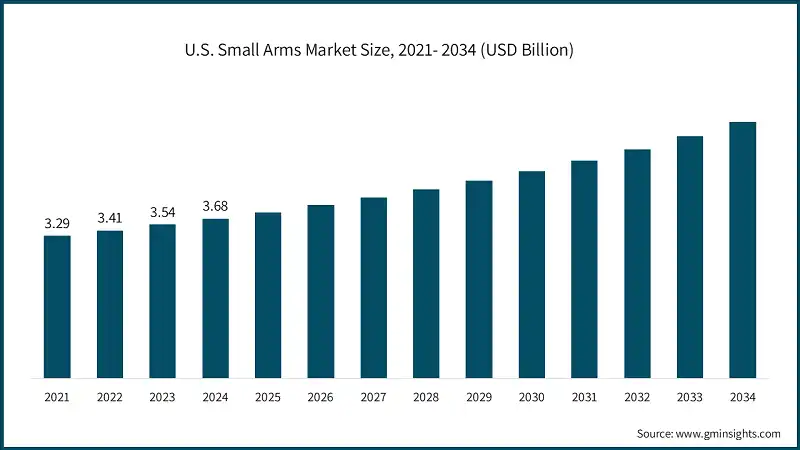
North America small arms market was valued at USD 4 billion in 2024 and is anticipated to grow with a CAGR of 4.8% during the forecast period of 2025 – 2034. Stimulated from elevated levels of civilian firearm ownership in addition to municipal police purchases, and robust defense spending.
- U.S. small arms market reached a valuation of USD 3.7 billion in 2024, fueled by elevated levels of military spending, modernization of armed forces, and increased purchases of small arms for defense and tactical applications. Demand for market will continue to be bolstered by rising levels of defense spending combined with a greater emphasis on the affordability of updated weaponry at the infantry level.
- Companies need to emphasize developing long-lasting, high precision firearms; developing strong partnerships with Department of Defense & military units; and developing firearms with modular, and mission-ready weapon systems that can respond to varied operational environments.
- Canadian small arms market is projected to grow at a CAGR of 3.5% during the forecast period of 2025-2034, driven by levels of military spending, current modernization initiatives, and increased demand for updated weaponry within the Canadian Armed Forces and federal or provincial law enforcement units. Growing demands stemming from focus on tactical and operational relevance, gradually updating individual soldier weapons in tactical scenarios, and replacing aging inventories also support growth prospects.
- Companies should turn to durable, accurate, modular firearms designated for various operational demands. Companies' opportunities to capture opportunities long-term in Canada's market will be to seek out enhanced partnerships with defense and law enforcement entities in Canada, invest in research and development on future weapon systems, deliver training and support services.
Europe accounted for 21.7% of the small arms market in 2024, driven by strong government incentives supporting the military sector and the significant investments in building weapons and military technology.
- Germany small arms market was valued at USD 500.9 million in the year 2024. Growth is driven by increasing defense spending, NATO interoperability needs, and modernization programs. Germany commitment to spend more than two percent of GDP in defense by 2027 will sustain the procurement of rifles, machine guns, and support weapons for domestic and NATO use.
- Companies need to partner with the government on Germany's rearmament agenda and partner with the Bundeswehr and industry in Germany. This means investing in domestic partnerships, complying with the strict NATO standards, and providing modular upgradable systems. Companies who secure local assembly or offset benefits will secure those long-term contracts and perpetual sustainment revenue streams.
- UK small arms market is anticipated to surpass USD 590.2 million by 2034. The expansion can be attributed to the British Army’s Future Soldier modernization program, the transitioning of outdated small arms through the British Army’s “Project Hunter” program, and the escalating demand from homeland security and law enforcement sectors. In addition, the UK will continue to affirm NATO commitments and increase its funding to the MOD, which will allow more procurement of next-generation rifles, pistols, and support weapon systems.
- Companies need to be positioned and engaged with the UK’s defense priorities by collaborating with the MoD and local defense primes. The three main points of focus will revolve around lightweight and modular weapon systems that can work along with advanced optics, NATO compliance, and the lifecycle support for these systems through long-term sustainment contracts. In addition, engaging with UK companies will be imperative to meeting a domestic content requirement and securing a place in future procurement cycles.
The small arms market in Asia Pacific is the largest market valued at 2.8 billion in 2024, growth of this specific market segment is due to the increasing security concerns, elevated investments by militaries, and growing demand for private security. The increased defense spending across the region, urbanization, and changing crime rates across the region has led to increasing demand for personal protection and law enforcement equipment.
- China small arms market is projected to reach USD 2 billion by the year 2034. This expansion is driven by several factors, including military modernization programs; a growth of the defense manufacturing base in India; and increased procurement of infantry weapon systems for the Indian armed forces. Indian government priorities around infantry weapons, including rifles, pistols, and tactical firearms, a rapid increase in domestic production, and leveraging new technologies like modularity and lightweight designs, helps to support the Indian armed forces.
- Companies should collaborate with Indian defense OEMs and state-owned enterprises, which seek advanced small arms and accessories for military use. Focus should be on convertible systems, compliant with PLA specifications, and based on high value durability, modularity, and military interoperability. Other options include long-term partnerships to develop and supply future technology; participating in military procurement competitions; an opportunity to penetrate the Indian market based on government programs to support indigenous innovation and self-reliance in defense manufacturing.
- India is the fastest-growing market in Asia-Pacific with a CAGR of 7.1% during the forecast period of 2025–2034. Growth is also driven by increases in defense budgets, upgraded infantry weapons, and procurement of rifles, pistols, and tactical firearms for the Indian armed forces. Initiatives to “Make in India – Defense” support improved domestic defense manufacturing, transfer of advanced technology and advanced small arms systems; and additionally provides additional market opportunities to expand.
- Companies should concentrate on forming alliances with Indian defense original equipment manufacturers and public sector enterprises to develop and supply lightweight, adaptable, and modern small arms. By focusing on in-country manufacturing, customization aligned with the specifications of the Indian Army, and advanced training and simulation technologies, companies can position themselves to capitalize on high-growth segments of the fast-evolving market.
- Japan accounted for 14.1% of the small arms market share in 2024. Market growth is fueled by modernization initiatives espoused by the Japanese Self-defense Forces alongside a growing appetite for increased quantities of pistols, rifles, and non-lethal munitions, as well an overall government agenda of increasing domestic production of defense technology innovation. Further demand is driven by policy focusing on purchasing high-quality small arms that are lightweight and designed for easy handling.
- Companies should seek to partner with Japanese defense organizations and local industry to provide modular, rugged, and compliant small arms solutions. Emphasis on safety, technology innovations, and precision engineering within a highly regulated environment can support long-term contracts in this developing market.
Latin America held 1.9% of the small arms market share in 2024. Market growth is driven by a greater civilian appetite for firearms for personal and home self-defense, and broader military modernization programs within the region. Growing governmental concerns for border control and counter-organized crime initiatives are diversifying spending.
The MEA small arms market was valued at USD 365.9 million in 2024, increased demand is due to increasing defense spending, heightened security concerns, and modernization of military and paramilitary forces throughout the area.
- The small arms market in Saudi Arabia is projected to grow with a CAGR of 4.3% during the forecast period of 2025-2034, driven by the government's attention to national security, military modernization programs and counter-terrorism initiatives in relation to crime and conflict. Investment in terms of border protection, defense contracts, national infrastructure and paramilitary forces all generate increased demand.
- Manufacturers should focus on developing advanced, high-performance small arms tailored to military modernization and counter-terrorism needs. Emphasizing reliability, precision, and durability is essential for national security and border protection applications.
- South Africa small arms market was valued at USD 69.1 million in 2024, is driven by escalation in security threats, rising crime and need for self-defense solutions and law enforcement. Violent crime and civil disorders have driven demand for personal protection and security. Military modernization and counter-terrorism programs have also driven demand as South Africa continues to transition to advanced firearms for both defense and public safety.
- Companies should work with defence ministries and approved local distributors of advanced small arms solutions which have complied with regulatory requirements, and provide training programs that instil confidence and capability to personnel in support of their position in the marketplace.
- The small arms market in UAE is anticipated to surpass USD 151.3 million by 2034; Growth is fueled due to ongoing military modernization, elevated private security needs, and increased spending on advanced defense technologies. Projects supported by government authorities for domestic security and law enforcement are also contributing to demand.
- Companies should seek online partnerships with local defense contractors, provide authorized high-quality compliant small arms, and explore the broader governmental and private security sectors for opportunities for growth.
Small Arms Market Share
The market is highly fragmented with many big and small players. The top 5 players in the small arms industry are Smith & Wesson Brands, Inc., Sturm, Ruger & Co., Inc., SIG SAUER, Inc., GLOCK Ges.m.b.H., and FN Herstal (FN Browning Group), collectively hold 32.4% of the global market share in 2024.
- Smith & Wesson Brands, Inc. led the small arms market in 2024 with a 7.9% market share in 2024. The company is known for its extensive range of pistols, revolvers, and rifles, it also occupies a prominent position in the U.S. and North American market. Smith & Wesson's legendary status is enhanced through product development, quality control, and secure partnerships with law enforcement and military organizations.
- Sturm, Ruger & Co., Inc. held a share of 7% of the market, and the share was driven by its diversified offering of rifles, pistols, and revolvers. Ruger facilities are focused on high-quality manufacturing, advanced safety features and wide distribution networks on the U.S., Canada and Europe. Ruger focuses on customizable solutions, durable design, manufacturing cost-effective firearms, and civilian and professional market activity supports reasonably strong growth and market presence.
- SIG SAUER, Inc. accounted for 6.6% of the market in 2024, supported by precision engineered firearms, specifically pistols and rifles used by military, law enforcement and civilian firearm users worldwide. The SIG SAUER reputation for dependability and use of advanced materials and designs was pioneered using a modular design in its firearms, support greater competition in the firearm arena. Recent strategic global expansion by broadening into smart firearms and optics integration is supporting further adoption across all professional and civilian segments.
- GLOCK Ges.m.b.H. held a 5.8% share of the market in 2024, due in part to the popularity of its polymer-framed pistols around the world. GLOCK's emphasis on lightweight, durable, and low-maintenance designs has made it the firearm of choice for law enforcement officials, military personnel, and civilians. GLOCK has also distinguished itself as a firearm manufacturer with continued product innovation, outreach training programs, and positive global distribution channels supports its growth and brand dominance.
- FN Herstal (FN Browning Group) held 5.1% market share in 2024, driven by their comprehensive selection of military-grade firearms and small arms for commercial markets. FN Herstal focuses on technological innovation, precision manufacturing, and compliance with high international standards. In addition, the company continues to develop strategic relationships with defense organizations and enhance costly established product lines in rifles and pistols, which establishes a strong position in the defense and civilian segments.
Small Arms Market Companies
Major players operating in the small arms industry are:
- Smith & Wesson Brands, Inc.
- Sturm, Ruger & Co., Inc.
- SIG SAUER, Inc.
- GLOCK Ges.m.b.H.
- FN Herstal (FN Browning Group)
- Heckler & Koch GmbH
- Colt’s Manufacturing Co, LLC
- Beretta USA Corp.
- Kalashnikov Concern JSC
- Remington Outdoor Company
- Daniel Defense Inc.
- Barrett Firearms Manufacturing Inc.
- Armscor International Inc.
- CZ (Ceská Zbrojovka a.s.)
- Taurus Armas S.A.
- Israel Weapon Industries (IWI)
- Savage Arms
- Mossberg & Sons
- Benelli Armi S.p.A.
- American Outdoor Brands Corporation
- Smith & Wesson Brands, Inc., Sturm, Ruger & Co., Inc., SIG SAUER, Inc., GLOCK Ges.m.b.H. and FN Herstal (FN Browning Group) are the dominant companies in the small arms market and comprise the largest market shares overall. Each has an extensive portfolio of product offerings, good brand awareness, and global distribution networks to remain leader companies. Continuous innovation in firearm design, manufacturing technology, design and tactical solutions for military, law enforcement and civilian segments cumulatively fortifies their competitive positions. Strategic partnerships with government customers and private contractors in the defense sector create nominal revenue continuity and may somewhat lessen the need to worry about the volatility of the market.
- Heckler & Koch GmbH, Colt’s Manufacturing Co, LLC, Beretta USA Corp., Kalashnikov Concern JSC, and Remington Outdoor Company are challengers in the market. They all have the advantage called historical brand heritage, production expertise commonly applied to firearms, and advanced capabilities in R&D to enable expansion specifically in the military, law enforcement, and civilian segments. By investing in new technologies such as modular weapon systems and other projects using smart accessories or focus on tactical adds-ons, means they can work towards out pacing their market competitors, and ensuring they are still responding to the evolving requirements of defense and security.
- Companies such as Daniel Defense Inc., Barrett Firearms Manufacturing Inc., Armscor International Inc., CZ (Ceská Zbrojovka a.s.), and Taurus Armas S.A. are market followers. These firms are focused on niche applications, tactical firearms, and unique hunting and sporting weapons. They satisfy regional or segment demand by producing high-quality products at acceptable price points aimed at emerging markets or specialized military contracts.
- IWI (Israel Weapon Industries), Savage Arms, Mossberg & Sons, Benelli Armi S.p.A., and American Outdoor Brands Corp. contribute mainly from the perspective of more specialized or innovative products in tactical, sporting, or semi-automatic categories. They are more successful at producing targeted solutions -- high caliber rifles, shotguns, or modular firearms and collaborate in markets targeting defense, law enforcement, and competitive shooting cultures to provide for a niche market presence.
Small Arms Market Report Attributes
| Key Takeaway | Details |
|---|---|
| Market Size & Growth | |
| Base Year | 2024 |
| Market Size in 2024 | USD 9.4 Billion |
| Market Size in 2025 | USD 9.8 Billion |
| Forecast Period 2025-2034 CAGR | 4.9% |
| Market Size in 2034 | USD 15.1 Billion |
| Key Market Trends | |
| Market Leaders |
Top 2 companies hold 14.9% market share |
| Top Players |
Collective market share in 2024 is 32.4% |
| Competitive Edge |
|
| Pitfalls & Challenges | Impact |
| Strict firearm regulations and licensing requirements | Limits market penetration and slows growth in highly regulated countries by 10%. |
| High cost of advanced small arms | Reduces adoption among smaller defense budgets and civilian consumers, constraining market expansion by 8%. |
| Opportunities: | Impact |
| Integration of smart gun technologies | Opens new segments for electronically controlled firearms, potentially boosting niche market revenue by 12%. |
| Rising demand from emerging markets | Encourages market entry and expansion, supporting 15% CAGR in Asia-Pacific, Latin America, and Africa. |
| Integration of smart gun technologies | Opens new segments for electronically controlled firearms, potentially boosting niche market revenue by 12%. |
| Market Leaders (2024) | |
| Market Leaders |
Top 2 companies hold 14.9% market share |
| Top Players |
Collective market share in 2024 is 32.4% |
| Competitive Edge |
|
| Regional Insights | |
| Largest Market | North America |
| Fastest growing market | Asia Pacific |
| Emerging countries | India, China & Japan |
| Future outlook |
|
What are the growth opportunities in this market?
Small Arms Industry News
- In January 2025, Kalashnikov Concern JSC delivered the first batch of Model 2023 AK-12 rifles to the Russian Armed Forces. The company plans to maintain high production volumes annually to meet operational requirements.
- In 2024, SIG SAUER, Inc. introduced the limited-edition P320, designated SIGP320978, as part of the Special Weapons Group program. The model features enhanced grip and optics, specifically designed to cater to professional contracts.
- In 2023, Barrett Firearms Manufacturing Inc. launched the MRADELR Rifle, a high-precision, long-range firearm featuring user-changeable barrels and calibers. It is specifically designed for extreme long-range shooting and military applications.
The small arms market research report includes in-depth coverage of the industry with estimates & forecasts in terms of revenue (USD Million & Thousand units) from 2021 to 2034, for the following segments:
Market, By Type
- Pistols & revolvers
- Rifles
- Shotguns
- Machine guns
- Others
Market, By Caliber
- 5.56 mm
- 7.62 mm
- 9 mm
- 12.7 mm
- 14.5 mm
- Others
Market, By Barrel Type
- Rifled barrel
- Smoothbore
Market, By Technology
- Guided
- Unguided
Market, By Firing Mechanism
- Gas operated
- Recoil operated
- Manual (bolt/lever/pump)
Market, By Operation Mode
- Manual
- Semi-automatic
- Automatic
Market, By End Use Application
- Defense
- Military
- Law enforcement
- Civil & Commercial
- Sporting
- Hunting
- Self defense
- Others
The above information is provided for the following regions and countries:
- North America
- U.S.
- Canada
- Europe
- Germany
- UK
- France
- Italy
- Spain
- Netherlands
- Asia Pacific
- China
- India
- Japan
- Australia
- South Korea
- Latin America
- Brazil
- Mexico
- Argentina
- MEA
- South Africa
- Saudi Arabia
- UAE
Frequently Asked Question(FAQ) :
What is the market size of the small arms industry in 2024?
The small arms market was valued at USD 9.4 billion in 2024, with a CAGR of 4.9% expected from 2025 to 2034 driven by rising investment in the global military sector and increasing defense modernization programs.
What is the projected value of the small arms market by 2034?
The small arms market is expected to reach USD 15.1 billion by 2034, supported by growing defense spending, technological advancements, and increasing civilian firearm ownership for personal security.
How much revenue did the pistols & revolvers segment generate in 2024?
The pistols & revolvers segment led the market with 39.7% share in 2024.
What was the valuation of the rifled barrel segment in 2024?
The rifled barrel segment was valued at USD 6.7 billion in 2024, driven by superior accuracy, longer range, and widespread use in military and law enforcement applications.
What is the growth outlook for the rifles segment from 2025 to 2034?
The rifles segment is anticipated to grow at a CAGR of 6.2% through 2034, fueled by military modernization programs, tactical operations, and expanding participation in shooting sports.
Which region leads the small arms market?
The U.S. small arms industry held a valuation of USD 3.7 billion in 2024, leading the global market. Growth is driven by high military spending, modernization of armed forces, and increased civilian firearm ownership.
What are the upcoming trends in the small arms industry?
Key trends include modernization of infantry weapons, integration of smart gun technologies, use of modular and lightweight materials, and the evolution of networked or smart small arms with advanced optics and AI-enabled targeting systems.
Who are the key players in the small arms market?
Leading players include Smith & Wesson Brands, Inc., Sturm, Ruger & Co., Inc., SIG SAUER, Inc., GLOCK Ges.m.b.H., FN Herstal (FN Browning Group), Heckler & Koch GmbH, Colt’s Manufacturing Co, LLC, Beretta USA Corp., Kalashnikov Concern JSC, and Remington Outdoor Company.
Small Arms Market Scope
Related Reports