Summary
Table of Content

SLI Battery Market
Get a free sample of this report
Form submitted successfully!
Error submitting form. Please try again.
Thank you!
Your inquiry has been received. Our team will reach out to you with the required details via email. To ensure that you don't miss their response, kindly remember to check your spam folder as well!
Request Sectional Data
Thank you!
Your inquiry has been received. Our team will reach out to you with the required details via email. To ensure that you don't miss their response, kindly remember to check your spam folder as well!
Form submitted successfully!
Error submitting form. Please try again.
SLI Battery Market Size
The market is benefiting greatly from the expansion of the automotive sector, which encompasses the production of both commercial and passenger automobiles.
SLI Battery Market Key Takeaways
Market Size & Growth
- 2025 Market Size: USD 46 Billion
- 2026 Market Size: USD 47.3 Billion
- 2035 Forecast Market Size: USD 56.9 Billion
- CAGR (2026–2035): 2.1%
Regional Dominance
- Largest Market: Asia Pacific
- Fastest Growing Region: Middle East & Africa
Key Market Drivers
- Growth in Vehicle Production.
- Increasing Vehicle Electrification of Accessories.
- Expansion of Aftermarket Replacement Demand.
Challenges
- Lead‑acid SLI batteries face rising competition from advanced chemistries.
Opportunity
- Expansion in Developing Automotive Markets.
- Demand from Aftermarket Replacement Segment.
Key Players
- Market Leader: Clarios led with over 30% market share in 2025.
- Leading Players: Top 5 players in this market include Clarios, Exide Technologies, GS Yuasa, Enersys, East Penn Manufacturing, which collectively held a market share of 62% in 2025.
Get Market Insights & Growth Opportunities
Rising demand in hybrid vehicles and electric cars, it is imperative that the global market is set to evolve, and manufacturers are required to develop newer and better batteries. For example, in January 2022, Clarios launched a new 12V AGM battery within its AGM battery segment that was specifically created for EVs uses and featured monitoring technology that would report performance issues and needed maintenance.
To meet the demands of current automobiles having a higher energy density, new developments like EFBs and AGM batteries have come to aid flooded batteries. Nonetheless, the market is constrained by the growing number of policies on environmental protection that seek to limit the use of lead, leading to a transition to more environmentally friendly materials and packaging. Further, the increasing vehicle maintenance and replacement trend leading to a rise in aftermarket sales also acts as an important driver of the market.
The market is highly competitive as large companies invest in product development and acquisitions or merge with other companies and increase their geographical presence to keep their share of the market in the changing automotive industry.
According to a recent study by Global Market Insights Inc., the SLI battery market was estimated at USD 46 billion in 2025. The market is expected to grow from USD 47.3 billion in 2026 to USD 56.9 billion by 2035, at a CAGR of 2.1%.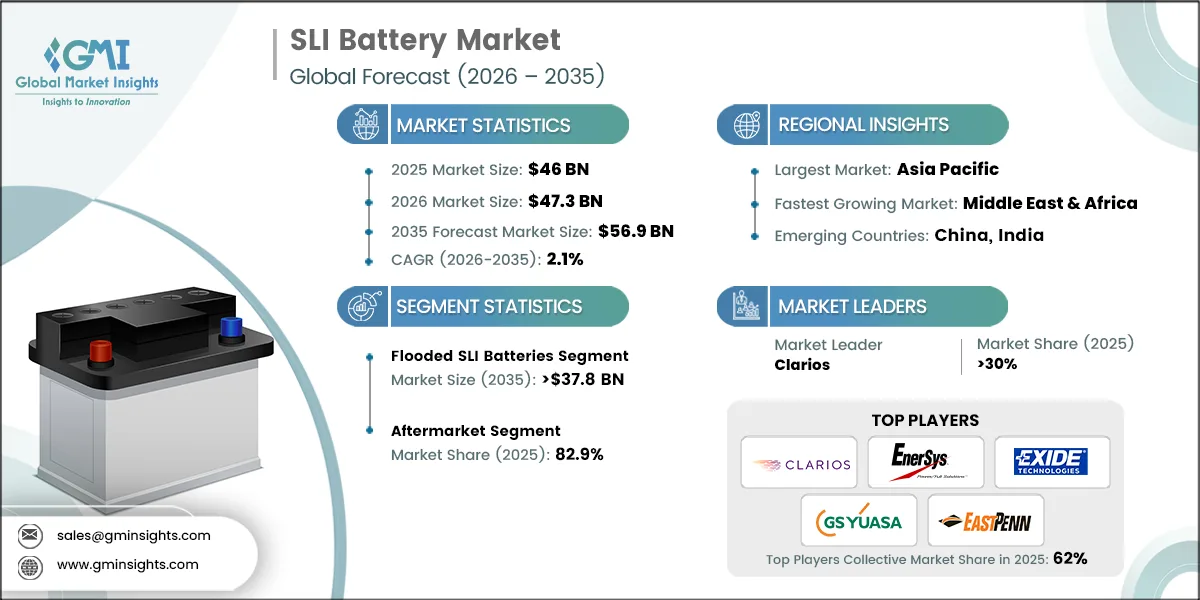
To get key market trends
SLI Battery Market Trends
- The market for SLI batteries will further diversify given the ongoing evolution of automotive technology and customer requirements. The widespread use of start-stop systems in vehicles increases demand for high-performance lead-acid batteries. These include enhanced flooded batteries (EFBs) and absorbent glass mat (AGM) batteries, which are superior to the conventional options in both effectiveness and durability.
- For instance, Crown Battery announced in April 2023 their purpose to cut back on lead-acid battery waste by optimizing their lead recycling methods. The emergence of new hybrid and electric vehicles produced by various international companies has also spurred these leaders to develop batteries with a longer lifespan.
- OEMs are also deploying technologies to save fuel which require high-performance batteries, which further increases the demand for these advanced battery variants. In addition, the need to recycle batteries due to environmental regulations is also aiding in new methods of battery production that decrease the amount of lead used.
- Ongoing advancements in automobiles and battery technologies have created a positive scenario for SLI battery market growth. Furthermore, the technological advancements have improved the optimization and monitoring of the battery technologies, which further drive the industry growth.
- As vehicles become more intelligent and more data‑driven, the demand for batteries that deliver higher energy density and uninterrupted power has grown sharply. Modern systems rely on dependable energy support, and that’s pushing the industry toward solutions designed to keep vehicles running smoothly, even as their electrical loads continue to rise.
- Currently, there is strong collaboration between battery manufacturers and automotive producers in the design and manufacture of SLI batteries tailored to the parameters of modern vehicles. This development is shaping the batteries to handle better charge acceptance and extended cycle charging.
SLI Battery Market Analysis
Learn more about the key segments shaping this market
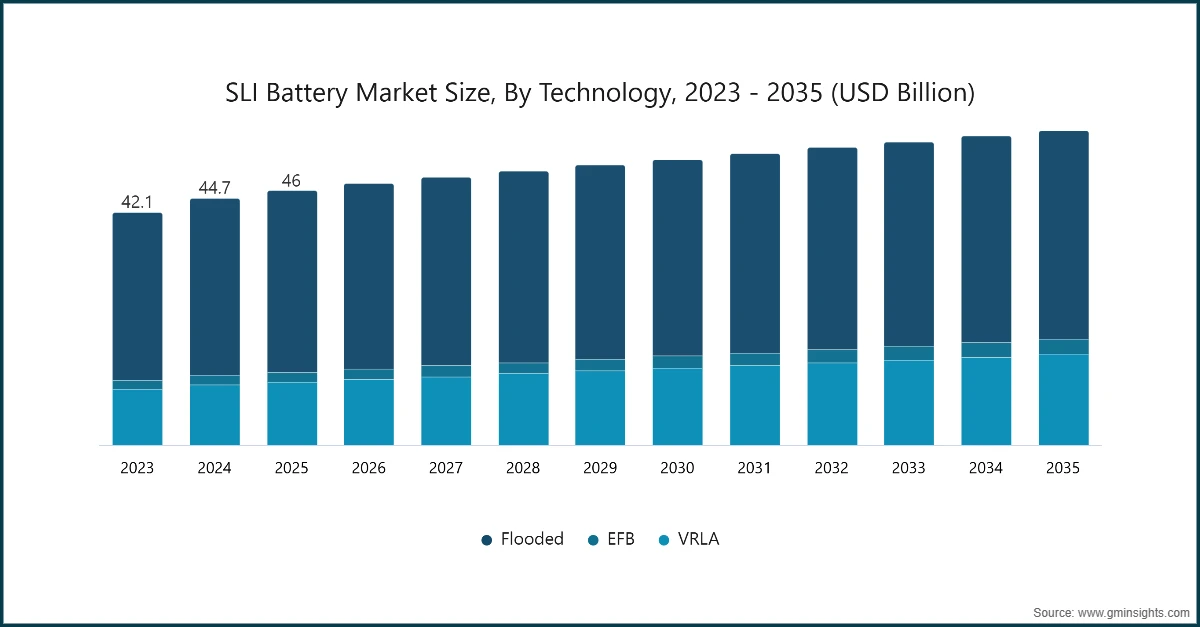
The SLI battery market is characterized by flooded, EFB, and VRLA technologies. The market for flooded SLI batteries is expected to grow over USD 37.8 billion by 2035. Flooded batteries are commonly used in standard cars and are inexpensive and, as a result, are competing in the market among the cost-sensitive regions. However, the market is shifting towards EFB and VRLA technologies due to increased installation of start-stop systems and the growing concerns for battery performance.
Driven by the rapid expansion of start‑stop systems, enhanced flooded batteries (EFBs) now require stronger charge acceptance and a longer cycle life to deliver the consistent performance these vehicles demand. The start-stop systems and electric vehicles have also increased demand for enhanced flooded batteries due to their offer of better charge acceptance and cycle life. Vehicles fitted with start-stop systems consume 4-10% less fuel than conventional ones in urban conditions, according to the U.S. Environmental Protection Agency, thus fueling increased demand for enhanced flooded batteries.
Furthermore, EFB offers a practical balance between affordability and modern battery technology., thus making them popular for use in mid-range cars. VRLA batteries, including the AGM batteries are gaining substantial popularity across the globe in the high end automobile sector. These batteries offer very low maintenance, high vibration resistance and higher energy density levels, which in turn complement their adoption. As these tendencies show, the manufacturing of new vehicles is done with increasing attention to strength, efficiency, and ecological compatibility, which leads to constant advancements within the technology.
Learn more about the key segments shaping this market
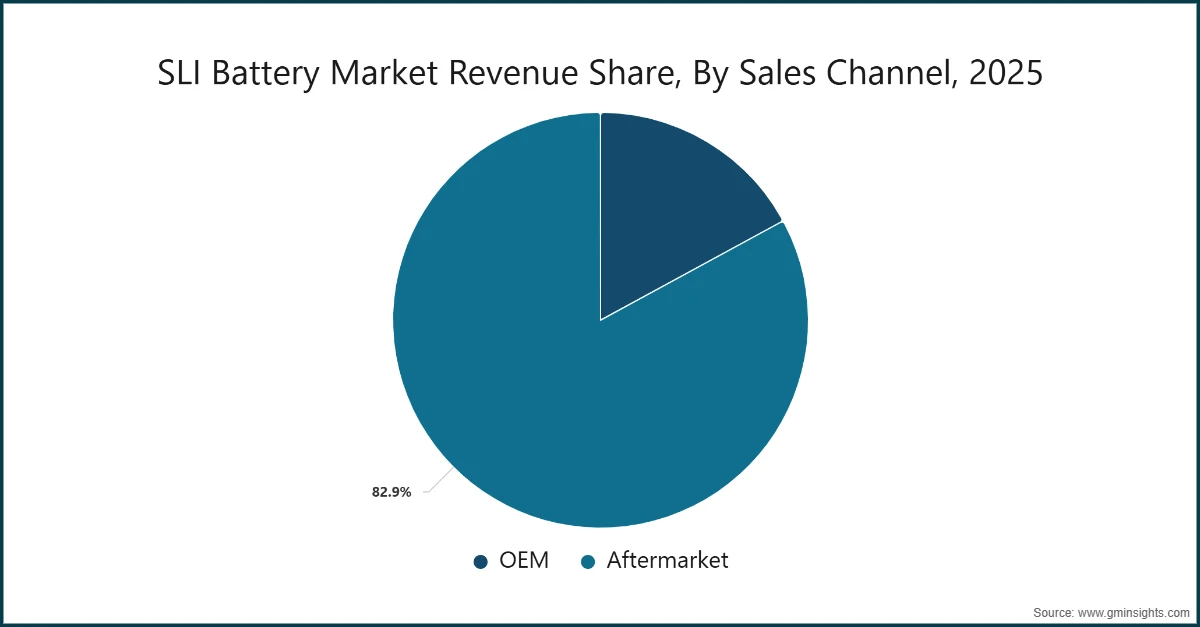
In the SLI battery market, the aftermarket segment holds a market share of 82.9% in 2025 is expected to grow at a steady rate, with an expected CAGR of 2.2% by 2035. The aftermarket division is gaining prominence owing to the increase in the number of vehicles and the rising need for replacement batteries. As the vehicles become older, and the demand for efficient and effective replacements gives rise to sales in the aftermarket.
Notably, battery manufacturers and carmakers have formed strong alliances stimulating OEM sales that guarantee a constant supply of new vehicles. Flooded and AGM batteries, along with other battery technologies, are becoming more readily available across OEM and aftermarket as the need for automobiles grow.
For instance, GS Yuasa announced that in April 2024 it will introduce the upgraded ECO.R HV auxiliary VRLA batteries for Toyota hybrids. These types of batteries have improved performance characteristics, and they do not require rehydration. In addition, the batteries target the improvement of the efficiency and reliability of a hybrid vehicle by being designed for trunk or rear-seat installation.
Moreover, the demand for after-sales batteries is changing because of e-commerce platforms since it gives customers easy and better access to a range of battery products. Manufacturers can use this integrated approach to fulfill different types of customers and increase market coverage.
Looking for region specific data?
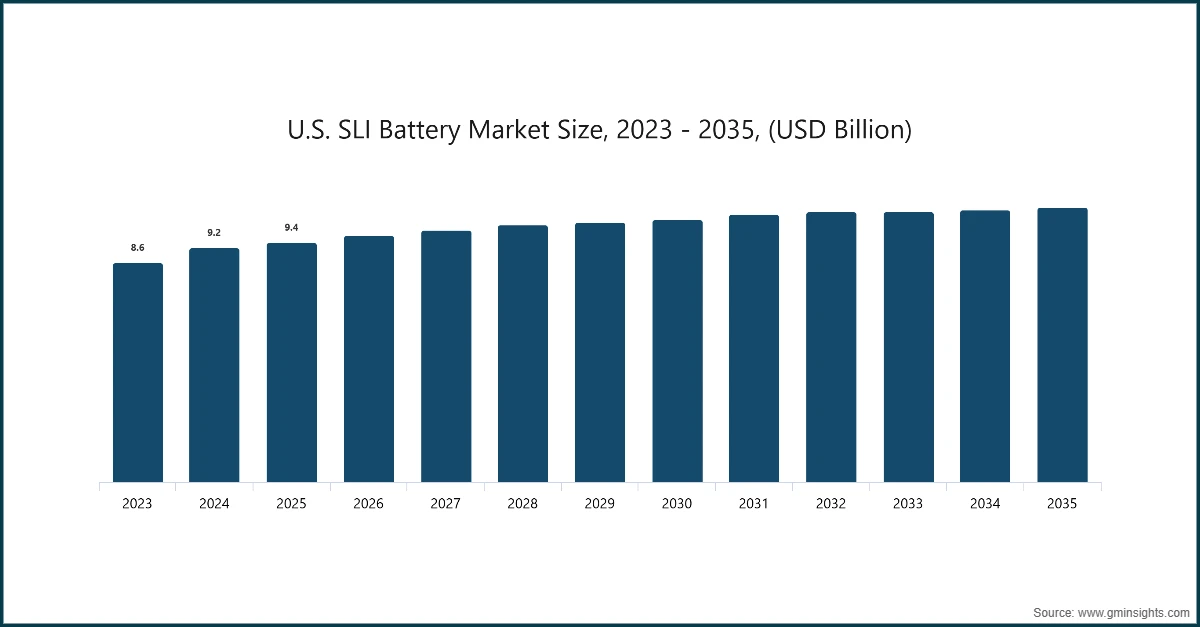
- The US SLI battery market is valued at USD 8.6 billion, USD 9.2 billion and USD 9.4 billion in 2023, 2024 and 2025 respectively. This growth is subjected to the rising use of modern technologies, such as start-stop systems, along with the expanding automotive fleet.
- The market is witnessing advancements due to the increasing need for specialized batteries in electric, hybrid, and start-stop systems within North America. The manufacturing sector is now placing more emphasis on solutions that are high-performance and more eco-friendly.
- For instance, in November 2023, East Penn Manufacturing introduced the EHP 12V AGM battery, which emphasizes the shift towards reliable power for electric vehicles in the sector. There is more demand for green, safe, and recyclable materials, which is, in return, increasing this trend.
- Due to Germany’s robust automotive industry and their emphasis on eco-friendly technologies, the demand for high-performance SLI batteries has gone up within Germany, which has now become the largest market in Europe.
- Europe will, in turn, hold over 33 % of the global SLI battery market in 2025. It is estimated that by 2026 end, Euro 7 emission standards would be set in place, which would shift the market in favor of strong SLI batteries. The increased regulatory attention towards sustainability and electrical vehicle technologies, such as the start-stop systems, has and will continue to aid Germany’s growth.
- Automotive manufacturing, high incomes, and the growing use of electric and hybrid cars drive revenue growth in the Asia and the Oceania regions.
- China has the largest share of the Asia-Pacific market, with an extensive automobile industry and government programs aimed at enhancing EV consumption. The Chinese Ministry of Industry and Information Technology reports that sales of electric vehicles rose by 50 % in 2023 compared to 2022.
- Sales growth of new vehicles, especially in emerging markets, and the growth of aftermarket care services for aging vehicles raise the SLI battery demand in the Middle East and Africa. Iran is the fastest-growing market in this region, due to the increasing number of vehicles owned and greater demand for inexpensive replacement batteries in a market where cost is a key concern, but some level of performance is still required.
SLI Battery Market Share
The top 5 players operating in the SLI battery industry include Clarios, Exide Technologies, GS Yuasa, Enersys, and East Penn Manufacturing, with a collective market share of 62% in 2025. Clarios has a considerable presence in the SLI battery industry owing to its wide range of products, superior manufacturing capabilities, as well as strong international distribution channels. The company takes advantage of its strong relationship with automotive OEMs and aftermarket distributors, which guarantees constant sales of its batteries. Moreover, Clarios also allocates a lot of resources to R&D in order to increase the efficiency, lifespan, and ecology of its batteries, which places them at the forefront in meeting both their customers’ and regulators’ requirements all over the globe.
SLI Battery Market Companies
Major players operating in the SLI battery industry are:
- ACDelco
- Acumuladores Moura
- Amara Raja Batteries
- Banner Batteries
- Camel Group
- Chaowei Power
- Clarios
- Continental Battery Systems
- Crown Battery
- Discover Battery
- East Penn Manufacturing
- EnerSys
- Erdil Battery
- Exide Industries
- FIAMM Energy Technology
- Fengfan
- First National Battery
- Furukawa Battery
- GS Yuasa
- Hankook
- Interstate Battery System
- Leoch International Technology
- MEBCO
- MOLL Batterien
- Mutlu Battery
- Superior Battery Manufacturing
- Tianneng Power
- YigitAKU
SLI Battery Market Report Attributes
| Key Takeaway | Details |
|---|---|
| Market Size & Growth | |
| Base Year | 2025 |
| Market Size in 2025 | USD 46 Billion |
| Market Size in 2026 | USD 47.3 Billion |
| Forecast Period 2026-2035 CAGR | 2.1% |
| Market Size in 2035 | USD 56.9 Billion |
| Key Market Trends | |
| Drivers | Impact |
| Growth in Vehicle Production | Rising global production of passenger cars and commercial vehicles continues to drive SLI battery demand. Every internal combustion engine vehicle requires an SLI battery for starting and auxiliary functions, making automotive manufacturing trends a primary market growth catalyst. |
| Increasing Vehicle Electrification of Accessories | Modern vehicles are equipped with power-intensive electronics, infotainment, climate control, ADAS sensors, and connectivity systems. These additional electrical loads increase the need for robust, durable SLI batteries, particularly advanced variants like AGM and EFB, driving market expansion. |
| Expansion of Aftermarket Replacement Demand | Since SLI batteries have a limited lifespan of 3–5 years, the replacement cycle consistently fuels aftermarket demand. Harsh climates, increased vehicle usage, and maintenance awareness accelerate replacement frequency, making the aftermarket segment a stable revenue driver. |
| Pitfalls & Challenges | Impact |
| Lead‑acid SLI batteries face rising competition from advanced chemistries | SLI batteries risk declining demand as vehicles adopt start‑stop, hybrid, and electric technologies requiring more advanced chemistries like AGM or lithium‑ion. This shift threatens the traditional lead‑acid market, increasing pressure on manufacturers to innovate or lose relevance. |
| Opportunities: | Impact |
| Expansion in Developing Automotive Markets | Growing vehicle ownership in emerging economies increases demand for reliable, affordable SLI batteries. As new cars, two‑wheelers, and commercial vehicles enter these markets, manufacturers gain opportunities to scale production, strengthen distribution networks, and build long‑term customer relationships. |
| Demand from Aftermarket Replacement Segment | A large global vehicle fleet ensures consistent need for battery replacements. Harsh climates, increased electronics load, and shorter battery life cycles boost aftermarket sales, giving SLI manufacturers a stable, recurring revenue stream and opportunities for premium, maintenance‑free product offerings. |
| Market Leaders (2025) | |
| Market Leader |
Over 30% Market Share |
| Top Players |
Collective market share of 62% |
| Competitive Edge |
|
| Regional Insights | |
| Largest Market | Asia Pacific |
| Fastest growing market | Middle East & Africa |
| Emerging countries | China, India |
| Future outlook |
|
What are the growth opportunities in this market?
SLI Battery Industry News
- In September 2025, Leoch announced it is evaluating a new U.S. battery plant while fast‑tracking capacity expansion at its yet‑to‑open Mexico facility, even as interim profit fell more than 70%. Management launched feasibility studies to anchor long‑term North American growth, citing strong datacenter‑driven UPS demand and resilient SLI sales. The potential U.S. factory and accelerated Mexico scale‑up signal a strategy to localize supply, offset tariff headwinds, and capture critical‑power opportunities across the Americas.
- In 2024 November, Exide Technologies continued the expansion of its AGM battery portfolio with the introduction of two new models, EK454 and EK457 (45Ah/380A, size B24). These advanced types of AGM batteries are perfectly suitable for start-stop and hybrid cars. Such batteries offer enhanced cycling and high speed recharging, which in turn leads to lower fuel consumption. This expansion serves as an excellent indicator of Exide focusing on new energy technologies, hence their ability to remain competitive in the world market of rechargeable batteries.
- In April 2024, Clarios was contracted with one of the world leaders in automaking, for whose it was a supplier of a well-known 12V AGM battery which is claimed to enhance fuel economy and reduce CO2 emissions of those start-stop systems vehicles. Robust and very low-maintenance batteries fit on all the measures of sustainability which further strengthens that growing lead Clarios has always held in Eco-friendly automotive lead-acid battery technologies.
SLI battery market research report includes in-depth coverage of the industry with estimates & forecast in terms of “USD Million & ‘Million Units” from 2022 to 2035, for the following segments:
Market, By Technology
- Flooded
- EFB
- VRLA
- AGM
- GEL
Market, By Sales Channel
- OEM
- Aftermarket
The above information has been provided for the following regions and countries:
- North America
- U.S.
- Canada
- Europe
- Russia
- France
- Germany
- Italy
- UK
- Asia Pacific
- Australia
- China
- India
- Japan
- South Korea
- Middle East & Africa
- Saudi Arabia
- UAE
- Iran
- Turkey
- South Africa
- Latin America
- Argentina
- Brazil
- Mexico
Frequently Asked Question(FAQ) :
What is the market size of the SLI battery in 2025?
The market size was USD 46 billion in 2025, with a CAGR of 2.1% expected through 2035. Growth is driven by the expansion of the automotive sector and rising demand for hybrid and electric vehicles.
What is the projected value of the SLI battery market by 2035?
The market is projected to reach USD 56.9 billion by 2035, supported by advancements in battery technologies and increasing adoption of start-stop systems in vehicles.
What is the expected size of the SLI battery industry in 2026?
The market size is projected to reach USD 47.3 billion in 2026.
How much revenue did the aftermarket segment generate in 2025?
The aftermarket segment held an 82.9% market share in 2025 and is expected to grow at a CAGR of 2.2% through 2035, driven by regular battery replacement demand.
What was the valuation of the flooded SLI battery segment in 2025?
The flooded SLI battery segment is expected to surpass USD 37.8 billion by 2035, owing to its affordability and widespread use in conventional vehicles.
Which region leads the SLI battery sector?
The United States leads the market, valued at USD 9.4 billion in 2025, supported by adoption of start-stop technologies and expansion of the automotive fleet.
What are the upcoming trends in the SLI battery market?
Key trends include adoption of enhanced flooded batteries (EFB) and AGM batteries, improved battery recycling methods, OEM partnerships, and development of higher-energy-density batteries with longer lifespans.
Who are the key players in the SLI battery industry?
Key players include ACDelco, Acumuladores Moura, Amara Raja Batteries, Banner Batteries, Camel Group, Chaowei Power, Clarios, Continental Battery Systems, Crown Battery, and Discover Battery.
SLI Battery Market Scope
Related Reports