Summary
Table of Content

Sleep Coaching Market
Get a free sample of this report
Form submitted successfully!
Error submitting form. Please try again.
Thank you!
Your inquiry has been received. Our team will reach out to you with the required details via email. To ensure that you don't miss their response, kindly remember to check your spam folder as well!
Request Sectional Data
Thank you!
Your inquiry has been received. Our team will reach out to you with the required details via email. To ensure that you don't miss their response, kindly remember to check your spam folder as well!
Form submitted successfully!
Error submitting form. Please try again.
Sleep Coaching Market Size
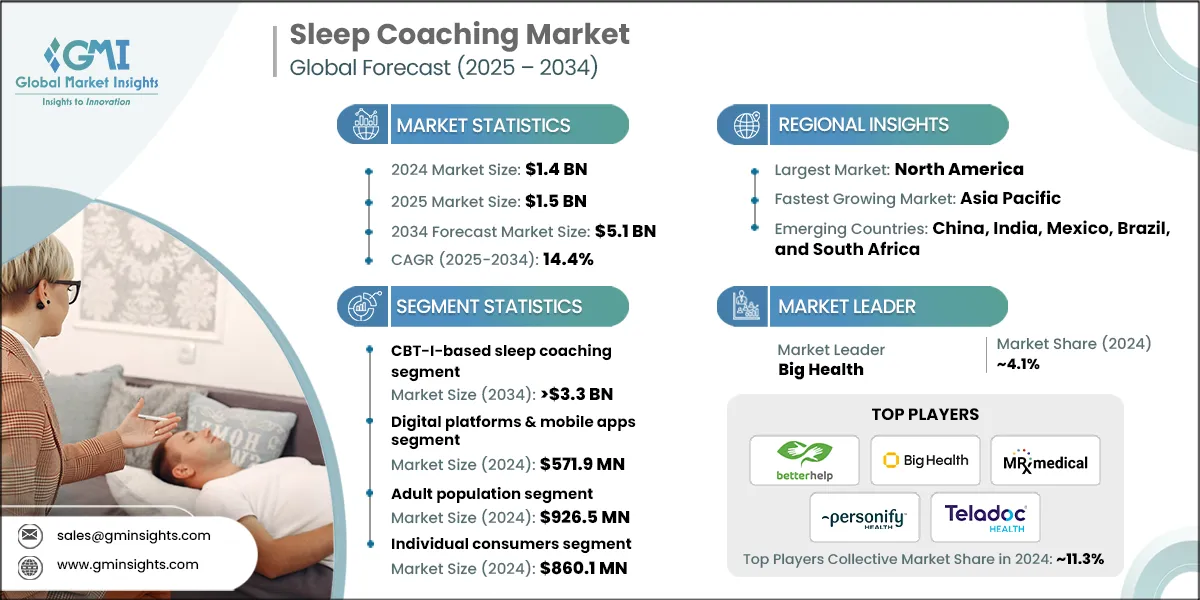
The global sleep coaching market was valued at USD 1.4 billion in 2024. The market is expected to grow from USD 1.5 billion in 2025 to USD 5.1 billion in 2034, at a CAGR of 14.4% during the forecast period, according to the latest report published by Global Market Insights Inc. The high market growth is attributed to rising prevalence of insomnia and sleep disorders, increased awareness of sleep’s impact on health, and supportive government policies and insurance coverage, among others.
Sleep Coaching Market Key Takeaways
Market Size & Growth
- 2024 Market Size: USD 1.4 Billion
- 2025 Market Size: USD 1.5 Billion
- 2034 Forecast Market Size: USD 5.1 Billion
- CAGR (2025–2034): 14.4%
Regional Dominance
- Largest Market: North America
- Fastest Growing Region: Asia Pacific
Key Market Drivers
- Rising prevalence of insomnia and sleep disorders.
- Technological Advancements.
- Increased awareness of sleeps impact on health.
- Supportive government policies and insurance coverage.
Challenges
- High cost of personalized coaching and diagnostics.
- Lack of standardized protocols across providers.
Opportunity
- AI-powered sleep coaching platforms.
- Expansion into pediatric and adolescent sleep care.
Key Players
- Market Leader: Big Health led with over 4.1% market share in 2024.
- Leading Players: Top 5 players in this market include Better Help, Big Health, MRx, personify HEALTH, Teladoc HEALTH, which collectively held a market share of 11.3% in 2024.
Get Market Insights & Growth Opportunities
Sleep coaching solutions represent a significant change in behavioral health and wellness, providing customized, non-medication-based interventions to enhance sleep quality in a wide range of populations. Leading providers such as Big Health, MRx, Better Help, personify HEALTH, and Teladoc HEALTH deliver comprehensive sleep coaching portfolios that include AI-powered mobile platforms, certified coaching programs, and hybrid care models. These solutions are designed to enhance sleep hygiene, support cognitive restructuring, and integrate wearable data for real-time feedback, improving sleep outcomes, productivity, and overall well-being.
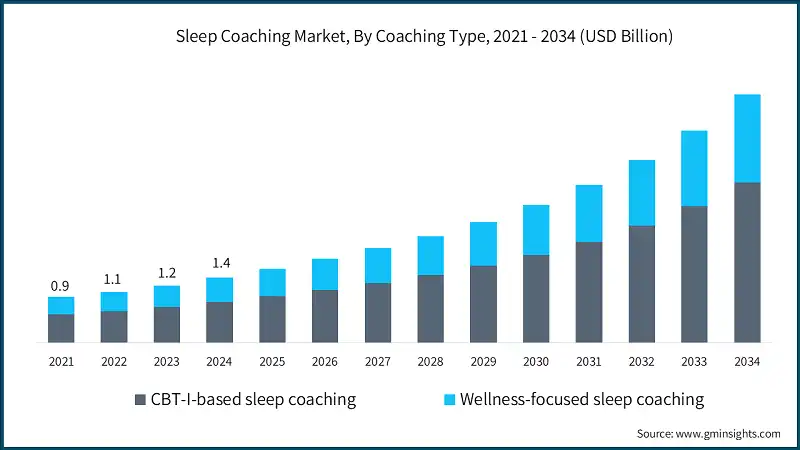
The market has increased from USD 945.2 million in 2021 and reached USD 1.2 billion in 2023, with a historic growth rate of 11.9%. This expansion has been driven by the rising prevalence of sleep disorders, growing awareness of non-pharmacological interventions, and the integration of digital platforms and wearable technologies into personalized sleep coaching programs.
Sleep disorders have become a global public health concern, with nearly one-third of adults reporting difficulty falling or staying asleep at least three times per week, according to ResMed’s 2025 Global Sleep Survey across 13 countries. In the U.S., 30.1% of adults sleep less than the recommended 7 hours per night, contributing to increased risks of cardiovascular disease, obesity, and mental health issues. Among older adults, sleep disturbances affect up to 50% of individuals aged 60 and above globally. This growing burden has intensified demand for accessible, effective, and non-invasive sleep solutions, positioning sleep coaching as a critical intervention.
Additionally, there is a marked shift toward non-pharmacological sleep interventions, driven by concerns over medication side effects and long-term dependency. Cognitive behavioral therapy for insomnia (CBT-I) is now widely recognized as the first-line treatment for chronic insomnia, with strong evidence supporting its efficacy across sleep onset, duration, and quality. Wellness-focused approaches, such as mindfulness, lifestyle coaching, and exercise-based programs, are also gaining traction, especially among older adults and corporate wellness initiatives.
Sleep coaching refers to personalized guidance and behavioral interventions aimed at improving sleep quality, addressing sleep disorders, and promoting healthy sleep habits.
To get key market trends
Sleep Coaching Market Trends
Technological advancements are playing a critical role in accelerating the adoption and evolution of sleep coaching services.
- The integration of wearable devices has enabled continuous sleep tracking, providing users and coaches with real-time data on sleep duration, quality, and disturbances. These insights allow for more targeted interventions and progress monitoring, making sleep coaching more data-driven and outcome-oriented. Additionally, the rise of home-based sleep diagnostics and IoT-enabled environments has expanded access to sleep care beyond clinical settings.
- Furthermore, artificial Intelligence (AI) and machine learning are further revolutionizing sleep coaching by enabling personalized, scalable solutions. AI-powered platforms can analyze sleep patterns, predict insomnia risk, and deliver tailored coaching modules based on user behavior and feedback. Chatbots and virtual assistants offer 24/7 support, while predictive analytics help optimize intervention timing. These technologies not only improve user engagement but also reduce the cost and complexity of traditional sleep therapy, making it more accessible to broader populations.
- Moreover, mobile-first platforms and telehealth integration have made sleep coaching more convenient and inclusive. Apps offering CBT-I protocols, mindfulness exercises, and gamified behavior change programs are now widely available, allowing users to engage with sleep improvement tools anytime, anywhere. Combined with cloud-based data storage and remote monitoring capabilities, these innovations are driving the global expansion of sleep coaching services across individual, corporate, and healthcare segments.
Sleep Coaching Market Analysis
Learn more about the key segments shaping this market
The global market was valued at USD 945.2 million in 2021. The market size reached USD 1.2 billion in 2023, from USD 1.1 billion in 2022.
Based on coaching type, the sleep coaching market is segmented into CBT-I-based sleep coaching and wellness-focused sleep coaching. The CBT-I-based sleep coaching segment accounted for 62.7% of the market in 2024 due to its strong clinical validation, widespread adoption as a first-line treatment for chronic insomnia and increasing integration into digital health platforms. The segment is expected to exceed USD 3.3 billion by 2034, growing at a CAGR of 14.7% during the forecast period.
On the other hand, the wellness-focused sleep coaching segment held a market share of 37.3% in 2024, and its growth can be attributed to the rising demand for holistic, lifestyle-oriented sleep solutions that address stress, productivity, and overall well-being. Unlike clinical interventions, wellness-focused coaching emphasizes mindfulness, behavioral change, and personalized routines, making it highly appealing to health-conscious consumers and corporate wellness programs.
- The effectiveness of CBT-I in improving sleep onset, duration, and quality without medication has made it the preferred choice among healthcare providers, employers, and individual consumers seeking evidence-based, scalable solutions. Additionally, the rise of AI-powered CBT-I apps and telehealth delivery models has expanded access, reduced costs, enhanced personalization, further driving market dominance.
Based on delivery mode, the sleep coaching market is segmented into digital platforms & mobile apps, hybrid models, and personalized coaching/face-to-face therapy. The digital platforms & mobile apps segment continues to dominate, accounting for a majority market share valued at USD 571.9 million in 2024.
- This leadership is driven by the widespread adoption of mobile-first health solutions, the convenience of on-demand coaching, and the integration of wearable devices that enable real-time sleep tracking and personalized feedback. These platforms offer scalable, cost-effective access to both CBT-I-based and wellness-focused interventions, making sleep coaching more inclusive and engaging for users across age groups and geographies.
- The hybrid models segment held a revenue of USD 436.5 million in 2024, with projections indicating a steady expansion at 14.6% CAGR from 2025 to 2034. This growth is driven by the increasing demand for flexible, personalized sleep coaching experiences that combine the scalability of digital platforms with the human touch of certified coaches. Hybrid models offer users the convenience of app-based tracking and AI-driven insights, while also providing access to one-on-one guidance, group sessions, and clinical escalation when needed.
- The personalized coaching/face-to-face therapy segment held a revenue of USD 341.7 million in 2024, with projections indicating a steady expansion at 12.9% CAGR from 2025 to 2034, fueled by the growing demand for high-touch, individualized sleep care. This segment benefits from its ability to address complex sleep issues through direct interaction with certified coaches or clinicians, offering tailored interventions, emotional support, and accountability that digital-only models may lack.
Based on patient, the sleep coaching market is segmented into the adult population, geriatric population, and pediatric & adolescent. The adult population segment continues to dominate, accounting for a majority market share valued at USD 926.5 million in 2024.
- This dominance is driven by the high prevalence of sleep disorders among working-age adults, increased stress and lifestyle-related sleep disturbances, and growing awareness of sleep’s impact on productivity, mental health, and chronic disease management. Adults are also the primary users of digital sleep platforms, CBT-I programs, and corporate wellness initiatives, making them the most commercially active demographic in both clinical and wellness-focused sleep coaching services.
- The geriatric population segment held a revenue of USD 305.9 million in 2024, with projections indicating a steady expansion at 15.2% CAGR from 2025 to 2034. This growth is fueled by the high prevalence of sleep disturbances among older adults, including insomnia, fragmented sleep, and comorbid conditions such as chronic pain and cognitive decline.
- The pediatric & adolescent segment held a revenue of USD 117.6 million in 2024, with projections indicating a steady expansion at 14.6% CAGR from 2025 to 2034. This growth is driven by increasing awareness of sleep’s role in cognitive development, emotional regulation, and academic performance among children and teens. Rising cases of behavioral sleep disorders, screen-time-related disruptions, and anxiety-induced insomnia have prompted parents, schools, and pediatricians to seek structured, non-pharmacological interventions.
Learn more about the key segments shaping this market
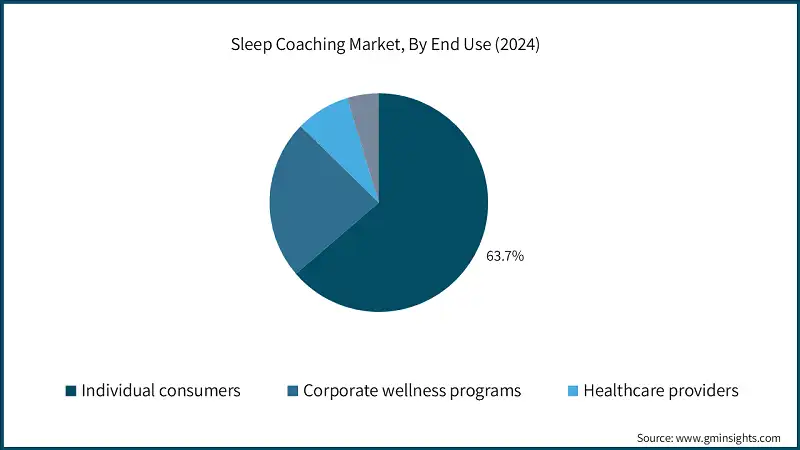
Based on end use, the sleep coaching market is segmented into individual consumers, corporate wellness programs, healthcare providers, and other end users. The individual consumers segment accounted for USD 860.1 million in 2024 and is expected to grow at a 14.3% CAGR from 2025 to 2034.
- This growth is driven by increasing awareness of sleep health, rising prevalence of sleep disorders such as insomnia and sleep apnea, and the growing adoption of personalized wellness solutions. The integration of wearable technology and mobile applications is further enhancing the accessibility and effectiveness of sleep coaching for individuals, making it a key growth driver in the market.
- The corporate wellness programs segment accounted for USD 318.6 million in 2024 and is expected to grow at a 15.3% CAGR from 2025 to 2034. This growth is driven by rising employer awareness of how sleep affects employee productivity, mental health, and overall well-being. As organizations adopt more holistic wellness strategies, sleep coaching emerges as a key element of corporate wellness programs.
- The healthcare providers segment is expected to grow at a substantial pace during the period from 2025 to 2034 at a CAGR of 13.2%. This growth is driven by the increasing integration of sleep coaching into clinical care pathways, especially in primary care, mental health, and sleep medicine. Healthcare providers are recognizing the value of non-pharmacological interventions for sleep disorders, and sleep coaching is emerging as a complementary service to traditional treatments.
- The other end users segment is expected to grow at a substantial pace during the period from 2025 to 2034 at a CAGR of 11.8%. This segment includes educational institutions, sports organizations, and community health programs. Growth in this category is supported by increasing recognition of sleep’s role in cognitive performance, athletic recovery, and overall wellness.
Looking for region specific data?
North America Sleep Coaching Market
North America dominated the global market with the highest market share of 44% in 2024.
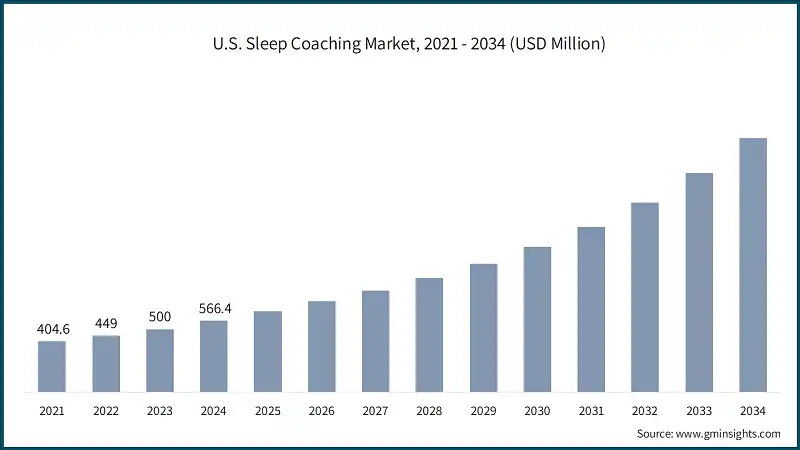
- The U.S. market was valued at USD 404.6 million and USD 449 million in 2021 and 2022, respectively. The market size reached USD 566.4 million in 2024, growing from USD 500 million in 2023, and is anticipated to grow at a CAGR of 13.6% between 2025 and 2034.
- The region benefits from advanced healthcare infrastructure, high awareness of sleep health, and widespread adoption of digital health platforms. The prevalence of sleep disorders such as insomnia and sleep apnea is notably high, prompting individuals and organizations to seek professional sleep coaching services. Corporate wellness programs and insurance-backed sleep solutions are also gaining traction, further fueling market growth.
- The U.S. is a key contributor, with a strong presence of sleep coaching startups and established wellness brands. The integration of wearable technology and mobile apps has enhanced the personalization and accessibility of sleep coaching. Moreover, the rise in mental health awareness and the shift toward holistic wellness have positioned sleep coaching as a mainstream healthcare service in North America.
Europe Sleep Coaching Market
Europe sleep coaching industry accounted for USD 366.8 million in 2024 and is anticipated to show lucrative growth over the forecast period.
- Europe holds a significant share in the sleep coaching market, driven by increasing awareness of sleep-related health issues and a mature healthcare system. Countries like Germany and the UK are leading the charge, supported by government initiatives such as the EU’s Medical Device Regulation (MDR) and digital health funding.
- Technological integration, including AI and IoT-enabled sleep monitoring devices, is a key trend in Europe. Public health campaigns and aging demographics are also contributing to demand. However, regulatory challenges and high device costs may limit market penetration in certain areas. Despite this, Europe remains a hub for innovation and strategic partnerships in sleep health.
Asia Pacific Sleep Coaching Market
The Asia Pacific market is anticipated to grow at a CAGR of 15.7% during the analysis timeframe.
- Rapid urbanization, rising disposable incomes, and increasing awareness of sleep health are driving demand. Countries like China, India, Japan, and South Korea are witnessing a surge in sleep app usage and wearable sleep tech adoption.
- The region’s growth is also supported by expanding healthcare infrastructure and digital transformation. Sleep coaching services are increasingly being integrated into mobile platforms, making them accessible to a broader population. Strategic investments by tech firms and partnerships with healthcare providers are accelerating market expansion. Despite cultural differences in sleep habits, the universal need for better sleep is creating a robust market opportunity.
Latin America Sleep Coaching Market
The Latin America market is experiencing robust growth over the analysis timeframe.
- Brazil leads the region, followed by Mexico and Argentina. Growth is driven by rising healthcare awareness, smartphone adoption, and improved internet infrastructure, which support the expansion of sleep apps and digital coaching platforms.
- Government initiatives promoting telemedicine and healthcare modernization are also contributing to market growth. However, challenges such as uneven healthcare access and economic disparities may affect adoption rates. Despite these hurdles, the region shows strong potential, especially in urban centers where demand for wellness services is rising.
Middle East & Africa Sleep Coaching Market
The Middle East & Africa (MEA) sleep coaching industry is experiencing notable growth over the analysis timeframe.
- The MEA region is witnessing steady growth in the sleep coaching market, supported by increasing awareness of sleep disorders and expanding healthcare infrastructure. Countries like Saudi Arabia, the UAE, and South Africa are investing in digital health and wellness programs.
- As training programs and awareness campaigns gain traction, MEA is expected to witness gradual growth in sleep coaching services over the coming years.
Sleep Coaching Market Share
Leading industry players such as Big Health, MRx, Better Help, personify HEALTH, and Teladoc HEALTH collectively hold a market share of 11.3% in the global market. These companies maintain their dominance through continuous innovation in AI-driven sleep tracking, personalized coaching algorithms, and integration with wearable health devices that enhance behavioral interventions and sleep hygiene. Their platforms offer scalable solutions for individuals, corporate wellness programs, and healthcare providers, improving sleep outcomes through data-driven insights and cognitive behavioral techniques.
Meanwhile, emerging players are carving out niches by focusing on cost-effective, tech-enabled, and region-specific sleep coaching solutions, particularly in Asia-Pacific and Latin America. Strategic collaborations with academic institutions, digital health platforms, and pediatric wellness providers are enabling these companies to address unmet clinical needs such as sleep anxiety, circadian rhythm disruption, and adolescent sleep disorders.
Sleep Coaching Market Companies
A few of the prominent players operating in the sleep coaching industry include:
- Better Help
- Big Health
- dawn
- furo.fit
- International Parenting & Health Institute
- MRx
- personify HEALTH
- SLEEP SPACE
- Stanford MEDICINE
- Stellar Sleep
- Teladoc HEALTH
- THE INSOMNIA AND SLEEP INSTITUTE OF ARIZONA
- Big Health
Big Health is a pioneer in digital therapeutics for mental health and sleep wellness, offering clinically validated programs like Sleepio for insomnia and Daylight for anxiety. Its USP lies in delivering evidence-based cognitive behavioral therapy (CBT) through scalable digital platforms, ensuring accessibility without the need for sleep medications or in-person visits. Big Health emphasizes clinical rigor, personalization, and seamless integration with employer wellness programs and health systems, making it a trusted partner for organizations seeking cost-effective, preventive mental health solutions.
Personify Health, formed through the merger of Virgin Pulse and HealthComp, offers a comprehensive health engagement platform that unifies wellbeing, benefits navigation, and care coordination. Its USP is the ability to deliver personalized, connected health experiences at scale, leveraging behavioral science, AI-driven insights, and concierge-level support. By combining health plan administration with holistic wellness solutions, Personify Health empowers employers and members to manage physical, mental, and sleep health through a single, integrated ecosystem.
MRx specializes in prescription digital therapeutics (PDTs) designed to treat chronic conditions, including sleep disorders, through software-based interventions. Its USP is the combination of clinical-grade efficacy and regulatory compliance, enabling healthcare providers to prescribe MRx solutions as part of standard care. The company focuses on data-driven personalization, adherence monitoring, and integration with electronic health records (EHRs), positioning itself as a leader in bridging the gap between traditional medicine and digital innovation.
Sleep Coaching Market Report Attributes
| Key Takeaway | Details |
|---|---|
| Market Size & Growth | |
| Base Year | 2024 |
| Market Size in 2024 | USD 1.4 Billion |
| Market Size in 2025 | USD 1.5 Billion |
| Forecast Period 2025 - 2034 CAGR | 14.4% |
| Market Size in 2034 | USD 5.1 Billion |
| Key Market Trends | |
| Drivers | Impact |
| Rising prevalence of insomnia and sleep disorders | Expands the addressable market for clinical and wellness-based sleep interventions. |
| Technological Advancements | Enables scalable, personalized coaching through AI, wearables, and mobile platforms. |
| Increased awareness of sleeps impact on health | Drives consumer demand for preventive and holistic sleep solutions. |
| Supportive government policies and insurance coverage | Improves accessibility and affordability of sleep coaching services. |
| Pitfalls & Challenges | Impact |
| High cost of personalized coaching and diagnostics | Limits adoption among low-income and uninsured populations. |
| Lack of standardized protocols across providers | Creates inconsistency in outcomes and hinders clinical validation. |
| Opportunities: | Impact |
| AI-powered sleep coaching platforms | Offers cost-effective, data-driven solutions with high scalability. |
| Expansion into pediatric and adolescent sleep care | Opens new market segments with growing behavioral health needs. |
| Market Leaders (2024) | |
| Market Leaders |
~4.1% Market Share |
| Top Players |
Collective market share in 2024 is ~11.3% |
| Competitive Edge |
|
| Regional Insights | |
| Largest Market | North America |
| Fastest growing market | Asia Pacific |
| Emerging countries | China, India, Mexico, Brazil, and South Africa |
| Future outlook |
|
What are the growth opportunities in this market?
Sleep Coaching Industry News
- In February 2024, Virgin Pulse and HealthComp announced their merger under a new brand name, Personify Health. The combined entity introduces the first-of-its-kind personalized health platform that integrates health plan administration, holistic wellbeing solutions, and comprehensive health navigation into a single, streamlined experience. This merger helped the company gain a competitive edge over its peers.
The sleep coaching market research report includes an in-depth coverage of the industry with estimates and forecasts in terms of revenue in USD Million from 2021 - 2034 for the following segments:
Market, By Coaching Type
- CBT-I-based sleep coaching
- Wellness-focused sleep coaching
Market, By Delivery Mode
- Digital platforms & mobile apps
- Hybrid models
- Personalized coaching/Face-to-face therapy
Market, By Patient
- Adult population
- Geriatric population
- Pediatric & adolescent
Market, By End Use
- Individual consumers
- Corporate wellness programs
- Healthcare providers
- Other end use
The above information is provided for the following regions and countries:
- North America
- U.S.
- Canada
- Europe
- Germany
- UK
- France
- Spain
- Italy
- Netherlands
- Asia Pacific
- China
- Japan
- India
- Australia
- South Korea
- Latin America
- Brazil
- Mexico
- Argentina
- Middle East and Africa
- South Africa
- Saudi Arabia
- UAE
Frequently Asked Question(FAQ) :
What is the market size of the sleep coaching industry in 2024?
The market size was USD 1.4 billion in 2024, with a CAGR of 14.4% expected through 2034 driven by the rising prevalence of insomnia, growing awareness of sleep health, and adoption of digital sleep solutions.
What is the current sleep coaching market size in 2025?
The market size is projected to reach USD 1.5 billion in 2025.
What is the projected value of the sleep coaching market by 2034?
The market size for sleep coaching is expected to reach USD 5.1 billion by 2034, fueled by technological advancements in AI-based platforms, wearable integration, and increasing preference for non-pharmacological sleep interventions.
How much revenue did the CBT-I-based sleep coaching segment generate in 2024?
The CBT-I-based sleep coaching segment accounting for 62.7% of the total market, driven by its strong clinical validation and digital adoption as a first-line treatment for chronic insomnia.
What was the valuation of the digital platforms & mobile apps segment in 2024?
The digital platforms & mobile apps segment was valued at USD 571.9 million in 2024.
What is the growth outlook for hybrid models from 2025 to 2034?
Hybrid models are projected to grow at a 14.6% CAGR through 2034, driven by user demand for flexible, personalized sleep coaching that combines digital convenience with human expertise.
Which region leads the sleep coaching market?
North America dominated the industry with USD 566.4 million in 2024, accounting for 44% of the global market. The region’s growth is supported by high awareness of sleep health, integration of digital therapeutics, and expansion of corporate wellness programs.
What are the upcoming trends in the sleep coaching industry?
Key trends include AI-powered sleep analytics, mobile-first CBT-I delivery, integration of wearable biosensors, multilingual virtual coaching, and gamified engagement tools that enhance accessibility and adherence.
Who are the key players in the sleep coaching market?
Key players include Big Health, Better Help, MRx, Personify Health, Teladoc Health, Stellar Sleep, Dawn, Sleep Space, Stanford Medicine, Furo.fit, and The Insomnia and Sleep Institute of Arizona.
Sleep Coaching Market Scope
Related Reports