Summary
Table of Content

Skin Care Devices Market
Get a free sample of this report
Form submitted successfully!
Error submitting form. Please try again.
Thank you!
Your inquiry has been received. Our team will reach out to you with the required details via email. To ensure that you don't miss their response, kindly remember to check your spam folder as well!
Request Sectional Data
Thank you!
Your inquiry has been received. Our team will reach out to you with the required details via email. To ensure that you don't miss their response, kindly remember to check your spam folder as well!
Form submitted successfully!
Error submitting form. Please try again.
Skin Care Devices Market Size
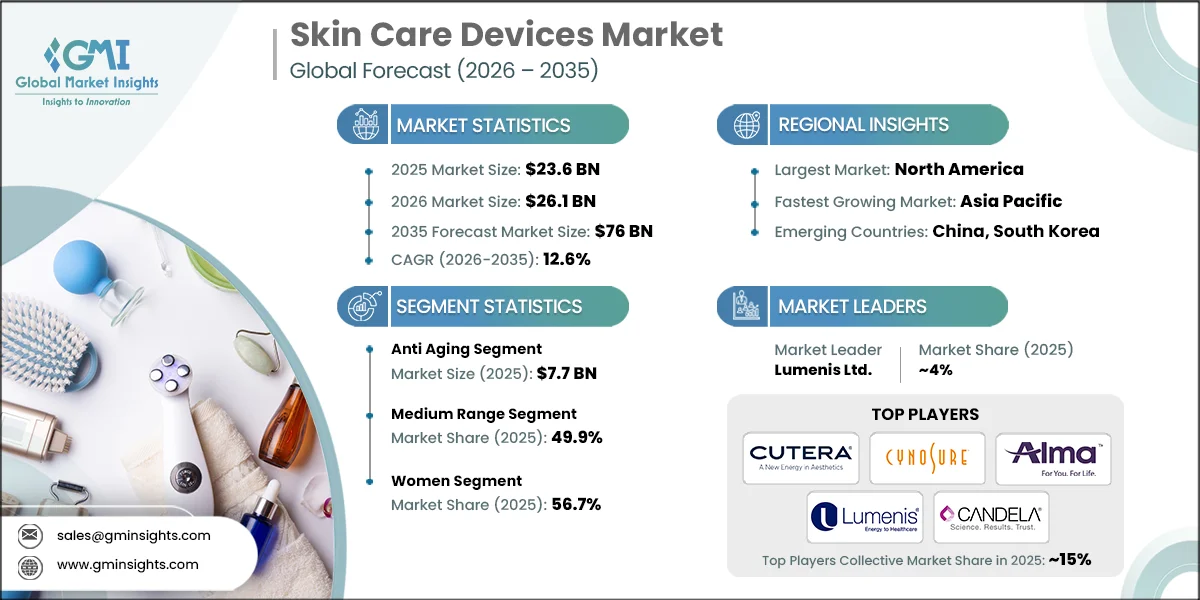
The global skin care devices market was estimated at USD 23.6 billion in 2025. The market is expected to grow from USD 26.1 billion in 2026 to USD 76 billion in 2035, at a CAGR of 12.6%, according to latest report published by Global Market Insights Inc.
To get key market trends
- Currently, the growth of the skincare market is largely the result of consumers' desire to use professional-grade at-home skincare devices that have been validated by clinical studies and regulatory bodies. Professional-grade at-home skincare devices allow consumers to produce measurable and observable results related to skin appearance (e.g., anti-aging, acne, and skin tightening). As such, professional-grade at-home devices are becoming an integral part of many individuals' skincare routines.
- The increasing popularity of at-home devices that utilize RF microneedling, high-powered LEDs, microcurrent, and laser treatments is indicative of an overall trend of premiumization. Consumers are increasingly attracted to these new technologies due to the efficacy of their results being equivalent to the treatments provided in a professional setting, yet they can be accomplished in the comfort of one's own home.
- Consumers are driving this demand for the newest technology because they are making a conscious effort to prioritize self-care; therefore, they are looking for innovative and advanced solutions to achieve their desired skincare results. Premium devices are attractive to consumers because they represent the convergence of convenience and efficacy.
- Social media as a platform has become a major influencer of consumer buying decisions, especially amongst Gen Z and Millennials. As a result, these platforms have also been instrumental in popularizing the use of advanced skincare devices for home use. In addition, become devices have also shifted from elitist/niche categories of products to becoming commonplace within the marketplace. Many examples of viral or trending product categories are now heavily associated with social media. This includes LED light therapy masks; microcurrent toning devices; and radiofrequency technologies. Not only have these devices generated a massive amount of press coverage, they have also now become symbols, in terms of status, of the current generation’s obsession with skincare.
- The generational shift towards self-care and the use of advanced skincare devices appears to be directly linked to the ease of access, through social media, to vast amounts of information about these devices as well as user reviews and experiences. The rise of video content on platforms such as TikTok and Instagram, as well as content created by licensed Dermatologists who discuss the use of advanced skincare devices, has allowed consumers to easily find, research, and ultimately buy these types of devices.
- Furthermore, seeing videos of actual product demonstrations, along with videos of user testimonials, has greatly increased the confidence of consumers and decreased any reluctance they may have had about trying out a specific advanced skincare device.
Skin Care Devices Market Report Attributes
| Key Takeaway | Details |
|---|---|
| Market Size & Growth | |
| Base Year | 2025 |
| Market Size in 2025 | USD 23.6 Billion |
| Market Size in 2026 | USD 26.1 Billion |
| Forecast Period 2026-2035 CAGR | 12.6% |
| Market Size in 2035 | USD 76 Billion |
| Key Market Trends | |
| Drivers | Impact |
| Premiumization and proven clinical efficacy | The skincare market is witnessing a significant shift as consumers increasingly gravitate toward professional-grade at-home devices that are supported by robust clinical evidence and regulatory approvals. These devices, designed to deliver effective and measurable results in areas such as anti-aging, acne treatment, and skin firmness, are becoming indispensable in modern skincare routines. |
| Increasing social media impact | Social media platforms have emerged as powerful tools in shaping consumer behavior, particularly among younger generations such as Gen Z and Millennials. These platforms have played a pivotal role in popularizing advanced at-home skincare devices, transforming them from niche products into mainstream essentials. |
| Increasing incidence of skin disorders & aging population | Higher prevalence of acne, psoriasis, and pigmentation issues, combined with a growing elderly population seeking anti-aging solutions, is driving market demand. |
| Pitfalls & Challenges | Impact |
| Economic slowdown and price sensitivity in emerging markets | Premium devices (laser, RF) remain expensive, restricting penetration in emerging markets and among middle-income consumers. |
| Proliferation of low-quality counterfeits and unregulated products | Platforms such as Amazon, Temu, and AliExpress are saturated with substandard, non-certified devices. This erodes category trust, increases return rates, and damages the reputation of legitimate premium brands. |
| Opportunities: | Impact |
| Rapid expansion in male segment of the market | The male-targeted segment is growing than the overall market. Men exhibit higher willingness to pay for tech-forward, results-oriented devices, creating a significant whitespace for specialized microcurrent, RF, LED, and cleansing solutions. |
| Integration of AI & IoT in skin care devices | The integration of smartphone-connected devices with AI-driven skin analysis, adaptive treatment protocols, and real-time progress tracking represents the next frontier. Early leaders are positioning connected devices to capture 25–30% of the total market. |
| Market Leaders (2025) | |
| Market Leader |
Market share of ~4% |
| Top 5 Players |
Collective market share of ~15% |
| Competitive Edge |
|
| Regional Insights | |
| Largest Market | North America |
| Fastest growing market | Asia Pacific |
| Emerging countries | China, South Korea |
| Future outlook |
|
What are the growth opportunities in this market?
Skin Care Devices Market Trends
- At-home skin care devices are gaining popularity as consumers prioritize convenience, cost-effectiveness, and ease of use. These devices, designed for applications such as hair removal, acne treatment, and anti-aging, offer an accessible alternative to professional treatments. The ability to maintain effective skin care routines at home has become increasingly appealing, especially as individuals seek portable and user-friendly solutions that fit seamlessly into their lifestyles.
- Smart technology is revolutionizing the skin care devices market, with features such as artificial intelligence, Internet of Things connectivity, and app-based treatment guidance becoming integral to product offerings. These advancements enable personalized care, real-time monitoring, and enhanced user experiences. For instance, AI-powered tools can analyze skin conditions and recommend tailored treatments, while IoT-enabled devices allow users to track progress and control settings through their smartphones, ensuring a more interactive and effective approach to skin care.
- The demand for non-invasive skin care solutions is on the rise as consumers increasingly seek painless and efficient alternatives to surgical procedures. Devices offering treatments such as radiofrequency skin tightening, LED therapy, and microcurrent technology are becoming highly sought after. These solutions provide effective results with minimal downtime, making them an attractive option for individuals looking for quick and non-disruptive ways to enhance their skin health and appearance.
- Manufacturers are focusing on developing multifunctional skin care devices that combine various features into a single unit. These devices often integrate cleansing, rejuvenation, and anti-aging functionalities, catering to consumers who value versatility and efficiency. By offering multiple benefits in one product, these innovations address the growing demand for comprehensive skin care solutions, further driving market growth and consumer satisfaction.
- With increasing environmental awareness, brands are prioritizing sustainability in their product development. This includes the use of eco-friendly materials, sustainable packaging, and energy-efficient technologies in skin care devices. Consumers are actively seeking products that align with their values, prompting companies to adopt environmentally responsible practices. This shift not only meets consumer expectations but also enhances brand reputation and market positioning.
- The male grooming segment is emerging as a significant growth area within the skin care devices market. Men are increasingly adopting devices for applications such as hair removal, anti-aging, and acne treatment. This trend is driven by changing societal norms and a growing awareness of personal grooming among men. In response, manufacturers are introducing products specifically designed to cater to this demographic, further expanding the market’s reach and diversity.
Skin Care Devices Market Analysis 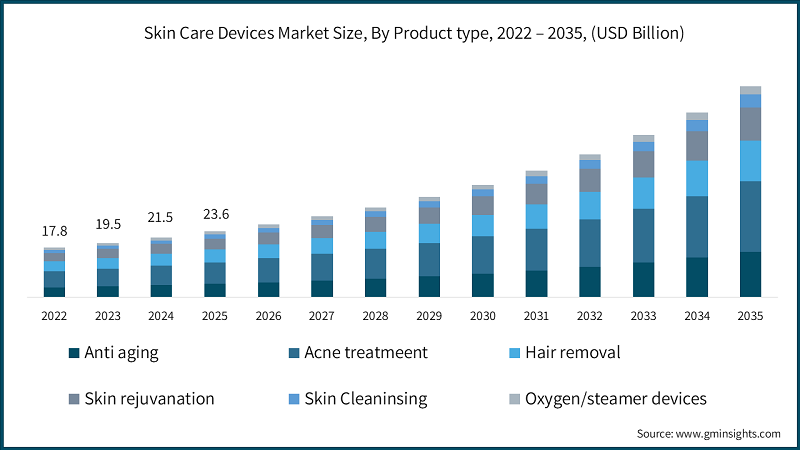 Learn more about the key segments shaping this market
Based on product, the skin care devices market is categorized into anti-aging, acne treatment, hair removal, skin rejuvenation, skin cleansing and oxygen/steamer devices. The anti aging segment accounted for revenue of around USD 7.7 billion in 2025 and is anticipated to grow at a CAGR of 12.8% from 2026 to 2035.
- The serum and toner segment has emerged as a dominant force within the skin lightening category due to its high concentration of active ingredients and targeted efficacy.
- Consumers increasingly prefer serums for their lightweight texture and ability to deliver potent brightening agents like niacinamide, vitamin C, and alpha arbutin directly to the skin. Toners complement this by prepping the skin for better absorption, creating a synergistic effect when used as part of a regimen. This segment appeals strongly to informed, ingredient-conscious buyers who prioritize visible results and are willing to invest in specialized treatments rather than basic creams.
- The rise of K-beauty and multi-step skincare routines has further fueled demand for serums and toners, positioning them as premium yet essential components of modern skin lightening solutions.
Learn more about the key segments shaping this market
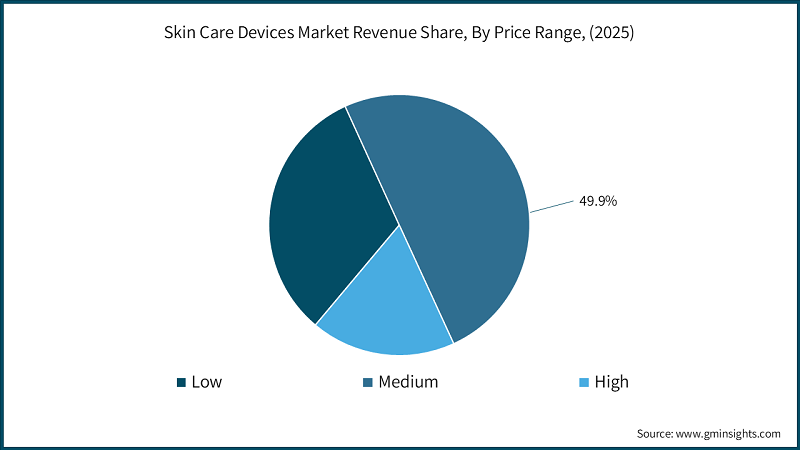
Based on price range, of skin care devices market consists of low, medium and high. The medium range emerged as leader and held 49.9% of the total market share in 2025 and is anticipated to grow at a CAGR of 10.8% from 2026 to 2035.
- The anti-aging devices segment has emerged as a dominant force in the skin care devices market, driven by the increasing global emphasis on maintaining a youthful appearance and the growing aging population. Consumers are increasingly seeking non-invasive solutions to address concerns such as wrinkle reduction, skin tightening, and collagen stimulation.
- Technologies like radiofrequency, microcurrent, and ultrasound have gained significant traction due to their ability to deliver effective results without the need for invasive procedures. The influence of social media further amplifies this demand, as consumers are exposed to trends and testimonials that highlight the benefits of these devices. Additionally, the availability of advanced home-use devices that offer near-professional results has made these technologies more accessible to a broader audience.
- Manufacturers are capitalizing on this trend by introducing multifunctional anti-aging devices that combine various treatments into a single product. For instance, devices that integrate LED therapy and micro-dermabrasion provide comprehensive solutions, catering to consumers who seek convenience and efficiency.
- Continuous technological advancements further strengthen this segment's position, as manufacturers innovate to enhance device performance, usability, and effectiveness. The adoption of these devices is robust across both developed and emerging markets, reflecting their universal appeal and the growing consumer awareness of advanced skin care solutions.
Based on consumer group, skin care devices market consists of women, men and unisex users. The women segment emerged as leader and held 56.7% of the total market share in 2025 and is anticipated to grow at a CAGR of 13.3% from 2026 to 2035.
- Women remain the largest consumer group in the market, driven by a heightened focus on beauty and personal care. This demographic demonstrates a strong preference for devices that address anti-aging, hair removal, and skin rejuvenation needs. Social media trends and influencer marketing play a pivotal role in amplifying demand, as women are increasingly exposed to innovative products and their benefits. Multifunctional devices that save time and deliver visible results are particularly popular among women, reflecting their preference for efficiency and effectiveness in personal care routines.
- Manufacturers are tailoring their offerings to align with the preferences of women, focusing on product aesthetics, usability, and innovative features. Portable devices, app-based guidance, and eco-friendly designs are among the innovations that resonate strongly with this demographic.
- By addressing these preferences, companies are ensuring the sustained dominance of women as the primary consumer group in the skin care devices market. The ability to adapt to evolving consumer expectations and deliver solutions that meet their needs positions manufacturers to maintain a competitive edge in this dynamic market.
Looking for region specific data?
North America Skin Care Devices Market
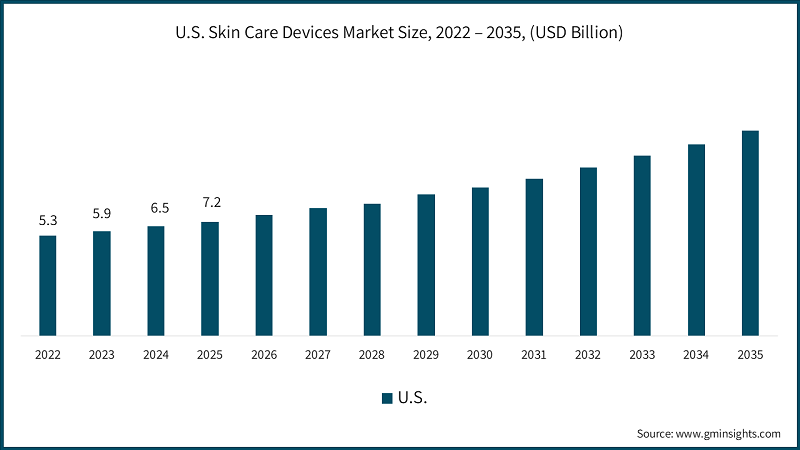
The U.S. dominates an overall North America market and valued at USD 7.2 billion in 2025 and is estimated to grow at a CAGR of 9.9% from 2026 to 2035.
- The United States leads the market due to its advanced healthcare infrastructure, high consumer spending on beauty and wellness, and strong presence of leading manufacturers. The country has a mature market for both professional and home-use devices, driven by high awareness of non-invasive aesthetic treatments and rapid adoption of innovative technologies like RF, LED therapy, and AI-powered devices. Additionally, the influence of social media and celebrity endorsements further accelerates demand for premium skin care solutions.
- The U.S. market benefits from robust R&D investments and frequent product launches, ensuring continuous technological advancements. With a large aging population and strong preference for anti-aging and rejuvenation treatments, the U.S. is expected to maintain its dominant position in the global market.
Europe Skin Care Devices Market
In the European market, Germany is expected to experience significant and promising growth from 2026 to 2035.
- Germany holds a significant share in the European market, supported by its strong medical aesthetics industry and high consumer preference for quality and safety. The country’s well-regulated healthcare system and stringent product standards foster trust in advanced skin care technologies. German consumers prioritize anti-aging and skin rejuvenation treatments, making devices like RF and ultrasound highly popular.
- Moreover, Germany’s focus on sustainability and eco-friendly products aligns with emerging trends, giving local manufacturers a competitive edge. With increasing demand for multifunctional and home-use devices, Germany continues to be a key driver of growth in Europe.
Asia Pacific Skin Care Devices Market
In the Asia Pacific market, the China held 23.3% market share in 2025 and is anticipated to grow at a CAGR of 13.7% from 2026 to 2035.
- China is one of the fastest-growing markets for skin care devices, fueled by rising disposable incomes, urbanization, and strong beauty consciousness among younger consumers. The country’s booming e-commerce sector and social media platforms like TikTok and WeChat play a pivotal role in promoting skin care devices, especially portable and affordable options. Hair removal and anti-aging devices are particularly popular among Chinese consumers.
- Government initiatives to support domestic manufacturing and technological innovation further strengthen China’s position. With a large population and increasing adoption of premium beauty products, China is expected to become a global leader in the coming years.
Middle East and Africa Skin care devices market
In the Middle East and Africa market, Saudi Arabia held 24.5% market share in 2025 promising growth from 2026 to 2035.
- Saudi Arabia is emerging as a key market in the Middle East, driven by high spending on luxury beauty products and growing demand for advanced aesthetic treatments. Cultural emphasis on personal grooming and appearance, combined with rising awareness of non-invasive procedures, is boosting adoption of skin care devices. Hair removal and skin rejuvenation devices dominate the market, supported by strong demand from women consumers.
- The country’s expanding beauty clinics and medical aesthetics centers, along with increasing penetration of home-use devices, contribute to market growth. With a young, beauty-conscious population and rising disposable income, Saudi Arabia is poised for significant expansion in the skin care devices segment.
Skin Care Devices Market Share
- In 2025, the prominent manufacturers in market are collectively held the market share of ~35%.
- Cutera stands out for its strong portfolio of energy-based aesthetic devices, particularly in laser and light-based technologies for hair removal, skin rejuvenation, and vascular treatments. Its competitive edge lies in continuous innovation and physician-focused solutions, making it a preferred choice in professional dermatology clinics.
- Cynosure’s strength is its broad product range covering multiple applications, including body contouring, skin revitalization, and tattoo removal. The company leverages advanced laser and RF technologies and has a strong global distribution network, giving it a competitive advantage in both developed and emerging markets.
Skin Care Devices Market Companies
Major players operating in the skin care devices industry include:
- Alma Lasers GmbH
- BTL Aesthetics
- Candela Medical
- Canfield Scientific, Inc.
- Conair Corporation
- Cutera, Inc.
- Cynosure, Inc.
- Fotona d.o.o.
- Lumenis Ltd.
- Nu Skin Enterprises, Inc.
- Panasonic Corporation
- Philips Healthcare
- Silkn
- Solta Medical, Inc.
- Syneron Medical Ltd.
- TRIA Beauty, Inc.
Alma Lasers is recognized for cutting-edge laser and light-based platforms like Harmony and Soprano, which offer versatility across aesthetic and medical applications. Its competitive edge comes from technological leadership and modular systems, allowing clinics to customize treatments and maximize ROI.
Lumenis is a pioneer in energy-based medical devices, with a reputation for high-quality laser, IPL, and RF systems used in both aesthetic and ophthalmology markets. Its competitive advantage lies in strong R&D capabilities and global brand recognition, ensuring trust and adoption among premium clinics.
Candela excels in laser hair removal and skin resurfacing technologies, supported by a robust clinical research foundation. Its competitive edge is clinical efficacy and safety, combined with training and support programs for practitioners, which strengthen customer loyalty and market penetration.
Skin Care Devices Industry News
- In September 2025, Candela launched Glac hydrodermabrasion treatment combining LED, cupping massage, and serum infusion aimed at “glass skin” effect.
- In November 2025, Lumenis Ltd. launched updated Stellar M22 platform with XPL™ technology, offering 30+ clinical applications.
- In April 2024, Cutera, Inc. launched xeo+, a next-generation multi-application laser/IPL platform in North America featuring redesigned handpieces, larger spot sizes, and enhanced contact cooling for faster, more comfortable treatments.
The skin care devices market research report includes in-depth coverage of the industry, with estimates & forecast in terms of revenue (USD Billion) and volume (Million Units) from 2022 to 2035, for the following segments:
Market, By Product Type
- Anti-aging devices
- Laser devices
- Ultrasound devices
- Microcurrent devices
- Others (derma pens, etc.)
- Acne treatment devices
- Laser spot treatment devices
- Thermal spot treatment devices
- RF devices
- Hair removal devices
- IPL devices
- Laser devices
- Epilators
- Threading devices
- Skin rejuvenation
- Microdermabrasion devices
- Oxygen infusion devices
- Skin Cleansing devices
- Silicone Cleansing Devices
- Exfoliating devices
- Others (ultrasonic excavators, etc.)
- Oxygen/steamer devices
- Oxygen devices
- Steamer devices
- Facial steamer devices
- Nano mist devices
Market, By Technology
- Light/LED therapy
- Radiofrequency (RF)
- Ultrasound
- Microcurrent
- Laser
- Intense pulsed light (IPL)
Market, By Price Range
- Low
- Medium
- High
Market, By End Use
- At-home
- Beauty salon & spa
- Dermatology clinics
- Others
Market, By Consumer Group
- Men
- Women
- Unisex
Market, By Application
- Acne treatment
- Psoriasis treatment
- Tattoo removal
- Hair removal
- Cellulite reduction
- Skin tightening
- Body contouring
- Pigmentation & spot reduction
- Wrinkle reduction
- Skin resurfacing
- Skin hydration & oxygen therapy
- Skin brightening
- Others (rosacea treatment, vascular lesion treatment, etc.)
Market, By Distribution Channel
- Online
- E-commerce
- Company websites
- Offline
- Supermarkets/hypermarkets
- Specialty beauty stores
- Dermatology clinics
- Others (aesthetic centres, etc.)
The above information is provided for the following regions and countries:
- North America
- U.S.
- Canada
- Europe
- Germany
- UK
- France
- Italy
- Spain
- Asia Pacific
- China
- Japan
- India
- South Korea
- Australia
- Latin America
- Brazil
- Mexico
- Argentina
- MEA
- Saudi Arabia
- UAE
- South Africa