Summary
Table of Content

Single-Port Laparoscopic Surgery Devices Market
Get a free sample of this report
Form submitted successfully!
Error submitting form. Please try again.
Thank you!
Your inquiry has been received. Our team will reach out to you with the required details via email. To ensure that you don't miss their response, kindly remember to check your spam folder as well!
Request Sectional Data
Thank you!
Your inquiry has been received. Our team will reach out to you with the required details via email. To ensure that you don't miss their response, kindly remember to check your spam folder as well!
Form submitted successfully!
Error submitting form. Please try again.
Single-Port Laparoscopic Surgery Devices Market Size
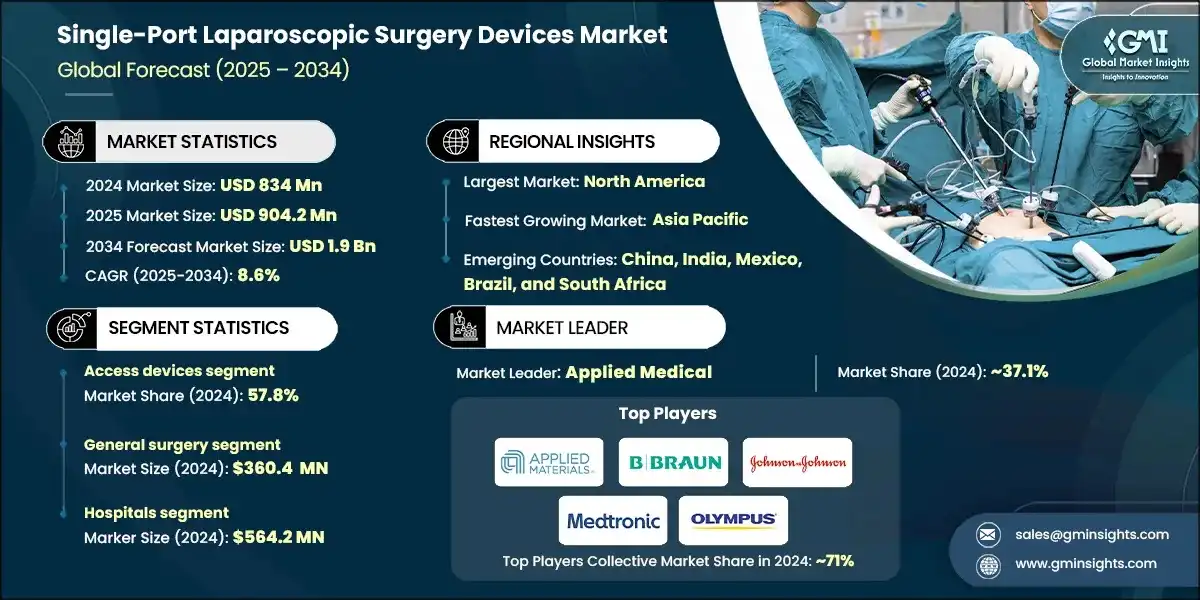
The global single-port laparoscopic surgery devices market size was valued at USD 834 million in 2024. The market is expected to grow from USD 904.2 million in 2025 to USD 1.9 billion in 2034, at a CAGR of 8.6% during the forecast period, according to the latest report published by Global Market Insights Inc. The high market growth is attributed to increasing prevalence of obesity, colorectal diseases, and gynecological conditions, along with the rising preference for minimally invasive surgery and a surge in outpatient surgeries, among other factors.
To get key market trends
Single-port laparoscopic surgery (SPLS) devices represent a transformative advancement in minimally invasive surgery, enabling surgeons to perform complex procedures through a single incision, typically at the umbilicus, thereby minimizing trauma, scarring, and recovery time. Leading manufacturers such as Applied Medical, Medtronic, Johnson & Johnson, Olympus, and B. Braun offer comprehensive SPLS portfolios that include multi-channel access ports, articulating laparoscopic instruments, and advanced single-port platforms. These solutions are designed to optimize surgical ergonomics, enhance instrument triangulation, and improve procedural efficiency.
The market has increased from USD 715 million in 2021 and reached USD 782.9 million in 2023, with a historic growth rate of 4.6%. This expansion has been driven by the rising demand for minimally invasive surgical techniques, increasing adoption of single-incision procedures across general and gynecological surgeries, and the integration of advanced technologies such as articulating instruments and enhanced access devices.
Patients and healthcare providers are increasingly favoring procedures that offer reduced trauma, shorter hospital stays, faster recovery times, and improved cosmetic outcomes. Unlike traditional open surgeries, minimally invasive approaches such as single-port laparoscopy require only small incisions, significantly lowering the risk of infection and postoperative complications. This shift is further supported by advancements in surgical instrumentation, imaging technologies, and perioperative care, which have collectively enhanced the safety, precision, and efficacy of these procedures.
Additionally, growing awareness among patients regarding the benefits of reduced postoperative pain, faster recovery, and improved cosmetic outcomes has further accelerated market uptake. The expansion of ambulatory surgical centers and favorable reimbursement policies in developed markets have also contributed to sustained growth.
Single-port laparoscopic surgery devices are specialized medical instruments designed to facilitate minimally invasive surgical procedures through a single incision, typically made at the umbilicus.
Single-Port Laparoscopic Surgery Devices Market Report Attributes
| Key Takeaway | Details |
|---|---|
| Market Size & Growth | |
| Base Year | 2024 |
| Market Size in 2024 | USD 834 Million |
| Market Size in 2025 | USD 904.2 Million |
| Forecast Period 2025 - 2034 CAGR | 8.6% |
| Market Size in 2034 | USD 1.9 Billion |
| Key Market Trends | |
| Drivers | Impact |
| Increasing prevalence of obesity, colorectal diseases, and gynecological conditions | Expands the patient pool requiring surgical intervention, boosting demand for SPLS procedures. |
| Technological Advancements | Enhances surgical precision, safety, and outcomes, making SPLS more accessible and effective. |
| Rising preference for minimally invasive surgery | Drives adoption due to benefits like reduced pain, faster recovery, and better cosmetic results. |
| Surge in outpatient surgeries | Fuels demand for SPLS devices as they support quicker procedures with shorter hospital stays. |
| Pitfalls & Challenges | Impact |
| High cost of laparoscopic devices | Limits adoption in cost-sensitive markets and smaller healthcare facilities. |
| Stringent government regulations | Slows down product approvals and market entry for innovative SPLS technologies. |
| Opportunities: | Impact |
| Healthcare infrastructure expansion | Opens new markets and increases procedural volumes in emerging economies. |
| Development of flexible, ergonomic, and reusable instruments | Reduces costs and improves surgeon comfort, driving broader adoption. |
| Market Leaders (2024) | |
| Market Leaders |
~37.1% Market Share |
| Top Players |
Collective market share in 2024 is ~71% |
| Competitive Edge |
|
| Regional Insights | |
| Largest Market | North America |
| Fastest Growing Market | Asia Pacific |
| Emerging Country | China, India, Mexico, Brazil, and South Africa |
| Future Outlook |
|
What are the growth opportunities in this market?
Single-Port Laparoscopic Surgery Devices Market Trends
Technological advancements are playing a critical role in accelerating the adoption and evolution of single-port laparoscopic surgery (SPLS) devices, transforming them into more precise, efficient, and user-friendly tools for minimally invasive procedures.
- One of the most significant innovations is the development of articulating and flexible instruments that overcome the traditional limitations of triangulation and maneuverability within a single incision. These instruments allow surgeons to perform complex tasks with greater dexterity and control, even in anatomically constrained spaces, thereby expanding the scope of SPLS across various specialties, including gynecology, urology, and general surgery.
- Additionally, advancements in imaging and visualization technologies, including high definition (HD), 4K, and 3D endoscopic systems, are enhancing intraoperative visibility, enabling surgeons to identify anatomical structures with greater clarity. Coupled with real-time navigation systems and AI-powered decision support, these tools help to reduce intraoperative errors and improve patient outcomes.
- Moreover, the shift toward digital surgery ecosystems is enabling seamless integration of SPLS devices with preoperative planning software, cloud-based data sharing, and surgical simulation platforms. These technologies support personalized surgical strategies, improve training and skill acquisition, and facilitate remote collaboration between surgical teams.
- As these innovations continue to mature, they are expected to make SPLS more accessible, efficient, and scalable across diverse healthcare settings.
Single-Port Laparoscopic Surgery Devices Market Analysis

Learn more about the key segments shaping this market
The global market was valued at USD 715 million in 2021. The market size reached USD 782.9 million in 2023, from USD 746.9 million in 2022.
Based on product type, the market is segmented into access devices and laparoscopic instruments. The access devices segment accounted for 57.8% of the market in 2024 due to their critical role in enabling single-incision entry, instrument navigation, and procedural efficiency across a wide range of laparoscopic surgeries. The segment is expected to exceed USD 1.1 billion by 2034, growing at a CAGR of 8.4% during the forecast period.
On the other hand, the laparoscopic instruments segment held a significant market share of 42.2% in 2024, and its growth can be attributed to the increasing demand for precision tools that enable complex maneuvers through a single incision, especially in anatomically constrained procedures. These instruments, such as articulating graspers, trocars, scissors, dissectors, and needle holders, are essential for maintaining surgical dexterity and control in single-port procedures, where instrument crowding and limited triangulation are common challenges.
- Additionally, access devices serve as the foundational component of any single-port laparoscopic procedure, facilitating the simultaneous insertion of multiple instruments through a single incision while maintaining pneumoperitoneum. Their design innovations, such as flexible sealing systems, multi-channel configurations, and compatibility with articulating instruments, have significantly improved procedural efficiency and reduced intraoperative complications.
Based on application, the single-port laparoscopic surgery devices market is segmented into general surgery, gynecological surgery, urological surgery, bariatric surgery, and other applications. The general surgery segment continues to dominate, accounting for a majority market share valued at USD 360.4 million in 2024.
- The growth of this segment is driven by the high volume of procedures such as cholecystectomy, appendectomy, and hernia repair that are well-suited for single-port access. Its dominance is further reinforced by the widespread adoption of SPLS in both inpatient and outpatient settings, where reduced recovery time and improved cosmetic outcomes are key decision factors for patients and providers alike.
- The gynecological surgery segment held a revenue of USD 223.9 million in 2024, with projections indicating a steady expansion at 9.3% CAGR from 2025 to 2034. This growth is supported by rising awareness of minimally invasive options among women, advancements in specialized gynecological instruments, and the growing preference for outpatient surgical settings that offer faster recovery and improved cosmetic outcomes.
- The urological surgery segment held a revenue of USD 131.4 million in 2024, with projections indicating a steady expansion at 8.9% CAGR from 2025 to 2034, fueled by the increasing use of SPLS in procedures such as nephrectomy, prostatectomy, and pyeloplasty.
- The bariatric surgery segment held a revenue of USD 82.9 million in 2024, with projections indicating a steady expansion at 7.9% CAGR from 2025 to 2034. This growth is supported by the global rise in obesity rates, increasing awareness of surgical weight-loss options, and the growing preference for minimally invasive bariatric procedures such as sleeve gastrectomy and gastric bypass performed via single-port access.
- The other applications segment held a revenue of USD 35.4 million in 2024, with projections indicating a steady expansion at 7% CAGR from 2025 to 2034, driven by the growing use of SPLS in specialized and emerging procedures such as hepatobiliary surgery, thoracic interventions, adrenalectomy, and other procedures.
Learn more about the key segments shaping this market
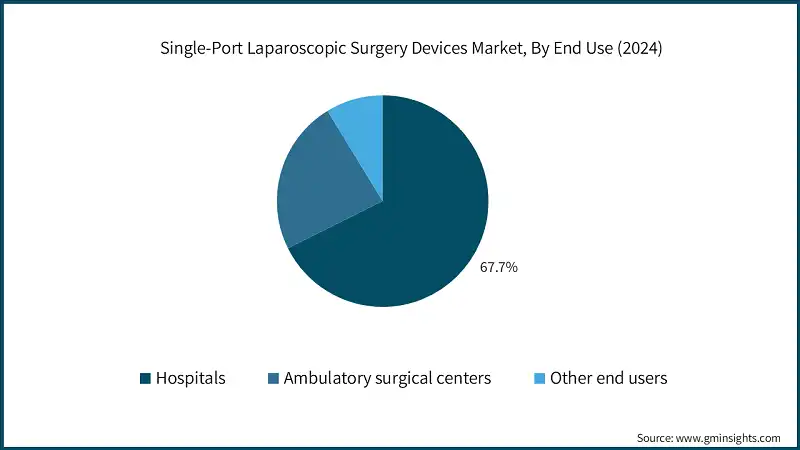
Based on end use, the single-port laparoscopic surgery devices market is segmented into hospitals, ambulatory surgical centers, and other end users. The hospitals segment accounted for USD 564.2 million in 2024 and is expected to grow at an 8.6% CAGR from 2025 to 2034.
- The growth of this segment is driven by the high volume of complex surgical procedures performed in hospital settings, where advanced infrastructure and skilled surgical teams support the adoption of single-port laparoscopic techniques. Hospitals also benefit from integrated surgical suites, robotic systems, and access to training programs, making them the primary adopters of SPLS devices across general, gynecological, and urological surgeries.
- The ambulatory surgery centers (ASCs) segment accounted for USD 196.8 million in 2024 and is expected to grow at a 9.5% CAGR from 2025 to 2034. ASCs offer faster turnaround times, reduced hospital overhead, and improved patient convenience, making them ideal settings for single-port laparoscopic surgeries. The growing availability of compact, reusable SPLS devices tailored for ambulatory environments is further accelerating adoption in this segment.
- The other end users segment is expected to grow at a substantial pace during the period from 2025 to 2034 at a CAGR of 6.5%. The other end users include specialty clinics, government facilities, and research institutions, representing a growing avenue for device utilization.
Looking for region specific data?
North America Single-Port Laparoscopic Surgery Devices Market
North America dominated the global market with the highest market share of 45% in 2024.
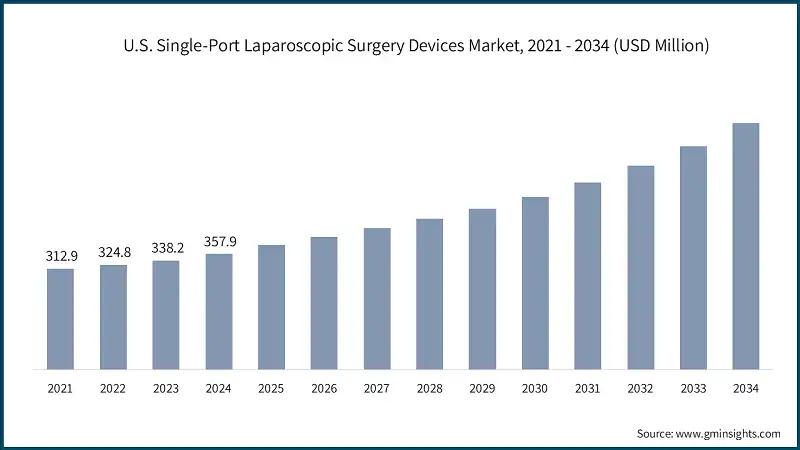
- The U.S. market was valued at USD 312.9 million and USD 324.8 million in 2021 and 2022, respectively. The market size reached USD 357.9 million in 2024, growing from USD 338.2 million in 2023, and is anticipated to grow at a CAGR of 7.9% between 2025 and 2034.
- The U.S. leads in the integration of advanced single-port platforms, supported by strong reimbursement frameworks and a high concentration of skilled laparoscopic surgeons. Leading manufacturers such as Medtronic and Johnson & Johnson have a strong presence in the region, further fueling innovation and accessibility.
- The region also benefits from robust investments in surgical training, simulation platforms, and digital surgery ecosystems, which are accelerating the adoption of SPLS across specialties. The growing preference for outpatient procedures and the expansion of ambulatory surgical centers are contributing to increased demand for compact, reusable, and cost-effective SPLS systems. As patient awareness and demand for minimally invasive options continue to rise, North America is expected to maintain its leadership position in the global market.
Europe Single-Port Laparoscopic Surgery Devices Market
Europe market accounted for USD 226.6 million in 2024 and is anticipated to show lucrative growth over the forecast period.
- Europe holds a significant share in the SPLS devices market, supported by a strong network of public and private hospitals, favorable regulatory policies, and increasing adoption of minimally invasive techniques. Countries like Germany, France, and the UK are at the forefront of SPLS adoption, with widespread use in general, gynecological, and colorectal surgeries. European manufacturers such as STORZ and B Braun contribute to the region’s technological edge with high-quality instruments and access platforms.
- The region is also witnessing a shift toward value-based care and sustainability, driving demand for reusable and bioresorbable SPLS instruments. Government initiatives promoting surgical innovation and cross-border healthcare collaboration are further enhancing market growth.
Asia Pacific Single-Port Laparoscopic Surgery Devices Market
The Asia Pacific market is anticipated to grow at a CAGR of 9.9% during the analysis timeframe.
- Asia-Pacific is emerging as the fastest-growing region in the SPLS devices market, fueled by rapid healthcare infrastructure development, rising surgical volumes, and increasing awareness of minimally invasive procedures.
- Countries like China, India, Japan, and South Korea are investing heavily in modernizing operating rooms and expanding access to advanced surgical technologies. The region’s large patient population and growing middle class are driving demand for cost-effective and cosmetically superior surgical solutions.
- Local and international manufacturers are introducing affordable SPLS systems tailored to the needs of price-sensitive markets, while training programs and partnerships with global surgical societies are helping to overcome the learning curve.
Latin America Single-Port Laparoscopic Surgery Devices Market
The Latin America market is experiencing robust growth over the analysis timeframe.
- Latin America is experiencing gradual growth in the SPLS devices market, supported by increasing investments in healthcare modernization and a rising focus on minimally invasive surgical techniques. Brazil and Mexico lead the region in terms of SPLS adoption, particularly in general and gynecological surgeries. The expansion of private healthcare facilities and medical tourism is also contributing to market momentum.
- As awareness and demand for outpatient procedures rise, Latin America is expected to see steady growth in SPLS utilization.
Middle East & Africa Single-Port Laparoscopic Surgery Devices Market
The Middle East & Africa (MEA) market is experiencing notable growth over the analysis timeframe.
- Countries like the UAE, Saudi Arabia, and South Africa are leading the way with modern surgical facilities and growing interest in minimally invasive techniques. Government initiatives to improve surgical care and attract medical tourism are also supporting market development.
- As training programs and awareness campaigns gain traction, MEA is expected to witness gradual growth in SPLS adoption over the coming years.
Single-Port Laparoscopic Surgery Devices Market Share
Leading industry players such as Applied Medical, Medtronic, Johnson & Johnson, Olympus, and B. Braun collectively hold a market share of approximately 71% in the competitive SPLS devices market. These companies maintain their dominance through continuous innovation in articulating instruments, multi-channel access platforms, and advanced single-port systems that enhance surgical precision, ergonomics, and patient outcomes. Their global distribution networks, surgeon education programs, and regulatory expertise enable widespread adoption across hospitals and ambulatory surgical centers, reinforcing their leadership in minimally invasive surgery.
Meanwhile, emerging players are carving out niches by focusing on cost-effective reusable instruments, flexible access ports, and region-specific device customization, particularly in Asia-Pacific and Latin America. Strategic collaborations with academic institutions, digital surgery platform providers are enabling these companies to introduce novel solutions that address unmet clinical needs. Overall, the SPLS devices market is evolving toward digitally integrated, patient-centric, and ergonomically optimized surgical systems, intensifying competition and driving continuous improvements in device performance, affordability, and procedural efficiency.
Single-Port Laparoscopic Surgery Devices Market Companies
A few of the prominent players operating in the single-port laparoscopic surgery devices industry include:
- Applied Medical
- B. Braun
- CITEC
- GYTR-VII
- Hospiinz
- Johnson & Johnson
- KANGJI
- LOOKMED
- Medtronic
- OLYMPUS
- STORZ
- UNIMAX
- Applied Medical
Applied Medical is a recognized innovator in the SPLS space, known for its GelPOINT advanced access platforms that enable efficient single-incision procedures across general, colorectal, and gynecological surgeries. The company emphasizes ergonomic design, clinical versatility, and cost-effectiveness, making its devices highly suitable for both high-volume hospitals and ambulatory surgical centers. Applied Medical’s vertically integrated manufacturing model allows for rapid product development and customization, while its strong focus on surgeon education and procedural efficiency reinforces its reputation as a value-driven leader in minimally invasive surgery.
Ethicon, a subsidiary of Johnson & Johnson MedTech, holds a prominent position in the SPLS market with its SILS Port platform and a comprehensive suite of laparoscopic instruments and energy devices. The company’s strength lies in its ability to integrate SPLS solutions within a broader surgical ecosystem, offering standardized instrumentation, advanced visualization systems, and hemostatic technologies that enhance procedural outcomes.
Medtronic is a key player in the SPLS market, offering the widely adopted SILS Port system designed for single-incision laparoscopic access. The company’s SPLS portfolio is built around multi-channel access platforms and precision laparoscopic instruments that support a wide range of procedures, from general surgery to gynecology. Medtronic’s focus on instrument reliability, procedural standardization, and global accessibility has made its SPLS solutions a preferred choice in both developed and emerging markets.
Single-Port Laparoscopic Surgery Devices Industry News:
- In August 2021, Olympus announced that it had launched its LESS Port for Minimal Access Surgery. The LESS Port is a flexible port that is designed to be inserted through a single incision, providing access to the surgical site for multiple instruments. This product launch helped the company to enhance its product range and generate increased revenue.
The single-port laparoscopic surgery devices market research report includes an in-depth coverage of the industry with estimates and forecasts in terms of revenue in USD Million from 2021 - 2034 for the following segments:
Market, By Product Type
- Access devices
- Laparoscopic instruments
Market, By Application
- General surgery
- Gynecological surgery
- Urological surgery
- Bariatric surgery
- Other applications
Market, By End Use
- Hospitals
- Ambulatory surgery centers
- Other end use
The above information is provided for the following regions and countries:
- North America
- U.S.
- Canada
- Europe
- Germany
- UK
- France
- Spain
- Italy
- Netherlands
- Asia Pacific
- China
- Japan
- India
- Australia
- South Korea
- Latin America
- Brazil
- Mexico
- Argentina
- Middle East and Africa
- South Africa
- Saudi Arabia
- UAE
Frequently Asked Question(FAQ) :
Who are the key players in the global single-port laparoscopic surgery devices industry?
Key players include Applied Medical, Medtronic, Johnson & Johnson (Ethicon), Olympus, B. Braun, CITEC, STORZ, LOOKMED, KANGJI, Hospiinz, GYTR-VII, and UNIMAX.
Which region is expected to be the fastest growing in the single-port laparoscopic surgery devices market?
The Asia Pacific region is projected to grow at a CAGR of 9.9% through 2034, supported by rapid healthcare expansion, increasing surgical volumes, and growing awareness of the benefits of minimally invasive procedures.
Which region leads the global single-port laparoscopic surgery devices market?
North America led the global market with a 45% share (USD 375 million) in 2024, driven by advanced healthcare infrastructure, strong presence of key manufacturers, and favorable reimbursement frameworks for minimally invasive surgeries.
Which end-use segment accounted for the largest share in 2024?
The hospitals segment dominated with USD 564.2 million revenue in 2024, owing to the high volume of complex surgical procedures, advanced operating room infrastructure, and surgeon access to training and robotic-assisted technologies.
Which application segment generated the highest revenue in 2024?
The general surgery segment led the market with USD 360.4 million revenue in 2024, supported by the high procedural volume of cholecystectomy, appendectomy, and hernia repair, which are well-suited for single-port access.
Which product type segment dominated the global single-port laparoscopic surgery devices market in 2024?
The access devices segment held the largest share of 57.8% (USD 482.6 million) in 2024, driven by their essential role in enabling single-incision entry, instrument navigation, and maintaining pneumoperitoneum during surgical procedures.
What is the market size of the global single-port laparoscopic surgery devices market in 2024?
The market size was USD 834 million in 2024, driven by the rising prevalence of obesity, colorectal, and gynecological disorders, along with the increasing adoption of minimally invasive surgical techniques.
What is the projected market value of the global single-port laparoscopic surgery devices market by 2034?
The market is expected to reach USD 1.9 billion by 2034, growing at a CAGR of 8.6%, fueled by advancements in surgical technology, growing demand for outpatient procedures, and the integration of robotic and AI-assisted platforms.
What is the estimated market size of the global market in 2025?
The market is projected to reach USD 904.2 million in 2025, supported by increased preference for single-incision surgeries offering faster recovery, minimal scarring, and reduced postoperative complications.
Single-Port Laparoscopic Surgery Devices Market Scope
Related Reports