Summary
Table of Content

Silicon Based Biostimulants Market
Get a free sample of this report
Form submitted successfully!
Error submitting form. Please try again.
Thank you!
Your inquiry has been received. Our team will reach out to you with the required details via email. To ensure that you don't miss their response, kindly remember to check your spam folder as well!
Request Sectional Data
Thank you!
Your inquiry has been received. Our team will reach out to you with the required details via email. To ensure that you don't miss their response, kindly remember to check your spam folder as well!
Form submitted successfully!
Error submitting form. Please try again.
Silicon Based Biostimulants Market Size
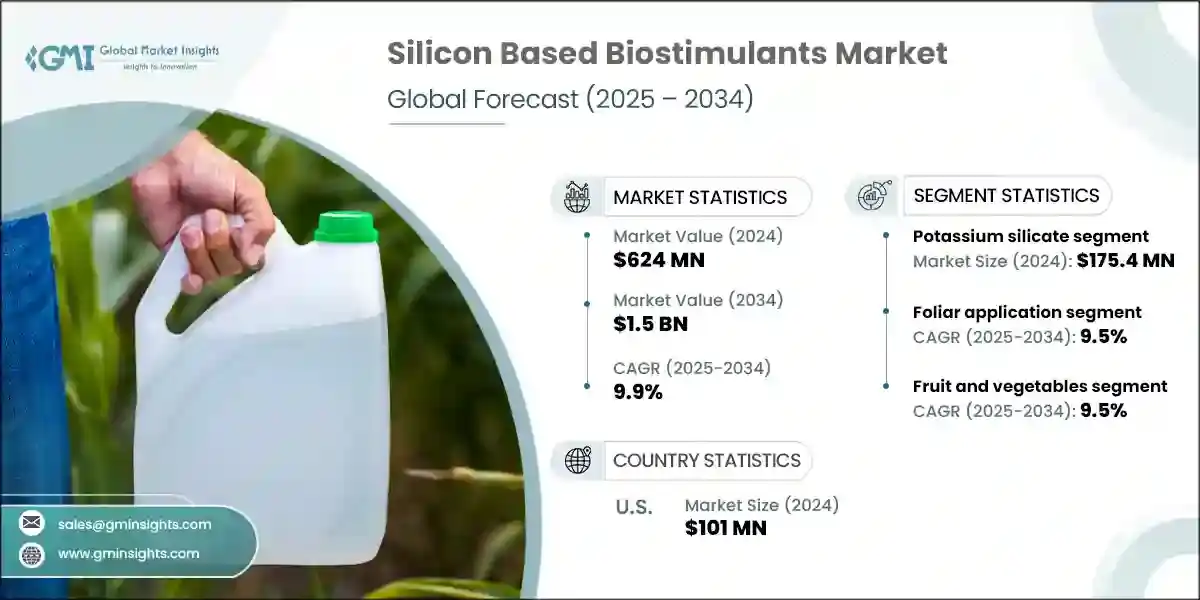
The global silicon based biostimulants market reached USD 624 million in 2024. The market is expected to grow from USD 682.7 million in 2025 to USD 1.5 billion in 2034, at a CAGR of 9.9%.
Silicon Based Biostimulants Market Key Takeaways
Market Size & Growth
- 2024 Market Size: USD 624 Million
- 2034 Forecast Market Size: USD 1.5 Billion
- CAGR (2025–2034): 9.9%
Regional Dominance
- Largest Market: North America
- Fastest Growing Region: Asia Pacific
Key Market Drivers
- Rising demand for sustainable agriculture.
- Enhanced crop stress tolerance and yield.
- Regulatory support for biostimulants use.
- Advancements in product formulations and nanotechnology.
Challenges
- Limited farmer awareness and education.
- Higher cost compared to conventional inputs.
Opportunity
- Expansion in emerging markets.
- Integration with precision and digital agriculture.
Key Players
- Leading Players: Top 5 players in this market include Bayer AG (Crop Science Division), Biolchim S.p.A., Certis Biologicals, Corteva Inc., BASF SE, which collectively held a market share of 41.3% in 2024.
Get Market Insights & Growth Opportunities
- The silicon based biostimulants market worldwide is dynamic growth, as agriculture is giving increased attention to sustainable and resilient crop production. Increased adoption of the use of silicon-based products across a wide range of agricultural systems, as outlined above, provides the necessary impetus to sustain the growth of industry.
- In terms of product type, potassium silicate is the leader in the market with a market share of 28.1% and is widely designed for its impact on enabling plants to be healthy by providing greater strength and plant tolerance to abiotic stressors. Stabilized silicic acid and sodium silicate also hold significant shares of the market, with stabilized silicic acid gaining the most traction; this is mainly due to the unique characteristics of stabilized silicic acid that allow for high bioavailability and rapid uptake by plants. Silicon nanoparticles, while a smaller part of the market today, are expected to be the fastest-growing segment of the market mainly due to increased research and development of nanotechnology in agriculture.
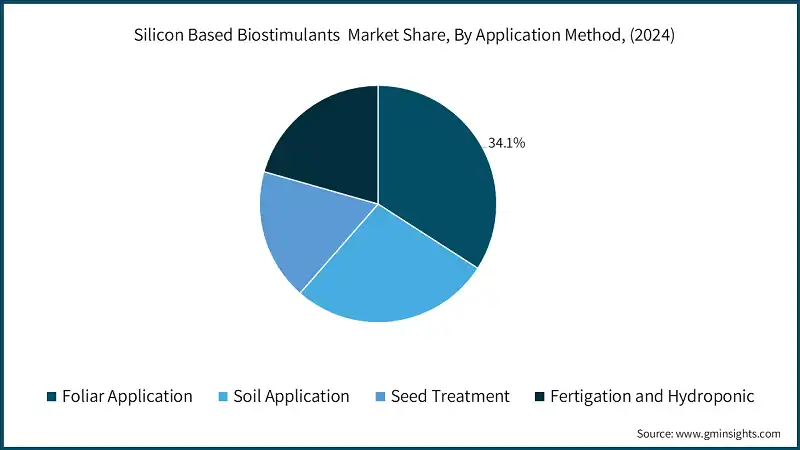
- Foliar application is the most common application method across the survey as it is simple and efficient. Foliar applications account for 34.1% of the overall product application methodology. Foliar application enables producers to see quick results in plant health improvement and overall plant physiology performance. Soil applications are also a popular application in this market segment, especially where soil conditions are less than desirable.
- By crop type fruits and vegetables collected 33.1% of the market share for silicon-based biostimulants, due to their high value, and sensitivity to environmental stressors. Cereals and grains drive a significant share of the market, with farmers eager to improve yields and resilience on staple crops. Industrial crops, turf, ornamentals, and other specialty crop types are all types of crops that represent different complexities in the market and are interested in the favorable properties of silicon-based inputs.
- Regionally, North America leads the market with a 31.7% market share that is significantly promoted by large scale adoption in US and Canada; Asia Pacific and Europe follow closely behind where there is collective regulatory support for sustainable agriculture. Latin America and the Middle East & Africa, along with innovations and implementation of sustainable agriculture practices, may promise to represent a new and emerging market.
To get key market trends
Silicon Based Biostimulants Market Trends
- A significant trend for silicon-based biostimulants is the intersection of nanotechnology and silicon-based biostimulants. The introduction of nano-silicon biostimulants means the formulation of silicon-based nanoparticles exhibiting their bioavailability using targeted delivery, enhanced plant uptake, improved plant stress resistance, and overall product efficiency. These factors make silicon nanoparticles for high-value specialty crops and precision agriculture interesting. As research and commercialization of nano-silicon products is increasing, it is likely that new innovations and market segments will develop based on the increasing number of research findings, especially in regions with agricultural practice sophistication.
- With growing concern about climate change and soil degradation, farmers and agribusinesses are exploring new products. Hugely influential are silicon-based biostimulants, especially in improving agricultural resilience towards biotic / abiotic stressors such as drought, salinity, and heavy metals. There is a large momentum to promote sustainable farm inputs and the chemicals that can help transition to sustainable farming practices as sustainable farming is becoming the preferred way forward for agriculture. More producers are putting silicon-based biostimulants into their sustainable crop management program based on sustainable farm inputs/developing climate-resilient crops.
Silicon Based Biostimulants Market Analysis
Learn more about the key segments shaping this market
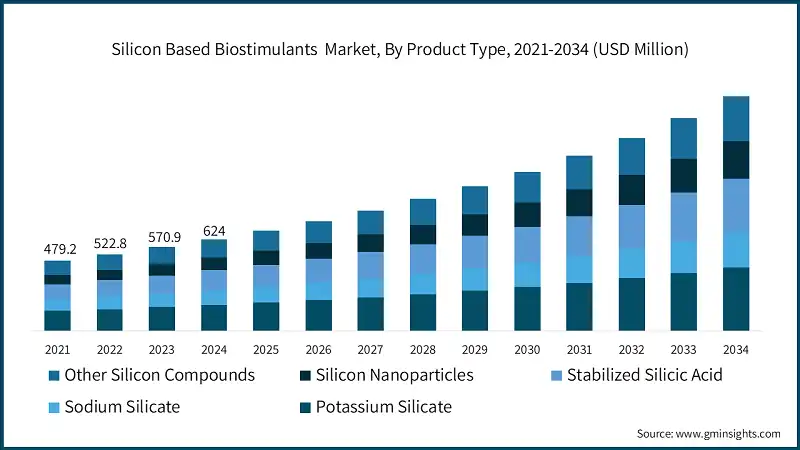
Based on product type, the market is segmented into potassium silicate, sodium silicate, stabilized silicic acid, silicon nanoparticles, and other silicon compounds. Potassium silicate holds a significant share at a valuation of USD 175.4 million in 2024.
- Potassium silicate is the leader of the silicon-based biostimulants market with a share of nearly 28.1%, owing to its established potential to enhance the strength and stress tolerance of crops across a diverse array of crops. Sodium silicate is expected to grow at a steady 9.1% CAGR as it is primarily used for fruits and vegetables notably in Europe where the recognized value of sodium silicate will continue to enhance the quality of their crops.
- The rapid growth of stabilized silicic acid is primarily a result of its high bioavailability coupled with a quick uptake, encouraging uses in high-value crops, as well as for industrial crops. Silicon nanoparticles represented 13.8% of the market at this time and are the fastest growing segment of the silicon-based biostimulants market with a market growth estimate of 11.5%, fostering by the latest developments in nanotechnology and better function in the field of precision agriculture and hydroponic.
- Other silicon compounds are essential growth stimulants and will continue to expand at a consistent uptake rate of 9.3% CAGR. Their included primary uses involve niche and specialty crops, in instances where growers require custom solutions.
Learn more about the key segments shaping this market
Based on application methods, the market is segmented into foliar application, soil application, seed treatment, and fertigation and hydroponic.
- Foliar application is the primary method in the silicon based biostimulants market, accounting for nearly 34.1% of total market share and expected to grow at a CAGR of 9.5%. The development of foliar application is attributed to the rapid and efficient uptake of silicon through plant leaves, and numerous other components have immediate effects visible by the gardener in plant health, stress resistance, and changes to yield quality.
- Using soil applications can improve the physical structure of soil, increase root establishment and can provide positive long-term effects. Applying silicon to soil can also help reduce the initial effects of soil-borne stresses in the environment or as a result of being grown in a saline environment, particularly heavy metal toxicity which represents a recycling potential that has a unique value in extreme forms of agriculture.
- Seed treatment provides protection at an early stage of development and establishes vigorous seedling growth. This is especially beneficial for specialty or industrial crops because seed treatment improves germination and root development while enabling the crop to tolerate any initial stresses that may arise.
- Fertigation and hydroponic applications are becoming more popular in controlled-environment agriculture with a concentrated focus on nutrient application, efficiency in resources, and improved integration of nutrients.
Based on crop type, the silicon based biostimulants market is segmented into cereals and grains, fruits and vegetables, industrial crops, turf and ornamentals, other specialty crops.
- Fruit and vegetables have the largest share of 33.1% of the market and growing at CAGR of 9.5%. This is due in large part to the significant perceived value of these crops, as well as their sensitivity to environmental stresses such as drought, salinity, and disease.
- Cereals and grains represent 28.9% of the market. The increase in applications of silicon-biostimulants to cereals and grains is largely driven by demand to improve tolerance to abiotic stressors in major staple crops such as wheat, rice, and maize. Silicon is known to strengthen plant cell walls, directly increase the lodging resistance of crops, and improve tolerance to abiotic stressors.
- Industrial crops benefit from silicon applications that improve stress tolerance and fiber quality which can lead to improvements in yield, and processing characteristics. In some cases, the need for silicon is needed to meet quality criteria in a competitive global market for industrial crops.
- Turf and ornamentals is seeing broader adoption in landscaping, sports fields and urban green spaces, where plant health, aesthetics and durability are critical. Silicon-based products help retain bright, healthy and durable turf and ornamental plants, which can help reduce maintenance costs and improve aesthetics.
- Growers in Other specialty crops segment are looking for customized solutions for niche applications, such as medicinal plants and herbs, as the stress-mitigating and quality-enhancing benefits of silicon are being recognized. Ultimately, market growth across these segments can be attributed to the search for improved yield, quality and stress resilience.
Looking for region specific data?
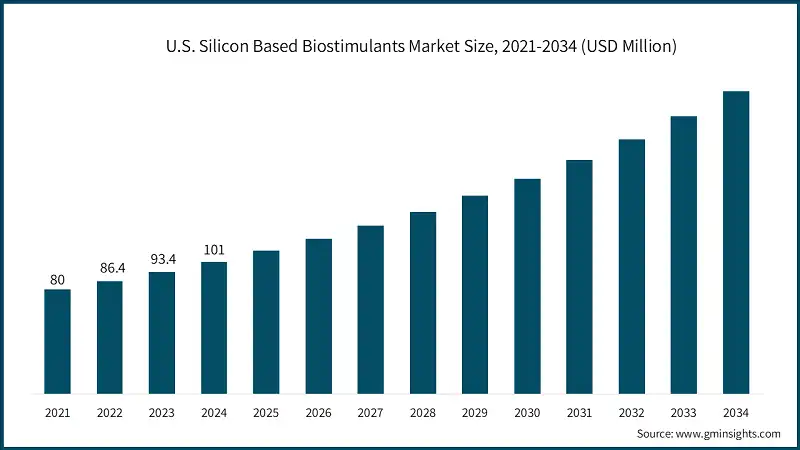
U.S. dominated the silicon based biostimulants market in North America with around 80.1% share and generated USD 101 million in revenue in 2024.
- The U.S. is a dynamic and mature market for silicon-based biostimulants which has been further fueled by rapid advancements in agricultural technology, a prioritization of environmental sustainability and a well-established regulatory framework enabling biostimulants use.
- Within the U.S. market, there is a large adoption of silicon products in cereals and grains, fruits and vegetables, with growers utilizing silicon as part of a combination of biostimulants products to improve yield, quality, and stress tolerance under changing climate conditions. The U.S. has a prominent R&D sector with companies constantly developing silicon-based products, including nanoparticles and stabilized silicic acid formulations, as part of their suite of Agri-inputs and services to the market.
- In the U.S., precision agriculture and digital or 'smart' farming platforms are incorporating silicon-based biostimulants to ensure targeted use in a timely manner, maximizing efficiency and ROIs for farmers. The market also benefits from widespread farmer education Agri-input programs and farmer driver government policies with global targets for sustainability and green agriculture.
The silicon based biostimulants market in India is projected to experience robust and sustained growth from 2025 to 2034.
- India’s silicon biostimulants market is experiencing visual growth with a CAGR of 10.9%, based on India's immense, heterogeneous agriculture sector and the immediate need for crops and cropping systems to increase resilience in light in climate variability. Adoption of biostimulants are highest in rice, wheat, sugarcane, and horticulture as farmers seek to increase yield, decrease production costs, and protect themselves from seasonal drought, salinity, and pest pressures.
- Both local and multi-national companies are also investing substantial amounts into distribution and farmer education to ensure that biostimulants get to even the most remote rural areas of India. Overall, growing acceptance of organic farming and export-oriented horticulture where uniqueness, quality, and residue-free production matter, is also increasing growth.
The silicon based biostimulants market in Germany is forecasted to optimistic growth between 2025 and 2034.
- Germany is a one of the leading markets for silicon-based biostimulants in Europe, supported by environmentally regulated, a strong organic farming community, and advanced agricultural technologies. Fruits, vegetables, and specialty crops are the primary crops that benefit growers wanting to meet domestic and export market quality and safety requirements.
- Traceability of products, certification of products, and demonstrable efficacy, are highly sought after, resulting in suppliers investing in quality assurance processes and transparent sources of supply. The market has benefited, also, from collaborations between research organizations and Agri-tech start-ups, with established input companies, contributing to continuous innovation.
The silicon based biostimulants market in Brazil is forecasted to undergo remarkable and steady growth from 2025 to 2034 due to increased health awareness, increased disposable income and growing sports nutrition industry.
- Brazil is a fast-growing market for silicon-based biostimulants, with the emphasis being mainly for food production and to improve the ability of plants to cope with major stressors, in this case climate change. Given Brazil's status as an agricultural power and diversity of Agro-ecological condition, necessitating a focus on improving how plants can manage with drought, pests, and diseases, this is becoming a country of choice for farmers to increase adoption of the product.
- The Brazilian government is focusing on sustainable agriculture and the need for export-quality produce, such as what is needed to get into the USA marketplace for fresh fruit and vegetables where the market is very selective to comply with high standard regulations. This has been made evident by large investments by local and international corporations into research, field trials and farmer training on how they can benefit from the usage of silicon-based solutions.
- The high-value fruit and vegetable sectors are broadening growth, where the quality, flavor and shelf life of food being produced is of utmost importance to ensure a return on investment for all of growers, wholesalers, retailers and overall consumers. With the scale of farming across Brazil, the policy environment within the country, and patterns of innovation position Brazil as a key market in the wider Latin America marketplace for silicon-based biostimulants.
Saudi Arabia’s silicon based biostimulants market is set to experience dynamic and substantial expansion during the period from 2025 to 2034.
- Saudi Arabia's silicon-based biostimulants market is emerging market trying to mitigate the adverse climate conditions in agriculture and the government's focus on food security and sustainable agriculture.
- The potential benefits of silicon-based biostimulants can offer solutions to some of the unique pitfalls of agriculture in Saudi Arabia, which include the extreme arid climate, water scarcity, and poor quality of the soil, while supporting improvements in productivity, promoting stress tolerance and water-use efficiency.
- Government investments in controlled-environment agriculture, irrigation systems, and sustainable agricultural practices to drive adoption, especially among commercial growers. International suppliers and local distributors are now becoming more involved with the agriculture sector and promoting tailored solutions with educational and technical support for farmers' specific needs.
Silicon Based Biostimulants Market Share
The top 5 companies in the market are BASF SE, Syngenta AG, Bayer AG, Corteva Inc., and UPL Limited contributing around 41.3% of the market in 2024. These companies have robust portfolios of silicon-based biostimulants and global distribution networks and are significantly investing in research and development. The competition is fueled by innovations such as enhanced silicon formulations and delivery systems intended to enhance crop resilience and stress tolerance and overall yield.
- Collaborations / partnerships with Agri-tech companies, research institutions and local distributors provide manufacturers with unique opportunities and increased capacity to provide appropriate site-specific solutions based on specified crops or local needs for better market penetration.
- Brands are increasingly considering the role of compliance with foreign regulations and international quality standards to maintain unique products in these highly competitive markets. Global manufacturers are investing in developing digital agriculture technologies, conducting field trials to demonstrate efficiency and providing education for farmers to support clean label-based claims and growers willing to experiment with innovative products.
- The ability to provide an integrated crop management solution by providing production system strategies that combine silicon based biostimulants with crop protection, nutrient products and sustainability introduces a new dimension to market development
BASF SE: BASF SE is a global player in agricultural solutions and is involved in silicon-based biostimulants that exert a positive effect on plant resilience, uptake of nutrients, and abiotic stress resistance. In this respect, the company's products are designed to support increases in crop yields and quality while promoting sustainable agriculture. The company invests a lot of money in research and development to develop biostimulant formulations for advanced biostimulants for a variety of crops all over the world.
Eutrema: Eutrema develops biostimulant solutions, which includes silicon-based products, that combat abiotic stress while promoting plant health. Eutrema products have a strong emphasis on root development, nutrient absorption, and the overall performance of the crop. The company puts a strong emphasis on developing environmentally friendly formulations whose primary association is organic use but manufactures products for a traditional agricultural market as well and has established a reputation as a science-based company in the biostimulant market.
Haifa Group: Haifa Group is a leading supplier of specialty fertilizers and biostimulants to growers of horticultural crops and is also involved in silicon-based products. Their products are designed to increase cell wall resistance to nil, improve the efficiency of nutrient use, and increase the abiotic stress resistance of the plant. Haifa's silicon-based biostimulants have been used with horticulture and agriculture to produce sustainably high yield in crops around the world.
Silicon Based Biostimulants Market Companies
Major players operating in the silicon based biostimulants industry are:
- BASF SE
- Eutrema
- Haifa Group
- Intermag
- Nuvia Technologies
- Orion Future Technology Ltd
- Plant Food Company Inc
- PlantoSys Nederland B.V.
- Roam Technology
- Shield Lifesciences and Resins Pvt Ltd
- Sustainable Agro Solutions S.A
- Syngenta AG
Silicon Based Biostimulants Market Report Attributes
| Key Takeaway | Details |
|---|---|
| Market Size & Growth | |
| Base Year | 2024 |
| Market Size in 2024 | USD 624 Million |
| Forecast Period 2025 – 2034 CAGR | 9.9% |
| Market Size in 2034 | USD 1.5 Billion |
| Key Market Trends | |
| Drivers | Impact |
| Rising demand for sustainable agriculture | Boosts adoption of eco-friendly crop inputs |
| Enhanced crop stress tolerance and yield | Increases farmer interest in silicon-based products |
| Regulatory support for biostimulants use | Accelerates market growth and product approvals |
| Advancements in product formulations and nanotechnology | Expands application scope and product effectiveness |
| Pitfalls & Challenges | Impact |
| Limited farmer awareness and education | Slows market penetration in developing regions |
| Higher cost compared to conventional inputs | Restricts adoption among price-sensitive farmers |
| Opportunities: | Impact |
| Expansion in emerging markets | Unlocks new growth avenues for manufacturers |
| Integration with precision and digital agriculture | Enhances targeted application and efficiency |
| Market Leaders (2024) | |
| Market Leaders |
15.7 Market Share |
| Top Players |
Collective share of 41.3% in 2024 |
| Competitive Edge |
|
| Regional Insights | |
| Largest Market | North America |
| Fastest Growing Market | Asia Pacific |
| Emerging Countries | India, Vietnam, Philippines, Indonesia, Brazil, Egypt |
| Future outlook |
|
What are the growth opportunities in this market?
Silicon Based Biostimulants Industry News
- In January of 2024, Orion Future Technology published a study done in conjunction with STRI demonstrating significant turf grass health from foliar applications of their silicon biostimulants “Fossil”. In the published trial, there was 36% more root mass, verified ground cover improvements, improved green color, and improved leaf density all with a two liter per hectare application of Fossil.
- Lantos’s obtained the CE mark for its biostimulants products Silica Power (silicon-based) and SalicylPure (willow bark extract-based) in February of 2025 following extensive research on eight CEN-standardized crop groups in addition to a rigorous evaluation by an accredited control body.
The silicon based biostimulants market research report includes in-depth coverage of the industry with estimates & forecasts in terms of revenue (USD Mn) and volume (Tons) from 2021 to 2034, for the following segments:
Market, By Product Type
- Potassium silicate
- Sodium silicate
- Stabilized silicic acid
- Silicon nanoparticles
- Other silicon compounds
Market, By Application Method
- Foliar application
- Soil application
- Seed treatment
- Fertigation and hydroponic
Market, By Crop Type
- Cereals and grains
- Fruits and vegetables
- Industrial crops
- Turf and ornamentals
- Other specialty crops
The above information is provided for the following regions and countries:
- North America
- U.S.
- Canada
- Europe
- Germany
- UK
- France
- Italy
- Spain
- Rest of Europe
- Asia Pacific
- China
- India
- Japan
- Australia
- South Korea
- Rest of Asia Pacific
- Latin America
- Brazil
- Mexico
- Argentina
- Rest of Latin America
- MEA
- South Africa
- Saudi Arabia
- UAE
- Rest of Middle East & Africa
Frequently Asked Question(FAQ) :
What is the market size of the silicon based biostimulants in 2024?
The market size was USD 624 million in 2024, with a CAGR of 9.9% expected through 2034 driven by rising demand for sustainable agriculture and enhanced crop stress tolerance.
What is the projected value of the silicon based biostimulants market by 2034?
The silicon based biostimulants industry is expected to reach USD 1.5 billion by 2034, fueled by advancements in nanotechnology, eco-friendly inputs, and supportive regulations.
How much revenue did the potassium silicate segment generate in 2024?
Potassium silicate generated USD 175.4 million in 2024, leading with a 28.1% market share.
What was the share of foliar application in the market in 2024?
Foliar application accounted for 34.1% market share in 2024.
What is the growth outlook for silicon nanoparticles segment from 2025 to 2034?
Silicon nanoparticles are projected to grow at an 11.5% CAGR, driven by innovation in nanotech and demand in precision agriculture and hydroponics.
Which crop type dominated the silicon based biostimulants market in 2024?
Fruits and vegetables held the largest share at 33.1% in 2024.
Which region leads the silicon based biostimulants market?
North America held a 31.7% share in 2024. Growth was driven by U.S. adoption and regulatory support.
What are the upcoming trends in the silicon based biostimulants industry?
Trends include the rise of nano-silicon formulations, integration with digital farming, and growing focus on sustainability and crop resilience.
Who are the key players in the silicon based biostimulants market?
Key players include BASF SE, Syngenta AG, Haifa Group, Corteva Inc., Bayer AG, Eutrema, Sustainable Agro Solutions, Intermag, and UPL Limited.
Silicon Based Biostimulants Market Scope
Related Reports