Summary
Table of Content

Shotcrete Spray Machines Market
Get a free sample of this report
Form submitted successfully!
Error submitting form. Please try again.
Thank you!
Your inquiry has been received. Our team will reach out to you with the required details via email. To ensure that you don't miss their response, kindly remember to check your spam folder as well!
Request Sectional Data
Thank you!
Your inquiry has been received. Our team will reach out to you with the required details via email. To ensure that you don't miss their response, kindly remember to check your spam folder as well!
Form submitted successfully!
Error submitting form. Please try again.
Shotcrete Spray Machines Market Size
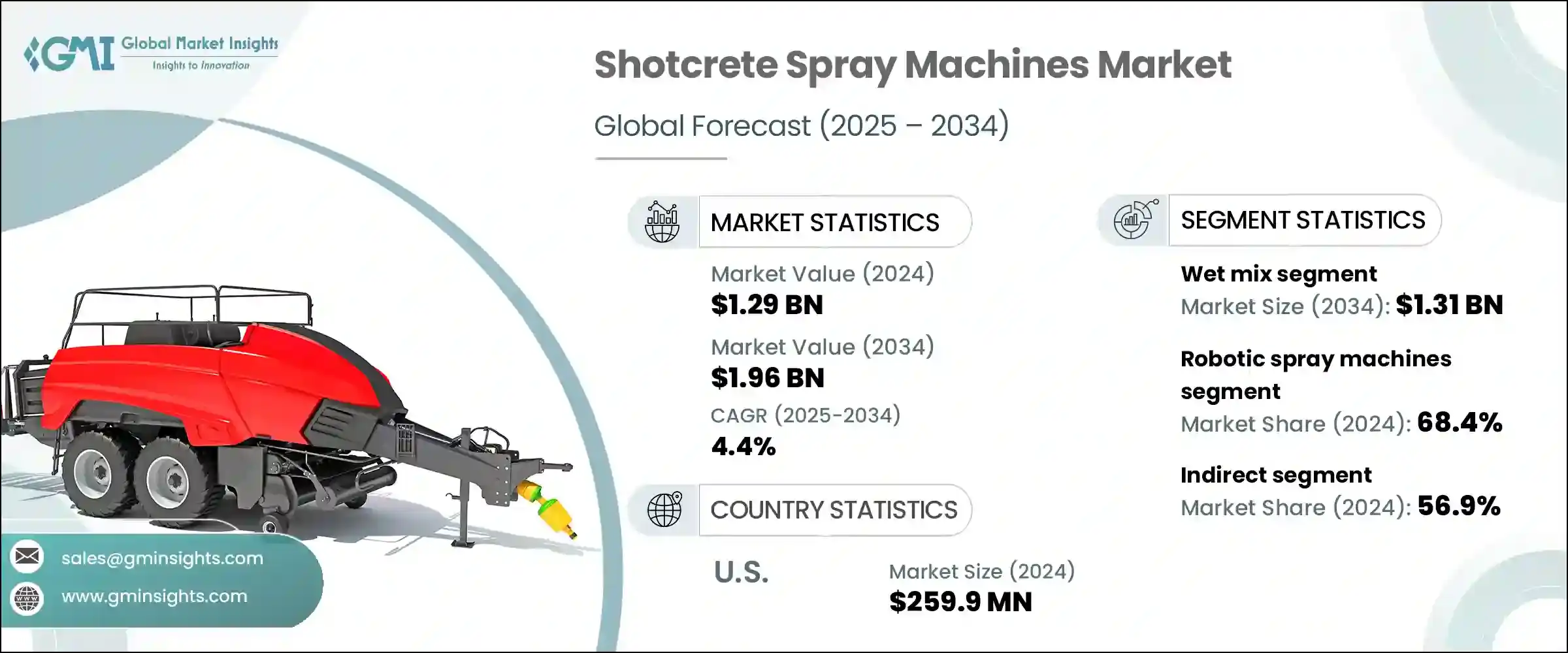
The global shotcrete spray machines market size was valued at USD 1.29 million in 2024 and is projected to grow at a CAGR of 4.4% between 2025 and 2034. Rapid urban growth and large-scale infrastructure programs are pushing up demand for shotcrete machines. The United Nations estimates that, by 2050, two-thirds of the entire population of the world will live in cities, urging planners to focus on space and services. As urban areas expand, contractors increasingly rely on shotcrete sprayers to line tunnels and stabilize underground work.
Shotcrete Spray Machines Market Key Takeaways
Market Size & Growth
- 2024 Market Size: USD 1.29 Billion
- 2034 Forecast Market Size: USD 1.96 Billion
- CAGR (2025–2034): 4.4%
Key Market Drivers
- Increasing tunneling and underground infrastructure projects.
- Rising adoption of robotic shotcrete systems.
- Technological advancements in shotcrete equipment and materials.
Challenges
- High initial equipment and maintenance costs.
- Lack of skilled operators and technical know-how.
Get Market Insights & Growth Opportunities
Across Europe and Asia, national and local governments are investing into underground projects that include new metro lines, hydropower tunnels, and city ring roads. The European Investment Bank, for example, set aside more than USD 2.3 billion in 2023 for urban transport, the bulk of which will go toward expanding existing metro networks. At the same time, China’s 14th Five-Year Plan highlights underground work and plans to spend roughly USD 150 billion on rail and tunnel schemes. Contractors now prefer shotcrete spraying robots because they apply concrete quickly, fit into tight locations, and build tougher, lasting structures. As city streets grow busier, this underground push will sustain steady demand for shotcrete machines between 2024 and 2029.
Furthermore, robotic shotcrete are getting traction as they deliver pinpoint accuracy, keep crews out of danger, and cut labor hours. The International Tunneling and Underground Space Association predicts the global tunnel market will expand at 7% a year from 2024 onward. Modern robotic shotcrete rigs come packed with innovative automation, featuring remote-control dashboards, agile nozzle arms, and 24/7 performance monitors.
Labour scarcity and tough safety rules across North America and Europe are pushing contractors toward this technology. The U.S. Bureau of Labor Statistics noted a 7% drop in available construction workers between 2020 and 2023, underlining the need for automation. Robotic rigs limit worker exposure to dangerous zones and help sites meet OSHA standards in the States or EU directives elsewhere. Therefore, these systems have become vital, thereby propelling the market.
To get key market trends
Shotcrete Spray Machines Market Trends
- Robotic and automated shotcrete systems are quickly reshaping the spraying-machine market by tackling safety, speed, and accuracy hurdles on job sites. The International Tunneling and Underground Space Association estimates that using these robots’ cuts worker exposure to dust, noise, and falling debris by 70%. Linking with tools like 3D printing and Building Information Modeling (BIM), contractors can program robots to form intricate, custom shapes on demand. Industry leaders, including Putzmeister and Normet, are developing smarter machines, adding deeper automation and cloud-based monitoring to the next-generation devices.
- The need for fiber-reinforced shotcrete (FRS) keeps growing due to its tougher mechanics and long-lasting natur as steel, synthetic, or glass fibers blended into the mix boost tensile strength, ductility, and crack resistance. These qualities suit FRS for tunnel linings, slope bracing, and other elements for heavy loads or rough weather. The American Concrete Institute notes that FRS can lengthen a structures service life by roughly 25% when compared with standard mixes. In response, suppliers such as BASF and Sika now offer novel admixtures aimed at lifting shotcrete performance even further.
- Green shotcrete options are gaining popularity as builders face issues on climate issues and seek cleaner ways to work. By mixing in materials-SCMs such as fly ash, slag, or silica fume-crafters, trim the amount of cement used and shrink the mixes carbon footprint. The Portland Cement Association estimates that this practice can cut greenhouse gas emissions by as much as 40%. At the same time, new low-VOC admixtures and energy-smart spraying rigs now on the market lessen solvent release and curb rebound waste by nearly 20%. Makers like Aliva and CIFA thus stay ahead of environmental codes while still delivering the durability and consistency in projects demand.
Shotcrete Spray Machines Market Analysis
Learn more about the key segments shaping this market
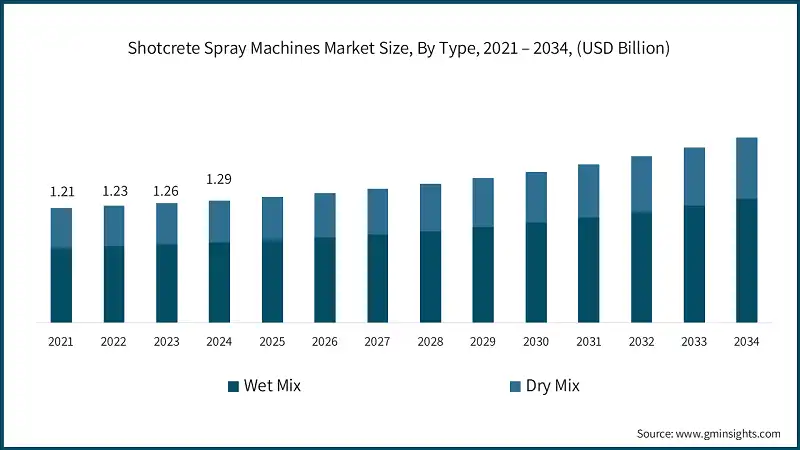
Based on type, the market is segmented into wet mix shotcrete and dry mix shotcrete. The wet mix segment exceeded USD 846.3 million in 2024 and is expected to reach USD 1.31 billion by 2034.
- Wet-mix shotcrete has surged to the forefront of the shotcrete spraying equipment industry, leaving the dry-mix technique far behind. Its growth stems from a blend of practical benefits that appeal especially to contractors running large job sites. Because every ingredient, including water, is blended before pumping, the mixture remains uniform from the first pump to the last. That uniformity leads to more reliable compressive strength, usually falling between 4,000 and 7,000 psi, depending on specific project demands. The wet process also produces much lower rebound loss rates often under 10%. Less bounce-back cuts waste decreases costs, and leaves crews with a clean and safer workplace.
- Wet-mix shotcrete equipment is built for heavy output, with some units pouring more than 30 cubic meters each hour which is suitable for massive infrastructure jobs, from tunneling and bridge work to large-scale repair efforts. Manufacturers like Putzmeister and Sika now track steady sales growth for their wet-mix machines, especially across North America and Europe, where refurbishing and expanding aging networks is a top priority.
Learn more about the key segments shaping this market
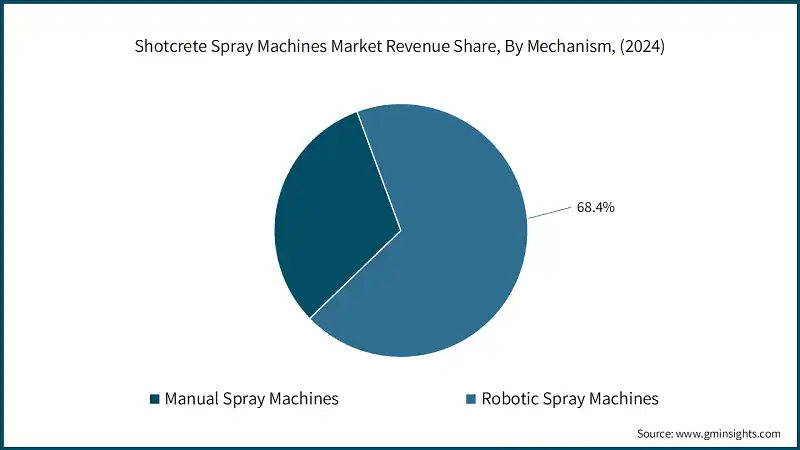
Based on mechanism, the shotcrete spray machines market is segmented into manual spray machines and robotic spray machines. The robotic spray machines segment accounted for a market share of around 68.4% in 2024 and is projected to grow at CAGR of 4.7% from 2025 to 2034.
- Robotic spray machines have begun to reshape the shotcrete business, winning favor on today’s construction and mining sites. These automated units deliver an even layer keeping thickness and mix quality far steadier. Their targeting systems often stay within ±5 millimeters-an accuracy. Because the machines can be run from a distance, human operators spend far less time in overhead-danger zones.
- Robotic spray machines also boost productivity. Running non-stop at high speeds, some units can deliver 20 cubic meters of material every hour and save project schedules by as much as 25%. Because the equipment needs fewer people at the controls, labor expenses fall as well. Manufacturers including Normet and Aliva, now offer models that automate nozzle placement and relay performance data in real time, raising both output and finish quality.
Based on distribution channel, the shotcrete spray machines market is segmented into direct and indirect. The indirect segment accounted for a market share of around 56.9% in 2024.
- Indirect distribution channels are significant as the equipment is purpose-built, costly, and technically demanding. Instead of handling every sale themselves, manufacturers count on a web of distributors, dealers. This strategy proves especially useful in areas where local know-how and pre-existing connections determine how quickly a new product breaks through.
Looking for region specific data?
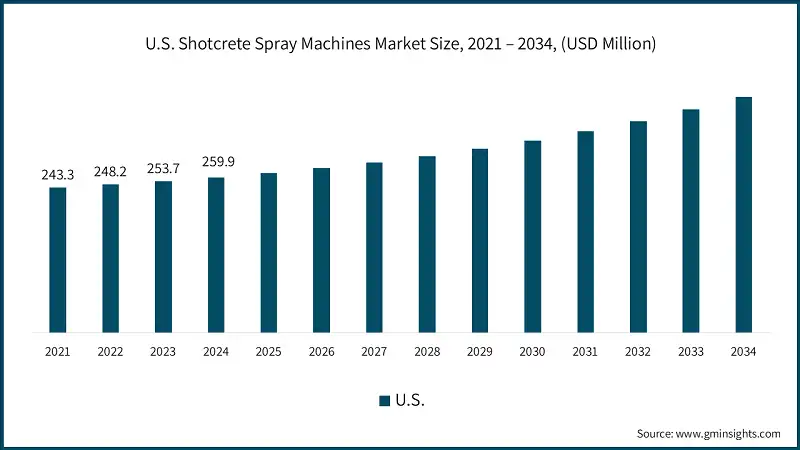
U.S. shotcrete spray machines market was valued at USD 259.9 million in 2024 and is projected to grow at CAGR of 4.4% up to 2034.
- The U.S. market for shotcrete spraying machines is characterized by a strong emphasis on infrastructure repair and rehabilitation, given the aging public infrastructure across the country. Additionally, ongoing residential and commercial construction, contributes to demand. The market sees a notable adoption of advanced, often robotic, wet-mix systems for efficiency and safety, particularly in larger projects.
- The broader North American market also sees significant activity in underground construction for urban development and mining operations. The emphasis on worker safety and efficiency drives the adoption of wet-mix systems and increasingly, robotic spraying technologies, with Canada showing a promising growth trajectory in this space.
Germany shotcrete spray machines market is projected to grow at CAGR of 4.7% for the forecast period of 2025-2034.
- Germany plays a central role in Europe’s shotcrete sector, providing a mature, tech-savvy market for spraying machines. Strong local traditions in engineering and manufacturing fuel continuous equipment upgrade and design innovation. Demand grows from fresh transport and urban schemes as well as ongoing upkeep of aging bridges and tunnels.
- Across Europe, underground investments in metros, rail lines, and freight tunnels account for a large chunk of global shotcrete purchases, thereby propelling the market.
China shotcrete spray machines market is projected to grow at a CAGR of 4.3% for the forecast period of 2025-2034.
- The ongoing urbanization and industrial growth keep construction activity at a relentless pace nationwide. Both wet-mix and dry-mix methods are in use, leaning more toward high-performance wet and robotic setups that promise better speed, quality, and reliability on large, intricate jobs.
- The growth in the Asia Pacific region is primarily attributed to rapid urbanization, burgeoning populations, and massive investments in infrastructure development. Countries like India and Southeast Asian nations are witnessing significant growth in road networks, smart cities, and industrial zones. The need for cost-effective and efficient construction methods, coupled with increasing awareness of shotcrete's benefits, drives demand across diverse applications, from underground construction to protective coatings and repair works.
The Saudi Arabia shotcrete spray machines market is projected to grow at CAGR of 4.1% for the forecast period of 2025-2034.
- The market for shotcrete spraying machines in Saudi Arabia is on an upward trajectory, driven by Vision 2030 initiatives such as NEOM, the Red Sea Project, and Qiddiya, all of which call for extensive tunnelling, new urban districts, and major leisure amenities. Because such projects unfold in a harsh desert climate, builders favour fast, resilient methods, and shotcrete fits that need perfectly.
- Across the MEA region, demand for shotcrete-spraying machines continues to grow, fuelled by large-scale infrastructure spending in GCC nations and ongoing projects in parts of Africa. Rapid urban expansion, the rise of commercial and residential developments, and a strengthening mining industry all add to the workload.
Shotcrete Spray Machines Market Share
The shotcrete spray machines industry is moderately fragmented, with prominent players, such as Putzmeister, Normet, Sika, Reed and Gengli led the market holding a market share of 30%-35% in 2024.
- Putzmeister leans on cutting-edge, high-output robotic sprayers designed for major tunnels and mines, making them a first choice for large projects. After-sale support and strong OEM parts keep machines running and clients coming back.
- Normet bundles machines, additives, and on-site service. The company pushes regional growth and smarter automation, with Europe and Latin America serving as current focus areas.
- Sika couples its expertise with shotcrete hardware, offering systems that come with patented admixtures. To win tunneling and mining contracts, it stresses project-specific design and joint work with global equipment makers.
- Reed competes with tough, budget-friendly sprayers aimed at mid-sized repair jobs and urban buildings.
- Gengli sells budget-minded robotic and manual sprayers, meeting the needs of Asian municipalities and growing export markets. Fast assembly, local deals, and razor-thin pricing help it move volume and stand out against bigger brands.
Shotcrete Spray Machines Market Companies
Major players operating in the shotcrete spray machines industry are:
- Blastcrete
- CIFA
- Epiroc Deutschland
- Filamos
- Gengli
- Gunite Supply & Equipment
- JUHE Group
- Leadcrete
- MacLean Engineering
- Normet
- Putzmeister
- Reed
- Sika
- Tünelmak
- YG Machinery
The shotcrete spray machines market features a competitive landscape marked by the presence of both global industrial giants and specialized automation firms. Competition is driven by innovation in connectivity, flexibility, and ease of integration, with increasing emphasis on Industry 4.0 compatibility and scalable production.
Shotcrete Spray Machines Market Report Attributes
| Key Takeaway | Details |
|---|---|
| Market Size & Growth | |
| Base Year | 2024 |
| Market Size in 2024 | USD 1.29 Billion |
| Forecast Period 2025 – 2034 CAGR | 4.4% |
| Market Size in 2034 | USD 1.96 Billion |
| Key Market Trends | |
| Growth Drivers |
|
| Pitfalls & Challenges |
|
What are the growth opportunities in this market?
Shotcrete Spray Machines Industry News
- In April 2025, At bauma 2025, Putzmeister showcased Wetkret4, an advanced shotcrete sprayer for underground mining/tunneling as well as the TransMix5500TML horizontal mixer, demonstrating its commitment to productivity and operator safety.
- In June 2023, Normet launched the fully electric Spraymec MF050VCSD, targeting safer and cleaner underground mining applications.
- In 2023, Sika inaugurated a new factory in Kharagpur, India, specifically for mortar, concrete admixtures, and shotcrete accelerators, expanding its global production capabilities.
The shotcrete spray machines market research report includes in-depth coverage of the industry, with estimates & forecasts in terms of revenue (USD Million) and Volume (Thousand Units) from 2021 to 2034, for the following segments:
Market, By Type
- Wet mix
- Dry mix
Market, By Mechanism
- Manual spray machines
- Robotic spray machines
Market, By Mobility
- Stationary
- Mobile
- Trailer mounted
- Truck mounted
Market, By Application
- Mining
- Tunneling
- Building construction
- Water retaining structures
- Repair works
- Others (slope stabilization, Military Installation, etc.)
Market, By End Use
- Construction & mining companies
- Government agencies
- Others (rental agencies, contractors, etc.)
Market, By Distribution channel
- Direct
- Indirect
The above information is provided for the following regions and countries:
- North America
- U.S.
- Canada
- Europe
- UK
- Germany
- France
- Italy
- Spain
- Asia Pacific
- China
- Japan
- India
- South Korea
- Australia
- Latin America
- Brazil
- Mexico
- MEA
- Saudi Arabia
- UAE
- South Africa
Frequently Asked Question(FAQ) :
How big is the shotcrete spray machines market?
The shotcrete spray machines market was valued at USD 1.29 billion in 2024 and is expected to reach around USD 1.96 billion by 2034, growing at 4.4% CAGR through 2034.
What will be the size of wet mix segment in the shotcrete spray machines industry?
The wet mix segment is anticipated to cross USD 1.31 billion by 2034.
How much is the U.S. shotcrete spray machines market worth in 2024?
The U.S. shotcrete spray machines market was worth over USD 259.9 million in 2024.
Who are the key players in shotcrete spray machines market?
Some of the major players in the shotcrete spray machines industry include Gengli, Gunite Supply & Equipment, JUHE Group, Leadcrete, MacLean Engineering, Normet, Putzmeister, Reed, Sika, Tünelmak, YG Machinery.
Shotcrete Spray Machines Market Scope
Related Reports