Summary
Table of Content

Shipping & Port Material Handling Equipment Market
Get a free sample of this report
Form submitted successfully!
Error submitting form. Please try again.
Thank you!
Your inquiry has been received. Our team will reach out to you with the required details via email. To ensure that you don't miss their response, kindly remember to check your spam folder as well!
Request Sectional Data
Thank you!
Your inquiry has been received. Our team will reach out to you with the required details via email. To ensure that you don't miss their response, kindly remember to check your spam folder as well!
Form submitted successfully!
Error submitting form. Please try again.
Shipping & Port Material Handling Equipment Market Size
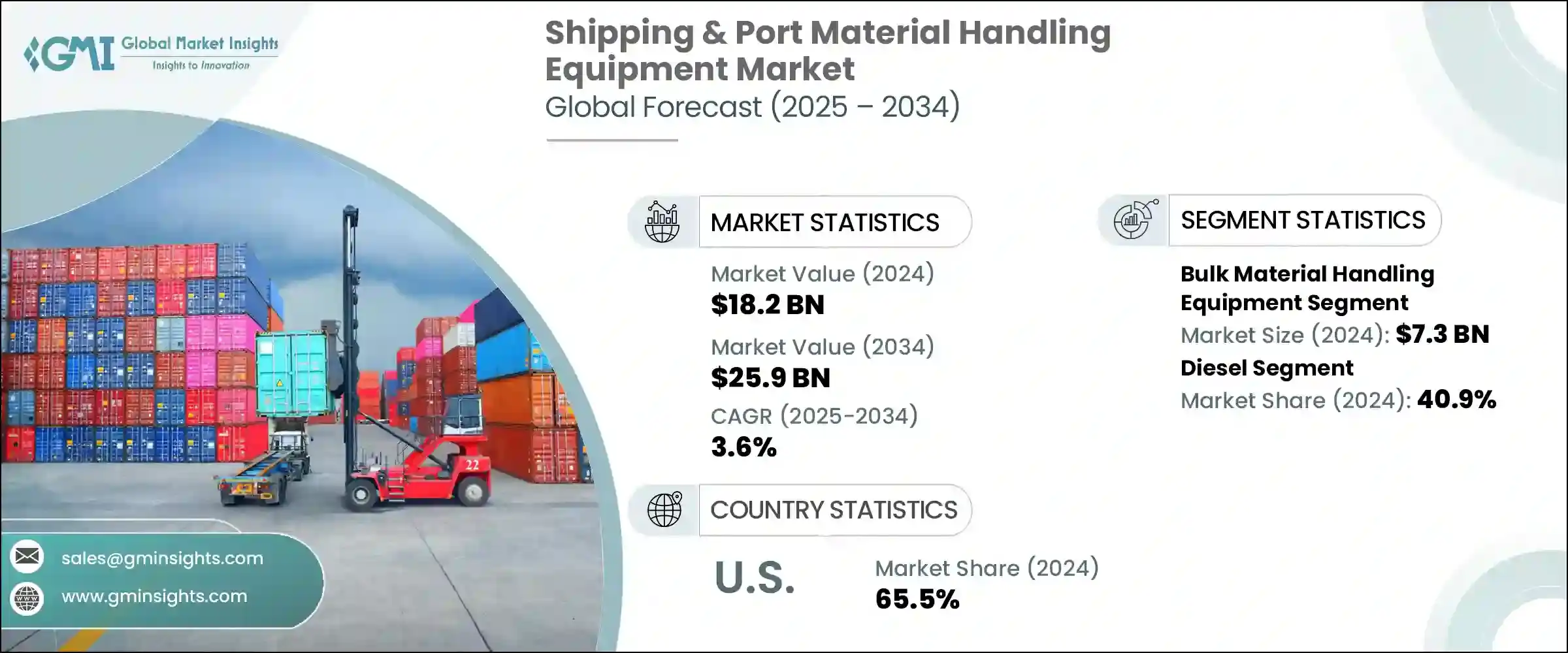
The global shipping & port material handling equipment market size was estimated at USD 18.2 billion in 2024 and is expected to reach USD 18.8 billion in 2025 to USD 25.9 billion by 2034, at a CAGR of 3.6%.
Shipping & Port Material Handling Equipment Market Key Takeaways
Market Size & Growth
- 2024 Market Size: USD 18.2 Billion
- 2034 Forecast Market Size: USD 25.9 Billion
- CAGR (2025–2034): 3.6%
Key Market Drivers
- Growth in global trade.
- Expansion e-commerce sector.
- Port modernization and infrastructure development.
Challenges
- Complexity in technological integration.
- Geopolitical uncertainties and sudden shift in supply-demand patterns.
Opportunity
- Technological innovation and automation integration.
- Emphasis on green port initiatives.
Get Market Insights & Growth Opportunities
- Shipping & port material handling systems are required for handling cargo, facilitating logistics, and ensuring smooth operations within port facilities. The market encompasses a diverse range of equipment that includes cranes, and bulk material handling equipment.
- Shipping & port material handling equipment plays a key role in the efficient operation of ports globally. The transit of materials across and out of ports cannot be regulated without efficient shipping & port machinery, thus leading to shipment delays, congestion and increased costs throughout the supply chain.
- Ports are important infrastructures responsible for trade and economic vitality and depend on a broad range of machinery. Most of the shipping & port equipment is powered by diesel or gasoline, emitting greenhouse gases and contributing to air pollution. Cranes and forklifts help in efficiently loading and unloading cargo from ships, trucks, and trains, enabling on-time delivery and minimizing supply chain delays.
- Cargo handling equipment such as top handlers, side handlers, reach stackers, straddle carriers, gantry cranes, forklifts, terminal tractors, and yard trucks, are crucial to port operations. Loaders, cranes, and forklifts handle bulk cargo, steel, lumber, cement and salt.
- The global shift towards decarbonization and clean technologies is driving the demand for electric/battery or hybrid powered equipment. However, the integration of advanced technology within the shipping and port material handling equipment sector presents a notable challenge.
- Many port handling and logistics companies continue to lack compatibility with modern digital innovations. The requirement of various equipment such as cranes, and associated software to effectively communicate and function is a complex technical challenge. Addressing this complexity is essential for enhancing efficiency and productivity in the industry.
- Asia-Pacific holds the largest share in the shipping & port material handling equipment market. The region accounts for majority of global container traffic and the high number of busiest ports. Asian countries such as China, Japan and South Korea continue to lead in cargo handling performance.
- As per the United Nations Trade and Development, as of 2023, 18 of the 35 major ship-owning companies were in Asia. China is the second-largest ship-owning country after Greece, followed by Japan, Singapore, Hong Kong, the Republic of Korea, and Taiwan Province of China.
To get key market trends
Shipping & Port Material Handling Equipment Market Trends
- According to the International Monetary Fund 2024 World Economic Outlook, global trade is expected to increase by 3.3% in 2025. As a result, the demand for port infrastructure will continue to rise as these countries seek to develop and integrate into global trade. The growing global trade and surge in cargo volume reflects the increased demand for shipping & port material handling equipment.
- Automation and digitalization have emerged as pivotal aspects in modern port operations. To enhance operational efficiency, ports are increasingly investing in remote-controlled cranes, robotic sorting systems, and real-time monitoring technologies. This strategic shift aims to reduce human error, speed up loading and unloading processes, and minimize downtime.
- The concept of smart ports is gradually taking shape, where the integration of the Internet of Things (IoT), artificial intelligence (AI), and 5G connectivity facilitates seamless data exchange and informed decision-making.
Shipping & Port Material Handling Equipment Market Analysis
Learn more about the key segments shaping this market
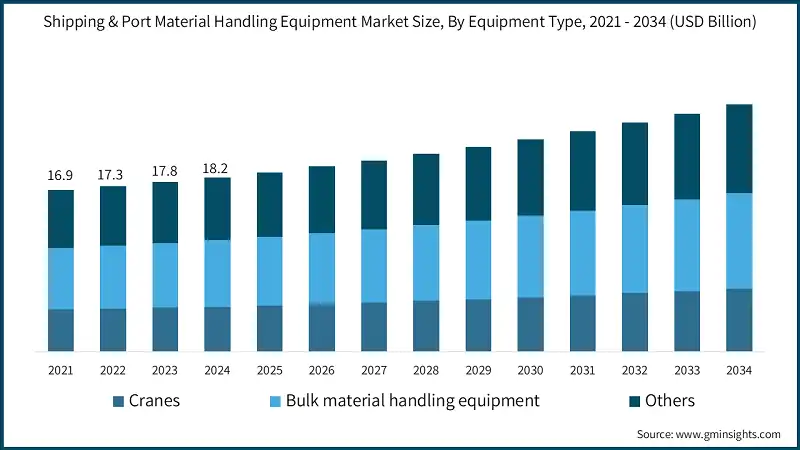
Based on equipment type, the market is segmented into cranes, bulk material handling equipment, and others. In 2024, the bulk material handling equipment segment held the major market share, generating a revenue of USD 7.3 billion in 2024.
- The key bulk material handling equipment consists of ship loaders and unloaders (cargo grab unloaders, continuous ship unloaders, screw unloaders); conveyors (belt, pipe, pneumatic); stackers and reclaimers to inventory stockpiles; hoppers and silos for short-term storage; and cranes (gantry crane, mobile harbor crane) that are designed for bulk materials.
- The bulk material handling equipment market in shipping and ports operations is a significant market, industrial construction and materials handling, driven by global trade, industrialization, and the need for efficient and safe movement of cargo. It includes a wide variety of machinery that enables the transportation, storage, and processing of loose unpackaged materials such as ores, grains, coal, and aggregates.
Learn more about the key segments shaping this market
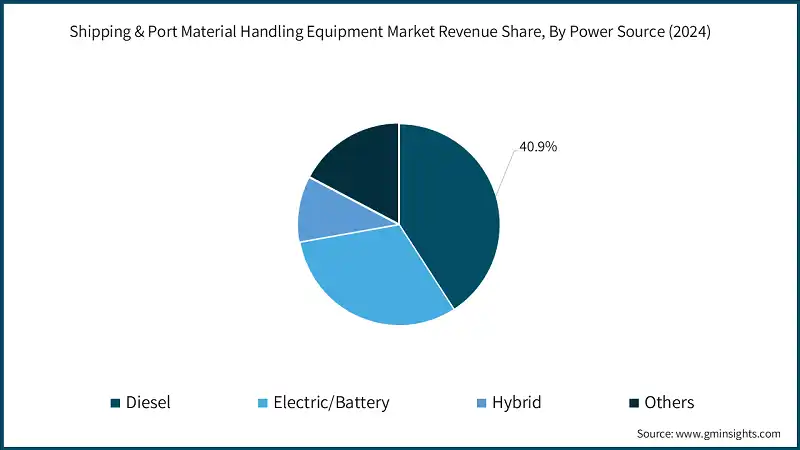
Based on power source, the market is segmented into diesel, electric/battery, hybrid, and others. In 2024, the diesel segment held 40.9% share and generated USD 7.5 billion in the global shipping & port material handling equipment market.
- Ports worldwide have well-developed sophisticated and reliable fueling infrastructure specifically for diesel engines. These engines are celebrated for their exceptional power and torque delivery, particularly at lower revolutions per minute (RPM). These characteristics render diesel engines suitable for demanding and heavy-duty operations, which include the transportation of fully loaded containers, substantial bulk materials, and large machinery.
- The diesel segment holds the largest share in the market, due to the established advantages, and practical considerations, particularly for heavy duty and continuous operations.
Looking for region specific data?
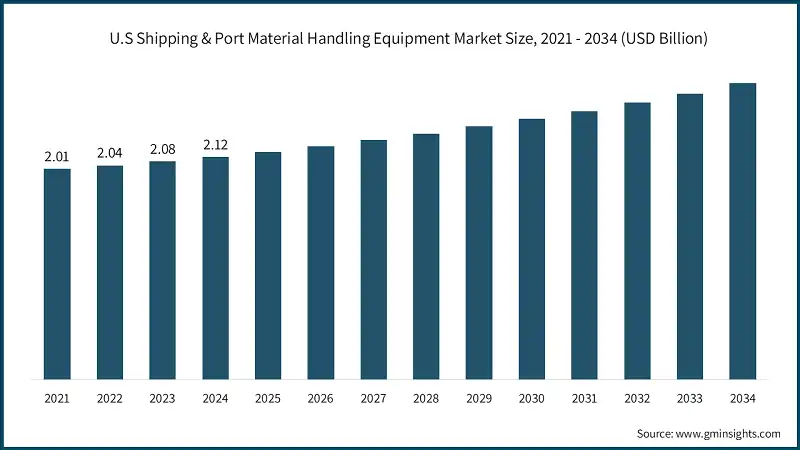
In 2024, the U.S. contributed significantly to the shipping & port material handling equipment market growth in North America, accounting for 65.5% share.
- The market is characterized by significant investment in port infrastructure and expansion of global trade. In 2024, the U.S Department of Transportation’s Maritime Administration planned to invest USD 580 million in the improvement of 31 ports across 15 states.
Asia Pacific held the largest share in the global market, valued at USD 7.9 billion in 2024, driven by rapid economic growth and accelerating global trade volumes. The increased manufacturing output and import-exports across China, India, Japan and Singapore, fuel the market growth.
- As per the Center for Strategic & International Studies, the Indo-Pacific is a major hub of global commerce and will continue to be the main target for China’s maritime control. The 10 busiest container ports in the world are located along the shores of the Pacific and Indian Oceans. The Indian Ocean hosts 80% of Chinese imported oil and 95% of Chinese trade with the Middle East, Africa, and Europe. China also has a strong presence in port construction in the developing world as it operates or has ownership of 91 active port projects across the globe.
The Europe shipping & port material handling equipment market accounted for 27% share in the global market.
- Europe is a key center for maritime trade, featuring several major ports like Rotterdam, Antwerp, Hamburg, and Valencia. The industry in this region concentrates on updating port infrastructure, boosting automation, and adopting sustainable practices to stay competitive in global shipping. The rising use of automation, robotics, and IoT in port operations improves efficiency and safety.
Shipping & Port Material Handling Equipment Market Shares
- The top companies in the market include Konecranes, Liebherr Group, TIL Limited, Toyota Material Handling and Liebherr Group, collectively hold a major share in the market.
- Liebherr Group specializes in crane manufacturing, with a diverse portfolio that includes mobile cranes, crawler cranes, tower cranes, for the ports and shipping applications. Within its maritime crane division, the company manufactures an extensive range of container handling equipment, which encompasses ship-to-shore (STS) cranes, mobile harbor cranes and reach stackers.
- Toyota Material Handling is an established leader in the production of material handling equipment, specializing in forklifts and warehouse solutions. The comprehensive range of warehouse equipment provided by the company includes pallet jacks, reach trucks, order pickers, and stackers.
Shipping & Port Material Handling Equipment Market Companies
Major players operating in the global shipping & port material handling equipment industry are:
- A. R. Equipment
- Anhui Heli
- Cargotec Corporation
- CVS Ferrari
- Hyster Company
- Jost's Engineering Company
- Konecranes
- Liebherr Group
- Lonking Holdings Limited
- Mitsubishi Logisnext Co Ltd
- Nandan GSE
- Sany Group
- Shanghai Zhenhua Heavy Industries
- TIL Limited
- Toyota Material Handling
The key players are proactively involved in strategic endeavors, such as mergers & acquisitions, facility expansions & collaborations, to expand their product portfolios, extend their reach to a broad customer base, and strengthen their market position. The shipping & port material handling equipment market marks the presence of both well-established global market players, specialized material handling equipment manufacturers.
Shipping & Port Material Handling Equipment Market Report Attributes
| Key Takeaway | Details |
|---|---|
| Market Size & Growth | |
| Base Year | 2024 |
| Market Size in 2024 | USD 18.2 Billion |
| Forecast Period 2025 – 2034 CAGR | 3.6% |
| Market Size in 2034 | USD 25.9 Billion |
| Key Market Trends | |
| Drivers | Impact |
| Growth in global trade | Growth in global trade activities drives the demand for shipping & port material handling equipment. |
| Expansion e-commerce sector | Surge in e-commerce operations drive the demand for automated conveyor systems and material handling equipment. |
| Port modernization and infrastructure development | Infrastructure development fosters demand for automatic stacking cranes and integrated logistics systems. |
| Pitfalls & Challenges | Impact |
| Complexity in technological integration | Integration of new technologies with existing systems is capital intensive process and requires expertise. |
| Geopolitical uncertainties and sudden shift in supply-demand patterns | Geopolitical tensions, trade wars and policy shifts hinder the established supply chains and port operations. |
| Opportunities: | Impact |
| Technological innovation and automation integration | The shipping and port material handling equipment market is growing as the ports globally are increasingly using robotic cranes, and driverless container handling systems to improve efficiency and safety. |
| Emphasis on green port initiatives | Emphasis on the green port initiative creates new opportunities for eco-friendly material handling equipment. Ports globally are starting green initiatives, promoting the use of electric-powered cranes that produce zero emissions. |
| Market Leaders (2024) | |
| Market Leader |
|
| Top Players |
Collective market share in 2024 is 18.3% |
| Competitive Edge |
|
| Regional Insights | |
| Largest Market | Asia-Pacific |
| Fastest Growing Market | Asia Pacific |
| Emerging Countries | UAE, Brazil, India |
| Future outlook |
|
What are the growth opportunities in this market?
Shipping & Port Material Handling Equipment Industry News
- In March 2025, the Saguenay Port Authority in Quebec (Canada) ordered a Konecranes Gottwald ESP.6B mobile harbor crane for a new cargo handling system. ESP.6B is equipped with an electric cable reel at the boom top to operate an electric hook rotator and spreaders, along with 125-ton maximum lifting capacity.
- In March 2025, Mormugao Port Authority (India) announced the arrival of Liebherr mobile harbour cranes from Germany, each with a lifting capacity of 125 tons.
- In November 2024, Euroports Group strengthened its bulk handling capacity at North Sea Port (Ghent) with the addition of Generation 6 Konecranes Gottwald ESP.7B mobile harbor crane.
The shipping & port material handling equipment market research report includes in-depth coverage of the industry with estimates & forecast in terms of revenue (USD Billion) and volume (Thousand Units) from 2021 to 2034, for the following segments:
Market, By Equipment Type
- Cranes
- Ship-to-Shore (STS) cranes
- Rubber-Tired Gantry (RTG) cranes
- Mobile harbor cranes
- Others
- Bulk material handling equipment
- Ship loaders & unloaders
- Conveyor belt systems
- Others
- Others
Market, By Power Source
- Diesel
- Electric/Battery
- Hybrid
- Others
Market, By Operation Mode
- Manual
- Semi-automatic
- Fully automatic
Market, By Application
- Container handling
- Bulk handling
- Stacking
- General cargo
- Others
The above information is provided for the following regions and countries:
- North America
- U.S.
- Canada
- Europe
- Germany
- UK
- France
- Spain
- Italy
- Asia Pacific
- China
- Japan
- India
- Australia
- South Korea
- Latin America
- Brazil
- Mexico
- Argentina
- MEA
- South Africa
- Saudi Arabia
- UAE
Frequently Asked Question(FAQ) :
What is the market size of the shipping & port material handling equipment in 2024?
The market size was USD 18.2 billion in 2024, projected to grow at a CAGR of 3.6% through 2034, driven by expanding global trade activities.
What is the projected value of the shipping & port material handling equipment market by 2034?
The global market for shipping & port material handling equipment is expected to reach USD 25.9 billion by 2034, supported by port modernization, infrastructure development, and technological innovations.
How much revenue did the bulk material handling equipment segment generate in 2024?
The bulk material handling equipment segment generated USD 7.3 billion in 2024, holding the largest share by equipment type.
What was the market share of the diesel-powered equipment segment in 2024?
The diesel segment held 40.9% of the market share and generate USD 7.5 billion in 2024.
Which region led the shipping & port material handling equipment market in 2024?
Asia-Pacific led the market with USD 7.9 billion in 2024, attributed to high manufacturing output and increasing global trade volumes.
What is the market share of Europe in the shipping & port material handling equipment?
Europe accounted for 27% of the market share, driven by major ports such as Rotterdam, Antwerp, and Hamburg, along with rising automation and sustainability initiatives.
What are the upcoming trends in the shipping & port material handling equipment market?
Key trends include the adoption of automation, digitalization, IoT, AI, and green port initiatives promoting electric-powered equipment to reduce emissions.
Who are the key players in the shipping & port material handling equipment market?
Major players include Konecranes, Liebherr Group, Toyota Material Handling, Cargotec Corporation, Hyster Company, and Mitsubishi Logisnext Co Ltd.
Shipping & Port Material Handling Equipment Market Scope
Related Reports