Summary
Table of Content

Sheet Face Mask Market
Get a free sample of this report
Form submitted successfully!
Error submitting form. Please try again.
Thank you!
Your inquiry has been received. Our team will reach out to you with the required details via email. To ensure that you don't miss their response, kindly remember to check your spam folder as well!
Request Sectional Data
Thank you!
Your inquiry has been received. Our team will reach out to you with the required details via email. To ensure that you don't miss their response, kindly remember to check your spam folder as well!
Form submitted successfully!
Error submitting form. Please try again.
Sheet Face Mask Market Size
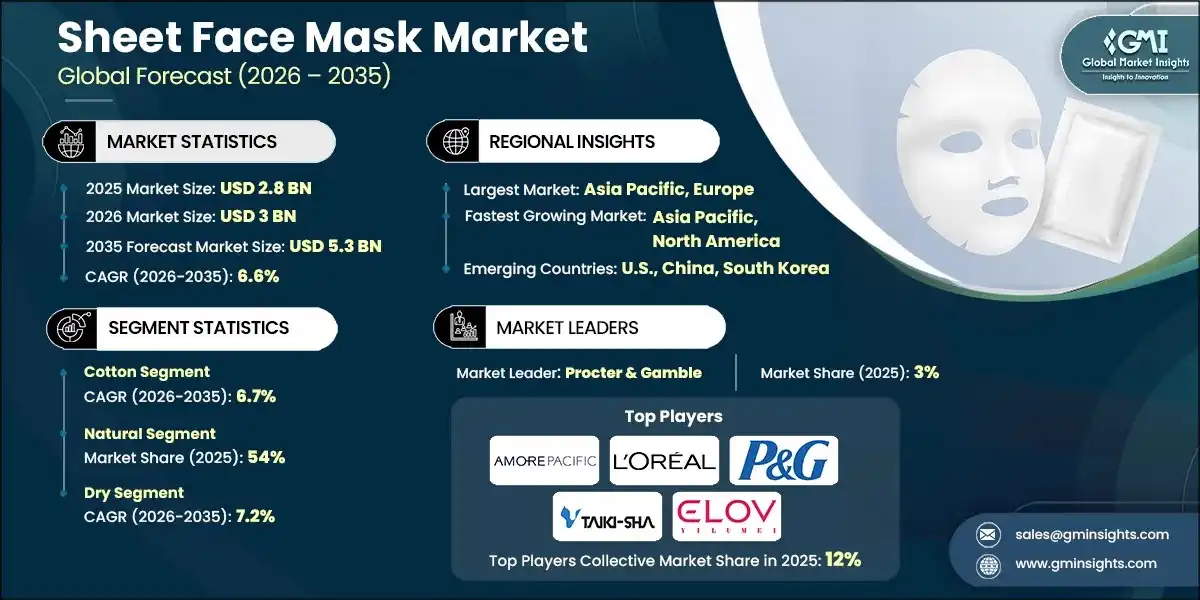
The global sheet face mask market was estimated at USD 2.8 billion in 2025. The market is expected to grow from USD 3 billion in 2026 to USD 5.3 billion in 2035, at a CAGR of 6.6% according to latest report published by Global Market Insights Inc.
Sheet Face Mask Market Key Takeaways
Market Size & Growth
- 2025 Market Size: USD 2.8 Billion
- 2026 Market Size: USD 3 Billion
- 2035 Forecast Market Size: USD 5.3 Billion
- CAGR (2026–2035): 6.6%
Regional Dominance
- Largest Market: Asia Pacific, Europe
- Fastest Growing Region: Asia Pacific, North America
Key Market Drivers
- Rising consumer awareness regarding skincare and personal grooming.
- Increasing demand for convenient and easy-to-use skincare products.
Challenges
- High competition from alternative skincare products, such as creams and serums.
- Concerns over environmental sustainability due to the single-use nature of sheet masks.
Opportunity
- Rising consumer preference for natural and organic products.
- Expansion of E-commerce platforms.
Key Players
- Market Leader: Procter & Gamble led with over 3% market share in 2025.
- Leading Players: Top 5 players in this market include Amorepacific, Loreal, Procter & Gamble, Taiki, ELOV Cosmetics, which collectively held a market share of 12% in 2025.
Get Market Insights & Growth Opportunities
The sheet face mask market has been growing due to consumer behavior, innovation, distribution, and cultural trends. The shift in consumer behavior towards self-care, spa-at-home, and skincare routines has significantly broadened the addressable market for sheet face masks. The convenience, use-and-throw packaging, and immediate satisfaction of sheet face masks highly appeal to the millennial and Gen Z consumer base.
Furthermore, South Korean consumers, who are presently the leading spenders on beauty products on a per-capita basis in the world, with an average expenditure of $493 a year, showing a significant demand for such a line of products.
The increasing worldwide interest in K-beauty has come to be noted as a major contributing factor to the growth of the market, as the export of Korean cosmetics has broken the record of over $10.2 billion in 2024, posting a yearly growth of 20.6%, led by basic skincare items, which include sheet masks, valued at over USD 7.67 billion. Several countries, including the main export nations of the US, which recorded exports of $1.4 billion within the first ten months of 2024, have shown a significant interest in the export of Korean cosmetics.
Product innovation in materials, formulations, and actives has been critical in driving market growth and premiumization. Having migrated from traditional cotton sheet masks to more innovative forms like hydrogel masks and bio-cellulose masks is a key trend, where hydrogel masks are marketed as a premium substitute with better adherence capability, rich texture, and better penetration of active ingredients in the skin.
The affordability factor coupled with quality formulation has democratized luxury ingredients in skin care. Sheet masks thus offer an entry point into this segment.
To get key market trends
Sheet Face Mask Market Trends
- Sheet masks quickly gain popularity now because of the capability to attain the required outcome within a shorter duration of 10-20 mins, application ease, adaptability, ease of portability, among several factors.
- Sheet masks provide several benefits like skin hydrating, balancing, moisturizing, calming, and brightening. This product has its origins in South Korea. Unlike paste face masks, the sheet face masks do not dry out, which is a benefit to the skin.
- The materials commonly used in the production of face mask sheets that would contain nutrients or bioactive compounds would include non-woven fabric, cotton, microfiber, cupra, tencel, pulp, lyocell, hydrogels, or biocellulose. Sheet masks are composed of extremely thin facial sheets that contain a nourishing serum consisting of nutrients like vitamins, minerals, probiotics, cannabidiol (CBD), and so on.
- It has been found that using skin products containing probiotics and prebiotics is helpful in achieving the balanced level of skin microbiota. Probiotics, when used as topical products, are helpful in curing various skin problems such as eczema, acne, dry skin, and even wrinkles, as well as the risk of skin cancer due to UV exposure.
- Studies by L’Oreal research prove that some of the probiotics which are alive include Bifidobacterium, Lactobacillus, and Vitreoscilla. These probiotics help the skin by offering protection to the dermal layer between the toxins and the surface of the skin by forming a barrier with the probiotics present between the skin surface and the
- However, the regions providing a sheet facemask are moving beyond their home grounds in Asian regions and entering into other successful markets. The US has been identified as a rapidly growing country and Korean exported cosmetics to the US exceeded a billion dollars in the year 2024.
- Issues pertaining to the use of single-use materials and the disposal of packaging have pushed the agenda of sustainability from a niche to a strategic priority. Consumers and the government alike are taking a closer look at the environmental concerns associated with the use of single-use sheet masks and, as such, there is a drive to use biodegradable materials.
Sheet Face Mask Market Analysis
Learn more about the key segments shaping this market
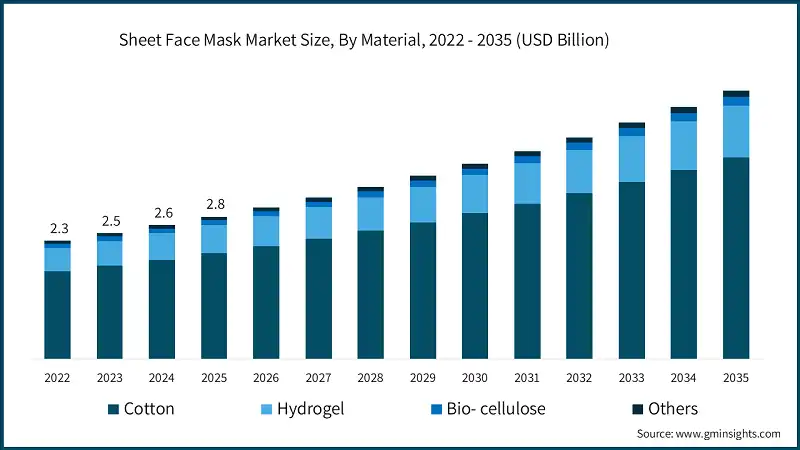
Based on the material, the sheet face mask market is divided into cotton, hydrogel, bio- cellulose and others. In 2025, cotton dominated the market generating revenue of USD 2.1 billion and expected to grow at a CAGR of 6.7% during the forecast period.
- The Cotton segment is continuing its steady growth momentum on the back of market development in emerging geographies, besides sustained market performance in developed geographies. The Cotton segment is aided by an optimized manufacturing cost structure and well-established market suites.
- This is particularly true concerning cotton sheet masks, which are prized for their comfort, breathability, and ability to deliver skin serums. The cotton material’s natural fiber composites will appeal to consumers who look for comfortable, less-intimidating skin care experiences, particularly those sensitive to synthetic materials.
- The growth of the bio-cellulose segment is led by the far superior functionality properties of the substance, justifying the premium pricing. Its attribute of unparalleled conformability, achieved by the use of ultra-fine networks, will facilitate the closest possible contact between the product and facial areas, including challenging areas around the eyes, nose, and mouth, to maximize the delivery of ingredients on the facial surface.
Learn more about the key segments shaping this market
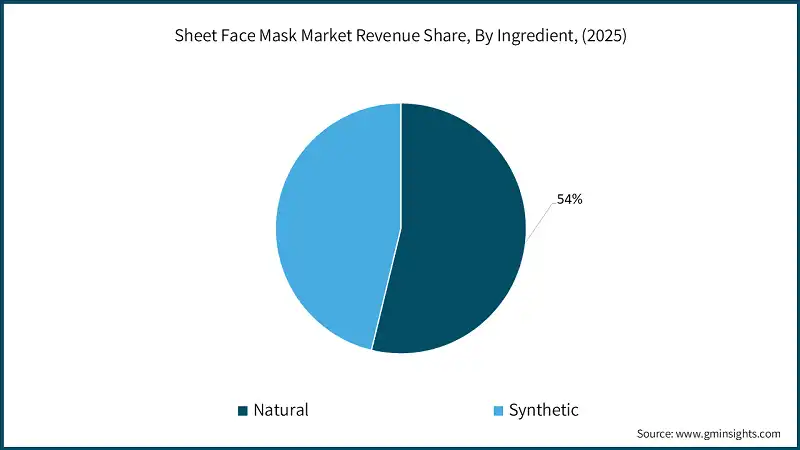
Based on ingredients, the sheet face mask market is segmented into natural and synthetic. In 2025, natural segment dominates the market with 54% market share, and the segment is expected to grow at a CAGR of 6.9% from 2026 to 2035.
- The natural ingredients segment is growing rapidly due to the global "clean beauty" trend, increased skepticism among consumers regarding the use of artificial ingredients, and rising knowledge about the safety of natural ingredients.
- Consumer health awareness and worries related to exposure to various synthetic chemicals such as parabens, sulfates, phthalates, and fragrance are boosting the popularity of alternatives that are recognized as being gentler and safer.
- For instance, regulation in the major markets, such as the EU ban on some synthetic preservatives and skin lightening substances, has driven the movement towards natural substitutes. Social media campaigns promoting the "clean beauty" movement have increased public awareness and social pressure to switch to natural options.
Based on form, the sheet face mask market is segmented into wet and dry. In 2025, the dry segment is expected to grow at a CAGR of 7.2% from 2026 to 2035.
- Dry sheet masks symbolize the progressive and innovative category in the market of sheet facial masks, consisting of a small but ever-expanding niche in relation to diversified advantages and applications.
- Ease of portability and travel friendliness can be seen as the major advantages with the extremely reduced weight and volume that the dry masks have over the liquid-saturated masks.
- The most prevalent packaging in the sheet facials mask category is wet sheet masks. This category comprises masks that are pre-soaked in serum or essence and come in separate packets to preserve product freshness and sterility.
Looking for region specific data?
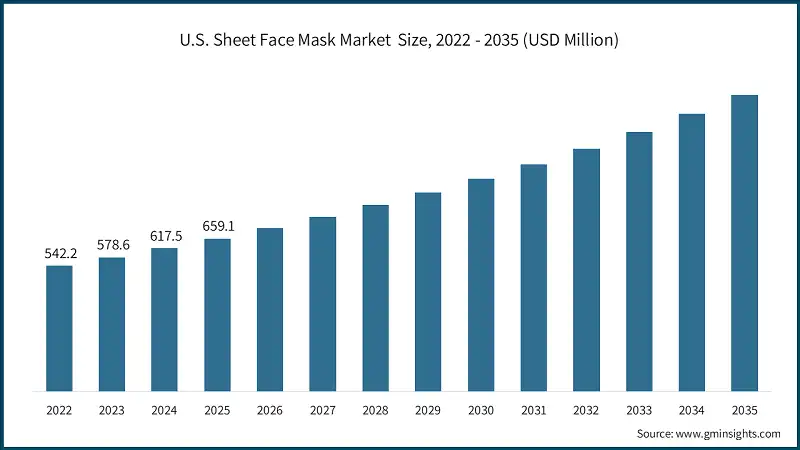
In terms of country, the United States led the sheet face mask market with 80% of the North American market share and estimated USD 659.1 million in revenue during 2025.
- The main drivers for the growth of the market in the US include raising awareness among consumers regarding skincare and the need for convenient skincare solutions.
- The increasing use of social networking websites and influences in the field of beauty has further increased the demand for sheet facial masks. In addition, the presence of diverse products, such as moisturizing, anti-aging, and brightening sheet facial masks, for several types of skin is further propelling the market.
- In addition, the US market is also influenced by advancements in product formulation and packaging design that increase user experience and consumer appeal. However, environmental issues associated with disposable masks and competitiveness from other skincare products may pose a slight threat to growth.
The Europe sheet face mask market was valued at USD 715.9 million in 2025 and is projected to grow at a CAGR of 6.2% between 2026 and 2035.
- The driving factors in the Europe market are rising consumer education regarding skincare and the increase in demand for convenient and effective skincare solutions. The preference for natural ingredients in the Europe region has also boosted the usage of sheet face masks since plant extracts are being increasingly incorporated in them.
- The growing number of online businesses in the European market has ensured the availability of these types of products, leading to the growth of the market. Germany, the UK, and France are currently the leading countries in the market due to their high disposable income as well as a well-developed beauty and personal care industry.
The Asia Pacific sheet face mask market was valued at USD 891.4 million in 2025 and is projected to grow at a CAGR of 7.1% between 2026 and 2035.
- China, Japan, South Korea, and India are among the prominent players in the market due to their high population and rising per capita income. Moreover, K-beauty trends and natural and organic cosmetic products are also boosting the market at a tremendous rate.
- The need for convenient and easy-to-use skincare products has also contributed to its development, with various companies launching masks addressing different issues such as hydration, anti-aging, and lightning.
The Middle East and Africa sheet face mask market was valued at USD 166.3 million in 2025 and is projected to grow at a CAGR of 5.7% between 2026 and 2035.
- This has been made possible by the rising disposable income of consumers, especially in urban settings. Moreover, the role of social trends and social media has also been a key factor in increasing the use of these products in the region.
- Regions like United Arab Emirates, Saudi Arabia, and South Africa are turning out to be important markets owing to their increasing urban population and demands for innovative dermatological products.
Sheet Face Mask Market Share
- The top 5 companies in the market are Amorepacific, Loreal, Procter & Gamble, Taiki and ELOV Cosmetics collectively hold a share of 12% in the market.
- These companies continue to acquire and merge with others, expand facilities, and make various collaborations to increase their product offerings, access customer bases, and secure their market positions.
- Amorepacific is utilizing its R&D strengths to bring innovative sheet facial masks with natural ingredients to market. The company is concentrating on high-end products as well as proper marketing strategies in order to increase its market share in the global facial mask market, in the Asia-Pacific market.
- Procter & Gamble leverages its widespread distribution channels and portfolio of brands to create a competitive advantage in the sheet face mask industry. This company prioritizes innovative products to suit various consumer needs in the market. This factor acts as an advantage to the company.
- Taiki enhances its products with technological developments in the raw materials used for sheet masks, including bio-cellulose and hydrogel. The firm partners with top brands to supply the best masks on the market. Taiki's technical knowledge and innovation enable the firm to capture considerable market share .
Sheet Face Mask Market Companies
Major players operating in the sheet face mask industry are:
- Amorepacific
- CITTA
- ELOV Cosmetics
- HyWeCo
- Lessonia
- Loops Beauty
- Loreal
- Olivanna
- Procter & Gamble
- RainShadow Labs
- Seoul Mamas
- Taiki
- TCI Group
- TY Cosmetic
- Zeralabs
To improve the product and market share key players are constantly investing in technological activities and are also entering into partnerships to provide improved and better solutions for the customers. These investments are benefiting both companies and customers as they help develop and offer solutions as per the changing technological trends and thus the customer requirements.
Amorepacific is a leading South Korean beauty and cosmetics company, renowned for its innovative skincare solutions. The company offers a diverse range of sheet face masks, leveraging advanced formulations and natural ingredients. With a strong global presence, Amorepacific continues to drive growth through research, development, and sustainable practices in the beauty market.
Loops Beauty is a modern skincare brand that emphasizes convenience and efficacy. Known for its biodegradable sheet face masks, the company combines clean ingredients with innovative formulations. Loops Beauty targets a younger demographic, promoting sustainability and self-care through its vibrant branding and high-performance skincare products.
Procter & Gamble (P&G) is a multinational consumer goods corporation with a strong presence in the beauty and personal care market. The company offers a variety of sheet face masks under its well-known brands. P&G focuses on innovation, quality, and consumer-centric solutions to maintain its leadership in the global skincare industry.
Taiki is a global leader in beauty tools and skincare solutions, specializing in sheet face masks and related products. The company emphasizes innovation, quality, and sustainability in its offerings. Taiki collaborates with leading brands worldwide, providing expertise in product development and manufacturing to meet evolving consumer demands.
Sheet Face Mask Market Report Attributes
| Key Takeaway | Details |
|---|---|
| Market Size & Growth | |
| Base Year | 2025 |
| Market Size in 2025 | USD 2.8 Billion |
| Market Size in 2026 | USD 3 Billion |
| Forecast Period 2026-2035 CAGR | 6.6% |
| Market Size in 2035 | USD 5.3 Billion |
| Key Market Trends | |
| Drivers | Impact |
| Rising consumer awareness regarding skincare and personal grooming | This is driving the demand for sheet face masks, contributing to market growth. |
| Increasing demand for convenient and easy-to-use skincare products | The portability and ease of application of sheet masks are boosting their adoption, positively impacting the market. |
| Pitfalls & Challenges | Impact |
| High competition from alternative skincare products, such as creams and serums | This is limiting the market share of sheet face masks, posing a challenge to growth. |
| Concerns over environmental sustainability due to the single-use nature of sheet masks | This is leading to negative consumer perception, potentially hindering market growth. |
| Opportunities: | Impact |
| Rising consumer preference for natural and organic products | Rising consumer preference for natural and organic products |
| Expansion of E-commerce platforms | The proliferation of e-commerce platforms has made sheet face masks more accessible to a global audience. |
| Market Leaders (2025) | |
| Market Leaders |
3% market share |
| Top Players |
|
| Competitive Edge |
|
| Regional Insights | |
| Largest Market | Asia Pacific, Europe |
| Fastest growing market | Asia Pacific, North America |
| Emerging countries | U.S., China, South Korea |
| Future outlook |
|
What are the growth opportunities in this market?
Sheet Face Mask Industry News
- In December 2025, CITTA launch new sheet mask collection designed to help consumers consciously let go of persistent skin concerns and step into 2026 with confidence and a healthy, radiant glow. The new sheet mask collection features four thoughtfully crafted variants, each designed to help users consciously part ways with a specific skin concern.
- In December 2023, Olivanna launched their new biodegradable Instant Hydra-Glow Sheet Mask. Infused with soothing aloe vera, hydrating hyaluronic acid, and protecting antioxidant brown algae, it acts as a second skin to penetrate the ingredients into the tissue thanks to the use of bio cellulose as the mask material. We have used them and they really work. Leaving us looking and feeling great.
- In October 2023, Loreal announced the investment in new sheet face mask manufacturing facilities in China and South Korea. The strategic development aims at expanding presence in Asia where sheet face masks are popular.
The sheet face mask research report includes in-depth coverage of the industry with estimates & forecasts in terms of revenue (USD Billion) and volume (Million Units) from 2022 to 2035, for the following segments:
Market, By Material
- Cotton
- Hydrogel
- Bio- cellulose
- Others (micro-fibers, charcoal etc.)
Market, By Ingredient
- Natural
- Synthetic
Market, By Form
- Wet
- Dry
Market, By Skin Type
- Oily
- Dry
- Sensitive
- All skin types
Market, By Consumer Group
- Men
- Women
Market, By Price
- Low
- Medium
- High
Market, By Distribution Channel
- Online
- E-commerce
- Company websites
- Offline
- Supermarkets/hypermarket
- Specialty retail stores
- Others (independent retailer etc.)
The above information is provided for the following regions and countries:
- North America
- U.S.
- Canada
- Europe
- Germany
- UK
- France
- Spain
- Italy
- Netherlands
- Asia Pacific
- China
- Japan
- India
- Australia
- South Korea
- Latin America
- Brazil
- Mexico
- Argentina
- MEA
- South Africa
- Saudi Arabia
- UAE
Frequently Asked Question(FAQ) :
What was the market size of the sheet face mask market in 2025?
The market size was USD 2.8 billion in 2025, with a CAGR of 6.6% expected through 2035, driven by increasing demand for skincare products offering convenience and quick results.
What is the projected value of the sheet face mask market by 2035?
The market is expected to reach USD 5.3 billion by 2035, fueled by the rising popularity of sheet masks, advancements in materials, and growing consumer awareness of skincare benefits.
What is the projected size of the sheet face mask market in 2026?
The market is expected to reach USD 3 billion in 2026.
How much revenue did the cotton material segment generate?
The cotton material segment generated USD 2.1 billion in 2025 and is projected to grow at a CAGR of 6.7% during the forecast period.
What was the market share of the natural ingredients segment?
The natural ingredients segment held a 54% market share in 2025 and is expected to grow at a CAGR of 6.9% from 2026 to 2035.
Which region leads the sheet face mask market?
The United States led the market in 2025, accounting for 80% of the North American market share with an estimated revenue of USD 659.1 million. The region's dominance is attributed to high consumer spending on skincare and the presence of key market players.
What are the upcoming trends in the sheet face mask market?
Key trends include the increasing use of probiotics and prebiotics in skincare products, advancements in sheet mask materials such as biocellulose and hydrogels, and the growing preference for natural and sustainable ingredients.
Who are the key players in the sheet face mask market?
Key players include Amorepacific, CITTA, ELOV Cosmetics, HyWeCo, Lessonia, Loops Beauty, L'Oréal, Olivanna, Procter & Gamble, RainShadow Labs, Seoul Mamas, and Taiki.
Sheet Face Mask Market Scope
Related Reports