Summary
Table of Content

Shape Memory Polymers Market
Get a free sample of this report
Form submitted successfully!
Error submitting form. Please try again.
Thank you!
Your inquiry has been received. Our team will reach out to you with the required details via email. To ensure that you don't miss their response, kindly remember to check your spam folder as well!
Request Sectional Data
Thank you!
Your inquiry has been received. Our team will reach out to you with the required details via email. To ensure that you don't miss their response, kindly remember to check your spam folder as well!
Form submitted successfully!
Error submitting form. Please try again.
Shape Memory Polymers Market Size
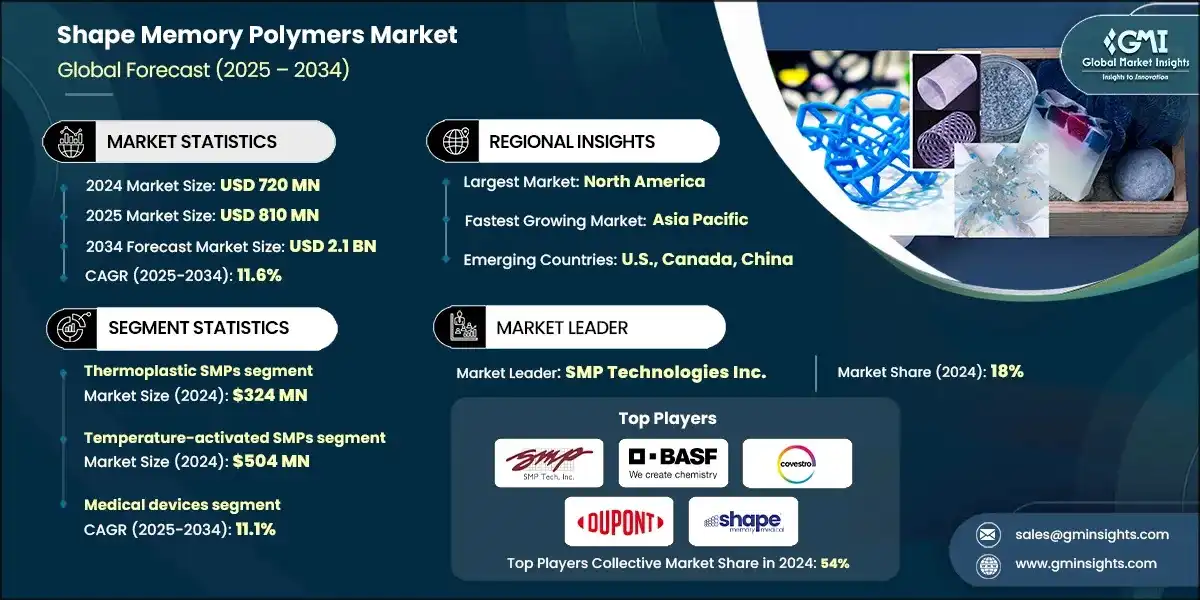
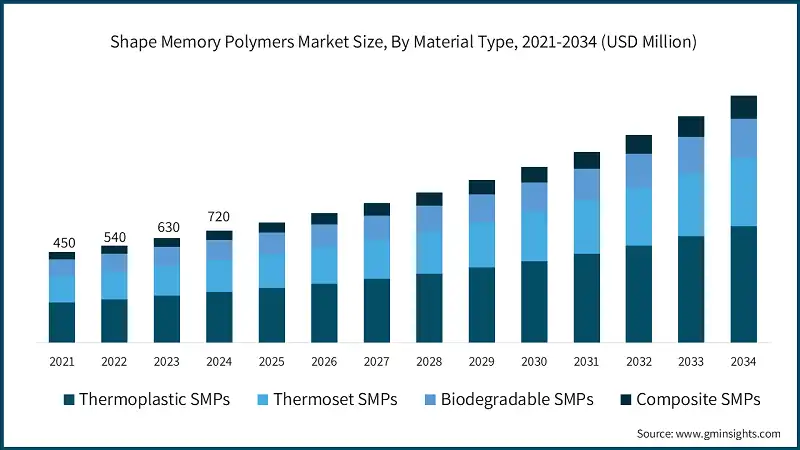
The global shape memory polymers market was estimated at USD 720 million in 2024. It is expected to grow from USD 810 million in 2025 to USD 2.1 billion by 2034, at a CAGR of 11.6%, according to latest report published by Global Market Insights Inc.
To get key market trends
- The increased global demand for smart and adaptive materials has resulted in the rapid growth of the SMP market. The ability of SMPs to reform into their original shape upon exposure to external stimuli has enabled further integration into high-performance industries thirsty for material intelligence and responsiveness. The Department of Energy of the United States mentioned that the emphasis on smart materials is key to realizing energy efficiency and durability in next-generation manufacturing.
- Biomedical innovation has become the strongest growth pillar for the adoption of SMPs. This is epitomized by the U.S. FDA's clearance of the IMPEDE-FX Embolization Plug, a shape memory polymer technology device, allowing for the transition of these materials from laboratory research to clinical applications. SMPs are currently finding their place in self-expanding stents, orthopedic implants, and minimally invasive surgical tools to ensure better safety and recovery for the patients.
- SMPs are becoming an increasingly strong candidate in the aerospace and defense sector due to light weight, immense tolerance to fatigue, and self-healing ability. Research programs of the U.S. DoD and NASA have pointed out the usefulness of SMPs as materials for deployable structures, morphing wings, and reconfigurable components for spacecraft. These programs will increase efficiency in terms of operations while minimizing losses associated with materials and maintenance.
- Sustainability and material innovation also influence the extension of the SMP market. With worldwide determinations to lessen carbon footprints and favor recyclable polymers, SMPs particularly biodegradable and bio-based variants are gaining increased acceptance in green manufacturing. Developments under the European Union's Horizon Europe framework and the U.S. Department of Energy's Advanced Materials Program focus on eco-friendly smart materials.
Shape Memory Polymers Market Report Attributes
| Key Takeaway | Details |
|---|---|
| Market Size & Growth | |
| Base Year | 2024 |
| Market Size in 2024 | USD 720 Million |
| Market Size in 2025 | USD 810 Million |
| Forecast Period 2025 - 2034 CAGR | 11.6% |
| Market Size in 2034 | USD 2.1 Billion |
| Key Market Trends | |
| Drivers | Impact |
| Rising demand for smart materials | The increasing integration of SMPs into smart systems and IoT-enabled products is fueling market expansion across consumer electronics and automation sectors |
| Advancements in biomedical applications | Breakthroughs in SMP-based medical devices such as self-expanding stents and tissue scaffolds—are unlocking new revenue streams in healthcare |
| Growing aerospace and defense sector | SMPs offer lightweight, morphing capabilities ideal for aerospace components and defense-grade actuators. Their adoption supports mission-critical innovation in adaptive structures and stealth technologies. |
| Pitfalls & Challenges | Impact |
| Limited recovery force compared to shape memory alloys | SMPs often fall short in applications requiring high mechanical strength, limiting their competitiveness in load-bearing or high-stress environments. |
| High production costs for specialty formulations | Custom SMP formulations, especially bio-compatible or multi-responsive variants, involve complex synthesis and high material costs |
| Opportunities: | Impact |
| Climate-adaptive building envelope systems | SMPs can revolutionize green architecture by enabling fades that respond to temperature and light, improving energy efficiency. |
| Sustainable & bio-based formulation development | The push for eco-friendly materials is driving R&D in bio-based SMPs, aligning with ESG goals and regulatory incentives. |
| Market Leaders (2024) | |
| Market Leaders |
18% |
| Top Players |
Collective market share in 2024 is 54% |
| Competitive Edge |
|
| Regional Insights | |
| Largest Market | North America |
| Fastest Growing Market | Asia Pacific |
| Emerging Country | U.S., Canada, China |
| Future Outlook |
|
What are the growth opportunities in this market?
Shape Memory Polymers Market Trends
- The industry now tends to shift rapidly into the realm of Multi stimuli-responsive SMPs, which could be triggered by heat, light, pH, or electrical signals, rather than the older, simpler single-trigger polymer types. With this, design flexibility is hardly compromised and use possibilities stretch across biomedical applications, aerospace, and soft robotics. For example, SMP composites responsive to temperature and light have been developed in Japan and the U.S. universities and R&D centers-powered precision-controlled actuation systems.
- 4D printing and SMP technology combined are redefining much of materials engineering and product design itself. High-tech adaptive implants, self-deploying aerospace components, and smart responsive textiles are some of the examples of 4D-printed SMP structures that can change shape over time by external stimuli. Research projects funded by the European Space Agency as well as MIT's materials lab testify to this transformation phenomenon. Integration of faster prototyping, less waste manufacturing, and better customization pushes SMP producers closer into the additive manufacturing ecosystems.
- The next stage of development for SMP is highly dominated by strong emphasis on material development that is sustainable and circular. As a result, governments and organizations such as the European Commission with the Horizon Europe program support research and development activities for bio-based and recyclable SMPs with an aim towards lessening polymer waste. Manufacturers are also investing in research to produce biodegradable SMP composites that yield high performance amidst environmental regulations.
Shape Memory Polymers Market Analysis
Learn more about the key segments shaping this market
Based on material type, the market is segmented into thermoplastic SMPs, thermoset SMPs, biodegradable SMPs, composite SMPs. Thermoplastic SMPs hold a significant share at a valuation of USD 324 million in 2024.
- Thermoset shape memory polymers (SMPs) shows rapid growth as it comprise of major shares in the SMP market due to their excellent mechanical strength, thermal stability and durability in extreme conditions that regulate the retention of shape memory properties. Their successful working in areas such as aerospace and different automotive applications can be attributed to greater dimensional recovery properties, chemical resistance, and durability. Long-term performance success in terms of environmental exposure is a factor that encourages industries to consider thermoset SMPs for structural and load bearing applications.
- There is gradual momentum building in the market among other material types such as thermoplastic, biodegradable and composite SMPs. Sustainability has emerged as one of the key focus areas for growth. Biodegradable and composite Interest in thermoplastic SMPs lies in their recyclability and ease of processing. They are, however, few and limited in strength and temperature tolerance, which has significantly reduced market share. Nevertheless, advances in the formulation of newer reprogrammable and multi-responsive SMPs should gradually diversify the materials landscape over the next few years.
Based on stimulus type, the shape memory polymers market is segmented into temperature-activated SMPs, light-activated SMPs, electrically activated SMPs, magnetically activated SMPs. Temperature-activated SMPs holds a significant share at a valuation of USD 504 million in 2024.
- Temperature-activated shape memory polymers (SMPs) dominate the stimulus segmentation as they can be applied in a variety of ways, are simple in their activation mechanism, and can be integrated with existing manufacturing processes. These are mainly found to be extensively used in automobiles, aerospace, and biomedical applications, where the thermal triggers control shape recovery and self-healing properties.
- Other stimulus types include light, electricity, and magnetic fields. These are relatively new areas that mostly can be applied in niche high-precision applications. They include areas of soft robotics, electronics, and smart textiles. These advanced activation mechanisms have a faster response and can be controlled remotely, though very expensive in production and high complexity of materials. Increasingly encouraging R&D activities on multi-stimuli responsive SMPs and hybrid systems will ensure that the progressive widening of their commercial zone will benefit future advanced applications.
Learn more about the key segments shaping this market
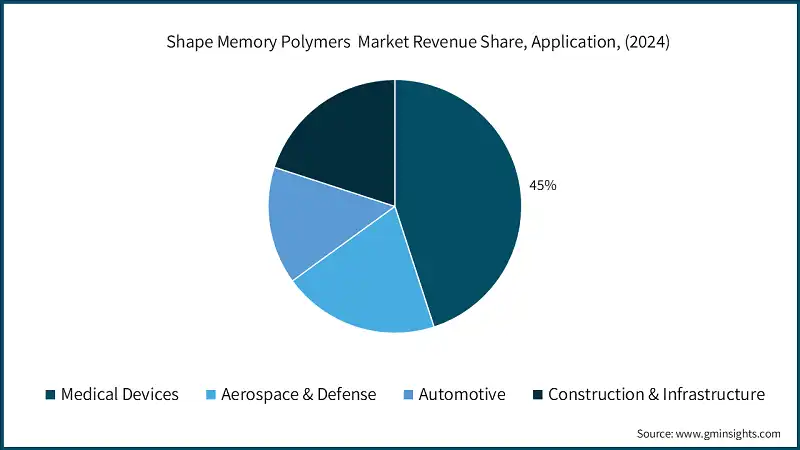
Based on application, the shape memory polymers market is segmented into medical devices, aerospace & defense, automotive, and construction & infrastructure. Medical devices is estimated to grasp a value of USD 362 million in 2025 and is expected to grow at 11.1% of CAGR during the forecast period.
- Medical devices application holds the largest share in the segmentation which are characterized by their high biocompatibility, flexible nature, and responsiveness to physiological conditions. SMPs find extensive application in minimally invasive implants, self-expanding stents, tissue scaffolds, and sutures, where temperature-triggered shape enhances patient outcome and improves procedural efficiency. The growing prevalence of cardiovascular and orthopedic diseases, along with the advancement of bioresorbable and biodegradable SMPs, has further accelerated their acceptance in the healthcare domain.
- Other than for medical applications, aerospace & defense, automobile, and construction sectors are gradually employing SMPs for adaptive structures, lightweight components, and self-healing materials. In aerospace and automotive, the emphasis is to reduce weight and improve energy efficiency; and in construction, focus is on smart joints and vibration-damping systems. Though slowly but surely growing, these sectors will never catch up to the medical applications, which remain the world over-expenditure-generating sector due to precision, performance, and regulatory compliance of SMPs in such applications.
Looking for region specific data?
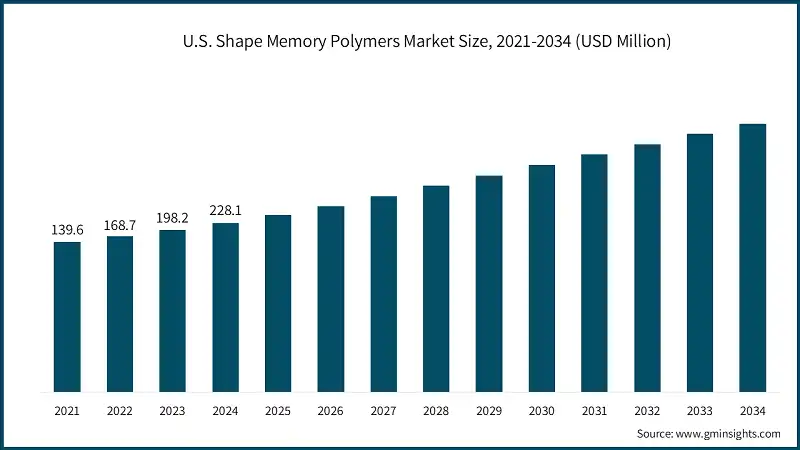
North America shape memory polymers market accounted for USD 288 million in 2024 and is anticipated to show lucrative growth over the forecast period.
- North America accounts for nearly 40% market share in 2024 of the overall shape memory polymer market, with a highly dominant share held by the United States due to a robust industrial base, advanced R&D ecosystem, and major end-user sectors such as aerospace, biomedical, and automotive. This area also includes many polymer manufacturers and medical device innovators which are actively adopting SMPs in self-expanding stents, adaptive structural components, and solid patent support and funding for advanced material development.
- Market growth in the region enjoys additional impetus from increased investments into lightweight materials, modernizing defense programs, and expanding healthcare applications. Government initiatives toward promoting advanced manufacturing and advanced material innovation along with cooperative efforts of research institutions and private companies would cause further commercialization of next-generation SMP solutions.
Europe accounted for USD 180 million in 2024 and is anticipated to show lucrative growth over the forecast period.
- The Europe shape memory polymers market shares nearly 25% market share of the global shape memory polymer market in 2024, aided mostly by strong industrial bases in Germany, the UK, and France. Germany leads this regional adoption owing to its advancements in the automotive manufacturing and material science research that are supported by companies investing in lightweight composites and high-performance polymers. The established aerospace and healthcare sectors in the region also help sustain the demand for SMPs as more applications are introduced in medical implants, adaptive components, and responsive structures.
- Sustainable development has been the prime focus of recent strength on market development in Europe along with the EU ambition of smart and recyclable materials within its Green Deal framework. Innovative initiatives have more recently been bolstered with continuous funding for R&D, through the Horizon Europe programs, thereby speeding up advancement in bio-based SMPs and environmentally friendly ways of production.
Asia Pacific shape memory polymers market accounted for USD 178 million in 2024 and is anticipated to show lucrative growth over the forecast period.
- Asia Pacific accounts for 24.7% market share in the global market in 2024 along with its three major contributors, China, Japan, and South Korea. The growth leader in this region is China as it has been expanding its manufacturing base that has the most extensive capacity for mass polymer production. Increasing investment towards high-performance materials further consolidates China's prominent position. Japan and South Korea will drive regional demand for innovations in electronics, robotics, and medical applications, ensuring the integration of SMPs into precision devices and flexible components.
- The expansion of the Asian market is further supplemented by favorable government initiatives in this line for promoting advancements in the innovation of materials and domestic R&D investments. Collaborations between academic institutions and manufacturing firms are experiencing a surge that is fast-tracking the commercialization of field-tuned, low-cost SMP formulations for the regional industries. The increasing demand for lightweight and tuned materials in consumer electronics and infrastructure applications further positions Asia Pacific as a market in which memory polymers are indeed dynamic and rapidly evolving.
Latin America shape memory polymers market accounted for 6% market share in 2024 and is anticipated to show steady growth over the forecast period.
- Latin America is a subsection of the model memory polymer market, small but steadily increasing, and comprises Brazil and Mexico. This new territorial financial support is mostly based on increasing familiarity with intelligent polymers coupled with generation adoption of advanced materials in manufactured automotive as well as healthcare. The limited domestic manufacturing capabilities led to dependence on importation from North America and Europe; hence, partnership with a global supplier would help in improving technology transfer and regional availability.
Middle East and Africa shape memory polymers market accounted for 4.3% market share in 2024 and is anticipated to show steady growth over the forecast period.
- The Middle East and Africa market is showing stable growth mainly due to increasing diversification in the industrial sectors of the Gulf countries, with some emerging health infrastructure in South Africa and the UAE. Investment from the government in innovations and material research together with the increasing focus on advanced medical and construction applications are the reasons supporting the slow but steady pace of SMP adoption. Further, market development is only medium, given the low penetration of R&D as compared to other regions and the lack of high-tech manufacturing infrastructure.
Shape Memory Polymers Market Share
The shape memory polymer (SMP) market is moderately consolidated, with the leading five players: SMP Technologies Inc., BASF SE, Covestro AG, DuPont de Nemours Inc., and Shape Memory Medical Inc. hold market share of almost 54% market share of the global market in 2024. These firms use powerful R&D competencies, product diversification as well as well-organized global supply chains to sustain leadership in the market. The competitive advantage of them is in terms of vast technical experience, mass-manufacturing plants and developed co-operations both in the field of automotive and aerospace, and biomedical sphere where they can establish industry standards and shape the tendencies of innovation in the SMP area.
To remain competitive, major companies are emphasizing on-going innovation with enhanced material engineering by having high-performance and sustainable SMP formulations that are specific application oriented. Strategic alliances, joint ventures, and technology licensing are also helping companies to increase their presence in the market to enhance product integration across the industries. Also, cost optimization, regulatory compliance, and supply chain resilience are still in the focus of their operational strategy. Companies are also improving customer interaction through the provision of tailor-made solutions and technical services, as well as geographical diversification in the search of new market opportunities and to reduce the fluctuations in demand in regions.
Shape Memory Polymers Market Companies
Major players operating in the shape memory polymers industry are:
- DOW Corning
- BASF SE
- Evonik Industries AG
- DSM N.V.
- Syngenta AG
- 3M Company
- Ashland Global Holdings Inc.
- Coating Place Inc.
- Capsugel (Lonza Group)
- Balchem Corporation
- Aveka Inc.
SMP Technologies is one of the leading companies in the field of SMP and has more than 75 patents. It offers innovative polyurethane and epoxy-based SMPs under the name DIAPLEX®. The company is also known for ultra-fast shape recovery materials that are used in sensors, microfluidics, and medical devices. Strong research and development capabilities and ISO-certified production are well known for biomedical applications.
BASF SE offers all-round expertise for the chemical industry on a global scale matched specifically with the development of SMP. BASF is one of the biggest chemical companies in the world, hence, it has a great deal of resources in terms of R&D investment and large-scale manufacturing. The broad product portfolio of BASF coupled with its established market presence in the automobile, construction, and specific areas of healthcare create multiple avenues for the commercial use of SMP technology.
Covestro AG brings to the new development of SMP polyurethane expertise and global manufacturing capacities. Covestro is an eminent manufacturer of high-performance polymers with its established supply chains and customer relationships ready for SMP commercialization. The company's commitment to sustainable solutions and principles of circular economy goes hand-in-hand with increasing demand for environmentally responsible SMP formulations.
DuPont adds to the SMP market through some advanced material platforms, with its launch and its major activities mostly in aerospace and automotive. Though it doesn't take part in being a major producer of SMPs, its prowess in the field of engineering polymers and composites contributes to the integration of SMPs in morphing structures and self-healing systems.
Shape Memory Medical specializes in the cranial avenue of neurovascular and peripheral vascular, where SMP-based medical devices are placed. The proprietary SMP foams are designed to facilitate embolization and vessel occlusion with controlled expansion and biocompatibility. The company occupies a niche in clinical-grade applications of SMP with FDA-cleared products far less common and undergoing clinical trials.
Shape Memory Polymers Industry News
- In September 2023, Shape Memory Medical announced that the FDA granted the company investigational device exemption (IDE) to initiate a prospective, multicenter, randomized, open-label trial to evaluate the safety and efficacy of the IMPEDE-FX RapidFill Device in improving abdominal aortic aneurysm sac behavior when used with elective endovascular aneurysm repair.
- In July of 2023, Shape Memory Medical announced the initiation of a sublicense agreement with a separate global MedTech market leader to sublicense its shape memory polymer technology for a narrow indication in a therapeutic area that is outside of Shape Memory Medical's cardiovascular, endovascular, and neurovascular focus.
The shape memory polymers market research report includes in-depth coverage of the industry with estimates & forecast in terms of revenue (USD Million) & volume (Kilo Tons) from 2021 to 2034, for the following segments:
Market, By Materials Type
- Thermoplastic SMPs
- Polyurethane-based systems
- Polyester-based systems
- Polycaprolactone systems
- Thermoset SMPs
- Epoxy-based systems
- Cyanate ester systems
- Polyimide systems
- Biodegradable SMPs
- Poly(ε-caprolactone) based
- PLGA-based systems
- PHA-based systems
- Composite SMPs
- Carbon fiber reinforced
- Glass fiber reinforced
- Nanoparticle enhanced
Market, By Stimulus Type
- Temperature-activated SMPs
- Glass transition triggered systems
- Melting temperature triggered systems
- Body temperature activated systems
- Light-activated SMPs
- UV-triggered systems
- Visible light systems
- Nir-activated systems
- Electrically activated SMPs
- Joule heating systems
- Conductive filler integration
- Resistive heating applications
- Magnetically activated SMPs
- Iron oxide nanoparticle systems
- Ferromagnetic filler integration
- Remote activation applications
Market, By Application
- Medical devices
- Vascular embolization devices
- Stents & catheters
- Orthopedic implants
- Surgical instruments
- Drug delivery systems
- Aerospace & defense
- Deployable structures
- Morphing aircraft components
- Space applications
- Self-healing composites
- Actuator systems
- Automotive
- Self-repairable components
- Adaptive aerodynamics
- Interior applications
- Safety systems
- Lightweighting applications
- Construction & infrastructure
- Pipeline renovation systems
- Adaptive building envelopes
- Seismic resilience applications
- Smart infrastructure systems
- Self-healing concrete
- Industrial & manufacturing
- Actuator systems
- Smart components
- Process equipment
- Automation applications
- Textile applications
The above information is provided for the following regions and countries:
- North America
- U.S.
- Canada
- Europe
- UK
- Germany
- France
- Italy
- Spain
- Rest of Europe
- Asia Pacific
- China
- India
- Japan
- South Korea
- Australia
- Rest of Asia Pacific
- Latin America
- Brazil
- Mexico
- Argentina
- Rest of Latin America
- MEA
- UAE
- Saudi Arabia
- South Africa
- Rest of Middle East and Africa
Frequently Asked Question(FAQ) :
Who are the key players in the shape memory polymers market?
Key players include SMP Technologies Inc., BASF SE, Covestro AG, DuPont de Nemours Inc., Shape Memory Medical Inc., Evonik Industries AG, Lubrizol Corporation, and Huntsman International LLC.
What are the upcoming trends in the shape memory polymers industry?
Key trends include the development of multi-stimuli-responsive SMPs, integration with 4D printing technology, and growth of bio-based and recyclable SMP formulations for sustainable manufacturing.
What is the market size of the North America shape memory polymers market in 2024?
The market was valued at USD 288 million in 2024 and is projected to grow significantly through 2034. Growth is driven by increasing use of smart materials in biomedical, aerospace, and automotive applications.
What is the growth outlook for the medical devices application segment from 2025 to 2034?
The medical devices segment is expected to grow at a CAGR of 11.1% through 2034, supported by increasing adoption of SMPs in minimally invasive implants, stents, tissue scaffolds, and surgical instruments.
What was the valuation of the temperature-activated SMPs segment in 2024?
The temperature-activated SMPs segment held a valuation of USD 504 million in 2024, leading the market due to its simple activation mechanism and extensive use across aerospace, biomedical, and automotive applications.
What is the market size of the shape memory polymers industry in 2024?
The market size was USD 720 million in 2024, with a CAGR of 11.6% expected through 2034, driven by the rising adoption of smart and adaptive materials in biomedical, aerospace, and automotive industries.
How much revenue did the thermoplastic SMPs segment generate in 2024?
The thermoplastic SMPs segment generated USD 324 million in 2024, driven by its recyclability, ease of processing, and growing application in automotive and consumer electronics sectors.
What is the projected value of the shape memory polymers market by 2034?
The shape memory polymers market is expected to reach USD 2.1 billion by 2034, fueled by advancements in biocompatible medical devices, 4D printing, and sustainable polymer innovations.
What is the current shape memory polymers market size in 2025?
The market size is projected to reach USD 810 million in 2025.
Shape Memory Polymers Market Scope
Related Reports