Summary
Table of Content

Sex Toys Market
Get a free sample of this report
Form submitted successfully!
Error submitting form. Please try again.
Thank you!
Your inquiry has been received. Our team will reach out to you with the required details via email. To ensure that you don't miss their response, kindly remember to check your spam folder as well!
Request Sectional Data
Thank you!
Your inquiry has been received. Our team will reach out to you with the required details via email. To ensure that you don't miss their response, kindly remember to check your spam folder as well!
Form submitted successfully!
Error submitting form. Please try again.
Sex Toys Market Size
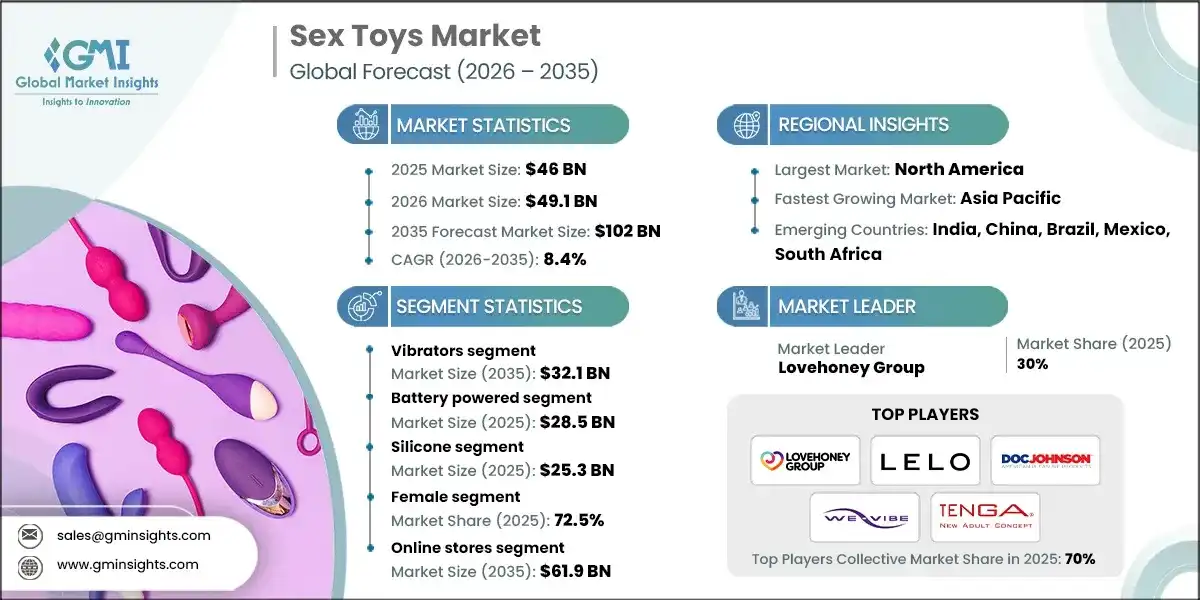
The global sex toys market was valued at USD 46 billion in 2025 and is projected to grow from USD 49.1 billion in 2026 to USD 102 billion by 2035, expanding at a CAGR of 8.4%, according to the latest report published by Global Market Insights Inc. This steady growth is driven by the increasing spending capacity changing perception of customers and increasing awareness about sexual wellbeing.
Sex Toys Market Key Takeaways
Market Size & Growth
- 2025 Market Size: USD 46 Billion
- 2026 Market Size: USD 49.1 Billion
- 2035 Forecast Market Size: USD 102 Billion
- CAGR (2026–2035): 8.4%
Key Market Drivers
- Increasing spending capacity.
- Changing perception of customers.
- Increasing awareness about sexual wellbeing.
- Increasing investment in sex tech companies.
Challenges
- Lack of government regulations for manufacturers.
- Social stigma and cultural taboos.
Opportunity
- Increasing demand for products framed as wellness tools for stress relief, pelvic health, and managing sexual dysfunction.
Key Players
- Market Leader: Lovehoney Group led with over 30% market share in 2025.
- Leading Players: Top 5 players in this market include Lovehoney Group, LELO, Doc Johnson Enterprises, WE-VIBE, Tenga, which collectively held a market share of 70% in 2025.
Get Market Insights & Growth Opportunities
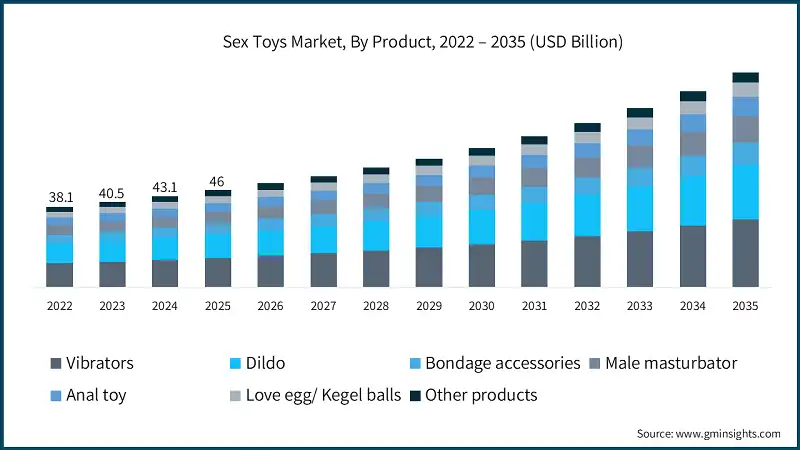
The market increased from USD 40.5 billion in 2023 to USD 43.1 billion in 2024. The increasing income and growing consumer willingness to invest in personal wellness products have significantly contributed to the expansion of the sex toys market. As individuals experience improved financial stability, they tend to allocate more resources toward lifestyle and intimacy-enhancing products. This trend reflects a broader shift in consumer behavior, where sexual wellness is increasingly viewed as an essential component of overall health and self-care rather than a taboo subject.
For instance, in 2022, about four in ten consumers who owned sex toys in the U.S. reported spending 100 U.S. dollars or more on such products within the past 12 months. This statistic underscores the growing tendency of consumers to invest in quality and variety, signaling a strong correlation between rising spending capacity and market performance. Higher expenditure levels also encourage companies to introduce technologically advanced and aesthetically appealing products, further fueling innovation.In conclusion, increasing spending capacity acts as a pivotal driver for the sex toys market by enabling consumers to prioritize sexual wellness and explore diverse product categories. As economic conditions improve and awareness continues to rise, this trend is expected to sustain long-term growth across global markets.
The growing emphasis on sexual health and wellbeing has emerged as a key factor driving the sex toys market. Consumers today are more informed about the importance of sexual wellness as part of overall physical and mental health. This shift is supported by educational campaigns, social media discussions, and the influence of healthcare professionals advocating for open conversations around intimacy. As stigma surrounding sexual wellness reduces, individuals feel more comfortable exploring products that enhance personal satisfaction and relationship quality.
Awareness initiatives have also led to greater acceptance of sexual wellness products across diverse demographics.. This evolving perception has expanded the market beyond niche segments to mainstream retail channels, creating opportunities for brands to innovate and cater to varied preferences. As a result, rising awareness about sexual wellbeing is transforming consumer attitudes and purchasing behavior, stimulating growth in the sex toys market. This trend not only benefits manufacturers and retailers but also contributes to a broader cultural shift toward prioritizing holistic wellness.
Sex toys are the devices that are designed in various shapes and sizes to enhance the stimulation and sexual pleasure among men and women. They are intended to use either as a part of sexual activity or during solo masturbation.
To get key market trends
Sex Toys Market Trends
- Rising investments in sex tech companies have accelerated innovation and expanded the market. Venture capital and private equity firms are increasingly recognizing the profitability and growth potential of sexual wellness, leading to significant funding rounds. This influx of capital enables companies to scale operations, enhance product portfolios, and enter new geographic markets, thereby driving overall industry growth.
- With increased funding, manufacturers are introducing advanced features such as ergonomic designs, body-safe materials, longer-lasting rechargeable batteries, and app-controlled functionalities. These innovations cater to evolving consumer preferences for convenience, personalization, and technology integration, making products more appealing and accessible.
- For instance, Lovense, a leading sex tech company, has leveraged investment to develop app-connected devices that allow remote control and customizable vibration patterns. Similarly, We-Vibe has introduced products with Bluetooth connectivity and enhanced battery life, reflecting how funding supports technological progress and premium product development.
- In conclusion, growing investment in sex tech companies is a critical driver of market expansion. It fosters product innovation and also normalizes sexual wellness as part of mainstream health and lifestyle. As investor confidence continues to rise, the industry is expected to witness growth, increased competition, and broader consumer adoption globally.
Sex Toys Market Analysis
Learn more about the key segments shaping this market
Based on product, the market is divided into vibrators, dildo, bondage accessories, male masturbator, anal toys, love egg/kegel balls, and other products. The vibrators segment is estimated to account for USD 32.1 billion by the end of 2035.
- This growth is highly attributed due to the widespread acceptance of the vibrators among the men and women. This device’s ability to cater both partnered and solo use makes it a preferred and popular choice among these demographics.
- For instance, according to data from WebMD, approximately 49.8% of homosexual men and 43.8% of heterosexual men in the U.S. report using these devices either with partners or alone. Furthermore, around 52.3% of women in the U.S., aged between 18 and 60, have used such a device in the past.
- In addition, continuous technological improvements such as waterproof designs, app-controlled functionalities, and customizable vibration patterns are enhancing individual experiences. These innovations are stimulating consumer interest and driving overall market growth.
Based on type, the sex toys market is segmented into manual devices and battery powered. The battery powered segment was valued at USD 28.5 billion in 2025.
- Battery-powered devices currently hold a significant share of the market due to their advanced features, enhanced user experience, and widespread availability in both traditional and online retail. They provide consistent, high-intensity stimulation that manual options cannot replicate, making them a preferred choice for consumers seeking effective and technologically advanced solutions.
- Additionally, the rise of rechargeable technology and smart features (like app control and AI integration) contribute to their increasing dominance across various demographics.
- While manual products remain available due to their simplicity, powered devices continue to dominate the market due to their technological innovation and the ability to deliver superior user experience.
Based on material, the sex toys market is segmented into Silicone , PVC, leather, plastic, and metal. The silicone segment was valued at USD 25.3 billion in 2025.
- Silicone is the most used material in sex toys manufacturing. It is favored primarily for its medical-grade safety being non-porous and hypoallergenic, silicone does not harbor bacteria and is 100% body-safe. Its unique physical properties such as a velvety-soft texture, high durability, and the ability to retain temperature make it the preferred choice for a wide variety of devices, including high-end vibrators, realistic dildos, and sophisticated masturbation sleeves.
- Additionally, manufacturers are increasingly using medical grade silicone to craft complex, high-end devices, including app-controlled vibrators, ergonomic dildos, and dual-density masturbation sleeves. This material choice directly fuels market growth by boosting consumer confidence, as buyers move away from cheaper, potentially harmful materials, they are more willing to invest in premium silicone products.
- Furthermore, innovations like biodegradable silicone and heated designs are expanding the market by appealing to eco-conscious and tech-savvy demographics.
- As a result, due to body safety and long-lasting quality, silicone products have become the preferred choice among consumers.
Based on end user, the sex toys market is bifurcated into male and female. The female segment accounted for USD 33.3 billion with a revenue share of 72.5% in 2025.
- The segment’s dominance can be attributed to the growing adoption, popularity, and acceptance of these devices among the female demographic. The increasing normalization of female sexuality has significantly contributed to higher usage and acceptance of such products.
- For example, according to Statista data from 2022, approximately 82% of women in the U.S. owned at least one sex toy. Additionally, BBC estimates indicate that nearly 70% of men and women in Italy have used a sex toy at some point in their lives.
- Moreover, the availability of these products in a wide range of designs and sizes tailored to women’s preferences has enhanced their appeal and accessibility within this demographic.
- In addition to personal satisfaction, these devices offer therapeutic and health benefits for women, such as pelvic floor strengthening and stress relief. These factors collectively drive higher adoption rates among female consumers, which is expected to accelerate segment growth in the coming years
Learn more about the key segments shaping this market
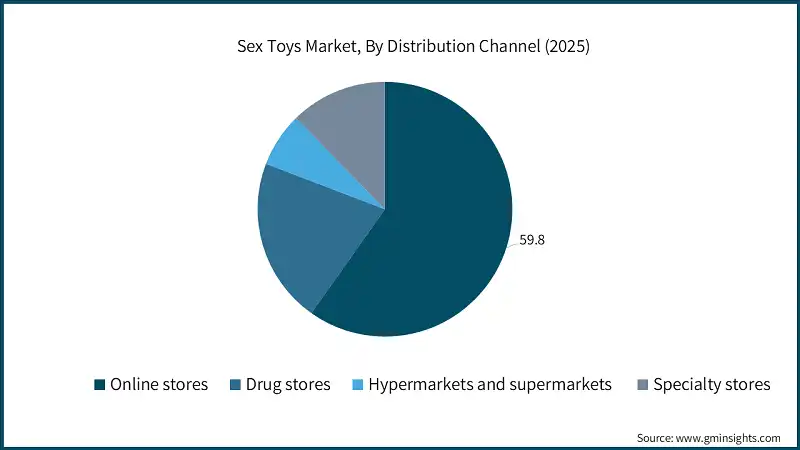
Based on distribution channel, the sex toys market is classified into online stores, drug stores, hypermarkets and supermarkets, and specialty stores. The online stores segment is estimated to account for USD 61.9 billion by the end of 2035.
- Online stores offer superior convenience compared to traditional distribution channels, as they enable customers to browse, compare, and purchase products from the comfort of their homes. This ease of access eliminates the need for physical visits, making online platforms an attractive option for busy consumers.
- Additionally, e-commerce channels provide discreet packaging and secure payment methods, addressing privacy concerns that are often associated with intimate product purchases. These features enhance consumer confidence, positioning online platforms as a preferred choice among individuals seeking confidentiality.
- Moreover, online stores present an extensive product range, including premium and niche brands that may not be available in physical outlets. This comprehensive catalog transforms online platforms into a one-stop destination for diverse product categories, appealing to both male and female demographics.
- Furthermore, most online platforms display customer reviews and ratings for purchased products, enabling buyers to make informed decisions. This transparency fosters trust and accelerates adoption of the online segment, reinforcing its growth in a rapidly evolving market.
Looking for region specific data?
North America Sex Toys Market
The North America region accounted for 35.4% of the market in 2025. The market in North America is experiencing robust expansions.
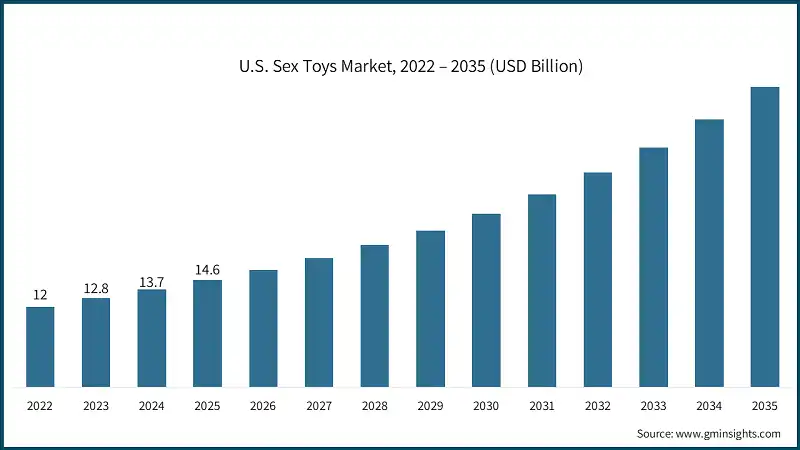
- The U.S. market was valued at USD 12 billion and USD 12.8 billion in 2022 and 2023, respectively. In 2025 the market size increased to USD 14.6 billion from USD 13.7 billion in 2024.
- The U.S. sex toys market is growing rapidly as consumer attitudes toward sexual wellness become more open and progressive. Greater acceptance of intimate products as part of self-care and relationship enhancement has reduced stigma, creating a favorable environment for market expansion. A major contributor to this trend is the rising LGBTQ population, which shows strong engagement with sexual wellness products for self-pleasure and inclusivity.
- For instance, the percentage of U.S. adults identifying as lesbian, gay, bisexual, transgender, or other than heterosexual has reached 7.1%, doubling since 2012. This demographic’s openness toward sexual exploration and preference for diverse, inclusive products is driving demand and shaping innovation in the market.
- In conclusion, changing perceptions combined with increasing LGBTQ adoption are important drivers of the U.S. market. As inclusivity and sexual wellness gain mainstream acceptance, manufacturers and retailers are expected to introduce more personalized, gender-neutral, and technologically advanced products, ensuring sustained growth and broader consumer reach.
Europe Sex Toys Market
Europe market accounted for USD 10.1 billion in 2025 and is anticipated to show lucrative growth over the forecast period.
- The European sex toys market is witnessing a surge in investments from venture capital and private equity firms. This trend reflects growing confidence in the sector’s potential, driven by shifting consumer attitudes toward sexual wellness and technology integration.
- Sex tech companies are leveraging these investments to develop innovative, tech-enabled products such as app-controlled devices and AI-driven personalization. This innovation is helping brands differentiate in a competitive market and cater to evolving consumer preferences for discreet, high-quality experiences.
- Rising funding is also enabling companies to scale operations, expand distribution networks, and strengthen marketing strategies across Europe. As regulatory frameworks become clearer and societal acceptance grows, investors view this segment as a high-growth opportunity within the broader wellness industry.
Germany's sex toys market is projected to experience steady growth between 2026 and 2035.
- Growing public discourse around sexual health and wellness is significantly influencing consumer behavior in Germany. Educational campaigns, social media advocacy, and healthcare initiatives are normalizing conversations about intimacy and self-care, creating a positive environment for sex toy adoption.
- As awareness rises, consumers are increasingly viewing sexual wellbeing as an integral part of overall health. This shift is driving demand for products that enhance personal satisfaction and reduce stigma, positioning sex toys as wellness-oriented rather than taboo items.
- The trend is further supported by collaborations between sexual health experts and lifestyle brands, which emphasize safe and informed usage. This evolving perception is expected to sustain market growth, as consumers prioritize quality, safety, and inclusivity in their purchasing decisions.
Asia Pacific Sex Toys Market
The Asia Pacific region is projected to show a lucrative growth of about 8.5% during the forecast period.
- Consumer attitudes toward sexual wellness in Asia-Pacific are gradually shifting from taboo to acceptance, driven by rising awareness and urbanization. Younger demographics, influenced by global trends and social media, are increasingly open to exploring intimate products as part of self-care.
- This changing perception is reducing stigma and encouraging discreet purchasing behavior. As sexual wellbeing becomes associated with personal health and lifestyle, demand for innovative and quality products is growing across diverse cultural markets in the region.
- Online platforms have emerged as the dominant sales channel, offering privacy, anonymity, and a wide product range. In countries with strong social taboos, e-commerce ensures convenience and confidentiality, making it a critical driver for market penetration and growth.
China sex toys market is poised to witness lucrative growth between 2026 – 2035.
- In China, shifting cultural attitudes toward sexual wellness are gradually reducing stigma, especially among younger, urban consumers. Rising awareness through social media and discreet educational content is fostering acceptance of intimate products as part of personal health.
- For instance, China and India rank among the world’s fastest-growing markets for sex toys, highlighting the region’s evolving consumer behavior. Additionally, China is the global manufacturing hub, producing nearly 70% of all sex toys, which ensures product availability and competitive pricing, further fueling domestic demand.
- This evolving perception is driving demand for high-quality, innovative products while encouraging discreet purchasing behavior. Consumers increasingly view sex toys as lifestyle and wellness accessories rather than taboo items, supporting steady market growth.
Latin America Sex Toys Market
Brazil is experiencing significant growth in the market
- Brazil’s market is evolving rapidly, driven by rising awareness of sexual wellness and increasing acceptance of intimate products. The market features a dynamic competitive landscape where international luxury brands compete with local manufacturers, offering consumers a wide range of options from premium, tech-integrated products to affordable alternatives. This diversity caters to different income groups and preferences, fueling overall market growth.
- Innovation remains a major growth driver, with companies investing in aesthetically appealing designs, advanced technology such as app-controlled features, and body-safe materials like medical-grade silicone.
- Premium products, coupled with increasing disposable income, are creating demand for luxury products. While challenges such as cultural barriers and regulatory compliance persist, opportunities in tech integration and localized branding strategies position Brazil as one of the most promising markets in Latin America for sex toys.
Middle East and Africa Sex Toys Market
- Saudi Arabia market for sexual wellness products is witnessing a gradual shift in consumer perception, driven by increasing awareness of personal health and intimacy. Traditionally, cultural and religious norms have created significant barriers to open discussion and adoption of such products. However, younger demographics, exposure to global trends through social media, and discreet e-commerce platforms are fostering a more accepting attitude toward sexual wellness as part of overall well-being.
- The rise of online retail channels has played a pivotal role in reducing stigma, allowing individuals to explore options without fear of social judgment. This shift is not only expanding the customer base but also encouraging brands to invest in localized strategies that respect cultural sensitivities while promoting wellness benefits.
- As a result, demand for high-quality, body-safe, and technologically advanced products is expected to grow.
Sex Toys Market Share
- Leading companies in the sex toys industry are investing heavily in advanced technologies to enhance user experience and product functionality. Innovations such as app-controlled devices, smart connectivity, and body-safe materials are enabling greater personalization and convenience. These advancements help improve customer satisfaction, increase adoption rates, and drive overall market growth.
- The top five players in market are; Lovehoney Group, LELO, Doc Johnson Enterprises, WE-VIBE, and Tenga collectively accounting for 70% of market share
- Through acquisitions and global expansion strategies, these companies are strengthening their presence in the sexual wellness ecosystem. Collaborations with e-commerce platforms, wellness brands, and influencers are enabling broader access to premium products, particularly in emerging markets. This approach ensures better market penetration and caters to diverse consumer preferences worldwide.
- The emphasis on automation, remote control features, and compliance with safety standards will significantly shape the future of the sex toys market. Companies are focusing on integrating AI-driven personalization and sustainable materials to meet evolving consumer expectations and regulatory requirements.
- Commitment to innovation and strategic alliances will accelerate global adoption, enhance user experience, and drive sustained growth in the sex toys industry. As technology and consumer awareness continue to advance, the market is poised for long-term expansion and increased competitiveness.
Sex Toys Market Companies
Few of the prominent players operating in the sex toys industry include:
- BMS Factory
- DOC Johnson Enterprises
- Fun Factory
- LELO
- Lifestyles Healthcare Pte
- PinkCherry
- Reckitt Benckiser Group
- Tenga
- WE-VIBE
- Lovehoney Group
- Lovesense
- Hot octopuss
- Fantasy4toys
- JOYDIVSION International
- WE-VIBE
- WE-VIBE is a technology-driven brand specializing in app-connected and couple-focused pleasure products. Known for its emphasis on innovation and user experience, WE-VIBE integrates smart features and ergonomic designs to enhance intimacy. The company leverages digital platforms and partnerships to strengthen its global reach, positioning itself as a leader in connected sexual wellness solutions.
- Tenga
- Tenga is a brand celebrated for its minimalist design and discreet approach to male-focused pleasure products. The company prioritizes functionality, hygiene, and affordability, making its products widely accessible. Tenga’s commitment to design innovation and cultural sensitivity has helped it establish a strong presence in both domestic and international markets.
- Lovense
- Lovense is a technology-focused brand specializing in app-controlled and interactive pleasure products. The company is recognized for its strong emphasis on connectivity, offering Bluetooth-enabled devices that integrate with mobile apps and virtual platforms. Lovense invests heavily in innovation, creating solutions for long-distance intimacy and immersive experiences through VR and teledildonics. Its commitment to advanced engineering and user-centric design positions Lovense as a leader in the smart sexual wellness segment, catering to tech-savvy consumers worldwide.
Sex Toys Market Report Attributes
| Key Takeaway | Details |
|---|---|
| Market Size & Growth | |
| Base Year | 2025 |
| Market Size in 2025 | USD 46 Billion |
| Market Size in 2026 | USD 49.1 Billion |
| Forecast Period 2026-2035 CAGR | 8.4% |
| Market Size in 2035 | USD 102 Billion |
| Key Market Trends | |
| Drivers | Impact |
| Increasing spending capacity | Higher disposable income allows consumers to invest in premium products and services related to sexual wellness and technology. |
| Changing perception of customers | Reduces stigma around sexual wellness, making products more socially acceptable. |
| Increasing awareness about sexual wellbeing | Drives innovation in products that emphasize health benefits and personal care. |
| Increasing investment in sex tech companies | Accelerate product development and technological advancements |
| Pitfalls & Challenges | Impact |
| Lack of government regulations for manufacturers | Reduces consumer trust and slows market adoption. |
| Social stigma and cultural taboos | Restricts consumer willingness to purchase openly, pushing reliance on discreet channels. |
| Opportunities: | Impact |
| Increasing demand for products framed as wellness tools for stress relief, pelvic health, and managing sexual dysfunction | Broadens target audience beyond sexual wellness to general health and lifestyle segments. |
| Market Leaders (2025) | |
| Market Leaders |
30% market share |
| Top Players |
|
| Competitive Edge |
|
| Regional Insights | |
| Largest Market | North America |
| Fastest Growing Market | Asia Pacific |
| Emerging Country | India, China, Brazil, Mexico, South Africa |
| Future Outlook |
|
What are the growth opportunities in this market?
Sex Toys Market News:
- In February 2023, the sex toy company LELO launched a new range of products called "Fjord," which included vibrators, a prostate massager, and a couples' ring. The range featured a sleek, minimalist design and was made from sustainable materials. This product development helped the company strengthen its product portfolio.
- In January 2023, the sex toy company We-Vibe launched a new product called "Nova X," an upgraded version of their popular "Nova" rabbit vibrator. The new version featured a stronger motor, longer battery life, and improved connectivity. This strategic product launch helped the company enhance its product portfolio and provided a competitive edge in the market.
The sex toys market research report includes an in-depth coverage of the industry with estimates and forecast in terms of revenue in USD Million and from 2021 – 2034 for the following segments:
Market, By Product
- Vibrators
- Dildo
- Bondage accessories
- Male masturbator
- Anal toy
- Love egg/ Kegel balls
- Other products
Market, By Type
- Battery powered
- Manual
Market, By Material
- Silicone
- PVC
- Leather
- Plastic
- Metal
Market, By Distribution channel
- Specialty stores
- Drug stores
- Hypermarkets and supermarkets
- Online stores
Market, By End Use
- Female
- Male
The above information is provided for the following regions and countries:
- North America
- U.S.
- Canada
- Europe
- Germany
- UK
- France
- Italy
- Spain
- Netherlands
- Asia Pacific
- China
- India
- Japan
- Australia
- South Korea
- Latin America
- Brazil
- Mexico
- Argentina
- Middle East and Africa
- Saudi Arabia
- South Africa
- UAE
Frequently Asked Question(FAQ) :
What was the market size of the sex toys market in 2025?
The market was valued at USD 46 billion in 2025, with a CAGR of 8.4% projected through 2035, driven by increasing consumer spending, changing perceptions, and growing awareness of sexual well-being.
What is the projected value of the global sex toys market by 2035?
The market is expected to reach USD 102 billion by 2035, supported by advancements in product innovation, rising investments in sex tech, and expanding geographic penetration.
What was the valuation of the battery-powered segment in 2025?
The battery-powered segment was valued at USD 28.5 billion in 2025, reflecting its dominance in the market.
What was the valuation of the Silicone segment in 2025?
The Silicone segment was valued at USD 25.3 billion in 2025, driven by its popularity as a body-safe material in sex toy manufacturing.
What is the projected size of the online stores segment by 2035?
The online stores segment is estimated to account for USD 61.9 billion by 2035, driven by increasing e-commerce penetration and consumer preference for discreet purchasing options.
Which region led the global sex toys market in 2025?
North America held a 35.4% market share in 2025, driven by robust market expansion, increasing consumer awareness, and a strong presence of key players.
What are the key trends in the global sex toys industry?
Key trends include rising investments in sex tech companies, the introduction of advanced features such as app-controlled functionalities and ergonomic designs, and the growing demand for personalized and technology-integrated products.
Who are the key players in the global sex toys market?
Prominent players include BMS Factory, DOC Johnson Enterprises, Fun Factory, LELO, Lifestyles Healthcare Pte, PinkCherry, Reckitt Benckiser Group, Tenga, WE-VIBE, and Lovehoney Group.
Sex Toys Market Scope
Related Reports