Summary
Table of Content

Serverless Architecture Market
Get a free sample of this report
Form submitted successfully!
Error submitting form. Please try again.
Thank you!
Your inquiry has been received. Our team will reach out to you with the required details via email. To ensure that you don't miss their response, kindly remember to check your spam folder as well!
Request Sectional Data
Thank you!
Your inquiry has been received. Our team will reach out to you with the required details via email. To ensure that you don't miss their response, kindly remember to check your spam folder as well!
Form submitted successfully!
Error submitting form. Please try again.
Serverless Architecture Market Size
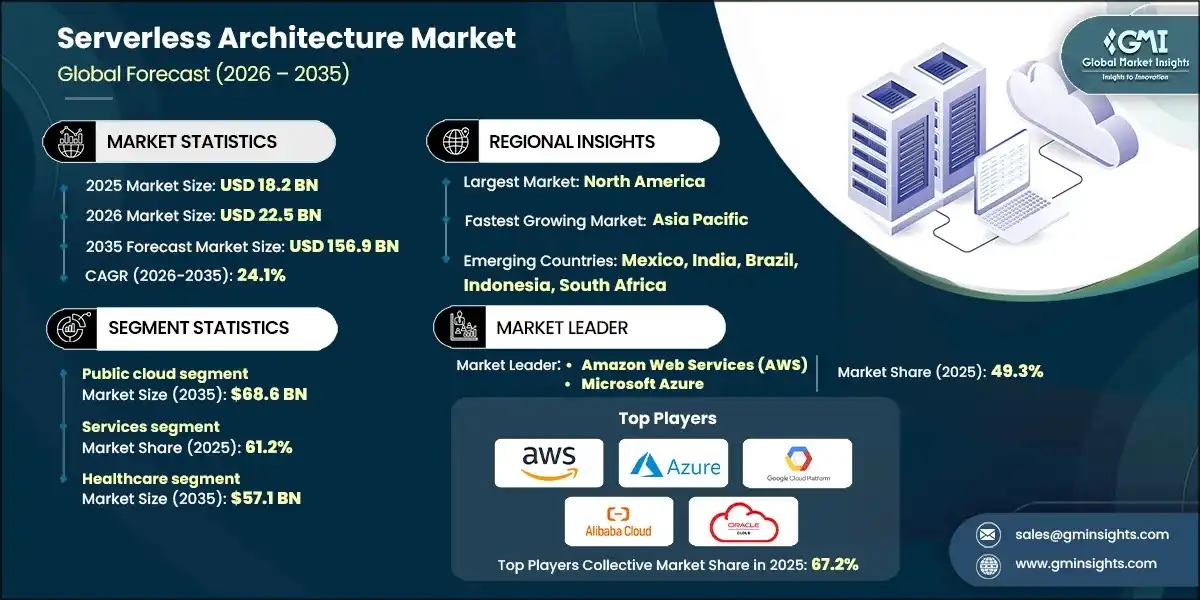
The global serverless architecture market size was valued at USD 18.2 billion in 2025. The market is expected to grow from USD 22.5 billion in 2026 to USD 156.9 billion by 2035, growing at a CAGR of 24.1% during the forecast period.
Serverless Architecture Market Key Takeaways
Market Size & Growth
- 2025 Market Size: USD 18.2 Billion
- 2026 Market Size: USD 22.5 Billion
- 2035 Forecast Market Size: USD 156.9 Billion
- CAGR (2026–2035): 24.1%
Regional Dominance
- Largest Market: North America
- Fastest Growing Region: Asia Pacific
Key Market Drivers
- Integration with AI/ML, real-time data processing and modern workloads.
- Demand from cross-industry adoption across sectors (e.g. finance, healthcare, IoT).
- Cost efficiency and resource-optimization (OPEX over CAPEX).
- Shift toward microservices / cloud-native architectures.
- Rising multi-cloud and hybrid-cloud adoption enabling flexibility.
Challenges
- Limited visibility and control over underlying infrastructure.
- Vendor lock-in risks across major cloud providers.
Opportunity
- Expansion of serverless in edge computing and distributed architectures.
- Growth of function-as-a-service solutions for AI agents and automation.
- Growth of function-as-a-service solutions for AI agents and automation can accelerate intelligent workflow orchestration, enabling enterprises to scale automated decision-making and AI-driven processes..
- Adoption of serverless in DevOps and AIOps pipelines for continuous automation.
Key Players
- Market Leader: Amazon Web Services (AWS) led with over 49.3% market share in 2025.
- Leading Players: Top 5 players in this market include Amazon Web Services (AWS), Microsoft Azure, Google Cloud Platform (GCP), Alibaba Cloud, Oracle Cloud, which collectively held a market share of 67.2% in 2025.
Get Market Insights & Growth Opportunities
- The serverless architecture market is being driven by the increasing integration of AI/ML, instantaneous analytics, and the newly adopted workloads, and the expansion across sectors such as finance, healthcare, and the Internet of Things. The market momentum is also reinforced by the rising focus on efficiency through OPEX-driven models and the switch towards microservices and cloud-native architectures.
- There is a strong demand for serverless technologies as companies look for an infrastructure that can dynamically scale to address compute demand. This is the result of the incorporation of AI/ML, real-time data analytics, and modern workloads. This was further evidenced on January 2024 when Alibaba Cloud launched a serverless version of its PAI-Elastic Algorithm Service, allowing cost-efficient deployment and inference of advanced Generative AI models, thereby broadening the range of operational use cases for serverless environments.
- The shift of organizations towards microservices cloud-native architectures to improve the agility, modularity, and efficiency of operational applications is enhancing and strengthening the market. This structural shift enables faster cycle development, independent service scaling, and enhanced resource utilization, elements that are compatible with serverless execution models. In November 2023, IBM announced the addition of GPUs to the Cloud Code Engine, as well as IBM Serverless Fleets.
- This upgrade adds serverless functionality to support the training of new and complex AI models, performing generative simulations, risk modeling, and other high-performance computing tasks. This demonstrates the seamless intersection of cloud-native design and high-powered computing. The combination of cloud-native design and high-powered computing is driving the adoption of serverless computing across various enterprises, especially those with the requirement for complex automated systems to support advanced and next-generation applications.
- In 2025, North America accounted for 33.5% share of the serverless architecture market. North America is experiencing increasing acceptance of serverless architectures influenced by cloud modernization, the proliferation of AI workloads, and enterprise prioritization of lowering infrastructure management inefficiencies. The regions’ investments in GPU-optimized serverless platforms and increased microservice integration within the financial, retail, and technology industries is also influencing the market development within the area
To get key market trends
Serverless Architecture Market Trends
- There will be a rapid increase in the use of applications powered by artificial intelligence and workloads that require processing real-time data from 2025 - 2035. North America, Europe, and Asia-Pacific have been identified as the key regions where large-scale serverless deployment is anticipated to occur. This is primarily due to their well-developed cloud infrastructure and enterprise digital initiatives.
- The period between 2025 and 2032 is poised to witness considerable growth in serverless orchestration, event-driven computing, and GPU-enabled functions, with the potential to enhance performance and pace of inference, as well as provide improved scalability for applications that are data-rich and sensitive to latency.
- Deeper collaboration among cloud providers, enterprise technology firms, and specialized start-ups will reshape the market between 2026 and 2032, fostering rapid experimentation, unified tooling, and accelerated development of domain-specific serverless solutions.
- The need for standardized observability, governance frameworks, and cross-platform portability will rise from 2026 to 2032, improving performance monitoring, security, and seamless integration of serverless workloads across hybrid and multi-cloud environments.
Serverless Architecture Market Analysis
Learn more about the key segments shaping this market
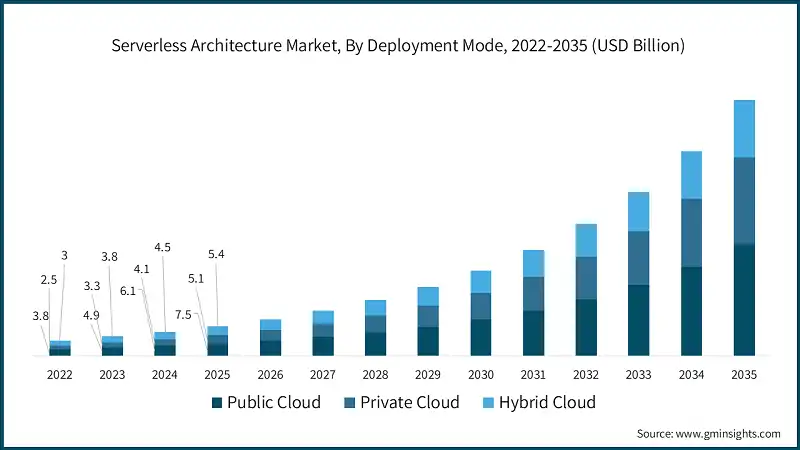
On the basis of deployment type, the serverless architecture market is segmented into public cloud, private cloud, and hybrid cloud.
- The public cloud segment is anticipated to reach USD 68.6 billion by 2035. Flexibility, cost-effectiveness, and ease of integration with AI/ML, real-time analytics, and event-driven applications fuel the increasing adoption of the public cloud for serverless computing.
- Service providers must present scalable and secure serverless platforms, tailored for optimized public cloud environments.
- The private cloud segment is anticipated to grow at a CAGR of 26.3% during the forecast period. Enterprises are increasingly using private clouds for serverless deployments to maintain control, ensure compliance, and protect sensitive data while modernizing workloads.
- Service providers should deliver customizable, secure serverless solutions that integrate with private cloud infrastructures.
Learn more about the key segments shaping this market
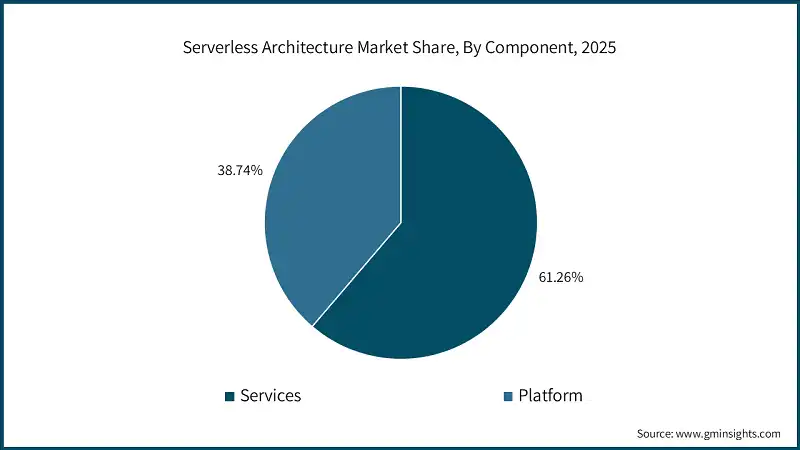
On the basis of component, the serverless architecture market is divided into services and platform.
- The services segment held a market share of 61.2% in 2025. As organizations strive to ease deployment and maximize operational efficiencies, there is a growing demand for managed serverless services, consultative, and integration support.
- To increase adoption, service providers should broaden managed solutions and offer comprehensive serverless support.
- The platform segment is anticipated to grow at a CAGR of 22.2% during 2026 to 2035. Serverless platforms are evolving with GPU support, event-driven orchestration, and hybrid-cloud capabilities to meet complex enterprise workloads.
- Service providers should develop feature-rich, flexible platforms that support AI, analytics, and multi-cloud workloads.
On the basis of industry vertical, the serverless architecture market is segmented into IT and telecom, healthcare, retail and e-commerce, banking, financial services, and insurance (BFSI), government, education, and others.
- The healthcare market is anticipated to reach USD 57.1 billion by 2035. The IT and telecom industries are utilizing serverless technology to decrease infrastructure costs, increase scalability, and enable real-time processing of data and AI applications.
- Service providers should tailor serverless solutions for high-traffic, latency-sensitive, and mission-critical workloads.
- IT and telecom segment is anticipated to grow at a CAGR of 24.5% from 2026 to 2035. Healthcare organizations are utilizing serverless architecture for applications that require extensive data operations, immediate data analysis, and management of patients' data.
- Service providers should provide compliant, secure, and scalable serverless platforms designed for healthcare workloads and regulatory requirements.
Looking for region specific data?
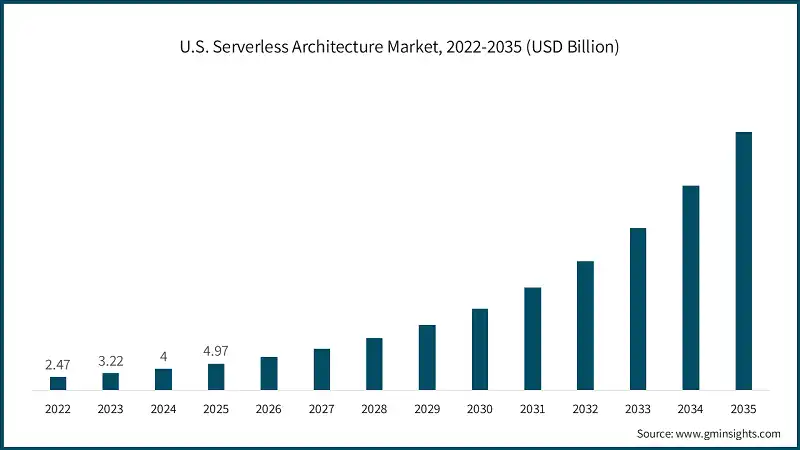
North America held a serverless architecture market share of 33.5% in 2025 and is anticipated to grow at a CAGR of 24.9% till 2035. North America is experiencing serverless technology adoption due to the ongoing digital transformation at enterprises, the integration of AI/ML processes, and the growing need for scalable, affordable solutions in the cloud. The area is experiencing increased investments in microservices, as well as in GPU-accelerated serverless architectures, which enable real-time and high-performance computing.
- U.S. dominated the serverless architecture market, accounting for USD 4.9 billion in the year 2025. The U.S. stands at the forefront in serverless adoption due to its well-established cloud infrastructure, robust enterprise digital strategies, and rising needs in AI-focused and data-intensive applications. Companies are leveraging serverless technologies to improve cost efficiency, streamline deployment, and develop integrations within a hybrid cloud and microservice architecture.
- To meet the sophisticated demands of U.S. businesses, service providers need to create unified, serverless systems that offer advanced observational capabilities and multi-cloud interoperability.
- Canada is anticipated to grow at a 22.2% CAGR during the forecast period, driven by increasing commercial adoption and research initiatives. As businesses move to the cloud, the use of serverless technologies will increase in Canada. Statistics Canada reports that over 90% of small and large businesses in Canada in 2023 cited the use of cloud computing, indicating that businesses in Canada are well prepared to use serverless technologies.
- To encourage more widespread adoption by customers in Canada, service providers should offer affordable, flexible, serverless, and easily integrated solutions.
Europe accounted for 23.5% of the serverless architecture market in 2025. The European Commission quoted that 74% of European Union businesses exhibit minimal digital integration, adopting technologies like the cloud, artificial intelligence, and social media. Meanwhile, small and medium-sized enterprises incorporate these digital technologies at a 73% rate, a significant lag relative to the 98% rate of large corporations. This points to a considerable and unexploited opportunity for adopting serverless technologies, especially for mid to large businesses that require scalable and cost-effective digital technologies.
- Germany is anticipated to grow at a 23.4% CAGR through 2035. In Germany, the adoption of serverless solutions is on the rise, due to the nation’s focus on and the seamless integration of Operational Efficiency, Cloud-Native Modernization, and the AI & Real-Time Analytics of Enterprises. In addition, the strong governmental support for digital transformation and adoption of industry 4.0 continues to drive the market.
- German service providers can capitalize on this opportunity by developing fully compliant and high-performance serverless solutions specifically designed for the diverse computational needs of industries and enterprises.
- UK's serverless architecture market is anticipated to reach USD 4.2 billion by 2035. The United Kingdom market is seeing increasing serverless adoption due to high digital maturity, strong cloud infrastructure, and enterprise demand for scalable, event-driven applications. Employing serverless technologies helps organizations minimize operational costs, streamline deployment speeds, and manage workloads associated with AI.
- Service providers should center their attention on providing secure, flexible, high-quality, enterprise-level serverless services with hybrid and multi-cloud integration.
Asia-Pacific held a share of 31% in the serverless architecture market and is the fastest-growing region with a 25.9% CAGR during the forecast period. Due to the acceleration of the digital transformation, adoption of the cloud, and the proliferation of AI and real-time data workloads across industries the Asia-Pacific serverless market is undergoing rapid growth. Businesses are focusing on innovations in cost-efficient, scalable, and cloud-computing systems.
- The serverless architecture market in China is anticipated to reach USD 12.1 billion by the year 2035. The government policies in China that enhance infrastructure and cloud usage provide a firm base for the country’s serverless market. There is a growing enterprise interest in artificial intelligence and the Internet of Things workloads. Many enterprises have started adopting serverless technologies to lower operational complexities.
- Service providers should offer flexible, high-performance serverless platforms with local compliance and integration for enterprise AI and IoT applications.
- Japan's serverless architecture market was valued at USD 1.3 billion in 2025. In Japan, businesses are implementing serverless solutions to update their legacy systems, improve the speed of application deployment, and facilitate real-time analytics and AI workloads. The digital transformation and the need for greater operational efficiencies in the manufacturing, finance, and technology sectors are the main drivers for this growth in the market.
- Service providers should develop reliable, secure, and low-latency serverless platforms tailored for Japan’s enterprise digital and industrial requirements.
- India's serverless architecture market is anticipated to grow at a CAGR of over 29.2% during the forecast period. The increasing interest and implementation of serverless architecture is paving the way for infrastructure-light AI innovations. In October 2023, Yotta Data Services launched Shakti Studio, an enterprise-level serverless AI cloud platform that aims to remove infrastructure barriers for businesses, startups, and developers to facilitate their model-to-market journeys.
- Service providers should focus on creating cost-efficient, scalable serverless platforms that enable AI innovation and rapid deployment for enterprises and startups in India.
Latin America held 4.2% of the serverless architecture market share in 2025 and is anticipated to grow at a 17.3% CAGR during the forecast period. Latin America has witnessed growing serverless architecture adoption as organizations undergo digital transformations and cloud-native architectural shifts aiming for operational agility and cost savings.
In 2025, the Middle East and Africa held a share of 7.7% and is anticipated to grow at a 13.4% CAGR during the forecast period. In the MEA region, the convergence of public sector digitalization efforts, acceleration of cloud services, and the rise of enterprise AI and analytics is driving the development of the MEA sector. Companies use serverless architectures to improve scalability, minimize infrastructure costs, and accelerate innovation.
- Saudi Arabia accounted for an 28.9% market share in 2025. Serverless adoption is on the rise in Saudi Arabia driven by Vision 2030 initiatives, massive cloud investments, and a focus on AI, IoT, and real-time analytics. Organizations are improving operational efficiency and accelerating application deployment.
- Service providers should provide scalable, secure serverless solutions aligned with national digital transformation strategies and enterprise AI requirements.
- The South Africa market is anticipated to grow at a CAGR of 15.3% during the forecast period. In South Africa, adoption of serverless technology is becoming prevalent as businesses significantly require economical cloud services along with improved flexibility for digital applications, especially in the Financial, Telecom, and Tech industry. The ability to process data in real time and the use of cloud-based technology for operational activities are the primary factors responsible for growth.
- Service providers should develop localized, efficient serverless platforms to support enterprise cloud modernization and real-time application requirements.
- The UAE accounted for a share of 23.4% in the market in 2025. The UAE market is expanding quickly because of the government’s backing of cloud computing infrastructure, digitally transforming processes, and businesses’ demands for scalable, AI-driven, serverless applications. Initiatives involving smart cities and the sophisticated use of data continue to drive the adoption.
- Service providers should deliver high-performance, compliant, and flexible serverless platforms to enable UAE enterprises to scale AI and cloud-native workloads effectively.
Serverless Architecture Market Share
The key players in the serverless architecture industry are Amazon Web Services (AWS), Microsoft Azure, Google Cloud Platform (GCP), Alibaba Cloud, and Oracle Cloud. Collectively, these companies held more than 67% of the market in 2025.
- Amazon Web Services (AWS) led the serverless architecture market with a 29.0% share in 2025. The company provides a diverse range of serverless computing facilities like AWS Lambda, API Gateway, and Fargate, helping businesses construct scalable applications with lowered infrastructure supervision. AWS’s has strong presence globally, possesses enhanced developer community and ongoing advancement in cloud services which helps to secure a top position in the market.
- Microsoft Azure held a 20.3% market share in 2025. The company offers Azure Functions, Logic Apps, and Event Grid as serverless applications capabilities for enterprise and public sector clients. Azure’s integrated offering of Microsoft programs, hybrid cloud functionality, and solid enterprise acceptance fortifies its position within the serverless architecture industry.
- Google Cloud Platform (GCP) captured 11.8% of the market in 2025. The company provides Cloud Functions, Cloud Run, and Eventarc to help developers to rapidly create event-driven applications. Growing capabilities in AI/ML integration, data analytics, and multi-cloud flexibility enhance GCP's influence within the serverless ecosystem.
- Alibaba Cloud held a 3.4% market share in 2025. The company offers Function Compute, EventBridge, and Serverless Kubernetes Services in relation to cloud-native applications in the Asia Pacific region. Alibaba Cloud’s robust presence in the region along with a dedication to digital transformation as well as strategic collaborations with businesses, strengthen its market position.
- Oracle Cloud accounted for 2.7% of the market in 2025. The company provides services for cloud computing in the form of event-driven, scalable, Oracle Functions, API Gateway, and Autonomous Cloud system. Oracle Cloud's infrastructure capabilities in integrating and deploying databases, as well as compatible enterprise software, make it one of the leading providers in the seamless serverless architecture sector.
Serverless Architecture Market Companies
Major players operating in the serverless architecture industry are:
- Amazon Web Services (AWS)
- Microsoft Azure
- Google Cloud Platform (GCP)
- IBM Cloud
- Oracle Cloud
- Alibaba Cloud
- Red Hat (IBM)
- Salesforce
- Fujitsu
- Amazon Web Services (AWS), Microsoft Azure, Google Cloud Platform (GCP), Alibaba Cloud, and Oracle Cloud are considered leaders in the serverless architecture market. Their leading position is supported by comprehensive serverless offerings, global infrastructure, strong developer ecosystems, continuous innovation in cloud services, and strategic partnerships with enterprises and public sector clients.
- IBM Cloud, Red Hat (IBM), Salesforce, Fujitsu, TIBCO Software, SAP, and VMware are categorized as challengers. By offering specialized platform services, integrated enterprise solutions, hybrid cloud capabilities, and high enterprise adoption across multiple sectors, these companies compete and enhance their position in the serverless market.
- DigitalOcean, Akamai Technologies, Netlify, Cloudflare, Couchbase, Postman, and Tencent Cloud are categorized as followers. Strengths of these companies include their serverless solutions with cost efficiency, their focus on niche applications, and their tailored offerings for SMEs, developers, and particular industry verticals. Although their innovations are more limited than the market leaders, they are able to focus on and effectively meet the requirements for certain use cases.
- Deloitte and Hewlett Packard Enterprise (HPE) are acknowledged as niche players in the market. These firms focus on customized serverless consulting, integration services, and specialized deployment solutions for specific enterprise requirements, creating unique market differentiation through tailored business implementations.
Serverless Architecture Market Report Attributes
| Key Takeaway | Details |
|---|---|
| Market Size & Growth | |
| Base Year | 2025 |
| Market Size in 2025 | USD 18.2 Billion |
| Market Size in 2026 | USD 22.5 Billion |
| Forecast Period 2026-2035 CAGR | 24.1% |
| Market Size in 2035 | USD 156.9 Billion |
| Key Market Trends | |
| Drivers | Impact |
| Integration with AI/ML, real-time data processing and modern workloads | Integration with AI/ML and real-time workloads is expected to drive nearly 25% growth as enterprises shift toward high-performance, event-driven architectures. |
| Demand from cross-industry adoption across sectors (e.g. finance, healthcare, IoT) | Cross-industry adoption across finance, healthcare, and IoT could contribute around 22% market expansion through broader operational use cases. |
| Cost efficiency and resource-optimization (OPEX over CAPEX) | Cost efficiency and OPEX-driven optimization are likely to support approximately 20% growth by reducing infrastructure and scaling expenses. |
| Shift toward microservices / cloud-native architectures | The transition to microservices and cloud-native architectures is projected to add nearly 24% growth as enterprises modernize application ecosystems. |
| Rising multi-cloud and hybrid-cloud adoption enabling flexibility | Rising multi-cloud and hybrid-cloud adoption may drive about 18% growth by enabling flexible, portable, and distributed serverless deployments. |
| Pitfalls & Challenges | Impact |
| Limited visibility and control over underlying infrastructure | Limited visibility and control over underlying infrastructure can reduce operational transparency, making it difficult for enterprises to optimize performance and troubleshoot issues in complex environments. |
| Vendor lock-in risks across major cloud providers | Vendor lock-in risks across major cloud providers can restrict architectural flexibility, limiting organizations’ ability to migrate workloads or diversify their cloud strategies. |
| Opportunities: | Impact |
| Expansion of serverless in edge computing and distributed architectures | Expansion of serverless in edge computing and distributed architectures can enable faster processing, reduced latency, and improved support for real-time and location-dependent applications. |
| Growth of function-as-a-service solutions for AI agents and automation | Growth of function-as-a-service solutions for AI agents and automation can accelerate intelligent workflow orchestration, enabling enterprises to scale automated decision-making and AI-driven processes. |
| Growth of function-as-a-service solutions for AI agents and automation can accelerate intelligent workflow orchestration, enabling enterprises to scale automated decision-making and AI-driven processes. | Rising demand for low-code and no-code platforms integrating serverless backends can broaden adoption by empowering non-technical teams to build applications with minimal infrastructure management. |
| Adoption of serverless in DevOps and AIOps pipelines for continuous automation | Adoption of serverless in DevOps and AIOps pipelines can streamline automation, reduce deployment cycles, and enhance continuous integration and delivery across distributed systems. |
| Market Leaders (2025) | |
| Market Leaders |
Top 2 players held 49.3% market share |
| Top Players |
|
| Competitive Edge |
|
| Regional Insights | |
| Largest Market | North America |
| Fastest growing market | Asia Pacific |
| Emerging countries | Mexico, India, Brazil, Indonesia, South Africa |
| Future outlook |
|
What are the growth opportunities in this market?
Serverless Architecture Industry News
- In May 2025, Rafay Systems, a pioneer in cloud-native and AI infrastructure orchestration, announced that its Serverless Inference offering is available for general use. This use is tokened and provides NVIDIA Cloud Partners (NCPs) and GPU Cloud Providers with an effortless and highly profitable AI service that runs open-source and privately-trained large language models (LLMs) without the need to manage underlying infrastructure.
- In November 2025, Amazon Web Services launched a new capability called AWS Lambda Managed Instances, merging the simplicity of serverless computing with the flexibility and performance provided by EC2 instances.
The serverless architecture market research report includes in-depth coverage of the industry with estimates & forecasts in terms of revenue (USD Million) from 2022 to 2035, for the following segments:
Market, By Service Type
- Function as a service (FaaS)
- Backend as a service (BaaS)
Market, By Deployment Mode
- Public cloud
- Private cloud
- Hybrid cloud
Market, By Organization Size
- Small and medium enterprises (SME)
- Large enterprises
Market, By Component
- Services
- Professional Services
- Consulting Services
- Training and Education
- Integration and Testing Services
- Support and Maintenance
- Managed Services
- Professional Services
- Platform
Market, By Industry Vertical
- IT and Telecom
- Healthcare
- Retail and E-commerce
- Banking, Financial Services, and Insurance (BFSI)
- Government
- Education
- Others
The above information is provided for the following regions and countries:
- North America
- U.S.
- Canada
- Europe
- Germany
- UK
- France
- Spain
- Italy
- Netherlands
- Asia Pacific
- China
- India
- Japan
- Australia
- South Korea
- Latin America
- Brazil
- Mexico
- Argentina
- Middle East and Africa
- Saudi Arabia
- South Africa
- UAE
Frequently Asked Question(FAQ) :
What was the market size of the serverless architecture in 2025?
The market size was USD 18.2 billion in 2025, with a CAGR of 24.1% expected through 2035. The growth is driven by the integration of AI/ML, real-time analytics, and the adoption of cloud-native architectures.
What is the projected value of the serverless architecture market by 2035?
The market is poised to reach USD 156.9 billion by 2035, fueled by advancements in microservices, event-driven computing, and the adoption of OPEX-driven models.
What is the expected size of the serverless architecture industry in 2026?
The market size is projected to reach USD 22.5 billion in 2026.
How much revenue did the services segment generate in 2025?
The services segment accounted for 61.2% of the market share in 2025, led by the demand for managed services, consultative support, and integration solutions.
What was the valuation of the public cloud segment in 2025?
The public cloud segment was valued at USD 68.6 billion in 2025, propelled by its flexibility, cost-effectiveness, and compatibility with AI/ML and real-time analytics.
Which region leads the serverless architecture sector?
North America held a market share of 33.5% in 2025 and is set to expand at a CAGR of 24.9% up to 2035.
What are the upcoming trends in the serverless architecture market?
Trends include AI-powered applications, GPU-enabled functions, standardized observability frameworks, cross-platform portability, and deeper collaboration among cloud providers and enterprises.
Who are the key players in the serverless architecture industry?
Key players include Amazon Web Services (AWS), Microsoft Azure, Google Cloud Platform (GCP), IBM Cloud, Oracle Cloud, Alibaba Cloud, Red Hat (IBM), Salesforce, and Fujitsu.
Serverless Architecture Market Scope
Related Reports