Summary
Table of Content

Self-repairing Polymers Market
Get a free sample of this report
Form submitted successfully!
Error submitting form. Please try again.
Thank you!
Your inquiry has been received. Our team will reach out to you with the required details via email. To ensure that you don't miss their response, kindly remember to check your spam folder as well!
Request Sectional Data
Thank you!
Your inquiry has been received. Our team will reach out to you with the required details via email. To ensure that you don't miss their response, kindly remember to check your spam folder as well!
Form submitted successfully!
Error submitting form. Please try again.
Self-repairing Polymers Market Size
- The self‑repairing polymers market is evolving as material science shifts toward durability, lifecycle efficiency, and performance retention. The polymers exist to recover their mechanical and chemical and functional abilities after sustaining damage, which results in fewer material failures and maintenance requirements. People research these materials because they want to study intrinsic systems which depend on reversible chemical bonds and extrinsic systems which utilize embedded healing agents. Ongoing innovation through polymer chemistry and nanotechnology and bio‑inspired material design enables wider application of self-repairing polymers in challenging environments.
- Market growth is shaped by increasing use in high‑value applications where material failure carries economic or safety implications. Self-repairing polymers enable extended product life through their ability to maintain automotive parts and electronics protective coatings and construction materials. Aerospace and energy storage and medical devices now use these materials to create more reliable products which endure extreme temperature shifts and repeated mechanical stress. Research activity continues to center on developing better healing methods which can heal materials faster and more consistently without creating structural damage.
- The current growth trend results from both technological advancement and increased public understanding of sustainable material selection. The circular economy goals of resource efficiency and waste reduction through product longevity show how self‑repairing polymers enable waste reduction and resource efficiency. Manufacturing scalability improvements together with decreasing cost barriers will drive greater commercial adoption across industrial and consumer applications. The market outlook remains closely tied to advances in smart materials and adaptive systems and multifunctional polymer design.
The global self-repairing polymers market was valued at USD 3.2 billion in 2025. It is projected to grow from USD 3.9 billion in 2026 to USD 26.9 billion by 2035, representing 23.8% CAGR from 2026 to 2035, according to latest report published by Global Market Insights Inc.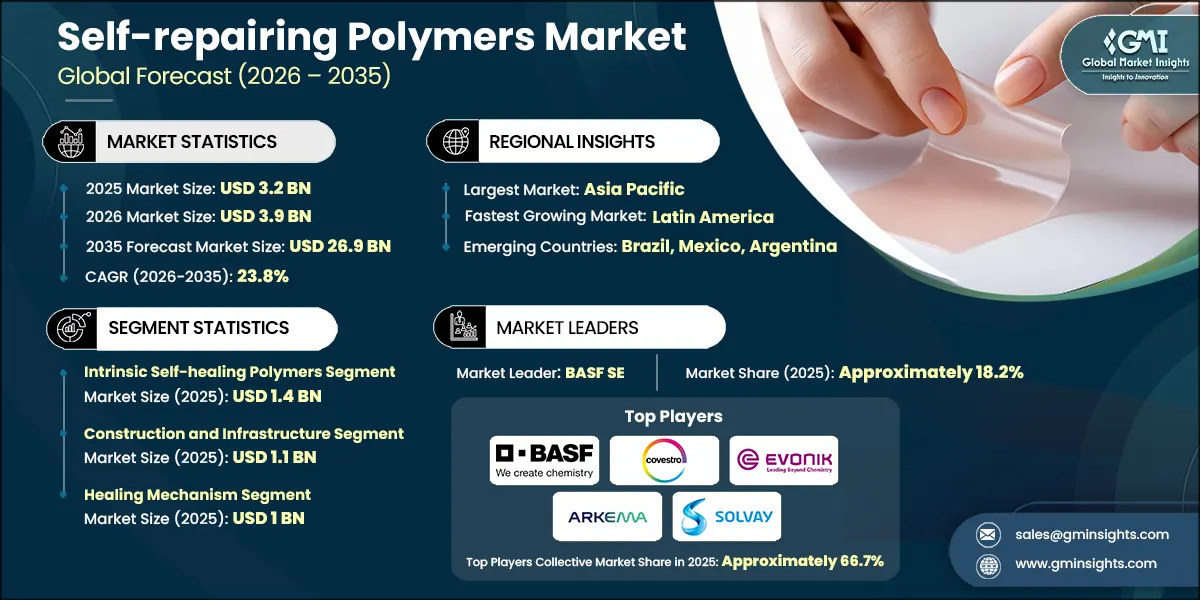
Self-repairing Polymers Market Key Takeaways
Market Size & Growth
- 2025 Market Size: USD 3.2 Billion
- 2026 Market Size: USD 3.9 Billion
- 2035 Forecast Market Size: USD 26.9 Billion
- CAGR (2026–2035): 23.8%
Regional Dominance
- Largest Market: Asia Pacific
- Fastest Growing Region: Latin America
Key Market Drivers
- Demand for extended material lifespan.
- Growth of advanced material applications.
- Focus on maintenance cost reduction.
- Advancements in polymer chemistry.
Challenges
- High material development cost.
- Processing and scalability limitations.
- Performance trade off concerns.
Opportunity
- Integration with smart and functional materials.
- Infrastructure durability requirements.
- Sustainability driven material selection.
- Customization for application specific needs.
Key Players
- Market Leader: BASF SE led with over 18.2% market share in 2025.
- Leading Players: Top 5 players in this market include BASF SE, Covestro AG, Evonik Industries AG, Arkema, Solvay S.A., which collectively held a market share of 66.7% in 2025.
Get Market Insights & Growth Opportunities
To get key market trends
Self-repairing Polymers Market Trends
- The market is currently adopting material systems which offer both damage recovery and functional stability through multiple damage tests. The research and development activities of today increasingly study intrinsic self-healing mechanisms which include reversible covalent bonds and supramolecular interactions because they enable materials to self-repair multiple times without needing exterior help.
- The current trend shows an increased need for polymers which preserve their performance throughout extended operational periods in situations where mechanical stress and temperature changes and microcracking occur. The current trend shows researchers developing self-repairing polymers into both smart material systems and multifunctional material platforms.
- Engineers design these polymers to provide additional properties which include conductivity and flexibility and transparency and chemical resistance together with their healing ability. The convergence of these two factors establishes a foundation for electronic devices and wearable technology and energy storage units which require the unbroken functioning of their materials. The manufacturing industry requires polymers which precise performance standards thus material customization and application-specific formulations are becoming vital.
- The market trends of today show manufacturers prefer sustainable products which need fewer resources to produce and which longlasting products and resource-saving production methods. Self-repairing polymers create circular material systems which decrease the need for replacements and decrease maintenance tasks. Development activity is expanding around bio-based polymers and low-energy healing systems to further enhance environmental compatibility.
- The material selection process which construction and transportation and consumer goods industries use is currently being affected by these trends. The development of scaling and processing compatibility has emerged as a vital area which demands concentrated development efforts. The manufacturing industry shows a wider adoption of conventional polymer processing techniques which improve product manufacturability.
- The development of additive manufacturing and coating technologies enables better self-repairing polymers to become integrated into intricate structures. The market shows increasing interest in commercial deployment because performance reliability has improved and processing boundaries have decreased from research purposes.
Self-repairing Polymers Market Analysis
Learn more about the key segments shaping this market
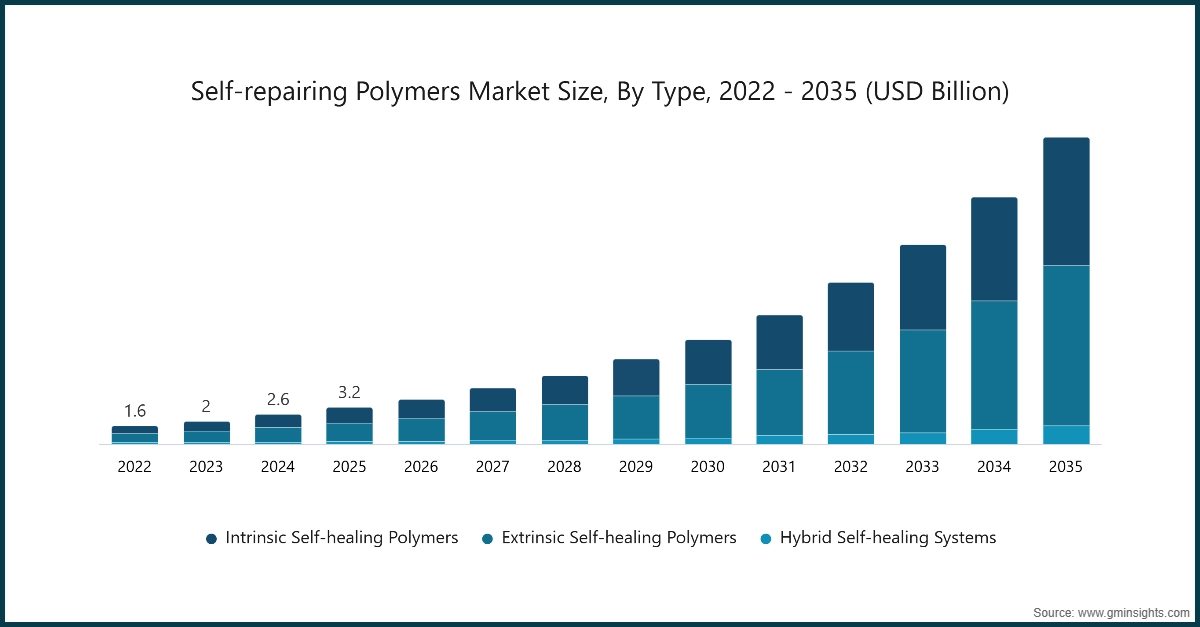
- The market includes intrinsic self-healing polymers as its main segment because these polymers can repair damage through their reversible bond system that exists in their polymer matrix. These materials enable repeated healing cycles because they do not require external healing agents which would lead to material loss, thus maintaining their long-term durability and performance stability. The molecular repair system of the material enables complete healing of microcracks and structural stress, which proves essential for applications that need continuous operation and face recurring mechanical or environmental stress. This market segment attracts industrial interest because it meets the demands of sectors that require dependable products with lightweight construction and low maintenance needs.
Self-repairing polymers market based on application is segmented into construction and infrastructure, automotive and aerospace, electronics and energy, biomedical and healthcare, consumer products, and others. The construction and infrastructure segment was valued at USD 1.1 billion in 2025, and it is anticipated to expand to 23.9% of CAGR during 2026-2035.
- The self‑repairing polymers market shows application segmentation across various sectors which include construction and infrastructure, automotive and aerospace, electronics and energy, biomedical and healthcare, consumer products, and other specialized uses. The various sectors use self‑repairing polymers to solve problems related to material degradation and mechanical stress and surface damage and functional failure in their respective operations. The construction and infrastructure sector uses its applications to handle crack repair and assessment of material performance over time, while the automotive and aerospace sector uses its applications to develop methods which restore hardware functionality after devices experience dynamic and thermal stress.
- The electronics and energy sector uses these polymers to sustain operational performance during periods of electrical and mechanical stress, whereas the biomedical and healthcare sector needs materials that maintain their structural properties and operational capabilities throughout multiple uses and physical changes. Self‑repairing polymers find application in consumer products to handle product deterioration and repair surface damage, while industrial and marine applications and protective materials development use these polymers to create solutions that meet particular operational requirements.
Learn more about the key segments shaping this market
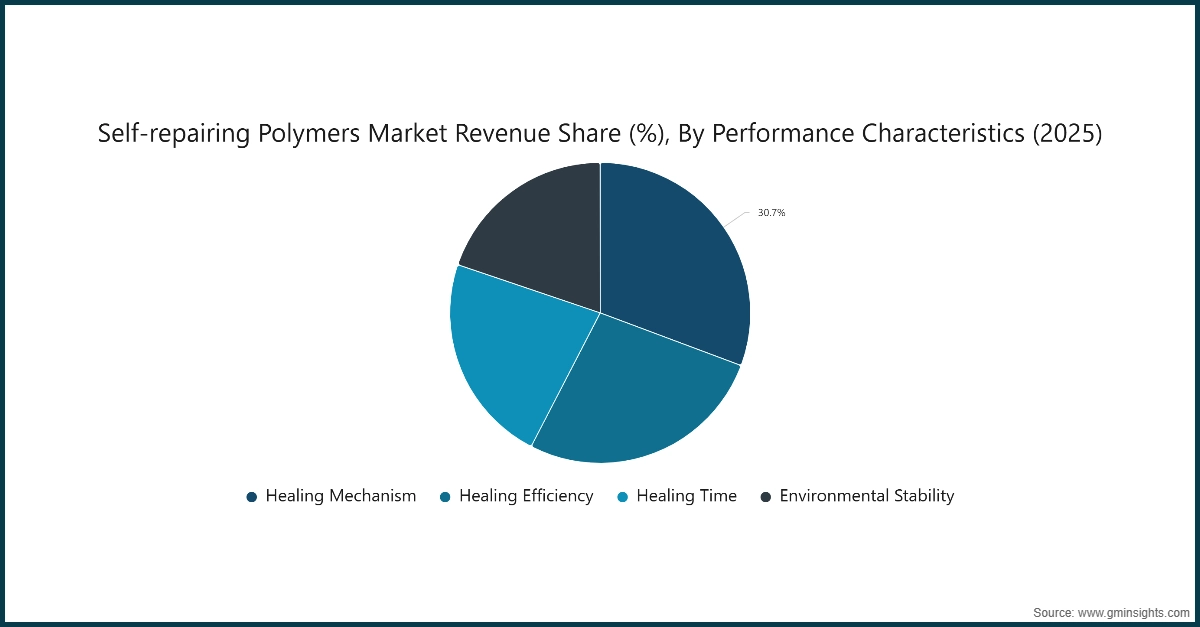
- The performance‑based segmentation of the self‑repairing polymers market includes healing mechanism, healing efficiency, healing time, and environmental stability, with the healing mechanism segment forming the foundation of material differentiation. This segment focuses on the underlying processes through which polymers restore damage, such as reversible chemical bonding, supramolecular interactions, or micro‑level structural rearrangement.
- Selection of a healing mechanism directly influences how effectively a polymer responds to stress, how often healing can occur, and how reliably performance is maintained over time. While healing efficiency and healing time define the extent and speed of damage recovery, and environmental stability determines performance under temperature, moisture, or chemical exposure, the healing mechanism remains the primary performance driver that shapes material behavior across applications and end‑use conditions.
Looking for region specific data?
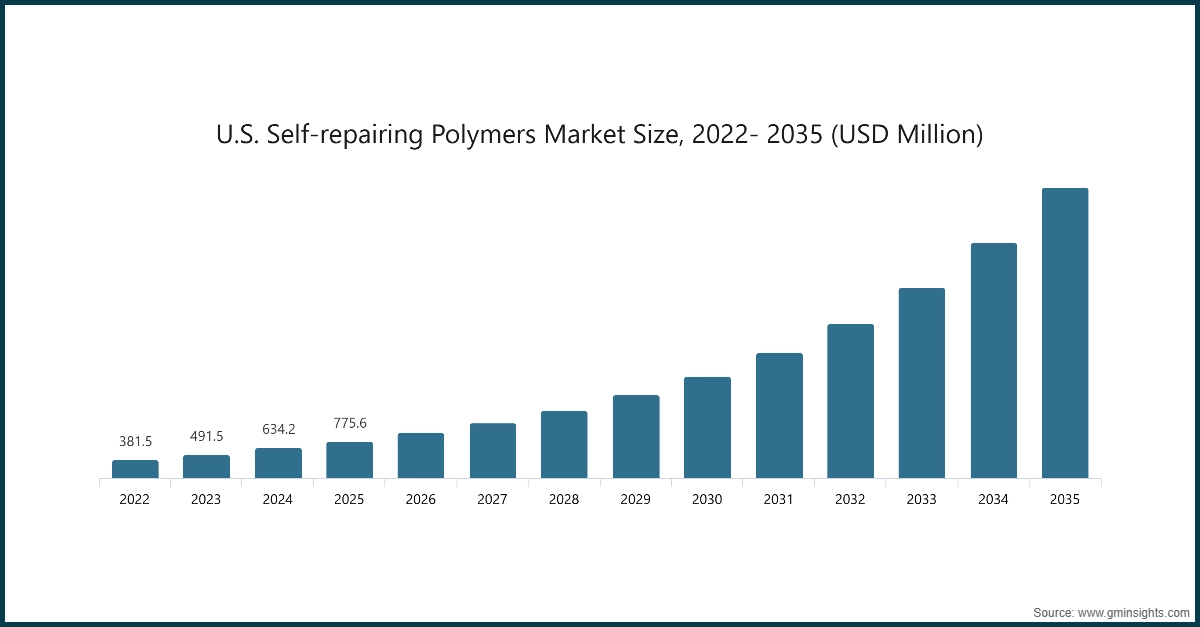
The North American region develops self-repairing polymers because of its established material science research base and early technology adoption and wide application use in advanced technology fields. Self-repairing polymers find active application in the region's automotive parts and aerospace materials and electronic device protection and infrastructure surface treatments. The United States serves as the central research hub because it maintains a strong research ecosystem and has multiple specialty polymer companies and develops defense systems and healthcare products and energy solution systems. Canada supports infrastructure projects through its research into advanced polymer systems and sustainable polymer technologies.
The Europe self-repairing polymers market accounted for USD 612.6 million in 2025 and is anticipated to show lucrative growth over the forecast period.
European regulations create a controlled environment for self-repairing polymers which Europeans use to achieve better material efficiency and environmental sustainability and material performance throughout extended product lifetimes. The construction materials industry and automotive systems and industrial coatings sector and healthcare device market use these applications across various sectors. Germany functions as a major automotive engineering center which drives its polymer research activities while France enables industry growth through its aerospace projects and infrastructure initiatives and advanced coatings technology. The regional focus on developing materials which demonstrate both long-lasting performance and recyclable capacity and durable attributes continues to shape how materials are developed and adopted by the market.
Asia Pacific self-repairing polymers market accounted for 38.6% market share in 2025 and is anticipated to show lucrative growth over the forecast period.
The market in Asia Pacific demonstrates strong growth because of industrial development and expanded manufacturing capacity and increased funding for advanced material research. The region demonstrates extensive applications across electronic devices energy storage systems automotive manufacturing facilities and infrastructure development projects. China plays a significant role through large-scale production capabilities and application in construction and electronics, while Japan contributes through precision material engineering, electronics protection, and automotive component innovation. Manufacturing in the region provides cost benefits while demand from end-users continues to grow.
Latin America self-repairing polymers market is anticipated to grow at a CAGR of 24.8% during the analysis timeframe.
Latin America develops as a new market for self-repairing polymers because people increasingly want materials that sustain their performance for extended periods in infrastructure projects and automotive production and industrial coating processes. The application of activities begins to grow because people now understand how maintenance cuts down and material life extension works. Brazil serves as a key country through its construction activity, automotive manufacturing base, and industrial material usage, while Mexico supports adoption through automotive assembly, electronics manufacturing, and cross-border industrial supply chains. The development of the market depends on both infrastructure projects and efforts to modernize industrial facilities.
Middle East & Africa self-repairing polymers market is expected to grow at a CAGR of 24.2% during the analysis timeframe.
The Middle East and Africa region shows selective adoption of self-repairing polymers which infrastructure resilience and industrial protection and environmental exposure management needs drive. The applications focus on three main areas which include construction coatings and protective pipeline systems and industrial materials which need to endure extreme temperature and challenging environmental situations. Saudi Arabia plays an important role through large‑scale infrastructure and industrial projects, while the United Arab Emirates supports adoption in construction, energy, and advanced building materials. The region needs materials which can sustain their functions when used in extreme operational conditions.
Self-repairing Polymers Market Share
- BASF SE, Covestro AG, Evonik Industries AG, Arkema, and Solvay S.A. are a significant part of the self-repairing polymers industry and with further standing of being highly consolidated with the top five players steadily holding 66.7% market share in the year 2025.
- The competitive landscape of the self‑repairing polymers market is shaped by a mix of specialty chemical producers, advanced materials companies, and research‑driven innovators. Participants focus on developing proprietary polymer chemistries that balance healing capability with mechanical strength and processing compatibility.
- Companies compete through material differentiation, particularly in intrinsic and hybrid self‑healing systems that allow repeated damage recovery without external intervention. Product portfolios are often tailored to specific application needs such as coatings, composites, electronics protection, or elastomers.
- Innovation intensity remains high, with competition centered on improving healing efficiency, response speed, and long‑term material stability. Firms invest in formulation refinement to ensure that self‑repairing functionality does not compromise thermal resistance, flexibility, or load‑bearing performance.
- Strategic collaborations between polymer manufacturers, academic institutions, and end‑use industries are common across the market. These partnerships support application testing, material validation, and faster transition from laboratory development to commercial use.
- Market participants emphasize application‑specific solutions rather than standardized products, reflecting diverse performance requirements across construction, automotive, electronics, and healthcare segments. Customization capability plays a key role in competitive positioning.
- Intellectual property development forms an important competitive factor, as companies seek to protect novel healing mechanisms and polymer architectures. Patented technologies are often used to secure long‑term supply agreements and application exclusivity.
- Manufacturing scalability and compatibility with existing processing methods influence competition, particularly for suppliers targeting industrial‑scale adoption. Companies with formulations adaptable to conventional polymer processing gain wider acceptance across end‑use sectors.
- Regional presence and application focus vary among competitors, with some concentrating on high‑performance markets such as aerospace and electronics, while others target volume‑driven segments like construction coatings and consumer materials.
- Competitive strategies increasingly align with sustainability objectives, including extended material lifespan and reduced replacement frequency. Companies that integrate self‑repairing functionality with environmental performance considerations strengthen their positioning within the evolving market landscape.
Self-repairing Polymers Market Companies
The major players operating in self-repairing polymers industry include:
- BASF SE
- Arkema
- Covestro AG
- Evonik Industries AG
- The Dow Chemical Company
- Sika AG
- Solvay S.A.
- Toray Industries, Inc.
- NEI Corporation
- Others
- BASF SE participates in the self‑repairing polymers market through its advanced materials and performance polymers portfolio. The company’s activities are centered on developing polymer systems with enhanced durability, stress resistance, and lifecycle performance. BASF focuses on integrating self‑repairing functionality into coatings, elastomers, and engineered plastics, supporting applications across automotive, construction, and industrial materials where long‑term reliability and reduced maintenance are critical.
- Covestro AG is engaged in self‑repairing polymers through its expertise in high‑performance polyurethanes, polycarbonates, and specialty polymer systems. The company emphasizes material innovation that supports flexibility, surface recovery, and functional stability. Its involvement aligns with applications such as coatings, electronics protection, and lightweight components, where material resilience and consistent performance under mechanical and environmental stress are key requirements.
- Evonik Industries AG contributes to the self‑repairing polymers market through specialty chemicals and advanced polymer solutions tailored for performance‑driven applications. The company’s focus includes material systems that support controlled damage recovery, chemical stability, and mechanical integrity. Evonik’s activities align with coatings, healthcare materials, and industrial applications, where precise material behavior and functional reliability influence product performance.
- Arkema is active in the self‑repairing polymers market through its specialty materials portfolio, including advanced resins and functional polymers. The company focuses on polymer architectures that support durability, surface repair, and resistance to environmental stress. Arkema’s approach supports applications in construction materials, automotive components, and protective coatings, where material longevity and performance consistency are essential considerations.
- Solvay S.A. participates in the self‑repairing polymers market through its advanced materials and specialty polymer offerings. The company emphasizes high‑performance polymer systems designed for demanding environments, including thermal, mechanical, and chemical exposure. Solvay’s involvement supports applications in aerospace, electronics, and industrial materials, where maintaining structural integrity and functional performance over extended use cycles is important.
Self-repairing Polymers Market Report Attributes
| Key Takeaway | Details |
|---|---|
| Market Size & Growth | |
| Base Year | 2025 |
| Market Size in 2025 | USD 3.2 Billion |
| Market Size in 2026 | USD 3.9 Billion |
| Forecast Period 2026-2035 CAGR | 23.8% |
| Market Size in 2035 | USD 26.9 Billion |
| Key Market Trends | |
| Drivers | Impact |
| Demand for extended material lifespan | Reduces replacement frequency and supports long term performance retention |
| Growth of advanced material applications | Increases adoption in high value and performance critical industries |
| Focus on maintenance cost reduction | Encourages use of polymers with autonomous damage recovery |
| Advancements in polymer chemistry | Enables development of reliable and repeatable self healing systems |
| Pitfalls & Challenges | Impact |
| High material development cost | Limits adoption in cost sensitive and volume driven applications |
| Processing and scalability limitations | Restricts large scale manufacturing compatibility |
| Performance trade off concerns | Slows acceptance where strength and healing balance is critical |
| Opportunities: | Impact |
| Integration with smart and functional materials | Expands application scope in electronics and adaptive systems |
| Infrastructure durability requirements | Creates demand for crack resistant and long life materials |
| Sustainability driven material selection | Supports adoption aligned with lifecycle efficiency goals |
| Customization for application specific needs | Enables tailored solutions across diverse end use segments |
| Market Leaders (2025) | |
| Market Leader |
Market Share Approximately 18.2% |
| Top Players |
Collective Market Share Approximately 66.7% |
| Competitive Edge |
|
| Regional Insights | |
| Largest Market | Asia Pacific |
| Fastest growing market | Latin America |
| Emerging countries | Brazil, Argentina, Mexico |
| Future outlook |
|
What are the growth opportunities in this market?
Self-repairing Polymers Industry News
- In August 2022: BASF has launched a new thermoplastic polyurethane (TPU) paint protection film, which offers self-healing properties to safeguard vehicle surfaces from scratches and damages. This advanced TPU film ensures that minor scratches can autonomously repair, maintaining the vehicle's aesthetic appeal and longevity.
The self-repairing polymers market research report includes in-depth coverage of the industry with estimates & forecasts in terms of revenue (USD Billion) & (Kilo Tons) from 2022 to 2035, for the following segments:
Market, By Type
- Intrinsic Self-healing Polymers
- Reversible Covalent Bond-based
- Supramolecular Interaction-based
- Shape Memory Polymers
- Others
- Extrinsic Self-healing Polymers
- Microcapsule-based Systems
- Vascular Network Systems
- Microfiber Reinforcement
- Others
- Hybrid Self-healing Systems
- Combined Intrinsic-Extrinsic Systems
- Multi-mechanism Systems
- Others
Market, By Application
- Construction and Infrastructure
- Self-healing Concrete
- Protective Coatings
- Sealants and Adhesives
- Others
- Automotive and Aerospace
- Structural Components
- Coatings and Paints
- Interior Applications
- Others
- Electronics and Energy
- Battery Components
- Flexible Electronics
- Solar Panels
- Others
- Biomedical and Healthcare
- Tissue Engineering
- Drug Delivery Systems
- Medical Devices
- Others
- Consumer Products
- Packaging
- Protective Films
- Textiles
- Others
- Others
Market, By Performance Characteristics
- Healing Mechanism
- Thermally Activated
- Light-activated
- pH-responsive
- Mechanically Activated
- Others
- Healing Efficiency
- High Efficiency (>80%)
- Medium Efficiency (50-80%)
- Low Efficiency (<50%)
- Healing Time
- Rapid Healing (<1 hour)
- Moderate Healing (1-24 hours)
- Slow Healing (>24 hours)
- Environmental Stability
- Temperature Resistant
- Chemical Resistant
- UV Resistant
- Others
The above information is provided for the following regions and countries:
- North America
- U.S.
- Canada
- Europe
- UK
- Germany
- France
- Italy
- Spain
- Rest of Europe
- Asia Pacific
- China
- India
- Japan
- South Korea
- Australia
- Rest of Asia Pacific
- Latin America
- Brazil
- Mexico
- Argentina
- Rest of Latin America
- MEA
- UAE
- Saudi Arabia
- South Africa
- Rest of Middle East and Africa
Frequently Asked Question(FAQ) :
What is the market size of the self-repairing polymers market in 2025?
The market was valued at USD 3.2 billion in 2025, driven by increasing demand for durable, long-lasting materials across high-performance industries such as automotive, electronics, and construction.
What is the current size of the self-repairing polymers industry in 2026?
The market is projected to reach USD 3.9 billion in 2026, supported by advancements in polymer chemistry and growing adoption of smart and sustainable materials.
What is the projected value of the self-repairing polymers market by 2035?
The market is expected to reach USD 26.9 billion by 2035, growing at a 23.8% CAGR, driven by increasing application in high-value industries and demand for lifecycle-efficient materials.
Which type segment dominates the self-repairing polymers market?
The intrinsic self-healing polymers segment dominated the market in 2025, valued at USD 1.4 billion, due to its ability to repeatedly repair damage without external healing agents.
Which performance characteristic segment holds the largest share in the market?
The healing mechanism segment held the largest share of 30.7% in 2025, as it defines how effectively polymers restore damage through reversible bonding and molecular interactions.
Which region leads the self-repairing polymers industry?
The North America self-repairing polymers market accounted for USD 868.5 million in 2025, supported by strong material science research, early technology adoption, and widespread use in automotive, aerospace, and electronics applications.
Who are the key companies operating in the self-repairing polymers industry?
Major companies in the industry include BASF SE, Covestro AG, Evonik Industries AG, Arkema, Solvay S.A., The Dow Chemical Company, Sika AG, Toray Industries, Inc., and NEI Corporation, focusing on innovation in self-healing materials and advanced polymer systems.
Self-repairing Polymers Market Scope
Related Reports