Summary
Table of Content

Self-Monitoring Blood Glucose Monitoring Devices Market
Get a free sample of this report
Form submitted successfully!
Error submitting form. Please try again.
Thank you!
Your inquiry has been received. Our team will reach out to you with the required details via email. To ensure that you don't miss their response, kindly remember to check your spam folder as well!
Request Sectional Data
Thank you!
Your inquiry has been received. Our team will reach out to you with the required details via email. To ensure that you don't miss their response, kindly remember to check your spam folder as well!
Form submitted successfully!
Error submitting form. Please try again.
Self-Monitoring Blood Glucose Monitoring Devices Market Size
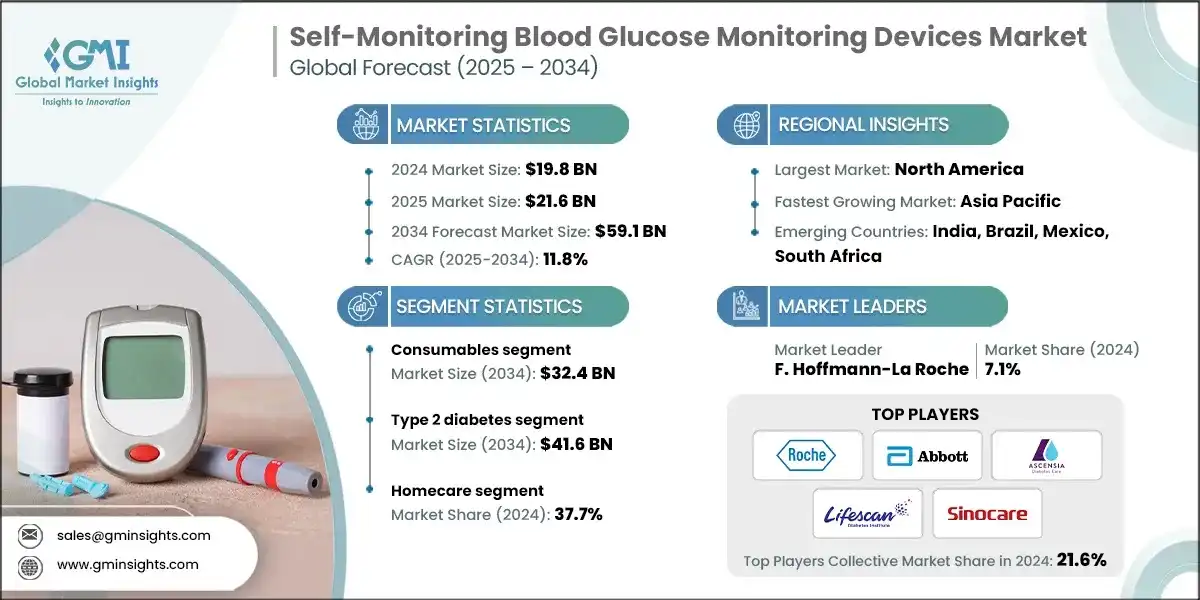
The global self-monitoring blood glucose monitoring devices market size was valued at USD 19.8 billion in 2024. The market growth is expected to grow from USD 21.6 billion in 2025 to USD 59.1 billion in 2034, growing at a CAGR of 11.8% from 2025 to 2034, according to the latest report published by Global Market Insights Inc.
To get key market trends
This steady growth is stimulated by various factors such as rising prevalence of diabetes worldwide, technological advancements of self-monitoring blood glucose monitoring devices in developed countries, government initiatives for increasing awareness pertaining diabetes among people.
Self-monitoring blood glucose devices are medical instruments used by individuals with diabetes to measure and monitor their glucose levels regularly. These devices enable patients to manage their condition effectively by providing real-time data on blood sugar levels, helping them make informed decisions about diet, physical activity, and medication. Major companies in the industry include F. Hoffmann-La Roche, Abbott Laboratories, Ascensia Diabetes Care Holdings, LifeScan, and Sinocare.
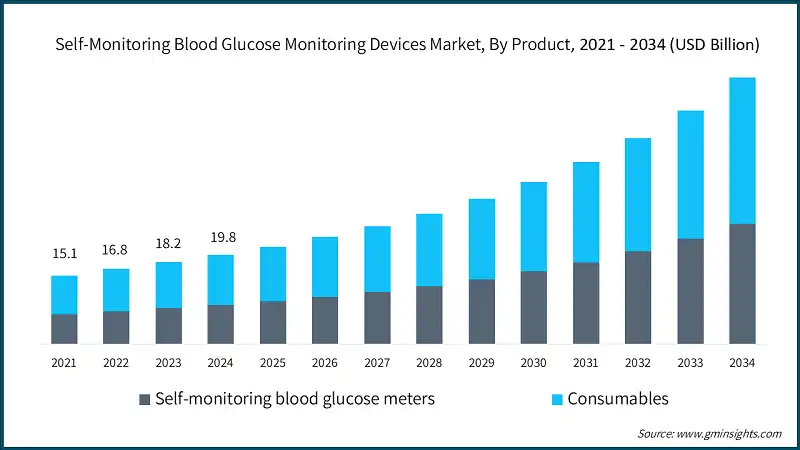
The market increased from USD 15.1 billion in 2021 to USD 18.2 billion in 2023. This market is growing due to an increasing prevalence of diabetes mellitus globally. For instance, as per the estimates from the International Diabetes Federation (IDF), 537 million people were living with diabetes worldwide in 2021. The trend is anticipated to increase that number to 643 million in 2030 and then to 783 million in 2045. As the disease is getting prevalent among patients and healthcare providers, the demand for SMBG devices is increasing in order to manage the disease.
In addition, government initiatives to increase awareness about management of diabetes mellitus aids in the early detection and is a reason for the expansion of the market as well. For instance, the U.S. National Diabetes Education Program (NDEP) is one such source wherein the advantages of SMBG devices in self-management have been brought forward.
Moreover, in the European Union, screening campaigns target the high-risk groups, such as people over 45 years of age or those having a family history of diabetes, encouraging early diagnosis and thereby creating demand for diabetes-related treatments. Such efforts by the government are helping to increase awareness about this lifestyle disease as well as helping in early detection of the condition. This, in turn, helps in boosting the demand for diabetes care devices as a measure to keep the disease under control.
Self-monitoring blood glucose devices are being used since decades; these operate by pricking a finger with sharp lancet and using the blood on the strip, which is further inserted into the glucometer to measure the blood glucose level of an individual.
Self-Monitoring Blood Glucose Monitoring Devices Market Report Attributes
| Key Takeaway | Details |
|---|---|
| Market Size & Growth | |
| Base Year | 2024 |
| Market Size in 2024 | USD 19.8 Billion |
| Forecast Period 2025 - 2034 CAGR | 11.8% |
| Market Size in 2034 | USD 59.1 Billion |
| Key Market Trends | |
| Drivers | Impact |
| Rising prevalence of diabetes worldwide | Increases demand for SMBG devices as more individuals require regular monitoring. |
| Government initiatives for increasing awareness among people | Boosts adoption rates through education and subsidized programs. |
| Technological advancements of self-monitoring blood glucose monitoring devices in developed countries | Enhances device accuracy, convenience, and user engagement, driving market growth. |
| Pitfalls & Challenges | Impact |
| High cost of advanced devices and accessories in developing countries | Limits accessibility and adoption among low-income populations, slowing market penetration. |
| Stringent regulatory requirements | Delays product approvals and increases compliance costs for manufacturers. |
| Opportunities: | Impact |
| Expansion in emerging markets | Offers significant growth potential due to rising diabetes cases and improving healthcare infrastructure. |
| Market Leaders (2024) | |
| Market Leaders |
7.1% |
| Top Players |
Collective market share in 2024 is 21.6% |
| Competitive Edge |
|
| Regional Insights | |
| Largest Market | North America |
| Fastest Growing Market | Asia Pacific |
| Emerging Country | India, Brazil, Mexico, South Africa |
| Future Outlook |
|
What are the growth opportunities in this market?
Self-Monitoring Blood Glucose Monitoring Devices Market Trends
- Technological advancements in SMBG devices are fueling the expansion of this market significantly.
- The devices can be linked to smartphone applications via bluetooth technology or USB ports. For instance, Omnitest 5 by B. Braun is a smart SMBG device that can be linked to the smartphone via bluetooth as well as a micro-USB port. This allows a seamless transfer of the data from the device to the application, which then is available for the consumer to view at a glance. Users can add their workout data as well within the application. Such advancements are encouraging individuals to buy these devices.
- Moreover, key players are focusing on data integration into cloud platforms, which is beneficial for the individuals. This allows remote monitoring of the glucose data by the users. For instance, Abbott’s FreeStyle Lite allows the users to upload their glucose data on the LibreView cloud system, which makes it easy for the medical practitioners to monitor their patient’s progress from anywhere. This feature enhances telehealth services and patient outcomes.
- Moreover, the accuracy of SMBG devices has improved immensely due to advanced AI algorithms and features such as incorporation of temperature, hematocrit, and other factors. These features reduce errors associated with blood glucose readings. For instance, the Accu-Chek Guide system enhances the effectiveness of disease management while reducing the chances of misdiagnosis, especially with no supervision at households.
- Furthermore, strip design is improving, which is yet another benefit for the users. Modern strips need less blood for sampling and also these strips come with no wipe technology, i.e. the strips can be inserted in the meter without wiping the excess blood, which eventually eases the process. This shift improves patient comfort by ensuring accurate results in shorter durations.
- Moreover, SMBG devices have also become more portable and comfortable due to compact and ergonomic designs. For instance, the CONTOUR NEXT ONE meter by Ascensia Diabetes Care is equipped with the Second Chance Sampling feature, which enables patients to add more blood to the test strip if the first sample didn’t fill the required amount. This cuts down on wasted lancets and test strips, saves on finger pricks, and increases the user's comfort with the device, thereby enhancing usability.
Self-Monitoring Blood Glucose Monitoring Devices Market Analysis
Learn more about the key segments shaping this market
The global market was valued at USD 15.1 billion in 2021. The market size reached USD 18.2 billion in 2023, from USD 16.8 billion in 2022. Based on product, the self-monitoring blood glucose monitoring devices market is segmented into self-monitoring blood glucose meters and consumables. The consumables segment is further bifurcated into testing strips and lancets. This segment was valued at USD 11.1 billion in 2024 and is projected to reach USD 32.4 billion by 2034, growing at a CAGR of 11.6%. In comparison, the self-monitoring blood glucose meters segment, valued at USD 8.7 billion in 2024, is expected to grow to USD 26.7 billion by 2034.
- Self-monitoring blood glucose devices need consumable items such as test strips and lancets for daily diabetes management. These are available over-the-counter, making them easily accessible.
- The biggest consumable components are test strip, which are single use devices that capture blood for consideration in glucose measurement. Their small size also makes them lightweight, portable, and compact. So, users can easily carry these with them and test their blood glucose levels at any place, be it the office, home or on a vacation.
- The accuracy of test strips is crucial for effective diabetes management. Test strips were found to be quite reliable by a study published in the Journal of Diabetes Science and Technology. It stated that modern test strips, when used with compatible meters, offer an accuracy level of ±15% compared to laboratory testing methods.
- Moreover, key players are also focusing on better needle designs for lancets, which are blood sample extracting devices, making blood collecting safer and less painful.
- Thus, the consumables segment, particularly test strips, is the most critical factor of the market's growth.
Based on application, the self-monitoring blood glucose monitoring devices market is segmented into type 1 diabetes, type 2 diabetes, and gestational diabetes. The type 2 diabetes emerged as a dominant segment in the market, accounting for 69.2% of revenue share in 2024 and is expected to reach by USD 41.6 billion in 2034.
- Type 2 diabetic patients have two major problems. The pancreas is not able to produce enough insulin, a hormone that controls the movement of sugar into the cells; and cells do not respond adequately to insulin and therefore take in less sugar. Increasing prevalence of this condition is a major reason behind dominance of this segment.
- For instance, according to data from the Centers for Disease Control and Prevention (CDC), around 38 million individuals in the U.S. are diabetic, and almost 90% - 95% of those cases accounts for type 2 diabetes. Usually, people aged 45 plus are more prone to suffering from type 2 diabetes, however, currently there is a rise in cases among children, teenagers, and young adults as well.
- Thus, type 2 diabetes is expected to be a dominant segment and continue to promote the growth of this market in the forecast period.
Learn more about the key segments shaping this market
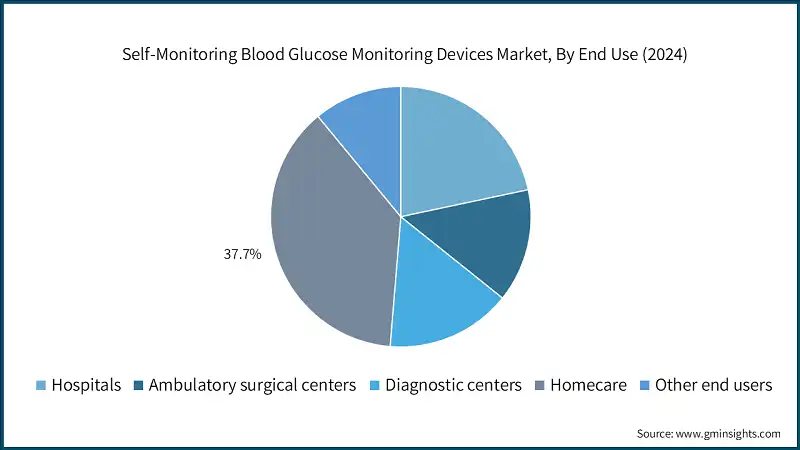
Based on end use, the self-monitoring blood glucose monitoring devices market is segmented into hospitals, ambulatory surgical centers, diagnostic centers, homecare, and other end users. Homecare accounted for the largest revenue share of 37.7% in 2024.
- Self-monitoring blood glucose (SMBG) devices have empowered patients to monitor their blood glucose levels at home instead of visiting a clinic. This improves the self-management of their condition, as it minimizes the need for clinical testing. It is highly beneficial for elderly patients or patients facing mobility challenges because it grants them more control over their health management.
- The use of SMBG devices at home also allows patients to modify their diets, physical activities, and medication regimens more frequently. For instance, NIH researchers reported that patients using SMBG devices daily had a 16% lower HbA1c level compared to those that did not, which means the patients were at a lower risk of complications associated with diabetes.
- Thus, as these devices can be used without supervision of doctors and considering their benefits for elderly patients, the segment is expected to have significant growth in the forecast period as well.
Looking for region specific data?
North America dominated the self-monitoring blood glucose monitoring devices market, with the highest market share of 38.2% in 2024.
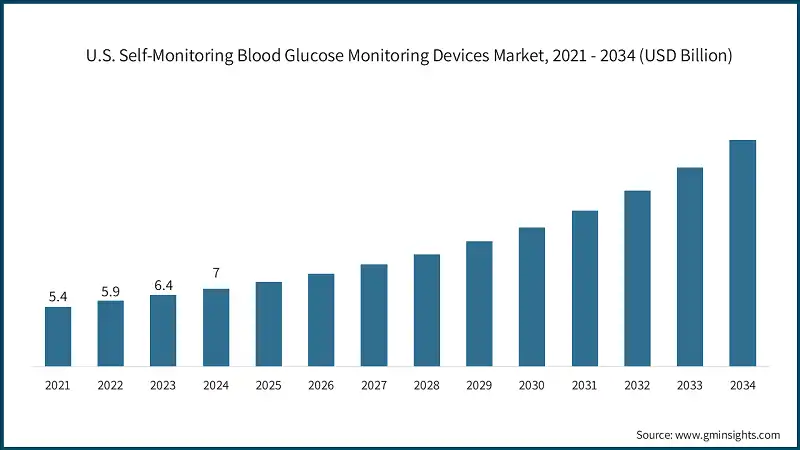
The U.S. self-monitoring blood glucose monitoring devices market was valued at 5.4 billion and USD 5.9 billion in 2021 and 2022, respectively. In 2024 the market size reached USD 7 billion from USD 6.4 billion in 2023.
- The high prevalence of diabetes in the U.S. carries a significant economic burden. As of 2022, the cost for dealing with diabetes in the U.S. was over USD 412.9 billion as American Diabetes Association reported, which is a leap from USD 327 billion in 2017.
- In addition to this, there's a reality that healthcare spending in the U.S. is exceptionally high, which allows for extensive integration of SMBG devices. These capital investments certainly aid in the delivery of groundbreaking innovations for the advanced SMBG devices, which fuel the economy.
Europe, self-monitoring blood glucose monitoring devices accounted for USD 5.3 billion in 2024 and is anticipated to show lucrative growth over the forecast period.
- The increasing number of diabetes cases in European countries has driven the demand for glucose monitoring solutions. The need for regular blood sugar monitoring among millions of individuals has made SMBG devices essential for diabetes management.
- Technological developments have contributed to market growth. SMBG devices now include smartphone connectivity, cloud-based data tracking, and non-invasive monitoring capabilities, which improve user convenience. These features enhance patient outcomes and promote regular device usage, supporting market expansion.
The self-monitoring blood glucose monitoring devices market in the UK is projected to experience steady growth between 2025 and 2034.
- The rate of diabetes is consistently growing within the UK. Public Health England estimates that the Diabetes Prevalence Model will reach 4.9 million diabetics in the UK by 2035.
- Hence, such high estimates along with efforts put in by NHS indicates that there is room for further expansion of this market in the UK.
The Asia Pacific self-monitoring blood glucose monitoring devices is anticipated to grow at the highest CAGR of 12.4% during the analysis timeframe.
- The Asia Pacific market for self-monitoring blood glucose devices is witnessing rapid expansion, driven by the increasing prevalence of diabetes, growing health consciousness among the population, and continuous improvements in healthcare infrastructure.
- The development of new hospitals and diagnostic centers across the region is significantly boosting the demand for advanced diabetes care technologies. These infrastructure enhancements are enabling better access to quality care for individuals living with diabetes, thereby accelerating the growth of the SMBG devices market in Asia Pacific.
Japan self-monitoring blood glucose monitoring devices market is anticipated to witness lucrative growth between 2025 - 2034.
- Japan's diabetes population is on the rise, in turn increasing the demand for SMBG devices due to the country's fast aging population. For instance, in 2022, approximately 29.9% of Japan's total populace were aged 65 years and above.
- Furthermore, increasing awareness regarding management in Japan is expected to increase usage of these devices significantly.
The self-monitoring blood glucose monitoring devices market in Saudi Arabia is expected to experience significant and promising growth from 2025 to 2034.
- The demand for market glucose monitoring devices is increasing, which is mostly caused due to the increasing dietary practices and obesity levels. This is directly related to the surge in cases of diabetes in the country.
- For instance, as per the data from the International Diabetes Federation, in 2021 around 24.1 million adults in Saudi Arabia had diabetes.
- In addition, adult diabetes is on the rise due to the emerging urban western lifestyles in the cities and is hence increasing the demand for self-monitoring blood glucose devices.
Self-Monitoring Blood Glucose Monitoring Devices Market Share
- The self-monitoring blood glucose devices industry is competitive, top five companies such as F. Hoffmann-La Roche, Abbott Laboratories, Ascensia Diabetes Care Holdings, LifeScan, and Sinocare hold the most market share accounting for approximately 21.6% in 2024. F. Hoffmann-La Roche is a key player in the market, leveraging its large product portfolio and early entry into the market. It has remained aggressive in accuracy and convenience and distribution while leveraging advanced research and commercial initiatives, as well as global partnerships.
- For instance, the company recently launched a campaign in India on World Diabetes Day to promote self-monitoring of blood glucose (SMBG) and reduce “diabetes distress.” This campaign emphasized the importance of pre-breakfast glucose checks for better diabetes management. Using an omnichannel approach, Roche reached over 15,600 patients through in-clinic sessions and influencer collaborations.
- Moreover, Abbott as a major competitor has also been gaining traction due to their strong focus on the digital health revolution. LibreView technology, which supports remote monitoring and improved telehealth functionality, is cloud-based. These developments have enabled Abbott to capture the tech market. Moreover, key players are also focused on the connectivity aspect of diabetes care, integrating Bluetooth, micro-USB, for data transfer in their products.
- Further, competition within the market has increased due to government initiatives to diabetes management in addition to the consumer appetite for health focused solutions. This complex environment illustrates the perpetual innovation and strategic flexibility of the market players needed to maintain and develop their market positions.
Self-Monitoring Blood Glucose Monitoring Devices Market Companies
Some of the eminent market participants operating in the self-monitoring blood glucose monitoring devices industry include:
- Abbott Laboratories
- AgaMatrix
- All Medicus
- Arkray
- Ascensia Diabetes Care Holdings
- B. Braun Melsungen
- Bionime Corporation
- DarioHealth
- F. Hoffmann-La Roche
- LifeScan
- Nova Biomedical
- Omnis Health
- Sanofi
- Sinocare
- Ypsomed Holding
- Ascensia Diabetes Care Holdings
Ascensia Diabetes Care Holdings, one of the key player in the self-monitoring blood glucose monitoring devices market with a share of 4.1% in 2024. Ascensia Diabetes Care offers novel and precise glucose monitoring devices developed for simplicity while addressing diabetes care management.
- LifeScan
LifeScan designs advanced patient-friendly blood glucose monitoring systems that help increase patient confidence and control.
- Nova Biomedical
Nova Biomedical specializes in powerful glucose meters that provide immediate and accurate measurements for better diabetes management.
Self-Monitoring Blood Glucose Monitoring Devices Industry News:
- In November 2024, Ascensia Diabetes Care collaborated with Fitterfly Healthtech to develop a free 21-day Diabetes Management Program offered on Ascensia glucometer devices. It is anticipated that diabetes care will be more effective with this program.
- In May 2022, ARKRAY, Inc. collaborated with Rimidi to enable wider data reach through the integration of the GLUCOCARD Shine Connex blood glucose monitoring device with the Rimidi platform, making life easier for both hospitals and patients. This partnership increased the visibility of ARKRAY’s glucose monitoring device and the overall glucose monitoring system allowing ARKRAY to expand into new markets.
- In May 2021, Glucometer Division of the Bionime Corporation began data management and synchronization of Bionime GM700 Pro 2 with other devices within hospitals. This product was expected to enhance revenue and expand the company’s product range.
- In March 2021, F. Hoffmann-La Roche Ltd introduced the Accu-Chek Instant system, which is a Bluetooth-enabled blood glucose monitoring system connected to the mySugr app for easy data transfer. This launch strengthened Roche's position in the market.
The self-monitoring blood glucose monitoring devices market research report includes an in-depth coverage of the industry with estimates and forecast in terms of revenue in USD Million from 2021 - 2034 for the following segments:
Market, By Product
- Self-monitoring blood glucose meters
- Consumables
- Testing strips
- Lancets
Market, By Application
- Type 1 diabetes
- Type 2 diabetes
- Gestational diabetes
Market, By End Use
- Hospitals
- Ambulatory surgical centers
- Diagnostic centers
- Homecare
- Other end use
The above information is provided for the following regions and countries:
- North America
- U.S.
- Canada
- Europe
- Germany
- France
- UK
- Italy
- Spain
- Netherlands
- Sweden
- Belgium
- Denmark
- Finland
- Norway
- Lithuania
- Latvia
- Estonia
- Russia
- Poland
- Switzerland
- Asia Pacific
- China
- Japan
- India
- Australia
- South Korea
- Taiwan
- Indonesia
- Vietnam
- Latin America
- Brazil
- Mexico
- Argentina
- Colombia
- Chile
- Peru
- Middle East and Africa
- South Africa
- Saudi Arabia
- UAE
- Turkey
- Egypt
- Israel
- Kuwait
- Qatar
Frequently Asked Question(FAQ) :
Who are the key players in the self-monitoring blood glucose devices industry?
Key players include Abbott Laboratories, AgaMatrix, All Medicus, Arkray, Ascensia Diabetes Care Holdings, B. Braun Melsungen, Bionime Corporation, DarioHealth, F. Hoffmann-La Roche, LifeScan, and Nova Biomedical.
What are the upcoming trends in the self-monitoring blood glucose devices market?
Trends include AI-powered accuracy improvements, cloud-based data integration, compact and ergonomic device designs, and advancements in strip technology for enhanced usability.
What was the valuation of the homecare segment in 2024?
The homecare segment accounted for 37.7% of the market revenue in 2024. This growth is led by the convenience of at-home glucose monitoring, especially for elderly and mobility-challenged patients.
Which region leads the self-monitoring blood glucose devices sector?
The U.S. leads the market with a valuation of USD 7 billion in 2024. Growth is driven by widespread adoption of advanced technologies and increasing diabetes prevalence in the region.
What is the growth outlook for the consumables segment from 2025 to 2034?
The consumables segment is set to witness 11.6% CAGR till 2034, propelled by advancements in strip technology and increasing demand for user-friendly devices.
What is the market size of the self-monitoring blood glucose devices in 2024?
The market size was USD 19.8 billion in 2024, with a CAGR of 11.8% expected through 2034. The growth is driven by the rising prevalence of diabetes, technological advancements, and government initiatives to increase diabetes awareness.
What is the expected size of the self-monitoring blood glucose devices market in 2025?
The market size is projected to reach USD 21.6 billion in 2025.
How much revenue did the consumables segment generate in 2024?
The consumables segment, including testing strips and lancets, generated USD 11.1 billion in 2024. This segments growth is attributed to the increasing adoption of advanced strip designs and ease of use.
What is the projected value of the self-monitoring blood glucose devices market by 2034?
The market is poised to reach USD 59.1 billion by 2034, fueled by innovations in device accuracy, cloud integration, and enhanced usability features.
Self-Monitoring Blood Glucose Monitoring Devices Market Scope
Related Reports