Summary
Table of Content

Self-Healing Joint Compounds Market
Get a free sample of this report
Form submitted successfully!
Error submitting form. Please try again.
Thank you!
Your inquiry has been received. Our team will reach out to you with the required details via email. To ensure that you don't miss their response, kindly remember to check your spam folder as well!
Request Sectional Data
Thank you!
Your inquiry has been received. Our team will reach out to you with the required details via email. To ensure that you don't miss their response, kindly remember to check your spam folder as well!
Form submitted successfully!
Error submitting form. Please try again.
Self-Healing Joint Compounds Market Size
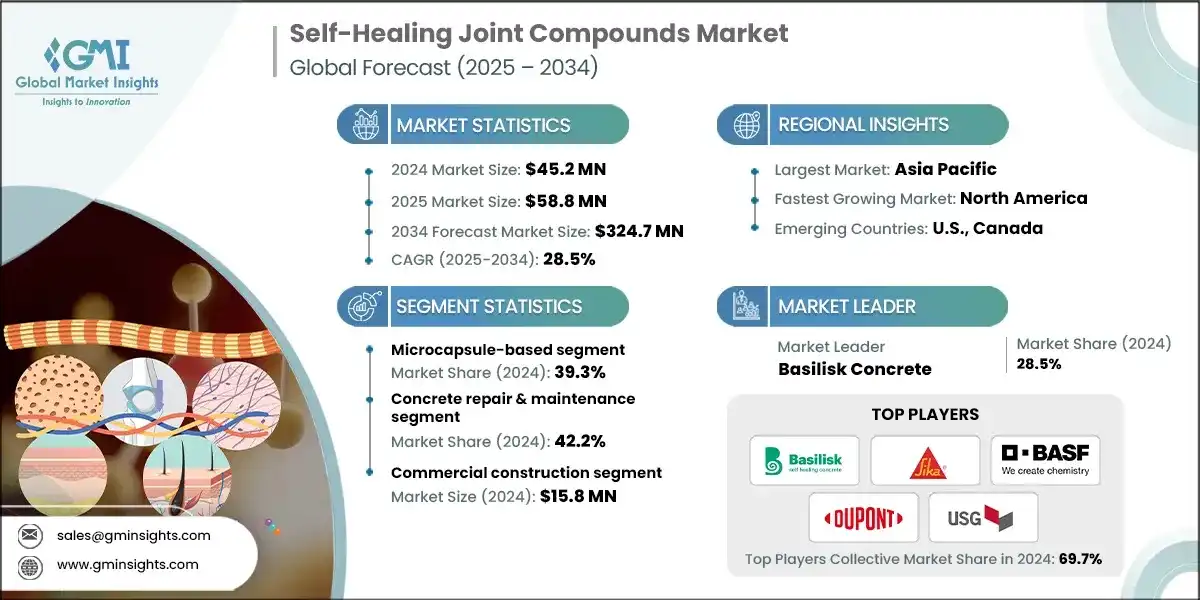
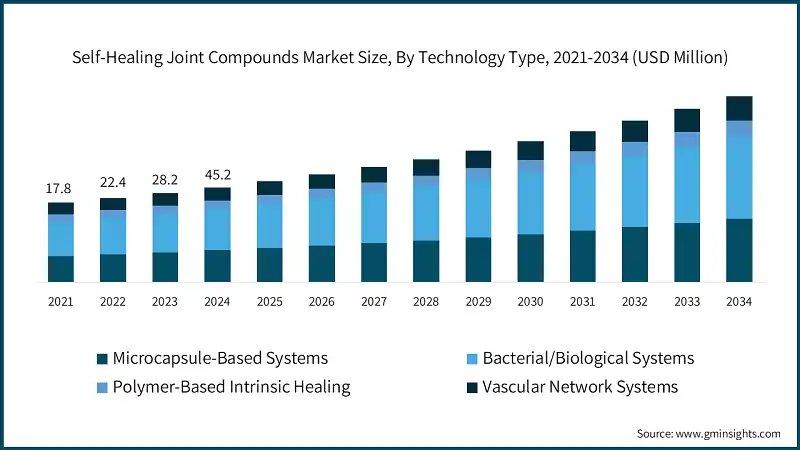
The global self-healing joint compounds market was valued at USD 45.2 million in 2024 and is set to expand from USD 58.8 million in 2025 to USD 324.7 million by 2034, reflecting a 28.5% CAGR according to latest report published by Global Market Insights Inc.
Self-Healing Joint Compounds Market Key Takeaways
Market Size & Growth
- 2024 Market Size: USD 45.2 Million
- 2025 Market Size: USD 58.8 Million
- 2034 Forecast Market Size: USD 324.7 Million
- CAGR (2025–2034): 28.5%
Key Market Drivers
- Shift toward sustainable, low-VOC building materials.
- Growth of smart & sustainable construction.
- Integration of smart sensors for structural health monitoring.
Challenges
- Regulatory complexity & compliance costs.
- Compatibility issues with existing materials.
Opportunity
- Expansion in green building certifications.
- Integration with Smart Building Technologies.
Key Players
- Market Leader: Basilisk Concrete led with over 28.5% market share in 2024.
- Leading Players: Top 5 players in this market include Basilisk Concrete, Sika AG, BASF SE, DuPont de Nemours, Inc., United States Gypsum Company (USG), which collectively held a market share of 69.7% in 2024.
Get Market Insights & Growth Opportunities
- Self-healing joint compounds have gained momentum as part of many industries, including joint compounds and coatings. North America is in the lead because of advanced research and development and substantial investments in infrastructure. At the same time, market of Asia Pacific is also growing as governments are increasing expenditures on rail, transit, and urban development projects.
- Self-healing joint compounds are rapidly growing segment of smart construction materials. These compounds are usually mixed to fight minor cracks or gaps in walls or structural joints, using embedded microcapsules, dynamic polymers, or biological agents. Primarily, minimizing forced maintenance will help extend the service life of building interiors and infrastructure and respond to the growing demands for durability and sustainability globally, both in residential and commercial construction.
- The growing need for cost-effective and very low maintenance building solutions is propelling market growth. Most established economies are of old infrastructures and thus force them to adopt materials that can bring down future repair costs. By reducing the need for repeated repairs on cracks in pavements and surfaces, costs associated with labor, material waste, and avoidable delays will save costs, thereby making it an excellent investment for contractors and project owners.
- Increased awareness of green building practices and demand for sustainable materials has also given a boost to adoption of self-healing technologies. Microencapsulation and bio-based technologies have further made these solutions more dependable and easier to implement, thus encouraging their use in new constructions and refurbished buildings.
To get key market trends
Self-Healing Joint Compounds Market Trends
- Sustainable construction is driving the demand for self-healing joint compounds with low VOC and green formulations. Contractors are favoring solvent-free, water-based systems with recycled content in line with the requirements of green building standards such as LEED, WELL, and corporate ESG commitments.
- The adoption of embedded sensors, wireless gateways, and condition-monitoring dashboards in building operations platforms has begun to create interest in materials for predictive maintenance. The market is increasingly oriented toward the compound-plus-data solution, where real-time monitoring provides a framework for subscription services that supports enhanced ROI and sets a new standard for intelligent material performance.
- Advancements in the areas of microencapsulation, solvent-free dispersion, and controlled-release technologies dynamically drive manufacturing consistency and cost reductions for self-healing joint compounds.
- Smart and sustainable practices are reengineering design and maintenance of building. The focus of developers is on materials that would improve energy efficiency along with reduced adverse effects on the environment over the lifetime of the building.
- Construction projects in eco-smart cities focus on sustainable materials endowed with technologies. This paradigm shift is enhancing the acceptance of self-healing joint compounds along with the green building approach, thus pushing market growth persistently.
Self-Healing Joint Compounds Market Analysis
Learn more about the key segments shaping this market
Based on technology type, the market is segmented into microcapsule-based systems, bacterial/biological systems, polymer-based intrinsic healing & vascular network systems. Microcapsule-based systems hold a significant market share of 39.3% in 2024.
- Microcapsule systems are gaining momentum because of ease of integrating them into existing joint compound formulations and relatively low-cost manufacturing. They bear compatibility with traditional materials for quick adoption without the need for an overhaul of existing production lines, thus making them suitable for standard applications in drywall. The intrinsic polymer systems are also evolving steadily, especially in high-movement joints, for their ability to self-heal several times without need of embedded agents. This characteristic becomes advantageous for interior applications and dynamic structural joints, where flexibility and durability are of the essence.
- Biological systems are seeing increased interest mainly due to sustainability objectives and green building certification drives. These are due to innovations like spray-dried carriers and increased shelf life, making them more viable for longer periods in healing and are therefore making them suitable for application to infrastructure projects. Vascular networks remain niche, but are being specified in high-risk, high-cost applications such as curtain walls and expansion joints where moisture ingress is not permissible under any circumstance. As the technology selection process becomes application-specific with the evolution of the industry, self-healing systems are now matched with the needs of the projects, thus pushing for more tailored market growth.
Learn more about the key segments shaping this market
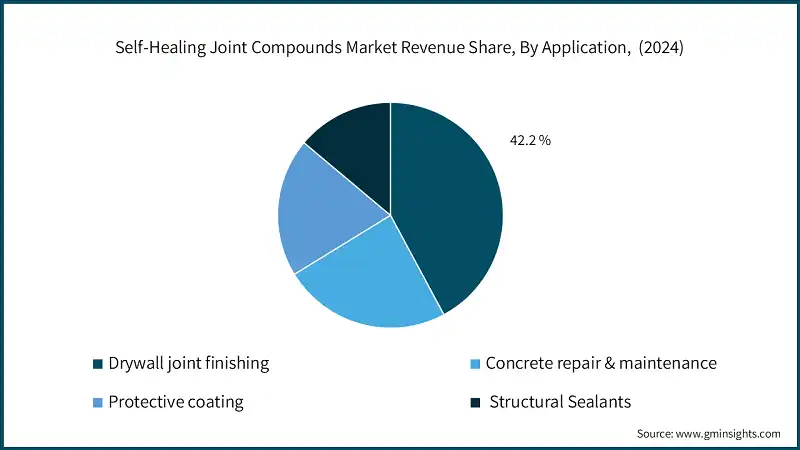
Based on application, the self-healing joint compounds market is segmented into drywall joint finishing, concrete repair & maintenance, protective coating, and structural sealants. The concrete repair & maintenance was valued at 42.2% market share in 2024. The majority of these activities are the result of rapidly growing infrastructure around the world, as bridges tunnels all require maintenance.
- Protective coatings are also growing, and they account roughly 24.1% of the market share in 2024 as they are increasingly used in harsh environments, such as offshore and industrial locations, to guard against corrosion and moisture ingress and extend the life of architectural finishes and equipment.
- Finishing drywall joints holds around 19.9% of the market share in 2024, and it is growing further as contractors strive toward less callbacks and improved turnover times using compounds that effectively seal microcracks from daily thermal cycles. Structural sealants are about 13.9% of the total market in 2024 but very high in growth rate under stricter energy codes that ask for airtight building and water barriers with longer service lives.
Based on end-user industry, the self-healing joint compounds market is segmented into residential construction, commercial construction, infrastructure/civil engineering, industrial facilities, marine/offshore. The commercial construction dominates the market which was valued at USD 15.8 million in 2024.
- Segmentation of the commercial sector leads the market due to increasing urbanization, the demand for office buildings, retail space, and warehouses has surged to accommodate e-commerce activities. Infrastructure/civil engineering activities come a close second, with value of USD 14.7 million in 2024, empowered by solid government investments in public projects like highways, bridges, and transit systems, which aim for economic development and sustainability. The residential construction segment, valued at USD 9.2 million in 2024, is growing with a corresponding increase in demand for housing and residential complexes, as population and urban migration escalate.
- Increasing manufacturing and logistic demands include industrial facilities that are in demand and result in further growth in the market. The marine/offshore sector has been developing mainly under the increasing number of offshore energy projects and upgrading of coastal infrastructure. A shift in economy priorities growth for the segments since commercial and infrastructure sectors benefit from urban development and government spending. Residential growth is driven by population, while industrial facilities develop based on manufacturing needs; the demand for energy and transport leads to growth in marine/offshore.
Looking for region specific data?
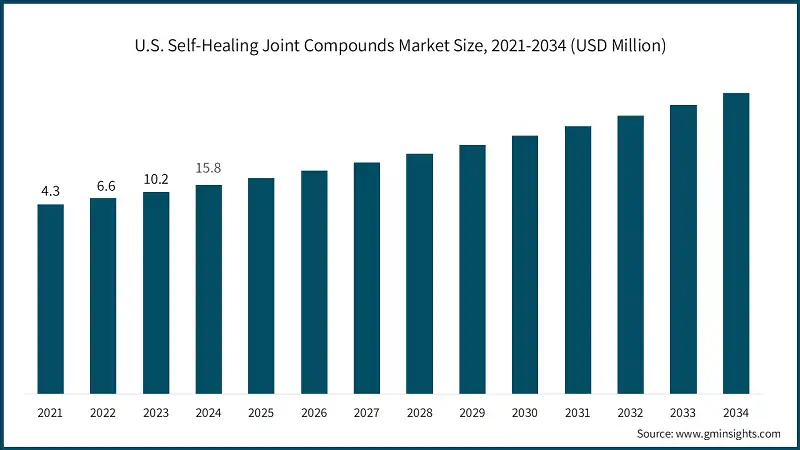
The U.S. self-healing joint compounds market accounted with value of USD 15.8 million in 2024.
- The North American market is driven by rising construction spending on infrastructure initiatives supported by the government, all aimed at durable, low-VOC materials. The initiatives in the U.S. for demonstration projects and full-scale training programs make the adoption and practical use of advanced compounds more viable. The technology needed for innovative development in drywall finishing, coatings, and sealants is strongly supported by the local R&D ecosystem from the universities and suppliers.
- The growth of the European market for self-healing joint compounds is in harmony with the EU Green Deal and the stringent renovation policies that focus on energy efficiency and the sustainability of materials. The influence of strict chemical regulations and harmonized standards promoting proven low-emission systems defines key markets such as Germany, the UK, France, Italy, and Spain. Research in biological and polymer technologies, accelerated through public and private funding such as Horizon Europe, is increasingly making its way to increased field validations, particularly in the transportation and public sectors
- The self-healing joint compounds industry across the Asia-Pacific is undergoing strong momentum primarily due to the large-scale modernization of infrastructure as well as the rapid pace of growing urbanization, which naturally demands ever more durable and scalable materials. With China's emerging markets propelled by manufacturing capabilities and economically viable high-speed transportation projects which require long-lasting sealing and finishing solutions. In India, expansion has been fueled by smart city initiatives along with mass housing developments targeted at lifecycle maintenance cost reduction.
- Extensive urban development and infrastructure projects are seen across major economies UAE, Saudi Arabia and South Africa, thus increasing the demand of self-healing joint compounds in the in the Middle East & Africa. Investments in smart cities, sustainable projects for buildings, and durable providing materials in extreme conditions demand further. In addition, several green building certification programs push forward market growth driven by regulation in low-maintenance, long-lasting construction materials. Further expansion in public-private partnership and regional funding in infrastructure also fuels adoption of modern practices in advanced joint compound technologies.
- In Latin America, the main driving force for the self-healing joint compounds market expansion is represented by increasing infrastructure investments along with housing development projects realized in Brazil, Mexico, and Argentina. Growing urbanization and necessity to upgrade infrastructure constructed many years ago entail relatively high demands for materials, reducing maintenance costs and at the same time contributing to the resilience of constructions in future. These governmental processes are motivating the adoption of green construction techniques and energy-efficient improvements within the scope of government initiatives. In addition, increasing awareness and adoption of innovative building materials through collaboration between local suppliers and international technology providers further enhance steady growth in the market.
Self-Healing Joint Compounds Market Share
The global self-healing joint compounds industry is moderately concentrated, with the top five players taking a 69.7% revenue share in 2024, with the market leader being Basilisk Concrete, which holds a 28.5% market share.
- The market for self-healing joint compounds is very dynamic, with the highly evolving construction industry increasingly demanding these alternative construction and repair materials to be tougher, less maintenance, and economical, especially in mega infrastructure and renovation projects.
- The top players in this market are heavily investing in R&D focused on polymer science, micro-encapsulation techniques, and bio-based healing agents for performance improvement under varied environmental and structural conditions.
- Innovation is also going beyond material formulation to include application, monitoring, and validation of these compounds on-site. Integration with smart construction systems and digital site diagnostics is becoming a key differentiator.
- There are efforts toward the production of application-friendly, regulation-compliant products that are in line with sustainability objectives and relevant building codes at different regional levels-the kind of people who stay way ahead in a value-driven and performance-sensitive market.
Self-Healing Joint Compounds Market Companies
Major players operating in the self-healing joint compounds industry include:
- Applied Nanotech Holdings, Inc.
- Autonomic Materials, Inc.
- BASF SE
- Basilisk Concrete
- CertainTeed Gypsum
- DuPont de Nemours, Inc.
- ITW Performance Polymers
- National Gypsum Company
- Sika AG
- United States Gypsum Company (USG)
Basilisk Concrete Basilisk is a Dutch company specializing in self-healing concrete technologies with bio-based agents to spontaneously heal cracks, thereby enhancing performance, maintenance periods, and cost. Having commercially launched some products and realized their projects in an operating infrastructure, the focus of Basilisk is to provide sustainable and durable repairs.
Sika AG Sika AG deals in specialty construction chemicals, offering advanced solutions including self-healing roofing membranes and high-performance repair mortars. Backed with state-of-the-art R&D and a global distribution network, Sika produces innovative and dependable materials, ensuring longer and sustainable life of any building structures.
BASF SE BASF SE is the world's leading chemical company with cutting-edge additives and admixtures for improving concrete performance that includes crack reducing and self-healing components. In construction industry BASF SE stands out as it has solutions that enhance durability and decrease lifecycle costs because of its strong research background and worldwide manufacturing.
DuPont de Nemours Du Pont de Nemours is a global company providing advanced materials and polymer technologies for the next generation of smart construction products, including emerging self-healing sealants and joint compounds. DuPont is known for innovation that mainly aims to enhance building resilience and sustainability through cutting-edge material science.
United States Gypsum Company (USG) United States Gypsum Company (USG) is a manufacturer of building materials and innovative construction solutions, specializing in drywall, joint compounds, ceiling systems, and related products. USG known for its commitment to sustainability and innovation, USG continues to deliver advanced solutions that meet the evolving needs of contractors, architects, and builders across North America.
Self-Healing Joint Compounds Market Report Attributes
| Key Takeaway | Details |
|---|---|
| Market Size & Growth | |
| Base Year | 2024 |
| Market Size in 2024 | USD 45.2 Million |
| Market Size in 2025 | USD 58.8 Million |
| Forecast Period 2025 - 2034 CAGR | 28.5% |
| Market Size in 2034 | USD 324.7 Million |
| Key Market Trends | |
| Drivers | Impact |
| Shift toward sustainable, low-VOC building materials | Self-healing joint compounds with low VOC formulations are in demand due to stricter indoor air quality regulations and growing awareness of health and environmental safety. |
| Growth of smart & sustainable construction | These compounds support green building standards by reducing the need for reapplication and material waste. This aligns with the growing global push for eco-friendly construction solutions. |
| Integration of smart sensors for structural health monitoring | Emerging innovations are combining self-healing compounds with embedded smart sensors to monitor microcracks, stress, and moisture levels in real time. This supports predictive maintenance in high-performance buildings, making the materials more attractive for critical infrastructure and smart construction projects. |
| Pitfalls & Challenges | Impact |
| Regulatory complexity & compliance costs | Navigating the evolving regulatory landscape for self-healing Joint Compounds can be complicated and resource intensive. |
| Compatibility issues with existing materials | Some self-healing compounds struggle to bond well with legacy construction materials, especially in renovation or mixed-material applications. This creates performance inconsistencies, affecting contractor trust and slowing repeat usage. |
| Opportunities: | Impact |
| Expansion in green building certifications | Self-healing joint compounds contribute to LEED, BREEAM, and other sustainability certifications by reducing material waste and enabling longer lifecycle performance, opening doors in eco-conscious construction projects. |
| Integration with Smart Building Technologies | Theres rising potential for self-healing materials to pair with smart sensors for real-time structural monitoring. This creates new value in high-tech infrastructure and intelligent building systems. |
| Market Leaders (2024) | |
| Market Leaders |
28.5% market share |
| Top Players |
Collective market share in 2024 is 69.7% |
| Competitive Edge |
|
| Regional Insights | |
| Largest Market | Asia Pacific |
| Fastest Growing Market | North America |
| Emerging Country | U.S., Canada |
| Future Outlook |
|
What are the growth opportunities in this market?
Self-Healing Joint Compounds Market News
- In June 2025, ITW Performance Polymers launched the Chockfast Red Versaflow 1-Bag Kit, a next-generation epoxy grout designed for fast, durable repairs in small or hard-to-reach areas. The pre-measured kit affords fast flow, good compressive strength (14,100 psi), and easy application with no special equipment required. This product is excellent for industrial and infrastructure applications, providing superior joint and crack repair, in keeping with the ever-increasing demand for advanced repair materials in the construction and maintenance markets.
- In May 2024, Southern Wall Products, Inc., a manufacturer of drywall finishing products, selected Anderson County to establish the company’s first South Carolina operation. Southern Wall Products manufactures and sells finishing solutions for the drywall industry under the Ruco brand name. The company produces ready-mix joint compound, ceiling textures, setting compounds and primers.
The self-healing joint compounds market research report includes in-depth coverage of the industry with estimates & forecast in terms of revenue (USD Million) and volume (Kilo Tons) from 2021 to 2034, for the following segments:
Market, By Technology Type
- Microcapsule-based Systems
- Bacterial/Biological Systems
- Polymer-based Intrinsic Healing
- Vascular Network Systems
Market, By Application
- Drywall Joint Finishing
- Concrete Repair & Maintenance
- Protective Coatings
- Structural Sealants
Market, By End Use Industry
- Residential Construction
- Commercial Construction
- Infrastructure/Civil Engineering
- Industrial Facilities
- Marine/Offshore
The above information is provided for the following regions and countries:
- North America
- U.S.
- Canada
- Europe
- UK
- Germany
- France
- Italy
- Spain
- Rest of Europe
- Asia Pacific
- China
- India
- Japan
- South Korea
- Australia
- Rest of Asia Pacific
- Latin America
- Brazil
- Mexico
- Argentina
- Rest of Latin America
- MEA
- UAE
- Saudi Arabia
- South Africa
- Rest of Middle East and Africa
Frequently Asked Question(FAQ) :
What is the market size of the self-healing joint compounds in 2024?
The market size was USD 45.2 million in 2024, with a CAGR of 28.5% expected through 2034 driven by R&D advancements and rising infrastructure investments across North America and Asia Pacific.
What is the projected value of the self-healing joint compounds market by 2034?
The self-healing joint compounds market is expected to reach USD 324.7 million by 2034, propelled by sustainable construction practices, integration with smart building technologies, and expansion in green building certifications.
What is the current self-healing joint compounds market size in 2025?
The market size is projected to reach USD 58.8 million in 2025.
How much revenue did the microcapsule-based systems segment generate in 2024?
Microcapsule-based systems held a significant market share of 39.3% in 2024, led by ease of integration into existing joint compound formulations and relatively low-cost manufacturing.
What was the valuation of concrete repair & maintenance application segment in 2024?
Concrete repair & maintenance accounted for 42.2% market share in 2024, supported by rapidly growing infrastructure worldwide including bridges and tunnels requiring maintenance.
Which region leads the self-healing joint compounds market?
The U.S. self-healing joint compounds market was valued at USD 15.8 million in 2024, driven by rising construction spending and government-supported infrastructure initiatives.
What are the upcoming trends in the self-healing joint compounds market?
Key trends include shift toward sustainable low-VOC building materials, integration of smart sensors for structural health monitoring, adoption of embedded sensors with wireless gateways for predictive maintenance, and advancements in microencapsulation and controlled-release technologies.
Who are the key players in the self-healing joint compounds market?
Key players include Applied Nanotech Holdings Inc., Autonomic Materials Inc., BASF SE, Basilisk Concrete, CertainTeed Gypsum, DuPont de Nemours Inc., ITW Performance Polymers, National Gypsum Company, Sika AG, and United States Gypsum Company (USG).
Self-Healing Joint Compounds Market Scope
Related Reports