Summary
Table of Content

Self-healing Flooring Materials Market
Get a free sample of this report
Form submitted successfully!
Error submitting form. Please try again.
Thank you!
Your inquiry has been received. Our team will reach out to you with the required details via email. To ensure that you don't miss their response, kindly remember to check your spam folder as well!
Request Sectional Data
Thank you!
Your inquiry has been received. Our team will reach out to you with the required details via email. To ensure that you don't miss their response, kindly remember to check your spam folder as well!
Form submitted successfully!
Error submitting form. Please try again.
Self-healing Flooring Materials Market Size
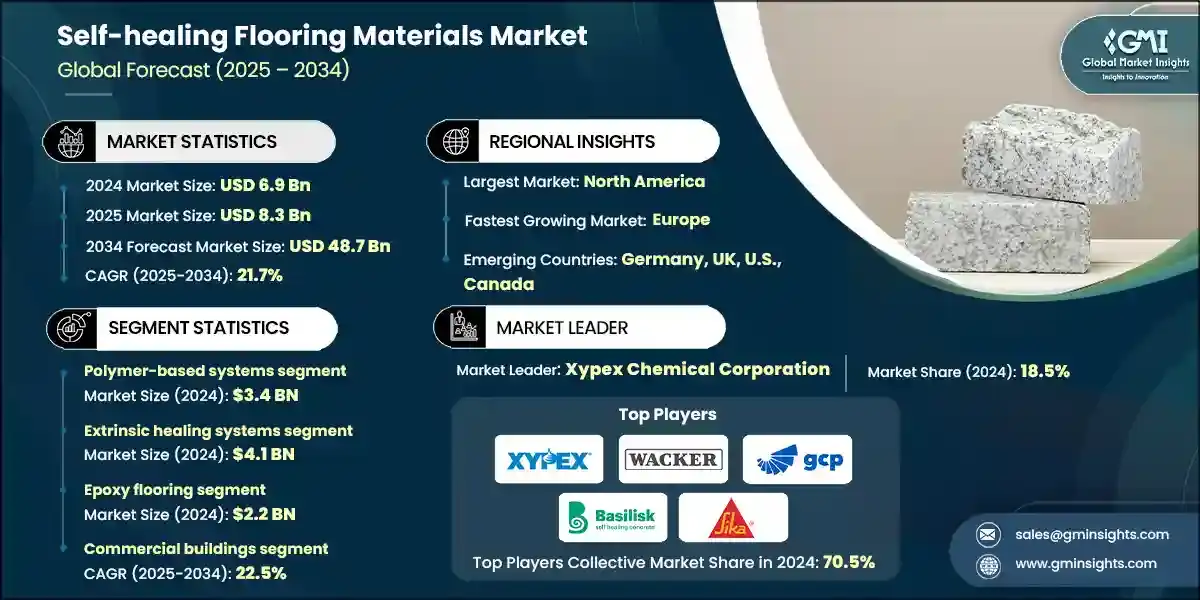
The global self-healing flooring materials market was estimated at USD 6.9 billion in 2024. The market is expected to grow from USD 8.3 billion in 2025 to USD 48.7 billion by 2034, at a CAGR of 21.7%, according to latest report published by Global Market Insights Inc.
To get key market trends
- Increasing demand for durable and low-maintenance floorings in various end use sectors is being witnessed, and thus the global self-healing flooring materials market is growing fast in its growth trajectory. The market reflects the growing acceptance of advanced materials technologies in construction and industrial applications.
- Total market value is contributed to by the floorings under different types such as epoxy, polyurethane, vinyl, concrete, rubber composites, and smart modular tiles indeed because individual adoption and price premiums. Epoxy flooring with 32.1% market share is in the lead followed by polyurethane with 23.1% market share, suggesting that these materials are well established for industrial as well as commercial applications in 2024.
- Self-healing floors are demanded more as they minimize maintenance costs and downtime of high-traffic environments, such as airports, hospitals, and commercial complexes. Research shows that self-healing polymers can reclaim a considerable share of their original mechanical strength when damaged, so they function well in flooring applications where they are commonly subjected to abrasion and impact. By minimizing the need for replacements, self-healing flooring also ensures sustainable floor systems by minimizing material waste and carbon emissions from flooring production.
- Recent developments have led to floor systems addressing the coalescence of self-healing and other properties: for instance, antimicrobial surfaces and thermal stability. Among the most promising candidates for such flooring coatings are vitrimers and supramolecular polymers with their unique ability for mild repeated healing while retaining mechanical strength. The developments are relevant for cushioning hygienic and sturdy surface demands, such as in healthcare and food processing facilities.
Self-healing Flooring Materials Market Report Attributes
| Key Takeaway | Details |
|---|---|
| Market Size & Growth | |
| Base Year | 2024 |
| Market Size in 2024 | USD 6.9 Billion |
| Market Size in 2025 | USD 8.3 Billion |
| Forecast Period 2025 - 2034 CAGR | 21.7% |
| Market Size in 2034 | USD 48.7 Billion |
| Key Market Trends | |
| Drivers | Impact |
| Infrastructure Maintenance Cost Reduction | Drives adoption of self-healing materials in commercial and public infrastructure projects to lower lifecycle expenses |
| Healthcare Infection Control Requirements | Boosts demand in healthcare settings where contamination risks necessitate advanced, low-maintenance flooring. |
| Industrial Downtime Minimization Needs | Encourages integration of self-healing floors in manufacturing and logistics facilities to ensure operational continuity. |
| Pitfalls & Challenges | Impact |
| High Initial Investment & Catalyst Costs | Slows adoption in cost-sensitive sectors, limiting penetration in developing regions and small-scale projects. |
| Installation Complexity & Contractor Training | Creates a barrier for widespread implementation, especially in regions lacking skilled workforce or training infrastructure. |
| Opportunities: | Impact |
| Post-Pandemic Healthcare Facility Expansion | Opens large-scale opportunities for self-healing flooring in new hospitals, clinics, and medical centers prioritizing infection control and durability. |
| Government Infrastructure Modernization | Accelerates adoption of self-healing flooring in government buildings, transport hubs, and educational institutions as part of smart infrastructure programs. |
| Market Leaders (2024) | |
| Market Leaders |
18.5% market share |
| Top Players |
Collective market share in 2024 is 70.5% |
| Competitive Edge |
|
| Regional Insights | |
| Largest Market | North America |
| Fastest growing market | Europe |
| Emerging countries | Germany, UK, U.S., Canada |
| Future outlook |
|
What are the growth opportunities in this market?
Self-healing Flooring Materials Market Trends
- The predominant trend features microcapsule-based healing systems that can perform repairs with some measure of autonomy. Encapsulated healing agents are designed to be released upon mechanical damage, thus allowing for localized crack repair without the need for outside intervention, states research in Frontiers in Chemistry. The higher microcapsule designs incorporate double cores with separate resin-to-hardener components, thus improving healing efficiency and mitigating catalyst dependency issues.
- Increased adoption of bio-inspired mending technologies utilizing natural polymers, plant-derived oils, or bacteria mineralization processes has been stimulated mostly through environmental sustainability. Bio renewable mending agents made of renewable feedstock include answers to environmental concerns, yet they do not lack performance efficiency compared to synthetic counterparts.
- The digital transformation of construction opens an arena in which self-healing flooring can be integrated with smart building systems and IoT connectivity. With built-in sensors, the floor is monitored in real-time for condition, stress levels, and healing activity for predictive maintenance and to optimize overall building operations.
- Integration technologies for these sensors include strain gauges, acoustic emission detectors, and electrical conductivity monitors, where continuous assessment is provided for floor integrity and healing effectiveness. Data analytics platforms will process sensor information to predict when maintenance is needed and to time the activation of the healing system accordingly.
Self-healing Flooring Materials Market Analysis

Learn more about the key segments shaping this market
Based on material type, the market is segmented into polymer-based systems, cementitious/concrete-based systems, hybrid/composite systems, bio-based/sustainable materials, and others. The polymer-based systems hold a significant share at a valuation of USD 3.4 billion in 2024.
- Polymer-Based Systems accounts for 50% Market Share With 21.2% CAGR in the forecasted period self-healing flooring materials market due to their versatility and articulated manufacturing infrastructures. Their composition nearly always ranges between polyurethane, epoxy, and advanced polymer blends that incorporate healing mechanisms via microcapsule integration or through intrinsic molecular design.
- In respect of hybrid structural polymers-concrete, the improvement of concrete characteristics with the healing properties of advanced polymers. The systems usually use vascular networks or distributed microcapsule systems to carry the healing action while maintaining load-bearing state. Fiber reinforcement via self-healing polymer matrices yields composite systems with better toughness and crack resistance.
- Microcapsule-enhanced concrete has shown healing efficiencies as high as 82.6% for healing shallow cracks where performance decreases with increasing depth of the cracks. The optimal microcapsule dosages of 3 to 5% by cement mass support good effective healing while still maintaining structural integrity. The advanced cementitious system involves the ultrasonic activation of the healing agents for effective distribution and release.
Based on self-healing mechanism, the market is segmented into extrinsic healing systems, intrinsic healing systems, and others. The extrinsic healing systems segment was valued at USD 4.1 billion in 2024.
- Extrinsic Healing Systems and the other systems operate mostly on microcapsule and vascular network technologies. These systems can store their healing agents in discrete reservoirs for localized repair, releasing the healing substance upon damage without needing an external activation source.
- Microcapsule-based extrinsic systems have demonstrated commercial viability with established processes, and they have predictable performance characteristics. The typical range of capsule sizes is between 3-150 micrometers, depending on application requirements, and larger capsules would therefore contain greater volumes of healing agents but may affect base material.
Based on flooring type, the market is segmented into epoxy flooring, polyurethane flooring, vinyl flooring, concrete flooring, rubber/composites flooring, and smart modular tiles. The epoxy flooring segment was valued at USD 2.2 billion in 2024.
- Epoxy flooring holds 32.1% market share, driven by the long-established applications in industrial and commercial applications. Seamless and chemical resistant surfaces, which are perfectly suitable for manufacturing facilities, laboratories, and health care environments.
- Self-healing industrial epoxy applications maintain surface integrity during heavy equipment usage and the above-mentioned exposure to chemicals. Microcapsule incorporation provides crack repair properties together with inherent chemical resistance and mechanical properties required in industrial environments. These new formulations often include antimicrobial additives for hygiene performance enhancement.
- Commercial polyurethane applications consist of retail spaces, offices, and hospitality areas where appearance maintenance as well as durability are crucial. Besides enhancing life-cycle cost benefits through retention appearance and decreasing refinish intervals, self-healing also increases end use retention. Advanced systems now include color-change indicators that signal healing activity.
- Applications in industrial concrete can take advantage of its self-damage healing property because of the characteristic features of such concrete, namely continuing load-bearing capacity, and the prevention of crack propagation. In the several types of bacterial healing systems, the integration of a microcapsule has been introduced as a complementary solution suitable for different crack types and environmental conditions. The large-scale demonstration would then concern infrastructure projects validating commercial viability and performance benefits.
Learn more about the key segments shaping this market
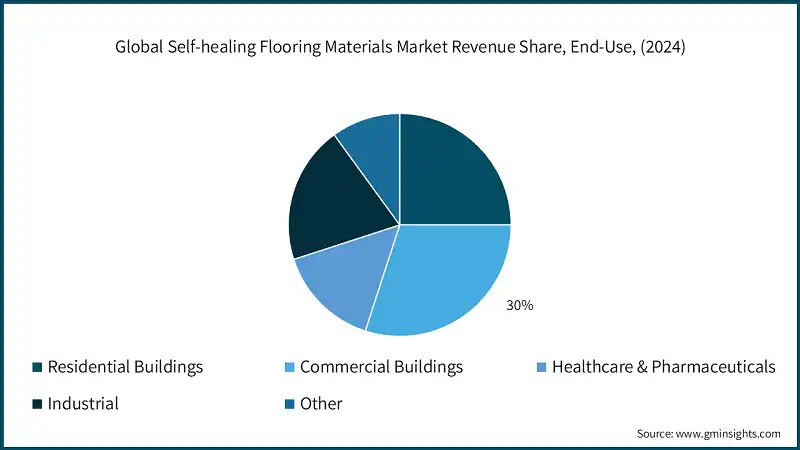
Based on end use, the market is segmented into residential buildings, commercial buildings, healthcare & pharmaceuticals, industrial, and other. The commercial buildings are estimated to grasp a value of USD 2.1 billion in 2025 and is expected to grow at 22.5% of CAGR during the forecast period.
- The self-healing floor materials are fast making a mark in various end use industries as they provide the cost-effective solutions to maintenance charges besides adding to the life service of its application. The residential houses and official buildings also emerge as significant adoption areas, adding to the importance of the floor since it must be aesthetically pleasing, durable, and cover the wear and tear of daily use. These materials are a great proposition to property owners for high traffic spaces, such as malls and offices, as they limit downtime and repair costs.
- Healthcare and pharmaceutical facilities have stringent hygiene requirements and high footfalls, which make them major consumers. The self-healing floors will restore seamless surfaces and can combine with antimicrobial properties so that health standards remain priority. Intense competition in industrial environments for these materials to have the floor maintain an integrity structure under heavy loads and harsh environments besides the few operational disruptions caused. Other areas such as public infrastructure and education are using these solutions for the long haul of sustainability and cost efficiency.
Looking for region specific data?
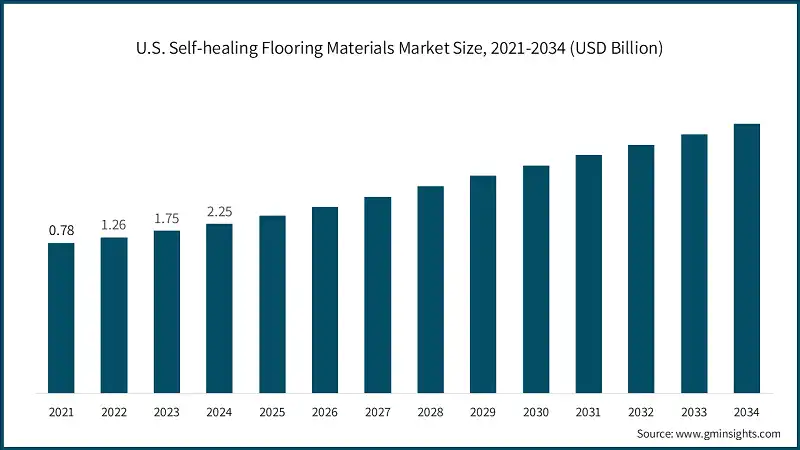
North America self-healing flooring materials market accounted for USD 2.8 billion in 2024 and is anticipated to show lucrative growth over the forecast period.
- North America, which has 41.5% market share in 2024, is demanding advanced construction standards, healthcare infrastructure, and industrial facility upgrades. United States is the biggest single-country market owing to stringent building codes and performance specifications in favor of advanced material technologies.
- Major enablers for hospital construction and clinical facility construction to embrace self-healing flooring systems are hygiene control and lower maintenance requirements. Gerflor USA documentation on healthcare construction in the U.S. finds very favorable conditions for self-healing flooring adoption based on seamless and hygienic surfaces.
- Production sites and maintenance interventions related to downtimes in production are assisted with self-healing technology applied in industrial method applications. High-end applications in pharmaceutical manufacturing, electronics, and precision manufacturing provide acceptance of higher price points for self-healing flooring systems.
Europe accounted for USD 2 billion in 2024 and is anticipated to show lucrative growth over the forecast period.
- The self-healing flooring materials market in Europe enjoys great popularity because of its firm regulatory framework promoting green building practices and sustainability. Germany, the UK, and France are leading the way in increased adoption of advanced materials in construction and infrastructure projects.
- The sector, owing to its mature construction climate and the high level of awareness regarding the environmental and economic benefits of self-healing technologies, allows such technologies to thrive. Manufacturers in Europe are pumping huge investments into nanotechnology and bio-based polymers, which are finding more space in flooring systems. Furthermore, strategic partnerships between academia and industry expedite the innovative development of self-healing flooring solutions for residential and commercial applications.
Asia Pacific self-healing flooring materials market accounted for USD 1.3 billion in 2024 and is anticipated to show lucrative growth over the forecast period.
- Market share of Asia Pacific stands at 18.4% market share in 2024 as the region drives rapidly along with the growing urbanization, infrastructure, and manufacturing sectors. The region's major contributors to growth are China and India in which the construction facilities and industrial facilities are booming.
- The surge in the manufacturing sector for electronics, automotive, and chemical processes is more likely to create a development demand on high-performance flooring solutions during production disruption. This self-healing technology is concerned about maintenance issues in environments with high throughput in manufacturing, where the cost of downtime is significant.
Latin America self-healing flooring materials market accounted for 7.2% share in 2024 and is anticipated to show steady growth over the forecast period.
- The market in Latin America is gradually changing as people are now opting advanced construction materials. Brazil and Mexico stir infrastructural activities that continuously create chances for using self-healing flooring solutions. These types of materials are considered as they can withstand environmental stress and reduce the frequency of repairs in both industrial and commercial applications. Apart from that, the improvement of building standards through governmental programs is one factor contributing to the development of the market.
Middle East and Africa market accounted for 3.6% market share in 2024 and is anticipated to show steady growth over the forecast period.
- Self-healing flooring materials in the Middle East and Africa are being explored as a part of the different efforts geared towards enhancing infrastructure durability and sustainability. Large construction projects, especially in the Gulf countries, are implementing new materials to deal with the challenges due to extreme temperatures and heavy traffic. Interest is growing in smart and green building technologies with self-healing flooring being assessed for its potential in prolonging the life and efficiency of structures.
Self-healing Flooring Materials Market Share
Xypex Chemical Corporation, Wacker Chemie AG, Saint Gobain, Basilisk BV, and Sika Group constitute a larger part of the global self-healing flooring materials and with the further standing of being moderately concentrated with the top five players steadily holding market share 70.5% in the year 2024. Concentration is characteristic of the specialized nature of self-healing technologies and the substantial R&D investment costs that must be incurred to achieve commercialization. Activities in this field seek to develop proprietary formulations and advanced material science solutions that deliver these autonomous repair capabilities to improve durability and reduce lifecycle costs.
The competitive landscape receives input from advances along crystalline, polymer-based, and bio-based healing systems while maintaining compatibility with modern concrete mixtures and sustainability requirements. Strategic alliances with contractors, material suppliers, and research institutions are common, supporting performance validation and widespread acceptance. High barriers to entry, such as patent protection, technical know-how, and long-term testing requirements, are favorable to the already established players, while continuous R&D investments are aimed at distinguishing the offerings based on improved healing efficacy, cost-effectiveness, and versatility for residential, commercial, and infrastructure applications.
Self-healing Flooring Materials Market Companies
Major players operating in the self-healing flooring materials industry are:
- Xypex Chemical Corporation
- Green-Basilisk BV
- Sika Group
- Oscrete Construction Products
- Fescon Oy
- Wacker Chemie AG
- Polycoat Products
- Saint Gobain
- Corbion
- Giatec Scientific Inc.
- HEGGEL GmbH
- SCHOMBURG GmbH
- Minicrete
- Sensicon Ventures Ltd
- Pacific Northwest National Laboratory (PNNL)
Xypex Chemical Corporation innovates new defined marketed products with crystalline waterproofing and self-healing concrete technologies. The company has proprietary technology that enables permanent waterproofing and self-healing capabilities to be employed for concrete structures by crystallization. It is established the year 1969 and has reached a worldwide market with manufacturing and distribution facilities in the Americas, Europe, Asia, and beyond.
Wacker Chemie AG adds state-of-the-art polymer and silicone technologies for self-healing applications. The German chemical company has deep expertise in polymer chemistry and materials science, allowing it to develop intrinsic healing systems and advanced polymer formulations. Additionally, Wacker has developed silicone-based healing systems, bringing innovative distinctive properties with respect to temperature stability and chemical resistance.
Saint-Gobain (GCP) Construction Chemicals, through its brands CHRYSO and GCP, has specialized knowledge and experience in concrete admixture technologies aimed at promoting self-healing and sustainable construction solutions. With worldwide reach and deep technical expertise, the company promotes large-scale application developments and market entries into various geographies.
Basilisk BV was the pioneer of bacterial self-healing concrete technology through the Basilisk system. The company, based in the Netherlands, takes a bio-based approach, using bacteria that generate limestone and are insentient in concrete until activated by cracks with permeation of water. This biological healing mechanism can provide very long-term repair and fulfill the sustainability requirements through natural processes.
The Sika Group capitalizes on its knowledge of construction chemicals to develop and market self-healing flooring solutions. The company's global reach and established customer relationships give Sika competitive advantages for adoption of self-healing technologies. Sika's strategy integrates polymer-based healing systems with traditional construction chemical product lines.
Self-healing Flooring Materials Market News
- In July 2025, Egger Flooring re-entered the U.S. laminate market due to renewed demand for durable high-quality flooring materials, with challenges on SPC and WPC products, aimed towards the bigger retailers and distributors.
- In June 2024, EUROBOND and RHEINZINK have introduced a self-healing zinc material to India, establishing a new benchmark in architectural flooring and façade materials with its eco-friendly, durable, and age-defying features.
- In April 2023, Evonik enlarged its global capacity for VESTAMID E PEBA, a high-performance polymer used in lightweight and durable flooring materials for athletic and industrial applications, with increasements in production in Asia and Germany to satisfy higher demand.
The self-healing flooring materials market research report includes in-depth coverage of the industry with estimates & forecast in terms of revenue (USD Billion) & volume (Kilo Tons) from 2021 to 2034, for the following segments:
Market, By Material Type
- Polymer-based systems
- Epoxy Resins
- Polyurethane
- Acrylic & methacrylate
- Polyurea
- Polydimethylsiloxane (PDMS)
- Cementitious/concrete-based systems
- Portland cement matrix
- Geopolymer systems
- Fiber-reinforced variants
- Hybrid/composite systems
- Polymer-concrete composites
- Fiber-reinforced polymers (FRP)
- Multi-layer systems
- Bio-based/sustainable materials
- Plant-based polymer systems
- Recycled content integration
- Biodegradable components
- Others
Market, By Self-Healing Mechanism
- Extrinsic healing systems
- Microcapsule-based healing agents
- Vascular network-based systems
- Encapsulated bacteria/enzyme system
- Hollow fiber integration
- External reservoir systems
- Intrinsic healing systems
- Dynamic covalent networks
- Supramolecular interactions
- Shape memory polymers
- Metal-ligand coordination
- Hydrogen bonding systems
- Temperature-responsive systems
- Self-assembly mechanisms
- Others
Market, By Flooring type
- Epoxy flooring
- Polyurethane flooring
- Vinyl flooring
- Luxury vinyl tile
- Vinyl composite tile
- Concrete flooring
- Rubber/composites flooring
- Smart modular tiles
Market, By End Use
- Residential buildings
- Commercial buildings
- Office buildings
- Retail facilities
- Educational institutions
- Hospitality & entertainment
- Sports & recreation
- Data centers
- Healthcare & pharmaceuticals
- Hospital operating rooms
- Sterile processing areas
- Laboratory facilities
- Pharmaceutical manufacturing
- Industrial buildings
- Chemical processing plants
- Automotive assembly
- Electronics manufacturing
- Aerospace facilities
- Other
The above information is provided for the following regions and countries:
- North America
- U.S.
- Canada
- Europe
- UK
- Germany
- France
- Italy
- Spain
- Rest of Europe
- Asia Pacific
- China
- India
- Japan
- South Korea
- Australia
- Rest of Asia Pacific
- Latin America
- Brazil
- Mexico
- Argentina
- Rest of Latin America
- MEA
- UAE
- Saudi Arabia
- South Africa
- Rest of Middle East and Africa
Frequently Asked Question(FAQ) :
Who are the key players in the self-healing flooring materials market?
Key players include Xypex Chemical Corporation, Green-Basilisk BV, Sika Group, Oscrete Construction Products, Fescon Oy, Wacker Chemie AG, Polycoat Products, Saint Gobain, Corbion, Giatec Scientific Inc., HEGGEL GmbH, SCHOMBURG GmbH, Minicrete, Sensicon Ventures Ltd, and Pacific Northwest National Laboratory (PNNL).
What are the upcoming trends in the self-healing flooring materials market?
Key trends include the integration of IoT sensors and AI analytics for predictive maintenance, the adoption of bio-based self-healing agents, and alignment with green building standards.
Which region leads the self-healing flooring materials market?
North America held a 41.5% share with USD 2.8 billion in 2024. The region's dominance is fueled by advanced construction standards, healthcare infrastructure, and industrial facility upgrades.
What is the growth outlook for commercial buildings from 2025 to 2034?
The commercial buildings segment is projected to grow at a 22.5% CAGR through 2034, supported by the need for cost-effective maintenance solutions and durability in high-traffic areas.
What was the valuation of the extrinsic healing systems segment in 2024?
The extrinsic healing systems segment was valued at USD 4.1 billion in 2024, as its reliance on microcapsule and vascular network technologies for localized repair.
How much revenue did the polymer-based systems segment generate in 2024?
Polymer-based systems generated USD 3.4 billion in 2024, holding a significant 50% market share due to their versatility and advanced manufacturing infrastructure.
What is the current self-healing flooring materials market size in 2025?
The market size is projected to reach USD 8.3 billion in 2025.
What is the market size of the self-healing flooring materials in 2024?
The market size was USD 6.9 billion in 2024, with a CAGR of 21.7% expected through 2034, driven by increasing demand for durable and low-maintenance flooring solutions across various sectors.
What is the projected value of the self-healing flooring materials market by 2034?
The self-healing flooring materials market is expected to reach USD 48.7 billion by 2034, propelled by advancements in material technologies and growing adoption in construction and industrial applications.
Self-healing Flooring Materials Market Scope
Related Reports