Summary
Table of Content

Self-Checkout System Market
Get a free sample of this report
Form submitted successfully!
Error submitting form. Please try again.
Thank you!
Your inquiry has been received. Our team will reach out to you with the required details via email. To ensure that you don't miss their response, kindly remember to check your spam folder as well!
Request Sectional Data
Thank you!
Your inquiry has been received. Our team will reach out to you with the required details via email. To ensure that you don't miss their response, kindly remember to check your spam folder as well!
Form submitted successfully!
Error submitting form. Please try again.
Self-Checkout System Market Size
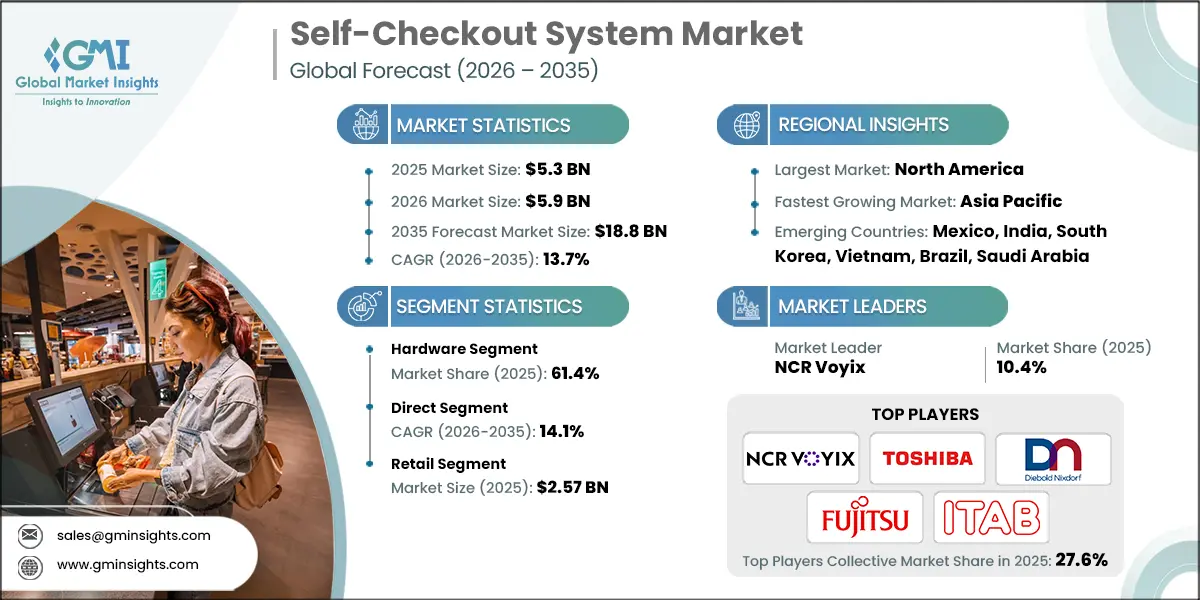
The global self-checkout system market size was valued at USD 5.3 billion in 2025. The market is expected to grow from USD 5.9 billion in 2026 to USD 18.8 billion in 2035 at a CAGR of 13.7%, according to latest report published by Global Market Insights Inc.
Self-Checkout System Market Key Takeaways
Market Size & Growth
- 2025 Market Size: USD 5.3 Billion
- 2026 Market Size: USD 5.9 Billion
- 2035 Forecast Market Size: USD 18.8 Billion
- CAGR (2026–2035): 13.7%
Regional Dominance
- Largest Market: North America
- Fastest Growing Region: Asia Pacific
Key Market Drivers
- Rising Demand for Contactless and Faster Checkout Experience.
- Growing Adoption of Automation in Retail Stores.
- Reduced Operational Costs for Retailers.
- Expansion of Supermarkets, Hypermarkets, and Convenience Stores.
Challenges
- High Initial Deployment and Maintenance Costs.
- Limited Adoption in Small and Budget-Constrained Retailers.
Opportunity
- Growing Demand from Emerging Markets and Developing Economies.
- Rising Adoption in Non-Retail Segments.
- Expansion of AI-Powered Autonomous Checkout Solutions.
- Integration with Mobile Apps, Loyalty Programs, and Analytics.
Key Players
- Market Leader: NCR Voyix led with over 10.4% market share in 2025.
- Leading Players: Top 5 players in this market include NCR Voyix, Toshiba Global Commerce Solutions, Diebold Nixdorf, Fujitsu, ITAB, which collectively held a market share of 27.6% in 2025.
Get Market Insights & Growth Opportunities
A growing volume of customers across the world, whether in the shopping malls, theatres, restaurants, bus stations, railways, airports or hospitals, puts an extreme load on the counter or billing desk. Such huge customer volume makes places more crowded as well, and tackling such customer crowds isn’t easy nowadays. Thus, self-checkout systems are now getting deployed in these places.
For instance, in January 2025, NCR Voyix, a leader in self-checkout solutions, released key findings from its 2025 Commerce Experience Report that found almost 77% of shoppers choose self-checkout for faster service in the United States. In which Gen Z and Millennial grocery shoppers are the biggest adopters of self-checkout. The majority (63%) of Gen Z shoppers (ages 18 to 29) prefer self-checkout.
These systems allow customers to complete purchases faster, without the need for store assistance, reducing waiting times and improving overall satisfaction. Furthermore, the self-checkout system facilitates sales for salespeople and redistributes employees to other areas of the store.
Another survey shows that self-checkouts offer valuable efficiencies in retail, reducing checkout times by up to 50%. Such time reductions in the checkout process increase operational efficiencies by shifting staff from the billing desk to other tasks that cut costs to the company because a single staff member can supervise multiple self-checkout stations, effectively serving more customers simultaneously than a traditional lane.
To get key market trends
Self-Checkout System Market Trends
The worldwide market for self-checkout systems is moving strongly toward cashless self-checkout systems. Contactless payment methods, like digital wallets, are being expanded to meet different store needs.
From the suppliers' side, key players of self-checkout systems are increasing their product efficiencies by using AI to make scanning faster and prevent losses. For example, OEMs such as Fujitsu, NCR and Diebold are benefiting from this technology. They are also creating systems that combine manned and self-service options.
Moreover, shoppers want faster and easier shopping, with 77% choosing self-checkout to save time. Younger groups, like Gen Z and Millennials, are driving the use of self-checkout because they prefer quick and independent transactions. After the pandemic, more people now prefer touchless shopping in busy stores.
Retailers are using self-checkout systems in supermarkets and convenience stores to save on labor costs during worker shortages. Retail chains are also adding self-service options in pharmacies and fuel stations. They are connecting kiosks with mobile apps to make online and in-store shopping smoother.
North America leads in using new technology, with big investments from major companies. Asia-Pacific is growing quickly due to urbanization and retail digitization in countries like China and India. In Europe, chains like Lidl are expanding self-checkout systems because of competition in the market.
Self-Checkout System Market Analysis
Learn more about the key segments shaping this market
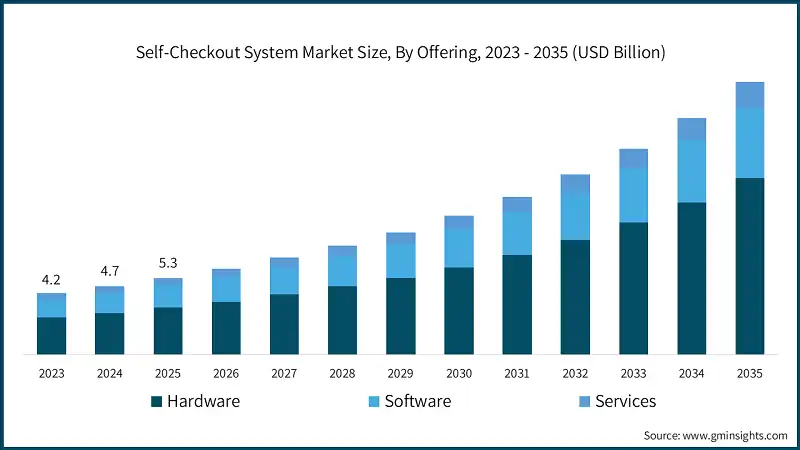
Based on offering, the self-checkout system market is divided into hardware, software and services. The hardware segment dominated the market with 61.4% share in 2025.
- The hardware segment leads the self-checkout system market because retail stores need durable scanners, touchscreens, and payment terminals. In 2025, the hardware segment was valued at USD 3.25 billion, making it the largest part of the market. Retailers prefer strong and reliable devices to handle daily use and ensure smooth checkout processes in supermarkets and convenience stores.
- The hardware segment is also expected to grow the fastest, with a high CAGR of 14.2% from 2026 to 2035. OEMs are now offering systems with built-in software, which strengthens the hardware's position in the market. These all-in-one systems make it easier for retailers to install and upgrade, saving time and reducing costs.
- These systems improve efficiency and support hybrid checkout models. Retailers like these ready-to-use systems because they help modernize stores quickly and improve customer flow without needing separate software.
- As hardware demand grows, services will also become more important. Services are needed to install, set up, and maintain these advanced self-checkout systems. Retailers will rely on vendors for software updates, security fixes, and hardware repairs.
Learn more about the key segments shaping this market
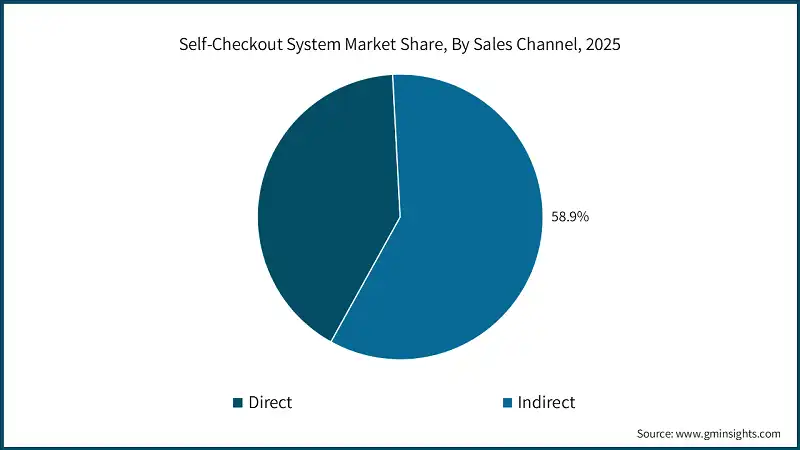
Based on sales channel, the self-checkout system market is divided into direct and indirect. The direct segment is expected to grow at the fastest CAGR of 14.1% between 2026 and 2035.
- Indirect sales channels were the largest ones in the market, which was valued at USD 3.12 billion in 2025. Retailers preferred to work with distributors and resellers because it allowed them to have access to many suppliers and also made the buying process more flexible.
- On the other hand, OEMs have their other view of the market because they want to be locally available for their customers. Thus, the direct sales channels are projected to have the highest growth rate, with a CAGR of 14.1% from 2026 to 2035.
- The OEMs are utilizing direct selling to establish closer ties with the big retail chains. This enables them to provide tailored solutions and quicker assistance. By cutting out the middleman, they can also minimize their expenses.
- For instance, Diebold Nixdorf in May 2025 started a new retail technology production line at North Canton, Ohio, in which self-checkout systems, including the DN Series EASY, will be manufactured. This initiative enhances the flexibility of manufacturing, caters to the increasing demand, and allows for better local support for U.S. retailers integrating digital and physical retail solutions.
Based on application, the self-checkout system market is divided into entertainment, healthcare, hospitality, retail, travel and others. In 2025, the retail segment led the market, reaching a market value of USD 2.57 billion.
- The retail sector leads with the largest share, around 48.5% in 2025. The sector has deployed the majority of the self-checkout systems worldwide. Supermarkets, hypermarkets and department stores use these systems to make checkouts faster and reduce the need for staff.
- In September 2024, Union Coop introduced self-checkout as a smart service. This allows customers to complete their purchases without needing a cashier. The retailer plans to add this service to all its branches soon, making shopping easier for customers. This highlights the retail sector's focus on faster and cashier-free shopping.
- Other industries are also using self-checkout systems. Cinemas use them for tickets and snacks to manage crowds quickly. Pharmacies in healthcare facilities use them to help patients pick up medicines faster. Hotels in the hospitality sector offer them for quick purchases. Airports use kiosks to reduce lines at gates and shops. These industries are expanding self-checkout use beyond just retail.
- In coming years, demand will be increased within the travel industry. From 2026 to 2035, this segment is expected to grow at a fast rate of 15.2% each year because of these improvements.
Looking for region specific data?
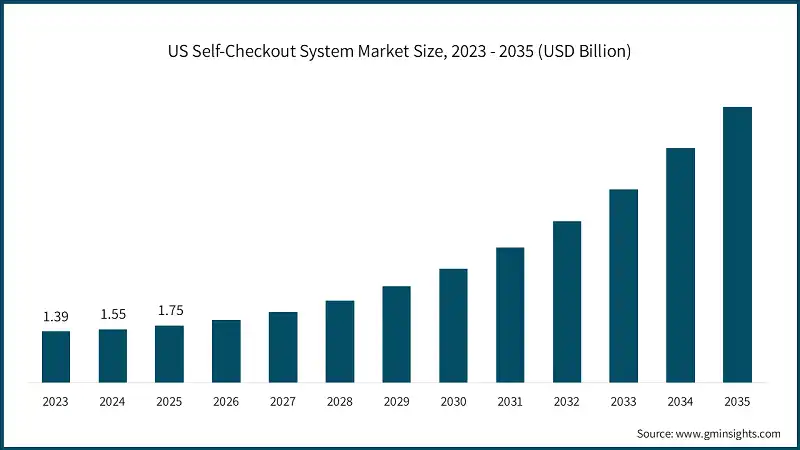
The US self-checkout system market reached USD 1.75 billion in 2025, growing from USD 1.55 billion in 2024.
- The largest supermarket chain in the United States where Walmart operates most of its outlets throughout the nation and dominates both, the revenue and the count of stores. The suppliers of the self-checkout system market are targeting the U.S. as their primary market and are building partnerships with the top retail chain leaders of the country.
- One such example is Walmart and NCR Voyix, the duo has been in a business relationship for a long time where NCR Voyix supports Walmart stores by providing the point-of-sale (POS) technology and self-checkout solutions.
- Furthermore, self-checkout systems are being added in grocery stores, big retailers, pharmacies, and convenience stores to cope with the rush in stores and frequent small purchases.
- From the consumer perspective, self-scanning and self-payment of items is becoming a more common practice among Americans. This is facilitated by the widespread acceptance of credit cards, mobile wallets, and contactless payments. Especially in cities and during busy hours many shoppers prefer to have quick “grab-and-go” shopping trips.
The North America self-checkout system market is estimated to reach USD 7.14 billion by 2035 and expected to grow at the CAGR of 13.7% between 2026 and 2035.
- North America is leading the trend of cashless economies that also accommodate cashier-less stores, popularly known as 'just walk out' stores, which are already in trend, and more and more retail outlets such as supermarkets, big-box retailers, pharmacies, and convenience stores are adopting self-checkout systems.
- The sensors and cameras along with digital payment systems are used in these stores to monitor the customers' activities and quickly charge them. The whole concept is to totally get rid of checkout lines and make shopping experience much more pleasant. At present, such stores are situated in limited locations, but they are impacting on the shopping habits and store layouts significantly.
- One of the major players in the market, Diebold Nixdorf, has recently announced the establishment of a new retail technology production line at its North America manufacturing facility in North Canton, Ohio, U.S., which can be seen as a step towards investing in the region. There are more examples like this that not only show the suppliers' movements but also their expansion strategies into the area.
The Europe self-checkout system market accounted for USD 1.63 billion in 2025 and is anticipated to grow at the CAGR of 12.9% between 2026 and 2035.
- The region shows a mixed pattern of human-machine deployment. However, retailers are transitioning from conventional checkouts to self-service checkouts. Therefore, the growth of the self-service checkout market in Europe has increased.
- In the UK, Germany and France the largest supermarket chain retailers (e.g, Tesco, Sainsbury's, Lidl) have led the transition in these countries from traditional checkout lanes and cashier-assisted shopping to self-service kiosk options for customers.
- Supermarket retailers and convenience store retailers typically have both cashier-assisted checkouts and self-service kiosk checkout systems as a means to address the needs of their customers while providing their employees with job efficiencies.
- Due to the shortage of labor and increased wages, retailers (pharmacies, convenience stores, grocery stores etc.) are adding self-service kiosk checkouts as an alternative means of processing customer checkouts.
Germany's self-checkout system market is growing quickly in Europe, with a strong CAGR of 13.6% between 2026 and 2035.
- Germany was already using self-checkout systems in more than 5,000 retail outlets which was analyzed in 2023, and the market is growing at a very fast pace every year. The implementation of AI cameras at self-checkouts was observed in some of the stores and supermarkets in Germany.
- Major companies like Aldi and Lidl are incorporating additional self-checkout machines into their stores as a way of cutting down on waiting periods and consequently reducing the number of cashiers needed.
- Shops located in busy urban areas are implementing a hybrid system consisting of traditional and self-checkout stations. Payment through apps or cards has been on the rise as a result of customers’ preferences for quicker and no-contact options.
The Asia Pacific self-checkout system market is estimated to reach USD 5.74 billion by 2035, by growing at a CAGR of 15.1% during the analysis timeframe.
- Modern retail stores grow in countries like China, Japan, Australia, and India. Supermarket, hypermarket, and convenience store chains, which operate on a large scale, are adding self-checkout to their stores in order to serve more customers and to be able to catch up with the changing needs of the customers.
- Over time, many countries have provided support in their respective markets by allowing and encouraging digital payments, thus they are pushing stores to adopt self-service technologies.
- In the midst of self-checkouts, the region is the fast-moving market due to rapid urbanization, raising middle-class incomes, and the increasing number of smartphone users. Retailers are not taking the long route by introducing the old systems, they are going straight through with the latest self-checkout systems with cashless payments being their only method right after the traditional cash registers.
China is estimated to grow with a CAGR of 14.7% in the projected period between 2026 and 2035, in the Asia Pacific self-checkout system market.
- Self-checkout systems in China are taking the lead and are fully supported by mobile payment platforms such as Alipay and WeChat Pay. The technologies allow users to pay easily and quickly, without any contact in supermarkets and convenience stores.
- Retailers such as Alibaba's Freshippo and JD.com are implementing facial recognition and AI to speed up the checkout process and minimize the number of staff required. The country’s authorities are also playing a role in developing digital infrastructure in urban areas.
- China has around 800 smart city projects, and this number is growing. These projects are expected to increase the use of self-checkout systems by connecting them with IoT networks.
Latin America self-checkout system market is estimated to reach USD 153.7 million in 2025 and is anticipated to show lucrative growth over the forecast period.
- Retailers in Brazil and Mexico are leading the use of self-checkout systems. Stores like Carrefour, Atacadão, and Walmart in Brazil are upgrading their machines to reduce waiting times and improve efficiency. In Mexico, Chedraui is using easy-to-use systems to give shoppers more choices, while Costa Rica's Megasuper is installing advanced machines. These changes are helping stores handle more customers and provide faster service.
- Supermarkets and grocery stores are driving the demand for self-checkouts as customers prefer quick and independent options instead of waiting in long lines. The growth of organized retail in cities is also encouraging this trend, combining self-service with staffed checkouts for flexibility.
- To make customers feel more comfortable, stores are using a mix of self-checkouts and staff assistance. This trend is spreading from big cities to smaller markets like Chile and Colombia, as stores compete to offer modern shopping experiences.
Brazil is estimated to grow with a CAGR of 8.2% between 2026 and 2035, in the Latin America self-checkout system market.
- More people in Brazilian cities are using cashless payments, so there is a higher demand for easy and quick checkout options. These kiosks help stores serve more customers during busy times without hiring extra staff.
- Big retail chains are adding self-checkout systems because shoppers like the speed and control they offer. The systems are now designed to be simple and easy to use, which helps avoid mistakes. Customers in supermarkets have given good feedback, and other types of stores are also starting to use self-checkouts to make shopping easier.
- Cashless payment options like NFC and digital wallets are making self-checkouts more popular. This works well with the rise in smartphone use in Brazil, allowing faster payments. Retailers are also adding tools to prevent theft and make self-checkouts safer. These systems are being set up in busy areas, combining automation with regular services to improve the shopping experience.
The Middle East and Africa self-checkout system market accounted for USD 75.9 million in 2025 and is anticipated to show lucrative growth over the forecast period.
- The demand is increasing in places like the UAE and South Africa, where more people use smartphones and digital wallets. Retailers in these countries are using self-checkout systems to update their stores and lower labor costs.
- Many stores are adding digital and contactless payment options to make transactions faster. As cities grow, supermarkets and hypermarkets are using these systems to handle more customers efficiently.
- Government plans for smart cities are helping stores upgrade their technology. Some stores are using a mix of self-checkout and staff assistance to make customers feel comfortable.
UAE to experience substantial growth in the Middle East and Africa self-checkout system market in 2025.
- Retailers in the UAE are using self-checkout systems to handle the large number of tourists and busy malls. Big chains like Carrefour and Lulu Hypermarket have added these systems in Dubai and Abu Dhabi to make shopping faster. The government is supporting smart retail technology, which is growing along with the use of cashless payments by both locals and expats.
- Supermarkets are leading this change by using a mix of manned and self-checkout systems to help shoppers adjust. Contactless payments like Apple Pay and NFC cards are becoming more popular as digital wallets grow.
- Hotels and airports are adding self-checkout kiosks to make transactions quicker. These kiosks work with loyalty apps to give regular customers special offers. There is also a focus on sustainability, with energy-saving kiosks being used in eco-friendly retail projects across the UAE.
Self-Checkout System Market Share
- The top 7 companies in the self-checkout system industry are NCR Voyix, Toshiba Global Commerce, Diebold Nixdorf, Fujitsu Limited, ITAB, ECR Software and HiStone POS, contributing 28.4% of the market in 2025.
- NCR Voyix provides self-checkout hardware like the R6 series and SELFSERV90. Their AI-powered software, Halo Checkout, uses computer vision to make item scanning faster and easier, improving the shopping experience and store operations.
- Toshiba Global Commerce offers self-checkout systems under the MxP Modular eXpansion Platform, including MxP SMART and MxP Vision Kiosk. These systems can handle cash or work cashless, making them flexible for different retail needs.
- Diebold Nixdorf has the DN Series EASY kiosks, including models like EASY ONE and EASY Pro. These kiosks are modular and can include cash handling, extra devices, and software, helping stores run smoothly.
- Fujitsu Limited makes the U-Scan family, including the compact U-SCAN BOLT and the larger U-SCAN Venture. These systems save space, hold more bags, and use AI Vision to recognize produce, making self-checkout easier.
- ITAB focuses on improving checkout with self-service systems like basket-to-bag and trolley-to-bag solutions. Their tools help stores move customers through faster and lower costs.
- ECR Software offers CATAPULT software and the Express Market Kiosk. Their features, like VisionMatch for production and AmbDex for scanning two items at once, make self-checkout simple and reduce the need for staff help.
- HiStone POS provides reliable self-checkout and EPOS systems. Their products are easy to use, work well, and fit both retail and hospitality businesses, making checkout better for customers.
Self-Checkout System Market Companies
Major players operating in the self-checkout system industry are:
- NCR Voyix
- Toshiba Global Commerce
- Diebold Nixdorf
- Fujitsu
- ITAB
- ECR Software
- HiStone POS
- StrongPoint ASA
- Pan-Oston
- Wintec
- NCR Voyix uses its large global network and advanced AI software, Halo, to connect a retailer's online and physical stores. This helps reduce theft and makes checkouts faster and easier.
- Toshiba Global Commerce focuses on strong, durable hardware (System 7) with a design that can be updated. Their systems are flexible and work well for different store types and customer needs, offering high reliability and easy access.
- Diebold Nixdorf offers the DN Series® EASY, a system that lets retailers combine different parts. This makes it cheaper to own and easier to upgrade in stores around the world.
- Fujitsu is known for its U-Scan systems and compact hardware like U-SCAN BOLT. They use AI to quickly recognize items and provide software that works with over 30 major POS systems worldwide.
- ITAB focuses on improving checkout areas by using data to design better store layouts. They provide solutions like basket-to-bag and belted systems, using their own hardware and software to speed up checkouts and lower labor costs.
- ECR Software uses the CATAPULT platform, where all systems work with the same logic. This reduces system issues and the need for fixes, mainly serving grocery stores in North America.
- HiStone POS provides reliable and fast hardware at affordable prices, often using advanced processors. Their systems focus on AI tools to prevent theft and identify fresh food, improving store operations and security.
Self-Checkout System Market Report Attributes
| Key Takeaway | Details |
|---|---|
| Market Size & Growth | |
| Base Year | 2025 |
| Market Size in 2025 | USD 5.3 Billion |
| Market Size in 2026 | USD 5.9 Billion |
| Forecast Period 2026 - 2035 CAGR | 13.7% |
| Market Size in 2035 | USD 18.8 Billion |
| Key Market Trends | |
| Drivers | Impact |
| Rising Demand for Contactless and Faster Checkout Experience | Boosts adoption as retailers prioritize quick, hygienic, and convenient shopping experiences for modern customers. |
| Growing Adoption of Automation in Retail Stores | Accelerates self-checkout installations as retailers automate operations to improve efficiency and customer service. |
| Reduced Operational Costs for Retailers | Encourages retailers to install self-checkout systems to save on staffing expenses and improve profitability. |
| Expansion of Supermarkets, Hypermarkets, and Convenience Stores | Increases market growth as expanding retail chains demand efficient checkout solutions to handle high footfall. |
| Pitfalls & Challenges | Impact |
| High Initial Deployment and Maintenance Costs | Slows adoption, especially among smaller retailers unable to allocate budget for advanced checkout systems. |
| Limited Adoption in Small and Budget-Constrained Retailers | Restricts market reach because many small businesses prefer cheaper traditional checkout options. |
| Opportunities: | Impact |
| Growing Demand from Emerging Markets and Developing Economies | Creates strong growth potential as retail modernization accelerates in these regions. |
| Rising Adoption in Non-Retail Segments | Expands market scope as airports, hospitals, and restaurants begin using self-checkout technologies. |
| Expansion of AI-Powered Autonomous Checkout Solutions | Drives innovation, enabling faster, cashier-less shopping experiences and attracting tech-focused retailers. |
| Integration with Mobile Apps, Loyalty Programs, and Analytics | Boosts demand as retailers use connected systems to improve engagement, personalization, and operational insights. |
| Market Leaders (2025) | |
| Market Leaders |
10.4% market share |
| Top Players |
|
| Competitive Edge |
|
| Regional Insights | |
| Largest Market | North America |
| Fastest growing market | Asia Pacific |
| Emerging countries | Mexico, India, South Korea, Vietnam, Brazil, Saudi Arabia |
| Future outlook |
|
What are the growth opportunities in this market?
Self-Checkout System Industry News
- In September 2025, Target launched a new self-checkout system for people with disabilities, including those who are blind or have low vision. This system will be available in Target stores across the country.
- In June 2025, Diebold Nixdorf started a new retail technology line at its factory in North Canton, Ohio. The self-checkout systems are made in the U.S. for grocery stores, general merchandise stores, quick service restaurants (QSR), and fuel and convenience stores.
- In June 2025, StrongPoint announced that COOP Estonia, a grocery retailer, ordered more than 130 self-checkouts. These will be delivered and installed as part of their ongoing partnership.
- In November 2024, EDEKA Jaeger opened its third store in Stuttgart Plieningen, Germany. The store has self-checkouts and AI technology to check a customer’s age. This technology helps customers buy items that have age restrictions. When such an item is scanned, the customer agrees to the process, and cameras with AI check their age by analyzing their features.
- In May 2024, Nexi announced a partnership with shopreme. Nexi will add shopreme's self-checkout solutions to its services for merchants.
The self-checkout system market research report includes in-depth coverage of the industry with estimates & forecasts in terms of revenue ($ Mn/Bn) and volume (Units) from 2022 to 2035, for the following segments:
Market, By Offering
- Hardware
- Entertainment
- Healthcare
- Hospitality
- Retail
- Travel
- Others
- Software
- Services
Market, By Transaction
- Cash-based
- Cashless
- Contact
- Contactless
- Hybrid
Market, By Model
- Standalone
- Wall-mounted or countertop
- Mobile
Market, By Sales Channel
- Direct
- Indirect
Market, By Autonomy Level
- Semi-automated
- fully-automated
Market, By Application
- Entertainment
- Healthcare
- Hospitality
- Hotel
- Restaurants
- Others
- Retail
- Supermarkets & Hypermarkets
- Convenience Stores
- Department Stores
- Others
- Travel
- Others
The above information is provided for the following regions and countries:
- North America
- US
- Canada
- Europe
- Germany
- UK
- France
- Italy
- Spain
- Russia
- Nordics
- Benelux
- Asia Pacific
- China
- India
- Japan
- South Korea
- ANZ
- Singapore
- Malaysia
- Indonesia
- Vietnam
- Thailand
- Latin America
- Brazil
- Mexico
- Argentina
- Colombia
- MEA
- South Africa
- Saudi Arabia
- UAE
Frequently Asked Question(FAQ) :
What was the market size of the self-checkout system in 2025?
The market size was valued at USD 5.3 billion in 2025, with a CAGR of 13.7% expected through 2035. Increasing customer volumes in retail and public spaces, coupled with the demand for faster and independent transactions, are driving market growth.
What is the projected value of the self-checkout system market by 2035?
The market is poised to reach USD 18.8 billion by 2035, driven by advancements in AI, the adoption of cashless payment systems, and the integration of self-service kiosks in various sectors.
What is the expected size of the self-checkout system industry in 2026?
The market size is projected to reach USD 5.9 billion in 2026.
How much revenue did the hardware segment generate in 2025?
The hardware segment generated approximately USD 3.25 billion in 2025, dominating the market with a 61.4% share due to the demand for durable and reliable devices in retail environments.
What was the valuation of the indirect sales channel segment in 2025?
Indirect sales channels accounted for USD 3.12 billion in 2025, as retailers preferred working with distributors and resellers for flexible purchasing and access to multiple suppliers.
What is the growth outlook for the retail segment from 2026 to 2035?
The retail segment, which led the market with a valuation of USD 2.57 billion in 2025, led by the widespread adoption of self-checkout systems in supermarkets, hypermarkets, and department stores.
Which region leads the self-checkout system sector?
North America leads the market, with the U.S. alone generating USD 1.75 billion in 2025. The region's dominance is fueled by significant investments in technology and partnerships with major retail chains like Walmart.
What are the upcoming trends in the self-checkout system market?
Trends include AI-driven scanning and loss prevention, wider adoption of contactless payments, kiosk–mobile app integration, and hybrid manned/self-service systems.
Who are the key players in the self-checkout system industry?
Key players include NCR Voyix, Toshiba Global Commerce, Diebold Nixdorf, Fujitsu, ITAB, ECR Software, HiStone POS, StrongPoint ASA, Pan-Oston, and Wintec.
Self-Checkout System Market Scope
Related Reports