Summary
Table of Content

Secondary Alkane Sulfonate Market
Get a free sample of this report
Form submitted successfully!
Error submitting form. Please try again.
Thank you!
Your inquiry has been received. Our team will reach out to you with the required details via email. To ensure that you don't miss their response, kindly remember to check your spam folder as well!
Request Sectional Data
Thank you!
Your inquiry has been received. Our team will reach out to you with the required details via email. To ensure that you don't miss their response, kindly remember to check your spam folder as well!
Form submitted successfully!
Error submitting form. Please try again.
Secondary Alkane Sulfonate Market Size
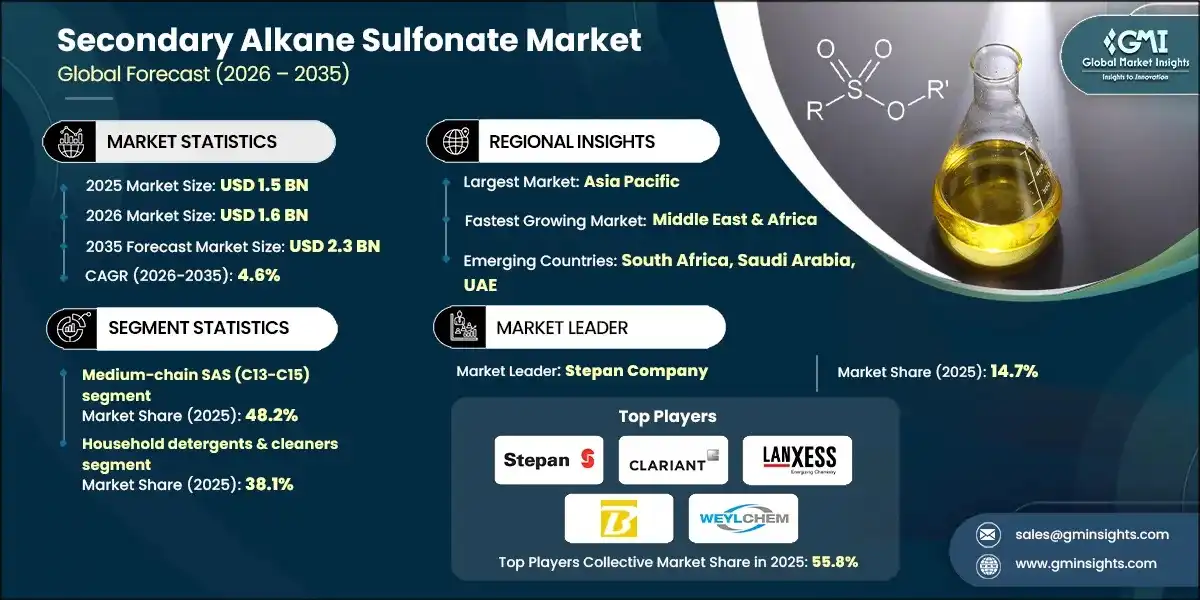
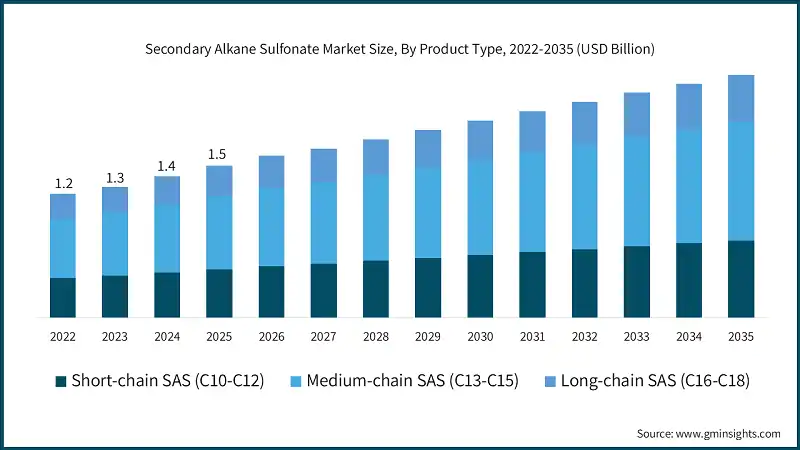
The global secondary alkane sulfonate market was valued at USD 1.5 billion in 2025. The market is expected to grow from USD 1.6 billion in 2026 to USD 2.3 billion in 2035, at a CAGR of 4.6%, according to latest report published by Global Market Insights Inc.
To get key market trends
- Secondary alkane sulfonate (SAS) is a synthetic anionic surfactant most extensively used for its properties of excellent foaming, emulsifying, and detergency in various forms of cleaning and detergent formulations. It is environmentally friendly, as it is considered biodegradable, thus meeting the needs of consumers as well as regulations to push for the use of sustainable cleaning solutions. With the ongoing shift in consumer preference toward biodegradable surfactants, increased regulatory pressures against environmentally harmful government regulations are expected to drive even greater growth in the SAS market.
- In Asia, unlike China, which has been tightening environmental regulations with respect to biodegradability and eco-friendliness, India's biodegradable products market has received various supports through favorable regulations mainly initiated by the government for promoting sustainable manufacturing practices. Asia currently occupies the largest share of the global SAS market, owing to its mammoth manufacturing base, expanding consumer base, and accelerating demand from household and personal care industries among the fastest-growing sectors in the region.
- Furthermore, the increasing rates of urbanization and rise in disposable incomes are creating more demand for premium cleaning products that contain SAS. Meanwhile, the Middle East and Africa are the fastest growing SAS markets. This growth can be attributed to an increase in investment of industrial cleaning and expanding personal care markets, mainly in developing countries, coupled with a rising focus in these regions on sustainable products. The different areas of growth are usually promoted through government policies that encourage friendly manufacturing with an increasing sensitivity of consumers to sustainability in most countries.
- The application of SAS is even higher under hard water conditions, especially in developing countries, further boosting demand, as it performs better even without water softening. The interconnected factors of increasing ecological awareness, expanding industries, and supportive regulatory frameworks across these regions bring out a phenomenon of a more conducive environment for the growth of the market around the world.
Secondary Alkane Sulfonate Market Report Attributes
| Key Takeaway | Details |
|---|---|
| Market Size & Growth | |
| Base Year | 2025 |
| Market Size in 2025 | USD 1.5 billion |
| Market Size in 2026 | USD 1.6 billion |
| Forecast Period 2026-2035 CAGR | 4.6% |
| Market Size in 2035 | USD 2.3 billion |
| Key Market Trends | |
| Drivers | Impact |
| Rising demand for biodegradable surfactants | Drives increased adoption of secondary alkane sulfonates due to their eco-friendly profile |
| Growth in household & personal care industries | Expands market opportunities for SAS as a key ingredient in various formulations |
| Superior performance in hard water conditions | Enhances the market appeal of SAS in cleaning applications, boosting sales |
| Pitfalls & Challenges | Impact |
| Raw material price volatility | Poses cost management challenges, potentially affecting profit margins and pricing strategies |
| Competition from alternative surfactants | Pressures SAS market share as consumers seek newer or cheaper surfactant options |
| Opportunities: | Impact |
| Development of bio-based SAS from renewable feedstocks | Presents opportunities for market expansion through sustainable product offerings |
| Emerging applications development | Opens new markets and product segments for SAS, fostering innovation and growth |
| Market Leaders (2025) | |
| Market Leaders |
14.7% |
| Top Players |
|
| Competitive Edge |
|
| Regional Insights | |
| Largest Market | Asia Pacific |
| Fastest Growing Market | Middle East & Africa |
| Emerging Country | South Africa, Saudi Arabia, UAE |
| Future Outlook |
|
What are the growth opportunities in this market?
Secondary Alkane Sulfonate Market Trends
- Innovation through green chemistry is spearheading the market towards the development of bio-based and eco-friendly formulations. New-age SAS formulations are being brought into the market by manufacturers who use renewable resources instead of petrochemicals, thus reducing dependence on this non-renewable resource. These next-generation surfactants will not only be more biodegradable but also less toxic, according to the consumer preferences of sustainable products.
- Most of the manufacturing enterprises have implemented advanced manufacturing technologies ranging from continuous flow processing to eco-friendly catalysts in line with the mission to attain efficiency and cut on the production cost of SAS. Sustainability goals have also considered the environmental footprint to be reduced by such technological shifts. Hence, companies can produce competitive quality SAS at lower costs to provide competitive pricing and, thus, accessed by wider markets.
- The industry seeks novel formulation technologies, including encapsulation and microemulsions, so that the operational performance of SAS would be further enhanced and the resulting products stabilized for a wider application area. The introduction of these technologies will serve to make SAS-based products more versatile and efficient for other applications, even under extreme conditions, such as high water hardness or elevated temperatures.
Secondary Alkane Sulfonate Market Analysis
Learn more about the key segments shaping this market
Based on product type, the market is segmented into short-chain SAS (C10-C12), medium-chain SAS (C13-C15) and long-chain SAS (C16-C18). Medium-chain SAS (C13-C15) dominated the market with an approximate market share of 48.2% in 2025 and is expected to grow with a CAGR of 4.7% by 2035.
- Medium-chain SASs (C13-C15) dominates the market because they offer the combination of biodegradability, washing performance, and cost. They perform extremely well in many applications-from household to industrial cleaning-requiring medium-chain lengths, even under ever-stricter environmental demands. It is this versatility that favors medium-chain SAS for both personal care and cleaning applications providing excellent foaming, solubilizing, and emulsifying properties.
- Short-chain SAS (C10-C12) is reserved mainly for specialty cleaning applications that favor rapid biodegradation and low toxicity, hence its niche use, which has limited widespread application.
- SAS with long chains (C16-C18) is valued for its foaming and emulsifying properties in special high-performance or industrial applications, but longer chain lengths tend to be less cost-effective to manufacture and degrade very slowly, thus limiting their application in other broader fields.
Learn more about the key segments shaping this market
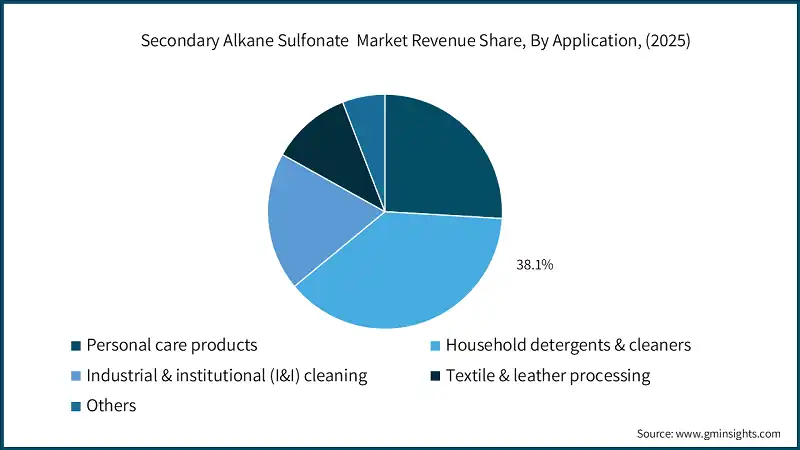
Based on application, the secondary alkane sulfonate market is segmented into personal care products, household detergents & cleaners, industrial & institutional (I&I) cleaning, textile & leather processing and others. Household detergents & cleaners held the largest market share of 38.1% in 2025.
- Household detergents as well as cleaners dominate the market from the demand with effective, biodegradable cleaning products. In fact, now urbanization, increased concern in environment and also the stricter regulations spearhead innovations in eco-friendly formulations, which makes SAS covers in hard water performance and sustainability and thus promotes continual growth in this section.
- Personal care products will usually attract a significant share as customer-doctors look for gentle cleaned and biodegradable cleansers. The friendliness of skin-and eco-conscious benefaction of SAS makes this compound popular with shampoos and body washes. The increasing adoption of naturally acquired with regulatory push supports steady growth in the industry for safely brought ingredients.
- Industrial & institutional (I&I) cleaning applications grow with demand summed up into high-performance, eco-friendly cleaning systems in sectors like healthcare and food processing. SAS's bio-efficacy in degrading irritant adsorbents thrives in the toughest stains, thereby meeting the most stringent environmental criteria, thus encouraging adoption for large-scale cleaning needs and sustainable manufacturing practice.
- SAS is used for cleaning and processing in an eco-friendly way in textile and leather processing. In terms of cleaning efficiency, its emulsifying and foaming properties can be utilized and improved. Growth on this application is driven by industry regulations for sustainability and through technological advances, making SAS an integral part of environment-responsible manufacturing techniques in textile and leather.
- Others include niche sectors such as agriculture and metal cleaning, which have emerging markets. These applications tap on AS's versatile and eco-friendly profile to push for increased sustainable solutions. In fact, this segment is expected to expand, driven by innovation and increased awareness on the environment.
Looking for region specific data?
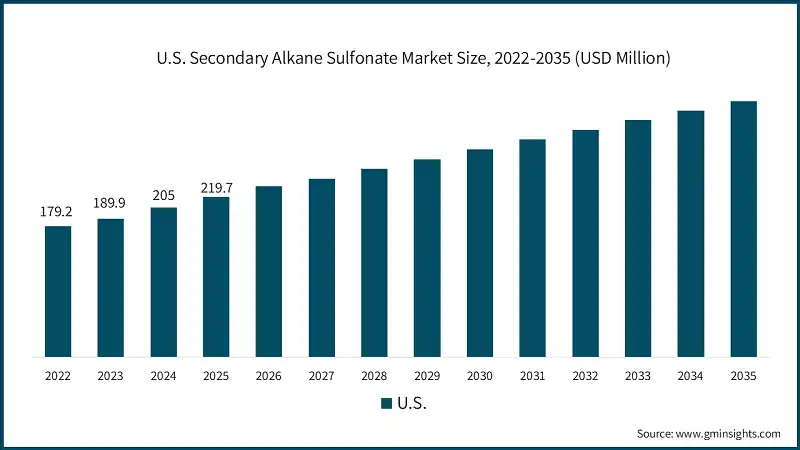
The secondary alkane sulfonate market in North America will grow at a CAGR from approximately 4.6% between 2026 and 2035.
- The recent trends of chemical recycling and waste minimization are modifying the industry for getting into greener and more sustainable alternatives fully in line with growing awareness on the consumers' end and with the increasing regulatory standards. Increased demand for eco-friendly surfactants in household and industrial cleaning has proliferated, thereby contributing toward the development of the market
The secondary alkane sulfonate markets in Europe, especially in a few countries like Germany, are expected to grow with a rapid pace in the coming years.
- These two factors, stringent environmental regulations and a commitment to a circular economy, push innovation in surfactant production toward sustainability. Bio-based and biodegradable formulations are receiving great advancement.
The secondary alkane sulfonate market in China and India is expected to have lucrative growth between 2026 and 2035, with CAGR 4.7% in the Asia Pacific region.
- Rapid urbanization and growing disposable incomes are driving demand for greener cleaning products and surfactants. This dream is supported by regulatory improvements in waste management and green energy, which in turn spur investments in bio-based and sustainable production methods for household and industrial cleaning applications.
Between 2026 and 2035, the market for secondary alkane sulfonate in the Middle East is projected to grow significantly during this period.
- Key drivers behind this trend include rising demand from hospitality, tourism, and food processing industries for green cleaning solutions. With government programs advocating sustainability and healthier habits, companies are beginning to move toward green formulations in surfactants and other cleaning and hygiene applications.
Between 2025 and 2035, a promising expansion of the secondary alkane sulfonate sector is foreseen in the Latin America.
- The increasing per capita disposable income, formulation of an increased investment for research in the science behind biodegradable or eco-conscious surfactants, and other related developments have increased demand. Increasing interest in these green products for household cleaning, food safety, or industrial application has attracted overall momentum in the market.
Secondary Alkane Sulfonate Market Share
The market is moderately consolidated with players like Stepan Company, Clariant AG, LANXESS AG, BIG SUN Chemical Corporation and WeylChem Performance Products GmbH accounted for 55.8% market share in 2025.
The market consists of such leading companies operating mostly in their regional areas. Their long years of experience with secondary alkane sulfonate allow these companies to maintain a strong market position worldwide. Their product offerings are diverse and majorly supported by production capacities and distribution networks, which can serve the increasing demand for secondary alkane sulfonate in various regions.
Secondary Alkane Sulfonate Market Companies
Major players operating in the secondary alkane sulfonate industry includes:
- BIG SUN Chemical Corporation
- Clariant AG
- LANXESS AG
- S.C. Johnson & Son
- Shaoxing Shangyu Simo Research Institute of Organic Chemistry
- Stepan Company
- WeylChem Performance Products GmbH
- Others
Stepan Company: Global surfactants leader with multi-region manufacturing, strong technical service, and certifications supporting institutional and retailer programs. The company continues to build capability sets aligned with sustainable chemistry and performance surfactants used in home care, personal care, and I&I applications.
Clariant AG: Specialty chemicals major headquartered in Switzerland. Beyond SAS (HOSTAPUR), the company’s innovation slate includes high-RCI sugar-based surfactants and soil-release polymers featured at SEPAWA and in integrated reporting, aligning with customer needs for renewable content and performance.
LANXESS AG: Global specialty portfolio with surfactants for leather, industrial cleaning, and consumer applications; leverages cross-category expertise and robust European manufacturing and compliance frameworks.
WeylChem Performance Products GmbH: Longstanding European SAS producer via the Hoechst light/water process; offers multiple actives (≈30/60/93%) and forms (liquid, paste, pellets, granules), comprehensive TDS support, and consistent quality valued by compliance-focused customers.
BIG SUN Chemical Corporation: Regional Asian supplier leveraging proximity, customization, and cost competitiveness to serve fast-growing APAC home care, personal care, and I&I demand.
Secondary Alkane Sulfonate Industry News
- In March 2024, WeylChem Wesseling announced both the establishment of its Advanced Materials Business Line and a strategic partnership with Novoset, thus moving beyond alkane sulfonates and into innovative cyanate ester derivatives for the aerospace and electronics industries.
- In December 2023, LANXESS completed the expansion of its plant for sustainable sulfur carriers, including eco-friendly additives such as alkane sulfonates, providing more supply at an increasingly high demand for environmentally sustainable lubricant solutions in metalworking application.
This secondary alkane sulfonate market research report includes in-depth coverage of the industry, with estimates & forecasts in terms of revenue (USD Billion) and volume (Kilo Tons) from 2022 to 2035, for the following segments:
Market, By Product Type
- Short-chain SAS (C10-C12)
- Medium-chain SAS (C13-C15)
- Long-chain SAS (C16-C18)
Market, By Application
- Personal care products
- Shampoos & hair care
- Shower gels & body washes
- Liquid hand soaps
- Facial cleansers
- Toothpastes
- Others
- Household detergents & cleaners
- Dishwashing liquids
- Liquid laundry detergents
- All-purpose cleaners
- Sanitary & bathroom cleaners
- Floor cleaners
- Others
- Industrial & institutional (I&I) cleaning
- Metal cleaners
- Automotive cleaners
- Food processing cleaners
- Healthcare disinfectant cleaners
- Others
- Textile & leather processing
- Textile dyeing & finishing
- Leather tanning & dyeing
- Others
- Others
The above information is provided for the following regions and countries:
- North America
- U.S.
- Canada
- Europe
- Germany
- UK
- France
- Spain
- Italy
- Rest of Europe
- Asia Pacific
- China
- India
- Japan
- Australia
- South Korea
- Rest of Asia Pacific
- Latin America
- Brazil
- Mexico
- Argentina
- Rest of Latin America
- Middle East and Africa
- Saudi Arabia
- South Africa
- UAE
- Rest of Middle East and Africa
Frequently Asked Question(FAQ) :
What are the upcoming trends in the secondary alkane sulfonate industry?
Key trends include the adoption of bio-based and eco-friendly formulations, the use of renewable resources over petrochemicals, and the implementation of advanced manufacturing technologies to reduce costs and environmental impact.
Which product type dominated the secondary alkane sulfonate market in 2025?
Medium-chain SAS (C13-C15) dominated the market with a 48.2% share in 2025 and is expected to grow at a CAGR of 4.7% by 2035.
Who are the key players in the secondary alkane sulfonate market?
Key players include BIG SUN Chemical Corporation, Clariant AG, LANXESS AG, S.C. Johnson & Son, Shaoxing Shangyu Simo Research Institute of Organic Chemistry, Stepan Company, and WeylChem Performance Products GmbH.
What was the market size of the secondary alkane sulfonate market in 2025?
The market size was valued at USD 1.5 billion in 2025, with a CAGR of 4.6% expected through 2035, driven by innovations in green chemistry and advanced manufacturing technologies.
Which region is expected to witness significant growth in the secondary alkane sulfonate market?
North America is projected to grow at a CAGR of approximately 4.6% between 2026 and 2035, driven by advancements in manufacturing and sustainability initiatives.
Which application segment held the largest market share in 2025?
Household detergents & cleaners held the largest market share at 38.1% in 2025.
What is the projected size of the secondary alkane sulfonate market in 2026?
The market is projected to reach USD 1.6 billion in 2026.
What is the projected value of the secondary alkane sulfonate industry by 2035?
The market is expected to reach USD 2.3 billion by 2035, supported by the development of bio-based formulations and increasing demand for sustainable products.
Secondary Alkane Sulfonate Market Scope
Related Reports