Summary
Table of Content

Seaweed Flavor Market
Get a free sample of this report
Form submitted successfully!
Error submitting form. Please try again.
Thank you!
Your inquiry has been received. Our team will reach out to you with the required details via email. To ensure that you don't miss their response, kindly remember to check your spam folder as well!
Request Sectional Data
Thank you!
Your inquiry has been received. Our team will reach out to you with the required details via email. To ensure that you don't miss their response, kindly remember to check your spam folder as well!
Form submitted successfully!
Error submitting form. Please try again.
Seaweed Flavor Market Size
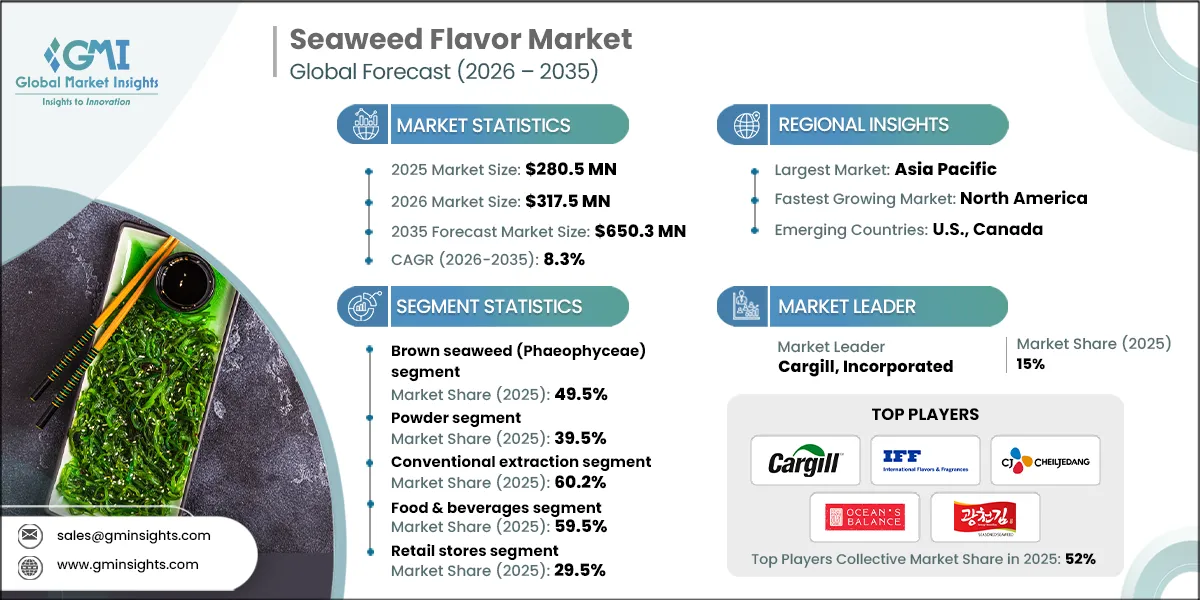
The global seaweed flavor market was valued at USD 280.5 Million in 2025. The market is expected to grow from USD 317.5 Million in 2026 to USD 650.3 Million in 2035, at a CAGR of 8.3% according to latest report published by Global Market Insights Inc.
Seaweed Flavor Market Key Takeaways
Market Size & Growth
- 2025 Market Size: USD 280.5 Million
- 2026 Market Size: USD 317.5 Million
- 2035 Forecast Market Size: USD 650.3 Million
- CAGR (2026–2035): 8.3%
Regional Dominance
- Largest Market: Asia Pacific
- Fastest Growing Region: North America
Key Market Drivers
- Plant-based food revolution.
- Salt reduction mandates & health consciousness.
- Sustainability & regenerative agriculture narrative.
Challenges
- Heavy metal & iodine contamination concerns.
- Fragmented organic certification standards.
Opportunity
- Biorefinery commercialization.
- North American & European production expansion.
Key Players
- Market Leader: Cargill, Incorporated led with over 15% market share in 2025.
- Leading Players: Top 5 players in this market include Cargill, Incorporated, IFF (International Flavors & Fragrances Inc.), CJ CheilJedang / bibigo, Ocean's Balance (Maine Coast Sea Vegetables), KwangcheonKim Co., Ltd., which collectively held a market share of 52% in 2025.
Get Market Insights & Growth Opportunities
- Health and wellness is one sustained force driving this market. Seaweeds are naturally rich in nutrients but low in calories, thus appealing to health-conscious users. The clean-label trend favors natural flavoring agents that are as little processed as possible. Thus, seaweed finds itself in good company compared to synthetic alternatives. On a different note, the growing prevalence of plant-oriented diets implicates seaweed in modern food innovation.
- Seaweed flavor can enhance the savory profiles of soups, sauces, snacks, and ready-to-eat meals, among others. Its added nutritional benefits of iodine and antioxidants make it a good fit for functional foods. More recently, seaweed flavor has been increasingly used as an environmentally sustainable way to bring complex savory notes to seasonings, condiments, and alternative protein products.
- Asia-Pacific regional market leads the industry because of the cultural taste for seaweed-based flavors and their use in traditional cooking. Europe is showing strong uptake based on natural and sustainable ingredient inclination, while North America is benefiting from plant-based diets and trends of fusion cuisines.
To get key market trends
Seaweed Flavor Market Trends
- Seaweed Flavor has set the standards for taste innovation and sustainability and is now transcending into the global food industry. Traditionally regarded as a niche ingredient in local delicacies, seaweed flavor is now focusing on being a solution in the future that will bring with it umami taste naturally, under clean-label criteria, and tending to the dietary conscience of consumers. This evolution marks a decisive move away from artificial flavor-enhancing agents to plant-based alternatives that foster low impact on human health and environmentalism worldwide.
- Key driving forces in this alteration include technological advancements on concentrated extracts against fermentation-based enhancement of flavors and scaling down of solvent operations. These concepts enhance flavor intensity and stability across multiple applications, and at the same time minimize resource consumption and waste, hence turning seaweed flavor quotation with regard to co-circular economy.
There is another emerging paradigm of embedding smart functionalities into flavor systems. The paradigms of bioactive enrichment and adaptive flavor modulation are slowly gaining traction, propelling manufacturers toward delivering personalized taste experiences layered with additional nutritional benefits. Developed alongside digital food innovation platforms, these new paradigms give a potential value proposition for brands seeking differentiation in competitive markets.
Seaweed Flavor Market Analysis
Learn more about the key segments shaping this market
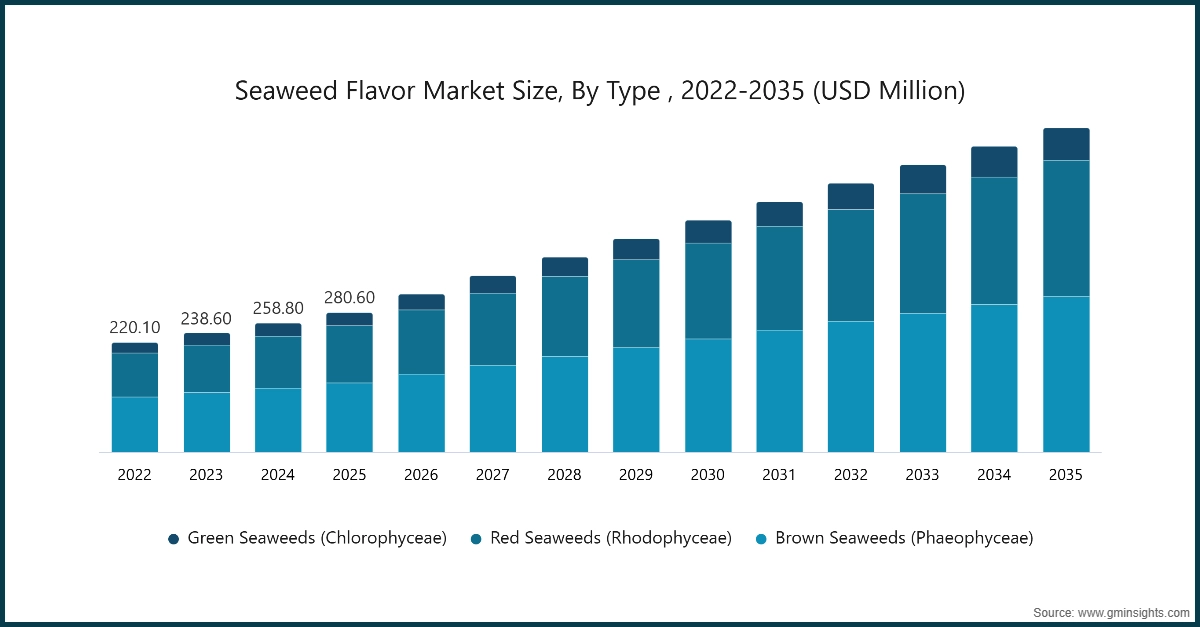
Based on type, the seaweed flavor market is segmented into brown seaweed (Phaeophyceae), red seaweed (Rhodophyceae), green seaweeds (Chlorophyceae). Brown seaweed (Phaeophyceae) dominated the market with an approximate market share of 49.5% in 2025 and is expected to grow with a CAGR of 8% by 2035.
Brown seaweeds (Phaeophyceae) dominate the flavor landscape with their rich umami and mineral-profile mouth-filling compositions that consistently find preference in savory applications such as soups, sauces, and seasoning. On the other hand, red seaweeds (Rhodophyceae) are highly valued for their sweet profile with mild flavor complexity. They are often classified as preferred ingredients for snacks, condiment items, or cuisines incorporating flavor fusion, where complex and balanced flavors are essential. Green seaweed (Chlorophyceae) has its fresh but slightly mild flavor in health-focused products, smoothies, and functional drinks, all targeting the growing demand for clean-labeled and nutrient-dense formulations.
Learn more about the key segments shaping this market
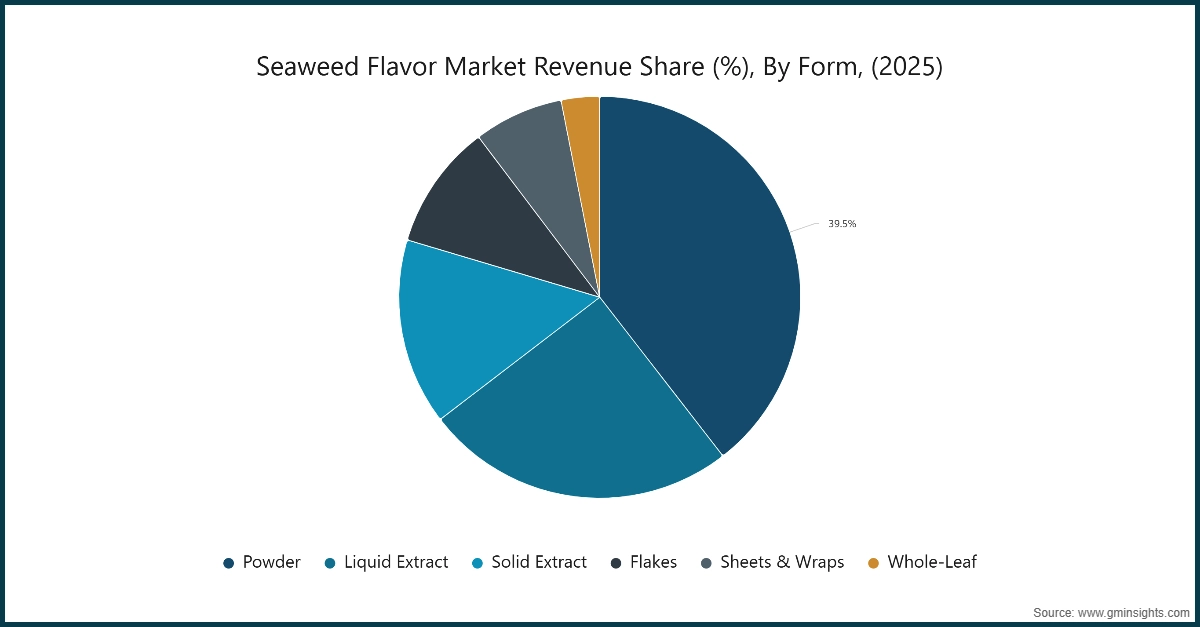
Based on form, the seaweed flavor market is segmented into powder, liquid extract, solid extract, flakes, sheets & wraps, whole-leaf. Powder held the largest market share of 39.5% in 2025 and is expected to grow at a CAGR of 7.9% during 2026-2035.
Powdered seaweed flavor is the most versatile due to ease of blending and stability into dry mixes, seasonings, and snacks, where application requires uniformity and shelf life. Liquid extracts dominate beverage formulations and sauces, where rapid solubility of extracts and timely concentrated flavor delivery represent one of the processing integral efficiencies. Solid extracts suit premium applications in functional foods, providing dense nutrition with a strong flavor profile.
Based on processing technology, the market is segmented into conventional extraction, advanced extraction technologies, biorefinery & cascade processing. Conventional extraction segment dominated the market with an approximate market share of 60.2% in 2025 and is expected to grow with the CAGR of 8.4% by 2035.
- Traditional extraction methods still reign supreme in seaweed flavor production; methods that ensure scalability cost-effectively for mass-market applications such as seasonings, snacks, or ready-to-eat meals. Such extraction methods remain simple and dependable for manufacturers that would like to keep flavor delivery consistent without excessive infrastructure.
Based on application, the market is segmented into food & beverages, culinary ingredients (food service), nutraceuticals & dietary supplements, animal feed & pet food, cosmetics & personal care. Food & beverages segment dominated the market with an approximate market share of 59.5% in 2025 and is expected to grow with the CAGR of 8% by 2035.
- Food and beverage applications remain the top end-user segment wherein seaweed flavor gives a natural umami taste, which Clean-label appeal for soups, sauces, snacks, and ready-to-eat meals. Culinary ingredients for foods service exploit their versatility to elevate taste profiles in gourmet and fusion dishes, thus meeting the increased demand for authentic and sustainable flavors.
- Nutraceuticals and dietary supplements have a dual functionality of the taste of seaweed flavor to capture its inherent nutritional benefits such as minerals and antioxidants in functional health positioning. The application of animal feeding and pet food products has however gained momentum, palatability through seaweed flavor, coupled with trace nutrients, is enhancing growth in this sector as it harmonizes with the trend toward natural additives in animal nutrition.
Based on distribution channel, the market is segmented into retail stores, online retail, food service & hospitality, wholesale distributors. Retail stores dominated the market with an approximate market share of 29.5% in 2025 and is expected to grow with the CAGR of 7.7% by 2035.
- Seaweed flavor products are primarily sold in retail outlets within easy reach of consumers, who buy packaged powders, flakes, and sheets to prepare them at home using traditional recipes. Another emerging channel is online retail, whose continuing expansion is creating opportunities for brands to attract health-conscious, specialty buyers through e-commerce platforms in a comfortable format while making it globally accessible.
Looking for region specific data?
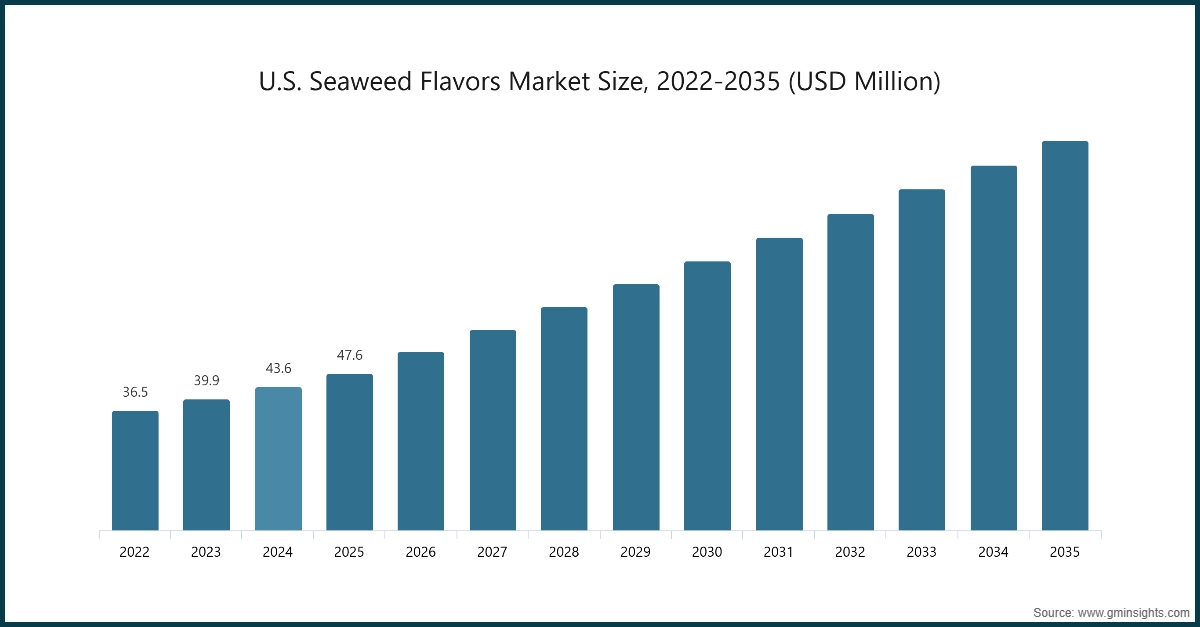
The North America Seaweed Flavor industry is growing rapidly on the global level with a market share of 20.4% in 2025.
- North America will be a stronghold for the Seaweed Flavor business due to the sprouting consumer acceptance towards any plant-based or clean-label goods aside from the great innovative strides in food technology. With advanced manufacturing infrastructure and regulatory sustainability, there will be a premium wave offering eco-friendly solutions to flavor development.
U.S. dominates the North America Seaweed Flavor market, showcasing strong growth potential.
- U.S. has been approaching policy development in favor of the healthier formulation to endorse natural ingredients. Such regulatory facilities, coupled with strong food service channels and growing popularity for functional nutrition, put the country at a significant position in creating true global drivers for seaweed-based flavor trends.
Europe Seaweed Flavor Market leads the industry with revenue of USD 56.7 million in 2025 and is anticipated to show lucrative growth over the forecast period.
- With regulatory attention directed toward clean-label formulations and eco-friendly sourcing, the transition to the next-generation seaweed-based flavors, which confer a taste, nutrition, and environmental value, is being accelerated.
Germany dominates the European Seaweed Flavor market, showcasing strong growth potential.
- Germany is leading the European Seaweed Flavor market, based on a strong consumer preference for natural ingredients and a sturdy regulatory framework supporting plant-based and environmentally friendly solutions.
The Asia Pacific seaweed flavor leads the market is anticipated to grow at a CAGR of 7.9% during the analysis timeframe.
- Asia Pacific is rapidly emerging as probably the most dynamic growth hub for the Seaweed Flavor market. This perception draws strength from the fact that seaweed is culturally very much integrated into traditional diets and that the emerging food processing industries and increasing consumer preference for plant-based functional ingredients support this proliferation of use.
China Seaweed Flavor Market is estimated to grow with a significant CAGR in the Asia Pacific region.
- China has transformed this scenario and used its high production capacities and the growing demand for natural flavors among both domestic and export markets.
Latin America Seaweed Flavor accounted for 8% market share in 2025 and is anticipated to show highest growth over the forecast period.
- Latin America is currently becoming the most favored emerging region for Seaweed Flavor, thanks to escalating consumer interest in natural and plant-based ingredients, modernization of food processing infrastructure, and initiatives fuelled by sustainability.
Brazil leads the Latin American Seaweed Flavor market, exhibiting remarkable growth during the analysis period.
- Brazil is the leader in the Latin American Seaweed Flavor market, combining its sound industrial foundation with a growing demand for functional and health-oriented food products.
Middle East & Africa Seaweed Flavor accounted for 6.7% market share in 2025 and is anticipated to show lucrative growth over the forecast period.
- The Middle East and Africa Seaweed Flavor Market is growing, mainly due to rising consumer awareness for plant-based diets, sustainability-driven policies, and diversification strategies with respect to the food industry.
Saudi Arabia Seaweed Flavor industry to experience substantial growth in the Middle East and Africa Seaweed Flavor market in 2025.
- Saudi Arabia emerged as a key growth driver in this regional context, as it is integrating seaweed flavor into the health-oriented and functional food segments through its industrial transformation agenda and investments in food innovation.
Seaweed Flavor Market Share
The top 5 companies in Seaweed Flavor industry include Cargill, Incorporated, IFF (International Flavors & Fragrances Inc.), CJ CheilJedang / bibigo, Ocean's Balance (Maine Coast Sea Vegetables), KwangcheonKim Co., Ltd. These are prominent companies operating in their respective regions covering approximately 52% of the market share in 2025. These companies hold strong positions due to their extensive experience in Seaweed Flavor market. Their diverse product portfolios, backed by robust production capabilities and distribution networks, enable them to meet the rising demand across various regions.
Cargill, Incorporated operates in the fields of food, agriculture, and nutrition, rendering ingredient solutions for food manufacturers and consumer products. An innovation-driven and sustainable sourcing company, Cargill caters to some of the ever-changing market needs by their plant-based and specialty ingredient production.
IFF involves itself in the development of flavors, fragrances, and specialty ingredients to manufacture them for food, beverage, or personal care industries. The innovative approach lies in the differentiation of superior offerings that include natural and functional solutions.
CJ CheilJedang is advocating the korean cuisine and global food innovation through its bibigo brand. Processed food, snack and ready-meal products combine traditional flavors with modern convenience and are destined for overseas markets.
Ocean's Balance is in the Maine Coast Sea Vegetables family and develops green products based on seaweed, such as products for culinary and health purposes.
KwangcheonKim Co., Ltd. is a seaweed manufacturer with snacks and allied items for the domestic and international markets. The authentic taste and quality are retained through some types of processed seaweed in retail and food service channels.
Seaweed Flavor Market Companies
Major players operating in the Seaweed Flavor market include:
- Cargill, Incorporated
- IFF (International Flavors & Fragrances Inc.)
- CJ CheilJedang / bibigo
- Ocean's Balance (Formerly Maine Coast Sea Vegetables)
- KwangcheonKim Co., Ltd.
- Nagai Nori Co., Ltd.
- Seaweed & Co.
- Mara Seaweed
- This is Seaweed Ltd.
- Wild Irish Seaweeds
- Hispanagar
- Seagarden AS
- The Seaweed Company
- Green Fresh (Fujian) Foodstuff Co., Ltd.
- Marusan
- Ocean Organics
Seaweed Flavor Market Report Attributes
| Key Takeaway | Details |
|---|---|
| Market Size & Growth | |
| Base Year | 2025 |
| Market Size in 2025 | USD 280.5 Million |
| Market Size in 2026 | USD 317.5 Million |
| Forecast Period 2026-2035 CAGR | 8.3% |
| Market Size in 2035 | USD 650.3 Million |
| Key Market Trends | |
| Drivers | Impact |
| Plant-based food revolution | Plant-based foods are propelling the flavors derived from seaweed for that natural umami note into vegan and alternative protein products motivated by demand |
| Salt reduction mandates & health consciousness | Seaweed flavor is very promising for low-sodium formulations without requiring taste sacrifices |
| Sustainability & regenerative agriculture narrative | Powers both the brand equity and the acceptance of seaweeds to eco-socio and carbon neutrality objectives |
| Pitfalls & Challenges | Impact |
| Heavy metal & iodine contamination concerns | The increasing costs associated with it and stringent quality assurance winding up the risk barriers to its scaling up |
| Fragmented organic certification standards | It presents entry barriers to the market and impedes harmonization at international levels for premium positioning |
| Opportunities: | Impact |
| Biorefinery commercialization | New streams in terms of integrated extraction of flavors, nutrients, and bioactives |
| North American & European production expansion | Results in a lessened dependence on supply chains and provided opportunities for localized innovations into high-value markets |
| Market Leaders (2025) | |
| Market Leader |
15% |
| Top Players |
Collective Market Share of 52% in 2025 |
| Competitive Edge |
|
| Regional Insights | |
| Largest Market | Asia Pacific |
| Fastest growing market | North America |
| Emerging countries | U.S., Canada |
| Companies covered: | 16 |
| Tables, Charts & Figures: | 205 |
| Countries covered: | 18 |
| No of Pages: | 190 |
What are the growth opportunities in this market?
Seaweed Flavor Industry News
- In May 2025 – Roquette, a global player in plant-based ingredients and pharmaceutical excipients for the health and nutrition sectors, announces the successful completion of its acquisition of IFF Pharma Solutions. This strategic milestone marks a significant step forward in its ambition to become a leader in support of the global pharma markets.
- In November 2022, OCEANIUM, a biotechnology firm based in Scotland, introduced a novel high-fiber substitute made from seaweed, designed as an alternative to methylcellulose in plant-based meat. Additionally, this innovation can be incorporated into gluten-free bread and beverages.
These Seaweed Flavor market research report includes in-depth coverage of the industry, with estimates & forecasts in terms of revenue (USD Million) and volume (Kilo Tons) from 2022 to 2035, for the following segments:
Market, By Type
Brown seaweeds (Phaeophyceae)
- Kombu (laminaria spp., saccharina spp.)
- Wakame (Undaria pinnatifida)
- Ascophyllum nodosum
- Other brown seaweeds (macrocystis, fucus)
Red seaweeds (Rhodophyceae)
- Nori (Porphyra/Pyropia spp.)
- Dulse (Palmaria palmata)
- Carrageenan-producing seaweeds (Eucheuma, Kappaphycus, Gracilaria)
- Other red seaweeds
Green seaweeds (Chlorophyceae)
- Sea lettuce (Ulva spp.)
- Other green seaweeds
Market, By Form
- Powder
- Liquid extract
- Solid extract
- Flakes
- Sheets & wraps
- Whole-leaf
Market, By Processing Technology
Conventional extraction
- Alkaline extraction
- Water-based extraction
Advanced extraction technologies
- Enzyme-assisted extraction (EAE)
- Supercritical fluid extraction (SFE)
- Microwave-assisted & ultrasound extraction
- Pulsed electric fields (PEF)
Biorefinery & cascade processing
Market, By Application
Food & beverages
- Plant-based meat alternatives
- Functional beverages
- Snacks
- Seasonings & condiments
- Soups, broths & dashi
- Bakery & confectionery
- Dairy & dairy alternatives
Culinary ingredients (food service)
Nutraceuticals & dietary supplements
Animal feed & pet food
Cosmetics & personal care
Market, By Distribution Channel
- Retail stores
- Online retail
- Food service & hospitality
- Wholesale distributors
The above information is provided for the following regions and countries:
· North America
- U.S.
- Canada
· Europe
- Germany
- UK
- France
- Spain
- Italy
- Rest of Europe
· Asia Pacific
- China
- India
- Japan
- Australia
- South Korea
- Rest of Asia Pacific
· Latin America
- Brazil
- Mexico
- Argentina
- Rest of Latin America
· Middle East and Africa
- Saudi Arabia
- South Africa
- UAE
- Rest of Middle East and Africa
Frequently Asked Question(FAQ) :
What was the market size of the seaweed flavor in 2025?
The market was valued at USD 280.5 million in 2025, with a CAGR of 8.3% expected through 2035. The market growth is driven by the rising demand for health-conscious products, clean-label trends, and plant-based diets.
What is the projected value of the seaweed flavor market by 2035?
The market is poised to reach USD 650.3 million by 2035, fueled by the increasing adoption of natural flavoring agents and innovations in plant-based food products.
What is the expected size of the seaweed flavor industry in 2026?
The market size is projected to reach USD 317.5 million in 2026.
What was the market share of brown seaweed in 2025?
Brown seaweed (Phaeophyceae) held an approximate market share of 49.5% in 2025 and is expected to grow at a CAGR of 8% by 2035.
What was the valuation of the powdered seaweed flavor segment in 2025?
The powdered seaweed flavor segment accounted for the largest market share of 39.5% in 2025, owing to its versatility, ease of blending, and stability in dry mixes, seasonings, and snacks.
What is the growth outlook for the food & beverages segment from 2026 to 2035?
The food & beverages segment, which dominated the market with a 59.5% share in 2025, is projected to grow at a CAGR of 8% till 2035.
Which region leads the seaweed flavor sector?
North America leads the market with a 20.4% share in 2025. The region's growth is led by increasing consumer acceptance of plant-based and clean-label products, advancements in food technology, and regulatory sustainability.
What are the upcoming trends in the seaweed flavor market?
Rising demand for natural, minimally processed flavors, growth of plant-based diets, and innovation in functional foods and beverages using seaweed ingredients.
Who are the key players in the seaweed flavor industry?
Key players include Cargill, Incorporated; IFF (International Flavors & Fragrances Inc.); CJ CheilJedang / bibigo; Ocean's Balance; KwangcheonKim Co., Ltd.; Nagai Nori Co., Ltd.; Seaweed & Co.; Mara Seaweed; This is Seaweed Ltd.; Wild Irish Seaweeds; and Hispanagar.
Seaweed Flavor Market Scope
Related Reports