Summary
Table of Content

Saudi Arabia Water Heater Market
Get a free sample of this report
Form submitted successfully!
Error submitting form. Please try again.
Thank you!
Your inquiry has been received. Our team will reach out to you with the required details via email. To ensure that you don't miss their response, kindly remember to check your spam folder as well!
Request Sectional Data
Thank you!
Your inquiry has been received. Our team will reach out to you with the required details via email. To ensure that you don't miss their response, kindly remember to check your spam folder as well!
Form submitted successfully!
Error submitting form. Please try again.
Saudi Arabia Water Heater Market Size
- Constant support for funding along with support for research and development activities aimed at advancing energy-efficient technologies is set to drive the industry scenario.
- Organizations comprising of the Saudi Standards, Metrology and Quality Organization (SASO) among others are responsible for the implementation of standards and regulations. Additionally, government-backed pilot projects which effectively demonstrate the utilization of new technologies will continue to encourage product adoption in the private sector.
- Increasing implementation of strict energy efficiency standards for heating appliances is set to drive the industry landscape. These regulations mandate minimum efficiency levels, leading manufacturers to innovate and produce efficient products.
- Energy efficiency labeling programs support the consumers to identify products that meet the rating standards driving the market growth. For instance, the Saudi Arabia’s Vision 2030 outlines ambitious goals for energy diversification and sustainability across the geography.
- The National Energy Efficiency Program aims to improve the energy efficiency across end use applications. Moreover, implementation of new building codes specifying requirements for heating and electrical appliances will complement the business landscape.
The Saudi Arabia water heater market was valued at USD 591.8 million in 2025. The market is anticipated to grow from USD 621.1 Million in 2026 to USD 958.1 million in 2035, at a CAGR of 4.9%.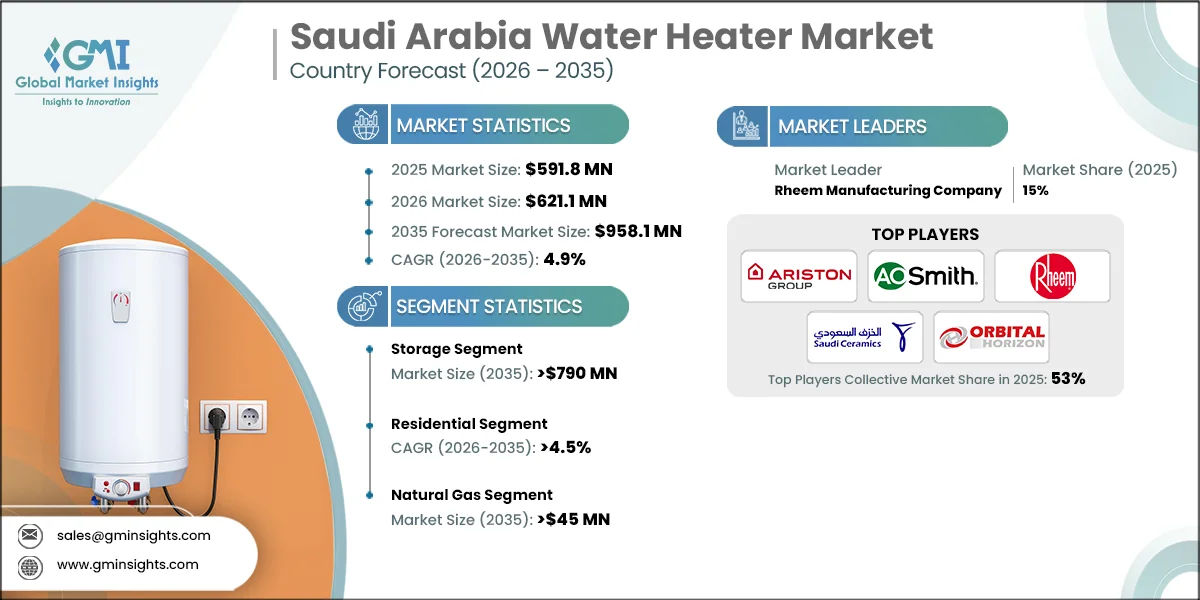
Saudi Arabia Water Heater Market Key Takeaways
Market Size & Growth
- 2025 Market Size: USD 591.8 Million
- 2026 Market Size: USD 621.1 Million
- 2035 Forecast Market Size: USD 958.1 Million
- CAGR (2026–2035): 4.9%
Key Market Drivers
- Growing demand for energy efficient products.
- Shifting focus on emission reduction.
- Rapid urbanization and rising demand for product customization.
Challenges
- Competition from alternative heating methods.
- High initial cost.
Opportunity
- Energy efficient and smart water heating solutions.
- Growing demand for solar water heaters.
Get Market Insights & Growth Opportunities
To get key market trends
Saudi Arabia Water Heater Market Trends
- Smart water heaters are equipped with IoT features which give freedom to the users to monitor and control the settings remotely, enhancing convenience and energy savings, augmenting the product requirement.
- Seamless integration of water heaters with other smart devices, consisting of home assistants and thermostats will allow for coordinated management of home energy use, increasing the efficiency, leading to surged product penetration.
Saudi Arabia Water Heater Market Analysis
Learn more about the key segments shaping this market
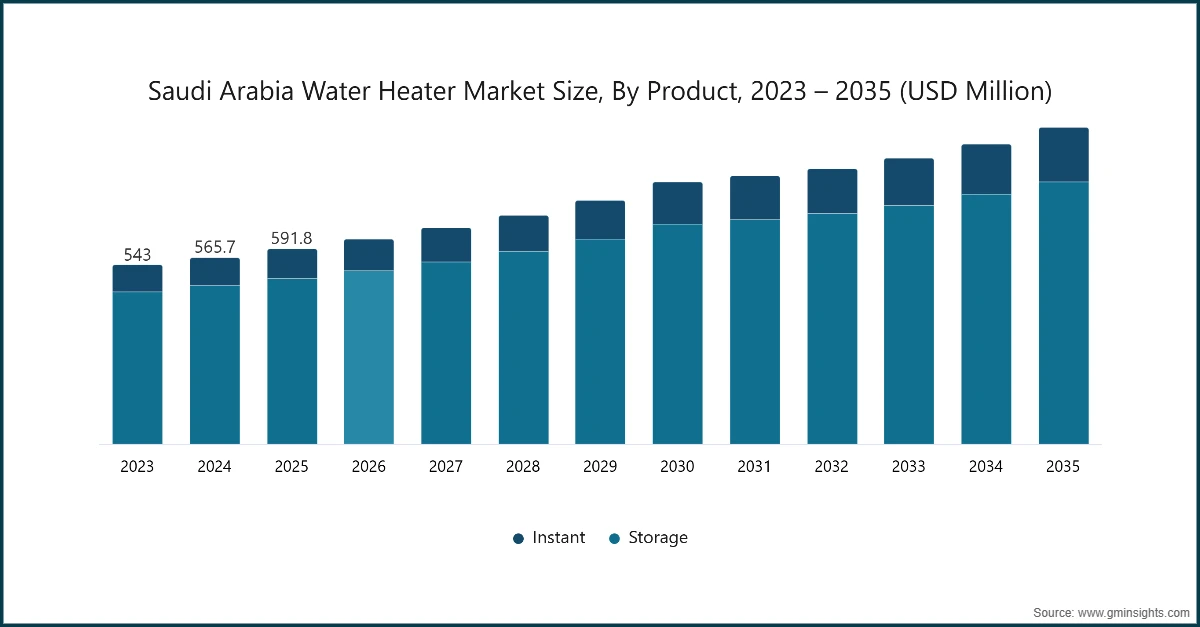
Based on product, the Saudi Arabia water heater market is segmented into instant and storage.
- Storage is set to grow more than USD 790 Million by 2035 due to rapid urbanization, population growth in cities like Jeddah, Riyadh, and Dammam. There are increasing construction activities in the urban centers across the country. The consumers are increasingly opting for storage systems that offer higher energy efficiency ratings, thereby augmenting the product penetration.
- Shifting focus toward hybrid water heaters that combine traditional heating elements with heat pump technology is anticipated to stimulate the business landscape. Key factors including reliability and durability remain a priority in storage water heaters, thereby increasing the requirement for models that can provide consistent performance and withstand extreme temperatures, strengthening the market outlook.
Learn more about the key segments shaping this market
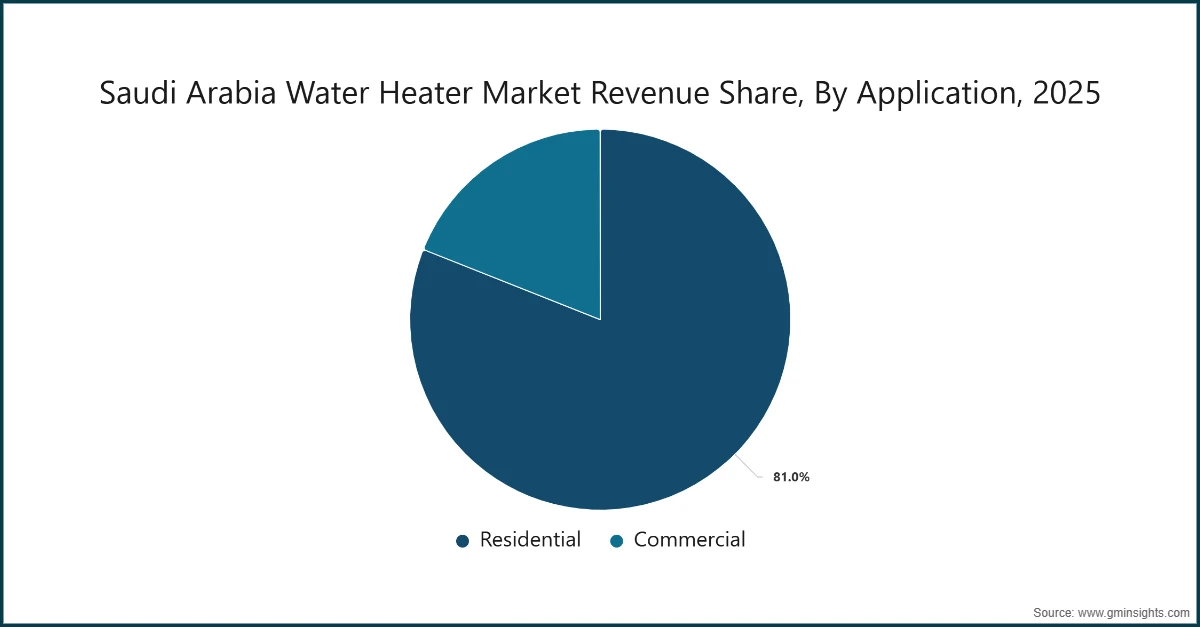
Based on application, the Saudi Arabia water heater market is segmented into residential and commercial.
- Residential is set to grow over CAGR of 4.5% by 2035 driven by changing consumer preferences, modern technological advancements, regulatory initiatives and economic conditions. Growing awareness of energy consumption and costs coupled with various benefits catering to different and varying consumer requirements will lead to market growth.
- Ongoing incorporation of smart technology in water heating products equipped with features comprising of mobile app control, adaptive heating systems and remote monitoring is set to appeal to tech-savvy consumers who favor efficiency and convenience, stimulating the business statistics. Furthermore, incentives for energy-efficient products and compliance with energy standards are anticipated to encourage consumers to choose modern water heating solutions, thereby augmenting the industry landscape.
Based on fuel, the Saudi Arabia water heater market is segmented into natural gas and LPG.
- Natural Gas is anticipated to grow by more than USD 45 Million by 2035 owing to enactment of energy policies, changing economic conditions, modern technological advancements and shifting consumer preferences. It is less expensive than electricity in the geography, and so a preferred choice for households to reduce their energy bills.
- Moreover, mandates and policies aimed at enhancing energy efficiency will favor the adoption of gas appliances, including water heaters. Increasing investments to develop natural gas infrastructure to provide wider access specifically in the urban areas, will drive the market scenario.
Saudi Arabia Water Heater Market Share
- The competitive landscape is shaped by key factors consisting of technological advancements, economic conditions and consumer preferences. Major global brands including A. O. Smith, Bosch and Rheem Manufacturing among others have a significant presence in the country, offering both energy-efficient and technologically advanced models.
- The government focusses majorly on promoting sustainability and energy efficiency influencing the market dynamics, thereby encouraging the manufacturers to innovate. Home improvement stores, specialized retailers are responsible for product availability through online and offline sales channel. This will provide consumers with more options and ease of convenience, stimulating the product penetration.
Saudi Arabia Water Heater Market Companies
Eminent players operating in the Saudi Arabia water heater industry are:
- A. O. Smith Corporation
- Al Jawdah Electric Water Heaters
- AlJammaz Hydrotek
- Ariston Holding
- Bradford White Corporation
- Ecotherm Austria
- F A J Trading
- GE Appliances
- Jaquar KSA
- Orbital Horizon
- Reem Water Heater Company
- Rheem Manufacturing Company
- Richmond Water Heaters
- Robert Bosch Middle East FZE
- Saudi Ceramics Company
- SACO Hardware
- State Water Heaters
- Viessmann Group
- Watts
- ZAINCO Limited Company
Saudi Arabia Water Heater Market Report Attributes
| Key Takeaway | Details |
|---|---|
| Market Size & Growth | |
| Base Year | 2025 |
| Market Size in 2025 | USD 591.8 Million |
| Market Size in 2026 | USD 621.1 Million |
| Forecast Period 2026-2035 CAGR | 4.9% |
| Market Size in 2035 | USD 958.1 Million |
| Key Market Trends | |
| Drivers | Impact |
| Growing demand for energy efficient products | Governments across the regions are implementing efficiency standards, labeling programs, and carbon reduction targets to lower greenhouse gas emissions and reduce dependence on fossil fuels. Furthermore, businesses and consumers are seeking solutions that lower the electricity consumption and operational expenses while enhancing performance and reliability, thereby driving the market outlook. |
| Shifting focus on emission reduction | The shifting focus on emission reduction is being driven by escalating climate change concerns, international decarbonization commitments, and tightening regulatory frameworks aimed at limiting greenhouse gas emissions. Governments are implementing carbon pricing mechanisms, stricter fuel efficiency norms, renewable energy mandates, and net-zero targets to align with global agreements such as the United Nations Framework Convention on Climate Change and the Paris Agreement. |
| Rapid urbanization and rising demand for product customization | Ongoing integration of modular designs, flexible production systems, and smart technologies to deliver personalized and differentiated offerings, will strengthen competitiveness, thereby enhancing the customer engagement across rapidly urbanizing markets, driving the market outlook. |
| Pitfalls & Challenges | Impact |
| Competition from alternative heating methods | Centralized boiler systems in residential compounds, district-level heating in certain developments, and the growing uptake of solar thermal solutions supported by sustainability initiatives offer substitute options to conventional standalone storage heaters. |
| High initial cost | The upfront cost of modern water heaters across many households and small businesses, can feel prohibitive, thereby limiting the product adoption. Imported models further add to the expense owing to shipping fees, tariffs, and currency changes. In addition, in large residential or commercial projects, the developers choose more affordable bulk options to stay within budget limiting the adoption of sustainable water heating systems in the market. |
| Opportunities | Impact |
| Energy efficient and smart water heating solutions | Increasing awareness about energy conservation, coupled with strict energy efficiency regulations and incentives, will encourage residential and commercial developers to invest in advanced water heaters that are equipped with smart timers, controls, and connectivity features to optimize energy usage and reduce costs over time, leading to market growth. |
| Growing demand for solar water heaters | Presence of abundant solar resources enable long-term savings thereby supporting national sustainability and renewable energy targets, contributing to the business momentum. Furthermore, innovative product designs and premium offerings owing to shifting consumer preferences toward greener, cost-effective, and technologically advanced water heating solutions will augment the industry landscape. |
| Market Leaders (2025) | |
| Market Leader |
|
| Top Players |
|
| Competitive Edge |
|
| Regional Insights | |
| Future outlook | Key factors including rapid expansion of residential and commercial infrastructure, sustained urbanization, along with rising awareness of energy efficiency will drive the market outlook. Further, rising penetration of premium brands and locally manufactured solutions is set to enhance the product diversity and competitive dynamics, thereby boosting the market growth., Technological innovation, product diversification coupled with companies investing in compact, tankless, solar-assisted, and hybrid systems to meet the demands of space-constrained urban developments will contribute to the business momentum. ket trends,and sustainability-conscious users. Moreover, increased availability of local manufacturing and distribution channels will support quicker deployment and customization, providing an edge over imported solutions. |
What are the growth opportunities in this market?
Saudi Arabia Water Heater Industry News
- The Saudi Standards, Metrology and Quality Organization (SASO) implemented its technical regulation on streamlining the energy consumption in water heaters, making energy-efficiency labeling and compliance mandatory for all products sold in the geography, in 2023.
- Bradford White Corporation introduced the Infiniti GS and GR tankless water heaters in 2022. These new models come equipped with multiple venting options, optional commercial rack mounts, and durable stainless-steel heat exchangers. The company aims to cater to the diverse needs of both commercial and residential sectors, bolstering its position in the water heater industry.
This Saudi Arabia water heater market research report includes an in-depth coverage of the industry with estimates & forecast in terms of volume and revenue in “’000 Units & USD Million” from 2022 to 2035, for the following segments:
Market, By Product
Instant
- Electric
- Gas
- Storage
- Electric
- Gas
Market, By Application
- Residential
- Commercial
- College/University
- Offices
- Government/Military
- Others
Market, By Capacity
- <30 Liters
- 30 – 100 Liters
- 100 – 250 Liters
- 250 – 400 Liters
- > 400 Liters
Market, By Fuel
- Natural Gas
- LPG
Frequently Asked Question(FAQ) :
What is the market size of the Saudi Arabia water heater in 2025?
The market size was USD 591.8 million in 2025, with a CAGR of 4.9% expected through 2035 driven by growing demand for energy-efficient products, shifting focus on emission reduction, and rapid urbanization with rising demand for product customization.
What is the projected value of the Saudi Arabia water heater market by 2035?
The Saudi Arabia water heater market is expected to reach USD 958.1 million by 2035, propelled by energy-efficient and smart water heating solutions and growing demand for solar water heaters.
What is the current Saudi Arabia water heater market size in 2026?
The market size is projected to reach USD 621.1 million in 2026.
What is the projected value of the storage water heater segment by 2035?
The storage segment is set to grow to more than USD 790 million by 2035, driven by rapid urbanization, population growth, and consumer preference for higher energy efficiency ratings.
What is the growth outlook for the residential application segment?
The residential segment is set to grow at a CAGR of over 4.5% by 2035, driven by changing consumer preferences, technological advancements, and regulatory initiatives promoting energy efficiency.
What is the projected value of the natural gas fuel segment by 2035?
The natural gas segment is anticipated to grow by more than USD 45 million by 2035, driven by lower costs compared to electricity and expanding natural gas infrastructure in urban areas.
What are the upcoming trends in the Saudi Arabia water heater market?
Key trends include integration of smart water heaters with IoT features for remote monitoring and control, seamless integration with home assistants and thermostats, and adoption of hybrid water heaters combining traditional heating elements with heat pump technology.
Who are the key players in the Saudi Arabia water heater market?
Key players include A.O. Smith Corporation, Al Jawdah Electric, AlJammaz Hydrotek, Ariston Holding, Bradford White, Ecotherm Austria, F A J Trading, GE Appliances, Jaquar KSA, Orbital Horizon, Reem Water Heater, Rheem Manufacturing, Richmond Water Heaters, Robert Bosch Middle East, Saudi Ceramics, SACO Hardware, State Water Heaters, Viessmann Group, Watts, and ZAINCO Limited.
Saudi Arabia Water Heater Market Scope
Related Reports