Summary
Table of Content

Saudi Arabia Molecular Diagnostics Market
Get a free sample of this report
Form submitted successfully!
Error submitting form. Please try again.
Thank you!
Your inquiry has been received. Our team will reach out to you with the required details via email. To ensure that you don't miss their response, kindly remember to check your spam folder as well!
Request Sectional Data
Thank you!
Your inquiry has been received. Our team will reach out to you with the required details via email. To ensure that you don't miss their response, kindly remember to check your spam folder as well!
Form submitted successfully!
Error submitting form. Please try again.
Saudi Arabia Molecular Diagnostics Market Size
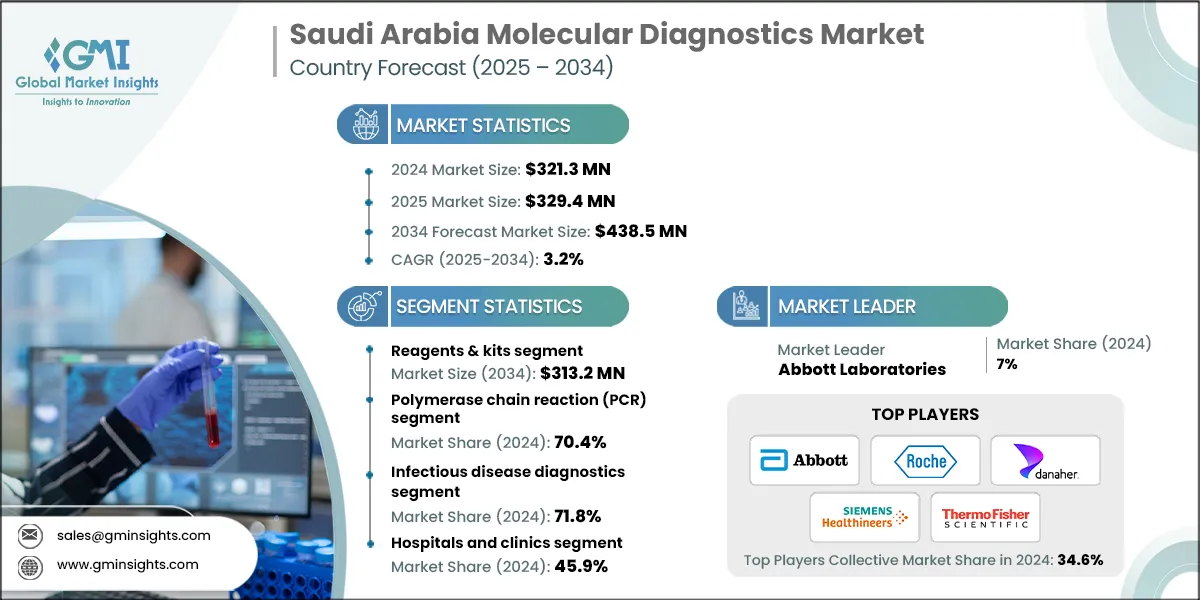
The Saudi Arabia molecular diagnostics market size was valued at USD 321.3 million in 2024. The market is projected to grow from USD 329.4 million in 2025 to USD 438.5 million by 2034, expanding at a CAGR of 3.2%, according to the latest report published by Global Market Insights Inc.
To get key market trends
The market growth is stimulated by various factors such as the rising prevalence of diseases across Saudi Arabia, technological advances and increasing awareness towards early disease diagnosis, increasing demand for POC diagnostics, and the growing geriatric population base. Major companies in the industry include Abbott Laboratories, F. Hoffmann-La Roche, Danaher Corporation, Siemens Healthineers, Thermo Fisher Scientific.
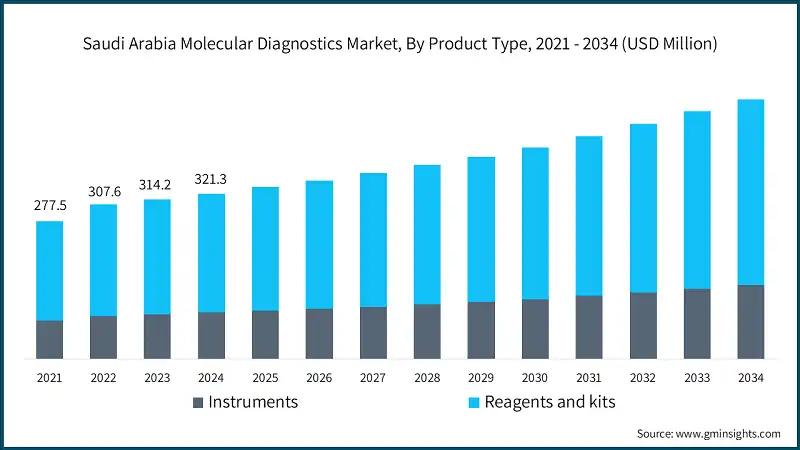
The market increased from USD 277.5 million in 2021 to USD 314.2 million in 2023. The increasing burden of infectious disease is a major catalyst for adoption of molecular diagnostic as cases of respiratory infections, sexually transmitted infection, and cancer is increasing the demand for rapid accurate and scalable diagnostic solution, encouraging healthcare providers to adopt advanced molecular technology such as PCR, this tools help early detection, precise pathogen identification, and real time monitoring which are critical for effective treatment and containment.
Saudi Arabia Molecular Diagnostics Market Report Attributes
| Key Takeaway | Details |
|---|---|
| Market Size & Growth | |
| Base Year | 2024 |
| Market Size in 2024 | USD 321.3 Million |
| Market Size in 2025 | USD 329.4 Million |
| Forecast Period 2025 - 2034 CAGR | 3.2% |
| Market Size in 2034 | USD 438.5 Million |
| Key Market Trends | |
| Drivers | Impact |
| Rising prevalence of diseases across Saudi Arabia | Drives consistent demand for accurate and early diagnostic solutions. |
| Technological advances and increasing awareness towards early disease diagnosis | Accelerates adoption of innovative molecular testing platforms. |
| Increasing demand for POC diagnostics | Expands market reach into decentralized and outpatient settings. |
| Increasing geriatric population base | Boosts the need for chronic disease monitoring and age-related diagnostic services. |
| Pitfalls & Challenges | Impact |
| High cost of molecular diagnostic tests | Limits accessibility and adoption, especially in smaller or underfunded healthcare settings. |
| Lack of skilled personnel | Slows down implementation and operation of advanced diagnostic technologies in clinical environments. |
| Opportunities: | Impact |
| Integration with artificial intelligence (AI) | Enhances diagnostic accuracy, speeds up data analysis, and supports personalized healthcare solutions |
| Market Leaders (2024) | |
| Market Leaders |
7% Market share |
| Top Players |
Collective market share in 2024 is 34.6% |
| Competitive Edge |
|
| Regional Insights | |
| Future outlook |
|
What are the growth opportunities in this market?
For instance, according to the World Health Organization (WHO), Saudi Arabia has reported 28,113 new cases, 13,399 deaths, and 94,951 prevalent cases over five years for a cancer, indicating a significant public health concern. The rising prevalence of diseases like cancer along with emerging threats is increasing adoption of molecular diagnostics, further accelerating the market growth.
The rapidly expanding elderly population in Saudi Arabia is significantly boosting the demand for molecular diagnostics. Individual aged 65 and above are more prone to chronicle illness that require ongoing testing. According to National Institutes of Health (NIH), in Saudi Arabia, the proportion of older adults (aged 60 and above) ranged from 5.59% to 6.9% of the total population between 2020 and 2022.
Similarly, hospital-based study revealed a high burden of chronic condition among patients aged 65 years and above around 58.1% suffered from hypertension 48.6% diabetes mellitus and 27.5% from cardiac disease, along with 14.6% suffered from lung disease, and 4.9% with asthma. These figures highlight increasing need for advanced diagnostic tools making molecular diagnostics solutions important. As the proportion of older adults grows, so does the demand for reliable diagnostic solutions to manage age related conditions, this accelerates the molecular diagnostics market growth.
Molecular diagnostics refers to a diagnostic method that examines biological markers in the genome and proteome, including RNA, DNA, and proteins, to identify and monitor various diseases. This technique is widely utilized for diagnosing genetic disorders, infectious diseases, and cancer due to its high effectiveness and precision.
Saudi Arabia Molecular Diagnostics Market Trends
- Technological progress in molecular diagnostics has led to a creation of compact portable testing device allowing diagnostics to be performed directly at point of care rather than in centralised laboratories. These portable tools are now commonly used in clinics, ambulance, and even at patients’ home which helps to increase convenience for both healthcare providers and patients.
- For instance, Biocartis offers the Idylla Platform, a fully automated real-time PCR system designed for rapid molecular biomarker testing. This compact and user-friendly device delivers results in under three hours with minimal hands-on time, making it ideal for fast-paced clinical environments. The platform is particularly suited for oncology diagnostics, supporting tests for key mutations such as EGFR, KRAS, and BRAF, which are critical in personalized cancer treatment. Its efficiency and ease of use exemplify the technological advancements driving the molecular diagnostics market forward.
- Additionally, recent innovations have shortened the time required for molecular diagnostic testing enabling quicker disease identification and more accurate and fast treatment decisions. These rapid tests are essential for managing patients effectively especially during infectious disease outbreaks and emergencies where diagnosis in specific time period can greatly improve health outcomes.
- Moreover, the integration of automation and intelligent software system has optimised the diagnostic process by reducing manual errors and increasing the capacity of testing and number of testings, this streamlining of operation helps and contributes to more reliable and efficient diagnostics.
- Technological advancement has also contributed to lower the overall cost in molecular diagnostic solutions by reducing the need for specialised infrastructure and personnel these innovations are making testing more affordable and scalable particular in under deserved regions and smaller healthcare facilities.
- Molecular diagnostics are becoming more efficient, affordable, and widely adopted across Saudi Arabia, thereby stimulating the market growth.
Saudi Arabia Molecular Diagnostics Market Analysis
Learn more about the key segments shaping this market
Based on the product type, the Saudi Arabia molecular diagnostics market is segmented into instruments and reagents & kits. The reagents & kits segment was valued at USD 231.3 million in 2024 and is projected to reach USD 313.2 million by 2034, growing at a CAGR of 3.1%.
- The reagents and kits segment dominate molecular diagnostic market due to their essential role in every test.
- These components such as enzymes primers and chemicals are important for detecting genetic material from pathogens like viruses and bacteria. As testing volume increases for disease like COVID-19, tuberculosis, and influenza the demand for these consumables rises accordingly. Their uses scale is directly with number of diagnostic tests that are being done.
- Reagents and kits are utilised across wide range of platforms from traditional laboratories systems to modern point of care devices their consistent use in each test ensures a reliable revenue stream.
- Additionally, innovation in kit design have made diagnostic faster, more accurate and easier to perform.
- For instance, Becton, Dickinson and Company (BD) offers the BD Rhapsody Single-Cell Reagents, a solution for single-cell multiomics analysis. These reagents enable simultaneous profiling of mRNA and proteins at the cell level, making them ideal for high-resolution diagnostics and research. Designed for automation compatibility, they streamline workflows and support precision diagnostics, reflecting the trend of innovation in the molecular diagnostics market.
- Therefore, reagents & kits in molecular test combined with their high usage rate and technological improvement make them dominant segment driving growth in the Saudi Arabia molecular diagnostic market.
Based on technology, the Saudi Arabia molecular diagnostics market is segmented into polymerase chain reaction (PCR), hybridization, sequencing, isothermal nucleic acid amplification technology (INAAT), microarrays, and other technologies. The polymerase chain reaction (PCR) segment accounted for the highest market share of 70.4% in 2024.
- Polymerase chain reaction continues to be leading technology in molecular diagnostic market due to its high precision rapid processing and broad applicability it is applicable for detecting small amount of genetic material making it an ideal tool for diagnosing infectious disease hereditary condition and various forms of cancer.
- Additionally, advancement in miniature PCR devices is enabling the expansion of molecular diagnostics into home and remote testing environments. These portable systems allow patients to perform test outside traditional clinical setting improving accessibility and supporting early detection in underserved regions.
- For instance, The Panther Fusion System is a fully automated molecular diagnostics platform that supports real-time PCR, transcription-mediated amplification (TMA), and reverse transcription PCR (RT-TMA). It offers high throughput, walkaway automation, and the ability to run laboratory-developed tests. The system is scalable and supports a broad menu of assays for infectious diseases and women’s health.
- Moreover, adoption of PCR is increased due to its accuracy, speed, scalability, its widespread application across various disease areas with ongoing technological advancement ensure that PCR continues to be central to diagnostic innovation and market expansion.
Based on application, the Saudi Arabia molecular diagnostics market is segmented into infectious disease, genetic disease testing, oncology testing, and other applications. The infectious disease diagnostics market is further bifurcated into COVID-19, flu, respiratory syncytial virus (RSV), tuberculosis, CT/NG, HIV, Hepatitis C, Hepatitis B, and other infectious disease diagnostics. The infectious disease diagnostics segment accounted for the highest market share of 71.8% in 2024.
- The rise in infectious disease, genetic disease testing, and oncology testing is a major factor that is affecting the growth of the Saudi Arabia molecular diagnostic market since these diseases require fast accurate and sensitive testing method.
- Molecular diagnostics especially PCR based test offer high precision and quick testing making them essential tools in routine screening.
- For example, a 2024 study notes there were 27,885 new cancer cases in 2020, with projections for this number to more than double by 2040. Thus, as cancer cases grow, especially in types including breast, colorectal, and thyroid, early and precise detection becomes critical.
- In conclusion, the growing prevalence of cancer patients is pushing healthcare systems to adopt advanced molecular diagnostics. The demand for early detection, better disease management, and public health surveillance is driving market expansion and innovation in diagnostic technologies.
Learn more about the key segments shaping this market
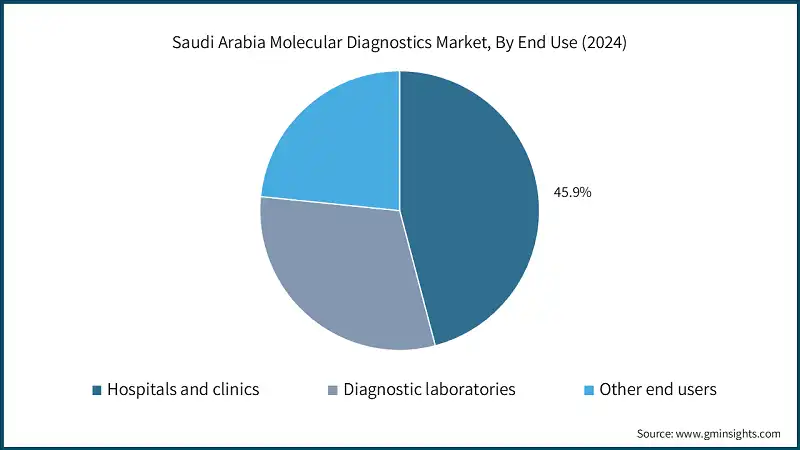
Based on end use, the Saudi Arabia molecular diagnostics market is segmented into hospitals and clinics, diagnostic laboratories, and other end users. The hospitals and clinics segment accounted for the highest market share of 45.9% in 2024.
- Hospitals are important in molecular diagnostics solutions, due to large patient volumes and ability to perform complex test with advanced lab structure and skilled personnel.
- Additionally, they are well equipped to conduct a wide range of molecular diagnostic test from infectious disease screening to cancer detection and genetic testing.
- Hospitals consistently incorporate molecular diagnostics both in routine care and emergency setting ensuring a stable and ongoing demand for these tests. Their ability to set in diagnostic into clinical workflow support timely and effective patient management.
- Moreover, centralized systems in hospitals enable high volume testing capabilities through advanced instrumentation and automation and allow for rapid and consistent results.
- Therefore, the hospital segment continues to drive the Saudi Arabia molecular diagnostic market through testing capacity and integration with advanced technologies.
Saudi Arabia Molecular Diagnostics Market Share
- Leading companies such as Abbott Laboratories, F. Hoffmann-La Roche, Danaher Corporation, Siemens Healthineers, and Thermo Fisher Scientific hold a significant share of the molecular diagnostics market in Saudi Arabia. Their dominance is driven by broad product portfolios, regulatory approvals, strategic collaborations, and continuous innovation.
- New entrants in the Saudi molecular diagnostics space are adopting diverse strategies to gain market presence. These include leveraging advanced technologies such as PCR, next-generation sequencing (NGS), AI-driven analytics, and point-of-care platforms. Many are focusing on specialized areas like personalized medicine, particularly in oncology and pharmacogenomics, while forming partnerships with hospitals, research centers, and established firms to navigate high equipment costs and regulatory barriers.
- Beyond clinical environments, there is a growing demand in Saudi Arabia for home-based and over-the-counter molecular testing kits. This trend is fueled by consumer preferences for convenience, faster results, and privacy especially in areas like infectious disease screening and genetic health assessments. This shift is opening new opportunities for both established and emerging companies to expand their reach and product offerings.
Saudi Arabia Molecular Diagnostics Market Companies
Few of the prominent players operating in the Saudi Arabia molecular diagnostics industry include:
- Abbott Laboratories
- Agilent Technologies
- Becton, Dickinson, and Company
- Biocartis
- Bio-Rad Laboratories
- Danaher Corporation
- F. Hoffmann-La Roche
- Hologic
- Qiagen
- QuidelOrtho Corporation
- Siemens Healthineers
- Sysmex Corporation
- Thermo Fisher Scientific
- F. Hoffmann-La Roche
F. Hoffmann-La Roche is a leader in molecular diagnostics, offering advanced solutions for oncology, infectious diseases, and genetic testing. The company’s diagnostics division provides PCR-based assays, sequencing platforms, and companion diagnostics that support precision medicine. Roche continues to expand its portfolio with innovations like the cobas systems and collaborations in point-of-care testing. Its molecular tools are widely used for early cancer detection, therapy monitoring, and outbreak surveillance. Roche’s commitment to R&D and strategic acquisitions strengthens its position in the market, driving growth through personalized healthcare and integrated diagnostic technologies.
Siemens Healthineers is actively expanding its molecular diagnostics portfolio with advanced PCR-based systems and syndromic testing platforms. Its VERSANT kPCR Molecular System enables real-time detection of viruses, bacteria, fungi, and parasites, supporting precision medicine and cost-effective diagnostics. Siemens strengthened its molecular imaging segment by acquiring Advanced Accelerator Applications from Novartis, boosting its PET radiopharmaceutical production and distribution.
Bio-Rad Laboratories is a prominent player in molecular diagnostics, known for its advanced Droplet Digital PCR (ddPCR) platforms used in oncology, infectious disease detection, and genetic analysis. Through continuous innovation and strategic acquisitions, Bio-Rad strengthens its position in the Saudi Arabia molecular diagnostics market, driving growth and technological advancement.
Saudi Arabia Molecular Diagnostics Industry News:
- In February 2023, Biocartis, a leading molecular diagnostics company, introduced the Idylla IDH1-2 Mutation Assay Kit (RUO) to select customers. This assay marked the first application of the new Idylla FLEX technology, which separates the generic components of an Idylla test from its test-specific elements. This launch strengthened Biocartis' competitive position in the market.
The Saudi Arabia molecular diagnostics market research report includes in-depth coverage of the industry with estimates and forecasts in terms of revenue in USD Million and from 2021 - 2034 for the following segments:
Market, By Product Type
- Instruments
- Reagents and kits
Market, By Technology
- Polymerase chain reaction (PCR)
- Hybridization
- Sequencing
- Isothermal nucleic acid amplification technology (INAAT)
- Microarrays
- Other technologies
Market, By Application
- Infectious disease diagnostics
- COVID-19
- Flu
- Respiratory syncytial virus (RSV)
- Tuberculosis
- CT/NG
- HIV
- Hepatitis C
- Hepatitis B
- Other infectious disease diagnostics
- Genetic disease testing
- Oncology testing
- Other applications
Market, By End Use
- Hospitals and clinics
- Diagnostic Laboratories
- Other end use
Frequently Asked Question(FAQ) :
Who are the key players in the Saudi Arabia molecular diagnostics industry?
Key players include Abbott Laboratories, Agilent Technologies, Becton, Dickinson, and Company, Biocartis, Bio-Rad Laboratories, Danaher Corporation, F. Hoffmann-La Roche, Hologic, Qiagen, and QuidelOrtho Corporation.
What are the key trends in the Saudi Arabia molecular diagnostics market?
Trends include portable point-of-care devices, automation with intelligent software, faster molecular testing, cost-efficient technologies, and growing adoption in underserved regions.
What was the valuation of the infectious disease diagnostics segment in 2024?
The infectious disease diagnostics segment held the largest market share of 71.8% in 2024, led by the rising prevalence of infectious and genetic diseases and the demand for oncology testing.
What was the market share of the polymerase chain reaction (PCR) segment in 2024?
The polymerase chain reaction (PCR) segment accounted for the highest market share of 70.4% in 2024.
How much revenue did the reagents & kits segment generate in 2024?
The reagents & kits segment generated approximately USD 231.3 million in 2024 and is expected to witness over 3.1% CAGR through 2034.
What is the expected size of the Saudi Arabia molecular diagnostics industry in 2025?
The market size is projected to reach USD 329.4 million in 2025.
What is the projected value of the Saudi Arabia molecular diagnostics market by 2034?
The market is poised to reach USD 438.5 million by 2034, fueled by advancements in diagnostic technologies, growing geriatric populations, and the increasing adoption of molecular diagnostics across healthcare facilities.
What is the market size of the Saudi Arabia molecular diagnostics in 2024?
The market size was valued at USD 321.3 million in 2024, with a CAGR of 3.2% expected through 2034. The market growth is driven by rising disease prevalence, technological advancements, increased awareness of early diagnosis.
Saudi Arabia Molecular Diagnostics Market Scope
Related Reports