Summary
Table of Content

Saltwater Aquaculture Market
Get a free sample of this report
Form submitted successfully!
Error submitting form. Please try again.
Thank you!
Your inquiry has been received. Our team will reach out to you with the required details via email. To ensure that you don't miss their response, kindly remember to check your spam folder as well!
Request Sectional Data
Thank you!
Your inquiry has been received. Our team will reach out to you with the required details via email. To ensure that you don't miss their response, kindly remember to check your spam folder as well!
Form submitted successfully!
Error submitting form. Please try again.
Saltwater Aquaculture Market Size
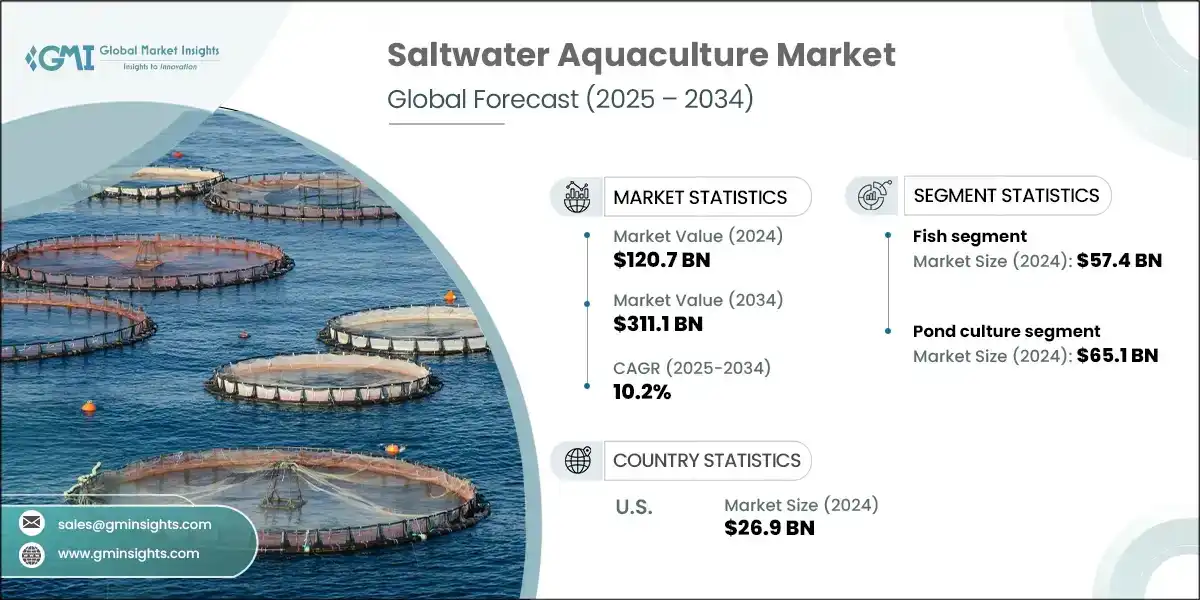
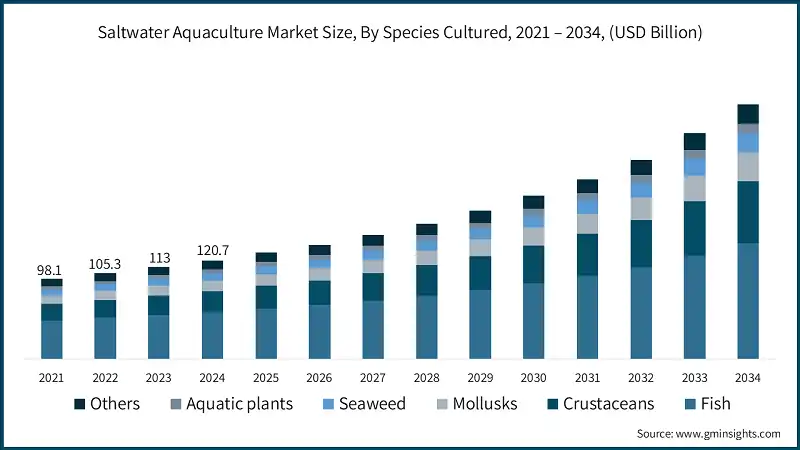
The global saltwater aquaculture market was estimated at USD 120.7 billion in 2024 and projected to grow at a CAGR of 10.2% from 2025 to 2034, as per the latest report published by global market insights, Inc.
Saltwater Aquaculture Market Key Takeaways
Market Size & Growth
- 2024 Market Size: USD 120.7 Billion
- 2034 Forecast Market Size: USD 311.1 Billion
- CAGR (2025–2034): 10.2%
Key Market Drivers
- Rising domestic demand for seafood and food security.
- Technological advancements and ecosystem integration.
- Regulatory support and economic incentives.
Challenges
- Environmental and zoning challenges.
- Public perception and market acceptance.
Opportunity
- Expansion into offshore aquaculture zones.
- Development of alternative and sustainable feed sources.
Key Players
- Market Leader: Marine Harvest ASA (Mowi) led with over 1.9% market share in 2024.
- Leading Players: Top 5 players in this market include Cermaq Group AS, Cooke Aquaculture Inc., Leroy Seafood Group ASA, Marine Harvest ASA (Mowi), Nippon Suisan Kaisha, Ltd., which collectively held a market share of 6% in 2024.
Get Market Insights & Growth Opportunities
- The market has grown 42% since 2019, driven by population growth, urbanization, and shifting dietary preferences toward protein-rich and low-fat food sources. According to the FAO, global aquaculture production reached 130.9 million tons in 2022, with 51% of aquatic animal production now coming from aquaculture rather than capture fisheries. This marks a significant shift in food systems, where saltwater aquaculture is increasingly relied upon to meet nutritional needs and reduce pressure on wild stocks. The FAO also notes that per capita consumption of aquatic foods rose to 20.7 kg globally, underscoring the growing consumer appetite for farmed seafood.
- Technological innovation is another key driver, particularly in offshore cage systems, recirculating aquaculture systems (RAS), and integrated multi-trophic aquaculture (IMTA). These systems are improving production efficiency, reducing environmental impact, and enabling expansion into previously unsuitable areas. The FAO highlights that Asia accounted for 89% of global aquaculture production, with countries like China, India, and Indonesia leading in marine farming innovation. These advancements are not only increasing yield but also enabling diversification into high-value species such as sea bass, tuna, and shrimp, which are in high demand across global markets.
- Government support and policy alignment are further accelerating market growth. The FAO’s “Blue Transformation” strategy emphasizes aquaculture as a pillar of sustainable food systems, encouraging countries to integrate marine farming into national food security and climate resilience plans. For instance, the U.S. and EU have launched initiatives to streamline permitting, invest in research, and promote sustainable practices.
- The FAO reports that aquaculture now contributes over 57% of aquatic animal food supply, a clear indicator of its central role in future food systems. These combined forces demand, innovation, and policy are positioning saltwater aquaculture as one of the most dynamic and essential sectors in global agriculture.
- The increasing per capita consumption of seafood in the U.S. reaching 20.8 pounds in 2022 reflects a growing consumer preference for protein-rich, low-fat food sources. This trend is not just a dietary shift but a strategic imperative for national food security. With over 75% of seafood consumed in the U.S. being imported, saltwater aquaculture presents a viable solution to reduce dependency on foreign supply chains and mitigate trade deficits, which stood at USD 20.6 billion in 2024 (FAO). The USDA and NOAA have emphasized aquaculture’s role in meeting future food needs while easing pressure on wild fisheries, which have plateaued in production since the 1980s. This demand-driven growth is further supported by federal initiatives such as Executive Order 14276, which aims to restore American seafood competitiveness by promoting domestic aquaculture. The strategic alignment of aquaculture with national food policy underscores its long-term viability and positions it as a cornerstone of sustainable protein production.
Saltwater aquaculture has benefited significantly from innovations in integrated multi-trophic aquaculture (IMTA), offshore cage systems, and recirculating aquaculture systems (RAS). These technologies not only enhance yield efficiency but also reduce environmental impact by mimicking natural ecosystems. For instance, NOAA’s AquaFort platform demonstrates how trout, mussels, and kelp can be co-cultured to mutually benefit each other, improving nutrient recycling and reducing waste.
Moreover, federal agencies such as NOAA and USDA have invested in research to develop alternative feeds, improve hatchery techniques, and optimize spatial planning for aquaculture zones. These advancements are not merely operational improvements, they represent a paradigm shift toward precision aquaculture, enabling producers to scale sustainably while maintaining ecological integrity.
Despite technological progress, saltwater aquaculture faces persistent environmental and spatial constraints. Marine farming operations must navigate complex federal, state, and local regulations to ensure compliance with water quality, habitat protection, and biodiversity standards. These regulatory layers, while essential for sustainability, often result in lengthy permitting timelines and increased operational costs.
To get key market trends
Saltwater Aquaculture Market Trends
- Governments and international bodies are tightening environmental and food safety regulations, compelling aquaculture firms to adopt more sustainable practices. The FAO emphasizes the growing role of ecosystem-based management and precautionary principles in marine farming, particularly in response to habitat degradation and disease outbreaks. These regulatory pressures are not only increasing compliance costs but also driving innovation in farming systems such as Recirculating Aquaculture Systems (RAS) and offshore cage technologies. Countries like Norway and Japan are leading in implementing traceability protocols and digital monitoring systems, setting new benchmarks for responsible aquaculture.
- In response to shifting consumer preferences, companies are moving beyond commodity seafood to value-added, health-oriented, and certified products. The FAO report highlights the rise of organic aquaculture, antibiotic-free certifications, and omega-3 enriched offerings. This trend is particularly strong in North America and Europe, where consumers are increasingly skeptical of farmed seafood and demand transparency in sourcing and production. Firms like Mowi and Leroy Seafood are investing in retail branding and storytelling, positioning their products as premium, sustainable, and traceable. This shift from bulk production to differentiated marketing is helping companies withstand price competition and build brand loyalty.
- The adoption of AI, IoT, and biotechnology is transforming operational efficiency and competitive dynamics. According to the FAO, smart aquaculture systems are being deployed to monitor water quality, automate feeding, and detect early signs of disease, significantly reducing mortality rates and feed waste. This digital transformation is not limited to large players; emerging markets like India and Indonesia are also piloting tech-enabled aquaculture zones. As a result, the competitive landscape is shifting from scale-based dominance to tech-driven agility, where innovation and adaptability are becoming key differentiators in a crowded market.
Saltwater Aquaculture Market Analysis
Learn more about the key segments shaping this market
The market by species cultured is segmented into fish, crustaceans, mollusks, seaweed, aquatic plants, and others (frogs, eels, etc.). In 2024, the fish segment dominated the market and generated a revenue of USD 57.4 billion and is expected to grow at CAGR of around 9.7% during the forecast period 2025 to 2034.
- Fish, particularly species like salmon, sea bass, and tuna, are widely consumed across global markets due to their nutritional value, mild flavor, and versatility in culinary applications.
- Compared to crustaceans and mollusks, many fish species exhibit superior feed efficiency, translating into lower production costs and higher profitability for producers.
- Fish farming benefits from decades of technological advancement, including offshore cage systems, hatchery management, and disease control protocols, making it more scalable and commercially viable.
- Fish products, especially salmon and tilapia, are among the most traded aquaculture commodities globally, supported by robust cold chain logistics and international certification standards.

Learn more about the key segments shaping this market
The saltwater aquaculture market by culture systems is segmented into pen culture, pond culture, floating cage culture, recirculating aquaculture systems (RAS), integrated multi-trophic aquaculture (IMTA), and others. The pond culture segment was the leading segment in this market in 2024 with a revenue of USD 65.1 billion and has a market share of around 54%.
- Pond culture requires relatively low capital investment compared to advanced systems like RAS or offshore cages, making it accessible for small and medium-scale producers in emerging economies.
- The system allows for straightforward monitoring of water quality, feeding, and harvesting, which is particularly advantageous in regions with limited access to high-tech aquaculture tools.
- Many national aquaculture programs promote pond culture as a means of livelihood enhancement, especially in coastal and rural areas, contributing to its widespread adoption.
- Pond systems support a diverse range of species including finfish, crustaceans, and mollusks, enabling producers to adapt to market demand and environmental conditions.
- Pond culture can be easily integrated with agriculture and livestock systems, facilitating resource recycling and improving overall farm productivity in mixed-use landscapes.
Looking for region specific data?
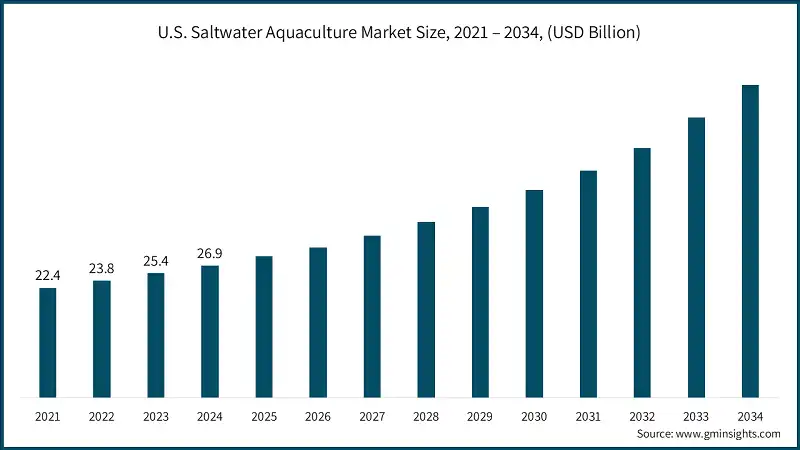
- The U.S. saltwater aquaculture market was valued at around USD 26.9 billion in 2024 and is anticipated to register a CAGR of 9.2% between 2025 and 2034.
- The FAO highlights that U.S. aquaculture is benefiting from technological innovation, consumer demand for sustainable seafood, and government-backed research initiatives. These factors are enabling diversification into species like sea bass, seaweed, and shellfish, while also improving feed efficiency and disease control.
- The U.S. market is expected to shift toward offshore aquaculture, recirculating systems, and value-added products, driven by environmental regulations and climate resilience goals. The FAO’s Blue Transformation strategy aligns with national efforts to integrate aquaculture into broader food security and sustainability frameworks
- The U.S. produced 478,100 tons of farmed aquatic animals in 2022, marking a 6.7% increase from 2020. Despite this growth, production remains below its historical peak of 607,600 tons in 2004, indicating room for recovery and expansion.
- Europe: Europe witnessed promising demand in the saltwater aquaculture market with a share of around 22.2% in 2024 and is expected to grow at a robust CAGR of 9.4% during the forecast period.
o Europe is demonstrating strong demand in the saltwater aquaculture industry due to a combination of strategic policy alignment, consumer behavior, and production capabilities. According to Eurostat, the EU produced nearly 1.1 million tons of aquatic organisms in 2023, valued at approximately USD 5 billion, with Spain, France, Greece, and Italy contributing over 66.6% of the total output. This growth is underpinned by the EU’s Common Fisheries Policy (CFP) and Blue Growth Agenda, which promote environmentally and economically sustainable aquaculture. The increasing focus on high-value species such as seabass and tuna priced at USD 8/kg and USD 14/kg respectively reflects a shift toward premium product offerings that meet evolving consumer preferences.
o Moreover, the EU Fish Market Report 2024 highlights a notable rise in the apparent consumption of farmed seafood, reaching 6.82 kg per person in 2022, the highest in a decade. This trend is driven by growing awareness of sustainability, traceability, and health benefits associated with aquaculture products. Despite inflationary pressures, household spending on aquaculture rose by 6% in 2022, indicating resilient demand.
- Asia Pacific: In 2024, the saltwater aquaculture market revenue for the Asia Pacific was around USD 44.4 billion and is expected to reach USD 124.7 billion by 2034.
o Asia Pacific continues to demonstrate robust production and consumption in the market, driven by its vast coastline, favorable climatic conditions, and strong policy support. According to the FAO, the region accounted for over 89% of global aquaculture production in 2022, with China, India, Indonesia, and Vietnam leading the charge. China alone contributed more than 60 million tons, making it the world’s largest aquaculture producer. This dominance is supported by integrated farming systems, government subsidies, and innovations such as Integrated Multi-Trophic Aquaculture (IMTA), which now represents 40% of China’s mariculture output. India’s National Fisheries Development Programme (NFDP) also emphasizes marine cage culture and coastal aquaculture as strategic growth areas.
o On the consumption side, Asia Pacific’s rising middle class and urbanization are fueling demand for protein-rich seafood. The FAO notes that per capita fish consumption in Asia reached over 24 kg/year, significantly higher than the global average. Countries like Japan and South Korea are also investing in high-value species and traceability systems to meet domestic and export market standards.
Saltwater Aquaculture Market Share
- The top 5 companies in the saltwater aquaculture industry, such as Cermaq Group AS, Cooke Aquaculture Inc., Leroy Seafood Group ASA, Marine Harvest ASA (Mowi), and Nippon Suisan Kaisha, Ltd., hold a market share of 5-7%.
- Cermaq, a subsidiary of Mitsubishi Corporation, has strategically positioned itself across three major salmon-producing regions Norway, Chile, and Canada. Its resilience in a competitive market stem from its commitment to clean farming practices, including reduced antibiotic use and enhanced fish welfare standards. Cermaq’s emphasis on local partnerships and digital traceability systems allows it to meet rising consumer demand for transparency and sustainability. By integrating environmental stewardship with operational efficiency, Cermaq has built a reputation that supports premium pricing and long-term brand loyalty.
- Cooke Aquaculture’s strength lies in its vertical integration from broodstock management to feed production and equipment development. This control over the entire value chain enables cost optimization and quality assurance, giving Cooke a competitive edge in both domestic and international markets. The company’s expansion into retail and distribution networks across North America, coupled with its investment in nutritional innovation through Northeast Nutrition Inc., reflects a strategy focused on scalability and market responsiveness. Cooke’s diversified operations allow it to adapt quickly to regulatory changes and consumer trends.
- Leroy Seafood has adopted a multi-country production and packaging strategy, with facilities spread across Europe and Asia. This geographic diversification not only mitigates supply chain risks but also enables Leroy to cater to regional preferences with tailored product offerings. The company’s focus on value-added seafood products and sustainable sourcing has helped it penetrate over 80 global markets. Leroy’s investment in digital logistics and cold chain infrastructure ensures product freshness and traceability, reinforcing its brand as a reliable supplier of high-quality seafood.
Saltwater Aquaculture Market Companies
Mowi, the world’s largest producer of Atlantic salmon, leverages its global footprint across 24 countries to maintain market dominance. Its portfolio of consumer-facing brands such as Rebel Fish and The Irish Organic Salmon Company demonstrates a strategic pivot toward retail branding and premiumization. Mowi’s investment in automated farming systems, AI-driven monitoring, and sustainable feed development positions it at the forefront of aquaculture innovation. By aligning its operations with ESG goals and consumer health trends, Mowi continues to expand its market share while maintaining operational resilience.
Nissui’s strategy is rooted in regional specialization, with salmon and trout farming outside Japan and species like yellowtail and tuna cultivated domestically. This dual-market approach allows Nissui to optimize production based on ecological and consumer factors. The company’s Oita Marine Biological Technology Center drives R&D in sustainable aquaculture, focusing on disease resistance and feed efficiency. Nissui’s global distribution network and commitment to biotechnology innovation enable it to meet diverse market demands while maintaining high standards of quality and sustainability.
Major players operating in the saltwater aquaculture industry are:
- Aller Aqua
- Cermaq Group AS
- Cooke Aquaculture Inc.
- GeneSeas Aquacultura Ltda.
- Grieg Seafood ASA
- Huon Aquaculture Group Ltd.
- Innovasea
- Leroy Seafood Group ASA
- Marine Harvest ASA (Mowi)
- Nippon Suisan Kaisha, Ltd.
- Nueva Pescanova
- P/F Bakkafrost
- PHARMAQ (Zoetis)
- SalMar ASA
- Yalelo Zambia
Saltwater Aquaculture Market Report Attributes
| Key Takeaway | Details |
|---|---|
| Market Size & Growth | |
| Base Year | 2024 |
| Market Size in 2024 | USD 120.7 Billion |
| Forecast Period 2025 - 2034 CAGR | 10.2% |
| Market Size in 2034 | USD 311.1 Billion |
| Key Market Trends | |
| Drivers | Impact |
| Rising domestic demand for seafood and food security | Accelerates global investment in marine aquaculture infrastructure to reduce import dependency and enhance national food sovereignty. |
| Technological advancements and ecosystem integration | Promotes sustainable expansion of aquaculture in offshore and ecologically sensitive zones, reducing pressure on wild fisheries worldwide. |
| Regulatory support and economic incentives | Encourages cross-border collaborations and policy harmonization, enabling streamlined growth of aquaculture enterprises in emerging markets. |
| Pitfalls & Challenges | Impact |
| Environmental and zoning challenges | Restricts geographic expansion and delays project approvals, limiting global scalability of marine aquaculture operations. |
| Public perception and market acceptance | Suppresses consumer demand and investor confidence, especially in regions where farmed seafood faces cultural resistance or misinformation. |
| Opportunities: | Impact |
| Expansion into offshore aquaculture zones | Unlocks vast untapped marine areas for scalable production, reducing land-use conflicts and enabling higher yields in environmentally regulated settings. |
| Development of alternative and sustainable feed sources | Reduces reliance on wild-caught fishmeal and fish oil, lowering ecological footprint and enhancing cost-efficiency across global supply chains. |
| Market Leaders (2024) | |
| Market Leaders |
1.9% market share |
| Top Players |
Collective market share in 2024 is Collective market share is 6% |
| Competitive Edge |
|
| Regional Insights | |
| Largest Market | Asia Pacific |
| Fastest Growing Market | Middle East and Africa |
| Emerging Country | Vietnam, India, Bangladesh, Egypt, and Indonesia |
| Future Outlook |
|
What are the growth opportunities in this market?
Saltwater Aquaculture Industry News
- In May 2025, NOAA’s Milford Laboratory launched a state-of-the-art seawater pumping system designed to support advanced research in salmon and shellfish aquaculture. This new infrastructure delivers clean, temperature-controlled seawater directly from the Long Island Sound, enhancing the lab’s capacity to simulate real-world marine conditions for species health, nutrition, and growth studies. The initiative reflects NOAA’s commitment to strengthening the U.S. aquaculture sector through innovation and environmental stewardship, aligning with national goals for sustainable seafood production.
- In May 2025, the U.S. Environmental Protection Agency (EPA) granted a modified wastewater discharge permit to Ocean Era for its Velella Epsilon project, marking a significant regulatory milestone for saltwater aquaculture in the Gulf of Mexico. The permit allows the company to operate what could become the region’s first commercial-scale offshore fish farm, producing up to 55,000 pounds of red drum annually. Located 40 miles off Florida’s Gulf Coast, the facility must comply with stringent environmental safeguards under the National Pollutant Discharge Elimination System (NPDES), including effluent controls, disaster resilience measures, and strict limits on nutrient discharge to prevent marine ecosystem degradation.
- In August 2023, China launched a groundbreaking initiative to develop seawater aquaculture in the deserts of Xinjiang, aiming to bolster national food security and reduce reliance on traditional agricultural zones. According to the South China Morning Post, this project utilized saline groundwater and advanced aquafarming systems to cultivate marine species like shrimp and sea cucumbers in arid inland regions. The move aligned with China’s broader strategy to diversify food production sources amid climate challenges and geopolitical uncertainties, positioning aquaculture as a key pillar of its long-term agricultural resilience.
- In June 2023, Mote Marine Laboratory in Florida began releasing redfish cultivated at its inland aquaculture facility into local inshore waters, marking a significant milestone in sustainable marine restoration. The initiative aimed to replenish wild populations impacted by environmental stressors such as red tide and habitat loss. By leveraging land-based recirculating aquaculture systems (RAS), Mote ensures controlled, disease-free rearing conditions, aligning with broader efforts to integrate aquaculture into ecosystem recovery and coastal resilience strategies.
The saltwater aquaculture market research report includes in-depth coverage of the industry, with estimates & forecasts in terms of revenue (USD Billion) and (Million Tons) from 2021 to 2034, for the following segments:
Market, By Species Cultured
- Fish
- Crustaceans
- Mollusks
- Seaweed
- Aquatic plants
- Others (Frogs, Eels, etc.)
Market, By Culture Systems
- Pen culture
- Pond culture
- Floating cage culture
- Recirculating aquaculture systems (RAS)
- Integrated multi-trophic aquaculture (IMTA)
- Others
Market, By Environment
- Marine water
- Brackish water
- Mixed water systems
Market, By End Use
- Food services
- Retail
- Pharmaceutical and nutraceuticals
- Cosmetics and personal care
- Others
Market, By Distribution Channel
- Direct sales
- Indirect sales
The above information is provided for the following regions and countries:
- North America
- U.S.
- Canada
- Europe
- Germany
- U.K.
- France
- Italy
- Spain
- Netherlands
- Asia Pacific
- China
- Japan
- India
- South Korea
- Australia
- Latin America
- Brazil
- Mexico
- Argentina
- MEA
- UAE
- Saudi Arabia
- South Africa
Frequently Asked Question(FAQ) :
What is the market size of the saltwater aquaculture industry in 2024?
The market size was USD 120.7 billion in 2024, with a CAGR of 10.2% expected through 2034 driven by rising domestic seafood demand, food security goals, and technological advancements in marine farming.
What is the projected value of the saltwater aquaculture market by 2034?
The market size for saltwater aquaculture is expected to reach USD 311.1 billion by 2034, supported by offshore farming expansion, sustainable feed innovations, and increasing integration into national food security strategies.
How much revenue did the fish segment generate in 2024?
The fish segment generated USD 57.4 billion in 2024.
What was the valuation of the pond culture segment in 2024?
Pond culture held 54% market share and generated USD 65.1 billion in 2024.
What is the growth outlook for the U.S. saltwater aquaculture market from 2025 to 2034?
The U.S. market is projected to grow at a CAGR of 9.2% through 2034, driven by technological innovation, government-backed research, and consumer demand for sustainable, locally produced seafood.
What are the upcoming trends in the saltwater aquaculture industry?
Key trends include adoption of offshore and recirculating aquaculture systems, AI-driven farm monitoring, alternative sustainable feeds, and a shift toward premium, certified, and traceable seafood products.
Who are the key players in the saltwater aquaculture market?
Key players include Marine Harvest ASA (Mowi), Cermaq Group AS, Cooke Aquaculture Inc., Leroy Seafood Group ASA, Nippon Suisan Kaisha Ltd., SalMar ASA, Grieg Seafood ASA, Huon Aquaculture Group Ltd., Nueva Pescanova, and P/F Bakkafrost.
Saltwater Aquaculture Market Scope
Related Reports