Summary
Table of Content

Ruggedized Embedded System Market
Get a free sample of this report
Form submitted successfully!
Error submitting form. Please try again.
Thank you!
Your inquiry has been received. Our team will reach out to you with the required details via email. To ensure that you don't miss their response, kindly remember to check your spam folder as well!
Request Sectional Data
Thank you!
Your inquiry has been received. Our team will reach out to you with the required details via email. To ensure that you don't miss their response, kindly remember to check your spam folder as well!
Form submitted successfully!
Error submitting form. Please try again.
Ruggedized Embedded System Market Size
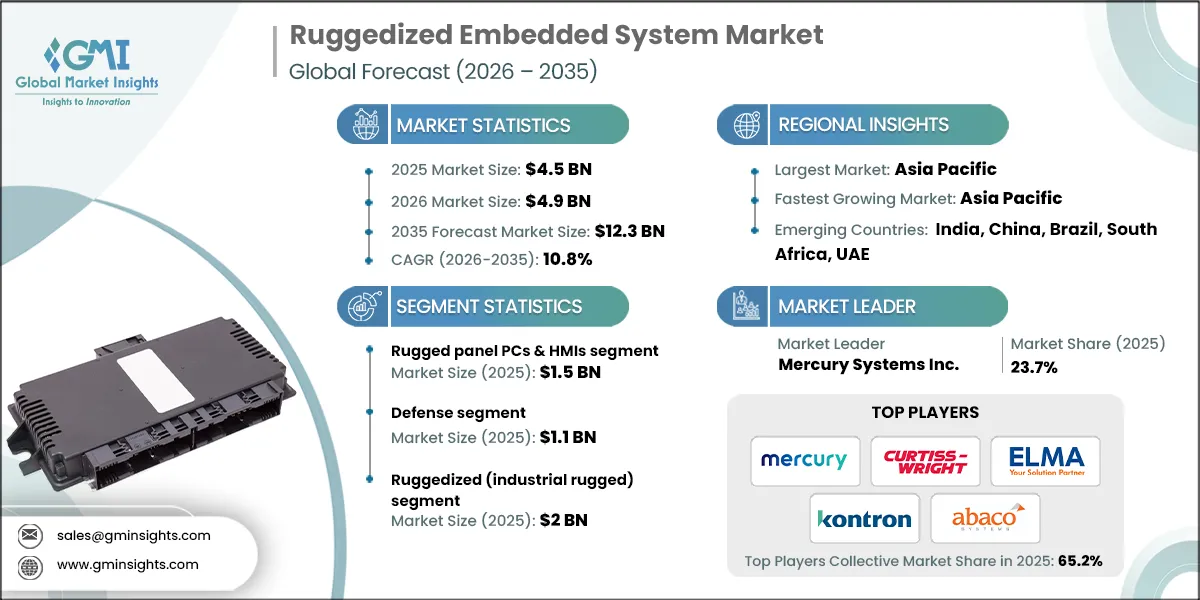
The global ruggedized embedded system market was valued at USD 4.5 billion in 2025. The market is expected to grow from USD 4.9 billion in 2026 to USD 7.7 billion in 2031 and USD 12.3 billion in 2035, at a CAGR of 10.8% during the forecast period, according to the latest report published by Global Market Insights Inc.
Ruggedized Embedded System Market Key Takeaways
Market Size & Growth
- 2025 Market Size: USD 4.5 Billion
- 2026 Market Size: USD 4.9 Billion
- 2035 Forecast Market Size: USD 12.3 Billion
- CAGR (2026–2035): 10.8%
Regional Dominance
- Largest Market: Asia Pacific
- Fastest Growing Region: Asia Pacific
Key Market Drivers
- Increasing demand for reliable systems in harsh environments.
- Rising adoption in defense and aerospace applications.
- Growth of industrial automation and smart manufacturing.
- Expansion of transportation and automotive electronics.
- Advancements in low-power, high-performance embedded technologies.
Challenges
- High development and production costs.
- Complex integration with legacy systems.
Opportunity
- Integration of AI-enabled edge intelligence in rugged systems.
- Rising government investment in resilient digital and critical infrastructure.
Key Players
- Market Leader: Mercury Systems Inc. led with over 23.7% market share in 2025.
- Leading Players: Top 5 players in this market include Mercury Systems Inc., Curtiss-Wright Corporation, Elma Electronic AG, Kontron AG, Abaco Systems, which collectively held a market share of 65.2% in 2025.
Get Market Insights & Growth Opportunities
The ruggedized embedded system market is expanding, owing to increasing demand for reliable systems in harsh environments, rising adoption in defense and aerospace applications, growth of industrial automation and smart manufacturing, expansion of transportation and automotive electronics, and advancements in low-power, high-performance embedded technologies. Embedded systems that are ruggedized are proving to be very crucial especially in defense and aerospace domains. These systems are mission critical because they are relied upon by aircraft, unmanned vehicles and communication networks to perform work under harsh environments. Resilient embedded computing is becoming a key investment by governments to make their countries secure and modernize critical systems.
For instance, in November 2025, Aitech introduced Aitech Defense Solutions, LLC, a unit focused on working with U.S. government agencies and defense contractors. This venture is aimed at the development and delivery of advanced ruggedized embedded computing platforms to classified and national defense applications, which has emphasized the enhanced cooperation between governments and industry stakeholders.
The shift of the automotive industry towards highly developed, automated, and networked technologies is increasing the need to utilize ruggedized embedded systems to a considerable extent. These systems play an essential role in the long-lasting computing systems needed by the current cars. Smart mobility is becoming a priority in national approaches and regulatory frameworks and developing standards in the new types of vehicles. For instance, the Chinese government is further deepening its strategic emphasis on smart mobility in October 2025. Ministries proclaimed to come up with policies of intelligent and connected cars and speed up the merging of artificial intelligence and auto technology thus pushing the next generation automotive electronics to require rugged embedded systems.
A ruggedized embedded system is a specialty computing platform that is intended to work in hard and harsh conditions such as high or low temperature, vibration, shock, dust and moisture among others. These systems incorporate processors, memory, storage and I/O interfaces into hard, reinforced boxes. Ruggedized embedded systems are usually deployed in defense, aerospace, industrial automation, transportation and automotive systems to provide sustained performance, real time data processing and secure operation.
To get key market trends
Ruggedized Embedded System Market Trends
- The rugged embedded systems are making progress in edge computing and IoT networks, allowing sensor data to be processed in real time and in remote and harsh environments without the need to be connected to a cloud. Organizations specializing in digital strategies and governments are focusing on next-generation IoT infrastructure and edge computing to make industrial and essential operations more efficient as a part of the broader digital transformation efforts in manufacturing and transportation industries.
- Artificial intelligence combined with rugged embedded systems is changing next generation systems in order to allow localized decision making and autonomy. The presence of national and regional AI programs as suggested by the OECD and EU digital strategy programs focus on the closer proximity of AI potential to data sources in order to enhance efficiency and resilience. This has been increasing the pace of demand in intelligent rugged computing solutions across the defense, industrial automation as well as the critical infrastructure.
- Public-sector funding and joint projects e.g. EU-funded projects on edge and IoT-standardization and technology-testbeds are boosting the ruggedized embedded systems ecosystem. Such initiatives are building interoperable standards and spurring the implementation of resilient computing solutions in the smart infrastructure, manufacturing, and linked transportation networks.
- Modular, energy efficient rugged embedded platforms are being used increasingly to ensure sustainable operations during field deployments, which are becoming the new focus. The national policy directions targeting the edge-cloud continuum and semiconductor strategies will help to support local resilient hardware ecosystems. These measures are pushing manufacturers to implement superior power management, durability and flexibility in rugged systems to enable them to be fit in mission critical systems in remote and harsh environments.
Ruggedized Embedded System Market Analysis
Learn more about the key segments shaping this market
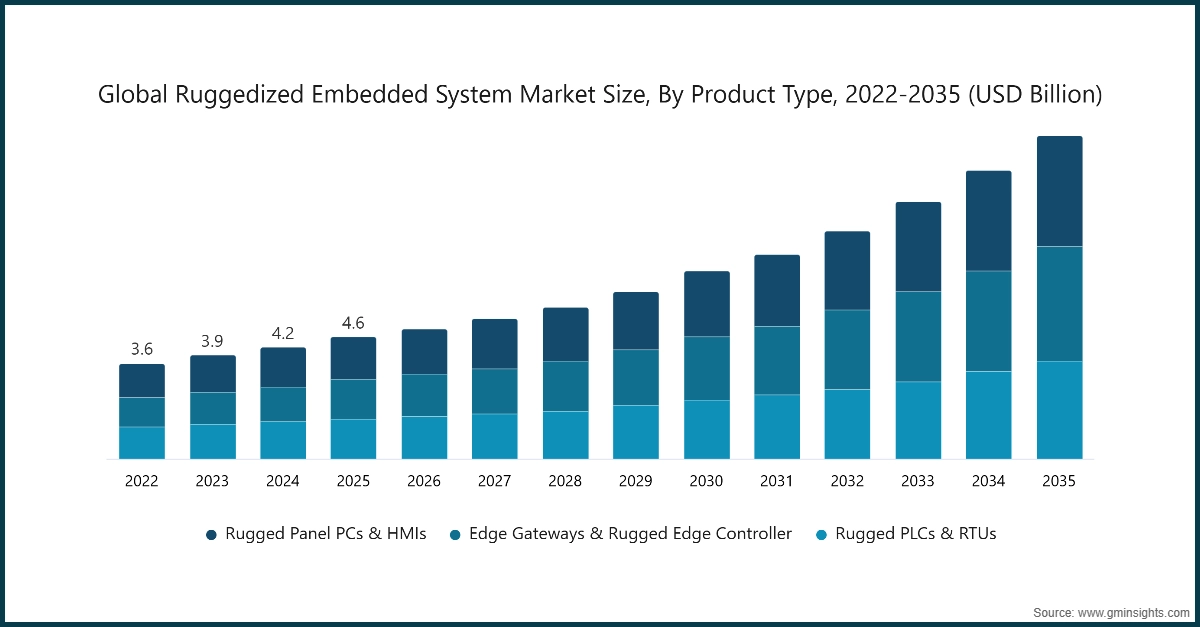
Based on product type, the market is divided into rugged panel PCs & HMIs, edge gateways & rugged edge controller, and rugged PLCs & RTUs.
- The rugged panel PCs & HMIs segment accounted for the largest market and was valued at USD 1.5 billion in 2025. Increasing deployment in industrial automation and manufacturing environments to enable real-time monitoring and control of critical processes under harsh conditions.
- Rising adoption in defense, transportation, and aerospace sectors due to demand for durable, reliable human-machine interfaces in extreme environments.
- Manufacturers should focus on developing customizable, high-resolution HMIs and rugged panel PCs to cater to sector-specific requirements, enhancing reliability and lifecycle support for industrial and defense applications.
- The edge gateways & rugged edge controller segment was the fastest growing market during the forecast period, growing at a CAGR of 11.8% during the forecast period. The growth of IoT and edge computing projects encourages the need to have rugged edge controllers to handle data close to the source in a remote, harsh environment in an efficient manner.
- Expanding the number of smart infrastructure and industrial projects supported by the government stands up the implementation of edge gateways in real-time analytics and secure connectivity.
- Manufacturers should invest in AI-enabled, low-latency rugged edge controllers with enhanced cybersecurity features to capitalize on growing smart infrastructure and IoT industrial deployments.
On the basis of ruggedized level, the ruggedized embedded system market is divided into ruggedized (industrial rugged), high ruggedized, and lower/semi-rugged.
- The ruggedized (industrial rugged) segment accounted for the largest market and was valued at USD 2 billion in 2025. Rampant use in the manufacturing industry, energy, logistics industry suggests the need of industrial-rugged systems that can operate without failure in atmospheric dust, vibration, and temperatures.
- The effort to have standardized industrial automation and control systems at both government and commercial facilities promote the use of proven cost effective ruggedized embedded systems.
- To enhance their standing in industries and infrastructure, manufacturers should emphasize offering long lifecycle support, industry-compliant embedded systems with durable features and easy maintenance.
- The high ruggedized segment was the fastest growing market during the forecast period, growing at a CAGR of 11.6% during the forecast period. Cost-sensitive industrial and commercial applications have semi-rugged systems to compromise durability and cost in less extreme conditions of use.
- Small scale automation projects and new markets are promoting the use of semi rugged solutions, which have moderate environmental resilience.
- Manufacturers should focus on providing affordable, versatile semi-rugged systems with sufficient durability for commercial and light-industrial applications to expand market penetration in emerging regions.
Learn more about the key segments shaping this market
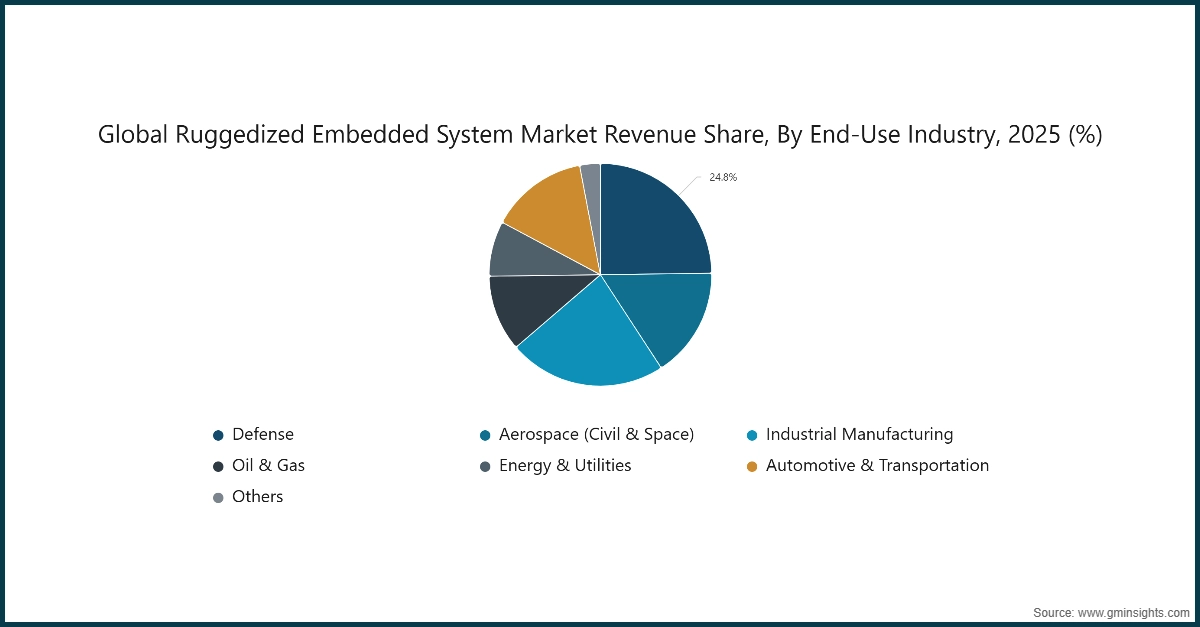
Based on end-use industry, the ruggedized embedded system market is divided into defense, aerospace (civil & space), industrial manufacturing, oil & gas, energy & utilities, automotive & transportation, and others.
- The defense segment accounted for the largest market and was valued at USD 1.1 billion in 2025. Rising demand for mission-critical computing in harsh environments, including battlefield operations, unmanned vehicles, and communication systems, and drives defense sector adoption.
- Government defense modernization programs and increased military spending globally encourage deployment of ruggedized embedded systems with high reliability and durability.
- Manufacturers should focus on developing highly secure, durable, and field-tested embedded systems tailored for defense applications, offering long lifecycle support and compliance with military standards.
- The industrial manufacturing segment was the fastest growing market during the forecast period, growing at a CAGR of 13.2% during the forecast period. Growing automation and Industry 4.0 adoption drive demand for ruggedized embedded systems to ensure uninterrupted operations in harsh manufacturing environments.
- Government initiatives to digitize industrial sectors and improve production efficiency further encourage deployment of resilient, real-time embedded solutions.
- Manufacturers should focus on modular, scalable embedded systems with strong industrial protocol support to serve smart factories and automation projects, enabling integration into diverse manufacturing environments.
North America Ruggedized Embedded System Market
North America held a market share of 25.3% in 2025 of the global market.
- North America maintains its dominance in the market because of the widespread adoption of these systems in the defense, aerospace, industrial automation, and energy industries.
- The United States is the key driver of demand for most ruggedized embedded systems due to its heavy defense budgets, advanced manufacturing infrastructure, and edge computing adoption in rugged industrial environments.
- Canada also witnesses strong growth in the mining, oil & gas, and utilities industries adopting rugged embedded systems.
- Overall, the region witnesses a mature IoT infrastructure, early adoption of Industry 4.0 technologies, and high digitalization of infrastructure and manufacturing processes, making it the largest contributor to the global market.
- Manufacturer needs to invest in ruggedized high-performance platforms that support North American industrial and defense standards, emphasizing edge analytics, interoperability, and long-term support to match enterprise and government procurement cycles.
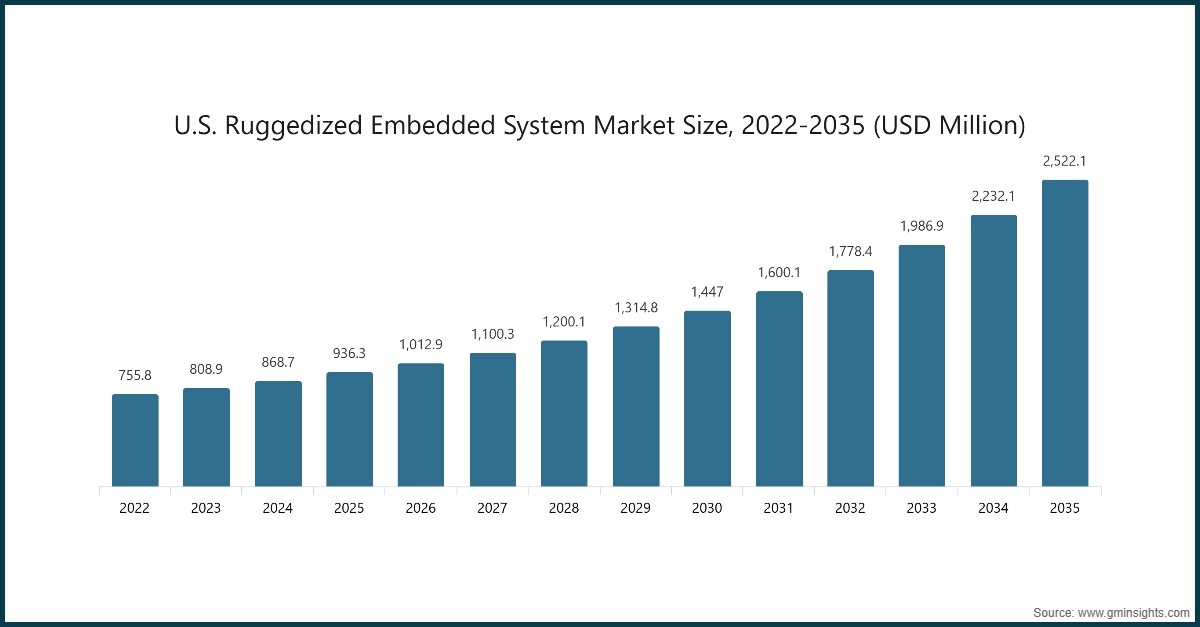
The U.S. ruggedized embedded system market was valued at USD 755.8 million and USD 808.9 million in 2022 and 2023, respectively. The market size reached USD 936.3 million in 2025, growing from USD 868.7 million in 2024.
- Ruggedized embedded systems are on the rise in the United States in defense modernization, aerospace, and industrial automation due to government spending on resilient computing and the convergence of cybersecurity with IoT devices.
- For instance, in January 2026, according to the Orfonline, government-oriented IT and cybersecurity events highlighted that the federal government is integrating zero-trust and behavioral analytics into secure embedded and AI-enabled systems to improve the reliability and resilience of mission-critical systems in the federal infrastructure.
- These changes in strategy continue to promote the use of rugged embedded systems architectures in military and critical infrastructure applications.
- US companies must focus on developing rugged systems with strong cybersecurity, zero-trust compliant architectures, and readiness for federal certification to secure defense and critical infrastructure contracts.
Looking for region specific data?
Europe Ruggedized Embedded System Market
Europe accounted for USD 884.9 million in 2025 and is anticipated to show lucrative growth over the forecast period.
- The adoption of ruggedized embedded systems in Europe is gaining momentum in the industrial, transportation, and energy domains, driven by the digitalization of the automotive and smart factory industries.
- Standardized safety and performance requirements, such as the EU Machinery and Radio Equipment Directives, are increasing the adoption of rugged embedded devices. The focus on the monitoring of the renewable energy grid, smart infrastructure initiatives, and industrial digitalization drives the market growth.
- EU and country-level strategies are driving the demand for robust computing solutions that can survive extreme operating conditions and satisfy strict regulatory and green requirements.
- Vendors need to create ruggedized embedded systems that are compatible with EU standards and energy-efficient to win European industrial automation and smart infrastructure business.
Germany dominated the Europe ruggedized embedded system market, showcasing strong growth potential.
- Technology focus in Germany is on semiconductor and digital ecosystem excellence, which indirectly supports rugged embedded system requirements through advanced manufacturing and automation.
- For instance, in October 2025, the German government approved a microelectronics strategy that aims to enhance semiconductor competence and supply chain resilience in the country, which is a crucial enabler for rugged embedded systems in the industrial and mobility domains.
- With the strong adoption of Industry 4.0 and digital transformation in manufacturing, Germany is a prime market in Europe for rugged and resilient embedded systems.
- Manufacturers must align their product strategies with the microelectronics and digitalization policies of Germany by localizing supply chains and achieving high reliability in the industrial automation and mobility markets.
Asia Pacific Ruggedized Embedded System Market
The Asia Pacific market is the largest and fastest growing market and is anticipated to grow at the CAGR of 11.2% during the analysis timeframe.
- The Asia Pacific market is turning out to be one of the fastest-growing markets for ruggedized embedded systems due to the rapid industrialization and modernization of infrastructure in China, India, Japan, and Southeast Asia.
- China is leading with significant adoption in manufacturing automation and logistics infrastructure, while Japan and South Korea are adopting ruggedized solutions for rail transport and airport control.
- Government initiatives to support digitalization, industrial IoT, and automation are fueling the adoption of edge computing and embedded devices, which are being integrated into smart city and energy grid projects.
- Manufacturers need to provide scalable and cost-effective ruggedized embedded solutions with local support in the Asia Pacific region to secure infrastructure, industrial automation, and smart city business.
China ruggedized embedded system market is estimated to grow with a CAGR of 11.9% during the forecast period, in the Asia Pacific market.
- The China ruggedized embedded system market is growing rapidly due to the expansion of industrial automation and intelligent transportation systems.
- The emphasis on technology sovereignty and smart manufacturing by the government through various national policies increases the adoption of trustworthy embedded platforms in factory automation, logistics, and infrastructure.
- The large-scale use of ruggedized systems in industrial control and edge computing applications helps meet the goals of digital transformation.
- Manufacturers must focus on ruggedized embedded solutions that are optimized for high-volume manufacturing, customization, and integration with China’s smart infrastructure and industrial automation platforms.
Latin American Ruggedized Embedded System Market
Brazil leads the Latin American market, exhibiting remarkable growth during the analysis period.
- The demand for ruggedized embedded systems in Brazil is driven by the mining, oil & gas, transportation, and industrial automation industries. The modernization of urban infrastructure and digital transformation projects in the utilities sector drive the adoption of rugged platforms.
- The growing industrial base in Brazil and the government’s infrastructure investment plans provide opportunities for ruggedized solutions that can operate effectively in Brazil’s challenging environmental conditions.
- Manufacturers should concentrate on rugged system robustness and services designed for the mining, energy, and transportation industries in Brazil.
Middle East and Africa Ruggedized Embedded System Market
South Africa market to experience substantial growth in the Middle East and Africa market in 2025.
- South Africa is seeing rising adoption of ruggedized embedded systems within energy and utility automation, transportation networks, and mining operations.
- Various government initiatives aimed at improving the reliability of critical infrastructure and the development of smart grid solutions are encouraging the demand for rugged computing solutions that can function continuously in harsh environments. The growth of the telecom and industrial IoT is also adding to the demand.
- Although the number of deployments in the region is lower compared to developed regions, infrastructure development and digital transformation initiatives are creating pockets of demand for ruggedized embedded solutions.
- South African manufacturers should provide ruggedized embedded products with strong environmental resilience and after‑sales support tailored to South Africa’s energy, mining, and transport infrastructure needs.
Ruggedized Embedded System Market Share
The market in the world is moderately consolidated with major multinational technology suppliers and regional and niche players. By 2025, the Mercury Systems Inc. and Curtiss-Wright Corporation, Elma Electronic AG, Kontron AG, and Abaco Systems, collectively accounted for 65.2% of the total market share, due to their strong branding, rugged embedded products portfolios, and worldwide distribution networks.
The new regional and local companies are growing swiftly in Asia Pacific, Latin America and Africa with low cost, high performance, application specific rugged embedded systems. The solutions apply to industries like defense, aerospace, automation in industries, transport as well as energy and utilities. In the region, North America is a leading force in the world market due to the high demand in the advancement of its defense, aerospace, industrial digitalization, and government programs in favor of local manufacture, technological development, and implementation of resilient and mission-critical computing solutions.
Ruggedized Embedded System Market Companies
Prominent players operating in the ruggedized embedded system industry are as mentioned below:
- Mercury Systems, Inc.
- Curtiss-Wright Corporation
- Elma Electronic AG
- Kontron AG (Germany)
- Aitech Defense Systems
- Abaco Systems (Ametek).
- Crystal Group, Inc. (USA)
- Trenton Systems (USA
- Concurrent Technologies plc
- General Micro Systems, Inc. (USA
- Crystal Group, Inc.
- Schroff (nVent/Pentair)
- Advantech Co., Ltd.
- Siemens AG
- ADLINK Technology Inc.
- Beckhoff Automation
- Eurotech
- IEI Integration Corp
- Neousys Technology
Mercury Systems Inc. owns 23.7% of the ruggedized embedded systems market, based on its full range of high performance, secure and mission critical computing solutions to both the defense and aerospace markets as well as to the industrial market. Mercury focuses on scalable architectures, enhanced security and designs. The company is working in partnership with the defense agencies, aerospace integrators and industrial customers to increase deployments so as to be regulatory compliant, operationally reliable, and capable of higher computing performance.
The company accounts for 20.1% with rugged embedded platforms, high-performance computing modules, and system integration solutions serving the aerospace, defense and industrial markets. Curtiss-Wright concentrates on dependability, extensibility and customized application services. The company collaborates with government organizations, industrial integrators, and OEMs to provide high-performance and resilient computing solutions to meet mission-critical settings.
Elma accounts for 5.5% market share and deals in modular, compact, and energy saving embedded systems used in aerospace, industrial automation, and transportation uses. Elma focuses on flexibility in design, ruggedness, and longevity. The company utilizes the system integrators, industrial manufacturers, and aerospace customers to implement robust, application-specific solutions.
Kontron AG represents 9.2% market share whereby it provides flexible embedded computing platforms, industrial mother boards, and modular systems to defense, aerospace and industrial automation. Kontron focuses on connectivity, interoperability and high performance in severe conditions. The company works with industrial OEMs, government bodies, and integrators to facilitate scalable and dependable mission-critical computing solutions.
Abaco holds a share of 6.7%, offering high-reliability rugged computer systems in aerospace, defense applications, and industrial settings. Abaco is concerned with real time performance, modularity and secure architecture. The company collaborates with defense prime, aerospace suppliers, and industrial integrators to implement mission-ready, high-performance embedded systems that are optimized to high performance under extreme operational environments.
Ruggedized Embedded System Market Report Attributes
| Key Takeaway | Details |
|---|---|
| Market Size & Growth | |
| Base Year | 2025 |
| Market Size in 2025 | USD 4.5 Billion |
| Market Size in 2026 | USD 4.9 Billion |
| Forecast Period 2026-2035 CAGR | 10.8% |
| Market Size in 2035 | USD 12.3 Billion |
| Key Market Trends | |
| Drivers | Impact |
| Increasing demand for reliable systems in harsh environments | Accelerates adoption of ruggedized embedded systems across defense, energy, mining, and transportation sectors, as organizations require computing platforms capable of operating reliably under extreme temperatures, vibration, shock, dust, and moisture without performance degradation or system failure. |
| Rising adoption in defense and aerospace applications | Strengthens demand for mission-critical rugged embedded systems as defense and aerospace programs prioritize high reliability, long operational life, cybersecurity, and compliance with stringent military and aviation standards for platforms such as unmanned systems, avionics, and surveillance systems. |
| Growth of industrial automation and smart manufacturing | Drives deployment of rugged embedded systems in factory floors and process industries by enabling real-time control, data acquisition, and edge analytics in harsh industrial environments, supporting Industry 4.0 adoption, predictive maintenance, and improved operational efficiency. |
| Expansion of transportation and automotive electronics | Boosts demand for rugged embedded platforms as vehicles and transportation infrastructure increasingly integrate advanced electronics, connectivity, and automation requiring durable systems capable of withstanding vibration, temperature fluctuations, and continuous operation. |
| Advancements in low-power, high-performance embedded technologies | Enhances market growth by enabling compact, energy-efficient rugged systems with higher processing capabilities, supporting AI inference, edge computing, and real-time analytics while reducing power consumption and thermal constraints in harsh deployment environments. |
| Pitfalls & Challenges | Impact |
| High development and production costs | Restricts broader adoption, particularly among cost-sensitive industrial and commercial users, as ruggedization requirements, specialized materials, certification processes, and extended testing cycles increase manufacturing complexity and overall system costs. |
| Complex integration with legacy systems | Creates deployment challenges by increasing system integration time, customization requirements, and compatibility risks, particularly in industrial and defense environments where legacy infrastructure limits seamless adoption of modern rugged embedded platforms. |
| Opportunities: | Impact |
| Integration of AI-enabled edge intelligence in rugged systems | Enhance operational efficiency and autonomy by enabling real-time decision-making, predictive maintenance, and localized analytics in harsh environments, encouraging adoption across defense, industrial automation, transportation, and critical infrastructure applications. |
| Rising government investment in resilient digital and critical infrastructure | Generate sustained demand for rugged embedded systems as governments modernize defense platforms, energy grids, transportation networks, and industrial infrastructure, prioritizing secure, durable, and long-life computing solutions for mission-critical operations. |
| Market Leaders (2025) | |
| Market Leader |
23.7% market share in 2025 |
| Top Players |
Collective market share is 65.2% in 2025 |
| Competitive Edge |
|
| Regional Insights | |
| Largest Market | Asia Pacific |
| Fastest growing market | Asia Pacific |
| Emerging countries | India, China, Brazil, South Africa, UAE |
| Future outlook |
|
What are the growth opportunities in this market?
Ruggedized Embedded System Industry News
- In January 2026, Congatec introduced the conga-TCRP1 COM Express 3.1 Type 6 Compact module family featuring AMD Ryzen AI Embedded P100 Series processors. These modules deliver up to 59 TOPS of AI performance for rugged, fanless industrial edge applications. Supporting industrial temperatures (-40°C to +85°C), they are designed for robotics, transportation, and medical technology.
- In February 2026, Variscite launched a new SMARC System on Module (SoM) based on the NXP i.MX 95 family, specifically designed for secure, vision-intensive edge computing in harsh conditions.
- In December 2025, MiTAC Digital Technology (MDT) launched the E420 Embedded System, a fanless, ruggedized computing unit designed specifically for smart factory automation, industrial IoT, and edge AI applications.
- In May 2025, Avalue Technology released the NUC-ADN, a palm-sized fanless system utilizing Intel Alder Lake-N processors, optimized for space-constrained industrial and medical settings.
The ruggedized embedded system market research report includes in-depth coverage of the industry with estimates & forecasts in terms of revenue (USD Million) from 2022 to 2035, for the following segments:
Market, By Product Type
- Rugged panel PCs & HMIs
- Edge gateways & rugged edge controller
- Rugged PLCs & RTUs
Market, By Service Type
- Custom enclosure design & fabrication
- System integration services
- Ruggedization services
- Test & qualification services
- Others
Market, By Ruggedized Level
- Ruggedized (industrial rugged)
- High ruggedized
- Lower/semi-rugged
Market, By End-Use Industry
- Defense
- Ground
- Naval
- Airborne
- Aerospace (civil & space)
- Industrial manufacturing
- Oil & gas
- Energy & utilities
- Automotive & transportation
- Others
The above information is provided for the following regions and countries:
- North America
- U.S.
- Canada
- Europe
- Germany
- UK
- France
- Spain
- Italy
- Netherlands
- Asia Pacific
- China
- India
- Japan
- Australia
- South Korea
- Latin America
- Brazil
- Mexico
- Argentina
- Middle East and Africa
- Saudi Arabia
- South Africa
- UAE
Frequently Asked Question(FAQ) :
What was the market size of the ruggedized embedded system market in 2025?
The market size was USD 4.5 billion in 2025, with a CAGR of 10.8% projected through 2035, driven by advancements in edge computing, IoT networks, and artificial intelligence integration.
What is the projected value of the ruggedized embedded system market by 2035?
The market is expected to reach USD 12.3 billion by 2035, fueled by the increasing adoption of intelligent rugged computing solutions across defense, industrial automation, and critical infrastructure sectors.
What is the projected size of the ruggedized embedded system market in 2026?
The market is expected to grow to USD 4.9 billion in 2026.
What was the market share of the rugged panel PCs & HMIs segment in 2025?
The rugged panel PCs & HMIs segment held the largest share, accounting for USD 1.5 billion in 2025, driven by their deployment in industrial automation and manufacturing environments for real-time monitoring and control under harsh conditions.
What was the market share of the industrial rugged segment in 2025?
The industrial rugged segment held a significant market share, valued at USD 2 billion in 2025, reflecting its widespread use in manufacturing, energy, and logistics industries.
Which end-user segment dominated the market in 2025?
The defense segment led the market with a valuation of USD 1.1 billion in 2025, driven by the rising demand for mission-critical computing in harsh environments, including battlefield operations, unmanned vehicles, and communication systems.
Which region leads the ruggedized embedded system market?
North America was the largest market in 2025, holding a 25.3% share of the global market. The region's growth is attributed to strong industrial infrastructure and technological advancements.
What are the upcoming trends in the ruggedized embedded system industry?
Key trends include advancements in edge computing and IoT networks, integration of artificial intelligence for localized decision-making, and the development of intelligent rugged computing solutions to enhance efficiency and resilience in industrial and defense applications.
Who are the key players in the ruggedized embedded system market?
Major players include Mercury Systems, Inc., Curtiss-Wright Corporation, Elma Electronic AG, Kontron AG (Germany), Aitech Defense Systems, Abaco Systems (Ametek), Crystal Group, Inc. (USA), Trenton Systems (USA), Concurrent Technologies plc, and General Micro Systems, Inc. (USA).
Ruggedized Embedded System Market Scope
Related Reports