Summary
Table of Content

Root Blower Market
Get a free sample of this report
Form submitted successfully!
Error submitting form. Please try again.
Thank you!
Your inquiry has been received. Our team will reach out to you with the required details via email. To ensure that you don't miss their response, kindly remember to check your spam folder as well!
Request Sectional Data
Thank you!
Your inquiry has been received. Our team will reach out to you with the required details via email. To ensure that you don't miss their response, kindly remember to check your spam folder as well!
Form submitted successfully!
Error submitting form. Please try again.
Root Blower Market Size
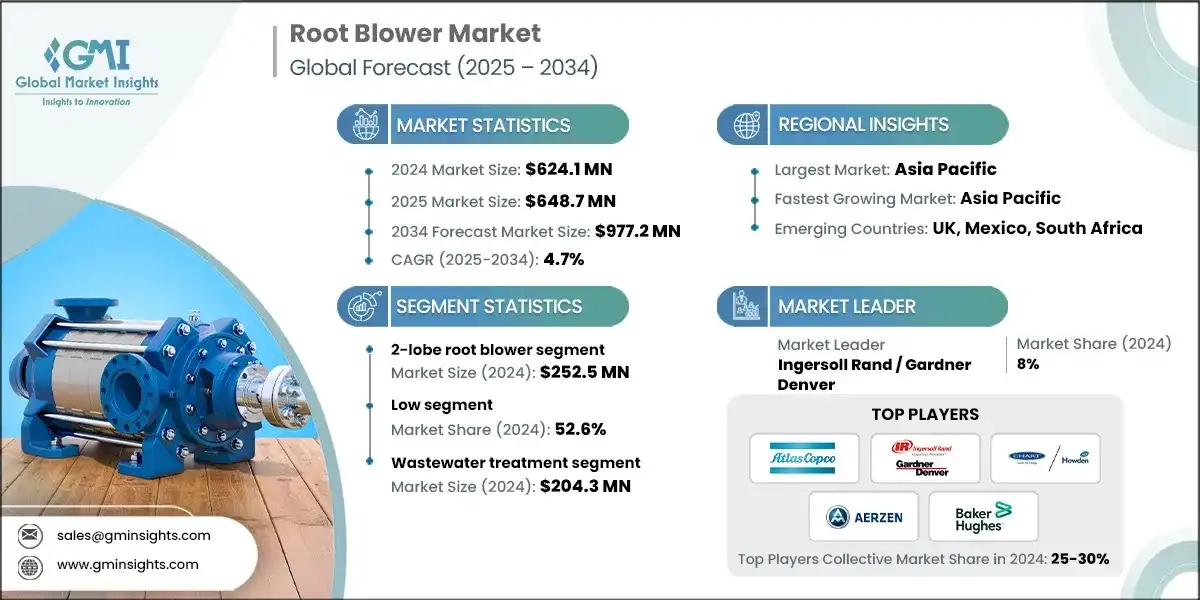
The root blower market was estimated at USD 624.1 million in 2024. The market is expected to grow from 648.7 million in 2025 to USD 977.2 million in 2034, at a CAGR of 4.7% according to latest report published by Global Market Insights Inc.
Root Blower Market Key Takeaways
Market Size & Growth
- 2024 Market Size: USD 624.1 Million
- 2025 Market Size: USD 648.7 Million
- 2034 Forecast Market Size: USD 977.2 Million
- CAGR (2025–2034): 4.7%
Key Market Drivers
- Industrial demand expansion.
- Technological advancements.
- Urban infrastructure & utility upgrades.
Challenges
- High Energy Consumption.
- Regulatory Compliance Pressure.
Opportunity
- Smart manufacturing & industry 4.0 integration.
- Energy-efficient and eco-friendly designs.
Key Players
- Market Leader: Ingersoll Rand / Gardner Denver led with over 8% market share in 2024.
- Leading Players: Top 5 players in this market include Atlas Copco, Ingersoll Rand / Gardner Denver, Howden/Chart Industries, AERZEN, Baker Hughes, which collectively held a market share of 30% in 2024.
Get Market Insights & Growth Opportunities
The global roots blower market has exhibited stable growth in recent years, mainly due to its necessity for a variety of industrial and municipal uses. Roots blowers are largely used in use due to their durability and ability to move large amounts of air, at a given constant pressure, for applications such as wastewater treatment, food processing, and many more.
The roots blower industry is flourishing, due to increasing industrial applications in wastewater treatment, cement, chemicals, steel, and power generation. Each of these industries uses Roots blowers in aeration, pneumatic conveying and combustion air supply. With rising global capital investment in infrastructure and environmental management in developed regions, including demand for specialized and economical ways to move air. Municipal projects, in particular water and sewage treatment, can buttress growth dramatically.
Technological improvements have also been a major force pushing the roots blower market onwards. Manufacturers will concentrate on developing blowers that are more energy-efficient, low-noise and compact while conforming to modern industrial standards. The use of smart technology like IoT-enabled monitoring & predictive maintenance are helping to improve operational efficiencies while reducing time. This can improve performance while addressing sustainability goals and compliance in regulatory environments with respect to sustainable operations, making Roots blowers more attractive to industries wanting a long-term sustainable approach.
In addition, it reduces contamination exposure along with lifecycle costs, making them well-suited for cleanroom and continuous operation environments. A development in the field is VSD compatible blowers; this technology provides better control of airflow and energy consumption, empowering users to manage operations based on current demand, and increasing adaptability to balance efficiency and sustainability.
To get key market trends
Root Blower Market Trends
The roots blower industry is growing and evolving to meet the anticipated need for energy-efficient technologies, integrated smart systems, and modifications for each specific application. As industries strive to minimize operational costs and comply with overall environmental standards, manufacturers continue to offer innovative solutions that provide improved function, decreased monthly expenses, and expandability into various industries.
- One trend is the changing landscape of cyclical requirements for energy-efficient blowers; as industries have been lackadaisical about purchasing energy-efficient solutions, a clear part responsible for the environmental footprint caused by producing emissions from fossil fuel usage generates enough operational costs to account for the fluctuating criteria.
- Industries organically want to reduce operational costs and equity-level carbon emissions, while adopting oil-free and low-noise blowers that satisfy conventional sustainability requirements. This trend is exacerbated by regulatory and/or governmental agency pressures to suppress emissions and corporate investment and participation in their company Environmental, Social, and Governance (ESG) criteria for sustainability.
- The integration of IoT-based sensors and control mechanisms into root blowers enables real-time monitoring of performance, predictive maintenance, and external diagnostics. This trend is consistent with broader shifts associated with Industry 4.0, a paradigm shift that places automation and data-facilitated decision-making at the forefront of operational efficiency.
- Vendors are also starting to offer custom solutions for blowers that are tailored to specific industries such as aquaculture, food processing, pharmaceutical, and renewable energy industries. These industries have distinctive operational requirements, that the ability to produce compact, modular, application-oriented blowers is a differentiating factor. Such a trend offers a market expansion beyond traditional heavy industry to a range of other viable growth opportunities.
Root Blower Market Analysis

Learn more about the key segments shaping this market
Based on product type, the market is divided into 2-lobe root blower, 3-lobe root blower, 4-lobe root blower and multi-stage root blower. The 2-lobe root blower generating a revenue of USD 252.5 million in 2024.
- The ease of use, reliability, and continuity of operation of the 2-lobe Roots blower make it a recognizable choice among industries. It is designed with two lobes rotating opposite each other so that it can establish a continuous flow of air without internal compression. The 2-lobe root blower is largely used in different industries, such as waste treatment, cement plants, and chemical plants, for application in aeration, pneumatic conveying, and combustion air because of robust performance in a variety of conditions.
- One of the key benefits of the 2-lobe root blower is its cost-effectiveness. The 2-lobe Roots blower is a cost-effective compromise that offers community, simplicity, and performance compared to more complicated blowers which are better suited for formal or more massive applications. The 2-lobe root blower can generally produce a range of pressures and flows without significant efficiency loss. Also, the simple design can be easily installed, providing extra incentive for integrating existing equipment mainly for retrofit projects, as well as upgrades to existing infrastructure.
- The prevalence of the 2-lobe root blower on the market is even further solidified by the direction of technology. Suppliers are now installing variable speed drives (VSDs), noise-reducing enclosures and smart monitoring systems for the blowers to create energy savings, reduction of operating noise and predictive maintenance capabilities all in line with industrial expectations. As industry continues to promote sustainability and automation, the 2-lobe Roots blower will remain a top solution because of its variable speed and proven reliability.
Learn more about the key segments shaping this market
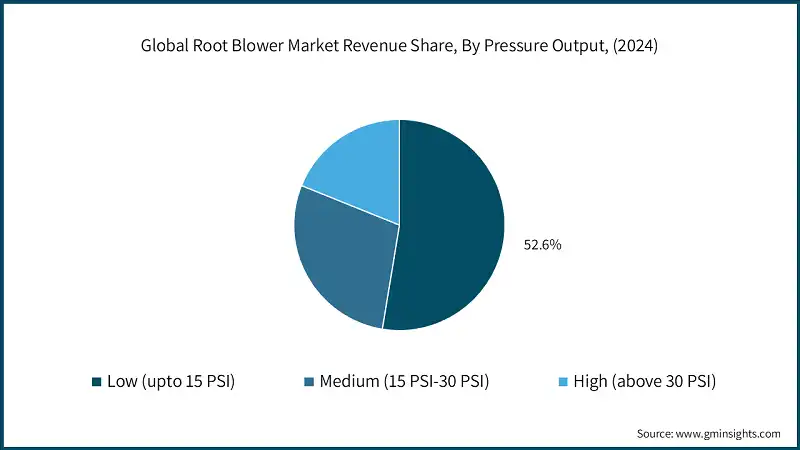
Based on pressure output, the root blower market is segmented low (Upto 15 PSI), medium (15 PSI-30 PSI) and high (above 30 PSI). The low segment held around 52.6% of the market share in 2024.
- Low-pressure Roots blowers (up to 15 PSI operating pressure) are often used in municipal wastewater treatment, aquaculture and light industrial processes. Most often, low pressure Roots blowers are used because the application requires a continual, non-pulsating flow of air at low pressures.
- Most often used for aeration in biological treatment systems, low-pressure Roots blowers can also be used for other processes in which high pressure is not necessary, but where low pressure is critical or benefit, such as pneumatic conveying of powders or grains. Thus, the long-life and reliability position the low-pressure Roots blower as the preferred solution by public utilities for emergency response projects, as well as small to medium industrial projects.
- A major advantage of low-pressure Roots blowers is their energy efficiency. Low-pressure operation reduces energy consumption, an important factor for organizations looking to reduce costs and achieve their sustainability goals. Low pressure Roots blowers also have a simple mechanical construction with fewer moving parts, which simplifies maintenance and improves longevity. These can be easily installed with standard control systems, which is another advantage in retrofit and upgrading situations when convenience is a concern.
Based on the application, the root blower market is segmented into wastewater treatment, pneumatic conveying systems, cement production, chemical processing, power generation and other. In 2024, wastewater treatment held a major market share, generating a revenue of USD 204.3 million.
- Root blowers are essential for wastewater treatment operations, especially in aeration processes in biological treatment systems. Roots blowers provide a steady flow of air to allow aerobic bacteria to grow in the wastewater for the purpose of digesting the organic waste in the wastewater. These low-pressure Roots blowers generate continuous, oil-free air flow to increase oxygen transfer rates which improves operating efficiency and process stability for activated sludge processes. Additionally, Roots blowers perform effectively and consistently under variable loads, which is why they are preferred in municipal and industrial treatment facilities.
- These are a critical end-use market for the wastewater treatment sector because aeration is key to proper biological treatment processes. They are designed to provide a continuous flow of air to a treatment plant's aeration tanks to promote the growth of aerobic bacteria that breaks down organic waste in wastewater. They are often used due to their ability to provide a continuous flow of steady, oil-free, and pulsation-free air, which teaches proper oxygen levels for effective biological treatment. They are also used for backwashing filters and agitating sludge, while the liquid continues to flow through the treatment plant uninterrupted.
- As more global focus on environmentally sustainable development grows combined with more stringent requirements for wastewater discharge, inclusive of high-level performance and reliability, the need for aeration systems has grown. These two issues are positively impacting the root blower market, especially in regions that are investing heavily into removing wastewater infrastructure, as technology improves in design and function to better the wastewater treatment processes, i.e. producing a blower that consumes less energy while producing lower noise levels. Municipalities and industries are looking for ways to do more with less investment while meeting environmental specs which evidently identifies the key role of root blowers in complementing innovations in modern wastewater treatment.

Looking for region specific data?
In 2024, the U.S. dominated the North America root blower market, accounting for around 78.4% share and generating around USD 145.6 million revenue in the same year.
- The market for root blowers in the U.S. is growing steadily; the market is fueled by the combination of existing aging infrastructure for wastewater treatment that needs to be upgraded and increasing pressure from regulatory agencies such as the Environmental Protection Agency (EPA). Root blowers are a common equipment type for aeration and sludge handling in municipal and industrial wastewater treatment plants, two processes that are critical for meeting rigorous effluent discharge limits.
- Across North America, the root blower market is experiencing significant growth due to environmental regulations, evolving technology, and increased awareness for sustainable water treatment practices. Both Canada and the U.S. are both investing into green infrastructure and modernizing wastewater treatment, and that creates an opportunity for advanced blower technologies. With a relatively mature industrial base and a growing strategic focus on reducing operating costs and carbon footprint, the region provides motivation to adopt higher efficiency root blowers. Coupled with established manufacturers and a strong distribution network, these conditions produce stability and innovation for the market.
Europe root blower market, Germany leads the with 19% share in 2024 and is expected to grow at 5.2% CAGR during the forecast period.
- The European market for root blowers is heavily influenced by strict environmental regulations including the EU Urban Wastewater Treatment Directive and European Green Deal. These regulations and frameworks drive high levels of expectations around wastewater quality, which is resulting in the uptake of dependable and efficient aeration techniques, like root blowers. Germany, France, and the Netherlands are primary drivers in the upgrading of wastewater infrastructure which is in turn increasing demand for new and improved blower systems.
- Europe's strong focus on sustainability and energy efficiency is encouraging manufacturers to develop low-noise, oil-free, energy-saving designs for root blowers. The integration of intelligent monitoring and variable frequency drives (VFDs) is becoming more common, particularly in municipal and industrial wastewater treatment plants. The market is becoming more competitive, as local and international manufacturers continue to invest R&D in discovering higher-performing products that also meet new environmental standards.
The Asia Pacific leads the root blower market; China holds revenue share of around 32% in 2024 and is anticipated to grow with a CAGR of 5.4% from 2025 to 2034.
- The rapidly urbanizing and industrializing APAC region, with key countries like China, India and Southeast Asia, is increasing the demand for effective wastewater treatment solutions. The governments of the region are investing heavily in extending or upgrading sewage treatment facilities to address issues of water pollution and to meet government mandated environmental standards. Root blowers are essential components in these systems, especially in areas of aeration and sludge disposal.
- National initiatives like India's “Namami Gange” program and China's “Water Ten Plan” of course will entail large investments in wastewater treatment facilities, stimulating the demand for root blowers. Additionally, growth in industries like pharmaceuticals, chemicals, and food processing through APAC is demand for industrial wastewater with ESP and eventually bringing root blower systems into play for secondary and tertiary treatment. There is also a growing number of domestic manufacturers providing affordable blower systems across the region to the benefit of both urban and rural projects.
Latin America Root blower market is growing at a CAGR of 4% during the forecast period.
- Latin America is experiencing growing urbanization which is stressing existing water and wastewater systems. Countries such as Brazil, Mexico and Colombia are investing in expansion and modernization of wastewater treatment plants to deal with pollution and public health. Root blowers are part of these projects due to their reliable aeration and solids handling in biological treatment at municipal and industrial wastewater facilities.
- The region is supported with financing and technical assistance from international organizations like the World Bank and Inter-American Development Bank which are currently funding water and sanitation projects. These projects are creating opportunities for technologies such as root blowers. Economic struggles and inconsistent enforcement of regulations across countries have moderated the market growth of blowers in the region. Cost-effective and energy-efficient blowers are highly desirable in the region.
Root Blower Market Share
Gardner Denver/Ingersoll Rand is leading with 8% market share. Gardner Denver/Ingersoll Rand, Atlas Copco, Howden/Chart Industries, AERZEN, and Baker Hughes collectively hold around 25-30%, indicating moderately fragmented market concentration. These prominent players are proactively involved in strategic endeavors, such as mergers & acquisitions, facility expansions & collaborations, to expand their product portfolios, extend their reach to a broad customer base, and strengthen their market position.
With a complete line of oil-free root blowers, screw blowers, and turbo blowers, Atlas Copco is a worldwide leader in working with compressor and blower technology for wastewater treatment applications. All of which are designed with energy efficiency, lower operating costs, and environmental compliance in mind. Many of these blowers by Atlas Copco are certified to ISO 8573-1 Class 0, making them perfect for the aeration in municipal and industrial treatment plants. Not only that, but the company looks beyond initial purchase price to lifecycle cost and monitoring possibilities, highlighting its service-based approach to installing a new piece of sustainable water infrastructure worldwide.
Ingersoll Rand (through its Gardner Denver and Robuschi brands) has also developed a strong portfolio of positive displacement and screw blowers that are commonly used in wastewater treatment especially Robuschi's energy-efficient tri-lobe and screw blower technologies which support aeration, sludge handling, and backwashing processes. Ingersoll Rand's blower systems are designed for low noise, low maintenance, and high reliability. Ingersoll Rand's global scale and depth of technical support make it a key player in developing and installing customized, cost-effective blowers for municipal and industrial applications.
Root Blower Market Companies
Major players operating in the root blower industry are:
- AERZEN
- Atlas Copco
- Azvetra
- Baker Hughes
- Gardner Denver/Ingersoll Rand
- Howden/Chart Industries
- Izhvent
- Kaeser
- KlimatVentMash
- Robuschi/Gardner Denver
- Roots
- TMC Fluid Systems
- Ukrventsystemy
- VENTPROM
- Ventinform
Roots blowers, initially developed by Dresser and subsequently acquired by Ingersoll Rand, has historically been one of the most well-recognized names in the positive displacement blower field. There is a reason for that recognition; Roots blowers have proven to be reliable, rugged, and applied in numerous wastewater treatment processes for aeration and gas transfer. The longevity and enduring brand loyalty have been focused on reliability, simple physical integration into various gas and liquid treatment plants, and proven adaptability across multiple treatment plant configurations. As the call for energy-efficient and a focus on maintenance-free solutions increases, Roots has consistently evolved its blower technology to address ever-changing regulatory requirements and operational needs.
TMC Fluid Systems provides advanced blower solutions including tri-lobe and twin-lobe root blowers for wastewater aeration and sludge applications. TMC also produces Aqua Series blowers for 100% oil-free air, making them suitable for sensitive applications including electroplating and aquaculture, in addition to waste treatment processes. TMC's commitment to producing intelligent, energy-efficient applications specifically, products have resulted in projects in over 40 countries demonstrating the company's technical expertise.
Root Blower Market Report Attributes
| Key Takeaway | Details |
|---|---|
| Market Size & Growth | |
| Base Year | 2024 |
| Market Size in 2024 | USD 624.1 Million |
| Market Size in 2025 | USD 648.7 Million |
| Forecast Period 2025 - 2034 CAGR | 4.7% |
| Market Size in 2034 | USD 977.2 Million |
| Key Market Trends | |
| Drivers | Impact |
| Industrial demand expansion | The increasing requirement for wastewater treatment within industries including chemicals, pharmaceuticals, and food processing is driving the current growth for root blowers. These industries typically need reliable aeration and sludge handling, making root blowers a crucial component of their treatment systems. |
| Technological advancements | New blower design aspects, like oil-free operation, reduced noise, and variable frequency drives, are also improving performance, energy efficiency, and providing manufacturers with a means of differentiation, while also meeting the demands of the modern wastewater treatment facilities. |
| Urban infrastructure & utility upgrades | Rapid urbanization and the upgrade of aging sewer systems continue to drive investment in wastewater infrastructure. Root blowers will play an essential role in these upgrades, particularly in processes associated with aeration and, therefore, will be an important technology within urban water management planning. |
| Pitfalls & Challenges | Impact |
| High Energy Consumption | This has led many energy-sensitive applications to seek energy-efficient lobe/gear models and/or alternative technologies, such as screw and turbo blowers. |
| Regulatory Compliance Pressure | Environmental oversight regulations for wastewater and other discharges have driven municipalities and industries to pursue increased performance treatment technologies. Pressure/Roots blowers have recently been applied with increasing frequency in applications designed to meet regulations for oxygen demand, nitrogen and phosphorus, as they are both highly reliable and meet air standards. |
| Opportunities: | Impact |
| Smart manufacturing & industry 4.0 integration | Smart monitoring and control systems are becoming increasingly common features of root blowers, enabling predictive maintenance, performance monitoring, and remote diagnostics to create alignment with Industry 4.0 practices to increase overall efficiencies and minimize downtime in the processes used for wastewater treatment. |
| Energy-efficient and eco-friendly designs | In addition, the sustainability movement is beginning to push large-scale manufacturers to design/produce and sell blower systems that are goal aligned to be eco-friendly with a lower carbon footprint. Energy-efficient pressure/Roots blowers accomplish not only operational efficiency but provide a means for clients to attain their environmental goals, becoming a more attractive project in green infrastructure. |
| Market Leaders (2024) | |
| Market Leaders |
8% market share |
| Top Players |
The collective market share in 2024 is 25-30% |
| Competitive Edge |
|
| Regional Insights | |
| Largest Market | Asia Pacific |
| Fastest Growing Market | Asia Pacific |
| Emerging Country | UK, Mexico, South Africa |
| Future Outlook |
|
What are the growth opportunities in this market?
Root Blower Market News
- In September 2025, Atlas Copco showcased its next-next-generation blower solutions in WEFTEC 2025, engineered for the wastewater treatment market. The manufacturer discussed the ZS VSD+ oil-free screw blower, which addresses low pressure applications and yields energy savings due to the Variable Speed Drive (VSD) technology built-in. The newly developed blower solutions included smart controls allowing reporting to a remote point of use that improve performance while optimizing operational costs.
- In June 2025, AERZEN USA launched compliant blowers and controls, based on the new Build America, Buy America (BABA) requirements, manufactured for manufacturing support alongside the rigorous BABA Act requirements. The blowers are intended for high-performance, energy efficiency, and long-lasting reliability, making them ideal for municipal wastewater processes. AERZEN invested in a U.S.-based manufacturing operation to localize the supply chain and redesign a product with increased foundational domestic content.
- In April 2024, Kaeser introduced its new rotary screw blower models, FBS 720 L and GBS 1050 L SFC. The SFC model will include an internal frequency converter and a Super Premium Efficiency synchronous reluctance motor that provides the efficiency of the permanent magnet motor and the durability of an asynchronous motor. In addition, the compact and maintenance-friendly design of the blowers allows side-by-side installation, providing an efficient and reliable aeration option for industrial or wastewater treatment facilities when space is a consideration.
- In March 2024, the Robuschi brand associated with Gardner Denver/Ingersoll Rand, launched the Robox Direct blower, a compact direct-drive rotary lobe blower that provides the performance of larger systems but in significantly smaller footprints. The design of the Robox Direct blower improves energy efficiency from standard "belt drive" systems by 8% while providing reduced maintenance. The modular design is compatible with motor requirements and easy installation providing a degree of flexibility to service demands of compact sustainable design blower solutions.
The root blower market research report includes in-depth coverage of the industry with estimates & forecasts in terms of revenue (USD Million) and volume (Thousand Units) from 2021 to 2034, for the following segments:
Market, By Product Type
- 2-lobe root blowers
- 3-lobe root blowers
- 4-lobe root blowers
- Multi-stage root blowers
Market, By Bearing Type
- Rolling element bearings
- Sleeve bearings
- Magnetic bearings
Market, By Sealing Technology
- Mechanical seals
- Labyrinth seals
- Contact seals
Market, By Pressure Output
- Low (Upto 15 PSI)
- Medium (15 PSI-30 PSI)
- High (above 30 PSI)
Market, By Application
- Wastewater treatment
- Pneumatic conveying systems
- Cement production
- Chemical processing
- Power generation
- Others
Market, By Distribution Channel
- Direct sales
- Indirect sales
The above information is provided for the following regions and countries:
- North America
- U.S.
- Canada
- Europe
- Germany
- UK
- France
- Italy
- Spain
- Asia Pacific
- China
- India
- Japan
- Australia
- South Korea
- Latin America
- Brazil
- Mexico
- Argentina
- Middle East and Africa
- South Africa
- Saudi Arabia
- UAE
Frequently Asked Question(FAQ) :
What is the market size of the root blower in 2024?
The market size was USD 624.1 million in 2024, with a CAGR of 4.7% expected through 2034 driven by rising demand for wastewater treatment across industries such as chemicals, pharmaceuticals, and food processing.
What is the projected value of the root blower market by 2034?
The root blower market is expected to reach USD 977.2 million by 2034, propelled by technological advancements, smart manufacturing integration, and demand for energy-efficient solutions.
What is the current root blower market size in 2025?
The market size is projected to reach USD 648.7 million in 2025.
How much revenue did the 2-lobe root blower segment generate in 2024?
2-lobe root blowers generated USD 252.5 million in 2024, leading due to their cost-effectiveness, reliability, and continuous operation capabilities.
What was the valuation of low-pressure output segment in 2024?
Low-pressure root blowers (up to 15 PSI) held 52.6% market share in 2024, widely used in municipal wastewater treatment and aquaculture applications.
What is the growth outlook for wastewater treatment application from 2025 to 2034?
Wastewater treatment generated USD 204.3 million in 2024 and is projected to grow steadily due to stricter environmental regulations and investments in water infrastructure globally.
Which region leads the root blower market?
Asia Pacific leads the market with China holding 32% revenue share in 2024 and anticipated to grow at 5.4% CAGR through 2034, driven by rapid urbanization and industrial expansion.
What are the upcoming trends in the root blower market?
Key trends include adoption of IoT-enabled monitoring systems, energy-efficient and oil-free designs, integration with Industry 4.0, and customized solutions for specific industries like aquaculture and pharmaceutical sectors.
Who are the key players in the root blower market?
Key players include AERZEN, Atlas Copco, Azvetra, Baker Hughes, Gardner Denver/Ingersoll Rand, Howden/Chart Industries, Izhvent, Kaeser, KlimatVentMash, Robuschi/Gardner Denver, Roots, TMC Fluid Systems, Ukrventsystemy, VENTPROM, and Ventinform.
Root Blower Market Scope
Related Reports