Summary
Table of Content

Robotics Laser Welding Market
Get a free sample of this report
Form submitted successfully!
Error submitting form. Please try again.
Thank you!
Your inquiry has been received. Our team will reach out to you with the required details via email. To ensure that you don't miss their response, kindly remember to check your spam folder as well!
Request Sectional Data
Thank you!
Your inquiry has been received. Our team will reach out to you with the required details via email. To ensure that you don't miss their response, kindly remember to check your spam folder as well!
Form submitted successfully!
Error submitting form. Please try again.
Robotics Laser Welding Market Size
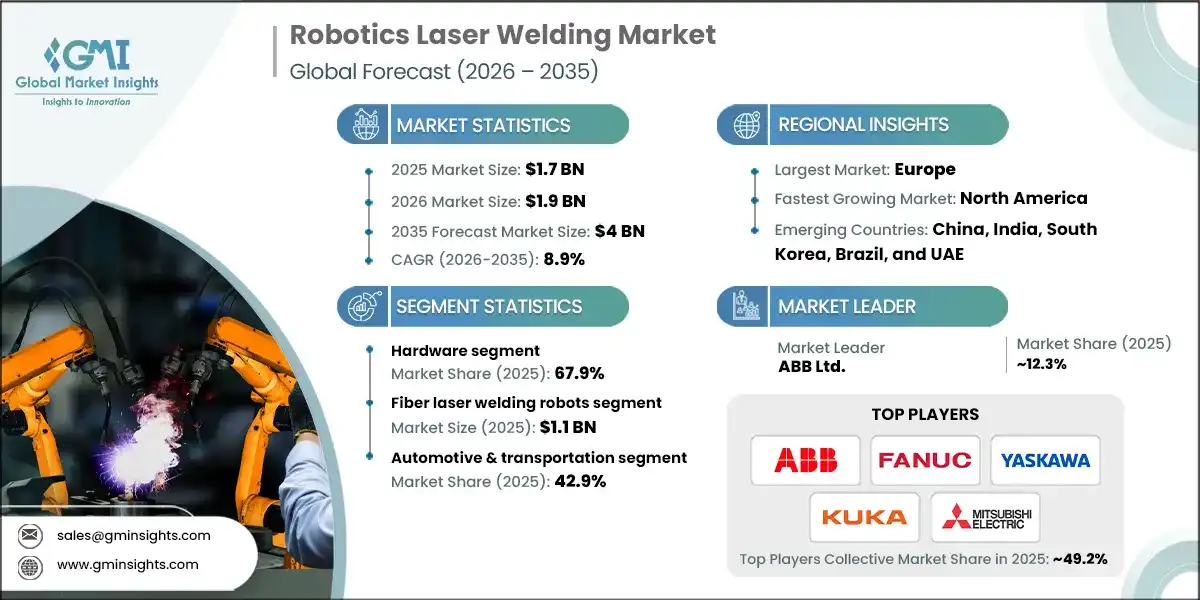
The global robotics laser welding market was valued at USD 1.7 billion in 2025. The market is expected to grow from USD 1.9 billion in 2026 to USD 2.9 billion in 2031 and USD 4 billion in 2035, at a CAGR of 8.9% during the forecast period according to the latest report published by Global Market Insights Inc.
Robotics Laser Welding Market Key Takeaways
Market Size & Growth
- 2025 Market Size: USD 1.7 Billion
- 2026 Market Size: USD 1.9 Billion
- 2035 Forecast Market Size: USD 4 Billion
- CAGR (2026–2035): 8.9%
Regional Dominance
- Largest Market: Europe
- Fastest Growing Region: North America
Key Market Drivers
- Growing Automotive and Aerospace Industries.
- Increasing Demand for High-Quality Welding.
- Global Expansion of Manufacturing Activities.
- Ongoing Advancements in Laser Technology and Robotics.
- Rising Demand for Lightweight Materials.
Challenges
- Initial Implementation Costs.
- Integration with Existing Systems.
Opportunity
- Development of Advanced Laser Technologies.
- Adoption of Industry 4.0 and Smart Manufacturing.
Key Players
- Market Leader: ABB Ltd. led with over 12.3% market share in 2025.
- Leading Players: Top 5 players in this market include ABB Ltd., FANUC Corporation, Yaskawa Electric Corp., KUKA AG, Mitsubishi Electric, which collectively held a market share of 49.2% in 2025.
Get Market Insights & Growth Opportunities
Several factors contribute to the augmentation of the market are growing automotive and aerospace industries, increasing demand for high-quality welding, global expansion of manufacturing activities, ongoing advancements in laser technology and robotics, & rising demand for lightweight materials.
The rapid growth of the automotive industry has increased demand for the use of robotics-based laser welding processes, due to the increased demand for precision and speed in the manufacturing of vehicles. The advantages of robotic laser welding process are the assurances associated with consistency in product quality and lower levels of manufacturing defects, as well as increased assembly speed. In 2023, the US Department of Commerce reported a total volume of foreign direct investment into the auto industry of USD 195.6 billion. This indicates that the auto industry has the robust potential to grow significantly, which creates the considerable adoption of advanced manufacturing technologies, such as robotic laser welding to improve production efficiency and product quality.
The continual rise in manufacturing activities, especially in emerging economies, is likely to pave the usage of automation solutions, including robotics laser welding. As the volumes of production grow, the need for precision and cost-effectiveness in production development is essential to ensuring product quality. As per United Nations Industrial Development Organization (UNIDO) statistics, the global manufacturing output increased by 0.6% month-over-month in September 2025. The findings also exhibited that the average manufacturing output growth rates in high-tech and medium-high tech industries registered a 1.5% increment for the period January to September 2025. Therefore, this evidence shows that the increased demand from technological advancements will provide a strong foundation for robotics laser welding automation solution usage during, thereby driving the market growth.
Between 2022 and 2024, the robotics laser welding market witnessed considerable growth, increasing from USD 1.4 billion in 2022 to USD 1.6 billion in 2024. To meet the increased demand for accurate welding technology due to the considerable focus on lighter-weight materials (such as aluminum), robotic laser welding enables for efficient materials amalgamation while preserving structural integrity. As per the Department of Energy, a 10% reduction in overall vehicle weight results in a 6–8% increase in fuel economy; therefore, the automotive and aerospace industries require more advanced welding technologies.
To get key market trends
Robotics Laser Welding Market Trends
- Artificial Intelligence and Machine Learning technologies have brought drastic changes to welding systems with laser robots by helping optimize welding parameters and enabling better predictive maintenance.
- Since the beginning of the 2020s, this trend has been gaining traction due to its ability to improve efficiency, precision, and weld quality, while reducing human errors. For example, in 2025, Novarc Technologies introduced a new NovAI (an AI vision-based control system) that contributes to improved quality criteria to maintain quality consistency with real time adjustments and full traceability throughout the weld cycle.
- The rapid rise in global electric vehicle (EV) production has become a key driver in the adoption of robotic laser welding technologies within the automotive industry. As manufacturers increasingly utilize robotic laser welding to process lightweight EV materials and to enhance the durability of advanced battery systems, demand for these solutions has grown substantially. Global EV output is anticipated to witness a growth from 14 million units in 2023 to roughly 17.3 million units in 2024, marking a year-on-year growth of about 25%. Notably, China is likely to produce around 12.4 million of these vehicles, as per the estimates from the International Energy Agency (IEA). This significant expansion in EV manufacturing has accelerated the need for more efficient, precise, and cost-effective robotic laser welding systems across the industry. This increase in electric vehicle production is predicted to continue into at least 2025 as the global electric vehicle (EV) market expands rapidly.
- Hybrid welding technology has gained a lot of popularity among robotic laser welding manufacturers. Hybrid welding technology is the combination of both laser welding and MIG/MAG welding. For this purpose, hybrid welding technology has witnessed an increased usage in automotive and manufacturing sector as a result of added advantages of hybrid welding technology like deep penetration, lower distortion and faster cycle times. As noted by the U.S. Department of Energy, hybrid laser-arc welding processes can be as much as 10 times quicker than traditional arc welding; they also use considerably less filler metal, shielding gas and energy. As demand for efficiency continues to rise, this trend will reach its peak by 2028.
Robotics Laser Welding Market Analysis
Learn more about the key segments shaping this market
The global market was valued at USD 1.4 billion and USD 1.5 billion in 2022 and 2023, respectively. The market size reached USD 1.7 billion in 2025, growing from USD 1.6 billion in 2024.
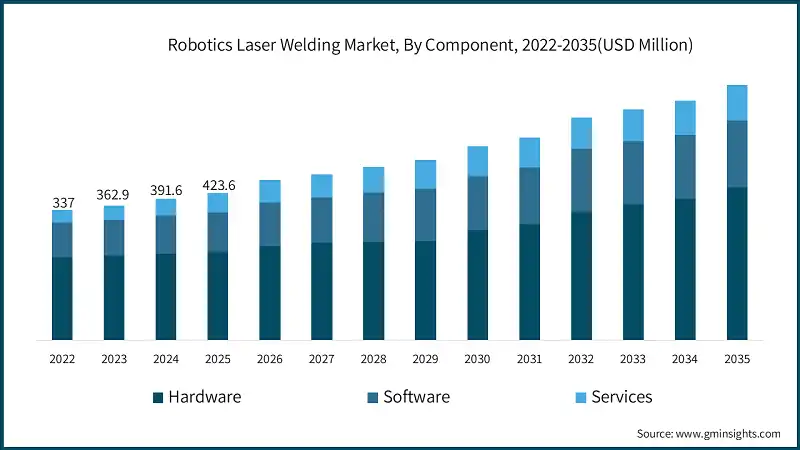
Based on the component, the global robotics laser welding market is divided into hardware, software, & services. The hardware segment accounted for 67.9% of the market in 2025.
- Technological advancements have driven the hardware component segment. The growing need for devices to perform better, smaller, and cheaper, as well as the ability to provide robust, scalable solutions across multiple industries.
- Manufacturers should focus on innovation, cost efficiency, performance optimization, sustainability, and meeting evolving consumer demands for advanced, reliable devices.
- The software segment was valued at USD 423.6 million in 2025 and is anticipated to grow at a CAGR of 9.3% over the forecast year. The software by component segment has evolved with advancements in technology. The growing need for automated solutions, cloud computing, AI integrations, and through-the-cloud, secured, scalable, and efficient software solutions, has presented great opportunity for manufacturers of this software.
Based on technology, the global robotics laser welding market is divided into fiber laser welding robots, CO2 laser welding robots, & solid-state laser welding robots. The fiber laser welding robots segment dominated the market in 2025 with a revenue of USD 1.1 billion.
- Fiber laser welding technology growth is a result of several key drivers including laser technology developments (new innovations in fiber lasers), improvements to automation (automation of processes associated with fiber lasers), and improvements to precision control (precision required for laser welding).
- As these technologies have developed, Company begun to offer fiber laser welding robots to support high speed, low energy consumption, and high accuracy welding solutions that are being utilized across multiple applications within multiple industries.
- On the other hand, the CO2 laser welding robots’ segment is expected to witness growth at a CAGR of 8.6% during the forecast period, due to the ability of CO2 laser welding robots such as its improved precision control, better automation and cost-effectiveness.
- Manufacturers’ better focus on the development of CO2 laser welding robots by improving their capability towards laser power, laser automation, increasing precision control, and reducing the cost is likely to ensure that CO2 welding robots are able to work across a variety of industries and applications. This factor is creating a lucrative opportunity for manufacturers to meet the rapidly changing needs of industrial users.
Learn more about the key segments shaping this market
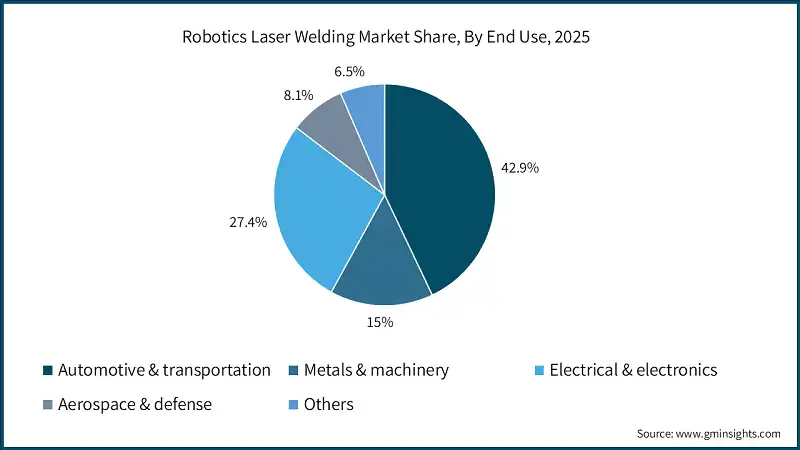
Based on the end-use, robotics laser welding market is classified into automotive & transportation, metals & machinery, electrical & electronics, aerospace & defense, & others. The automotive & transportation segment dominated the market in 2025 with a capture of 42.9%.
- The automotive and transport end-use segment continues to be driven by the latest technological advancements related to vehicle electrification and automation technologies; improved safety features; increased fuel efficiency; and greater end-user demand globally for eco-friendly/sustainable transportation solutions.
- Firms in this industry should develop electric vehicles; improve the technology associated with vehicle safety; improve fuel efficiency; and continue developing new sustainable solutions to keep pace with evolving consumer and regulatory trends.
- The electrical & electronics segment is expected to witness growth at a CAGR of 9.7% during the forecast period. The electrical and electronics end-use segment continues to be a major growth area for companies due to the advancements in miniaturization; the growing requirement for precision manufacturing; increase in demand for energy-efficient devices; & the surging adoption of automated assembly lines.
- Firms in the electrical and electronics industry should concentrate on improving precision; increasing automation; adopting more sustainable manufacturing methods; and developing more energy-efficient solutions to meet the growing customer needs within this market.
Looking for region specific data?
North America Robotics Laser Welding Market
North America market with a market share of 27.2% in 2025.
- The growth of the North American robotics laser welding industry is largely a response to the need for precision in welding by the automotive industry, as well as the advancements in the integration of laser technology with robots, and the eventual labor shortages resulting from this trend towards increasing automation for the purpose of enhancing efficiency in welding operations.
- Furthermore, North America's market continues to be fueled by the increasing number of government-supported initiatives that promote manufacturing innovation and the increased demand for cost-effective manufacturing solutions.
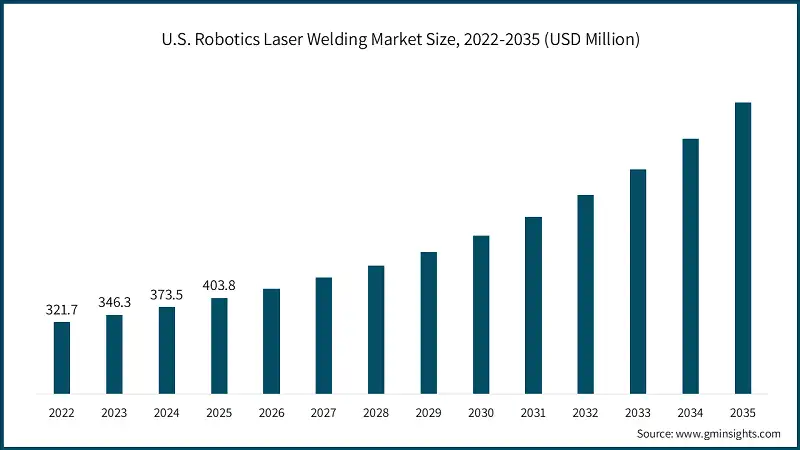
The U.S. robotics laser welding market was valued at USD 321.7 million and USD 346.3 million in 2022 and 2023, respectively. The market size reached USD 403.8 million in 2025, growing from USD 373.5 million in 2024.
- The market in the United States is being driven by the rising demand for high-precision welds, the accelerated introduction of Industry 4.0 technology, and the large amounts of money being spent on the creation of advanced automated manufacturing systems designed to increase productivity and reduce operational costs.
- Manufacturers must advance their capabilities for high-precision welding, implement Industry 4.0 technologies, and invest in advanced automated manufacturing systems designed to enhance the profitability of their businesses.
Europe Robotics Laser Welding Market
Europe market accounted for USD 585.2 million in 2025 and is anticipated to show lucrative growth over the forecast period.
- The growth of the market in Europe is largely attributable to the presence of a strong industrial and automotive sector, as well as an emphasis placed on environmentally sustainable practices in manufacturing, and the increasing use of lightweight materials in a variety of industries.
- Additionally, the increase in the number of electric vehicle manufacturing plants and the supportive policies and regulations enacted by governments to promote sustainability and innovation are stimulating growth in the European market.
Germany dominates the Europe robotics laser welding market, showcasing strong growth potential.
- Germany has a solid foundation to support its welding industry through a strong automotive sector along with the need for precision manufacturing, increased production of electric vehicles, and a high level of industrial automation. In addition, strong support from the German government for innovation in technology help in sustain the growth of the robotics laser welding industry.
- Manufacturing sector in Germany must focus on meeting the increasing demands for precision welding technologies, continuing to support electric vehicle production, advancing industrial automation, and taking advantage of government incentives.
Asia Pacific Robotics Laser Welding Market
The Asia Pacific market is anticipated to grow at the highest CAGR of 9.1% during the analysis timeframe.
- The Asia Pacific robotics laser welding industry is a fast-growing market due to the rapid industrialization and urbanization of the region, along with the rising demand for smart manufacturing processes. The market is also being fueled by the booming electronics and consumer goods sectors, both of which are driving demand for high-efficiency and high-precision products and manufacturing processes.
- In addition, the Asia Pacific robotics laser welding industry is also supported by government initiatives for technological advancement, as well as the availability of inexpensive labor and production costs in Asia.
China robotics laser welding market is estimated to grow with a significant CAGR of 9.7% in the Asia Pacific market.
- The rapid growth of the manufacturing sector in China is the primary driver of the market in China, therefore, as manufacturers continue to produce more electric vehicles, they need to focus on improving their manufacturing and production capabilities, supporting electric vehicle production, and leveraging government incentives related to developing new industrial capabilities and lowering labor costs while producing higher-end electronics.
Latin American Robotics Laser Welding Market
Brazil leads the Latin American market, exhibiting remarkable growth during the analysis period.
- The Brazilian robotics laser welding industry is presently in a period of growth primarily due to the increasing number of automotive and aerospace manufacturers in the nation, coupled with the growing demand for high-quality manufacturing practices. Moreover, with the introduction of government incentives for industrial automation, there is a rising trend of Brazilian manufacturers investing in the use of advanced manufacturing processes.
- Brazilian manufacturers need to continue to improve their manufacturing quality, implement more advanced automation technologies, increase their production efficiency, and take advantage of government incentives if they want to compete effectively in the sectors.
Middle East and Africa Robotics Laser Welding Market
South Africa market to experience substantial growth in the Middle East and Africa robotics laser welding industry in 2025.
- In the Middle East & Africa Region, the robotics laser welding industry in South Africa exponential growth due to the increased automotive manufacturing industry, the increased need for high-quality welds and the increase in government funding specifically designed to increase South Africa's domestic manufacturing capacities and innovation.
- Companies need to focus on improving weld quality, utilizing robotics to increase precision during manufacturing, utilizing government support and investing in precision engineering to create manufacturing efficiencies/competitive advantages.
Robotics Laser Welding Market Share
Industry leaders ABB Ltd., FANUC Corp., Yaskawa Electric Corp., KUKA Corp., and Mitsubishi Electric combined accounted for more than 49.2% of the total market in 2025. These market leaders play an important role in driving innovation and providing new Technology. They also are continually expanding their presence into new industries, and the growth of their businesses is driven by their strong portfolios of innovative products, their relationships with customers and their investments into automated robotic and robotic welding solutions; therefore, impacting the future of this industry.
There has been a rise in smaller niche players in the robotics laser welding industry providing specialized products and solutions. These niche players are creating competition, therefore driving more technological innovations by focusing on industry requirements.
Robotics Laser Welding Market Companies
Prominent players operating in the robotics laser welding industry are as mentioned below:
- ABB Ltd.
- Amada Holdings Co. Ltd.
- CLOOS GmbH
- Coherent Inc.
- Comau S.p.A.
- DAIHEN Corporation
- Esab
- Fanuc Corporation
- Han’s Laser Tech Group
- IPG Photonics
- Jenoptik AG
- Kawasaki Heavy Industries
- KUKA AG
- Laserline GmbH
- Miller Electric Mfg. LLC
- Mitsubishi Electric
- Nachi-Fujikoshi Corp.
- OMRON Corp.
- Panasonic Corporation
- Precitec Group
- Siasun Robot & Automation
- Stäubli International
- Toshiba Machine / Denso
- TRUMPF Group
- Universal Robots A/S
- Yaskawa Electric Corporation
ABB Ltd. is a provider of robotic automation solutions with a specialty in laser welding. They use their knowledge and experience in robotic and automation technologies to improve production efficiency, specifically for the automotive and aerospace segments.
FANUC Corporation is a worldwide leader in providing robotic products that are suitable for laser welding. Their products have a reputation for being reliable and flexible while serving industries that require very fast and precise welding applications and processes to be automated.
Yaskawa Electric Corp.
Yaskawa Electric Corp has developed a range of robotic systems and automation solutions specifically for laser welding applications. Their robots are regarded as some of the best available for performance, accuracy, and versatility, and have been developed to meet the growing consumer demand for precision in industrial welding.
KUKA AG
KUKA AG produces robotic automation solutions that include laser welding robots. They are recognized for their robots being flexible and scalable while providing precision for advanced welding applications in various industries, including automotive, aerospace, and electronics.
Mitsubishi Electric
Mitsubishi Electric provides a complete portfolio of robots and automation systems along with a line of laser welding systems and solutions. Mitsubishi Electric robotic arms with laser welding technology provide a higher level of precision, thus allowing manufacturers in high-volume and stringent production environments, such as automotive and aerospace, to achieve more efficiently.
Robotics Laser Welding Market Report Attributes
| Key Takeaway | Details |
|---|---|
| Market Size & Growth | |
| Base Year | 2025 |
| Market Size in 2025 | USD 1.7 Billion |
| Market Size in 2026 | USD 1.9 Billion |
| Forecast Period 2026 - 2035 CAGR | 8.9% |
| Market Size in 2035 | USD 4 Billion |
| Key Market Trends | |
| Drivers | Impact |
| Growing Automotive and Aerospace Industries | Drives 25% growth as increasing demand for high-performance, lightweight vehicles and aircraft boosts adoption of robotics laser welding for precise assembly of critical components. |
| Increasing Demand for High-Quality Welding | Contributes 22% growth as manufacturers seek high-quality, precise welds for critical applications, ensuring consistency and reducing defects in automotive, aerospace, and medical sectors. |
| Global Expansion of Manufacturing Activities | Fuel 18% growth as manufacturers expand globally, leading to higher demand for efficient automated welding solutions like robotics laser welding in mass production. |
| Ongoing Advancements in Laser Technology and Robotics | Accounts for 20% growth as advancements in laser technology and robotics enhance welding speed, accuracy, and energy efficiency, improving capabilities for automated systems. |
| Rising Demand for Lightweight Materials | Drives 15% growth due to the need for welding solutions that effectively join lightweight materials like aluminum and composites, especially in automotive and aerospace sectors. |
| Pitfalls & Challenges | Impact |
| Initial Implementation Costs | Restrains 18% of market growth as high initial setup and equipment costs for robotics laser welding systems pose a financial barrier, especially for small and medium-sized manufacturers. |
| Integration with Existing Systems | Limits 15% of market growth due to challenges in integrating new robotics laser welding systems with legacy machinery and existing manufacturing processes, leading to potential downtime and higher costs. |
| Opportunities: | Impact |
| Development of Advanced Laser Technologies | Drives innovation and efficiency by improving laser precision and power, reducing welding defects, and increasing adoption in industries with stringent quality demands. |
| Adoption of Industry 4.0 and Smart Manufacturing | Boosts growth by integrating robotics laser welding with IoT and AI, enabling real-time monitoring, predictive maintenance, and enhanced efficiency in production lines. |
| Market Leaders (2025) | |
| Market Leaders |
~12.3% market share in 2025 |
| Top Players |
|
| Competitive Edge |
|
| Regional Insights | |
| Largest Market | Europe |
| Fastest growing market | North America |
| Emerging countries | China, India, South Korea, Brazil, and UAE |
| Future outlook |
|
What are the growth opportunities in this market?
Robotics Laser Welding Industry News
- In September 2025, TRUMPF developed the BrightLine Scan for the TruLaser Weld 5000 that includes both the robot path and scanner beam guidance to improve overall weld quality, precision, and durability while delivering faster and more dependable laser welding solutions for extremely sophisticated industrial applications.
- In November 2023, IPG Photonics worked with Miller Electric to enhance the handheld laser welding technology by integrating IPG's fiber laser knowledge with Miller's welding engineering to provide customers with portable, precise, and efficient modern-day welding tools.
- In November 2023, Miller Electric Mfg. LLC announced a joint technological collaboration with IPG Photonics to provide a variety of advanced laser technologies to the handheld welding marketplace, which not only provides welders with better performing, efficient & accurate solutions for today's more sophisticated welding applications but also transform the way welders currently look at welding tools and equipment.
The robotics laser welding market research report includes in-depth coverage of the industry with estimates and forecast in terms of revenue in USD Million from 2022 – 2035 for the following segments:
Market, By Component
- Hardware
- Robots
- Welding equipment
- Sensors and vision systems
- Software
- Controller software
- Simulation software
- Services
Market, By Robot Type
- Industrial robots
- <50 kg payload
- 50-150 kg payload
- Above 150 kg payload
- Collaborative robots
- <50 kg payload
- 50-150 kg payload
- Above 150 kg payload
- Mobile robots
- <50 kg payload
- 50-150 kg payload
- Above 150 kg payload
Market, By Technology
- Fiber laser welding robots
- CO2 laser welding robots
- Solid-state laser welding robots
Market, By End Use
- Automotive & transportation
- Metals & machinery
- Electrical & electronics
- Aerospace & defense
- Others
The above information is provided for the following regions and countries:
- North America
- U.S.
- Canada
- Europe
- Germany
- UK
- France
- Spain
- Italy
- Netherlands
- Asia Pacific
- China
- India
- Japan
- Australia
- South Korea
- Latin America
- Brazil
- Mexico
- Argentina
- Middle East and Africa
- South Africa
- Saudi Arabia
- UAE
Frequently Asked Question(FAQ) :
What is the market size of the robotics laser welding market in 2025?
The robotics laser welding market size exceeded USD 1.7 billion in 2025, supported by rising adoption across automotive, aerospace, and high-precision manufacturing industries.
What is the current robotics laser welding market size in 2026?
The robotics laser welding market is projected to reach USD 1.9 billion in 2026, reflecting growing demand for automated and high-accuracy industrial welding solutions.
What is the projected value of the robotics laser welding market by 2035?
The robotics laser welding market is expected to reach USD 4 billion by 2035, growing at a CAGR of 8.9% from 2026 to 2035, driven by advancements in laser technology, Industry 4.0 integration, and expanding global manufacturing automation.
How much revenue did the hardware component segment generate in 2025?
The hardware segment dominated the robotics laser welding market with a 67.9% share in 2025, supported by strong demand for robotic arms, welding equipment, and vision systems in industrial automation.
What was the market value of the software segment in the robotics laser welding market in 2025?
The software segment was valued at USD 423.6 million in 2025, driven by rising adoption of AI-enabled control software, simulation tools, and cloud-based automation platforms.
Which technology segment led the robotics laser welding market in 2025?
Fiber laser welding robots led the market with USD 1.1 billion in revenue in 2025, owing to their high precision, energy efficiency, and suitability for high-speed industrial applications.
Which end-use industry dominates the robotics laser welding market?
The automotive & transportation segment dominated the robotics laser welding market with 42.9% share in 2025, supported by electric vehicle production, lightweight material adoption, and automated assembly lines.
Which region leads the robotics laser welding market, and what is the U.S. market value?
The U.S. robotics laser welding market reached USD 403.8 million in 2025. Growth is driven by Industry 4.0 investments, demand for high-precision welds, and expansion of automated manufacturing systems.
Who are the key players in the robotics laser welding market?
Key players in the robotics laser welding industry include ABB Ltd., FANUC Corporation, Yaskawa Electric Corporation, KUKA AG, and Mitsubishi Electric, collectively accounting for nearly half of the global market share in 2025.
Robotics Laser Welding Market Scope
Related Reports