Summary
Table of Content

Robotic Lawn Mower Market
Get a free sample of this report
Form submitted successfully!
Error submitting form. Please try again.
Thank you!
Your inquiry has been received. Our team will reach out to you with the required details via email. To ensure that you don't miss their response, kindly remember to check your spam folder as well!
Request Sectional Data
Thank you!
Your inquiry has been received. Our team will reach out to you with the required details via email. To ensure that you don't miss their response, kindly remember to check your spam folder as well!
Form submitted successfully!
Error submitting form. Please try again.
Robotic Lawn Mower Market Size
- The demand for smart and autonomous home solutions is driving the growth of the market. More people are using automatic machines to make their housework easier. The robotic lawn mower provides hands-free lawn maintenance by programming and using a sensor-based system. With the integration of smart home technology, mobile applications can be used by homeowners to remotely control and schedule the operation of robotic lawn mowers. Consumers are looking for products that save them time, need minimal physical effort, and require minimal manual intervention when maintaining the lawn.
- Robotic mowers can function effectively in custom-built lawns thanks to their advanced localization technology. Demand for connected ecosystems has increased, resulting in consumers wanting their robotic lawnmowers to work seamlessly with their voice assistants and home automation systems. The growth of urban populations is leading to an increase in demand for small and energy-efficient lawn maintenance equipment. Electric models are energy-efficient and align with households that make environmentally conscious buying decisions. Homeowners who invest in high-quality outdoor equipment typically do so because they want to improve their home's appearance. The continued innovation of battery technology has improved the performance of robotic mowers and enhanced their reliability.
- The growth of the robotic lawnmower market is being driven by the rapid expansion of e-commerce and omnichannel distribution. The availability of mower brands and models on online platforms gives consumers the ability to compare mowers based on features, prices, and reviews before purchasing. Consumers also find it easier to acquire large, costly items such as lawnmowers because they can have them delivered directly to their homes. Omnichannel retailing allows for a seamless integration of the buyer's experience between the store and online purchase.
- Manufacturers have also leveraged digital marketing to create new mower models and showcase their advanced capabilities. E-commerce also provides direct-to-consumer sales which increases the availability of robotic lawn mowers in urban and suburban areas. Promotional campaigns and seasonal discounts increase consumer awareness of the product in addition to increasing trial purchases. Many retailers are providing improved after-sale service for their products with integrated online support and maintenance information. The growing number of users with smartphones and access to the internet is further enhancing the digital adoption of outdoor smart devices.
- Low cutting height settings represent a key segment in the robotic lawn mower market due to demand for closely trimmed lawns. Homeowners prefer precise grass cutting for aesthetic appeal and uniform turf maintenance. Advanced mowers offer adjustable low-height functionality without compromising blade efficiency. Compact design and automation enable consistent results with minimal manual effort. Residential and commercial users benefit from time-saving operation and improved lawn health. Easy programming and sensor-assisted navigation enhance accuracy at low cutting heights. Rising adoption of smart gardening solutions strengthens demand for low-height mowing capabilities globally.
The robotic lawn mower market was estimated at USD 3.4 billion in 2025. The market is expected to grow from USD 3.5 billion in 2026 to USD 6.8 billion in 2035, at a CAGR of 7.5%, according to latest report published by Global Market Insights Inc.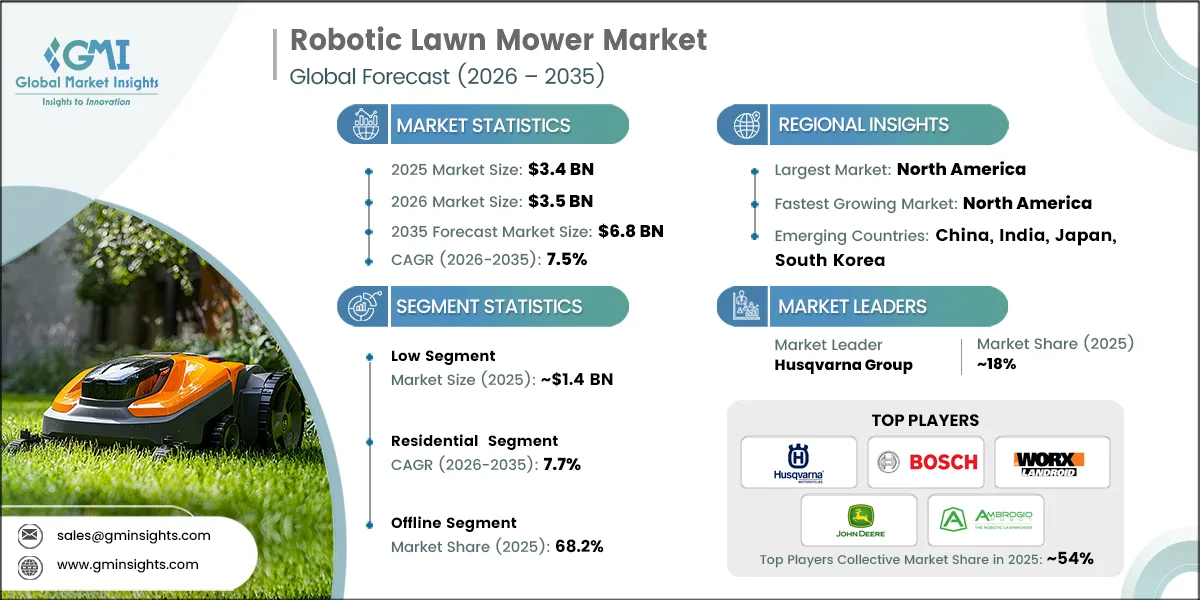
Robotic Lawn Mower Market Key Takeaways
Market Size & Growth
- 2025 Market Size: USD 3.4 Billion
- 2026 Market Size: USD 3.5 Billion
- 2035 Forecast Market Size: USD 6.8 Billion
- CAGR (2026–2035): 7.5%
Regional Dominance
- Largest Market: North America
- Fastest Growing Region: North America
Key Market Drivers
- Rising demand for smart and autonomous home solutions.
- Expansion of e-commerce and omnichannel distribution.
- Growth in residential landscaping and outdoor living trends.
Challenges
- High upfront purchase cost relative to traditional mowers.
- Complexity of installation and boundary setup.
Opportunity
- Integration with smart home ecosystems and voice assistants.
- Development of advanced terrain-adaptive and all-weather models.
Key Players
- Market Leader: Husqvarna Group led with over 18% market share in 2025.
- Leading Players: Top 5 players in this market include Husqvarna Group, Robert Bosch, Worx Landroid, John Deere, Ambrogio, which collectively held a market share of 54% in 2025.
Get Market Insights & Growth Opportunities
To get key market trends
Robotic Lawn Mower Market Trends
- The robotic lawn mower industry is expanding as homeowners seek automated solutions for yard maintenance. Busy lifestyles and limited free time make scheduled lawn care appealing without manual mowing. Robotic mowers operate independently using programmed paths to maintain consistent grass height. This convenience attracts consumers looking for efficient alternatives to traditional lawn mowing practices.
- Robotic lawn mowers are being equipped with advanced sensors and connectivity technologies. These features allow devices to detect obstacles, adjust mowing patterns, and navigate uneven terrain without human intervention. Connectivity with smartphone apps enables remote monitoring and customized mowing schedules. Enhanced intelligence improves performance, usability, and customer satisfaction with automated yard solutions.
- Consumers are showing stronger interest in electric robotic mowers due to their eco-friendly and quiet operation. Battery-powered units produce lower noise levels compared to conventional gas-powered lawn mowers. Reduced emissions and quieter performance make robotic solutions suitable for residential neighborhoods with noise restrictions. This environmental and acoustic advantage supports broader market acceptance among homeowners.
- Manufacturers are improving safety features and boundary detection capabilities in robotic lawn mowers. Built-in sensors and perimeter systems help prevent accidental collisions and keep units within defined mowing areas. Safety features also include automatic shut-off when lifted or tilted unexpectedly. These advancements increase user confidence and make robot mowers more suitable for homes with children or pets.
- The robotic lawn mower market is benefiting from wider distribution and professional support services. Retailers and online platforms now offer a broader range of models, making comparison and purchase easier for consumers. Some suppliers also provide installation and setup assistance to ensure optimal performance. Expanded accessibility and support contribute to higher adoption across diverse residential segments.
Robotic Lawn Mower Market Analysis
Learn more about the key segments shaping this market
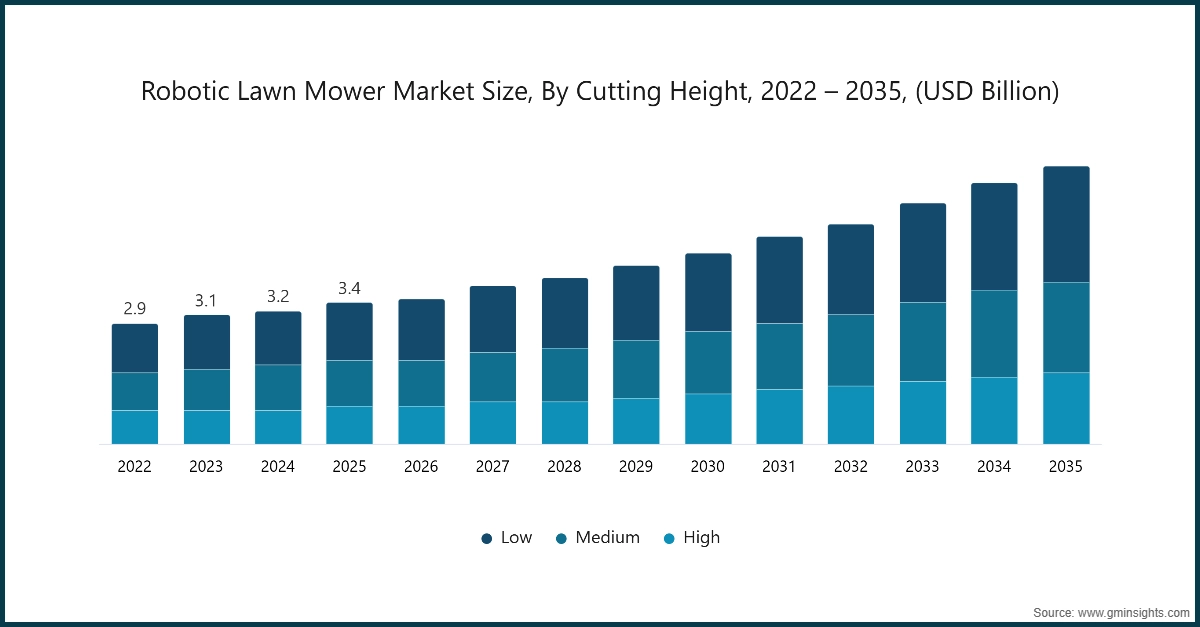
Based on cutting height, the market is categorized into low (0.5 inch to 1 inch), medium (1 inch to 1.5 inch), and high (1.5 inches to 2 inches). The low segment accounted for revenue of around USD 1.4 billion in 2025 and is anticipated to grow at a CAGR of 7.6% from 2026 to 2035.
- Low cutting height dominates the robotic lawn mower market due to growing demand for neatly manicured lawns. Homeowners and commercial users prefer close-cut grass for aesthetic appeal and uniform turf appearance. Advanced robotic mowers maintain precision at low heights without compromising blade performance. Automation reduces manual effort while ensuring consistent lawn maintenance.
- Sensor-assisted navigation and programmable settings improve cutting accuracy. Rising popularity of smart gardening and landscape management strengthens adoption of low-height mowing solutions. Consistent performance and convenience reinforce segment leadership globally.
Based on end use, of robotic lawn mower market consists of residential and commercial. The residential emerged as leader and held 64.7% of the total market share in 2025 and is anticipated to grow at a CAGR of 7.7% from 2026 to 2035.
- Residential end use leads the market due to rising adoption of smart home technologies. Homeowners seek automated solutions that reduce manual lawn maintenance efforts. Compact designs and user-friendly controls support easy integration into household routines. Increasing disposable income encourages investment in premium garden equipment.
- Growing preference for aesthetically maintained lawns strengthens residential demand. Wireless connectivity and app-based control enhance convenience for daily operation. Further expansion of suburban housing supports sustained growth in the residential segment.
Learn more about the key segments shaping this market
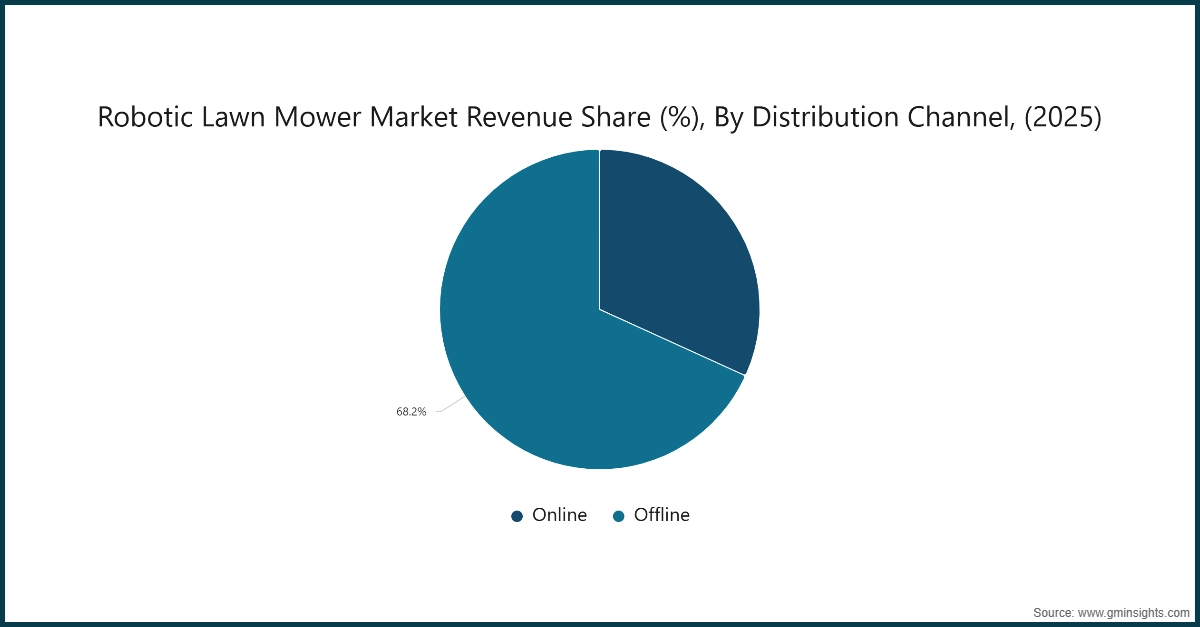
Based on distribution channel, robotic lawn mower market consists of online and offline. The offline emerged as leader and held 68.2% of the total market share in 2025 and is anticipated to grow at a CAGR of 7.3% from 2026 to 2035.
- Offline distribution channels emerged as leaders in the market due to strong dealer networks. Consumers prefer physical stores to evaluate product size, features, and build quality. In-store demonstrations improve understanding of navigation systems and cutting performance. Sales representatives provide technical guidance tailored to lawn size and terrain.
- Immediate product availability reduces waiting time for seasonal purchases. Authorized dealerships offer installation support and aftersales service assurance. Established retail presence reinforces offline channel dominance across residential markets.
North America Robotic Lawn Mower Market
Looking for region specific data?
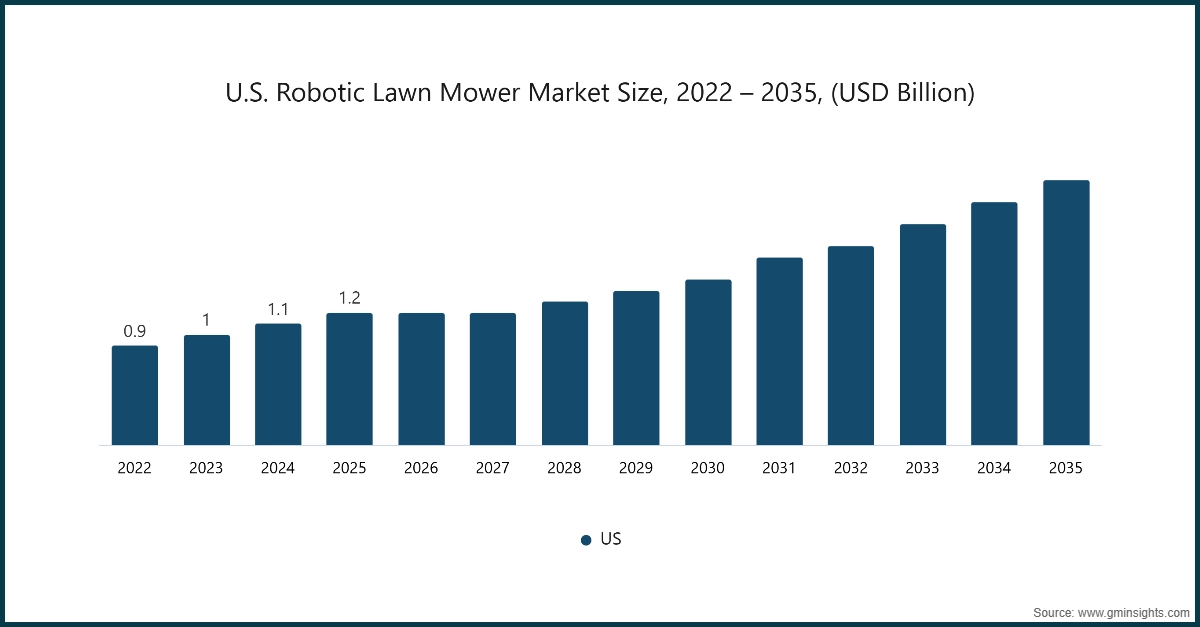
The U.S. dominates an overall North America market and valued at USD 1.2 billion in 2025 and is estimated to grow at a CAGR of 8.1% from 2026 to 2035.
- The U.S. robotic lawn mower market is driven by large residential yard ownership. Increasing consumer interest in time-saving home automation supports product adoption. GPS-enabled and app-controlled models gain popularity among tech-savvy homeowners. High disposable income enables investment in premium automated equipment. Demand rises in regions with strict noise regulations favoring quieter machines.
- Retail partnerships with home improvement chains improve nationwide distribution. Product innovation focuses on obstacle detection and weather adaptability. Growing acceptance of sustainable landscaping solutions supports electric mower adoption. Competitive pricing strategies encourage trial among first-time buyers.
Europe Robotic Lawn Mower Market
In the Europe robotic lawn mower industry, Germany is expected to experience significant and promising growth from 2026 to 2035.
- The Europe market demonstrates strong maturity across Western countries. High labor expenses encourage homeowners to adopt automated garden maintenance equipment. Compact garden sizes support efficient operation of robotic mowing systems. Strict environmental regulations promote electric and low-emission lawn equipment usage.
- Consumers value quiet performance due to dense residential living conditions. Well-established garden equipment brands maintain extensive dealer networks. Integration with smart home ecosystems enhances product appeal. Seasonal gardening culture sustains consistent replacement and upgrade demand.
Asia Pacific Robotic Lawn Mower Market
In the Asia Pacific robotic lawn mower industry, China held 36.40% market share in 2025 and is anticipated to grow at a CAGR of 8.2% from 2026 to 2035.
- The Asia Pacific market is emerging due to rising urban affluence. Growth of premium villas and gated communities supports adoption in select markets. Japan and Australia show higher penetration due to landscaping preferences. Price sensitivity limits widespread uptake in developing economies. Technological awareness among urban consumers supports interest in app-controlled models.
- Limited yard space in dense cities restricts mass adoption potential. Online retail channels improve accessibility for imported products. Market expansion depends on gradual lifestyle shifts and income growth.
Middle East and Africa Robotic Lawn Mower Market
In the Middle East and Africa robotic lawn mower industry, UAE held a significant market share in 2025 promising growth from 2026 to 2035.
- The Middle East and Africa market grows through luxury residential developments. High temperatures increase demand for automated maintenance solutions reducing manual effort. Adoption remains concentrated in affluent Gulf countries. Large villa properties create favorable conditions for robotic mowing equipment.
- Import dependence shapes product availability and pricing structures. Commercial landscaping services drive demand in hospitality properties. Water conservation landscaping trends influence equipment selection criteria. Market growth remains gradual due to limited awareness in wider regions.
Robotic Lawn Mower Market Share
- In 2025, the prominent manufacturers in robotic lawn mower industry are Husqvarna Group, Robert Bosch, Worx Landroid, John Deere, and Ambrogio collectively held the market share of ~51%.
- Husqvarna Group is the global leader in robotic lawn mowers, widely recognized for its Automower series. The company emphasizes reliability, advanced navigation technology, and integration with smart garden systems. Husqvarna serves residential, commercial, and large estate applications with a range of models suited to varied terrains and lawn sizes. Its strong brand heritage, extensive dealer network, and continued investment in autonomous mowing innovations support its leadership position.
- Robert Bosch offers robotic lawn mowers focused on precision, durability, and user‑friendly smart features. The company integrates automated lawn care with digital connectivity and safety sensors. Bosch’s strong engineering expertise and global distribution channels help maintain visibility across Europe and other key markets. Continuous R&D investment, broad service support, and strong brand reputation position Bosch as a major competitor in residential robotic mowing solutions.
Robotic Lawn Mower Market Companies
Major players operating in the robotic lawn mower industry include:
- Ambrogio
- Dreame
- Echo Robotics
- Ecoflow
- Gardena
- Honda Motor Company
- Husqvarna Group
- John Deere
- Kress Robotics
- Mammotion
- Robert Bosch
- Robomow
- Traqnology
- Worx Landroid
- Yarbo
Worx Landroid is a leading consumer robotic mower brand known for its modular design and app connectivity. The company focuses on ease of use, obstacle navigation, and scheduled automation tailored to small‑to‑medium lawns. Worx leverages strong e‑commerce presence and dealer relationships, appealing to tech‑savvy homeowners seeking reliable robotic yard maintenance. Its balance of performance, price, and smart features supports competitive market positioning.
John Deere competes in the robotic mower market with robust turf automation solutions designed for residential and commercial landscapes. The company emphasizes durability, precision cutting, and integration with broader John Deere smart equipment ecosystems. Leveraging its strong dealer network and brand trust, John Deere targets premium customers seeking professional‑grade robotic lawn care. Its focus on performance and reliability supports market share growth.
Ambrogio, a brand of the AS Mow group, specializes in robotic lawn mowers with advanced navigation algorithms and customizable mowing patterns. The company offers models suited for varied terrain types and lawn sizes, emphasizing quiet operation and battery efficiency. Ambrogio’s focus on European markets, strong local distribution, and innovation in autonomous lawn management support steady adoption among consumers seeking premium garden automation.
Robotic Lawn Mower Market Report Attributes
| Key Takeaway | Details |
|---|---|
| Market Size & Growth | |
| Base Year | 2025 |
| Market Size in 2025 | USD 3.4 Billion |
| Market Size in 2026 | USD 3.5 Billion |
| Forecast Period 2026-2035 CAGR | 7.5% |
| Market Size in 2035 | USD 6.8 Billion |
| Key Market Trends | |
| Drivers | Impact |
| Rising demand for smart and autonomous home solutions | Increasing consumer interest in IoT-enabled, hands-free lawn care drives adoption of robotic mowers as convenient, time-saving alternatives to traditional mowers. |
| Expansion of e-commerce and omnichannel distribution | Wider availability through online retail and home improvement channels increases accessibility and choice, accelerating market penetration. |
| Growth in residential landscaping and outdoor living trends | Homeowners placing higher value on outdoor aesthetics and maintenance boost demand for automated lawn care tools that maintain lawns with minimal effort. |
| Pitfalls & Challenges | Impact |
| High upfront purchase cost relative to traditional mowers | Premium pricing of robotic lawn mowers limits adoption among price-sensitive consumers, particularly in emerging markets. |
| Complexity of installation and boundary setup | Requirement for boundary wires or initial configuration can deter less tech-savvy users, slowing market uptake. |
| Opportunities: | Impact |
| Integration with smart home ecosystems and voice assistants | Seamless connectivity with platforms like Alexa and Google Home can elevate user convenience and attract tech-driven consumers. |
| Development of advanced terrain-adaptive and all-weather models | Development of advanced terrain-adaptive and all-weather models |
| Market Leaders (2025) | |
| Market Leader |
Market share of ~18% |
| Top Players |
Collective market share of ~54% |
| Competitive Edge |
|
| Regional Insights | |
| Largest Market | North America |
| Fastest growing market | North America |
| Emerging countries | China, India, Japan, South Korea |
| Future outlook |
|
What are the growth opportunities in this market?
Robotic Lawn Mower Industry News
- In February 2026, Dreame launched the A2 1200 robot lawn mower in Europe as a more affordable solution for standard gardens, featuring its OmniSense 2.0 system with 3D LiDAR and 1080p HDR camera navigation. This model aims to bring advanced LiDAR-based obstacle avoidance and precise edge cutting to customers at a lower price point.
- In October 2025, Husqvarna Group announced new robotic lawn mowers featuring AI Vision technology, including models with camera-led navigation, wire-free installation, and night-time operation capabilities. These additions expand its Automower and Gardena SILENO sense product lines with smarter obstacle avoidance and improved adaptability for varied lawn environments.
- In 2025, Ambrogio introduced AI-powered robotic lawn mower models incorporating RTK satellite navigation and cloud connectivity, enabling autonomous mowing without perimeter wiring and advanced garden mapping capabilities. Its Twenty 25 RTK robot mower covers up to 3,000 m² with autonomous RTK-based navigation.
- In January 2025, John Deere announced development of an autonomous commercial mower leveraging its advanced sensor and AI navigation technology for landscaping and turf applications, with planned commercial release targeted around 2026.
The robotic lawn mower market research report includes in-depth coverage of the industry, with estimates & forecast in terms of revenue (USD Billion) and volume (Thousand Units) from 2022 to 2035, for the following segments:
Market, By Type
- Fully autonomous
- Semi-autonomous
Market, By Cutting Height
- Low (0.5 inch to 1 inch)
- Medium (1 inch to 1.5 inch)
- High (1.5 inches to 2 inches)
Market, By Application
- Professional
- Individual
Market, By Lawn Size
- Small Lawns (up to 0.25 acres)
- Medium Lawns (0.25 - 0.5 acres)
- Large Lawns (0.5 acres and above)
Market, By Battery Capacity
- Up to 20V
- 20V to 30V
- Above 30V
Market, By Price
- Low
- Medium
- High
Market, By End Use
- Residential
- Commercial
Market, By Distribution Channel
- Online
- Company websites
- E-commerce
- Offline
- Specialty stores
- Supermarket/hypermarket
- Others
The above information is provided for the following regions and countries:
- North America
- U.S.
- Canada
- Europe
- Germany
- UK
- France
- Italy
- Spain
- Asia Pacific
- China
- Japan
- India
- South Korea
- Australia
- Latin America
- Brazil
- Mexico
- Argentina
- MEA
- Saudi Arabia
- UAE
- South Africa
Frequently Asked Question(FAQ) :
What was the market size of the robotic lawn mower in 2025?
The market size was USD 3.4 billion in 2025, growing at a CAGR of 7.5% through 2035, driven by rising demand for smart and autonomous home solutions.
What is the projected value of the robotic lawn mower market by 2035?
The market is poised to reach USD 6.8 billion by 2035, supported by advancements in battery technology, smart home integration, and increasing urbanization.
What is the expected size of the robotic lawn mower industry in 2026?
The market size is projected to reach USD 3.5 billion in 2026.
How much revenue did the low segment generate in 2025?
The low segment generated approximately USD 1.4 billion in 2025 and is expected to grow at a CAGR of 7.6% through 2035.
What was the market share of the residential segment in 2025?
The residential segment held 64.7% of the market share in 2025 and is projected to grow at a CAGR of 7.7% through 2035.
What was the valuation of the offline segment in 2025?
The offline segment accounted for 68.2% of the market share in 2025 and is expected to grow at a CAGR of around 7.3% through 2035.
Which region leads the robotic lawn mower sector?
The United States leads the North America market, valued at USD 1.2 billion in 2025, with a projected CAGR of 8.1% through 2035.
What are the upcoming trends in the robotic lawn mower market?
Key trends include advanced sensor integration, smartphone connectivity, eco-friendly electric models, improved safety features, and expanded distribution with professional support services.
Who are the key players in the robotic lawn mower industry?
Key players include Ambrogio, Dreame, Echo Robotics, Ecoflow, Gardena, Honda Motor Company, Husqvarna Group, John Deere, Kress Robotics, Mammotion, Robert Bosch, and Robomow.
Robotic Lawn Mower Market Scope
Related Reports