Summary
Table of Content

RF Front End Module Market
Get a free sample of this report
Form submitted successfully!
Error submitting form. Please try again.
Thank you!
Your inquiry has been received. Our team will reach out to you with the required details via email. To ensure that you don't miss their response, kindly remember to check your spam folder as well!
Request Sectional Data
Thank you!
Your inquiry has been received. Our team will reach out to you with the required details via email. To ensure that you don't miss their response, kindly remember to check your spam folder as well!
Form submitted successfully!
Error submitting form. Please try again.
RF Front End Module Market Size
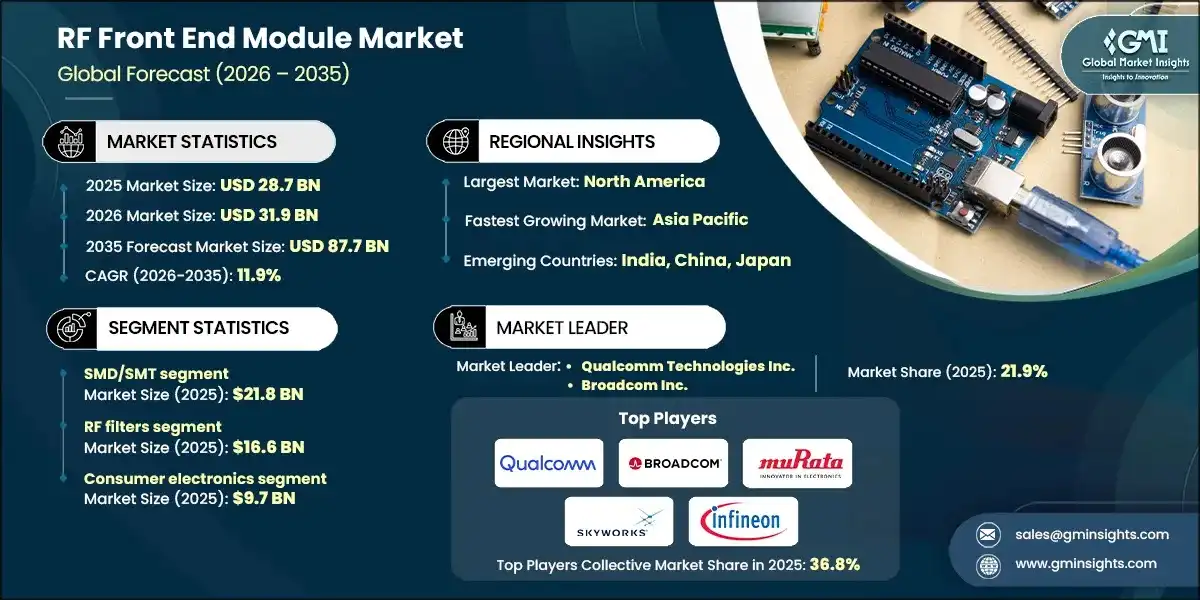
The global RF front end module market was estimated at USD 28.7 billion in 2025. The market is expected to grow from USD 31.9 billion in 2026 to USD 49.6 billion in 2030 and USD 87.7 billion by 2035, at a value CAGR of 11.9% during the forecast period of 2026–2035.
RF Front End Module Market Key Takeaways
Market Size & Growth
- 2025 Market Size: USD 28.7 Billion
- 2026 Market Size: USD 31.9 Billion
- 2035 Forecast Market Size: USD 87.7 Billion
- CAGR (2026–2035): 11.9%
Regional Dominance
- Largest Market: North America
- Fastest Growing Region: Asia Pacific
Key Market Drivers
- Growing Demand for 5G and Advanced Wireless Communication.
- Increasing Adoption of IoT and Connected Devices.
- Rising Smartphone and Consumer Electronics Penetration.
- Expansion of Wi-Fi 6/6E and Upcoming Wi-Fi 7 Standards.
- Increasing Demand in Automotive Radar and V2X Communication.
Challenges
- Security Concerns with Wireless Audio Transmission.
- Interference Issues in Crowded Wireless Environments.
Opportunity
- Expanding Connected Devices and Applications..
- Advancements in Wireless Communication Standards..
Key Players
- Market Leader: Qualcomm Technologies Inc. led with over 21.9% market share in 2025.
- Leading Players: Top 5 players in this market include Qualcomm Technologies Inc, Broadcom Inc., Murata Manufacturing Co. Ltd, Skyworks Solutions Inc., Infineon Technologies AG, which collectively held a market share of 36.8% in 2025.
Get Market Insights & Growth Opportunities
- The RF front end module demand is attributed to 5G deployment and enhanced wireless technological alignment, collateral rise of Internet of Things and interconnected devices, proliferation of smart consumer electronics, advancement of wi-fi 6/6e and anticipated wi-fi 7 standards and surge in automotive radar along V2X communications.
- The growing demand for 5G and advanced wireless communication is a key driver in the RF front-end module market. There were 1.60 billion subscriptions of 5G mobile devices in 2023 and is projected to be 2.27 billion by the end of 2024 according to reports by GSMA and Ericsson. The demand for higher speed and lower latency 5G mobile devices is the primary cause of these network subscriptions. 5G networks are being rapidly deployed increasing demand for RF front end devices in smartphones, base stations, and 5G enabled IoT devices. There are advanced RF power amplifiers, filters and antennas which optimize 5G performance, spectrum efficiency and power consumption.
- The increasing adoption of IoT and connected devices is a major driver of the RF front-end module market. According to 2023 GSMA report with 2030 predictions and a CAGR of 16%, global connections of IoT devices are estimated in connection will increase to 38.8 billion by 2030. IoT smart devices are becoming commonplace and in high demand with the advent of smart homes, automated industry, healthcare monitoring devices, and telematics in vehicles. IoT devices utilize and interface with a wide variety of wireless communication technologies, including but not limited to, Wi-Fi, Bluetooth, Zigbee, LoRa, as well as 4G/5G cellular networks. The growing demand of such devices and technologies creates and increases demand for high-performance RF front end technologies.
- The North America region dominated with over 29.9% market share in 2025. North America's adoption of WiFi 6/7 provides the frontline accessibility and interface for devices, increasing demand for advanced RF front end modules (FEMs) as the industry leader and maintainer. The North American RF front end module (FEM) market is being driven by the increasing growth of IoT related technologies, and the increasing adoption of smart devices in North America. According to Statista U.S. Smart home market is expected to reach USD 43 billion in 2025 and the increased prediction of meshed automated home systems accelerates the innovations of RF technologies with the focus of highly seamless wireless communication with less RF components.
To get key market trends
RF Front End Module Market Trends
- The transition to Gallium Nitride (GaN) in RF front-end modules began gaining significant momentum around 2018-2019, because of the growth of 5G networks and a need for greater power efficiency and increased performance on higher frequencies. A prime example is the QPF0219 introduced by Qorvo in 2023 as the first-ever front-end power module that covers the frequency range of 2 to 18 GHz. The 10-watt multichip FEM incorporates innovative GaN-on-SiC and GaAs technologies, making it suitable for use in a broader range of radar, electronic warfare and communications applications. With continuing deployment of 5G networks, the market of GaN devices is likely to reach its peak by 2025.
- RF front-end module (FEM) marketplace has begun embracing sustainability and energy efficiency as part of their eco-conscious technology initiatives to help mitigate growing concerns related to energy use in next generation wireless networks. The U.S. Department of Energy has implemented projects to develop RF connectivity modules with more than 50% lower active power consumption than conventional RF FEMs to support this trend. With the increasing emphasis on power savings and energy efficiency due to the rapid growth of the internet of things (IoT) and global environmental regulations, the demand for sustainable RF FEM technology will likely increase significantly between approximately 2020-2025, when sustainability becomes a principal focus of RF FEM companies.
- Automated testing and smart manufacturing in the RF front-end module (FEM) market is transforming production by integrating automation and AI-driven systems for improved efficiency and quality.
As manufacturers seek to provide reliable and superior quality products for their customers, there has also been increased interest in automating many manual processes associated with creating FPMs. In fact, recent research conducted by the Interdisciplinary Center for Advanced Manufacturing Systems (ICAMS) indicates that at least 56% of U.S. manufacturers are currently running pilot projects based on some form of Smart Manufacturing. This trend accelerated between 2018 and 2020, and will likely culminate between 2023 and 2025, since there will be intense competition in the wireless communications industry to produce RFID modules that are produced faster and are more uniform in quality.
RF Front End Module Market Analysis
Learn more about the key segments shaping this market
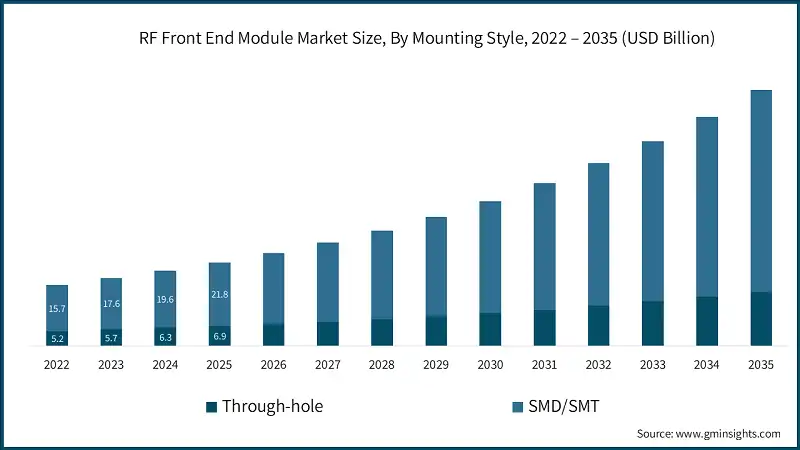
Based on the mounting style, the market is bifurcated into through-hole & SMD/SMT.
- The SMD/SMT segment was the largest market and was valued at USD 21.8 billion in 2025. The need for greater compactness, higher performance, and lower-cost RF front-end modules, as well as the need for maximum use of space and increased functionality, is driving the growth of the SMD/SMT market in the consumer electronics, automotive, and industrial sectors.
- Manufacturers must concentrate their efforts on the design and manufacture of SMD/SMT products that provide maximum integration and miniaturization along with the highest possible level of quality.
- The through-hole segment is anticipated to grow with a CAGR of 10.5 % during the forecast period of 2026 – 2035. The demand for through-hole technology is being driven by the ability of through-hole components to provide reliability in applications where maximum power handling capability and the ability to be easily serviced are required, including automotive, industrial, and aerospace industries.
- Manufacturers must devote most of their resources to ensuring that their through-hole components can withstand the rigors of high-power applications and are as durable as possible.
Learn more about the key segments shaping this market
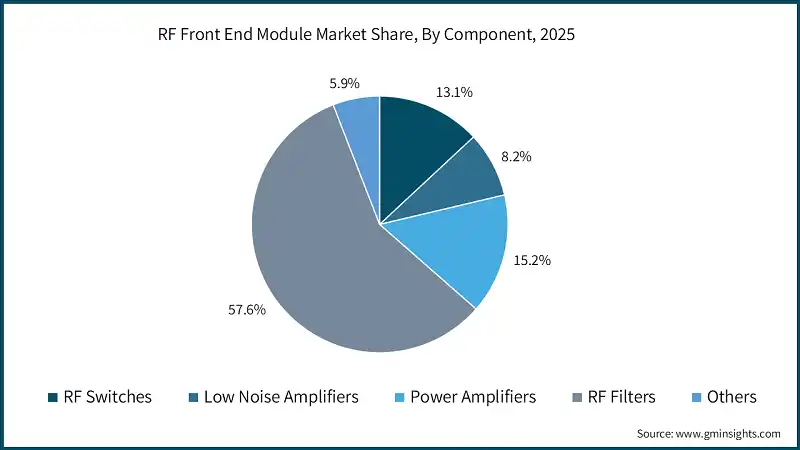
On the basis of component, the RF front end module market is segmented into RF switches, low noise amplifiers, power amplifiers, RF filters & others.
- The RF filters segment was the largest market and was valued at USD 16.6 billion in 2025. The increase in demand for high-quality signal filtering in the areas of 5G, IoT, and wireless communications is driving the growth of the RF filter marketplace, as uncertainty in the supply of these types of components will create an increase in technology development in this area.
- Manufacturers of RF filter components should be focusing their efforts on the design and development of high-performance filters that have improved signal integrity with reduced interference levels and are compatible with current and emerging technologies such as 5G and IoT.
- The power amplifiers segment is anticipated to grow with a CAGR of 11.2% during the forecast period of 2026 – 2035. The growth of the power amplifier market is primarily attributed to the demands for more efficient, higher output power, and more effective alternative materials in 5G, Satellite Communications and IoT applications, specifically the growing demands for GaN and GaAs.
- To fulfil the demand and interest in RF front end modules that drive the growth in power amplifiers (i.e. consumer electronics such as smartphones & wearables), to get to the point of developing these technologies, businesses must develop RF front end modules with significantly improved levels of thermal performance, Integration, Energy Efficiency over previous generations.
On the basis of end-use industry, the RF front end module market is categorized into consumer electronics, automotive, military & defense, medical & others.
- The consumer electronics segment was the largest market and was valued at USD 9.7 billion in 2025. The increase in demand for innovative consumer electronics, including smart phones and wearable technology, is driving the expansion of this segment of the market.
- Companies must develop improved RF Front End Modules in order to address the needs of the large numbers of smartphones, wearables and Smart Home Devices that are coming onto the market, in order to improve inter-device connectivity and energy efficiency for the next generation of connected devices.
- The automotive segment is the fastest growing market and is anticipated to grow with a CAGR of 13.6% during the forecast period of 2026 – 2035. Growth in the automotive sector is largely driven by the increasing need for advanced driver assistance systems (ADAS) and connected vehicles/autonomous cars; therefore, to enable the continued growth of ADAS and connected vehicle technology, there is a requirement for robust, high-performance rf front end modules for communication and sensor fusion.
- Manufacturers need to focus their attention on producing first-generation RF front-end modules that offer improved reliability and perform with low latency with optimum efficiency for advanced driver assistance systems (ADAS), driverless vehicles, and connected vehicles whereby communication and sensors are integrated.
Looking for region specific data?
North America RF front end module market was valued at USD 8.6 billion in 2025 and is anticipated to grow with a CAGR of 11.3% during the forecast period of 2026 – 2035. The increase in the demand for Internet of Things (IoT) devices and consumer electronics, and the rapid advancements in automotive technology are the reasons for the expansion of North American RF front-end module market.
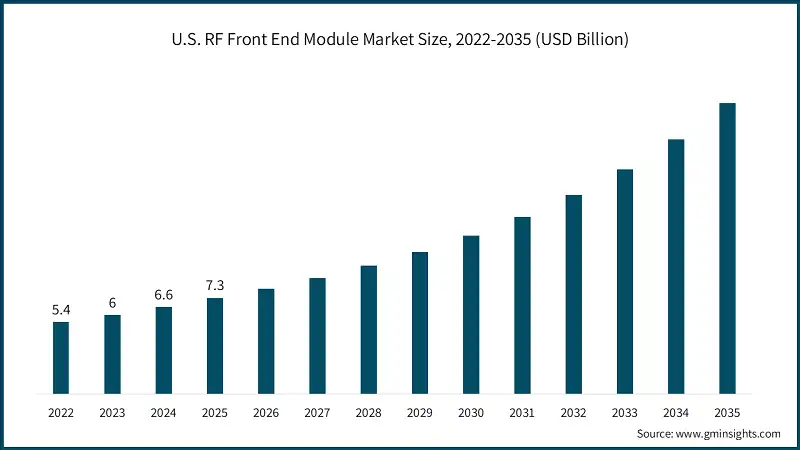
- U.S. dominated the RF front end module industry and was valued at USD 7.3 billion in the year 2025. Advancements in electronics for consumers, government spending on the Internet of Things (IoT), and the need for high-speed communication in defense systems have been the reasons for the increasing growth for this market in the United States.
- Manufacturers need to focus their attention on producing cutting-edge RF front-end modules that provide connectivity for 5G, the Internet of Things (IoT), and for defense to ensure that the demand with consumer electronics and smart systems to be high.
- The RF front end module market in Canada is anticipated to surpass USD 3.1 billion by 2035, driven by the expansion of rural broadband network connections; the upgrades by Canadian telecom providers to their telecom infrastructure; and wireless technology sustainability efforts, expansion throughout all Canadian market base sectors, urban and eco-friendly sectors.
- Manufacturers must extend and enhance already existing RF front-end module designs to support these expansions. These new Products need to be optimized for rural broadband connectivity benefits, upgraded Canadian telecom provider infrastructure enhancements, and supporting sustainable wireless solutions.
The RF front end module market in Europe is anticipated to grow with a CAGR of 12.4% during the forecast period of 2026 – 2035. In addition, the 5G roll-out is encouraging growth in the EU Market. Also, with increased adoption of IoT devices, plus the increased focus on automotive technology innovation, creating smart cities and sustainable technologies, have resulted in significant growth for the European market.
- Germany market was valued at USD 2.1 billion in the year 2025. This growth is supported by Germany's continued adoption of industry 4.0; implementation of smart manufacturing initiatives and development of sustainable technology creating new processes and products supporting innovation & increased efficiency across all sectors of the German marketplace.
- Manufacturers should make developing high-performance RF front-end Modules Supporting Industrial IoT Solutions, smart manufacturing and energy-efficient products, while also facilitating the seamless integration of these Products with Industry 4.0 technology and best sustainable practices a priority in their Product Development efforts.
- UK RF front end module market is anticipated to surpass USD 6.8 billion by 2035. UK marketplace has focused on growth for urban connected solutions, automotive wireless technology and electrification and sustainable energy.
- Manufacturers must improve urban connectivity, inter EV communication, and energy efficient designs for commercial products, especially for the UK sustainable focus and next-gen wireless technologies.
The RF front end module market in Asia Pacific was valued 8.1 billion in 2025. Due to the rapid expansion of mobile devices and the government’s push for integrated Industrial IoT and smart infrastructure, this region is the most developed in the Asia Pacific.
- China market is projected to reach USD 11.3 billion by the year 2035. Due to EV in China, there is strong growth in the consumer electronics market helped by the government’s Made in China 2025 initiative which helps improves overall manufacturing and tech in the country.
- Companies should focus on RF front-end modules that support electric vehicles, enhance performance of consumer electronics, and are aligned with China's change technology development initiative (Made in China 2025).
- The RF front end module market in Japan was valued at USD 1.3 billion in 2025. Japan's fast-growing RF front-end module market is being fueled by the increasing demand for smartphones and wearables, as well as the rapid deployment of 5G networks and growth within connected and autonomous vehicle markets.
- Manufacturers should target the development of RF front-end modules that have been optimized for both 5G networks and connected and autonomous vehicle applications while also being designed for use with high-performing consumer electronics. The integration of these products will provide an improved level of functionality to all three markets as they continue to grow rapidly.
- India RF front end module market is anticipated to grow with a CAGR of over 15.1% during the forecast period of 2026-2035. The rapid growth of the India RF front-end module market is related to the widespread availability of the internet to both urban and rural regions, alongside the deployment of smart grid technologies.
- Manufacturers must develop their products to support the ever-expanding Internet as well as the integration of smart grid technology and the efficient integration of their products into 5G and IoT applications to meet this demand.
The RF front end module market in Latin America was valued at USD 2.1 billion in 2025. The growth of Latin America's RF front-end module (FEM) market is the result of the increase in mobile broadband availability, digitalization by governments, and the growing use of smartphones.
MEA RF front end module market is projected to surpass USD 2.9 billion by 2035. The RF front-end module (FEM) market is growing primarily because of the need for dependable communication services in remote locations and the implementation of community-based technology solutions to improve urban lifestyles.
- South Africa market was valued at USD 227.6 million in 2025. The growth of the RF front-end module (FEM) market in South Africa is the result of an increase in local manufacturing capabilities and growing need for better rural connectivity for FEM and supportive government policies which will create more opportunities for innovation and job creation as well as for the development of telecom infrastructure.
- Manufacturers in South Africa should focus on the local assembly of RF components, cost-effective production methods, the development of Rural Connectivity (RC) solutions, the establishment of a 5G infrastructure, and compliance with governmental regulation for growth.
- The RF front end module market in Saudi Arabia is projected to grow with a CAGR of 6.6% during the forecast period of 2026-2035. The RF front-end modules market in Saudi Arabia is being boosted by the digital transformation driving investment in telecom, the creation of high-speed networks for infrastructural development, and minimizing the reliance on imported components.
- Local RF component production should be prioritized by manufacturers supporting 5G infrastructure and developing energy-efficient solutions while capitalizing on growth opportunities provided for manufacturers through Vision 2030 initiatives.
- The RF front end module market in UAE is anticipated to surpass USD 775.1 million by 2035. The UAE RF front-end modules market growth originates from an increase in connectivity due to smart cities, the digital economy initiative’s contribution to growth, and an increase in the number of connected devices.
- Businesses should direct their efforts toward enhancing the infrastructure required to support 5G, supporting connectivity for smart cities, and developing energy-efficient RF components and exploiting the rising market for IoT and connected devices.
RF Front End Module Market Share
- The RF front-end modules market is a fragmented, intensely competitive market with many small and large businesses represented within this sector; Qualcomm Technologies, Inc, Broadcom, Inc, Murata Manufacturing, Co., Ltd, Skyworks Solutions, Inc and Infineon Technologies, AG are some of the major competitors with a combined market share of 36.8% for the entire market in 2025.
- Qualcomm Technologies, Inc, held a significant position in the global RF front-end module market in 2025, controlling 11.9% of the total market share. The company is benefitted from strong positioning in 5G technology, establishing strategic partnerships, innovative solutions in semiconductor technology, and a broad base of customers worldwide.
- Broadcom Inc. held 9.9% of the RF front end module market in 2025, with a primary focus on advancing semiconductor manufacturing technologies, improving process precision, and supporting high-performance applications in telecommunications, consumer electronics, and automotive sectors.
- Murata manufacturing Co. Ltd held 6.2% of the market in 2025. They are a leader in RFFEM and are becoming increasingly important in the marketplace with their participation in both Mobile and IoT solutions. They provide miniaturized components and utilize innovative RF solutions.
- Skyworks Solutions Inc. achieved a 5.2% market share in 2025. Skyworks is considered a leader in the RFFEM market with a long-standing history as an innovator.
- Infineon Technologies AG secured 3.5% of the RF module market in 2025, their strength is in developing high-performance semiconductor solutions and leveraging expertise in power management, 5G technology, and automotive applications to increase connectivity and energy efficiency.
RF Front End Module Market Company
The top prominent companies operating in the RF front end module industry include:
- Analog Devices, Inc.
- Broadcom Inc.
- Infineon Technologies AG
- L3Harris Technologies, Inc.
- MACOM Technology Solutions
- Murata Manufacturing Co. Ltd
- NXP Semiconductors NV
- Qorvo Inc.
- Qualcomm Technologies Inc.
- Renesas Electronics Corporation
- Skyworks Solutions Inc.
- Microchip Technology Inc.
- OnMicro
- Nisshinbo Micro Devices Inc.
- Texas Instruments Incorporated
Qualcomm, Broadcom, and Skyworks are leaders in the RF front end module market. Qualcomm leverages its leadership in 5G technologies and long-standing relationships with telecommunications companies to provide industry-leading 5G solutions for mobile applications. Broadcom supplies RF Front End Modules for the mobile, automotive, and IoT sectors. Skyworks has developed a portfolio of high-performance, analog solutions that support 5G communications.
Murata, Infineon, and NXP are strong challengers in the RF front-end module market. Murata is known for its ability to produce miniaturized RF Front End Modules for mobile applications. Infineon is known for its power management solutions and development of 5G technologies. NXP has developed an extensive portfolio of semiconductor products for the automotive, industrial, and mobile sectors.
Qorvo, MACOM, Renesas, and Microchip are less established suppliers of RF Front End Modules but have a strong brand presence and continue to be a legitimate threat to larger players. These companies primarily focus on specialized applications, including automotive, IoT, and networking solutions; however, none of these competitors leads the mobile or telecommunications RF markets.
Niche players in the RF front-end module market, such as Analog Devices, focus on specialized solutions for specific sectors like automotive, industrial, and consumer electronics. While not competing at the scale of market leaders, they offer valuable, targeted innovations for applications, driving growth in niche markets.
RF Front End Module Market Report Attributes
| Key Takeaway | Details |
|---|---|
| Market Size & Growth | |
| Base Year | 2025 |
| Market Size in 2025 | USD 28.7 Billion |
| Market Size in 2026 | USD 31.9 Billion |
| Forecast Period 2026-2035 CAGR | 11.9% |
| Market Size in 2035 | USD 87.7 Billion |
| Key Market Trends | |
| Drivers | Impact |
| Growing Demand for 5G and Advanced Wireless Communication | Growing Demand for 5G and Advanced Wireless Communication |
| Increasing Adoption of IoT and Connected Devices | Drives 25% of market growth as the proliferation of IoT devices across various sectors demands efficient RF modules for reliable wireless connectivity. |
| Rising Smartphone and Consumer Electronics Penetration | Rising Smartphone and Consumer Electronics Penetration |
| Expansion of Wi-Fi 6/6E and Upcoming Wi-Fi 7 Standards | Contributes 15% of market growth as the adoption of Wi-Fi 6/6E and Wi-Fi 7 standards drives the need for high-performance FEMs to enable faster networking. |
| Increasing Demand in Automotive Radar and V2X Communication | Contributes 10% of market growth as the rise of ADAS, radar, and V2X communication in the automotive industry requires robust RF modules for connectivity. |
| Pitfalls & Challenges | Impact |
| Security Concerns with Wireless Audio Transmission | Restrains 20% of market growth due to vulnerabilities in wireless audio transmission, raising concerns about data breaches and unauthorized access in sensitive environments. |
| Interference Issues in Crowded Wireless Environments | Limits 18% of market growth as increased RF interference in crowded environments leads to signal degradation, affecting the performance and reliability of RF front-end modules. |
| Opportunities: | Impact |
| Expanding Connected Devices and Applications. | The growing IoT ecosystem drives demand for advanced RF solutions, offering new market opportunities for RF front-end modules in consumer, industrial, and healthcare sectors. |
| Advancements in Wireless Communication Standards. | The evolution of Wi-Fi 6/7 and 5G technologies creates significant growth in RF module demand, enabling faster, more reliable connectivity in mobile, automotive, and IoT devices. |
| Market Leaders (2025) | |
| Market Leaders |
21.9% |
| Top Players |
|
| Competitive Edge |
|
| Regional Insights | |
| Largest Market | North America |
| Fastest Growing Market | Asia Pacific |
| Emerging Countries | India, China, Japan |
| Future outlook |
|
What are the growth opportunities in this market?
RF Front End Module Industry News
- In January 2024, pSemi Corporation, a Murata company, introduced the PE562212 RF front-end module (FEM) for IoT applications. This ultra-compact PA-LNA-SW FEM supports Thread, Zigbee, Bluetooth, and Wi-Fi (2.4 GHz), delivering +21 dBm output power with high efficiency.
- In September 2024, Broadcom, in partnership with Tower Semiconductor, has been producing Wi-Fi 7 RF FEMs using Tower's advanced 300mm RFSOI technology. These modules are designed for mobile applications and offer superior performance and efficiency compared to existing non-SOI technologies.
The RF front end module market research report includes in-depth coverage of the industry with estimates and forecasts in terms of revenue (USD Billion) from 2022 – 2035 for the following segments:
Market, By Component
- RF switches
- Low noise amplifiers
- Power amplifiers
- RF filters
- Others
Market, By Mounting Style
- Through-hole
- SMD/SMT
Market, By Connectivity
- Wi-Fi
- Wi-Fi 5
- Wi-Fi 6/6E
- Others
- Bluetooth
- Zigbee
- Others
Market, By Cellular Technology
- 3G
- 4G
- 5G
- Others
Market, By Frequency
- Less than 2.5 GHz
- 2.5 to 3.5 GHz
- Above 3.5 GHz to 5 GHz
- Others
Market, By Application
- Smartphones
- PC
- Tablets
- Wearables
- Industrial IoT
- Mobile broadband
- Others
Market, By End Use Industry
- Consumer electronics
- Automotive
- Military & defense
- Medical
- Others
The above information is provided for the following regions and countries:
- North America
- U.S.
- Canada
- Europe
- Germany
- UK
- France
- Spain
- Italy
- Netherlands
- Asia Pacific
- China
- India
- Japan
- Australia
- South Korea
- Latin America
- Brazil
- Mexico
- Argentina
- Middle East and Africa
- Saudi Arabia
- South Africa
- UAE
Frequently Asked Question(FAQ) :
What is the RF front end module market size in 2025?
The market size for RF front end module was valued at USD 28.7 billion in 2025. Growth is driven by rapid 5G deployment, increasing adoption of IoT devices, and rising demand for high-performance wireless communication components.
What is the market size of the RF front end module industry in 2026?
The global RF front end module market reached USD 31.9 billion in 2026, supported by expanding smartphone penetration, Wi-Fi 6/6E adoption, and growth in connected consumer electronics.
What is the projected value of the RF front end module market by 2035?
The market size for RF front end module is projected to reach USD 87.7 billion by 2035, growing at a CAGR of 11.9%. This long-term expansion is fueled by 5G/6G communication upgrades, automotive V2X growth, and rising demand for high-frequency GaN- and GaAs-based RF components.
How much revenue did the SMD/SMT mounting style segment generate in 2025?
The SMD/SMT segment generated USD 21.8 billion in 2025, making it the leading mounting style. Its dominance stems from increasing demand for compact, power-efficient RF modules used in smartphones, wearables, and IoT devices.
What was the valuation of the RF filters segment in 2025?
The RF filters segment was valued at USD 16.6 billion in 2025, driven by the need for high-quality filtering solutions that enable 5G performance, reduce interference, and improve signal integrity across connected devices.
What is the growth outlook for the automotive end-use segment from 2026 to 2035?
The automotive segment is expected to grow at a CAGR of 13.6% from 2026 to 2035. Increasing adoption of ADAS, autonomous driving systems, and V2X communication is boosting demand for advanced RF front end modules in vehicles.
Which region leads the RF front end module market?
North America led the market with USD 8.6 billion revenue in 2025. Strong IoT penetration, early 5G rollout, and rapid adoption of advanced consumer electronics contribute to the region’s leadership.
What are the upcoming trends in the RF front end module industry?
Key trends include GaN-based FEM adoption, Wi-Fi 7 and 5G/6G upgrades, miniaturized RF modules for wearables, sustainable low-power RF designs, and increasing use of automated smart manufacturing for FEM production.
Who are the key players in the RF front end module market?
Major players include Qualcomm, Broadcom, Murata, Skyworks, Infineon, Qorvo, NXP, Renesas, Analog Devices, and Texas Instruments. These companies focus on developing high-performance RF modules, advanced 5G solutions, and miniaturized components for mobile and IoT devices.
RF Front End Module Market Scope
Related Reports