Summary
Table of Content

Residential Solar PV Inverter Market
Get a free sample of this report
Form submitted successfully!
Error submitting form. Please try again.
Thank you!
Your inquiry has been received. Our team will reach out to you with the required details via email. To ensure that you don't miss their response, kindly remember to check your spam folder as well!
Request Sectional Data
Thank you!
Your inquiry has been received. Our team will reach out to you with the required details via email. To ensure that you don't miss their response, kindly remember to check your spam folder as well!
Form submitted successfully!
Error submitting form. Please try again.
Residential Solar PV Inverter Market Size
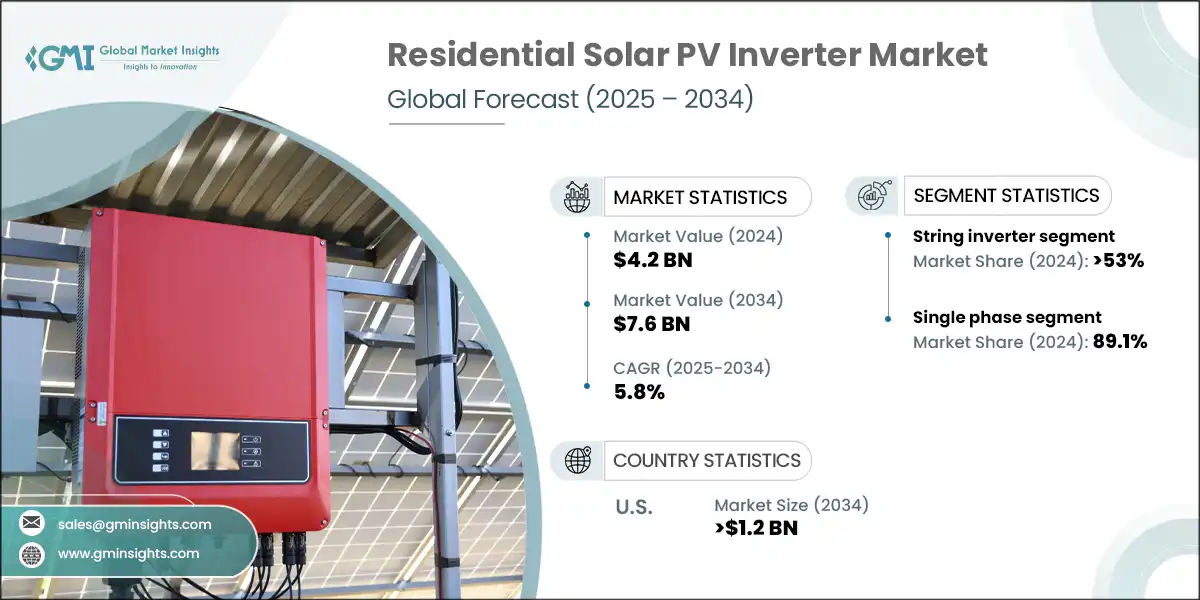
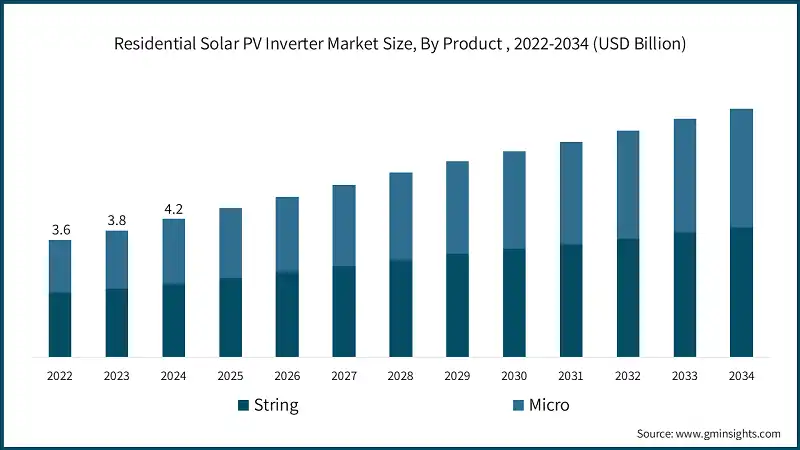
According to a recent study by Global Market Insights Inc., the global residential solar PV inverter market was estimated at USD 4.2 billion in 2024. The market is expected to grow from USD 4.5 billion in 2025 to USD 7.6 billion in 2034, at a CAGR of 5.8%.
Residential Solar PV Inverter Market Key Takeaways
Market Size & Growth
- 2024 Market Size: USD 4.2 Billion
- 2034 Forecast Market Size: USD 7.6 Billion
- CAGR (2025–2034): 5.8%
Regional Dominance
- Largest Market: Asia Pacific
- Fastest Growing Region: Europe
Key Market Drivers
- Increasing demand for renewable energy.
- Technological advancements.
Challenges
- High initial costs.
- Grid compatibility.
Opportunity
- Integration with energy storage systems.
- Expansion of smart home ecosystems.
Key Players
- Market Leader: Enphase Energy led with over 12% market share in 2024.
- Leading Players: Top 5 players in this market include Enphase Energy, Solar Edge Technologies, Inc., Huawei Technologies Co., Ltd., Sungrow, Growatt, which collectively held a market share of 37% in 2024.
Get Market Insights & Growth Opportunities
- The decreasing costs of solar panels and related technologies, combined with growing government financial incentives such as tax credits, rebates, and grants, are driving the adoption of solar energy. Additionally, rising electricity prices from conventional grid sources are prompting homeowners to seek alternative solutions to lower their monthly utility expenses, thereby boosting the demand for solar products, including PV inverters.
- A residential solar inverter is an electronic device that converts direct current generated by solar panels into alternating current for household use. These inverters integrate with residential solar power systems to ensure electricity compatibility with the household electrical grid. The inverters include system performance monitoring capabilities and safety protection features.
- Key players are at the forefront in adopting advanced solar technology in residential applications. For instance, in March 2024, the Indian company Statcon Energiaa released a new 3 kW single-phase grid-tie solar inverter for residential and small office use. Additionally, urbanization and the electrification of appliances are raising household energy consumption. This promotes homeowners to seek renewable alternatives, leading to product growth.
- The residential solar PV inverter market was valued at USD 3.2 billion in 2021 and grew at a CAGR of approximately 9.3% through 2024. Home automation and smart energy management systems are gaining popularity across the globe. Ongoing integration of smart technologies, including smart thermostats, lighting and appliances, is seeking energy solutions that offer greater connectivity and intelligence. This builds market positioning of modern solar PV inverters, especially smart and hybrid types, to align with these expectations.
- Asia Pacific is among the dominant regions with a high presence of regional and global players in the residential inverter space. These companies are offering compact, aesthetically designed, and easy-to-install solutions tailored for the home, propelling market growth. Rising electricity costs in the region, increasing rooftop solar installations, and growing environmental awareness are expected to drive product demand. For instance, in the second quarter of 2025, Australian households faced the steepest electricity prices in the region, averaging roughly 0.25 U.S. dollars per kilowatt-hour. These growing prices are set to influence demand for solar PV inverters as an affordable and environmentally friendly solution for homeowners.
- Europe is the fastest-growing region in the market, owing to the rising need for decentralized generation and grid stability via residential solar inverters. Additionally, increased adoption of energy communities, rising interest in peer-to-peer energy trading and advancements in hybrid inverter technology are further driving residential solar PV inverter demand in Europe. Moreover, higher building renovation rates under EU retrofit programs promote solar integration, leading to escalate the business trend.
To get key market trends
Residential Solar PV Inverter Market Trends
- Ongoing government policies and regulatory frameworks to boost the adoption of solar systems has increased significantly since the last decade. Growing governments, non-profits, and industry stakeholders’ efforts in information campaigns to highlight the long-term benefits and potential savings of solar power are key factors escalating solar PV inverters in residential applications.
- Increasing technological advancements, including smart inverters’ introduction with features such as remote monitoring, grid support functions and AI-based energy optimization, are boosting the product penetration. Rising companies’ efforts to incorporate new and advanced technologies in their product are expected to uplift the business forecast. For instance, in December 2023, Sungrow Power Supply Co., Ltd. introduced its SG5.0RS-L residential single-phase hybrid inverter at REI 2023. With a 16 A per-string input DC capacity, it supports high-capacity, large-format modules.
- Growing focus on energy independence and self-consumption, encouraging homeowners to reduce dependence on grid electricity and rising utility costs. This boosts solar inverters adoption in residential applications, enabling users to manage and optimize their rooftop solar power with battery storage, ensuring greater control over energy usage, leading to uplift the residential solar PV inverter market outlook.
- The rise in EV ownership is also influencing the inverter market. As per IEA, global electric car sales reached 17 million units in 2024, representing a growth of more than 25%. The year-over-year increase of 3.5 million units in 2024 exceeded the total electric car sales recorded in 2020. These growing statistics are increasing pairing solar inverters with EV charging infrastructure to minimize green energy usage and reduce reliance on fossil fuels, leading to stimulate the residential solar PV inverter market outlook.
- The increasing awareness of environmental concerns and sustainable energy solutions drives homeowners to minimize their carbon footprint and support environmental conservation efforts. Rising investments in modern inverters, including string inverters and microinverters, are driving market growth due to their improved performance, greater energy yield, and enhanced safety features.
- Solar components, including panels and inverters, have shown a significant drop in the past few years due to increased module efficiency and lower hardware and inverter costs. Solar inverters constitute approximately 8% of the total installed solar equipment cost. While solar inverter costs have decreased by 50% since 2013, the price reduction has stabilized in recent years. The decreasing product costing makes it more accessible to residential systems, leading to augment the industry outlook.
Residential Solar PV Inverter Market Analysis
Learn more about the key segments shaping this market
Based on product, the industry is segmented into string and micro. The string inverter segment accounting for over 53% market share in 2024 and is expected to grow at a CAGR of 5.7% through 2034.
- Increasing demand for affordable products with low initial and maintenance costs is set to drive the market growth. Furthermore, the robustness and durability of these products make them suitable for residential solar installations that require consistent performance and minimal downtime.
- Rising technological advancements in product efficiency, digital monitoring capabilities, and smart grid compatibility are enhancing system management and integration with home energy systems, influencing market growth. Companies are also diversifying their product line by incorporating these advanced features, driving the product growth. For instance, in July 2023, Goldi Solar launched VAMA on-grid smart string inverters for residential and commercial and industrial (C&I) consumers. The VAMA on-grid inverters incorporate DSP Control Technology, achieving efficiency rates of up to 98.6%.
- The micro inverter market will grow at a CAGR of 6% till 2034. Their ability to optimize power output at the individual panel level improves overall system efficiency, especially in shaded or complex rooftops, making it a preferred choice for homeowners. Additionally, growing demand for inverters with high safety features boosts micro inverters adoption, due to their lower DC voltage, simple plug and play installation and flexible system design, making them ideal for small-scale homes.
- Companies are putting efforts into expanding their presence in various developing regions through product introduction. For instance, in March 2025, SolaX Power is launching solar micro-inverters for the Indian market, designed for residential rooftop solar installations, ranging from 1 kW to 2.2 kW capacity. Additionally, rising energy costs and supportive policies promoting rooftop solar further encourage homeowners to invest in the product to improve energy independence and reliability.
Learn more about the key segments shaping this market
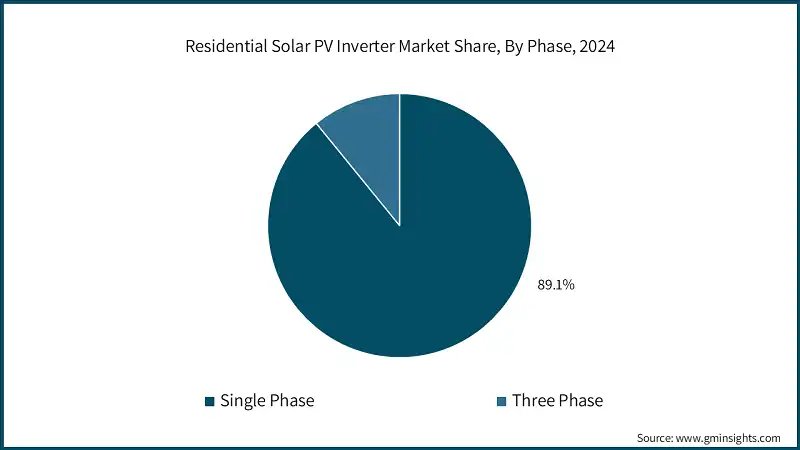
Based on phase, the residential solar PV inverter market is segmented into single phase and three phase. The single phase dominates the market with 89.1% share in 2024 and is expected to grow at a CAGR of 5.6% from 2025 to 2034.
- Increasing need for inverters that are compatible and suitable for typical household power needs is set to propel demand for single-phase solar PV inverters. Their cost-effective installation, compact size and ease of integration with rooftop solar systems additionally boosts the phase growth. Additionally, growing demand for inverters that can easily integrate with battery storage systems and smart home energy management solutions makes single phase attractive choice for homeowners seeking energy independence, lower bills and reduced carbon footprint.
- Companies are at the forefront in bringing in new product lines to overcome the product demand for residential applications. For instance, in May 2024, Statcon Energiaa, an Indian manufacturer, launched a 3 kW single-phase grid-tie solar inverter. This inverter is designed for use in residential settings and small offices. Furthermore, growing government incentives, net metering policies, and rising electricity prices further boost the single-phase penetration.
- Three phase inverter is set to grow at a CAGR of 7.5% till 2032 due to their superior energy efficiency, which provides higher energy yields and greater cost savings for homeowners. The increasing energy demands from larger residential properties, driven by extensive electrical appliances, electric vehicle charging stations, and home-based businesses, are driving product adoption. Multi-phase products provide enhanced grid stability and power quality by minimizing voltage fluctuations and reducing electrical grid strain. This is particularly significant in residential areas with high solar penetration, where grid stability remains a concern, thus increasing product demand.
Looking for region specific data?
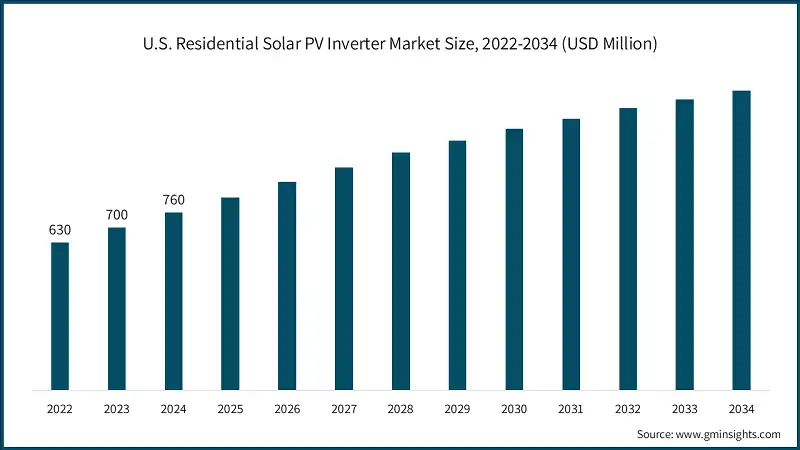
- The U.S. dominated the residential solar PV inverter market in North America with around 99.3% share in 2024 and is expected to generate over USD 1.2 billion revenue by 2034. Rising federal incentives, including the Investment Tax Credit (ITC), combined with renewable energy standards and incentives such as rebates, net metering, and solar-friendly regulations, are driving market growth.
- Presence of key players and their rising investments in developing advanced products is set to influence the business trend. For instance, in August 2022, GoodWe's ES G2 Series hybrid inverter offers 3-6 kW capacity for residential installations. The system features energy backup, peak shaving, and flexible configuration to optimize solar energy consumption. Moreover, improved product warranties and longer operational lifespans make inverters a more attractive long-term investment for households.
- The North America residential solar PV inverter market is projected to hit USD 1.3 billion by 2034. Ongoing research advancements and innovations in smart inverters that improve grid stability and energy management, along with homeowners' increasing requirement for energy independence and environmental awareness, are increasing market demand.
- The Europe residential solar PV inverter market was evaluated at USD 1.1 billion in 2024 driven by strong EU renewable energy targets, carbon reduction commitments and widespread decarbonization policies. Companies are expanding their footprint by introducing new product lines in various developed economies. For instance, in May 2025, Enphase Energy launched its IQ8P microinverter in Italy and Switzerland. The device supports solar modules up to 670W DC, with 14 amperes direct current capacity and 480W peak AC output.
- Germany holds a significant share in the residential solar PV inverter fueled by the nation’s strong commitment to the Energiewende policy, aiming for a high share of renewables in the energy mix. Additionally, rising household electricity prices and reduced feed-in tariffs encourage homeowners to maximize their self-consumption through efficient inverters, leading to uplift the product popularity.
- Asia Pacific residential solar PV inverter market is anticipated to grow over USD 2.8 billion by 2034. China's renewable energy targets, combined with government subsidies and incentives for solar technology adoption, along with its established manufacturing base for solar components, drive industry growth. In Japan, government support through feed-in tariffs and net metering regulations increases solar installations, contributing to market expansion.
- China holds the largest share in the Asia Pacific residential solar PV inverter market, driven by its supportive national policies promoting distributed solar generation under the dual carbon goal. Increasing environmental awareness, coupled with pilot programs for virtual power plants, positions the product as a critical enabler of China’s decentralized clean energy future in residential applications, leading to augment the business prospects.
- Key players are increasingly investing in opening new manufacturing high-capacity units for solar inverter to improve their dominance in China will further bolster the business outlook. In March 2023, Solar inverter manufacturer Solinteg is establishing a new manufacturing facility in Wuxi, China, with an initial production capacity of 4GW. The expansion aims to address the growing demand for its residential and C&I solar inverter products.
- The Middle East & Africa residential solar PV market is set to grow at a CAGR of 5.8% through 2034. Growing environmental consciousness and the desire for energy independence, particularly in areas with unreliable grids, are pushing homeowners toward self-sufficient solar solutions, often integrated with battery storage using hybrid inverters. Additionally, the abundance of solar resources makes solar energy a viable and attractive option, leading to uplift the industry prospects.
Residential Solar PV Inverter Market Share
- The top 5 companies, including Enphase Energy, Solar Edge Technologies, Inc, Huawei Technologies Co., Ltd, Sungrow, Growatt, account for around 37% market share. Major companies in the market invest in research and development to enhance inverter efficiency, reliability, and functionality.
- Companies form strategic partnerships and collaborations to expand their market presence, strengthen product portfolios, and improve customer service. New market entrants offer diverse product ranges to meet varying customer requirements. Additionally, key players are developing advanced inverter models, including string inverters, and microinverters, to serve multiple market segments.
- Major stakeholders are adopting digital technologies, AI-powered energy management systems, and remote monitoring to improve operational efficiency and service quality while meeting international decarbonization requirements and regulatory obligations. Companies are also pursuing strategic partnerships, mergers and acquisitions, and geographic expansion into high-growth markets in the Asia Pacific and the U.S. regions.
Residential Solar PV Inverter Market Companies
- Enphase Energy holds a significant position in the residential solar PV inverter industry. The company generated revenue of USD 356 million in Q1 2025. Enphase dominates the U.S. residential market with its IQ8 microinverter. The company's expansion strategy focuses on Southeast Asia, integration with smart energy platforms, and increased U.S. manufacturing capacity to reduce tariff effects and expand its global market presence.
- Huawei reported revenue of USD 118.2 billion and invested USD 25 billion in research and development in 2024. The company focused on advancing its residential solar PV inverter technology to strengthen its position in the renewable energy market. Huawei's inverter solutions were implemented across various solar projects, establishing the company as a significant provider of large-scale renewable energy solutions provider.
- SolarEdge Technologies, a global leader in smart energy technology, reported total revenues of USD 901.5 million in 2024. Their residential solar PV inverter solutions, including single-phase and three-phase offerings, focus on maximizing energy production using power optimizers for each module. This approach enhances safety, enables module-level monitoring, and provides design flexibility, even with partial shading. They also integrate with battery storage and EV charging to create a complete home energy ecosystem
Eminent players operating in the residential solar PV inverter market are:
- Canadian Solar
- Darfon Electronics Corp.
- Delta Electronics, Inc.
- Enphase Energy
- Eaton
- Fimer Group
- Fronius International GmbH
- General Electric
- Ginlong Technologies
- Goldi Solar
- GoodWe
- Hitachi Hi-Rel Power Electronics Private Limited
- Huawei Technologies Co., Ltd.
- INVERGY
- Panasonic Corporation
- Schneider Electric
- Siemens
- SMA Solar Technology AG
- Servotech Power Systems
- Solar Edge Technologies, Inc.
- Sungrow
Residential Solar PV Inverter Market Report Attributes
| Key Takeaway | Details |
|---|---|
| Market Size & Growth | |
| Base Year | 2024 |
| Market Size in 2024 | USD 4.2 Billion |
| Forecast Period 2025 - 2034 CAGR | 5.8% |
| Market Size in 2034 | USD 7.6 Billion |
| Key Market Trends | |
| Drivers | Impact |
| Increasing demand for renewable energy | Surge in rooftop solar installation and residential solar subsidies across the globe accelerates inverter deployment. |
| Technological advancements | Smart inverters with grid support features and AI-based monitoring systems are gaining widespread residential adoption. |
| Pitfalls & Challenges | Impact |
| High initial costs | Upfront investment for advanced inverters remains a barrier for many cost-sensitive homeowners. |
| Grid compatibility | Inverters may face integration challenges with aging or region-specific grid infrastructure and regulations. |
| Opportunities: | Impact |
| Integration with energy storage systems | Rising pairing of inverters with batteries enables energy independence, backup power and enhanced grid interaction. |
| Expansion of smart home ecosystems | Growing smart home adoption creates demand for intelligent inverters with real-time monitoring and automation features. |
| Market Leaders (2024) | |
| Market Leaders |
12% market share |
| Top Players |
Collective market share in 2024 is 37% |
| Competitive Edge |
|
| Regional Insights | |
| Largest Market | Asia Pacific |
| Fastest Growing Market | Europe |
| Emerging Countries | Australia, Brazil, Mexico, Japan & India |
| Future outlook |
|
What are the growth opportunities in this market?
Residential Solar PV Inverter Industry News:
- In April 2025, INVERGY launched its Off-Grid inverter series for residential use, providing households with an alternative to a grid-dependent power supply. The inverters, designed to meet India's increasing demand for solar systems, are available in power outputs ranging from 1.2 kW to 6.0 kW.
- In September 2024, Fronius introduced the GEN24 Plus hybrid solar inverter, an addition to its GEN24 residential solar string inverter series. The inverter, designed for the U.S. market, allows homeowners to integrate their solar arrays with battery storage systems.
- In February 2024, Servotech Power Systems, a solar technology manufacturer based in India, launched a new range of products that includes micro inverters, hybrid inverters, on-grid inverters, BESS, and pump controllers. The company designed these products for residential and commercial rooftop installations, along with agricultural applications to enable solar-powered farming operations.
This residential solar PV inverter market research report includes an in-depth coverage of the industry with estimates & forecast in terms of revenue and volume in “(USD Billion & MW)” from 2021 to 2032, for the following segments:
Market, By Product
- String
- Micro
Market, By Phase
- Single phase
- Three phase
The above information has been provided for the following regions and countries:
- North America
- U.S.
- Canada
- Europe
- Germany
- Italy
- Poland
- Netherlands
- Austria
- UK
- France
- Asia Pacific
- China
- Australia
- India
- Japan
- South Korea
- Middle East & Africa
- Israel
- Saudi Arabia
- UAE
- South Africa
- Egypt
- Nigeria
- Latin America
- Brazil
- Mexico
- Chile
Frequently Asked Question(FAQ) :
What is the market size of the residential solar PV inverter in 2024?
The market size was USD 4.2 billion in 2024, with a CAGR of 5.8% expected through 2034, driven by decreasing solar panel costs, government incentives, and rising electricity prices from conventional grid sources.
What is the projected value of the residential solar PV inverter market by 2034?
The residential solar PV inverter market is expected to reach USD 7.6 billion by 2034, propelled by technological advancements, smart inverter adoption, and growing demand for energy independence.
Which product segment dominates the residential solar PV inverter market?
String inverters dominated the market with 53% share in 2024, registering 5.7% CAGR through 2034 due to their affordability, low maintenance costs, and robust performance for residential installations.
What was the market share of single-phase inverters in 2024?
Single-phase inverters held 89.1% market share in 2024, owing to their compatibility with typical household power needs, cost-effective installation, and easy integration with rooftop solar systems.
What is the growth outlook for micro inverters from 2025 to 2034?
The micro inverters market is projected to grow at a 6% CAGR through 2034, due to their ability to optimize power output at individual panel level and superior performance in shaded conditions.
Which region leads the residential solar PV inverter market?
The U.S. region dominated about 99.3% share of the North America residential solar PV inverter market in 2024 and is projected to surpass USD 1.2 billion by 2034.
What are the key trends in the residential solar PV inverter market?
Key trends include adoption of smart inverters with AI-based monitoring, integration with energy storage systems, pairing with EV charging infrastructure, and development of hybrid inverter technologies.
Who are the leading players in the residential solar PV inverter market?
Major key players include Enphase Energy, Eaton, Fimer Group, Fronius International GmbH, General Electric, Ginlong Technologies, Goldi Solar, GoodWe, Hitachi Hi-Rel Power Electronics Private Limited, Huawei Technologies Co., Ltd., INVERGY, Panasonic Corporation, Schneider Electric, Siemens, SMA Solar Technology AG, Servotech Power Systems, Solar Edge Technologies, Inc., Sungrow.
Residential Solar PV Inverter Market Scope
Related Reports