Summary
Table of Content

Residential Cooling Meters Market
Get a free sample of this report
Form submitted successfully!
Error submitting form. Please try again.
Thank you!
Your inquiry has been received. Our team will reach out to you with the required details via email. To ensure that you don't miss their response, kindly remember to check your spam folder as well!
Request Sectional Data
Thank you!
Your inquiry has been received. Our team will reach out to you with the required details via email. To ensure that you don't miss their response, kindly remember to check your spam folder as well!
Form submitted successfully!
Error submitting form. Please try again.
Residential Cooling Meters Market Size
- Cooling meters are devices used in residential houses to measure the amount of cooling energy consumed by air conditioning systems or district cooling networks. These are essential to track and bill the cooling usage, primarily in multi-tenant buildings, individual homes, or units that are part of a larger cooling system.
- Growing integration with IoT platforms in smart homes to allow real-time monitoring and control of cooling systems will complement the market growth. In regions like the Middle East and parts of Asia Pacific region, increasing demand for accurate cooling meters will augment the product adoption.
- Increasing requirement for fair and transparent billing in multi-tenant residential buildings has increased the adoption of individual cooling meters that accurately measure consumption for each unit. Strong environmental policies will stimulate the product adoption owing to broader sustainability initiatives, thereby driving the industry outlook.
- Government subsidies and growing incentives for energy-efficient solutions are pushing property owners to upgrade their systems. Ongoing upgradation of replacing mechanical meters with smart or ultrasonic alternatives will accelerate the product penetration. Moreover, surging number of smart city projects, will complement the business landscape.
The residential cooling meters market size was valued USD 330.5 Million in 2025. It is anticipated to grow from USD 349.5 Million in 2026 to USD 624.3 Million in 2025, at a CAGR of 6.7%, according to Global Market Insights, Inc.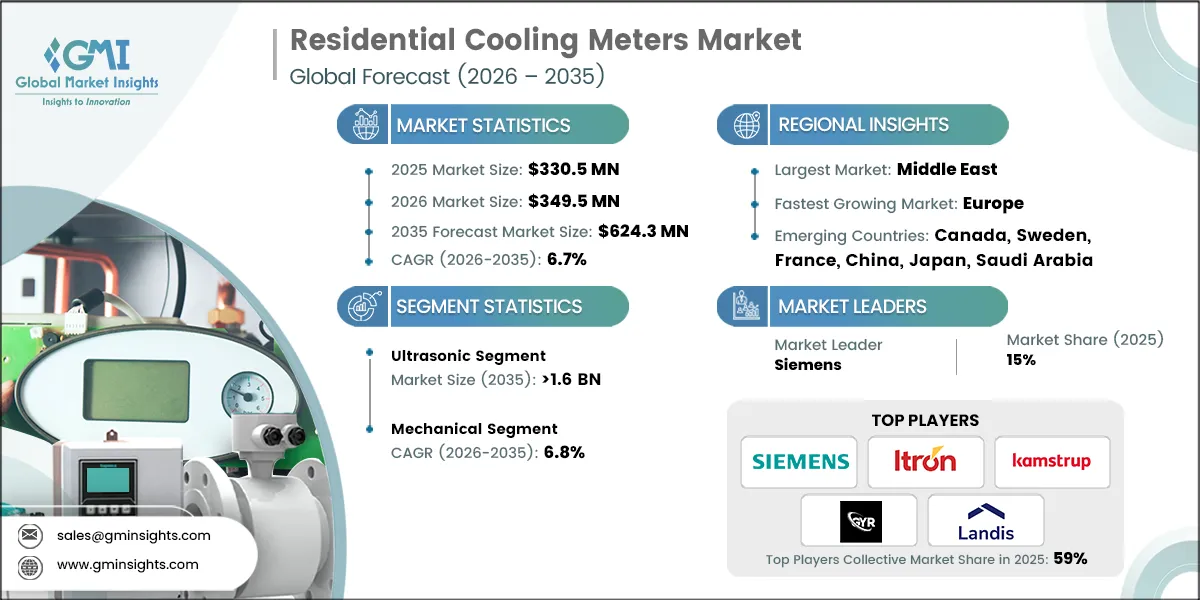
Residential Cooling Meters Market Key Takeaways
Market Size & Growth
- 2025 Market Size: USD 330.5 Million
- 2026 Market Size: USD 349.5 Million
- 2035 Forecast Market Size: USD 624.3 Million
- CAGR (2026–2035): 6.7%
Regional Dominance
- Largest Market: Middle East
- Fastest Growing Region: Europe
Key Market Drivers
- Favorable government efforts to adopt zero emission buildings.
- Surging requirement for cooling solutions across hot climate regions.
Challenges
- Technical limitations during extreme weather conditions.
Opportunity
- Smart Home and IoT Integration.
- Energy efficiency and green building initiatives.
Key Players
- Market Leader: Siemens led with over 15% market share in 2025.
- Leading Players: Top 5 players in this market include Siemens, Landis, Gyr, Kamstrup, Itron, which collectively held a market share of 59% in 2025.
Get Market Insights & Growth Opportunities
To get key market trends
Residential Cooling Meters Market Trends
- Smart meters offer features such as remote monitoring, real-time data collection, and integration with home systems, making them ideal for modern buildings, stimulating the business landscape. Increasing adoption in regions with district cooling systems along with ongoing smart city projects will augment the product demand.
- Ongoing implementation of strict energy efficiency regulations, especially in regions including Europe, Asia-Pacific, and North America is set to stimulate the market growth. They further ensure efficient usage and billing, driving the adoption of advanced cooling meters.
Residential Cooling Meters Market Analysis
Learn more about the key segments shaping this market
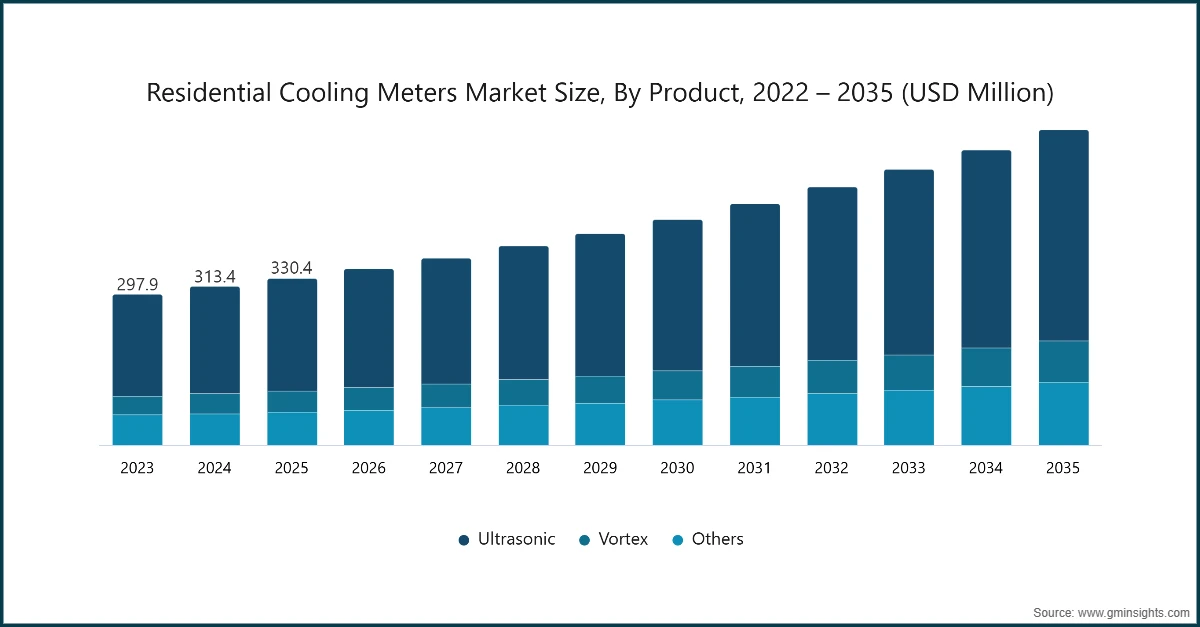
Based on product, residential cooling meters market is segmented into ultrasonic, vortex and others.
- Ultrasonic is set to grow more than USD 1.6 Billion by 2035 on account of their ability to deliver precise and accurate readings of cooling energy consumption. Many countries are pushing for more accurate metering systems contributing to better energy management, helping the residents to optimize their cooling usage and reduce overall consumption, contributing to the business momentum.
- Advanced features like remote reading eliminates the need for manual data collection which is beneficial in multi-residential buildings to efficiently gather data from individual units. Introduction of government incentives for homeowners to adopt smart energy solutions will accelerate the product demand. New building developments along with energy-efficient housing projects will benefit from the advancement and stimulate the market growth.
Learn more about the key segments shaping this market
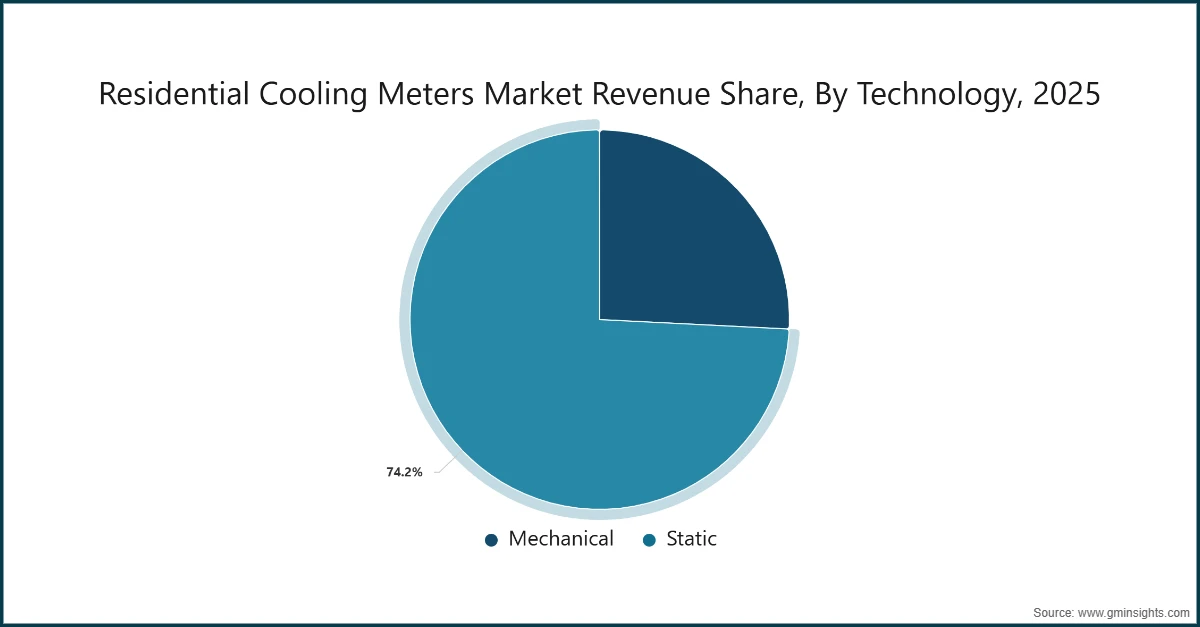
Based on technology, the residential cooling meters market is segmented into mechanical and static.
- Mechanical is set to grow at a CAGR of over 6.8% by 2035 owing to increasing regulatory requirements, along with growing requirements from residential consumers and increasing affordability in comparison to smart and ultrasonic meters. Shifting focus of low- to mid-income group toward efficient devices owing to low upfront costs is set to augment the market growth.
- Key factors comprising of lower maintenance costs make them suitable for home use primarily in regions with limited access to advanced technology. These meters are common in old buildings, where they were installed before the emergence of smart metering technologies. In addition, increasing cost of retrofitting new meters will lead to continued use of mechanical meters, thereby swaying the business statistics.
Looking for region specific data?
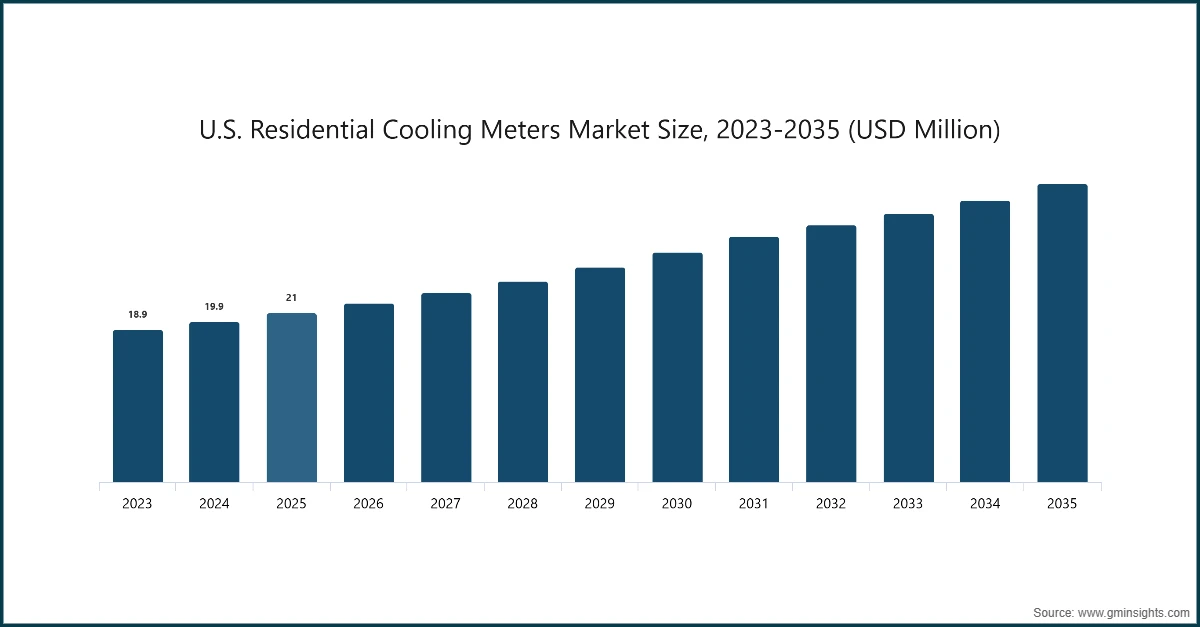
The U.S. residential cooling meters market will grow at a CAGR of over 5.5% by 2035 due to increasing prioritization for lower energy costs and sustainability.
- Rising requirement for electronic cooling meters equipped with remote reading and data logging along with growing integration with smart thermostat systems is set to augment the market statistics. They further provide control through apps or smart home platforms, allowing better cooling performance and energy optimization, thereby stimulating the product demand. In addition, increasing utilization across condominiums and housing complexes with shared cooling systems will sway the industry trends.
Middle East Residential cooling meters market is anticipated to grow over USD 395 Million by 2035 on account of rising demand for energy efficiency, growing government regulations, and increased urbanization.
- GCC countries like the UAE, Saudi Arabia, and Qatar, are promoting the use of energy-efficient technologies to reduce the energy consumption. The cooling meters are being adopted to help manage and optimize the energy usage. Growing adoption in multi-apartment buildings to accurately measure individual usage coupled with rapid urbanization in cities like Dubai, Riyadh, and Doha, due to adoption of smart city frameworks will drive the market scenario.
Residential Cooling Meters Market Share
- The competitive landscape in the residential cooling meters market is shaped by several key players, each vying for a share of the growing demand for efficient energy and cooling management systems in homes. Increasing focus by key players to expand their product portfolios while new entrants rely on cost-effectiveness and technological advancements to gain the market share.
- Companies like BMETERS, Axioma Metering, and Kamstrup have a strong foothold in the European market, where stringent energy regulations and growing environmental awareness are driving the adoption of cooling meters. In addition, companies like Secure Meters and Landis+Gyr focus on providing advanced functionalities, thereby augmenting the market growth. Competitive pricing amongst the players particularly in emerging markets like Asia Pacific region will contribute to the market landscape.
Residential Cooling Meters Market Companies
Eminent players operating in the residential cooling meters industry are:
- ABB
- Aclara Technologies
- Axioma Metering
- Apator SA
- Badger Meter
- BMETERS
- Danfoss
- Diehl Stiftung & Co. KG
- Elster Group
- Honeywell International
- Itron
- ista Energy Solutions Limited
- Kamstrup
- Landis+Gyr
- Metrix Polska
- RB Flowmeter
- Sensus
- Schneider Electric
- Secure Meters Ltd.
- Siemens
- Sontex
- ZENNER International GmbH & Co. KG
Residential Cooling Meters Market Report Attributes
| Key Takeaway | Details |
|---|---|
| Market Size & Growth | |
| Base Year | 2025 |
| Market Size in 2025 | USD 330.5 Million |
| Market Size in 2026 | USD 349.5 Million |
| Forecast Period 2026-2035 CAGR | 6.7% |
| Market Size in 2035 | USD 624.3 Million |
| Key Market Trends | |
| Drivers | Impact |
| Favorable government efforts to adopt zero emission buildings | Introduction of regulations, incentives, and programs to encourage the development of zero-emission and energy-efficient products will complement the business landscape. These policies support the use of cooling meters making it easier for establishments to comply with new standards and contribute to industry momentum. |
| Surging requirement for cooling solutions across hot climate regions | Hot climates and rising temperatures are increasing the demand for reliable cooling solutions in residential, commercial, and industrial buildings. Cooling meters play a crucial role by monitoring energy use, optimizing system performance, and helping to manage costs, which boosts adoption in these regions. |
| Pitfalls & Challenges | Impact |
| Technical limitations during extreme weather conditions | Very high or very low temperatures, humidity, or storms may cause devices to give inaccurate readings or even temporarily fail. This technical limitation can disrupt energy monitoring, reduce the reliability of data, and increase maintenance needs, which may slow down adoption, especially in regions with harsh climates. |
| Opportunities: | Impact |
| Smart Home and IoT Integration | There’s a growing opportunity to integrate residential cooling meters with smart home systems and Internet of Things (IoT) platforms. Connected meters that send real‑time usage data to mobile apps or home automation hubs help homeowners monitor and control cooling energy consumption more effectively. This integration appeals to energy‑conscious consumers and supports demand‑response programs, creating new value beyond simple measurement. |
| Energy efficiency and green building initiatives | As governments, utilities, and building codes increasingly emphasize energy efficiency and sustainability, residential cooling meters can play a key role in tracking and optimizing cooling energy usage. Incentives, rebates, and efficiency standards encourage homeowners and developers to install advanced metering technologies to reduce energy waste, lower utility bills, and meet green certification criteria. |
| Market Leaders (2025) | |
| Market Leader |
15% market share |
| Top Players |
Collective market share in 2025 is 59% |
| Competitive Edge |
|
| Regional Insights | |
| Largest Market | Middle East |
| Fastest growing market | Europe |
| Emerging countries | Canada, Sweden, France, China, Japan, Saudi Arabia |
| Future outlook |
|
What are the growth opportunities in this market?
Residential Cooling Meters Industry News:
- In January 2023, Itron Inc., partnered with Qatar Cool to deliver 25,000 units of its thermal energy meters and expand its operations across the country. Under the partnership, Qatar Cool also upgraded the data collection and Meter Data Management solutions from Itron. This initiative will enable the company to provide energy-efficient cooling systems and establish a strong position in the industry.
Residential cooling meters market research report includes an in-depth coverage of the industry with estimates & forecast in terms of volume and revenue in “(USD Million & ‘000 Units)” from 2022 to 2035, for the following segments:
Market, By Product
Ultrasonic
Vortex
- Others
Market, By Technology
Mechanical
Static
The above information has been provided for the following regions and countries:
- North America
- U.S.
- Canada
- Europe
- Germany
- Poland
- Sweden
- Italy
- France
- Finland
- Austria
- Norway
- Asia Pacific
- China
- Japan
- South Korea
- Singapore
- India
- Middle East
- Saudi Arabia
- UAE
- Qatar
- Oman
- Kuwait
Frequently Asked Question(FAQ) :
What was the market size of the residential cooling meters market in 2025?
The residential cooling meters market was valued at USD 330.5 million in 2025, with a CAGR of 6.7% expected through 2035, driven by increasing demand for accurate cooling meters and integration with IoT platforms in smart homes.
What is the projected value of the residential cooling meters market by 2035?
The market is expected to reach over USD 1.6 billion by 2035, supported by the adoption of ultrasonic meters, regulatory requirements, and the growing focus on energy optimization.
What is the projected size of the residential cooling meters market in 2026?
The market is expected to grow to USD 349.5 million in 2026.
What is driving the growth of ultrasonic cooling meters?
Ultrasonic cooling meters are expected to witness strong growth due to their ability to provide precise and accurate readings of cooling energy consumption, supporting improved energy management and reduced consumption.
What is the growth outlook for mechanical cooling meters?
Mechanical cooling meters are projected to grow at a CAGR of over 6.8% through 2035, driven by affordability, regulatory mandates, and demand from residential consumers.
Which region is expected to witness significant growth in the residential cooling meters industry?
The U.S. market is projected to grow at a CAGR of over 5.5% through 2035, fueled by increasing focus on reducing energy costs and enhancing sustainability.
Who are the key players in the residential cooling meters market?
Major companies include ABB, Aclara Technologies, Axioma Metering, Apator SA, Badger Meter, BMETERS, Danfoss, Diehl Stiftung & Co. KG, Elster Group, Honeywell International, and Itron.
Residential Cooling Meters Market Scope
Related Reports