Summary
Table of Content

Residential Boiler Market
Get a free sample of this report
Form submitted successfully!
Error submitting form. Please try again.
Thank you!
Your inquiry has been received. Our team will reach out to you with the required details via email. To ensure that you don't miss their response, kindly remember to check your spam folder as well!
Request Sectional Data
Thank you!
Your inquiry has been received. Our team will reach out to you with the required details via email. To ensure that you don't miss their response, kindly remember to check your spam folder as well!
Form submitted successfully!
Error submitting form. Please try again.
Residential Boiler Market Size
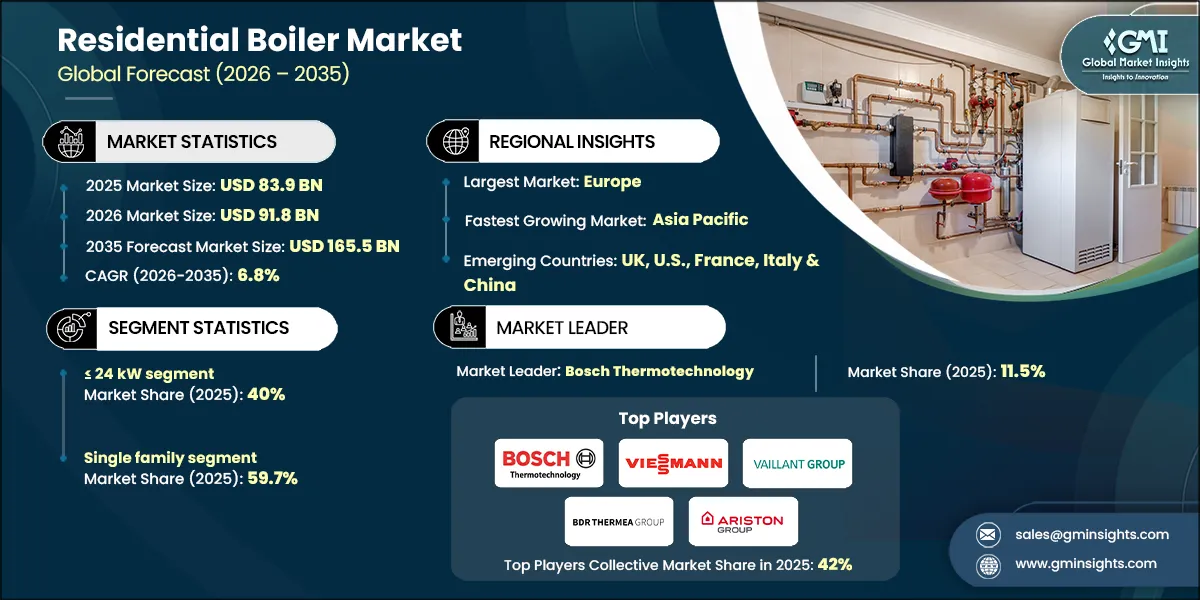
According to a recent study by Global Market Insights Inc., the residential boiler market was estimated at USD 83.9 billion in 2025. The market is expected to grow from USD 91.8 billion in 2026 to USD 165.5 billion by 2035, at a CAGR of 6.8%.
To get key market trends
- Severe weather patterns along with increasing adoption of smart home automation will positively sway the business outlook. Rising demand for efficient space heating, extended cold seasons, and ongoing upgrades to existing infrastructure will strengthen the residential boiler market scenario.
- Residential boilers are home heating systems that provide hot water and central heating for living spaces. They efficiently transfer heat throughout the household, ensuring consistent indoor comfort. Designed for safety, reliability, and energy efficiency, these units play a vital role in maintaining a comfortable and healthy living environment.
- These systems maintain consistent indoor temperatures and ensure adequate water supply. Their efficiency, durability, and ease of use are major factors influencing adoption. Advanced models incorporate automated temperature control and safety mechanisms to optimize energy use and protect users.
- For illustration, U.S. Boiler Company expanded its Milwaukee facility in July 2024 to scale up production of electric and hybrid boilers in response to rising demand for electrified heating systems. In February 2024, the company also announced a new 45,000-square-foot plant in Lancaster, Pennsylvania, backed by nearly USD 3 million in state support.
- The residential boiler market was valued at USD 61.5 billion in 2022 and grew at a CAGR of approximately 3.5% through 2025. Growing emphasis on energy-efficient heating systems, combined with increasingly stringent environmental regulations, will significantly accelerate the adoption of these technologies.
- Rising consumer demand for energy-efficient and reliable heating solutions is a major driver. Homeowners seek boilers that reduce energy consumption and operational costs while providing comfort. Environmental awareness further encourages the use of low-emission, high-efficiency systems that minimize household carbon footprints and comply with sustainability standards.
- These units feature smart thermostats, IoT connectivity, and automated diagnostics. Advanced technology, improved heat exchangers, and hybrid solutions enhance energy efficiency. These advancements provide convenience, reduce energy waste, and extend the lifespan of boilers, making them increasingly attractive for residential installations.
- For instance, in January 2025, the U.S. Department of Energy retracted its proposed 95% AFUE minimum efficiency mandate for residential boilers. This reversal created uncertainty regarding future policy direction, yet it allowed non-condensing boilers to remain viable in select residential applications, where cost considerations limit the use of higher-efficiency units.
Residential Boiler Market Report Attributes
| Key Takeaway | Details |
|---|---|
| Market Size & Growth | |
| Base Year | 2025 |
| Market Size in 2025 | USD 83.9 Billion |
| Market Size in 2026 | USD 91.8 Billion |
| Forecast Period 2026 - 2035 CAGR | 6.8% |
| Market Size in 2035 | USD 165.5 Billion |
| Key Market Trends | |
| Drivers | Impact |
| Stringent government regulations to limit carbon emissions | Tight emission norms accelerate adoption of high-efficiency, low-emission residential boilers, compelling homeowners to replace outdated systems with cleaner technologies. |
| Paradigm shift toward decarbonization | Growing focus on net-zero goals boosts demand for renewable-ready, hybrid, and hydrogen-compatible boilers to reduce household carbon footprints. |
| Ongoing technological advancements along with favorable government regulations | Innovations in condensing, smart-control, and low-NOx systems paired with supportive incentives encourage faster deployment of advanced residential boilers. |
| Pitfalls & Challenges | Impact |
| High availability of other alternatives | Widespread adoption of heat pumps, district heating, and electric systems reduces reliance on traditional residential boilers, restraining industry expansion. |
| Opportunities: | Impact |
| Growing adoption of hybrid heating systems | Rising preference for hybrid heat pump–boiler combinations enhance efficiency and creates opportunities for advanced, integrated boiler solutions in homes. |
| Increasing penetration of smart home technologies | Expanding smart thermostats and home automation ecosystems boost demand for connected boilers offering remote monitoring, predictive maintenance, and energy optimization. |
| Expansion of hydrogen-ready boiler development | Shift toward cleaner fuels accelerates demand for hydrogen-ready boilers, enabling manufacturers to tap future decarbonized heating markets. |
| Government incentives for energy-efficient retrofits | Subsidies, tax credits, and renovation programs encourage homeowners to upgrade to high-efficiency boilers, driving significant replacement and modernization opportunities. |
| Market Leaders (2025) | |
| Market Leaders |
11.5% market share |
| Top Players |
|
| Competitive Edge |
|
| Regional Insights | |
| Largest Market | Europe |
| Fastest Growing Market | Asia Pacific |
| Emerging Country | UK, U.S., France, Italy & China |
| Future outlook |
|
What are the growth opportunities in this market?
Residential Boiler Market Trends
- Increasing consumer inclination toward efficiency, reliability, cost, and ease of maintenance will fuel the product penetration. Safety features, noise levels, and integration with home automation systems also affect decisions. As living standards rise, the focus shifts to systems that combine performance, comfort, and environmental sustainability, shaping product development priorities.
- Climate, energy infrastructure, and housing density influence boiler adoption. Cold regions see higher demand for heating systems, while moderate climates prioritize energy-efficient or supplementary hot water solutions. Urban areas benefit from compact, wall-mounted models, whereas rural areas often use fuel-based boilers, reflecting variations in energy access and local heating requirements.
- For instance, in June 2025, Carrier released updated AHRI ratings for its infinity variable-speed cold climate heating solution with green speed Intelligence after completing the DOE Cold Climate Challenge. The unit now carries ratings of 21.2 SEER2, 13.5 EER2, and up to 10.5 HSPF2, positioning it as the highest-rated DOE cold-climate system currently available.
- The escalating global energy demand and the widespread adoption of heat-generating technologies are expected to boost conventional boiler systems, fueling growth in the boiler industry. Additionally, the rising preference for energy-efficient heating solutions, coupled with commitments to reducing carbon emissions, will further strengthen residential boiler market expansion.
- For citation, in 2025, the Canadian government committed over USD 240 million to support affordable housing development in Manitoba. The funding aims to build, refurbish, and upgrade more than 3,800 homes across 105 projects, ultimately improving living conditions for families throughout the province.
- Furthermore, increasing government incentives and subsidy programs will augment the business landscape. The rising adoption of smart grid-compatible heating systems, combined with a focus on compact, space-saving boiler designs for apartments, is set to boost demand for these heating systems.
- For illustration, in 2025, the Green Climate Fund (GCF) invested USD 686.8 million, leveraging a total of USD 1.5 billion with partner contributions and reinforcing its commitment to climate action. The financing will support 11 projects across 42 countries, benefiting 115.5 million people and reducing 45.3 million metric tons of CO2 emissions.
Residential Boiler Market Analysis
Learn more about the key segments shaping this market
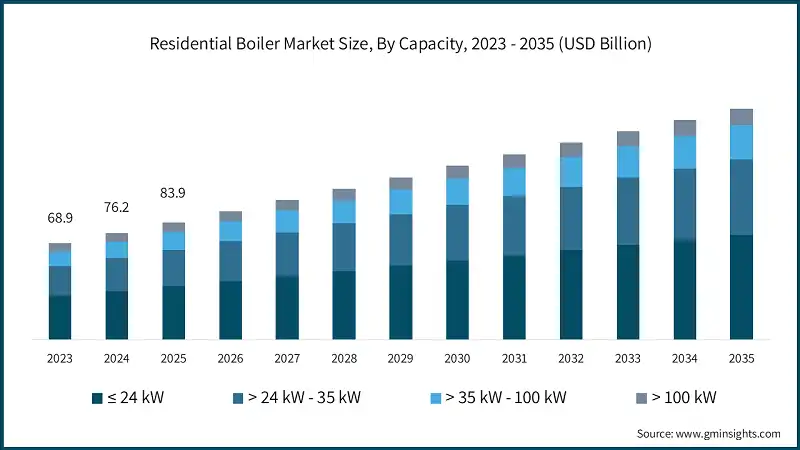
- Based on capacity, the industry is segmented into ≤ 24 kW, > 24 kW - 35 kW,> 35 kW - 100 kW and > 100 kW. The ≤ 24 kW residential boiler market holds a share of about 40% in 2025 and is projected to grow at a growth rate of over 6.5% through 2035.
- The industry for these systems is growing owing to the need for efficient, space-saving heating in small homes and apartments. Factors such as urbanization, cost-effective installation, and energy-efficiency regulations are boosting adoption. This segment remains popular for its compact design, reliable performance, and affordability in residential heating solutions.
- For instance, in 2024, Germany launched a comprehensive biomass package to strengthen biogas’s contribution to its future energy system. The reform aims to streamline spending and improve efficiency. During the first half of the year, biomass accounted for 9% of Germany’s electricity, supporting the country’s renewable transition, with renewables totalling around 58% of consumption.
- The > 24 kW - 35 kW segment is set to exceed USD 50 billion by 2035. These mid-range systems are chosen for medium to larger homes and apartments needing stronger heating and higher hot-water capacity. Their balanced output, energy-efficient condensing designs, and compliance with modern home-insulation standards driving the product adoption.
- The > 35 kW - 100 kW segment was valued at USD 12.9 billion in 2025. Energy-efficient, condensing, and modular designs enhance performance and reliability. Adoption is driven by stricter efficiency standards, growing residential construction, and the need for consistent, large-scale heating solutions.
- The > 100 kW residential boiler market serves large multi-unit buildings, high-rise apartments, and complexes requiring centralized heating and hot-water supply. High-capacity, energy-efficient, and modular designs ensure reliable performance. Adoption is driven by urbanization, growing multi-family housing, and strict efficiency standards, making these boilers suitable for heating needs.
- For illustration, London’s 101 George Street, housing 546 apartments, utilizes six high-capacity Viessmann boilers alongside CHP units to meet heating and hot-water demands. Similarly, Scotland’s Linen Quarter and several European high-rise residential buildings employ centralized heat-pump or boiler systems. These cases highlight the importance of reliable, energy-efficient, and large-capacity heating solutions for multi-unit residential complexes.
Learn more about the key segments shaping this market
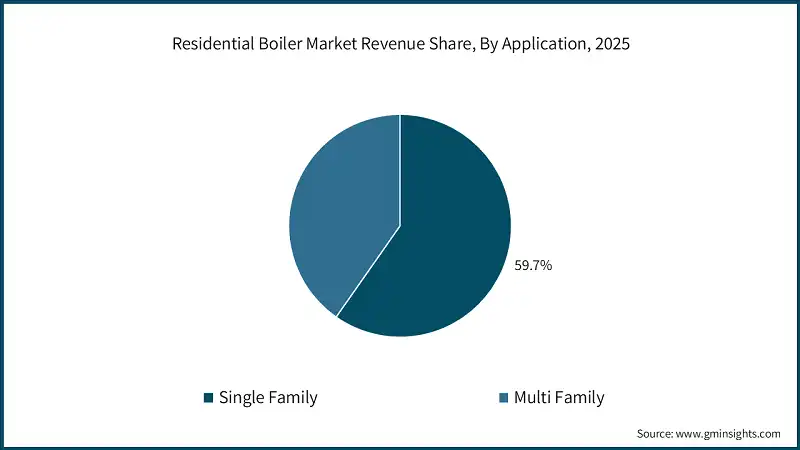
- Based on application, the residential boiler market is divided into single family and multi family. The single family segment holds a share of 59.7% in 2025 and is set to reach over USD 95 billion by 2035.
- The market is growing as homeowners seeks for efficient, dependable heating and hot-water solutions. Compact, easy-to-install designs and energy-efficient performance further support the product adoption. Rising urban development and environmental awareness are key drivers, while innovations in smart controls and low-emission technology are shaping future preferences.
- Multi family application was estimated at USD 33.8 billion in 2025. The industry is expanding as apartment complexes and condominiums demand centralized & high-capacity heating solutions. Energy-efficient, modular, and reliable designs ensure consistent hot-water supply for multiple units.
- Based on fuel, the residential boiler market is bifurcated into natural gas, oil, electric and others. The electric fired residential boiler will witness a CAGR of 10% by 2035. These boilers offer compact designs, quiet operation, and precise temperature control. Growth is driven by stricter emission regulations, increasing electricity penetration, and the push low-maintenance heating systems in modern homes.
- The natural gas residential boiler market is growing steadily, driven by demand for efficient, reliable, and cost-effective home heating. These boilers offer high energy efficiency and consistent performance. Expansion is supported by established gas infrastructure, favorable fuel costs, and increasing focus on low-emission solutions for environmentally conscious households.
- The oil-fired residential boiler industry is growing in regions lacking natural gas infrastructure. These boilers deliver high-capacity, reliable heating and hot water. Adoption is driven by improved fuel efficiency, stricter emission standards, and demand off-grid areas, making it a practical solution for dependable home heating.
Looking for region specific data?
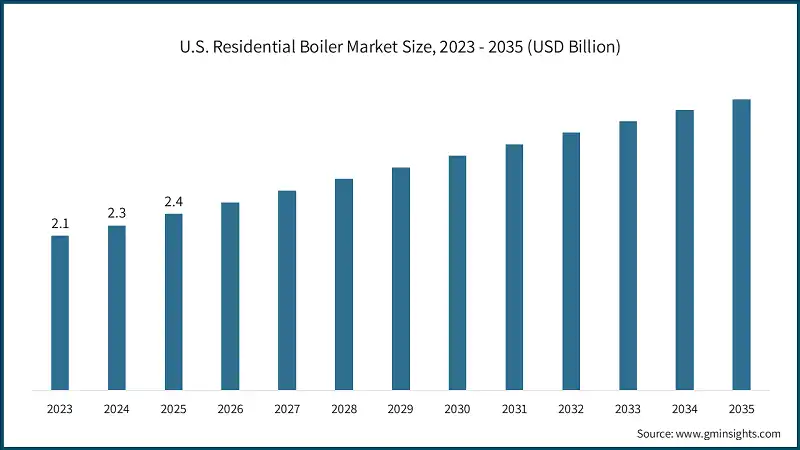
- The U.S. dominated the residential boiler market in North America with around 80% share in 2025 and generated USD 2.4 billion in revenue. Stringent government regulations aimed at reducing carbon emissions are set to drive industry growth. Rising disposable incomes, higher living standards, and a growing consumer preference for advanced, energy-efficient boiler systems will further reinforce the industry momentum.
- The North America residential boiler market is projected to hit USD 4.5 billion by 2035. The increasing adoption of sustainable and green technologies, along with rising demand for zoned heating solutions in modern homes, will drive greater product penetration. These boilers are essential for home heating, providing efficient, reliable warmth even in extreme weather conditions, thereby enhancing comfort and energy efficiency for homeowners.
- For citation, in 2024, the Canadian government strengthened its investment framework as part of its commitment to achieve net-zero emissions by 2050. The initiative introduces stricter measures to guide and assess investments using science-based criteria. By aligning financial activities with internationally recognized climate goals, the framework aims to direct capital toward projects that support long-term decarbonization and environmental sustainability.
- The Europe residential boiler market is expanding as homeowners and developers seek energy-efficient, low-emission heating solutions. Strict EU regulations, incentives for renewable integration, and replacement of aging boiler systems will drive the product adoption. These boilers meet stringent energy & emission standards providing reliable and consistent heating solutions.
- The Asia Pacific residential boiler market accounted for about 30% of the share in 2025. Ongoing urban development and investment in modernizing infrastructure, combined with the integration of advanced smart technologies into existing heating systems, will strengthen the industry landscape.
- For instance, in 2024, the Japanese government implemented new energy policies to expand zero-carbon electricity generation, supporting its 2050 Net-Zero Greenhouse Gas Emissions goal. Committed to achieving its 2030 targets alongside Ukraine, the government is prioritizing eleven key industries, emphasizing substantial investments in renewables and the gradual phase-out of fossil fuels.
- The Middle East & Africa residential boiler market is set to grow at a CAGR of over 6% by 2035. Growing awareness of energy conservation, coupled with rising utility costs, is encouraging homeowners to invest in modern, fuel-efficient heating solutions that provide long-term savings. Continued innovations, such as smart controls and hybrid heating systems, are set to further influence product development and enhance the industry outlook.
- For illustration, in 2025, Saudi Arabia took a significant step in its real estate sector by permitting foreign investment in publicly listed companies owning properties in Mecca and Medina. This aligns with Vision 2030, aiming to attract foreign capital, stimulate market activity, and drive large-scale development projects in these two key sacred cities.
- The growing emphasis on electrification, supported by targeted incentives and subsidies, is expected to promote the integration of boilers across Latin America. Advancements in R&D, along with developments compatible boiler technologies, are facilitating the transition to low-carbon heating and are poised to strengthen the industry’s future growth prospects.
Residential Boiler Market Share
- The top 5 players in residential boiler industry are Bosch Thermotechnology, Viessmann, Vaillant Group, BDR Thermea Group and Ariston Holding contribute around 42% of the market share in 2025.
- The industry is dominated by players that compete through broad product portfolios, technological innovation, and strong distribution networks. Companies emphasize condensing and hybrid systems, digital controls, and low-carbon solutions to differentiate offerings. The competition is driven by efficiency standards, brand reliability, after-sales service strength, and continual upgrades to hydrogen-ready and renewable-compatible technologies.
- Bosch Thermotechnology offers an extensive residential boiler portfolio, including high-efficiency wall-hung and floor-standing condensing boilers, combi systems, heat pumps, and hybrid heating solutions. Its products emphasize smart connectivity, low emissions, and reliable performance, supported by the Bosch and Buderus brands to meet diverse household heating and hot water needs.
- Viessmann provides a wide range of residential heating solutions featuring condensing gas boilers, combi boilers, oil boilers, hybrid systems, and renewable-ready units. Its portfolio focuses on high energy efficiency, low-NOx emissions, advanced digital controls, and integration with solar thermal and heat pumps, offering sustainable, future-proof home heating technologies.
- Vaillant Group delivers comprehensive boiler offerings, including compact wall-hung condensing boilers, floor-standing models, combi boilers, and system boilers. The company complements these with heat pumps, solar-thermal units, and smart controls. Its portfolio emphasizes energy savings, low emissions, and reliable comfort solutions suitable for varying household sizes and heating demands.
- BDR Thermea Group offers diverse residential boilers such as condensing, combi, and system models. The portfolio integrates hydrogen-ready designs, digital controls, and hybrid heat-pump systems. Products focus on efficiency, durability, and adaptability to regional heating standards across global markets.
- Ariston Holding provides residential heating solutions spanning condensing gas boilers, combi boilers, system boilers, and electric or gas water heaters. Its lineup includes systems emphasizing compact design, advanced controls, and energy efficiency. Products are tailored for reliable comfort, sustainability, and compatibility with modern home heating requirements.
Residential Boiler Market Companies
- Rinnai America Corporation reported net sales of USD 1.4 billion up to quarter 2025. The growth was driven by strong demand for tankless and condensing water heaters, improved manufacturing efficiency, and expanded local production capabilities. Strategic investments in product innovation and market expansion further supported the company’s revenue growth and strengthened its competitive position in the market.
- Carrier posted net sales of USD 22.5 billion in 2024, marking an 18.6% increase from USD 18.9 billion in 2023. The growth was largely driven by the robust performance of its HVAC segment, supported by improving market conditions. Strong customer demand, coupled with operational efficiency and strategic investments, contributed to the company’s year-over-year revenue expansion.
- BDR Thermea Group reported full year 2024 revenue of USD 2.3 billion, supported by strong demand for heating systems, with sales more than doubling. Adjusted for market challenges, including a slowdown in construction and regulatory uncertainties, the company strengthened its service and digital support, implemented cost efficiencies, and maintained robust growth across its heating, ventilation, and hot-water solutions.
Major players operating in the residential boiler market are:
- ACV International
- Ariston Holding
- A.O. Smith
- BDR Thermea Group
- Bradford White Corporation
- Bosch Thermotechnology Corp.
- Carrier
- Ferroli
- Hoval
- Laars Boilers
- Lennox International
- Lochinvar
- Navien
- NTI Boilers
- Noritz America Corp.
- PB Heat
- Rinnai America Corporation
- Smith Boilers
- Thermona
- U.S. Boiler Company
- Viessmann
- Vaillant Group
- WM Technologies
- Wolf
Residential Boiler Industry News
- In October 2025, Ariston has acquired a dedicated water heating production plant in India to boost local manufacturing capabilities, enhance cost competitiveness, and improve supply-chain flexibility. This strategic move supports the company’s broader Asia Pacific expansion plans, enabling it to tap into long-term growth opportunities and meet rising demand in rapidly growing water heating market, strengthening its regional presence.
- In May 2025, BDR Thermea sold its China operations, including manufacturing facilities, sales networks, and technologies for brands Baxi, De Dietrich, Chappée, and Brötje, to Midea. Under an exclusive licensing agreement, these brand names will continue in China under Midea. Post-transaction, BDR Thermea maintains a reduced presence in China focused on global strategic sourcing, while Midea supplies boiler products and services for markets outside China.
- In February 2025, Viessmann launched the compact Vitodens 025-W wall-mounted gas condensing combi boiler in Telford, UK. Available in 24 kW and 28 kW outputs, it features an ERP efficiency of 92% (Class A) and seasonal efficiency up to 98%. With a small footprint (300 × 400 × 700 mm), low noise, pre-commissioned units for quick installation, and warranties of 2 years standard or 5 years via the installer portal plus a 10-year heat exchanger warranty, it is designed for new builds, modernizations, and housing specification projects.
- In January 2025, Laars Boilers completed acquisition of Electro Industries of Monticello, Minnesota. Electro Industries manufactures controls, electric duct heaters, air-to-water heat pump technology, and electric boilers. The acquisition expands Bradford White's U.S. manufacturing footprint and broadens its residential, commercial, and industrial space-heating portfolio to address electrification policies and state & local regulations and Electro Industries will become a Laars subsidiary.
The residential boiler market research report includes in-depth coverage of the industry with estimates & forecast in terms of revenue (USD Million) & volume (000 Units) from 2022 to 2035, for the following segments:
Market, By Fuel
- Natural gas
- Oil
- Electric
- Others
Market, By Technology
- Condensing
- Natural gas
- Oil
- Electric
- Others
- Non-condensing
- Natural gas
- Oil
- Electric
- Others
Market, By Application
- Single family
- Multi family
Market, By Installation
- Wall-mounted
- Floor-standing
Market, By Capacity
- ≤ 24 kW
- > 24 kW - 35 kW
- > 35 kW - 100 kW
- > 100 kW
The above information has been provided for the following regions and countries:
- North America
- U.S.
- Canada
- Europe
- Denmark
- Finland
- Norway
- Sweden
- UK
- Russia
- Romania
- Poland
- Austria
- Belgium
- France
- Germany
- Netherlands
- Switzerland
- Greece
- Italy
- Portugal
- Spain
- Asia Pacific
- China
- Japan
- South Korea
- Australia
- Middle East & Africa
- Saudi Arabia
- UAE
- Qatar
- South Africa
- Latin America
- Brazil
- Argentina
- Mexico
Frequently Asked Question(FAQ) :
Which region leads the residential boiler market?
The U.S. residential boiler market held 80% share with USD 2.4 billion in 2025, fueled by strict carbon-reduction regulations.
Who are the key players in the residential boiler market?
Key players include Bosch Thermotechnology, Viessmann, Vaillant Group, BDR Thermea Group, Ariston Holding, ACV International, A.O. Smith, Bradford White Corporation, Carrier, Ferroli, Hoval, Laars Boilers, Lennox International, Lochinvar, Navien, NTI Boilers, Noritz America Corp., PB Heat, Rinnai America Corporation, Smith Boilers, Thermona, U.S. Boiler Company, WM Technologies, and Wolf.
What are the upcoming trends in the residential boiler market?
Key trends include adoption of hydrogen-ready boilers, integration of smart home technologies with IoT connectivity, hybrid heating systems combining heat pumps and boilers, and automated diagnostics for predictive maintenance.
What is the growth outlook for electric-fired boilers from 2026 to 2035?
Electric-fired residential boilers are projected to grow at a 10% CAGR through 2035, due to stricter emission regulations, increasing electricity penetration, and demand for low-maintenance heating systems.
What was the valuation of single family application segment in 2025?
Single family application held 59.7% market share and is set to reach over USD 95 billion by 2035.
How much revenue did the ≤ 24 kW capacity segment hold in 2025?
The ≤ 24 kW segment held approximately 40% market share in 2025, driven by demand for compact, space-saving heating solutions in small homes and apartments.
What is the current residential boiler market size in 2026?
The market size is projected to reach USD 91.8 billion in 2026.
What is the market size of the residential boiler in 2025?
The market size was USD 83.9 billion in 2025, with a CAGR of 6.8% expected through 2035 driven by rising demand for efficient space heating, prolonged cold seasons, and modernization of existing heating infrastructure.
What is the projected value of the residential boiler market by 2035?
The residential boiler market is expected to reach USD 165.5 billion by 2035, propelled by energy-efficient heating adoption, stringent environmental regulations, and technological advancements in smart controls.
Residential Boiler Market Scope
Related Reports