Summary
Table of Content

Renewable Energy Insurance Market
Get a free sample of this report
Form submitted successfully!
Error submitting form. Please try again.
Thank you!
Your inquiry has been received. Our team will reach out to you with the required details via email. To ensure that you don't miss their response, kindly remember to check your spam folder as well!
Request Sectional Data
Thank you!
Your inquiry has been received. Our team will reach out to you with the required details via email. To ensure that you don't miss their response, kindly remember to check your spam folder as well!
Form submitted successfully!
Error submitting form. Please try again.
Renewable Energy Insurance Market Size
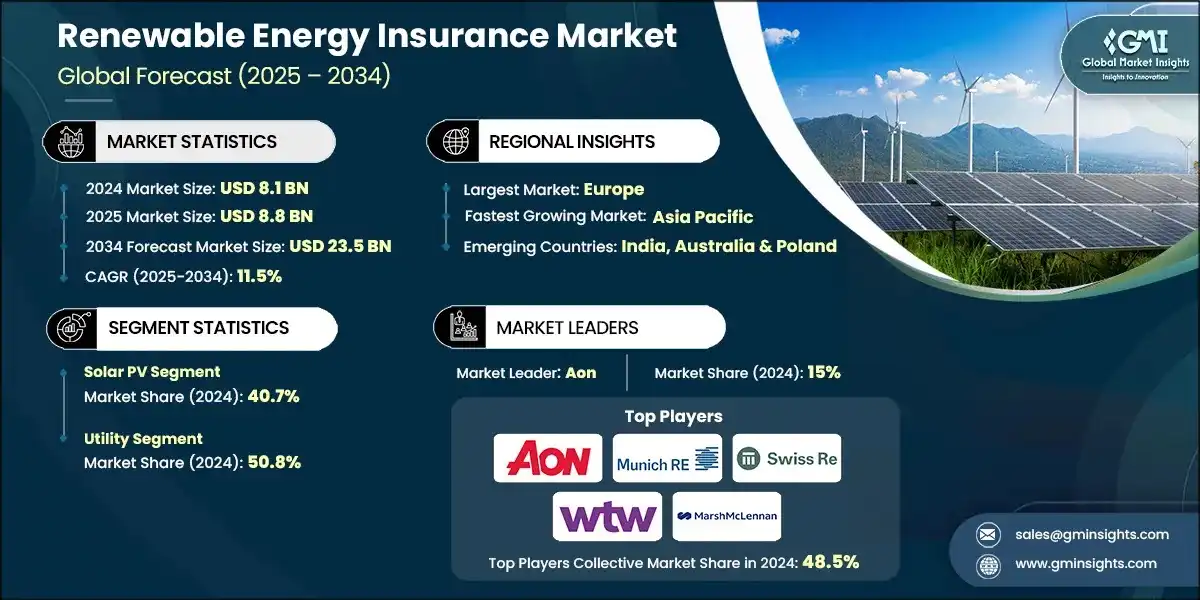
The global renewable energy insurance market was estimated at USD 8.1 billion in 2024. The market is expected to grow from USD 8.8 billion in 2025 to USD 23.5 billion in 2034, at a CAGR of 11.5% according to Global Market Insights Inc.
To get key market trends
- Increasing global investment in renewable energy is fueling the demand for insurance solutions tailored to this sector. For instance, as per IEA, in 2025, the European Union is set to boost its clean energy investments, nearing a commitment of USD 390 billion. Governments, corporations, and private investors are channeling funds into solar farms, wind parks, and battery storage systems. These high-value assets require protection against risks such as natural disasters, equipment failure, and construction delays, boosting insurance business to safeguard these investments, making projects more bankable and attractive to financiers.
- Renewable energy insurance is a specialized form of coverage designed to protect renewable energy projects such as solar, wind, hydroelectric, and bioenergy from financial losses due to operational, environmental, and technological risks. It typically includes protection against property damage, equipment failure, natural disasters, construction delays, business interruption, and liability claims. This insurance is crucial for developers, investors, and operators to ensure the financial viability and resilience of clean energy infrastructure.
- Companies are introducing new facilities and solutions to uplift the insurance adoption in the renewable sector. For instance, in July 2024, Zurich and Aon introduced a global insurance facility for clean hydrogen projects, offering coverage up to USD 250 million to support innovation and accelerate the net-zero energy transition. Additionally, growing regulatory and policy mandates are accelerating the service adoption. Governments are implementing laws that require developers to carry specific insurance coverage, such as liability, environmental, and construction-related policies, to obtain permits or qualify for incentives. These mandates ensure that projects meet safety and compliance standards, leading to bolster the business scenario.
- The renewable energy insurance market was valued at USD 6.2 billion in 2021 and grew at a CAGR of 9.5% through 2024. Rising threats from climate change are compelling energy developers to adopt robust insurance strategies. Extreme weather events, including floods, hurricanes, and wildfires, are becoming more frequent and intense, posing serious risks to renewable infrastructure. Solar panels, wind turbines, and hydroelectric systems are vulnerable to environmental damage and operational disruption, which strengthens insurance services demand by providing a safety net, covering repair costs, business interruption, and liability claims.
- Europe is among the dominant regions on account of increasing climate risks such as floods, wildfires, and windstorms, putting renewable energy infrastructure under pressure. For instance, according to the European Environment Agency, between 1980 and 2023, the EU faced over USD 851.2 billion in climate-related losses, with USD 186.8 billion in the last three years alone among the highest annual economic losses recorded. Solar farms in Southern Europe and offshore wind installations in the North Sea are facing increasing exposure to extreme weather events. These risks threaten operational continuity and financial stability, prompting developers to seek insurance coverage that protects against property damage, business interruption, and liability.
- Asia Pacific is the fastest-growing region in the renewable energy insurance market. Growing exposure to natural disasters in the region, such as typhoons, earthquakes, and monsoons, is increasing the demand for renewable energy insurance. The region’s geographic diversity makes energy assets highly vulnerable to environmental disruptions. Coastal wind farms in the Philippines and solar parks in India face seasonal risks that can halt operations and damage infrastructure, necessitating insurance service adoption that provides a buffer against these unpredictable events, ensuring continuity and recovery. Moreover, insurers are developing region-specific products, including parametric coverage and catastrophe modeling, to address these challenges.
Renewable Energy Insurance Market Report Attributes
| Key Takeaway | Details |
|---|---|
| Market Size & Growth | |
| Base Year | 2024 |
| Market Size in 2024 | USD 8.1 Billion |
| Market Size in 2025 | USD 8.8 Billion |
| Forecast Period 2025 - 2034 CAGR | 11.5% |
| Market Size in 2034 | USD 23.5 Billion |
| Key Market Trends | |
| Drivers | Impact |
| Increasing climate risks | Rising extreme weather events are damaging renewable assets, prompting insurers to offer tailored coverage for resilience and recovery across solar, wind, and hydro projects. |
| Growing investment in clean energy | Expanding global funding for renewable infrastructure boosts demand for insurance to protect high-value assets and ensure project bankability. |
| Pitfalls & Challenges | Impact |
| Limited historical data | Lack of long-term performance data for new technologies makes underwriting difficult, leading to cautious pricing and limited coverage options. |
| Rising premium costs | Escalating insurance premiums due to climate volatility can strain project budgets, discouraging smaller developers from securing comprehensive coverage. |
| Opportunities: | Impact |
| Expanding green hydrogen projects | Growing global investment in green hydrogen creates demand for specialized insurance to cover construction, operational risks, and carbon capture technologies in emerging energy markets. |
| Advancing climate risk analytics | Increasing use of AI and climate modeling enables insurers to offer precise, data-driven coverage, improving underwriting accuracy and confidence in renewable energy project viability. |
| Market Leaders (2024) | |
| Market Leaders |
15% market share |
| Top Players |
Collective market share in 2024 is 48.5% |
| Competitive Edge |
|
| Regional Insights | |
| Largest Market | Europe |
| Fastest Growing Market | Asia Pacific |
| Emerging Countries | India, Australia & Poland |
| Future outlook |
|
What are the growth opportunities in this market?
Renewable Energy Insurance Market Trends
- Growing adoption of smart technologies, including IoT sensors, drones, and AI analytics in renewable energy systems, is transforming risk management. These tools enable real-time monitoring, predictive maintenance, and data-driven insights, allowing insurers to assess risks more accurately. Enhanced visibility into asset performance reduces uncertainty and claims, making insurance more attractive and cost-effective. This digital transformation is fostering collaboration between tech providers and insurers, leading to innovative coverage models tailored to dynamic energy environments.
- Companies are adopting partnership and collaboration as key growth strategies in the renewable energy insurance business. For instance, in March 2025, Swiss Re granted a reinsurance deal to Terra Solar Philippines, safeguarding the latter's ambitious project. This project is set to deliver a robust capacity of 3,500 MW of solar power, complemented by a storage capability of 4,500 MWh, ensuring thorough protection from its inception through to completion.
- Furthermore, regulatory frameworks are also evolving to support green insurance products, encouraging insurers to develop innovative solutions. This alignment between policy and insurance is accelerating adoption, as developers seek compliance and financial protection in a rapidly expanding renewable energy insurance market.
- Rising emphasis on ESG (Environmental, Social, Governance) principles is driving demand for renewable energy insurance as part of responsible investing. Stakeholders expect transparency, resilience, and sustainability in energy projects, making insurance a key component of ESG compliance. Insurers are responding with products that support green technologies and sustainable practices. This trend is reshaping underwriting strategies and encouraging insurers to align with climate goals, leading to complement the renewable energy insurance market landscape.
- Increasing natural catastrophe losses linked to renewable energy assets are reshaping insurance strategies, with U.S. hail-related solar claims alone reaching nearly USD 300 million in 2022. Although hail events represent only 6% of total incidents, they account for over 70% of photovoltaic system losses, highlighting a disproportionate risk profile.
- Rising concerns over asymmetric perils are prompting insurers to explore parametric solutions, which activate coverage based on hailstone diameter or kinetic energy thresholds. Moreover, developers are adopting automated stow protocols to mitigate damage. This feedback loop of elevated loss ratios and specialty reinsurance costs is hardening premiums but also expanding opportunities for tailored insurance products.
- Increasing sustainable bond issuance, projected to stay near USD 1 trillion annually, is prompting banks and asset managers to seek insurance that addresses stranded asset and policy-change risks. Moreover, rising regulatory uncertainty, such as shifts in subsidies or carbon pricing, has led insurers to develop combined property-transition policies that activate during financial disruptions. These policies not only protect cash flows but also support ESG compliance, transforming insurance from a construction safeguard into a strategic enabler of sustainable investment and regulatory adaptability.
Renewable Energy Insurance Market Analysis
Learn more about the key segments shaping this market
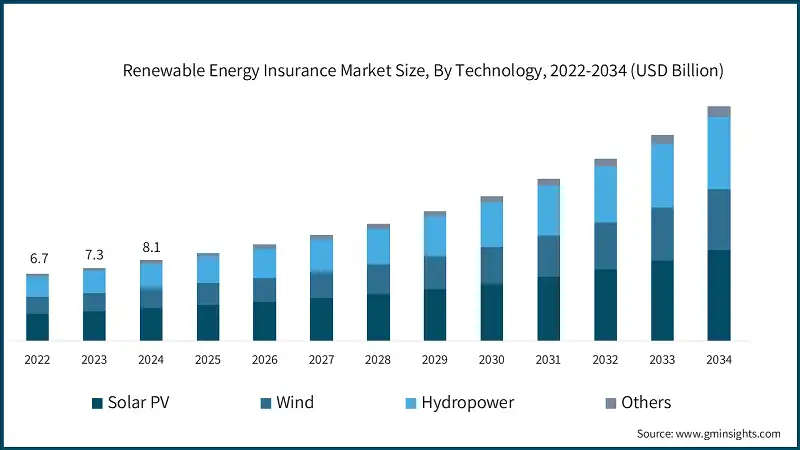
Based on the technology, the industry is segmented into solar PV, wind, hydropower and others. The solar PV technology dominated around 40.7% market share in 2024 and is expected to grow at a CAGR of 19% through 2034.
- Growing deployment of solar PV systems across diverse geographies has heightened exposure to climate-related risks such as hailstorms, wildfires, and floods. Globally, hail-related claims between 2019 and 2025 affected 1.3 million solar modules and 2.7 GW of capacity, resulting in a total gross claim amount of USD 342 million. These events can cause severe physical damage and operational disruptions, leading to significant financial losses, thereby boosting demand for insurance services.
- Wind technology market will grow at a CAGR of 11.9% by 2034. Growing deployment of large-scale wind turbines, especially offshore and in remote terrains, has led to increased exposure to mechanical failures, blade damage, and gearbox malfunctions. These components are costly to repair and can cause extended downtime, impacting energy output and revenue, leading to improved growth prospects for insurance providers who are responding with tailored coverage for equipment breakdown, business interruption, and performance guarantees.
- The hydropower technology market is expected to reach USD 7.2 billion by 2034. Growing reliance on hydropower as a stable renewable energy source has led to the development of large-scale dams and reservoirs, which are exposed to risks such as structural failure, sedimentation, and equipment breakdown. These risks can result in significant downtime, repair costs, and environmental damage, leading to necessitate demand for insurance service providers, offering tailored coverage for civil works, machinery breakdown, and business interruption to protect against such operational disruptions.
Learn more about the key segments shaping this market
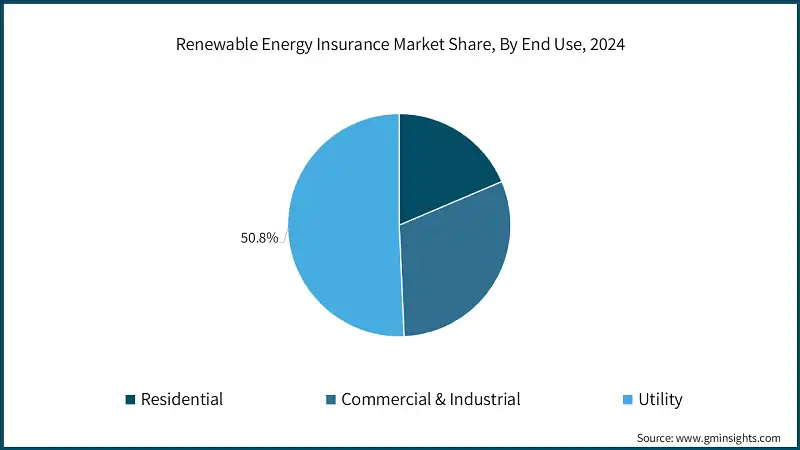
- Increasing integration of renewable energy into utility grids increases the complexity of grid operations and asset management. This includes risks related to intermittency, grid balancing, and equipment failure, creating demand for insurance solutions to cover operational disruptions, cyber risks, and liability exposures tied to distributed energy resources. Moreover, utilities are seeking coverage that ensures continuity of service and protects against financial losses from outages or system failures. This growing reliance on renewables is making insurance a vital component of utility risk management strategies.
- The commercial & industrial segment is set to grow at a CAGR of 12.2% through 2034. Rising commercial and industrial facilities, solar PV, wind turbines, and battery storage systems installations to reduce energy costs and meet sustainability goals will improve the industry prospects. These assets, often valued in the millions, are exposed to risks such as fire, theft, equipment failure, and weather damage, creating insurance services demand to protect these investments and ensure business continuity, leading to augment the business scenario.
- The residential segment is set to grow at a CAGR of 12.1% through 2034. Growing adoption of rooftop solar systems in residential areas is driving demand for insurance coverage to protect against physical damage, theft, and system failure. Increasing homeowners' investments in solar PV systems, often costing between USD 10,000 to 30,000, bolsters the need to safeguard these assets.
- Additionally, risks such as hail, fire, and grid fluctuations can lead to costly repairs and energy loss, creating the service demand. Insurance providers are offering tailored products that cover equipment, installation defects, and performance guarantees, making renewable energy insurance a key component of residential energy resilience.
Looking for region specific data?
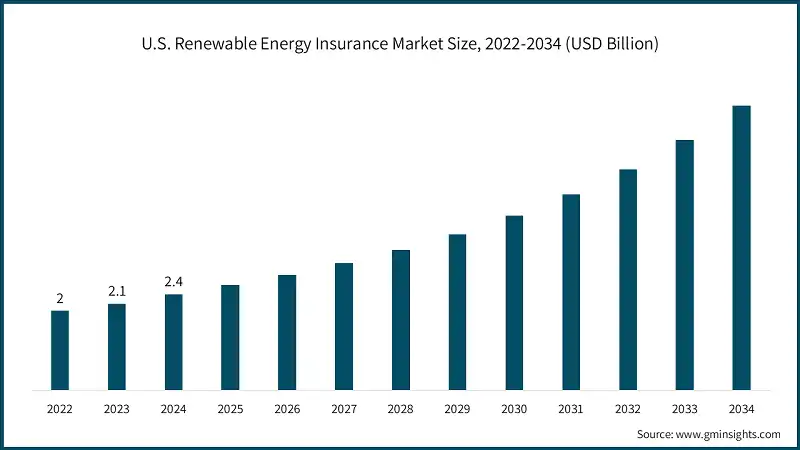
- The U.S. dominated the renewable energy insurance market in North America with around 96.1% share in 2024 and is expected to reach USD 7 billion by 2034. Rising frequency and severity of climate-related events such as hurricanes, wildfires, and hailstorms are significantly impacting renewable energy infrastructure across the U.S.
- For instance, hail-related claims in the solar sector alone exceeded USD 300 million in 2022. Wind farms and solar arrays are increasingly exposed to natural catastrophes, leading to higher loss ratios and reinsurance costs. This has prompted developers and asset owners to seek specialized insurance products that cover physical damage, business interruption, and parametric triggers.
- Moreover, growing demand for ESG-compliant infrastructure and sustainable finance is driving U.S. companies and utilities to adopt renewable energy insurance as part of their risk management strategy. With over 90% of Fortune 500 companies reporting ESG metrics, insurers are offering products that address policy-change risks, stranded assets, and carbon pricing disruptions. These policies help maintain financial stability and regulatory compliance amid evolving climate legislation, leading to strengthening the service business projections.
- The North America renewable energy insurance market size surpassed USD 2.5 billion in 2024. Growing investment in large-scale solar, wind, and energy storage projects across the region is accelerating the need for comprehensive insurance coverage. With the U.S. and Canada targeting aggressive clean energy goals such as 100% carbon-free electricity by 2035, developers are deploying multi-billion-dollar infrastructure that requires protection from construction delays, equipment failure, and performance risks. This escalates insurance products demand to cover complex risks across the full project lifecycle, including grid interconnection and revenue loss, thereby uplifting their business outlook.
- Europe renewable energy insurance market is set to reach over USD 8.4 billion by 2034. Growing investment in offshore wind farms and interconnectors across European countries is expanding the scale and complexity of renewable energy infrastructure. These projects face unique risks such as marine hazards, cross-jurisdictional regulations, and high-value equipment exposure, encouraging insurers to offer specialized marine, construction, and operational policies tailored to offshore and transnational projects.
- Asia Pacific renewable energy insurance market is anticipated to grow at a CAGR of 11.9% by 2034. Growing investment in renewable energy across emerging economies such as India, Vietnam, and Indonesia, is accelerating the need for insurance solutions tailored to local risks. These markets are rapidly expanding solar and wind capacity, often in areas with limited infrastructure and high exposure to natural hazards. Insurance is being adopted to cover construction delays, equipment damage, and grid instability. According to IRENA, Asia accounted for over 60% of global renewable energy growth in recent years, making risk mitigation through insurance essential for project bankability and investor confidence.
Renewable Energy Insurance Market Share
- The top 5 companies, including Aon, Munich Re, Swiss Re, Willis Towers Watson (WTW), and Marsh McLennan, account for around 48.5% market share. Insurers are developing highly specialized products tailored to different renewable technologies, solar, wind, hydro, and battery storage. These include parametric insurance, performance guarantees, and transition risk coverage. By customizing policies to address unique risks like hail damage in solar PV or turbine failure in offshore wind, insurers are enhancing relevance and value. This strategy helps attract developers and investors seeking precise risk mitigation, while also enabling insurers to differentiate themselves in a competitive market.
- Additionally, leading insurers are forming partnerships with renewable energy developers, asset managers, and technology providers. Collaborations with data analytics firms and IoT platforms allow insurers to integrate real-time monitoring and predictive maintenance into their offerings. These alliances improve underwriting accuracy and claims efficiency, while embedding insurance deeper into the renewable energy value chain.
- Insurers are also expanding into high-growth regions such as Southeast Asia, Latin America, and Africa, where renewable energy deployment is accelerating. By offering localized products and leveraging regional expertise, insurers can tap into underserved markets. This strategy not only supports global energy transition goals but also diversifies risk portfolios and enhances long-term growth potential.
Renewable Energy Insurance Market Companies
- Aon is a global leader in renewable energy insurance, offering tailored solutions across solar, wind, hydrogen, and battery storage. Its strategy focuses on risk transfer, climate resilience, and data-driven advisory services. Aon supports over 1,000 renewable projects globally, helping clients manage risks from supply chain disruptions to cyber threats. Through partnerships and innovation, Aon enables project bankability and ESG alignment.
- Munich Re Green Tech Solutions provides performance guarantees and risk absorption for technologies like solar PV, wind, hydrogen, and energy storage. It partners with research institutes to enhance underwriting and supports clients from prototype to commercial scale. Munich Re is known for insuring complex risks and pioneering parametric products for hail and offshore wind.
- Swiss Re launched a Centre of Competence for Renewable Energy to support clients with engineering, marine, and property insurance. It forecasts USD 237 billion in additional premiums by 2035, driven by solar, wind, and battery storage growth. Swiss Re-emphasizes treaty-based structures and operational risk coverage, helping investors de-risk emerging technologies.
- Willis Towers Watson (WTW) focuses on enabling clean energy investment through risk engineering, data analytics, and innovative insurance products. Its 2025 market review highlights softening premiums and rising demand for performance insurance and parametric solutions. WTW’s Connected Risk Intelligence platform helps clients balance risk retention and transfer for hybrid and emerging technologies.
- Marsh McLennan supports high capacity renewable energy projects globally. Its strategy includes lifecycle risk management, engineering advisory, and insurance broking across solar, wind, hydro, and BESS. With 400+ specialists, Marsh delivers customized solutions from pre-financial close to decommissioning. It plays a key role in accelerating the global energy transition.
Eminent players operating in the renewable energy insurance market are:
- Allianz Global Corporate & Specialty
- Aon
- Axis Capital
- Chubb
- Descartes Underwriting
- Gallagher
- Horton Group
- kWh Analytics
- Liberty Specialty Markets
- Marsh McLennan
- Munich Re
- RSA Insurance
- Swiss Re
- Tokio Marine Kiln
- Travelers
- Willis Towers Watson (WTW)
- Zurich Insurance
Renewable Energy Insurance Industry News:
- In September 2025, GreenieRE, a reinsurer specializing in financial solutions for energy infrastructure, partnered with United Casualty and Surety Insurance Company to launch a new Renewable Energy Surety Program. This initiative aims to support clean energy developers by offering specialized surety bonds that address key project risks such as interconnection, decommissioning, and performance obligations, helping unlock capital and improve project bankability.
- In June 2025, Ryan Specialty established Ryan Specialty Renewables, a global unit combining its renewable energy MGUs, including PERse Americas, PERse International, and Albus. This follows the acquisition of Castel Underwriting Agencies. The unit offers insurance for solar, wind, and battery storage assets, covering construction, operations, transit, and natural catastrophes, supporting the global shift toward clean energy.
This renewable energy insurance market research report includes an in-depth coverage of the industry with estimates & forecast in terms of revenue in “USD Billion” from 2021 to 2034, for the following segments:
Market, By Technology
- Solar PV
- Wind
- Hydropower
- Others
Market, By Coverage Type
- Property insurance
- Liability insurance
- Business interruption insurance
- Equipment breakdown insurance
- Others
Market, By End Use
- Utility
- Commercial & industrial
- Residential
The above information has been provided for the following regions and countries:
- North America
- U.S.
- Canada
- Europe
- UK
- Germany
- Poland
- Spain
- Asia Pacific
- China
- Japan
- India
- Australia
- Rest of World
Frequently Asked Question(FAQ) :
What was the valuation of the utility end-use segment in 2024?
The utility segment held 50.8% market share in 2024 and is projected to grow at a CAGR of 10.7% from 2025 to 2034.
What is the growth outlook for the Asia Pacific energy insurance market from 2025 to 2034?
Asia Pacific energy insurance market is anticipated to grow at a CAGR of 11.9% through 2034, led by rapid renewable capacity expansion and high exposure to natural disasters.
Who are the key players in the renewable energy insurance market?
Key players include Aon, Munich Re, Swiss Re, Willis Towers Watson (WTW), Marsh McLennan, Allianz Global Corporate & Specialty, Axis Capital, Chubb, Descartes Underwriting, Gallagher, Horton Group, kWh Analytics, Liberty Specialty Markets, RSA Insurance, Tokio Marine Kiln, Travelers, and Zurich Insurance.
Which region leads the renewable energy insurance market?
The U.S. held about 96.1% of the North American renewable energy insurance market in 2024 and is projected to reach USD 7 billion by 2034, supported by rising climate-related risks affecting renewable energy assets.
What are the upcoming trends in the renewable energy insurance market?
Key trends include adoption of parametric insurance solutions, AI and IoT-driven risk analytics, digital twin technology for real-time monitoring, and ESG-aligned products supporting sustainable finance and climate resilience.
What is the market size of renewable energy insurance in 2024?
The market size was USD 8.1 billion in 2024, with a CAGR of 11.5% expected through 2034 driven by rising global investments in renewable energy and increasing climate-related risks to clean energy infrastructure.
What is the projected value of the renewable energy insurance market by 2034?
The renewable energy insurance market is expected to reach USD 23.5 billion by 2034, propelled by expanding clean energy deployment, ESG compliance requirements, and growing adoption of specialized risk coverage solutions.
How much market share did the solar PV technology segment hold in 2024?
Solar PV technology dominated with 40.7% market share in 2024.
What is the current renewable energy insurance market size in 2025?
The market size is projected to reach USD 8.8 billion in 2025.
Renewable Energy Insurance Market Scope
Related Reports