Summary
Table of Content

Renewable Diesel Market
Get a free sample of this report
Form submitted successfully!
Error submitting form. Please try again.
Thank you!
Your inquiry has been received. Our team will reach out to you with the required details via email. To ensure that you don't miss their response, kindly remember to check your spam folder as well!
Request Sectional Data
Thank you!
Your inquiry has been received. Our team will reach out to you with the required details via email. To ensure that you don't miss their response, kindly remember to check your spam folder as well!
Form submitted successfully!
Error submitting form. Please try again.
Renewable Diesel Market Size
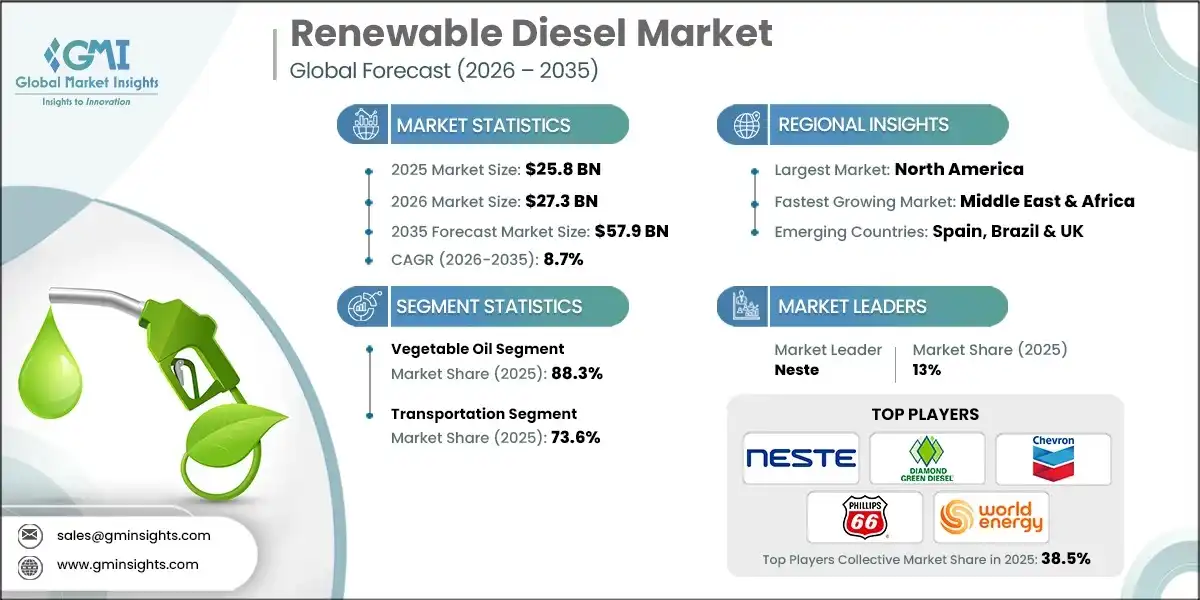
The global renewable diesel market was estimated at USD 25.8 billion in 2025. The market is expected to grow from USD 27.3 billion in 2026 to USD 57.9 billion in 2035, at a CAGR of 8.7% according to Global Market Insights Inc.
Renewable Diesel Market Key Takeaways
Market Size & Growth
- 2025 Market Size: USD 25.8 Billion
- 2026 Market Size: USD 27.3 Billion
- 2035 Forecast Market Size: USD 57.9 Billion
- CAGR (2026–2035): 8.7%
Regional Dominance
- Largest Market: North America
- Fastest Growing Region: Middle East & Africa
Key Market Drivers
- Rising demand for low-carbon fuels.
- Growing government incentives and mandates.
Challenges
- Rising feedstock supply constraints.
- Growing production cost pressures.
Opportunity
- Rising aviation and marine fuel demand.
- Growing circular economy initiatives.
Key Players
- Market Leader: Neste led with over 13% market share in 2025.
- Leading Players: Top 5 players in this market include Neste, Diamond Green Diesel, Chevron, Phillips 66, World Energy, which collectively held a market share of 38.5% in 2025.
Get Market Insights & Growth Opportunities
- Rising preference for renewable fuels offering lower greenhouse gas emissions compared to conventional petroleum diesel is driving the product adoption. Additionally, growing use of solutions compatible with existing diesel engines and infrastructure enables a smooth transition without major investments, accelerating renewable diesel penetration globally.
- Renewable diesel is a sustainable, low-carbon fuel derived from biomass sources such as vegetable oils, animal fats, or waste oils. It is chemically identical to petroleum diesel, enabling seamless use in existing engines while significantly reducing greenhouse gas emissions and improving energy security.
- Increasing government programs, such as the U.S. Renewable Fuel Standard and California’s Low Carbon Fuel Standard, are boosting renewable diesel development. For instance, Alberta granted tax incentives to Imperial Oil for its USD 507 million project to build Canada’s largest renewable diesel plant, expected to produce 20,000 barrels per day starting next year.
- Rising need for fuels that enhance energy security by reducing dependence on petroleum is complementing renewable diesel adoption. This trend is particularly significant amid geopolitical uncertainties and volatile crude oil prices, as countries seek to diversify energy sources and strengthen domestic fuel supply chains.
- Growing interest from key players in renewable diesel stems from its lower carbon emissions and higher cetane number compared to conventional diesel, enabling efficient combustion, drives the product growth. For instance, in October 2021, BP announced a USD 269 million investment at its Cherry Point Refinery to expand renewable diesel capacity, reduce emissions, and improve operational efficiency.
- North America is among the dominant regions on account of rising enforcement of low-carbon fuel standards across states, including California and Oregon. These regulations incentivize cleaner fuels, reducing greenhouse gas emissions and supporting decarbonization goals in transportation sectors.
- Moreover, growing interest from logistics companies, fleet operators, and municipalities in reducing greenhouse gas emissions is driving renewable diesel use. Key players' ongoing efforts in building a renewable future will complement the product growth. For instance, in August 2025, Imperial Oil completed its renewable diesel facility at Strathcona refinery near Edmonton, set to become Canada’s largest, producing up to 20,000 barrels per day of low-emission fuel.
- Latin America is the fastest-growing region in the renewable diesel market. Rising demand for low-carbon alternatives in freight and public transport is accelerating renewable diesel adoption. Countries aim to meet Paris Agreement targets and reduce greenhouse gas emissions, making renewable diesel a strategic solution for decarbonizing heavy-duty vehicles without major engine modifications.
- Additionally, increasing policy measures such as tax credits, renewable fuel blending mandates, and carbon reduction programs in Brazil, Argentina, and Chile are encouraging investments in renewable diesel production facilities, ensuring energy security and compliance with sustainability goals.
To get key market trends
Renewable Diesel Market Trends
- Increasing pressure from industries and consumers to adopt environmentally friendly solutions is reshaping markets. Sectors such as transportation, aviation, and logistics are prioritizing renewable diesel to meet sustainability targets and reduce carbon footprints. This shift is driven by corporate ESG commitments and regulatory frameworks, creating strong momentum for cleaner fuel alternatives globally.
- Ongoing companies' efforts in expanding into developing countries will foster the product growth. For instance, in August 2021, Petrobras began contracting to build Brazil’s first SAF and renewable diesel plant at RPBC refinery, processing 950,000 tons annually to produce 16,000 barrels daily from plant-based feedstocks and animal fats.
- Rising enforcement of emission-reduction policies is accelerating renewable diesel adoption. Regulations such as California’s Low Carbon Fuel Standard and the U.S. Renewable Fuel Standard compel producers to blend renewable diesel with conventional fuels. These mandates not only drive compliance but also create long-term demand, positioning renewable diesel as a critical solution for decarbonization.
- Increasing adoption of co-processing technologies in existing refineries is driving renewable diesel growth. These innovations allow petroleum refineries to integrate bio-based feedstocks without major infrastructure changes, reducing capital costs and accelerating production scalability. This approach supports faster market penetration while meeting stringent emission targets, making renewable diesel a practical and cost-effective solution for energy transition.
- Growing corporate initiatives toward net-zero emissions and sustainable energy use are fueling renewable diesel demand. For instance, Imperial Oil invested USD 560 million to build Canada’s largest renewable diesel facility at Strathcona refinery, expected to produce 20,000 barrels daily. This project aligns with Canada’s Clean Fuel Regulation, reducing transportation emissions significantly.
Renewable Diesel Market Analysis
Learn more about the key segments shaping this market
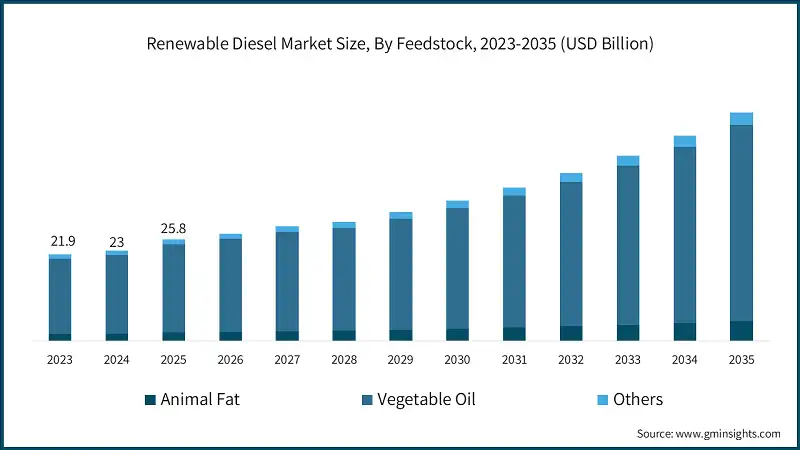
Based on feedstock, the industry is segmented into vegetable oil, animal fat, and others based on feedstock. The vegetable oil segment accounted for over 88.3% share in 2025 and is expected to grow at a CAGR of 9.9% through 2035.
- Increasing demand for sustainable feedstocks is driving the use of vegetable oils in renewable diesel production. Oils like soybean, canola, and rapeseed offer high energy density, enabling performance similar to petroleum diesel. Their renewable nature and compatibility with hydrotreated processes make them a preferred choice for reducing carbon emissions and meeting global decarbonization targets.
- Furthermore, increasing availability of vegetable oils such as palm, canola, soybeans, and rapeseed is simplifying feedstock sourcing and boosting renewable diesel production. In December 2024, Neste partnered with BMW to expand HVO100 fuel adoption, a renewable diesel made from hydrotreated vegetable oil, across more BMW vehicles. This fuel retains diesel-like performance while reducing greenhouse gas emissions by up to 90% compared to fossil diesel.
- The animal fat segment is projected to exceed USD 5 billion by 2035, driven by its lower greenhouse gas emissions compared to fossil diesel. Its abundance and cost-effectiveness make it an attractive feedstock for renewable diesel production. Additionally, the growing industrial and transportation sectors are increasing demand for sustainable fuels, positioning food-based biofuels as a practical alternative to plant-derived feedstocks to meet global sustainability objectives.
- Leading companies are actively investing to expand renewable diesel adoption across multiple applications. For instance, in September 2021, Shell approved the development of a major biofuels facility at its Energy and Chemicals Park in Rotterdam, formerly the Pernis refinery. Expected to be one of Europe’s largest, the plant will produce renewable diesel and sustainable aviation fuel using waste-based feedstocks such as used cooking oil, animal fats, and industrial residues.
Learn more about the key segments shaping this market
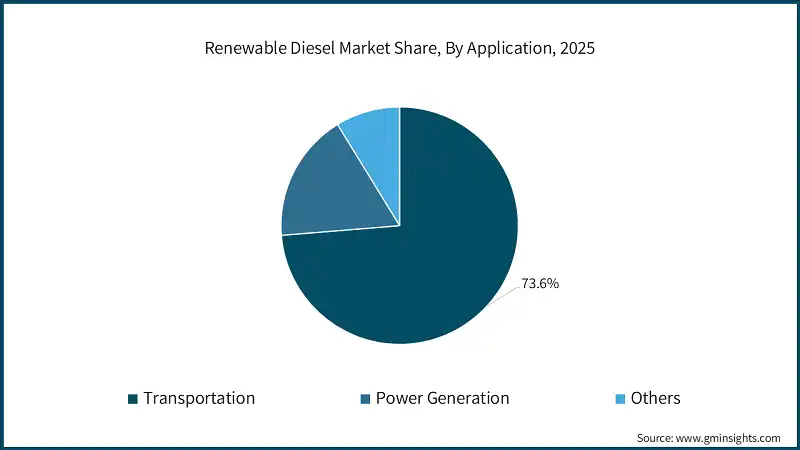
Based on application, the renewable diesel market is segmented into transportation, power generation and others. Transportation application dominate the market with a 73.6% share in 2025 and is expected to grow at a CAGR of 8.5% from 2026 to 2035.
- Growing focus among municipal transit agencies, logistics firms, and heavy-duty trucking fleets on renewable diesel adoption is driven by sustainability goals without compromising vehicle performance and reliability. This trend is strengthening renewable diesel penetration in the transportation sector, as fleets seek low-emission solutions to meet regulatory requirements and corporate environmental commitments.
- Increasing attention in North America and Europe toward cleaner technologies in public transport is reducing carbon footprints and addressing regulatory challenges. In March 2022, Neste supplied renewable diesel to U.S. school districts, aiding the transition from high-emission diesel buses. With over 95% of school buses running on diesel and emitting 5 million tons of greenhouse gases annually, renewable diesel adoption is critical for environmental and public health improvements.
- Power generation application is expected to grow at a faster CAGR of over 9.2% by 2035. Increasing transition of power producers toward low-carbon alternatives is accelerating renewable diesel adoption in the power generation sector. This shift supports corporate sustainability goals and participation in carbon credit markets. Additionally, rising volatility in fossil fuel prices and the need for energy diversification are driving demand for renewable diesel as a reliable and cleaner fuel option for power generation.
- Rising efforts by countries such as India, the U.S., China, and Germany to achieve net-zero targets are creating significant opportunities for renewable diesel in power generation. In September 2024, global utility companies pledged over USD 116 billion annually for clean energy and grid infrastructure. Initiatives such as the Utilities for Net Zero Alliance, launched at COP28, aim to accelerate electrification and decarbonization, boosting renewable diesel adoption worldwide.
Looking for region specific data?
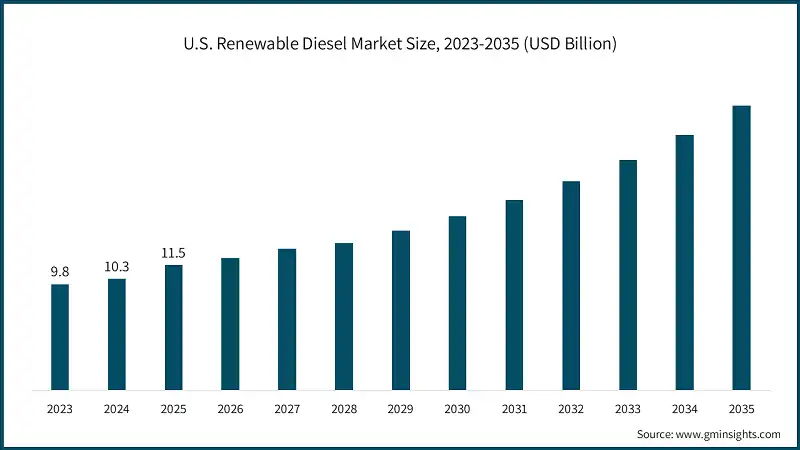
- The U.S. dominated the renewable diesel market in North America with around 90.3% share in 2025 and is expected to generate over USD 26.3 billion in revenue by 2035.
- Growing government policies and regulations, including the Renewable Fuel Standard (RFS) and Low Carbon Fuel Standard (LCFS), are incentivizing low-carbon fuel adoption. These frameworks encourage renewable diesel use across transportation, agriculture, and construction sectors, making it a viable alternative to conventional diesel while supporting emission reduction goals and compliance with sustainability mandates.
- Increasing partnerships among leading industry players are accelerating renewable diesel adoption and expanding market opportunities. For instance, in March 2022, Neste invested nearly USD 1 billion in a joint venture with Marathon Petroleum to convert the Martinez, California refinery for renewable diesel production, strengthening supply capabilities and meeting growing U.S. demand for cleaner fuels.
- The North America renewable diesel market accounted for a market value of USD 12.4 billion in 2025. Increasing emphasis on reducing greenhouse gas emissions is pushing industries and governments toward renewable diesel. Its compatibility with existing diesel engines and ability to meet stringent carbon reduction targets make it a preferred alternative. Additionally, rising pressure on companies to meet net-zero and ESG goals is accelerating renewable diesel adoption. Major fleets and logistics firms prefer renewable diesel to cut lifecycle emissions without costly engine modifications, supporting cleaner transportation strategies.
- Europe renewable diesel market is anticipated to cross over USD 9.7 billion by 2035. Increasing enforcement of emission reduction policies, such as the EU Renewable Energy Directive (RED II), which requires 14% of transport energy from renewables by 2030, is accelerating renewable diesel adoption. These mandates push fuel suppliers and transport operators toward cleaner alternatives to meet compliance targets.
- Growing alliances between major companies are helping address the increasing need for renewable diesel in transportation. For instance, in November 2022, Neste partnered with distributors to roll out Neste MY Renewable Diesel in France, aiming to significantly reduce transport-related emissions, up to 95% lower over its lifecycle compared to conventional diesel.
- Asia Pacific renewable diesel market is anticipated to grow at a CAGR of 9.2% by 2035. Increasing efforts to cut emissions in heavy transport and aviation sectors are driving renewable diesel use. Countries in the region are prioritizing low-carbon fuels to meet climate targets and reduce reliance on fossil-based diesel leading to enhance the product growth.
- Companies are coming together to form partnerships and joint ventures to improve their domestic dominance. For instance, in January 2025, Topsoe has partnered with Chuangui New Energy to deliver advanced technology and services for producing sustainable aviation fuel (SAF) and renewable diesel. This collaboration aims to accelerate clean fuel development and support carbon reduction goals globally.
Renewable Diesel Market Share
- The top 5 companies, including Neste, Diamond Green Diesel, Chevron, Phillips 66 and World Energy, account for around 38.5% market share. Leading renewable diesel producers are committing significant capital to expand refining capacity and upgrade existing plants. This strategy ensures a steady supply to meet growing transportation and industrial demand while complying with low-carbon fuel standards. By scaling operations, companies aim to reduce per-unit costs, improve efficiency, and strengthen their competitive position in global markets.
- Key players are forming strategic alliances with distributors, technology providers, and feedstock suppliers to enhance supply chain resilience. These collaborations accelerate renewable diesel adoption by improving distribution networks, sharing technological expertise, and optimizing production costs. Partnerships also enable companies to enter new markets quickly and meet rising demand for sustainable fuels.
- Companies are diversifying feedstock sources by utilizing waste oils, agricultural residues, and non-food crops. This approach ensures sustainability, reduces reliance on traditional raw materials, and meets global renewable energy mandates. Advanced sourcing strategies also help mitigate price volatility, improve lifecycle emissions performance, and maintain cost competitiveness in renewable diesel production.
- Key players are actively utilizing government policies, tax credits, and renewable fuel standards to boost renewable diesel adoption. By aligning operations with regulatory frameworks such as Low Carbon Fuel Standards and national decarbonization targets, firms reduce production costs and improve profitability. This approach not only ensures compliance but also strengthens market positioning by meeting sustainability requirements and attracting environmentally conscious customers.
Renewable Diesel Market Companies
- Neste, reported USD 24.2 billion in total revenue for 2024, with approximately 3.7?million?tonnes of renewable products sold. The company leads in supplying renewable diesel and SAF globally, driving its position as a top player in low?carbon fuel solutions.
- Diamond Green Diesel, is a 50/50 JV between Valero and Darling Ingredients. The renewable diesel segment reported USD 507?million operating income in 2024, deploying over 1.25?billion?gallons of fuel. As the second-largest U.S. renewable diesel producer, it operates at a 1.2 billion-gallon-per-year capacity.
- Chevron generated USD 202.8?billion in revenue in FY?2024. As highlighted in its annual report, Chevron’s low-carbon segment is focusing on investments in renewable diesel and SAF technologies, aligning with its energy transition strategy.
- Phillips 66 recorded USD 19.6?billion in total revenue for 2024. Its renewable fuels segment, including renewable diesel and SAF at Rodeo, contributed USD 28?million in earnings for Q4?2024, marking improved performance in its energy transition efforts.
- World Energy is a leading U.S. producer of renewable diesel and sustainable aviation fuel (SAF), utilizing waste fats and oils as feedstock. The company focuses on decarbonizing heavy-duty transport and aviation sectors, expanding production capacity to meet growing demand for low-carbon fuel solutions.
Eminent players operating in the renewable diesel market are:
- BP
- Cargill
- Carolina Renewable Products
- Chevron
- Diamond Green Diesel
- Eni
- Gevo
- HollyFrontier
- Imperial Oil
- LanzaJet
- Marathon Petroleum
- Neste
- Petrobras
- Phillips 66
- Preem AB
- Repsol
- Shell
- TotalEnergies
- Valero
- World Energy
Renewable Diesel Market Report Attributes
| Key Takeaway | Details |
|---|---|
| Market Size & Growth | |
| Base Year | 2025 |
| Market Size in 2025 | USD 25.8 Billion |
| Market Size in 2026 | USD 27.3 Billion |
| Forecast Period 2026-2035 CAGR | 8.7% |
| Market Size in 2035 | USD 57.9 Billion |
| Key Market Trends | |
| Drivers | Impact |
| Rising demand for low-carbon fuels | Rising global emphasis on reducing greenhouse gas emissions is driving renewable diesel adoption as a sustainable alternative to fossil diesel, supporting |
| Growing government incentives and mandates | Growing regulatory support through renewable fuel standards, tax credits, and blending mandates is accelerating renewable diesel production and consumption, fostering investments and market expansion worldwide. |
| Pitfalls & Challenges | Impact |
| Rising feedstock supply constraints | Rising feedstock supply constraints Rising competition for feedstocks including vegetable oils and animal fats creates supply challenges, increasing costs and limiting scalability for renewable diesel producers in a resource-constrained environment. |
| Growing production cost pressures | Growing capital and operational expenses for advanced refining technologies make renewable diesel less competitive compared to conventional diesel, impacting profitability and slowing adoption in price-sensitive markets. |
| Opportunities: | Impact |
| Rising aviation and marine fuel demand | Rising interest in renewable diesel for the aviation and marine sectors offers significant growth opportunities, as industries seek sustainable fuels to meet stringent emission reduction targets globally. |
| Growing circular economy initiatives | Growing focus on waste-to-fuel technologies creates opportunities for renewable diesel producers to utilize used cooking oil and agricultural residues, reducing environmental impact and enhancing resource efficiency. |
| Market Leaders (2025) | |
| Market Leaders |
13% market share |
| Top Players |
|
| Competitive Edge |
|
| Regional Insights | |
| Largest Market | North America |
| Fastest Growing Market | Middle East & Africa |
| Emerging Countries | Spain, Brazil & UK |
| Future outlook |
|
What are the growth opportunities in this market?
Renewable Diesel Industry News
- In October 2024, Repsol introduced Nexa, a fully renewable diesel available at its service stations. Designed for all diesel engines, this premium fuel improves performance and extends engine life, reinforcing Repsol’s commitment to sustainable mobility and reducing carbon emissions.
- In February 2024, Colonial Oil partnered with Finnish biofuel leader Neste to develop a renewable diesel initiative in Savannah, Georgia. This collaboration aims to boost renewable diesel availability across the southeastern U.S., supporting regional logistics companies and reducing transportation-related emissions significantly.
- In April 2021, BP adjusted its renewable fuel strategy, pausing two proposed projects for SAF and renewable diesel while continuing to evaluate three others. The decision reflects BP’s focus on optimizing investments amid changing market conditions and regulatory frameworks.
This renewable diesel market research report includes an in-depth coverage of the industry with estimates & forecast in terms of revenue and volume in “USD Billion & MT” from 2022 to 2035, for the following segments:
Market, By Feedstock
- Animal fat
- Vegetable oil
- Others
Market, By Application
- Transportation
- Power generation
- Others
The above information has been provided for the following regions and countries:
- North America
- U.S.
- Canada
- Europe
- Germany
- France
- Spain
- UK
- Italy
- Asia Pacific
- China
- India
- Indonesia
- Australia
- Middle East & Africa
- Saudi Arabia
- South Africa
- Latin America
- Brazil
- Argentina
Frequently Asked Question(FAQ) :
What is the market size of the renewable diesel in 2025?
The market size was USD 25.8 billion in 2025, with a CAGR of 8.7% expected through 2035 driven by rising demand for low-emission renewable fuels and government incentives.
What is the projected value of the renewable diesel market by 2035?
The renewable diesel market is expected to reach USD 57.9 billion by 2035, propelled by stricter environmental regulations, aviation and marine fuel demand, and circular economy initiatives.
What is the current renewable diesel market size in 2026?
The market size is projected to reach USD 27.3 billion in 2026.
How much market share did the vegetable oil feedstock segment hold in 2025?
Vegetable oil feedstock accounted for over 88.3% share in 2025 and is expected to grow at a CAGR of 9.9% through 2035, driven by sustainable feedstock demand and high energy density.
What was the market share of transportation application in 2025?
Transportation application dominated the market with a 73.6% share in 2025 and is expected to grow at a CAGR of 8.5% from 2026 to 2035.
Which region leads the renewable diesel market?
The U.S. dominated North America with around 90.3% share in 2025 and is expected to generate over USD 26.3 billion in revenue by 2035, driven by RFS and LCFS policies.
What are the upcoming trends in the renewable diesel market?
Key trends include increasing corporate ESG commitments, enforcement of emission-reduction policies, adoption of co-processing technologies, and growing focus on sustainable aviation fuel and marine applications.
Who are the key players in the renewable diesel market?
Key players include Neste (13% market share), Diamond Green Diesel, Chevron, Phillips 66, World Energy, BP, Cargill, Carolina Renewable Products, Eni, Gevo, HollyFrontier, Imperial Oil, LanzaJet, Marathon Petroleum, Petrobras, Preem AB, Repsol, Shell, TotalEnergies, and Valero.