Summary
Table of Content

Reinsurance Market
Get a free sample of this report
Form submitted successfully!
Error submitting form. Please try again.
Thank you!
Your inquiry has been received. Our team will reach out to you with the required details via email. To ensure that you don't miss their response, kindly remember to check your spam folder as well!
Request Sectional Data
Thank you!
Your inquiry has been received. Our team will reach out to you with the required details via email. To ensure that you don't miss their response, kindly remember to check your spam folder as well!
Form submitted successfully!
Error submitting form. Please try again.
Reinsurance Market Size
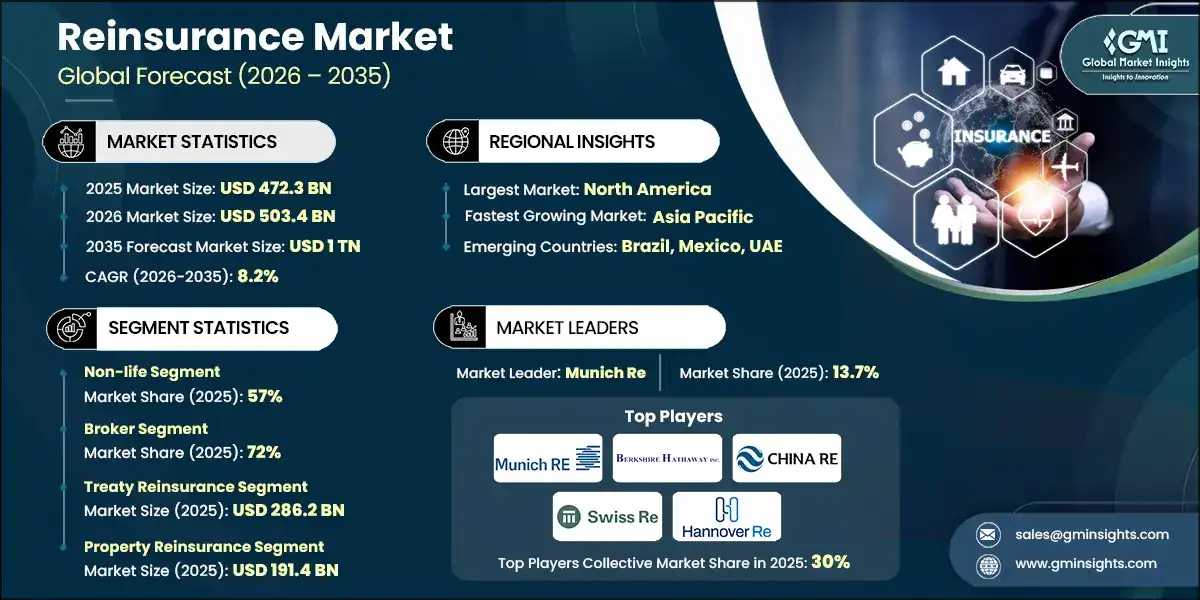
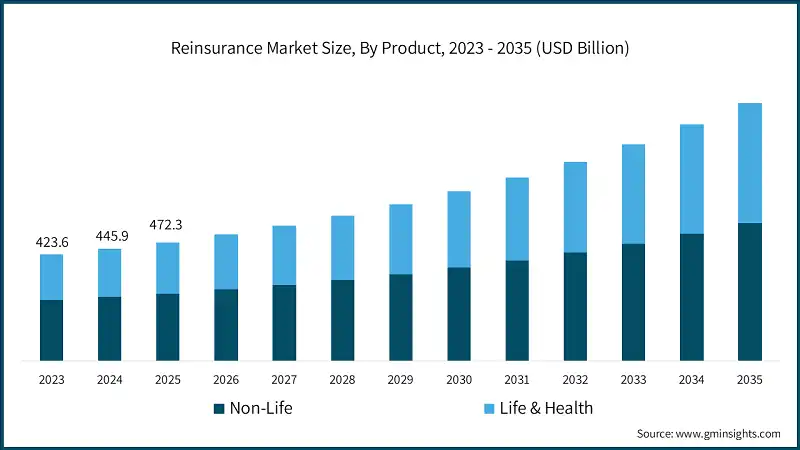
The global reinsurance market size was valued at USD 472.3 billion in 2025. The market is expected to grow from USD 503.4 billion in 2026 to USD 1 Trillion in 2035, at a CAGR of 8.2%, according to latest report published by Global Market Insights Inc.
Reinsurance Market Key Takeaways
Market Size & Growth
- 2025 Market Size: USD 472.3 Billion
- 2026 Market Size: USD 503.4 Billion
- 2035 Forecast Market Size: USD 1 Trillion
- CAGR (2026–2035): 8.2%
Regional Dominance
- Largest Market: North America
- Fastest Growing Region: Asia Pacific
Key Market Drivers
- Increasing Regulatory Compliance.
- Rising Exposure to Catastrophic Events.
- Technological Advancements.
- Global Insurance Market Expansion.
Challenges
- High Operational Complexity.
- Exposure to Extreme Loss Events.
Opportunity
- Parametric and Digital Reinsurance Solutions.
- Integrated Risk Management Platforms.
Key Players
- Market Leader: Munich Re led with over 13.7% market share in 2025.
- Leading Players: Top 5 players in this market include Munich Re, Berkshire Hathaway, China Reinsurance, Swiss Re, Hannover Re, which collectively held a market share of 30% in 2025.
Get Market Insights & Growth Opportunities
The reinsurance market is projected to witness substantial growth in the coming years, driven by increasing regulatory enforcement, rising exposure to catastrophic events, and the growing complexity of risk portfolios across insurance, banking, and corporate sectors. As insurance companies, brokers, and financial institutions prioritize risk transfer, capital optimization, and portfolio diversification, advanced reinsurance solutions are becoming essential to mitigate potential losses, enhance solvency, and maintain regulatory compliance.
Technological advancements such as AI and ML powered risk modeling, real-time catastrophe modeling, predictive analytics, blockchain-based risk sharing, and cloud-based portfolio management platforms are transforming traditional reinsurance operations. These innovations enable end-to-end visibility into risk exposures, improve claims assessment accuracy, optimize capital allocation, and enhance overall operational efficiency. In parallel, the adoption of digital insurance platforms, parametric insurance solutions, and cross-border reinsurance contracts increases the demand for automated, scalable, and intelligent reinsurance solutions.
The market’s growth is further accelerated by the expanding global insurance ecosystem, rising adoption of alternative risk transfer mechanisms, increasing regulatory scrutiny, and the need for robust risk management practices. Reinsurance activities such as risk underwriting, catastrophe modeling, claims management, retrocession, and portfolio optimization have become critical to the operational integrity and financial stability of insurance companies. Services including reinsurance consulting, managed risk services, and software-as-a-service (SaaS) platforms ensure operational continuity and adherence to international reinsurance standards.
In 2024, leading reinsurance solution providers such as Munich Re, Swiss Re, Hannover Re, SCOR, Berkshire Hathaway Re, Lloyd’s of London, PartnerRe, and Everest Re expanded their service portfolios. These companies invested in AI-driven risk analytics, cloud-native portfolio management platforms, real-time catastrophe modeling systems, and modular, scalable software architectures to enhance underwriting accuracy, reduce exposure to unexpected losses, and mitigate regulatory risks for insurers, reinsurers, and corporate risk managers.
The reinsurance ecosystem continues to evolve as advanced analytics, cloud computing, predictive modeling, and automated risk management workflows reshape risk transfer and capital management practices. Industry stakeholders are increasingly prioritizing integrated, end-to-end reinsurance networks that maximize operational visibility, reduce manual intervention, optimize cost structures, and support long-term regulatory adherence. These advancements are redefining the reinsurance market, enabling faster, safer, and more efficient risk assessment, capital optimization, and loss mitigation across global insurance systems.
To get key market trends
Reinsurance Market Trends
The demand for advanced reinsurance solutions is rapidly increasing, driven by growing collaboration among insurers, reinsurers, brokers, and regulatory technology providers. These partnerships aim to enhance risk assessment, portfolio optimization, operational efficiency, regulatory compliance, and overall financial stability. Stakeholders are working together to develop integrated, modular, and data-driven reinsurance systems incorporating AI and ML powered risk analytics, real-time catastrophe modeling, blockchain-based risk transfer verification, parametric insurance solutions, and cloud-enabled portfolio management platforms.
For instance, in recent years, leading companies such as Munich Re, Swiss Re, Berkshire Hathaway, Hannover Re, and China Re expanded collaborations with insurance carriers and corporate clients to deploy intelligent underwriting systems, automated claims assessment tools, and predictive catastrophe modeling platforms. These initiatives improved risk detection precision, optimized capital allocation, enhanced compliance visibility, and increased operational efficiency across real-time, cross-border, and digital insurance and reinsurance networks.
Regional customization of reinsurance solutions is also emerging as a key trend. Leading providers are establishing localized risk management frameworks, jurisdiction-specific underwriting modules, and regulatory-compliant monitoring systems across North America, Europe, Asia-Pacific, Latin America, and the Middle East. These frameworks support region-specific regulatory requirements, tailored portfolio management configurations, and specialized service models designed for diverse insurance environments, including high-volume digital policies, parametric insurance contracts, and cross-border risk transfer arrangements.
The rise of specialized InsurTech and RegTech startups offering AI-enabled risk modeling platforms, automated claims assessment systems, real-time catastrophe scoring tools, and blockchain-based policy verification is reshaping the competitive landscape. Companies developing predictive analytics engines, automated portfolio management solutions, and smart risk orchestration platforms are enabling scalable, cost-efficient deployment of advanced reinsurance capabilities. These innovations empower both established reinsurers and emerging technology players to improve risk transparency, strengthen regulatory compliance, and accelerate digital transformation across the reinsurance ecosystem.
The development of standardized, modular, and interoperable reinsurance platforms is transforming the market. Leading players such as Munich Re, Swiss Re, Berkshire Hathaway, Hannover Re, and China Re are deploying unified risk management architectures that support multiple insurance and reinsurance products, customizable workflows, and jurisdiction-compliant processes. These solutions improve scalability, enable real-time portfolio monitoring, support end-to-end integration across insurers and reinsurers, and enhance overall resilience in managing complex, large-scale risks.
Reinsurance Market Analysis
Learn more about the key segments shaping this market
Based on product, the market is divided into non-life and life & health. The non-life segment dominated the market, accounting for around 57% share in 2025 and is expected to grow at a CAGR of over 7.6% from 2026 to 2035.
- The non-life segment dominates the reinsurance market, driven by its critical role in providing coverage for property, casualty, natural catastrophes, liability, and specialty risks. High adoption of advanced risk modeling, catastrophe analytics, AI and ML powered underwriting tools, and cloud-based portfolio management platforms ensure insurers and reinsurers can efficiently assess, transfer, and manage high-volume, high-severity risks. These solutions form the core of non-life reinsurance operations, offering scalability, operational efficiency, and enhanced accuracy in risk assessment and capital optimization.
- The life & health segment also contributes to the market, including coverage for mortality, morbidity, longevity, and health-related risks. While essential for long-term risk management and financial stability, the volume and complexity of life & health reinsurance products are typically lower in terms of transactional frequency compared to the high-volume, short-duration non-life contracts. Advancements in predictive analytics, real-time risk monitoring, and cloud-enabled portfolio management further strengthen the non-life segment, reinforcing its position as the backbone of reinsurance operations across global insurance markets.
Learn more about the key segments shaping this market
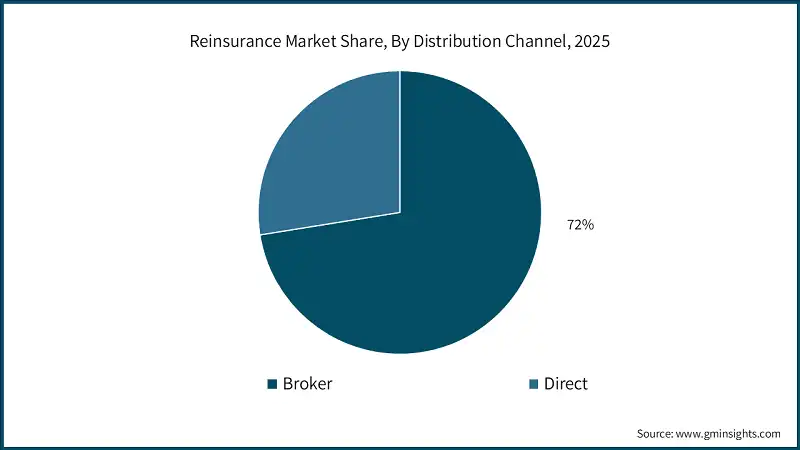
Based on distribution channel, the market is divided into broker and direct. The broker segment dominates the market, accounting for around 72% share in 2025, and the segment is expected to grow at a CAGR of over 7.8% from 2026 to 2035.
- The broker segment dominates the reinsurance market, driven by the high volume, complexity, and cross-border nature of risk transfer managed by major insurance companies and corporate clients. Brokers play a critical role in structuring reinsurance contracts, negotiating terms, optimizing capital allocation, and ensuring compliance with regulatory requirements. Their expertise in matching complex risks with suitable reinsurers makes them the preferred distribution channel for large-scale and specialty reinsurance programs.
- The direct segment also contributes to market growth, with insurers and corporate clients directly purchasing reinsurance solutions for specific portfolios or risk exposures. While significant, direct placement typically involves smaller volumes or standardized contracts compared to broker-facilitated transactions. Adoption of digital platforms, automated underwriting tools, and cloud-based risk management systems support direct channels, but the expertise, global networks, and negotiation capabilities of brokers continue to make the broker segment the dominant distribution channel in the market.
Based on type, the market is divided into treaty reinsurance, and facultative reinsurance. The treaty reinsurance segment dominated the market and was valued at USD 286.2 billion in 2025.
- The treaty reinsurance segment dominates the reinsurance market, driven by its ability to provide comprehensive, long-term risk coverage for insurers across portfolios of policies. Treaty reinsurance allows insurers to transfer a defined portion of multiple risks to reinsurers automatically, ensuring capital stability, regulatory compliance, and efficient risk management. This type of reinsurance remains the preferred choice for companies managing high volumes of policies or complex risk portfolios, offering predictable coverage, scalability, and operational efficiency.
- The facultative reinsurance segment also contributes to market growth, providing coverage for individuals or specialized risks that fall outside standard treaty arrangements. While significant, facultative reinsurance is typically deployed on a case-by-case basis and involves higher underwriting effort, negotiation, and administrative overhead. Advancements in risk modeling, AI-enabled underwriting, and digital placement platforms are improving efficiency and adoption in the facultative segment, but the volume, consistency, and portfolio-wide coverage of treaty reinsurance continue to make it the dominant type in the market.
Based on line of business, the market is divided into property reinsurance, casualty reinsurance, and specialty reinsurance. The property reinsurance segment dominated the market and was valued at USD 191.4 billion in 2025.
- The property reinsurance segment dominates the reinsurance market, driven by the high exposure to natural disasters, property damage, and high-value asset risks. Insurers rely on property reinsurance to transfer large-scale, high-frequency risks, ensure capital adequacy, and maintain regulatory compliance. Its prominence is supported by increasing frequency and severity of natural disasters, the critical need to protect insured assets, and the growing adoption of advanced risk modeling, catastrophe analytics, and AI-enabled underwriting tools.
- The casualty reinsurance and specialty reinsurance segments also contribute to market growth, providing coverage for liability, professional indemnity, marine, aviation, and niche risks. While essential for comprehensive risk management, these segments typically involve lower exposure volumes or more specialized underwriting requirements compared to property reinsurance. Advanced predictive analytics, cloud-based portfolio management, and automated claims assessment are increasingly adopted across these segments, complementing property reinsurance and supporting overall market expansion.
Looking for region specific data?
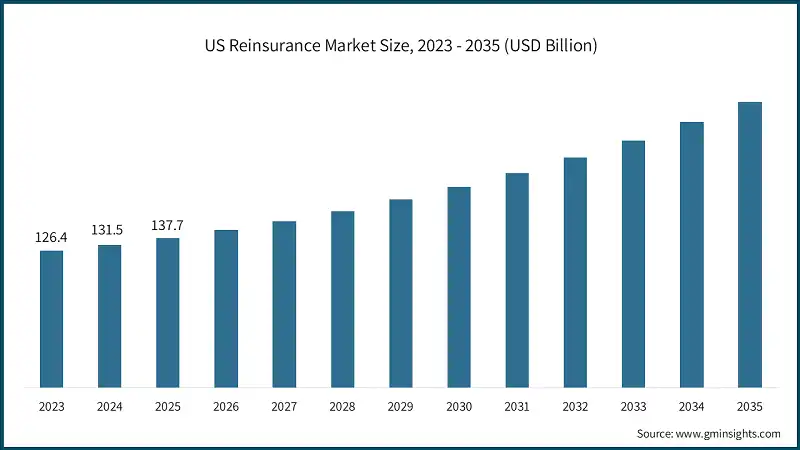
In 2025, US dominated the North America reinsurance market with around 91% market share and generated approximately USD 137.7 billion in revenue.
- The North America region dominated the market, supported by a mature insurance ecosystem, well-established insurer and reinsurer networks, and strong regulatory enforcement. The region benefits from advanced technological adoption, widespread use of AI and ML based risk analytics, catastrophe modeling platforms, and cloud-enabled portfolio management systems, positioning it as a global leader in reinsurance solutions and services.
- Within North America, the United States accounted for the largest share, driven by high exposure to natural catastrophes, complex corporate insurance portfolios, and stringent regulatory requirements from agencies such as NAIC (National Association of Insurance Commissioners) and state insurance regulators. Large-scale adoption of real-time risk assessment, automated underwriting, and predictive modeling platforms, combined with robust implementation by major insurers, reinsurers, and brokers, fuels market growth. States with major insurance hubs such as New York, Connecticut, and California serve as primary centers for reinsurance solution deployment, innovation, and regulatory compliance.
- Key industry players in the U.S., including Munich Re, Swiss Re, Berkshire Hathaway, Hannover Re, and China Re, continue to expand their service portfolios, enhance AI and analytics capabilities, and strengthen client support and integration services. Their ongoing investment in automated risk modeling, predictive catastrophe analytics, and cloud-enabled portfolio management consolidates the U.S.’s dominant position in the North American market.
Germany holds share of 26% in Europe reinsurance market in 2025 and it will grow tremendously between 2026 and 2035.
- Europe accounted for a significant share of the market, supported by growing insurance penetration, stringent regulatory frameworks, and increasing adoption of AI and ML based risk analytics and portfolio management solutions. Countries across the region are expanding insurance and reinsurance operations, while insurers and reinsurers focus on deploying advanced underwriting, catastrophe modeling, and claims management systems. Well-established regulatory oversight, strong technological infrastructure, and growing awareness of risk mitigation reinforce Europe’s position as a key regional reinsurance market.
- Germany dominated the Europe market, supported by its advanced insurance ecosystem, high regulatory compliance standards, and strong adoption of digital and automated reinsurance solutions. German insurers, reinsurers, and corporate clients are leading large-scale implementation of portfolio risk assessment platforms, predictive catastrophe modeling, AI-enabled underwriting, and cloud-based portfolio management systems. Investments in real-time analytics, scalable software architectures, and automated risk management workflows have strengthened operational efficiency, expanded solution portfolios, and accelerated market growth, positioning Germany as the regional leader.
- Other major European countries, including Switzerland, France, and the UK, are contributing to regional reinsurance market expansion, driven by increasing adoption of digital insurance platforms, growing cross-border risk transfer, and strengthening regulatory requirements. Switzerland focuses on life and specialty reinsurance, France emphasizes property and casualty risk portfolios, and the UK prioritizes corporate and parametric reinsurance solutions. Despite varying levels of market maturity, Germany maintains its leading role in scale, technological innovation, and comprehensive reinsurance solution adoption within Europe.
China holds share of 33% in Asia Pacific reinsurance market in 2025 and it is expected to grow tremendously between 2026 and 2035.
- Asia-Pacific holds a major share of the market, supported by rapid growth in insurance and reinsurance sectors, expanding corporate risk portfolios, and increasing regulatory compliance requirements. The region is witnessing steady growth as insurers, reinsurers, and corporate clients increase investments in AI and ML based risk analytics, predictive catastrophe modeling, and cloud-enabled portfolio management systems. Strong technological infrastructure, increasing cross-border insurance activity, and rising regulatory awareness continue to strengthen Asia-Pacific’s position in the reinsurance market.
- China represents the largest market in Asia-Pacific, driven by widespread adoption of digital insurance platforms, corporate risk management solutions, and strong regulatory enforcement from agencies such as the China Banking and Insurance Regulatory Commission (CBIRC). Major financial hubs such as Beijing, Shanghai, Shenzhen, and Guangzhou are experiencing high demand for AI-powered risk assessment platforms, cloud-based portfolio management systems, real-time claims monitoring tools, and predictive catastrophe analytics.
- Other Asia-Pacific markets, including Japan, South Korea, and India, are emerging as high-growth regions, supported by increasing insurance adoption, cross-border reinsurance transactions, and investments in automated portfolio management and risk monitoring solutions. Japan emphasizes large-scale insurance compliance platforms, South Korea focuses on digital insurance and parametric reinsurance solutions, and India is investing in cloud-based risk management systems and real-time underwriting analytics.
Reinsurance market in Brazil will experience significant growth between 2026 and 2035.
- Latin America holds a smaller share but is steadily expanding its presence in the market in 2025, driven by increasing insurance adoption, growing corporate and specialty risk portfolios, and strengthening regulatory enforcement across the region. Insurers and reinsurers are gradually deploying AI- and ML-enabled risk assessment platforms, automated underwriting tools, predictive catastrophe modeling, and cloud-based portfolio management systems. Strengthening insurance networks, expanding corporate risk coverage, and improving regulatory frameworks continue to support Latin America’s growing role in the reinsurance landscape.
- Brazil dominated the Latin America reinsurance market, supported by its large insurance and corporate sectors, high exposure to natural and industrial risks, and stringent regulatory requirements from agencies such as the Superintendência de Seguros Privados (SUSEP). Major financial and insurance hubs such as São Paulo, Rio de Janeiro, and Brasília host insurers, reinsurers, and corporate clients that focus on end-to-end risk transfer and portfolio management, including property and casualty coverage, catastrophe risk modeling, and real-time claims monitoring. Leading reinsurance providers, including Munich Re, Swiss Re, Berkshire Hathaway, Hannover Re, and China Re, actively offer AI-driven analytics, automated underwriting, and cloud-enabled portfolio management systems to support Brazil’s dominant position in the regional market.
- Mexico represents the second largest and rapidly growing market, driven by expanding insurance adoption, growing corporate and industrial risk coverage, and rising deployment of automated risk management solutions. Key cities such as Mexico City, Monterrey, and Guadalajara are witnessing higher demand for scalable, technology-enabled reinsurance systems, supported by growing adoption of predictive analytics, cloud platforms, and real-time risk monitoring across insurers, reinsurers, and corporate clients.
Reinsurance market in UAE will experience significant growth between 2026 and 2035.
- MEA accounted for a modest share of the market in 2025, supported by gradual digitalization of insurance services, growing adoption of corporate and specialty risk coverage, and increasing regulatory enforcement. Countries across the region are implementing AI and ML powered risk assessment platforms, automated underwriting systems, predictive catastrophe modeling, and cloud-based portfolio management solutions. Expansion of insurance networks, corporate risk services, and regulatory frameworks further supports MEA’s integration into the reinsurance landscape.
- The UAE dominated the MEA reinsurance market, driven by high adoption of advanced reinsurance solutions across insurers, reinsurers, and corporate clients. Key financial and insurance hubs such as Dubai and Abu Dhabi host major insurers, reinsurers, and multinational corporations implementing AI-driven risk analytics, automated portfolio management, predictive catastrophe modeling, and cloud-enabled reporting systems to improve operational efficiency, optimize capital allocation, and ensure regulatory compliance. Leading reinsurance providers, including Munich Re, Swiss Re, Berkshire Hathaway, Hannover Re, and China Re, are actively deploying technology-enabled platforms, automated workflows, and advisory services to strengthen the UAE’s position as the regional leader in reinsurance.
Reinsurance Market Share
- The top 7 companies in the market are Munich Re, Swiss Re, Hannover Re, Berkshire Hathaway, China Reinsurance, Lloyd’s and Everest Re. These companies hold around 30% of the market share in 2025.
- Munich Re is a global leader in reinsurance, offering comprehensive risk transfer, underwriting, and analytics-driven solutions across property, casualty, life, and specialty lines. The company emphasizes advanced catastrophe modeling, AI-powered risk assessment, actuarial analytics, and automated portfolio management to enhance underwriting accuracy, capital efficiency, and claims optimization.
- Swiss Re provides end-to-end reinsurance services covering life & health, property, casualty, and specialty risks. The company focuses on predictive risk modeling, large-scale catastrophe analytics, digital underwriting, and automated claims systems. With strong technological capabilities, cloud-enabled platforms, and partnerships with insurers and governments, Swiss Re delivers scalable, diversified, and resilient reinsurance solutions. Its global footprint and continuous innovation support long-term market expansion.
- Hannover Re is a major reinsurance provider offering solutions across property & casualty and life & health segments. The company emphasizes data-driven underwriting, AI-supported risk evaluation, and automated portfolio optimization. Its focus on cost-efficient operations, diversified risk exposure, and strategic collaborations with insurers enables stable growth. Cloud-enabled platforms, advanced actuarial tools, and strong global networks contribute to Hannover Re’s competitive positioning and consistent market performance.
- Berkshire Hathaway operates as a leading reinsurer, specializing in large-scale property, casualty, specialty, and retrocession business. The company emphasizes disciplined underwriting, strong capital strength, long-term risk management, and selective portfolio strategies. Backed by significant financial capacity, a global client base, and expertise in complex, high-value risk segments, Berkshire Hathaway delivers stability, flexibility, and resilience in reinsurance markets, reinforcing its strong competitive standing.
- China Re is a prominent reinsurance provider in Asia, offering property, casualty, life, and specialty reinsurance solutions. The company focuses on digital underwriting, catastrophe modeling, risk diversification, and regulatory-aligned portfolio strategies. Backed by strong government support, regional dominance, and rapidly expanding international operations, China Re leverages advanced analytics, cloud platforms, and strategic partnerships to strengthen risk assessment, improve operational efficiency, and enhance global presence.
- Lloyd’s operates as a reinsurance and specialty insurance marketplace, providing custom underwriting solutions across marine, aviation, cyber, property, and casualty risks. The marketplace emphasizes expert syndicate-based underwriting, predictive risk analytics, and advanced modeling systems. Lloyd’s strong global ecosystem, regulatory governance, and digital transformation initiatives such as the Lloyd’s Blueprint Two program enable secure, efficient, and scalable reinsurance transactions, reinforcing its position as a leading global specialty risk hub.
- Everest Re is a global provider of property, casualty, and specialty reinsurance solutions. The company focuses on data-driven underwriting, catastrophe modeling, AI-enhanced portfolio analysis, and automated claims management. Strong capital strength, global market reach, and strategic partnerships with insurers support scalable operations across multiple regions. Continuous investment in advanced analytics, digital platforms, and diversified risk strategies reinforces Everest Re’s competitive growth and market expansion.
Reinsurance Market Companies
Major players operating in the reinsurance industry include:
- Berkshire Hathaway
- China Reinsurance
- Everest Re
- Hannover Re
- Korean Reinsurance
- Lloyd’s
- Munich Re
- Reinsurance Group of America (RGA)
- SCOR
- Swiss Re
- The reinsurance market is highly competitive, with leading players such as Munich Re, Swiss Re, Hannover Re, Berkshire Hathaway, China Reinsurance, Lloyd’s, and Everest Re occupying key positions across property, casualty, life & health, specialty, and treaty/facultative reinsurance segments. These companies operate extensive global networks, offer diversified risk-transfer solutions, and provide strong underwriting expertise supported by advanced analytics and capital strength.
- Munich Re, Swiss Re, and Hannover Re lead the market with comprehensive, end-to-end reinsurance offerings, combining advanced risk modeling, strong capital adequacy, global underwriting capabilities, and diversified product portfolios. These companies focus on enhancing risk assessment accuracy, optimizing capital efficiency, expanding specialty reinsurance lines, and strengthening resilience against catastrophic events. Their leadership is supported by broad geographic presence, long-term client relationships, and continuous innovation in digital underwriting and risk analytics.
- Berkshire Hathaway, China Re, Lloyd’s, and Everest Re specialize in flexible, scalable, and sector-focused reinsurance solutions, emphasizing property & casualty (P&C), specialty risks, life & health, and structured reinsurance arrangements. These players leverage strong financial capacity, diversified underwriting platforms, and collaborative broker relationships to support global insurers. Their offerings enable improved risk diversification, pricing precision, and underwriting profitability across both mature and emerging insurance markets.
- Overall, the reinsurance market is characterized by strategic expansion, digital transformation, and advanced risk-analytics adoption. Companies continue to invest in AI-driven underwriting tools, catastrophe modeling, portfolio optimization systems, and capital-efficient reinsurance structures. Leading reinsurers are focused on delivering resilient, scalable, and high-performance risk-transfer solutions, strengthening global insurance capacity, reducing volatility, and supporting industry stability across property, casualty, specialty, and life & health segments.
Reinsurance Market Report Attributes
| Key Takeaway | Details |
|---|---|
| Market Size & Growth | |
| Base Year | 2025 |
| Market Size in 2025 | USD 472.3 Billion |
| Market Size in 2026 | USD 503.4 Billion |
| Forecast Period 2026 - 2035 CAGR | 8.2% |
| Market Size in 2035 | USD 1 Trillion |
| Key Market Trends | |
| Drivers | Impact |
| Increasing Regulatory Compliance | Stricter insurance and capital adequacy regulations are driving demand for reinsurance solutions to maintain solvency and mitigate risk. |
| Rising Exposure to Catastrophic Events | Growing frequency and severity of natural disasters (floods, hurricanes, wildfires) increase the need for risk transfer via reinsurance. |
| Technological Advancements | AI, ML, predictive modeling, and blockchain enhance risk assessment, portfolio optimization, and claims management. |
| Global Insurance Market Expansion | Rising adoption of digital insurance platforms, cross-border insurance contracts, and alternative risk transfer mechanisms drives reinsurance demand. |
| Pitfalls & Challenges | Impact |
| High Operational Complexity | Managing diverse risk portfolios, retrocession arrangements, and cross-border regulations can strain resources and reduce efficiency. |
| Exposure to Extreme Loss Events | Unexpected catastrophic events or pandemics can cause significant financial stress despite reinsurance coverage, impacting profitability. |
| Opportunities: | Impact |
| Parametric and Digital Reinsurance Solutions | Growth of on-demand, technology-driven reinsurance products allows insurers to hedge risks more flexibly and efficiently. |
| Integrated Risk Management Platforms | Cloud-based, AI-powered platforms offer end-to-end visibility and automation, creating opportunities for cost optimization and improved decision-making. |
| Market Leaders (2025) | |
| Market Leaders |
13.7% market share |
| Top Players |
|
| Competitive Edge |
|
| Regional Insights | |
| Largest Market | North America |
| Fastest growing market | Asia Pacific |
| Emerging countries | Brazil, Mexico, UAE |
| Future outlook |
|
What are the growth opportunities in this market?
Reinsurance Industry News
- In March 2025, Munich Re launched an upgraded risk analytics platform integrating AI and ML powered catastrophe modeling, real-time portfolio risk scoring, and automated claims assessment workflows. The initiative aims to enhance underwriting accuracy, improve capital allocation, and strengthen loss prediction capabilities for primary insurers across global markets.
- In February 2025, Swiss Re introduced a predictive underwriting module for its reinsurance solutions suite, featuring real-time risk monitoring, exposure modeling, and cloud-enabled reporting. The rollout focuses on improving treaty structuring efficiency, optimizing risk selection, and supporting insurers across property, casualty, and specialty lines.
- In January 2025, Hannover Re unveiled an AI-driven reinsurance platform designed for global insurers, incorporating automated regulatory reporting, portfolio diversification dashboards, and advanced catastrophe risk detection. The initiative targets high-volume treaty operations, cross-border reinsurance placements, and large-scale risk management.
- In December 2024, SCOR expanded its reinsurance technology offerings, adding enhanced client data integration tools, blockchain-enabled contract management, and predictive loss modeling capabilities. The deployment aims to support insurers with faster treaty processing, improved claims validation, and stronger capital adequacy compliance.
- In October 2024, Berkshire Hathaway Reinsurance Group, Lloyd’s, and PartnerRe launched integrated cloud-based reinsurance solutions, including real-time exposure analysis, automated pricing alerts, and data-driven risk intelligence dashboards. The move emphasizes scalable underwriting operations, increased transparency, and improved portfolio optimization across reinsurance networks.
The reinsurance market research report includes in-depth coverage of the industry with estimates & forecasts in terms of revenue ($ Bn) from 2022 to 2035, for the following segments:
Market, By Product
- Life & Health
- Facultative reinsurance
- Treaty Reinsurance
- Non-Life
- Facultative reinsurance
- Treaty Reinsurance
Market, By Type
- Facultative reinsurance
- Treaty reinsurance
Market, By Line of Business
- Property reinsurance
- Property Risk Reinsurance
- Property Catastrophe Reinsurance
- Casualty Reinsurance
- General Liability Reinsurance
- International Casualty Reinsurance
- Liability Proportional or XL Reinsurance
- Specialty Reinsurance
- Engineering Reinsurance
- Agriculture Reinsurance
- Credit and Surety Reinsurance
Market, By Distribution Channel
- Broker
- Direct
The above information is provided for the following regions and countries:
- North America
- US
- Canada
- Europe
- UK
- Germany
- France
- Italy
- Spain
- Belgium
- Netherlands
- Sweden
- Asia Pacific
- China
- India
- Japan
- Australia
- Singapore
- South Korea
- Vietnam
- Indonesia
- Latin America
- Brazil
- Mexico
- Argentina
- MEA
- South Africa
- Saudi Arabia
- UAE
Frequently Asked Question(FAQ) :
What was the market size of the reinsurance in 2025?
The market was valued at USD 472.3 billion in 2025, driven by increasing regulatory enforcement, rising exposure to catastrophic events, and the growing complexity of risk portfolios.
What is the projected value of the reinsurance market by 2035?
The market is poised to reach USD 1 trillion by 2035, growing at a CAGR of 8.2% from 2026 to 2035, fueled by advancements in risk transfer solutions, capital optimization, and portfolio diversification.
What is the expected size of the reinsurance industry in 2026?
The market size is expected to reach USD 503.4 billion in 2026.
How much revenue did the treaty reinsurance segment generate in 2025?
The treaty reinsurance segment generated USD 286.2 billion in 2025, dominating the market due to its ability to provide comprehensive, long-term risk coverage across policy portfolios.
What was the market share of the non-life segment in 2025?
The non-life segment accounted for approximately 57% of the market share in 2025 and is expected to grow at a CAGR of over 7.6% till 2035.
What is the growth outlook for the broker segment from 2026 to 2035?
The broker segment, which held a 72% market share in 2025 and is set to expand at a CAGR of over 7.8% up to 2035.
Which region leads the reinsurance sector?
North America leads the market, with the U.S. accounting for 91% of the regional market share and generating approximately USD 137.7 billion in revenue in 2025. The region benefits from a mature insurance ecosystem, advanced technological adoption, and strong regulatory enforcement.
What are the upcoming trends in the reinsurance market?
Key trends include AI/ML-driven risk analytics, real-time catastrophe modeling, blockchain-based risk transfer, parametric insurance, cloud portfolio management, and growing InsurTech and RegTech innovation.
Who are the key players in the reinsurance industry?
Major players include Berkshire Hathaway, China Reinsurance, Everest Re, Hannover Re, Korean Reinsurance, Lloyd’s, Munich Re, Reinsurance Group of America (RGA), SCOR, and Swiss Re.
Reinsurance Market Scope
Related Reports