Summary
Table of Content

Recycled Plastic Packaging Market
Get a free sample of this report
Form submitted successfully!
Error submitting form. Please try again.
Thank you!
Your inquiry has been received. Our team will reach out to you with the required details via email. To ensure that you don't miss their response, kindly remember to check your spam folder as well!
Request Sectional Data
Thank you!
Your inquiry has been received. Our team will reach out to you with the required details via email. To ensure that you don't miss their response, kindly remember to check your spam folder as well!
Form submitted successfully!
Error submitting form. Please try again.
Recycled Plastic Packaging Market Size
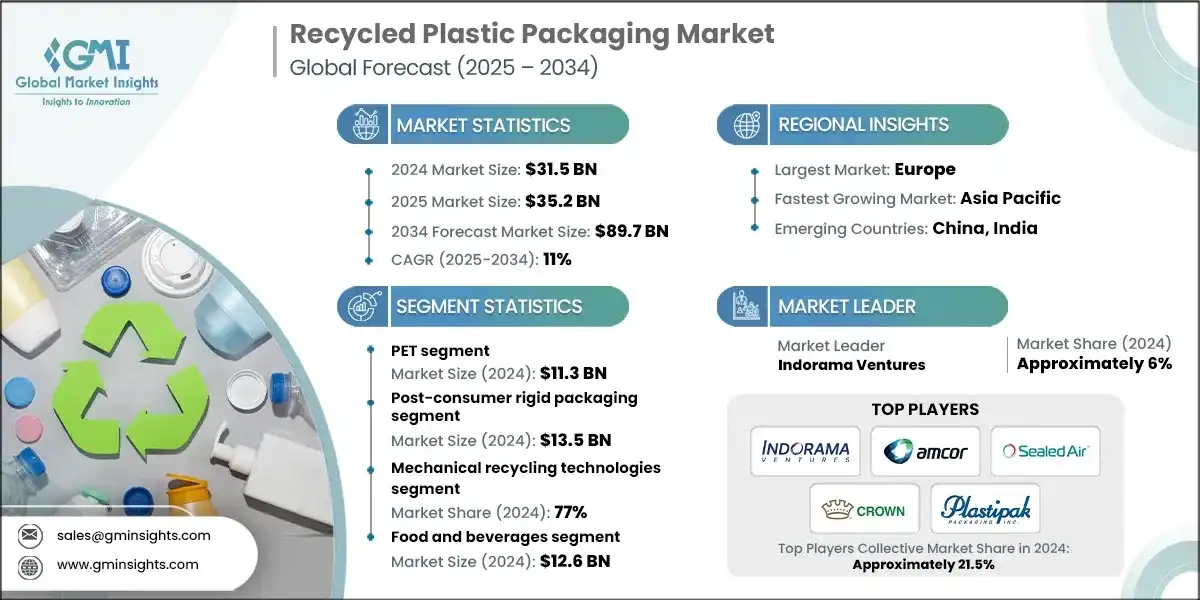
The global recycled plastic packaging market was valued at USD 31.5 billion in 2024. It is projected to grow from USD 35.2 billion in 2025 to USD 89.7 billion by 2034, representing 11% CAGR from 2025 to 2034, according to latest report published by Global Market Insights Inc.
To get key market trends
- The market of recycled plastic packaging has been recording healthy growth owing to the high requirements of the regulations and the introduction of the Extended Producer Responsibility (EPR) policies in the leading economies. Governments are setting targets for recycling and punishing the use of non-recyclable plastics forcing manufacturers to switch to recycled materials. The policies also increase the level of responsibility among producers and further increase investments in circular packaging solutions resulting in an improved market ecosystem as a whole.
- Simultaneously, evolving corporate sustainability and an ESG committal have turned out to be a key driver in market growth. Top brands and FMCG firms are including recycled content requirements into their packaging line to achieve the sustainable requirements of the world, as well as to improve their brand image. This corporate change towards circularity is motivating the use of recycled resins on a large scale and is influencing industries long-term demand.
- Market awareness has also become a force that is driving market development. The increasing demand for environmentally friendly and circular packaging among customers who have become sensitive to the environment is forcing brands to be inventive in using recycled package designs. This shift in consumerism is not only driving the consumption of the post-consumer recycled plastics but also providing the opportunity to develop new products and high-quality sustainable products.
- Furthermore, the increase in collection and sorting capacity has led to a high quality and quantity of recycled feedstock. The recycling process is being improved and the level of contamination decreased due to investments in waste management systems and high-level sorting technologies. It is this enhanced infrastructure that is guaranteeing a steady availability of high quality recycled material, scalable production and allows manufacturers to satisfy the continued sustainability based demand.
Recycled Plastic Packaging Market Report Attributes
| Key Takeaway | Details |
|---|---|
| Market Size & Growth | |
| Base Year | 2024 |
| Market Size in 2024 | USD 31.5 Billion |
| Market Size in 2025 | USD 35.2 Billion |
| Forecast Period 2025 - 2034 CAGR | 11% |
| Market Size in 2034 | USD 89.7 Billion |
| Key Market Trends | |
| Drivers | Impact |
| Regulatory mandates and extended producer responsibility (EPR) requirements | Accelerate adoption of recycled plastic packaging through compliance-driven demand. |
| Increasing corporate sustainability and ESG commitments | Push brands to integrate recycled content into packaging portfolios. |
| Rising consumer demand for eco-friendly and circular packaging | Fuels market growth by influencing brand choices and packaging redesigns. |
| Improved collection and sorting infrastructure for post-consumer plastics | Enhances feedstock availability and consistency for recycled packaging production. |
| Pitfalls & Challenges | Impact |
| Feedstock quality variability and contamination in recovered plastics | Undermines processing efficiency and final product performance. |
| Limited availability of high-grade post-consumer resin (PCR) | Constrains supply premium and food-grade packaging applications. |
| Technical constraints for food-contact safety and regulatory approval | Restrict recycled content usage in regulated packaging segments. |
| Opportunities: | Impact |
| Growing investment in closed-loop recycling systems and circular supply chains | Strengthens supply chain resilience and recycled material throughput. |
| Rising demand for bio-based and hybrid recycled materials | Opens new product development avenues in sustainable packaging. |
| Emergence of digital traceability solutions for recycled-content verification | Build trust and transparency in recycled content claims for packaging. |
| Market Leaders (2024) | |
| Market Leaders |
Market Share Approximately 6% |
| Top Players |
Collective Market Share Approximately 21.5% |
| Competitive Edge |
|
| Regional Insights | |
| Largest Market | Europe |
| Fastest growing market | Asia Pacific |
| Emerging countries | China, India |
| Future outlook |
|
What are the growth opportunities in this market?
Recycled Plastic Packaging Market Trends
- There is a trend in the market towards high post-consumer recycled (PCR) content packaging. Major consumer products and retail corporations are now placing targets for integrating a greater percentage of PCR materials in their product packaging portfolios. This tendency is increasing the demand of quality recycled resins and triggers new investments into recycling technologies and infrastructure to guarantee the stable provision of appropriate materials.
- The other major trend is the increased use of mono-material and design-to-recycling types of packaging systems. The manufacturers are shifting to the packaging which makes use of one kind of plastic to make the collection, sorting and recycling easier. The change will contribute to increased recyclability, decreased material contamination, and the further shift to circular and resource-efficient packaging systems, in general.
- Infrastructure and improvement through technology is also becoming a critical factor to transforming the industry. The efficiency and quality of the recycling processes is getting better with the introduction of automated sorting systems, advanced recycling systems, and digital tracking solutions. Such innovations are facilitating increased recycling of used plastics, which are contributing to the industry to achieve the increasing sustainability requirements.
- Also, the attention to the market expansion in developing economies is growing. A significant amount of waste management and recycling infrastructure is being invested in in countries in the Asian-Pacific region, Latin America, and some parts of Africa. The regional development is also offering new plastic recycling packaging opportunities owing to increased urbanization, regulatory encouragement and awareness of recycled plastic packaging
Recycled Plastic Packaging Market Analysis
Learn more about the key segments shaping this market
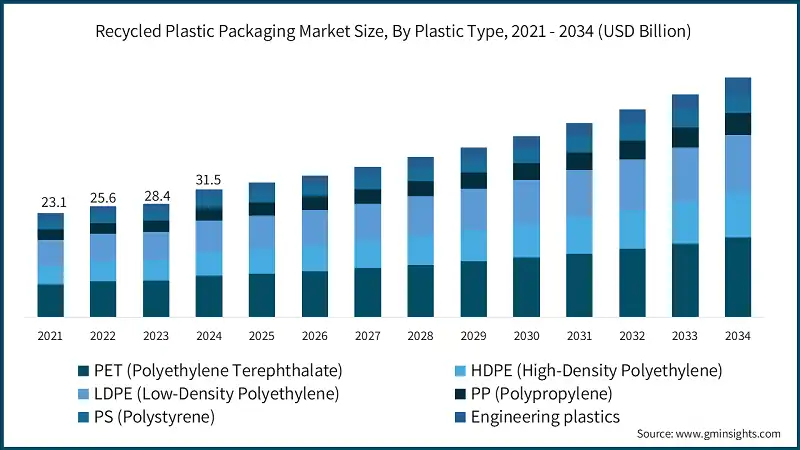
Recycled plastic packaging industry based on plastic type, segmented into PET (Polyethylene Terephthalate), HDPE (High-Density Polyethylene), LDPE (Low-Density Polyethylene), PP (Polypropylene), PS (Polystyrene), and Engineering plastics. The PET segment was valued at USD 11.3 billion in 2024, and it is anticipated to expand to 12.3% of CAGR during 2025-2034.
- Recycled plastic packaging is enjoying consistent growth of various types of plastics with PET and HDPE being the most popular products used in packaging of food, beverages and personal care products. PET is clear and strong and that is why it is preferable in bottles and containers, and HDPE has strength which allows its application in rigid packaging like household and industrial containers. The number of investments in cutting-edge recycling technologies is also increasing, which contributes to a higher rate of recovery and reuse of these materials, which helps to maintain the growth of their market.
- Recycling systems are also adopting LDPE, PP and PS as the systems are becoming more flexible to tackle the flexible and multi-layered packaging. The use of LDPE is more and more recycles into films and bags, and the use of PP is more versatile, with its application as caps, pouches, and containers. Specialty packaging is an area that is being explored by utilizing engineering plastics, which require high performance and sustainability. The net expansion of the markets in these segments is enabled by better sorting technology, design-to-recycle, and an increase in the adoption of the circular packaging material by the final consumers.
Recycled plastic packaging market based on source material segmented into post-consumer rigid packaging, post-consumer flexible packaging, post-industrial waste, ocean & environmental plastics, and commercial & institutional waste. The post-consumer rigid packaging segment was valued at USD 13.5 billion holding a market share of 43% in 2024.
- The market is growing because post-consumer rigid and flexible packaging the ability to recycle is being enhanced. The rigids packaging including bottles, containers and jars is also being recovered and recycled efficiently by means of improved collection scheme and improved mechanical recycling. In the meantime, post-consumer flexible packaging, which is hard to recycle, has experienced an increase in recovery via chemical recycling and mono-material design projects. These innovations are expanding the recyclable sources and enhancing the recyclable supply chain.
- Ocean or environmental plastic waste and post-industrial waste are developing as alternative sources of materials that are becoming valuable as second-use sources of materials. The manufacturers are also shifting towards sustainability objectives, and the circular economy by utilizing production scrap and recovered marine plastics into new forms of packaging. Also, the recycling of commercial and institutional waste including packaging used in retail and hospitality industries- is also contributing to the total feedstock. This diversified sourcing strategy is improving the reliability of material supply and is facilitating an unceasing expansion of the market.
Recycled plastic packaging market based on recycling process, segmented into mechanical recycling technologies, chemical recycling technologies, advanced physical recycling, and hybrid processing systems. The mechanical recycling technologies segment was valued at USD 24.5 billion in 2024, with a market share of 77%.
- Growth is being witnessed in the market with the continued use of mechanical recycling technologies to process such common packaging plastics as PET, HDPE and PP which continue to be improved in sorting, washing, and extrusion systems to improve the quality of resin and yield efficiency. This procedure is still the foundation of recycled plastic packaging because it is relatively cheap and has developed infrastructure specifically in case of post-consumer rigid packaging.
- The technological range of the market is widening by chemical recycling, sophisticated physical recycling as well as hybrid processing systems. Chemical recycling is facilitating transformation of mixed or low quality plastics to high quality feedstock which can be used in food grade. The use of advanced physical and hybrid systems involves mechanical and chemical processes that are utilized to make the most out of recovery efficiency and material quality. The increased adoption of these new innovative processes is enhancing the recyclability of different types of plastics and the emergence of new value streams in the recycled plastic packaging system.
Learn more about the key segments shaping this market
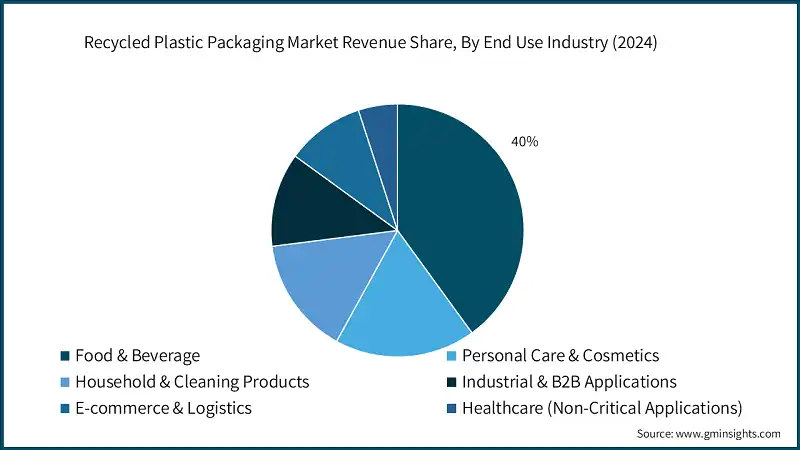
Food and beverages end use industry segment was valued at USD 12.6 billion in 2024, and it is anticipated to expand with a CAGR of 12.3% in the forecasted period and holds a market share of 40% in 2024.
- The food and beverage industry is one of the major expansion territories of recycled plastic packages as the global brands have become more sustainability-driven, and more consumers are ready to use the bottles and containers made of recycled material. PET and HDPE recycled are popular in the recycling of water bottles, beverages containers and food trays because manufacturers are more concerned with the circular format of packaging that is both safe and performance related. Other companies, including personal care, cosmetics, and home product producers, are also using recycled plastics to ensure that their brands are environmentally friendly and they are not as reliant on virgin plastics.
- New opportunities in the recycled packaging demand are being developed in the industrial, e-commerce, and healthcare segments. In the industrial and B2B market, recycled plastics are being used in containers, drums and other protective packaging that are durable and in e-commerce site; recycled plastics are being used in flexible packaging to reduce waste. Healthcare is another sector where non-critical applications including disposable trays, outer packaging and transport containers are switching to recycled materials. This diversified application in industries is pushing a steady rise in market and creating a robust circular economy system.
Looking for region specific data?
The North America recycled plastic packaging market accounted for USD 7.8 billion in 2024 and is anticipated to show lucrative growth over the forecast period.
Recycled plastic packaging industry in North America is growing with good support of regulation, corporate sustainability programs and the increasing eco-friendly packaging preference in the market by consumers. Government requirements promoting the use of recycled materials and investing in the circular economy are causing the extensive adoption in food, beverage, and personal care industries. The strong and stable infrastructure in the collection system of the region together with the fast development of mechanical and chemical recycling technologies is guaranteeing a stable supply of recycling in high quality resins. Furthermore, the collaboration between recyclers, packaging manufacturers, and brand owners consolidates the circle of the value chain of the market, enhancing its overall value.
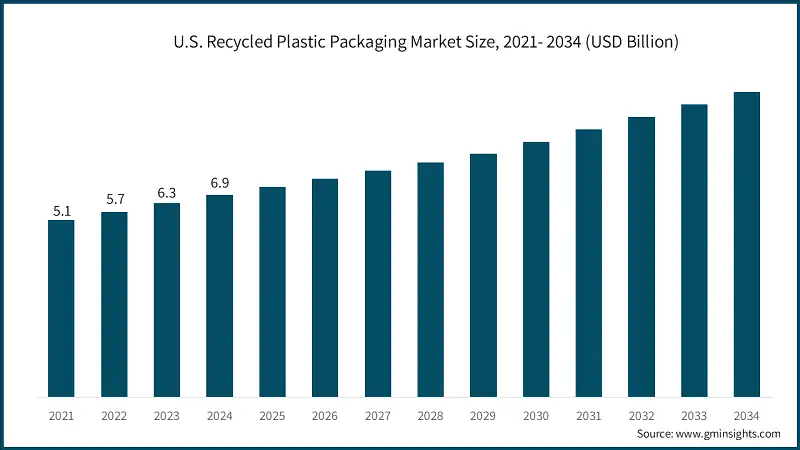
U.S. dominates the North America recycled plastic packaging market, showcasing strong growth potential.
The U.S. is a major growth opportunity that has federal and state level policies that support post-consumer recycled content. Firms are becoming more committed to using increased percentages of PCR in packaging to achieve sustainability and ESG objectives. The beverage, cosmetics, and household products giants are front runners in recycling partnerships to enhance material salvaging. Recycling is improving its capacity and efficiency as continuous investment in chemical recycling startups and retrofitted material recovery facilities (MRFs) are increasing. The innovations have seen the U.S. emerge as a leader in scalable, sustainable packaging growth in North America.
The Europe market accounted for USD 11.1 billion in 2024 and is anticipated to show lucrative growth over the forecast period.
The recycled plastic packaging market in Europe is developing at a high pace due to strict EU policies, including the Packaging and Packaging Waste Directive, and the Circular Economy Action Plan. The emphasis on the realization of recycling rates and the decrease in plastic wastes production is creating momentum in the market. European nations are also developing closed loop systems which focus on design-to-recycle and post-consumer content. The trend of regional change is supported by increased brand commitments and brand awareness, which compels manufacturers to scale up to using sustainable packaging solutions.
Germany dominates the Europe recycled plastic packaging market, showcasing strong growth potential.
Germany still remains prominent in the recycled plastic packing industry in Europe. The well-organized recycling system, effective recycling collection systems and very powerful policy implementation help in ensuring high recycling rates of PET and HDPE. Mechanical and chemical recycling are being adopted by companies to achieve national goals in terms of circular packaging. Recyclers, converters of packaging, and large FMCG brands are working together to facilitate the innovations in recycled-content packaging. These developments are putting Germany in a good position to be a model market in efficient and sustainable packaging practices in Europe.
Asia Pacific recycled plastic packaging market is anticipated to grow at a CAGR of 11.6% during the analysis timeframe.
Recycled plastic packaging in the Asia-Pacific region is also growing faster due to rapid industrialization, urbanization and changes in policy to sustainability. The governments are increasing their control over the management of plastic waste, including investments in recycling and the use of environmentally friendly packaging. The growing consumer environmental awareness that comes with the growing demands of the food, beverage and e-commerce industries is generating a great market potential. Material recovery rates are further being improved by infrastructure development and the emergence of local recycling.
China recycled plastic packaging market is estimated to grow with a significant CAGR, in the Asia Pacific market.
The country of China is becoming a significant growth driver in the Asia-Pacific market that is being driven by stringent national recycling policies and government-led sustainability projects. The attention of the country towards the need to reduce single-use plastics and create zones of a circular economy has triggered the large-scale financial interest in sophisticated recycling technologies. Domestics are also increasing their activities to process more high quality recycled resins as demand rises. Also, MNCs in China are incorporating recycled materials in their packaged products to meet the requirement in the country and to attract eco-friendly customers.
The Latin America recycled plastic packaging market accounted for 6% market share in 2024 and is anticipated to show lucrative growth over the forecast period.
The recycled plastic packaging industry in Latin America is changing as the governments in the region embrace more stringent environmental conservation policies and waste disposal systems. The nations are also allocating more resources towards collection and recycling systems in order to decrease reliance on landfills. The establishment of sustainable packaging programs in the beverage, personal care, and food producers is increasing the uptake in the region. The integration of the private and government sectors is also increasing accessibility to waste and recycling networks and innovation in the flexibility of packaging recovery.
Brazil leads the Latin America recycled plastic packaging market, exhibiting remarkable growth during the analysis period.
Recycled plastic packaging development is focusing on Brazil as a Latin-American center with the growth of sustainable corporate sustainability and recycling economic development strategies. The feedstock supply chain is being reinforced by the recycling cooperatives and the community-based collection systems within the country. Beverage and FMCG industries are on the forefront in using recycled bottles of PET and HDPE containers. Technological changes are being boosted by government incentives and recycling alliances established by industries, making Brazil increasingly high in an attempt to transform the sustainable packaging in the region.
Middle East & Africa recycled plastic packaging market is expected to grow at a CAGR of 10.7% during the analysis timeframe.
Recycled plastic packaging solutions are slowly being embraced by the Middle East and Africa region in the quest to achieve sustainability which is becoming a critical policy and business agenda. The national environmental strategies are facilitating the increase of investments in waste management, plastic recovery, and recycling infrastructure. The increase in industrialization, as well as brand-directed sustainability in packaging, is triggering growth in the region. Food, beverage, and logistics are the industries that are especially increasing the amount of demand for recycled materials.
Saudi Arabia recycled plastic packaging market to experience substantial growth in the Middle East and Africa market in 2024.
The Saudi Arabian market has robust growth in recycled plastic packaging due to the efforts during the aspects of Vision 2030 that places great focus on the development of the circular economy. The government and the private sector are joining together to set up large-scale recycling industries and efficiency in waste collection. Recycled plastics are being used to package products in local industries with the aim of achieving sustainability. These are contributing towards the development of a domestic recycling system, which will contribute to the ecological well-being of the environment as well as industrial diversification.
Recycled Plastic Packaging Market Share
- Indorama Ventures, Amcor plc., Sealed Air Corporation, Plastipak Holdings, Inc., and Crown Holdings, Inc. are a significant part of the global recycled plastic packaging industry and with the further standing of being fragmented with the top five players steadily holding 21.5% market share in the year 2024.
- Recycled plastic packaging market is characterized by competitive dynamics of strategic partnerships, constant innovation, and sustainability-based measures by the major players in the world market. Companies are also investing in newer and improved recycling systems, such as chemical and hybrid systems, to improve on the quality and flexibility of recycled resins.
- Companies have focused on innovation in their packaging design, material performance and recyclability hence they have been able to address the changing regulatory standards and customer demands. By these efforts, besides enhancing their operational efficiency, they are also making sure that they are competitive in the long term in an environmentally responsible market.
- The cooperation between the resin manufacturers, the recyclers and the packaging converters has made possible the establishment of closed-loop systems that guarantee the availability of feedstock and control of quality.
- Businesses are now forming joint ventures and supplier contracts to gain access to recycled materials after the consumer. These partnerships will add value to reliance on virgin plastics and support a sustainable business model that is consistent with the principles of the circular economy.
- These players are very interested in sustainability branding and transparency in order to ensure their survival in the market. They are establishing high recycled-content goals, are releasing yearly sustainability reports as well as acquiring third-party certifications to confirm their green assertions. This has been a promise of accountability that has boosted brand credibility and consumer trust.
- Moreover, numerous businesses are becoming more active in developing countries by funding the local recycling systems, which do not only contribute to the development of the region but also guarantee that the waste management rules applicable to the country in particular, are followed.
- Technological development is one of the key distinguishing factors in this competitive arena. The industry leaders are embracing the use of digital traceability systems, artificial intelligence-based sorting machines, and sophisticated processing systems to enhance the effectiveness of material recovery and minimization of contamination.
- The combination of both innovation and scale allows them to generate high-quality recycled material that can be used in packaging food grade and high-performance. With this technological advantage, they will be able to support the increasing demand in the key end-use segments including food, beverage, personal care, and e-commerce.
- Strategic actions of these businesses have impacted greatly on the development of the recycled plastic packaging market. Their aggressive sustainability, technological adaptation, and supply chain integration practices have enhanced the process of transforming the industry into a circle.
Recycled Plastic Packaging Market Companies
The major players operating in recycled plastic packaging industry include:
- Indorama Ventures
- Amcor plc.
- Sealed Air Corporation
- Plastipak Holdings, Inc.
- Crown Holdings, Inc.
- Others
- Indorama Ventures aims at enhancing its leadership by building huge capacity in Recycling and vertical integration in the PET value chain. To achieve the circular economy and global brand-building strategy, the company heavily invests in advanced mechanical and chemical recycling facilities to guarantee the continuous availability of high-quality recycled PET to use in packaging purposes.
- Amcor plc. maintains its niche in the market through constant innovation in recyclable and recycled material packaging. The company focuses on designs that are lightweight, mono material structure and collaboration with recyclers in order to achieve sustainability goals of clients. Its high level of R&D and international presence enables it to provide tailored and environmentally friendly packaging of high-volume FMCG brands.
- Sealed Air Corporation has been able to remain by its implementation of technological advancement and utilization of advanced recycled materials in the protection and food packaging. The company spends on closed- loop recycling systems, and smart packaging technology to minimize waste and carbon footprint. Its sustainable packaging solutions are competitive advantages because it is focused on material efficiency and circular design of products.
- Plastipak Holdings, Inc. maintains growth by having wide recycling activities and having in-house production of resin to produce high quality PET packaging. The company has several recycling facilities around the world that make the packaging products of the company have a circular supply chain. The fact that it uses recycled PET to make food and beverage containers indicates great conformity to the concept of sustainability and client-responsive environmental objectives.
- Crown Holdings, Inc. strengthens its position in the market through the diversification of the sustainable plastic packaging options and the expansion of recycling collaborations. The company emphasizes lightweight and recyclable packaging innovations with sponsorship of material recovery programs. This is because of its current sustainability programs and partnership with brand owners.
Recycled Plastic Packaging Industry News
- In April 2025, Huhtamaki took over Zellwin Farms to increase its presence in moulded-fibre and then introduced new recyclable/compostable ice-cream cups in mid-2025. These actions augmented the accessibility of fiber-backed and recyclable substitutes and strained the market to material-efficient and recyclable packaging options available.
- In April 2025, Novolex finalized its acquisition of Pactiv Evergreen Inc. (trade value of around USD 6.7 billion) combining their production and recycling base in North America and Europe. This merger increases the ability to recycle-rich packaging and improves the resilience of supply chains of PCR plastics in the packaging industry.
- In March 2025, majority stake in Aluflexpack acquired by Constantia Flexibles made a final move of acquiring a majority stake in Aluflexpack, following previous steps towards the deal in 2024 and announced major investments in product-portfolios; the move enlarged the options of flexible packaging with recyclable laminates and metal based laminates, making more recyclable formats available to brand customers.
- In January 2025, International Paper successfully acquired DS Smith (scheme effective date) after regulatory clearances; the integration was to form a scale in sustainable fiber-based packaging and recycling offer that indirectly influenced competitive moves in plastic-to-fiber substitution and recycling alliances in the packaging business.
- In November 2024, Banyan Nation had a seed investment of approximately $800,000 to expand its high-technology plastic cleaning and rHDPE/rPP resin operations; the investment would add capacity to traceable recycled resin production and facilitate more supply of high-quality PCR to regional brand development.
- In November 2024, Amcor finished the merger with Berry Global on April 30, 2025, after the announcement of the deal, forming an increased packaging group with a strong ability to provide packaging solutions with recycled content to a greater number of markets and increased investment capacity in the field of circular packaging.
The recycled plastic packaging market research report includes in-depth coverage of the industry with estimates & forecast in terms of revenue (USD Billion) & (Kilo Tons) from 2021 to 2034, for the following segments:
Market, By Plastic Type
- PET (Polyethylene Terephthalate)
- Clear PET (bottles, containers)
- Colored PET (non-food applications)
- PET-G (enhanced clarity/durability)
- rPET Flakes vs. rPET Pellets
- HDPE (High-Density Polyethylene)
- Natural HDPE (milk jugs, detergent bottles)
- Colored HDPE (non-food containers)
- HDPE Film Applications
- LDPE (Low-Density Polyethylene)
- LDPE Films (shopping bags, wraps)
- LDPE Rigid Applications
- LDPE Foam Applications
- PP (Polypropylene)
- PP Rigid (containers, caps)
- PP Films (flexible packaging)
- PP Non-woven (textiles, hygiene)
- PS (Polystyrene)
- Expanded PS (EPS foam)
- General Purpose PS (rigid packaging)
- High Impact PS (HIPS)
- Engineering Plastics
- PVC (limited recycling applications)
- PC (Polycarbonate)
- Multi-layer Structures
Market, By Source Material
- Post-Consumer Rigid Packaging
- Beverage Bottles (PET/HDPE)
- Food Containers (PP/PS)
- Personal Care Bottles (HDPE/PET)
- Household Chemical Containers
- Post-Consumer Flexible Packaging
- Shopping Bags (LDPE/HDPE)
- Food Wraps & Films (PE/PP)
- Multi-layer Barrier Films
- Pouches & Sachets
- Post-Industrial Waste
- Manufacturing Trim & Scrap
- Defective Products and Production Overruns
- Converting Waste
- Ocean & Environmental Plastics
- Marine Debris Collection
- Coastal Collection Programs
- River Interception Systems
- Commercial & Institutional Waste
- Office Building and Retail Waste
- Restaurant & Food Service
- Healthcare Facilities (non-contaminated)
Market, By Recycling Process
- Mechanical Recycling Technologies
- Basic Wash & Pelletize
- Advanced Sorting (AI/NIR)
- Compatibilizer-Enhanced Processing
- Super-Clean Processing
- Chemical Recycling Technologies
- Pyrolysis (thermal breakdown)
- Depolymerization (monomer recovery)
- Gasification (syngas production)
- Solvolysis (solvent-based)
- Advanced Physical Recycling
- Dissolution & Precipitation
- Supercritical Fluid Processing
- Enzymatic Processing
- Hybrid Processing System
- Mechanical + Chemical Integration
- Multi-stage Processing
- Cascade Recycling Systems
Market, By End Use Industry
- Food & Beverage
- Beverage Bottles (carbonated/non-carbonated)
- Food Containers (ready meals, dairy)
- Barrier Applications (oxygen/moisture sensitive)
- Single-serve Packaging
- Personal Care & Cosmetics
- Shampoo/Body Care Bottles
- Cosmetic Containers and Pump Dispensers
- Luxury Packaging (limited rPET)
- Household & Cleaning Products
- Detergent and Cleaning Product Containers
- Air Care and Automotive Care Products
- Industrial & B2B
- Chemical Containers (non-hazardous)
- Agricultural and Construction Materials
- Automotive Components
- E-commerce & Logistics
- Protective Packaging and Shipping Containers
- Void Fill Materials
- Temperature Control Packaging
- Healthcare (Non-Critical Applications)
- Over-the-Counter Packaging
- Medical Device Packaging (non-sterile)
- Supplement and Diagnostic Kit Packaging
The above information is provided for the following regions and countries:
- North America
- U.S.
- Canada
- Europe
- UK
- Germany
- France
- Italy
- Spain
- Rest of Europe
- Asia Pacific
- China
- India
- Japan
- South Korea
- Australia
- Rest of Asia Pacific
- Latin America
- Brazil
- Mexico
- Argentina
- Rest of Latin America
- MEA
- UAE
- Saudi Arabia
- South Africa
- Rest of Middle East and Africa
Frequently Asked Question(FAQ) :
What are the key trends shaping the recycled plastic packaging industry?
Major trends include the adoption of high post-consumer recycled (PCR) content, mono-material and design-to-recycle packaging, digital traceability solutions, and growing investments in hybrid and chemical recycling technologies.
Which region leads the recycled plastic packaging industry in 2024?
The North America industry was valued at USD 7.8 billion in 2024. Growth is driven by supportive government regulations, expanding circular economy initiatives, and corporate sustainability commitments across the food, beverage, and personal care sectors.
Who are the key players in the recycled plastic packaging market?
Key players include Indorama Ventures, Amcor plc, Sealed Air Corporation, Plastipak Holdings, Inc., and Crown Holdings, Inc. These companies focus on advanced recycling technologies, sustainability-driven innovation, and circular supply chain integration.
How much revenue did the food & beverage end-use industry generate in 2024?
The food & beverage industry generated USD 12.6 billion in 2024, capturing a 40% market share, supported by brand commitments toward circular packaging and growing consumer acceptance of recycled containers.
How much revenue did the PET (Polyethylene Terephthalate) segment generate in 2024?
The PET segment generated USD 11.3 billion in 2024, driven by its wide use in bottles and containers across the food, beverage, and personal care industries due to its clarity and strength.
What is the market size of the recycled plastic packaging industry in 2024?
The market size was USD 31.5 billion in 2024, with a CAGR of 11% expected through 2034 driven by growing regulatory mandates, corporate sustainability goals, and circular economy initiatives.
What was the valuation of the post-consumer rigid packaging segment in 2024?
The post-consumer rigid packaging segment was valued at USD 13.5 billion in 2024, holding a 43% market share, driven by improved collection systems and advancements in mechanical recycling.
What was the valuation of the mechanical recycling technologies segment in 2024?
Mechanical recycling technologies held a market value of USD 24.5 billion in 2024, accounting for 77% share, supported by its cost-effectiveness and established infrastructure for PET, HDPE, and PP packaging.
What is the projected value of the recycled plastic packaging market by 2034?
What is the projected value of the recycled plastic packaging market by 2034?
What is the current recycled plastic packaging market size in 2025?
The market size is projected to reach USD 35.2 billion in 2025.
Recycled Plastic Packaging Market Scope
Related Reports