Summary
Table of Content

Recirculating Aquaculture System Market
Get a free sample of this report
Form submitted successfully!
Error submitting form. Please try again.
Thank you!
Your inquiry has been received. Our team will reach out to you with the required details via email. To ensure that you don't miss their response, kindly remember to check your spam folder as well!
Request Sectional Data
Thank you!
Your inquiry has been received. Our team will reach out to you with the required details via email. To ensure that you don't miss their response, kindly remember to check your spam folder as well!
Form submitted successfully!
Error submitting form. Please try again.
Recirculating Aquaculture System Market Size
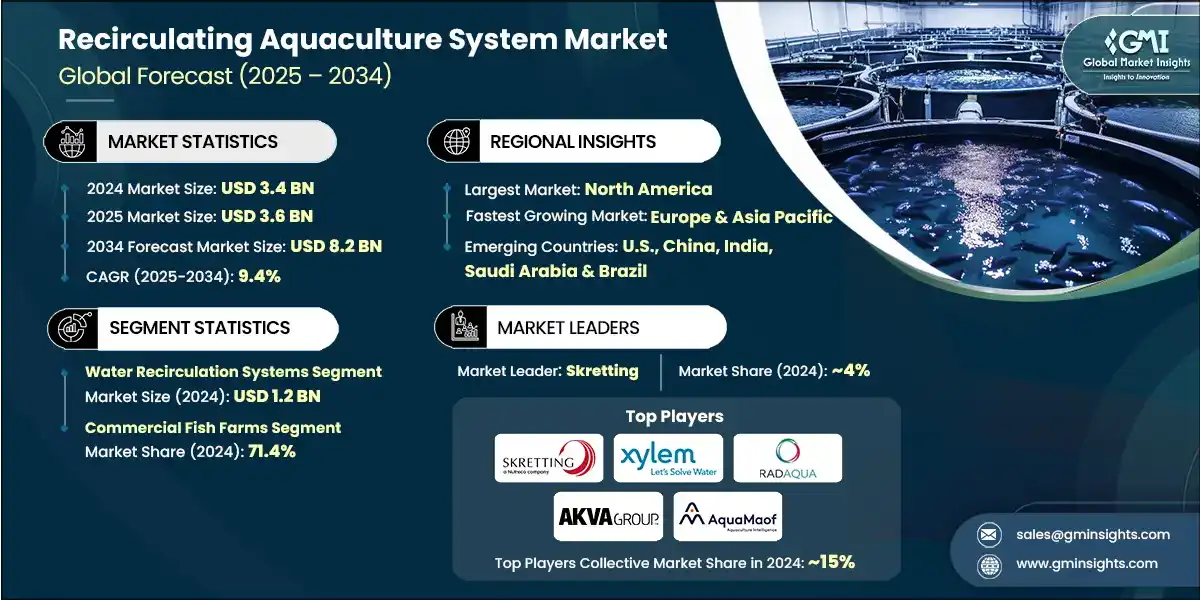
The global recirculating aquaculture system market was estimated at USD 3.4 billion in 2024. The market is expected to grow from USD 3.6 billion in 2025 to USD 8.2 billion in 2034, at a CAGR of 9.4%, according to latest report published by Global Market Insights Inc.
Recirculating Aquaculture System Market Key Takeaways
Market Size & Growth
- 2024 Market Size: USD 3.4 billion
- 2025 Market Size: USD 3.6 billion
- 2034 Forecast Market Size: USD 8.2 billion
- CAGR (2025–2034): 9.4%
Regional Dominance
- Largest Market: North America
- Fastest Growing Region: Europe & Asia Pacific
Key Market Drivers
- Rising demand for sustainable aquaculture.
- Increasing global seafood consumption.
- Technological advancements in water treatment.
Challenges
- High initial capital investment.
- Complex system design and operation.
Opportunity
- Urban aquaculture expansion.
- High-value species farming.
- Integration with renewable energy systems.
Key Players
- Market Leader: Skretting led with over 4% market share in 2024.
- Leading Players: Top 5 players in this market include Skretting, Xylem, RADAQUA, AKVA Group, AquaMaof, which collectively held a market share of 15% in 2024.
Get Market Insights & Growth Opportunities
- The recirculating aquaculture system (RAS) market is expanding rapidly, due to rising demand for sustainable practices in aquaculture. Traditional aquaculture is facing environmental challenges such as water pollution, habitat destruction, and disease outbreaks. This has led to a move toward greener and more sustainable aquaculture alternatives. RAS is a system that minimizes water use, lowers waste discharge, and provides controlled farming conditions to minimize environmental concerns. This makes it one of the most sustainable aquaculture methods. Governments and regulatory agencies are globally pushing for stronger and more strict environmental requirements and offering incentives to aquaculture producers to engage in sustainable practices. For example, the European Union has committed more than EUR 6 billion under the European Maritime and Fisheries Fund (EMFF) in support of sustainable aquaculture practices, including RAS. As sustainability becomes a priority, RAS is an emerging preferred technology that provides long-term resource efficiency and environmental compliance.
- The global consumption of seafood is increasing with population growth, urbanization, and the increasing awareness of the health benefits (high protein and omega-3 fatty acids) of seafood. According to the Food and Agricultural Organization (FAO), consumption of fish is projected to continue to rise from the current level of 20.5 kilograms per capita in 2023, which is a dramatic increase from 9 kilograms in the 1960s. However, wild fish stocks face significant pressures because of overfishing and climate change, which is amplifying the gap between supply and demand. RAS systems bridge this gap by enabling year-round production in controlled environments and in any geographic or seasonal restriction. This helps to meet the consistent and secure supply of seafood products, particularly of higher valued species such as salmon, trout, and shrimp, that are being demanded in increasingly greater quantities in developed and emerging markets. RAS also allows producers to optimize their production strategies and plans to meet global appetite and demand of high-value fish products.
- In fact, advances in water treatment systems and automation have begun to contribute to the RAS market. Modern RAS facilities utilize advanced technology for water treatment, including biofilters, UV sterilization, and automated monitoring systems to ensure that water quality and reduce disease risks. These technologies enable operators to control factors that are most important for fish growth, like oxygen levels, temperature, and pH, which contribute to optimal conditions for fish growth and feed conversion efficiencies. Similarly, RAS systems utilize IoT technology, artificial intelligence, and data analytics in managing their operations through real-time value monitoring systems, predictive analysis for operational maintenance, and general efficiency improvements. While these technologies continue to evolve, RAS units will become more scalable and cost-effective, making them possible for larger to smaller producers.
To get key market trends
Recirculating Aquaculture System Market Trends
Emerging technologies are changing the (RAS) recirculating aquaculture system industry by introducing advances in efficiencies, costs, integrating new technologies and time-saving methodologies.
- Automating routines, monitoring and tracking data with IoT, and analysing trends with AI and computer applications at modern RAS facilities is now standard when optimizing feeding, water quality, and waste management. Electricity and labour are two significant costs when operating aquaculture systems. New technologies equip RAS facilities with the necessary mechanisms for precise and efficient control of critical variables, like oxygen levels, temperature, and PH. Fish health, growth rates, and reductions in disease risks are linked to the efficiency and efficacy of precise and regulated environments as generated by data and technology. Energy-efficient filtration systems are becoming (temperature and pH) new standard features. Biosecurity measures are needed to reduce economic harm caused by diseases, injuries, or other biological incidents. RAS reduces long-term operational costs and other significant pressures on aquaculture operations and may lead to sustainable production farm practices. The use of smart technology in RAS not only saves time and increases operational efficiencies, but it enables real-time data analysis and predictive maintenance to support ongoing production and scaling operations on both large and small fish farms.
- In addition to integrating new technologies, RAS is gaining a foothold in urban aquaculture and land-based aquaculture projects around the globe. By utilizing recirculating technology, sustainable aquaculture production systems can exist in places where seafood production is a long distance from coastal areas or natural water bodies which reduces transportation costs due to closer proximity to consumer markets. A goal of urban RAS facilities is to meet the growing demand for locally sourced, high-quality seafood on a year-round basis despite seasonal or geographic restrictions. This initiative of urban RAS aquaculture in underserved areas is of economic significance for premium species, such as salmon, trout, and shrimp. These species sales contribute to consumer demand in developed and developing economies.
Recirculating Aquaculture System Market Analysis
Learn more about the key segments shaping this market
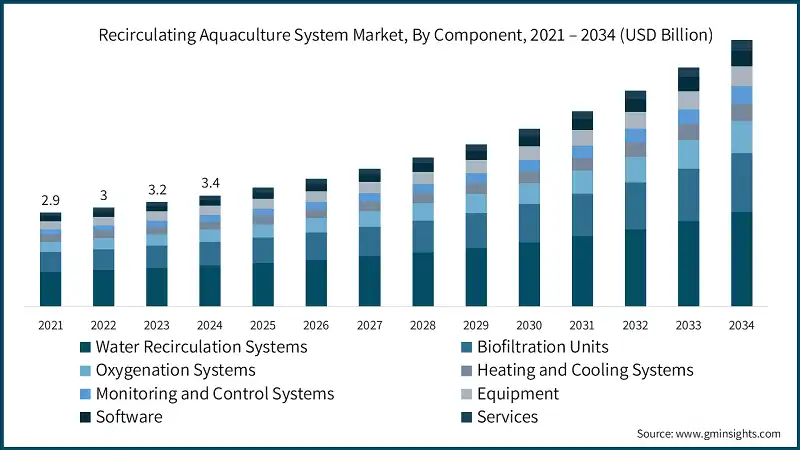
Based on component, the market is categorized into water recirculation systems, biofiltration units, oxygenation systems, heating and cooling systems, monitoring and control systems, equipment (tanks, pumps, aerators, etc.), software (real-time monitoring, analytics) and services (consulting, maintenance, training). The water recirculation systems accounted for revenue of around USD 1.2 billion in 2024 and is anticipated to grow at a CAGR of 9.1% from 2025 to 2034.
- These systems form the backbone of RAS by enabling continuous reuse of water, which significantly reduces freshwater consumption and minimizes environmental impact as a key factor as global regulations tighten around resource conservation and waste discharge. Water recirculation systems also maintain stable water quality by removing waste and controlling parameters such as temperature, oxygen levels, and pH, creating optimal conditions for fish growth and reducing disease risks.
- Additionally, advancements in filtration technologies and energy-efficient pumps have made these systems more cost-effective and scalable, encouraging adoption across both large commercial farms and smaller operations.
Learn more about the key segments shaping this market
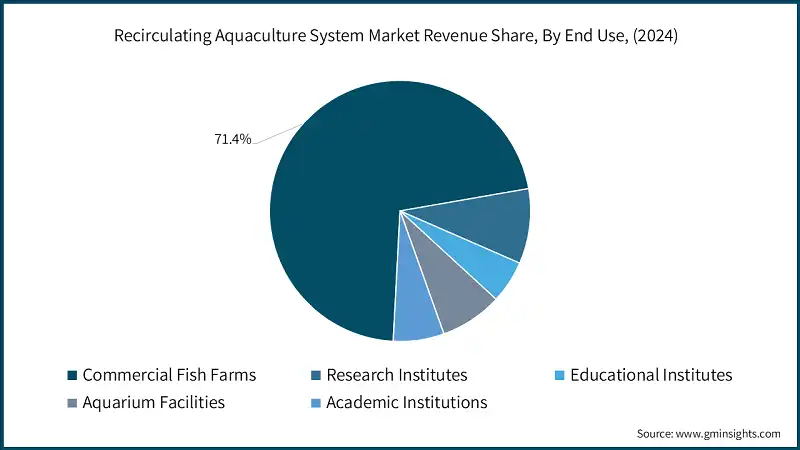
Based on end use, recirculating aquaculture system market consists of commercial fish farms, research institutes, educational institutes, aquarium facilities and academic institutions. The commercial fish farms emerged as leader and held 71.4% of the total market share in 2024 and is anticipated to grow at a CAGR of 9.2% from 2025 to 2034.
- These farms are under increasing pressure to adopt sustainable and efficient practices as wild fish stocks decline, and environmental regulations tighten. RAS technology offers commercial operators the ability to produce fish in controlled environments, ensuring consistent supply, better biosecurity, and reduced dependency on natural water bodies.
- Additionally, the ability to farm premium species such as salmon, trout, and shrimp year-round, regardless of geographic or seasonal constraints, makes RAS highly attractive for commercial operations. The integration of advanced monitoring systems, automation, and data analytics further enhances productivity and cost efficiency, enabling large farms to scale operations while maintaining quality standards.
Looking for region specific data?
North America Recirculating Aquaculture System Market
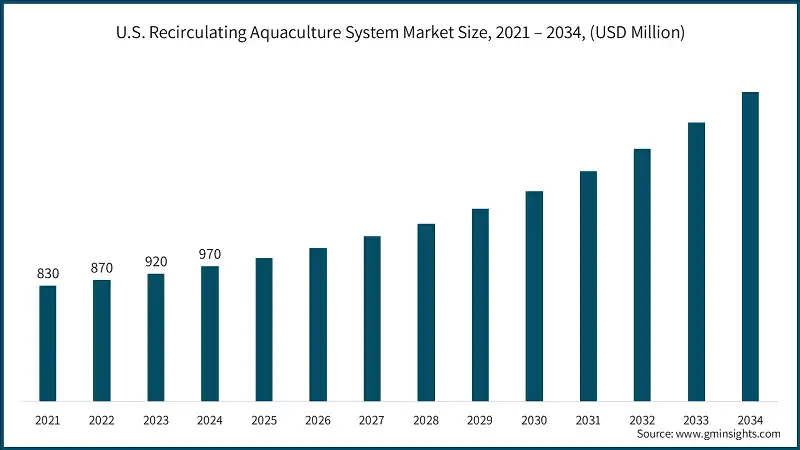
The U.S. dominates an overall North America market and valued at USD 970 million in 2024 and is estimated to grow at a CAGR of 8.9% from 2025 to 2034.
- The country has been at the forefront of adopting innovative technologies such as automated monitoring systems, IoT integration, and advanced water treatment solutions, which enhance operational efficiency and reduce environmental impact.
- Additionally, the U.S. market benefits from significant investments in land-based aquaculture projects, particularly for high-value species like salmon and trout, driven by the need to reduce reliance on imports and ensure year-round production. Stringent environmental regulations and sustainability certifications have further accelerated the shift toward RAS, as producers seek compliance while maintaining profitability.
Europe Recirculating Aquaculture System Market
In the European market, Germany held 29.4% market share in 2024 and is anticipated to grow at a CAGR of 9.3% from 2025 to 2034.
- The country has been proactive in adopting innovative aquaculture solutions to reduce dependency on wild fish stocks and meet the rising demand for high-quality, locally sourced seafood. RAS technology aligns perfectly with Germany’s sustainability goals by minimizing water usage, reducing waste discharge, and enabling controlled farming environments that ensure biosecurity and consistent production.
- Additionally, Germany’s robust research ecosystem and collaboration between technology providers and aquaculture operators foster continuous innovation in automation, water treatment, and monitoring systems.
Asia Pacific Recirculating Aquaculture System Market
In the Asia Pacific recirculating aquaculture system industry, the China held 37.6% market share in 2024 and is anticipated to grow at a CAGR of 9.7% from 2025 to 2034.
- As the world’s largest producer and consumer of seafood, China faces mounting pressure to reduce reliance on traditional open-water farming, which often leads to environmental degradation and disease outbreaks. RAS technology offers a solution by enabling controlled, land-based production that conserves water, minimizes waste, and ensures biosecurity. The Chinese government has introduced policies and funding programs to promote sustainable aquaculture practices, further accelerating RAS adoption.
Middle East and Africa Recirculating Aquaculture System Market
In the Middle East and Africa market, South Africa is expected to experience significant and promising growth from 2025 to 2034.
- The country faces increasing pressure to reduce reliance on traditional capture fisheries, which are vulnerable to overfishing and climate-related challenges. RAS technology offers a solution by enabling controlled, land-based production that conserves water, minimizes environmental impact, and ensures biosecurity. Government programs promoting food security and sustainable aquaculture practices are further encouraging investment in RAS infrastructure.
Recirculating Aquaculture System Market Share
- In 2024, the prominent manufacturers in recirculating aquaculture system industry are Skretting, Xylem, RADAQUA, AKVA Group and AquaMaof collectively held the market share of ~15%. These companies differentiate themselves through their expertise in water treatment, biofiltration, automation, and system integration, offering tailored solutions for commercial fish farms, research institutions, and urban aquaculture projects.
- Skretting, a global leader in specialized aquaculture nutrition, strengthens its position through integrated system solutions. The company allocates substantial resources to R&D, developing feeds specifically optimized for RAS environments. These innovations not only enhance growth rates and fish health but also significantly reduce waste. Additionally, Skretting leverages advanced digital platforms for feed management and performance monitoring, enabling farmers to make precise, data-driven decisions. With a strong emphasis on sustainability, their solutions minimize environmental impact and maximize resource efficiency, reinforcing their role as a trusted partner in high-value species farming.
- Xylem maintains its competitive edge by driving innovation in advanced water technologies. The company focuses on energy-efficient pumps, high-performance filtration systems, and cutting-edge oxygenation technologies, all designed to improve water quality and reduce operational costs in RAS facilities. By integrating IoT and smart monitoring tools, Xylem enables real-time tracking of water parameters and predictive maintenance, ensuring optimal conditions for fish growth. These solutions not only enhance operational efficiency but also align with sustainability standards, solidifying Xylem's position as a pivotal player in the RAS ecosystem.
Recirculating Aquaculture System Market Companies
Major players operating in the recirculating aquaculture system industry include:
- AKVA Group
- Aquacare Environment
- AquaMaof
- Billund Aquaculture
- Blue Planet Ecosystems
- Clewer Aquaculture
- Eyvi
- FRD Japan
- Hesy Aquaculture
- Nofitech
- PR Aqua
- Qingdao Haixing
- RADAQUA
- Skretting
- Xylem
RADAQUA distinguishes itself by delivering custom-engineered turnkey RAS facilities tailored to meet specific client requirements. The company prioritizes modular designs, offering scalability and flexibility to accommodate various species and production volumes. RADAQUA integrates advanced automation and AI-driven control systems to optimize feeding, water treatment, and biosecurity measures. Their innovation strategy also includes state-of-the-art biofiltration and CO2 degassing technologies, ensuring superior water quality and mitigating disease risks. This focus on engineering excellence and adaptability secures RADAQUA's competitive standing in global markets.
AKVA Group reinforces its leadership through comprehensive RAS technologies and integrated solutions. The company drives innovation with automated feeding systems, highly efficient oxygen cones, and advanced mechanical filtration technologies to optimize water quality. AKVA also offers semi-automatic cleaning systems and sludge reduction technologies, which significantly lower maintenance costs and enhance operational efficiency. By combining robust hardware with sophisticated digital monitoring platforms, AKVA enables farmers to precisely manage biological conditions, improving productivity and profitability.
Recirculating Aquaculture System Market Report Attributes
| Key Takeaway | Details |
|---|---|
| Market Size & Growth | |
| Base Year | 2024 |
| Market Size in 2024 | USD 3.4 billion |
| Market Size in 2025 | USD 3.6 billion |
| Forecast Period 2025 - 2034 CAGR | 9.4% |
| Market Size in 2034 | USD 8.2 billion |
| Key Market Trends | |
| Drivers | Impact |
| Rising demand for sustainable aquaculture | Accelerates adoption of RAS as an eco-friendly solution to reduce water usage and environmental impact. |
| Increasing global seafood consumption | Drives investment in RAS to ensure consistent, high-quality production and meet growing demand. |
| Technological advancements in water treatment | Enhances efficiency and scalability of RAS systems, making them more cost-effective and reliable. |
| Pitfalls & Challenges | Impact |
| High initial capital investment | Slows adoption among small and medium operators due to significant upfront costs. |
| Complex system design and operation | Requires specialized expertise and training, creating operational barriers for new entrants. |
| Opportunities: | Impact |
| Urban aquaculture expansion | Opens new markets for RAS by enabling seafood production in land-locked and metropolitan areas. |
| High-value species farming | Increases profitability for RAS operators by focusing on premium species like salmon and trout. |
| Integration with renewable energy systems | Reduces operational costs and strengthens sustainability credentials, attracting eco-conscious investors. |
| Market Leaders (2024) | |
| Market Leaders |
Market share of ~4% |
| Top Players |
Collective market share in 2024 is Collective market share of ~15% |
| Competitive Edge |
|
| Regional Insights | |
| Largest Market | North America |
| Fastest growing market | Europe & Asia Pacific |
| Emerging countries | U.S., China, India, Saudi Arabia & Brazil |
| Future outlook |
|
What are the growth opportunities in this market?
Recirculating Aquaculture System Industry News
- In March 2025, Innovasea forged a strategic alliance with AquaMaof, aiming to meld Innovasea's digital farming platform with AquaMaof's RAS facilities. This integration promises heightened real-time monitoring and optimized feeding across the unified systems.
- In June 2025, AquaMaof clinched a pivotal contract to deliver and set up a turnkey RAS facility for Leroy Seafood Group, marking a notable growth spurt for AquaMaof in the North Atlantic region.
- In December 2024, AKVA Group bolstered its portfolio by acquiring Aquaculture Systems Technologies, enhancing its suite of automation software and digital solutions tailored for recirculating aquaculture systems.
The recirculating aquaculture system market research report includes in-depth coverage of the industry, with estimates & forecast in terms of revenue (USD Billion) and volume (Thousand Feet) from 2021 to 2034, for the following segments:
Market, By Component
- Water recirculation systems
- Biofiltration units
- Oxygenation systems
- Heating and cooling systems
- Monitoring and control systems
- Equipment (tanks, pumps, aerators, etc.)
- Software (real-time monitoring, analytics)
- Services (consulting, maintenance, training)
Market, By System Type
- Indoor RAS
- Outdoor RAS
- Modular RAS
- Containerized RAS
- Freshwater RAS
- Saltwater RAS
- Hybrid RAS
- Integrated systems
- Specialized systems
Market, By Scale of Operation
- Small scale systems
- Medium scale systems
- Large scale systems
Market, By Species
- Finfish (salmon, trout, tilapia, catfish, sea bass)
- Shellfish (shrimp, lobster)
- Others
Market, By Application
- Commercial aquaculture
- Fish farming
- Shellfish farming
- Mollusk farming
- Aquatic plant farming
- Research & development
- Experimental aquaculture
- Urban aquaculture
- Species conservation
Market By End Use
- Commercial fish farms
- Research institutes
- Educational institutes
- Aquarium facilities
- Academic institutions
Market, By Distribution Channel
- Direct sales
- Indirect sales
The above information is provided for the following regions and countries:
- North America
- U.S.
- Canada
- Europe
- Germany
- UK
- France
- Italy
- Spain
- Asia Pacific
- China
- Japan
- India
- South Korea
- Australia
- Indonesia
- Malaysia
- Latin America
- Brazil
- Mexico
- Argentina
- MEA
- Saudi Arabia
- UAE
- South Africa
Frequently Asked Question(FAQ) :
What is the market size of the recirculating aquaculture system industry in 2024?
The market size was USD 3.4 billion in 2024, with a CAGR of 9.4% expected through 2034, driven by the rising demand for sustainable aquaculture and technological advancements in water treatment systems.
What is the current recirculating aquaculture system market size in 2025?
The market size is projected to reach USD 3.6 billion in 2025.
What is the projected value of the recirculating aquaculture system market by 2034?
The market is expected to reach USD 8.2 billion by 2034, driven by urban aquaculture expansion, high-value species farming, and integration with renewable energy systems.
How much revenue did the water recirculation systems segment generate in 2024?
Water recirculation systems generated USD 1.2 billion in 2024, leading the market with significant adoption due to their role in reducing water usage and improving sustainability.
What was the valuation of the commercial fish farms segment in 2024?
Commercial fish farms held 71.4% market share in 2024, driven by the growing demand for consistent, high-quality seafood production.
What is the growth outlook for the water recirculation systems segment from 2025 to 2034?
The water recirculation systems segment is projected to grow at a 9.1% CAGR till 2034, supported by advancements in biofiltration and oxygenation technologies.
Which region leads the recirculating aquaculture system market?
The U.S. dominates an overall North America market and valued at USD 970 million in 2024. The region's growth is fueled by strong demand for locally sourced seafood and government incentives promoting sustainable aquaculture practices.
What are the upcoming trends in the recirculating aquaculture system industry?
Key trends include the adoption of IoT-based monitoring, AI-driven analytics, and energy-efficient designs, along with the integration of renewable energy systems to enhance sustainability.
Who are the key players in the recirculating aquaculture system market?
Key players include AKVA Group, AquaMaof, Billund Aquaculture, Blue Planet Ecosystems, Clewer Aquaculture, Eyvi, FRD Japan, Hesy Aquaculture, Aquacare Environment, and Skretting.
Recirculating Aquaculture System Market Scope
Related Reports