Summary
Table of Content

Reciprocating Power Generating Engine Market
Get a free sample of this report
Form submitted successfully!
Error submitting form. Please try again.
Thank you!
Your inquiry has been received. Our team will reach out to you with the required details via email. To ensure that you don't miss their response, kindly remember to check your spam folder as well!
Request Sectional Data
Thank you!
Your inquiry has been received. Our team will reach out to you with the required details via email. To ensure that you don't miss their response, kindly remember to check your spam folder as well!
Form submitted successfully!
Error submitting form. Please try again.
Reciprocating Power Generating Engine Market Size
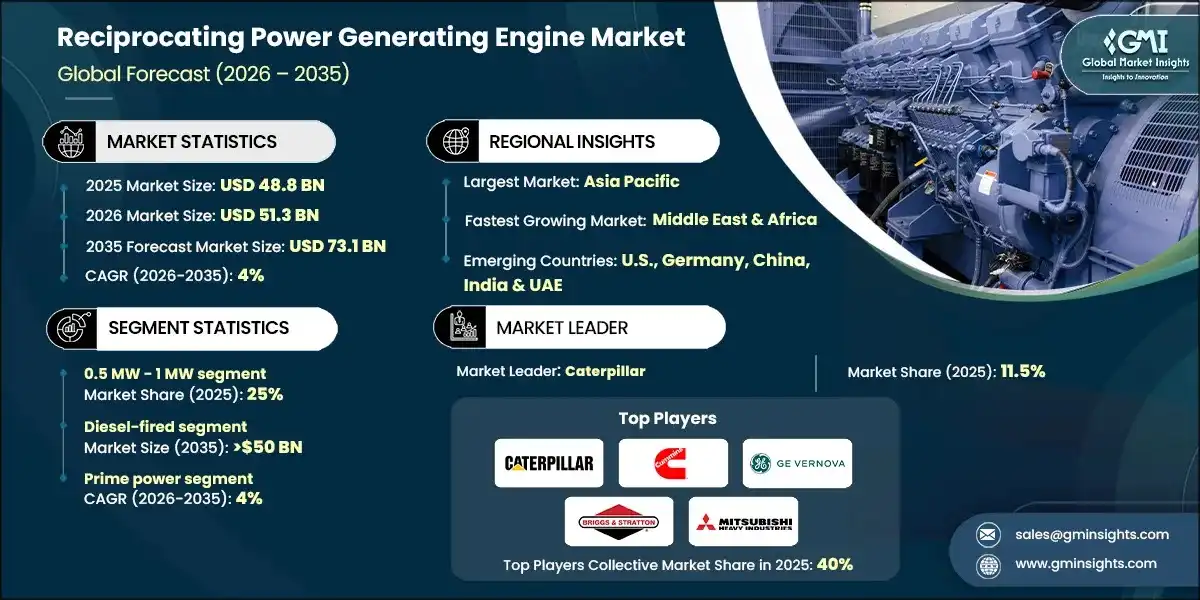
According to a recent study by Global Market Insights Inc., the reciprocating power generating engine market was estimated at USD 48.8 billion in 2025. The market is expected to grow from USD 51.3 billion in 2026 to USD 73.1 billion by 2035, at a CAGR of 4%.
Reciprocating Power Generating Engine Market Key Takeaways
Market Size & Growth
- 2025 Market Size: USD 48.8 Billion
- 2026 Market Size: USD 51.3 Billion
- 2035 Forecast Market Size: USD 73.1 Billion
- CAGR (2026–2035): 4%
Key Market Drivers
- Increasing intensity & frequency of weather-related disasters.
- Rising utilization of cogeneration technology.
- Growing investment toward power generation capacity expansion.
Challenges
- High initial investment.
Opportunity
- Expansion of distributed energy systems.
- Advancements in hybrid and renewable integration.
- Adoption of alternative and low-carbon fuels.
- Growing power demand from data centers.
Key Players
- Market Leader: Caterpillar led with over 11.5% market share in 2025.
- Leading Players: Top 5 players in this market include Caterpillar, Cummins, GE Vernova, Briggs & Stratton, Mitsubishi Heavy Industries, which collectively held a market share of 40% in 2025.
Get Market Insights & Growth Opportunities
- The continued growth of microgrids & rural industrial electrification initiatives will increase the need for scalable power systems, supporting wider deployment of these engines. Their rapid start-up, strong efficiency, and adaptable operation make them well-suited for delivering reliable power across both urban and remote areas, reinforcing the industry outlook.
- Reciprocating power generating engines are internal combustion engines that convert the linear motion of pistons into rotational mechanical energy to produce electricity. These engines operate through a series of controlled fuel ignitions within cylinders, driving pistons back and forth to generate power.
- For illustration, in 2024, the U.S. Department of Energy funded USD 75 million pilot project in California integrating reciprocating engines into distributed energy systems. The installation enhanced efficiency by 20% and reduced downtime by 30% during peak periods, delivering reliable, flexible power, strengthening grid stability, and lowering overall operational costs.
- The reciprocating power generating engine market was valued at USD 42.2 billion in 2022 and grew at a CAGR of approximately 2.5% through 2025. The growing deployment of these engines for industrial operations, grid stabilization and distributed power generation will accelerate the business growth.
- The strong performance of these engines and their capability to manage fluctuating loads, combined with the challenges of aging power infrastructure, will boost market demand. Rising investments in data centers, oil & gas operations, and the mining sector will further support the adoption of these systems and strengthen the industry outlook.
- For instance, according to the International Energy Agency, global electricity consumption rose by about 4% in 2024, up from 2.5% in 2023, highlighting the increasing demand for reliable power infrastructure and presenting substantial growth opportunities for the industry.
- The increasing emphasis on energy resilience among enterprises and utilities in emerging economies to address grid instability, minimize downtime, and withstand extreme weather conditions will strongly boost demand for reciprocating engines. Their rapid start-up capability and adaptable fuel options further strengthen their suitability for peaking and standby power needs.
To get key market trends
Reciprocating Power Generating Engine Market Trends
- The industry is gaining momentum as industries prioritize stable, dispatchable power amid rising grid disturbances. Their rapid start capability, superior part-load efficiency, and fuel flexibility position them as critical assets for continuous operations. Expanding urbanization and industrial growth in emerging economies continue to foster the product penetration.
- Rising investments in distributed generation and combined heat and power (CHP) systems are boosting the technological deployment. These engines enable efficient onsite power, heat recovery, and integration with microgrids. Their capability to operate on natural gas and emerging renewable fuels supports decarbonization strategies while maintaining high thermal and electrical efficiency.
- For instance, the German Federal Ministry of Education and Research provided USD 80.3 million to support the Eco-Engine 2023 project, bringing together leading industry players and research centers. The initiative targets an 18% reduction in engine emissions and a 10% decrease in fuel consumption through advanced catalysts, enhanced fuel control, and improved monitoring systems.
- The regions facing aging grid infrastructure and exposure to extreme weather increasingly rely on these units for grid support and peak-shaving applications. Their modularity allows rapid deployment in remote locations and urban centers alike. This flexibility strengthens energy resilience strategies while supporting growing electricity needs in developing regions with unreliable grids.
- Technological advancements, including digital engine controls, predictive maintenance systems, and hybrid configurations with battery storage, are shaping market competitiveness. These innovations improve uptime, reduce lifecycle costs, and optimize fuel consumption, which in turn will stimulate the business potential.
- Growing investments in gas infrastructure and the shift toward cost-effective, lower-emission alternative fuels will accelerate industry expansion. Moreover, increasing demand for rapid load modulation to support grid balancing and frequency regulation will further strengthen market growth and drive widespread adoption of these systems.
- For citation, in 2025, the U.S. Department of Energy allocated USD 80 million to a project demonstrating the use of gas reciprocating engines in industrial power applications. The initiative improved fuel efficiency by 17% and reduced emissions by 12% compared to baseline systems, highlighting the engines operational and environmental benefits.
Reciprocating Power Generating Engine Market Analysis
Learn more about the key segments shaping this market
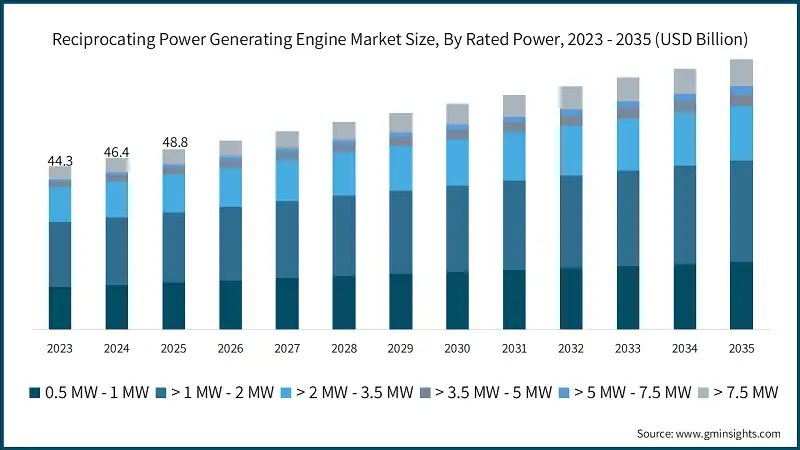
- Based on rated power, the industry is segmented into 0.5 MW - 1 MW, > 1 MW - 2 MW, > 2 MW - 3.5 MW, > 3.5 MW - 5 MW, > 5 MW - 7.5 MW and > 7.5 MW. The 0.5 MW - 1 MW reciprocating power generating engine market holds a share of about 25% in 2025 and is projected to grow at a growth rate of over 3.5% through 2035.
- The market is experiencing a sustained shift toward compact power units for industrial applications, driven by their cost-effectiveness and operational flexibility. Moreover, rising awareness and preference for dependable, affordable backup power solutions is significantly boosting the adoption of these engines across diverse end-use sectors.
- The power ratings in the >1 MW–2 MW range command a significant market share owing to rising natural disasters, frequent power outages, and deteriorating grid networks. Additionally, ongoing technological advancements and supportive power distribution reforms are further strengthening demand for these units and expanding their adoption across critical applications.
- For citation, in 2024, about USD 550 million was allocated for auxiliary power projects, including Entergy’s 45 MW natural gas piston engine south of Houston, which reduces storm-related outages by 80%. Additionally, growing demand for hybrid systems has driven companies such as Cummins and Caterpillar to achieve 25% year-on-year sales growth.
- The > 2 MW – 3.5 MW engines segment is set to exceed USD 12 billion by 2035. Growing use across construction, mining, industrial facilities, universities, landfill sites, and biomass projects will strengthen demand for these units. Rising grid load and heightened awareness of independent power solutions are further driving adoption. These engines utilize natural gas, biomass, and landfill gases to produce reliable electricity.
- The > 3.5 MW - 5 MW power rating category was valued at USD 1.8 billion in 2025. These capacity-rated engines are deployed in low-megawatt distributed power systems and industrial generator applications. They deliver strong performance for continuous prime power as well as cogeneration operations, offering efficiency, fuel flexibility, and reliable output.
- The growth in >5 MW - 7.5 MW capacity engines is driven by rising reliance on digital infrastructure and IT systems that demand uninterrupted power. Additionally, the escalating financial risks associated with data center outages are accelerating large-scale adoption and commercialization of these high-capacity reciprocating engines across critical industrial and commercial sectors.
- Industries in remote locations with limited grid access are increasingly turning to > 7.5 MW engines to meet high-power demands. Their fast, automatic start-up and dependable performance make them essential for continuous operations, driving wider adoption of these engines in energy-intensive, off-grid industrial and commercial applications.
Learn more about the key segments shaping this market
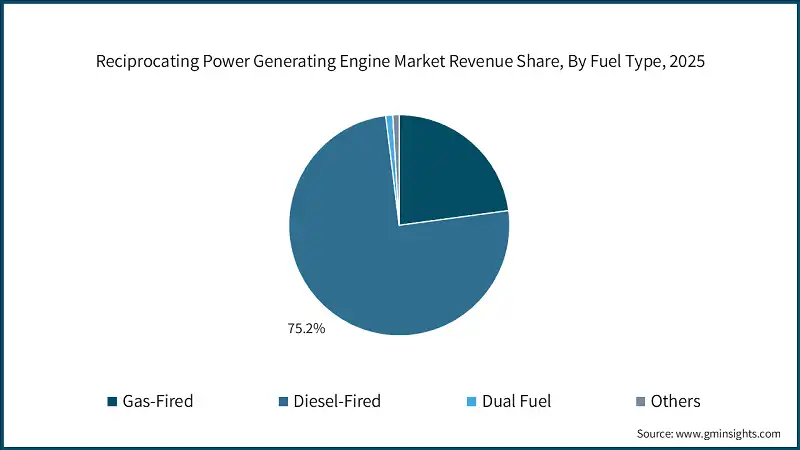
- Based on fuel type, the industry is divided into gas-fired, diesel-fired, dual fuel and others. The diesel-fired reciprocating power generating engine market holds a share of 75.2% in 2025 and is set to reach over USD 50 billion by 2035.
- These power generating engines are among the most efficient in the industry and have seen strong demand due to high electricity costs and limited grid access in emerging markets. Additionally, growing consumer preference for reliable emergency backup solutions amid frequent and severe grid disruptions is further supporting market growth.
- Gas-fired reciprocating power generating engine industry was estimated at USD 11.2 billion in 2025. The demand has risen sharply due to technological advancements, enhanced operational efficiency, and adherence to environmental regulations. Additionally, the growing integration of renewable energy sources is reshaping the industry, driving greater adoption and expansion of engines as flexible, reliable complements to intermittent renewable power generation.
- For instance, in 2024, MAN Energy Solutions deployed 12 MW dual-fuel engines at the UAE’s Ghasha Gas Project, replacing older turbines supporting LNG liquefaction. The engines reduced CO2 emissions by 25% compared to diesel-only operation during peak demand for ADNOC’s offshore facilities, highlighting the environmental advantages of dual-fuel technology in industrial applications.
- The dual fuel market is set to grow at a rate of 9.5% from 2026 to 2035. These engines mainly run on natural gas, with a small diesel admixture, offering versatile functionality. Using primarily cleaner, cost-effective natural gas makes them suitable for peak shaving and combined heat and power applications, while operating on 100% diesel allows them to fulfill the fuel requirements of on-site backup power systems.
- Based on end use, the industry is bifurcated into backup and prime power. The prime power industry will witness a CAGR of 4% by 2035. Rising industrial and construction activities are set to drive the industry growth. Additionally, adherence to environmental and emission standards, including the anticipated implementation of EU Stage V regulations, will significantly shape market dynamics and influence the adoption of compliant power generation solutions.
- For instance, in 2023, with around USD 150 million in funding, the U.S. Department of Energy’s Digital Power Generation Integration Project employs advanced sensors and IoT technologies to monitor reciprocating engines in real time. The initiative underscores the government’s commitment to leveraging digitalization to improve power generation efficiency, reliability, and environmental outcomes.
- Backup reciprocating power generating engines are deployed during temporary interruptions in the main grid or primary power supply, often caused by extreme weather events or sudden spikes in electricity demand. Rising urban power outages along with strict government regulations on carbon emissions are set to further propel the product adoption.
Looking for region specific data?
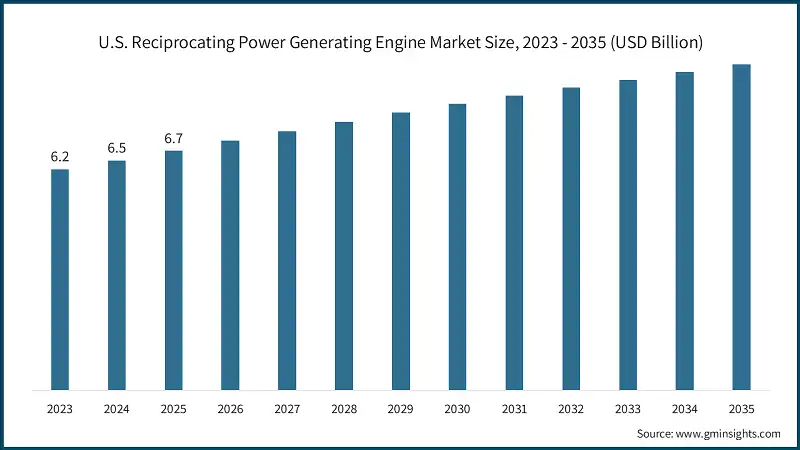
- The U.S. dominated the reciprocating power generating engine market in North America with around 70% share in 2025 and generated USD 6.7 billion in revenue. The industry is witnessing robust growth driven by rising demand for reliable backup power, aging grid infrastructure, and increasing adoption of distributed energy solutions. Technological advancements, regulatory support for cleaner fuels, and growth in data centers and industrial sectors are further propelling the market across various applications.
- For instance, according to the U.S. Department of Energy, datacenter power consumption in the U.S. surged from 58 TWh in 2014 to 176 TWh in 2023, marking a remarkable 203% increase over ten years. This rapid growth necessitates substantial investment in backup power systems, with engines offering the reliability and fast-start performance crucial for mission-critical operations.
- The North America reciprocating power generating engine market is projected to hit USD 10 billion by 2035. The inability of electrical grids to handle rising demand, combined with severe hurricane events such as Ike and Irma, has fueled substantial industry growth. Additionally, frequent data center outages and increasing consumer emphasis on dependable backup power solutions will energize the industry dynamic.
- The Europe reciprocating power generating engine market is set to grow at a rate of over 4% by 2035. Environmental and emission regulations, including the anticipated EU Stage V standards, are set to significantly shape the industry landscape. These directives have prompted manufacturers to transition toward cleaner energy solutions, offering eco-friendly, cost-efficient products that utilize alternative and lightweight materials, escalating the business scenario.
- For illustration, in 2024, the European diesel system modernization project in Eastern Europe, subsidized by the European Commission, greatly enhanced system dependability at peripheral power plant installations. This project achieved a 13% improvement in energy efficiency and 10% savings in maintenance expenditure.
- The Asia Pacific reciprocating power generating engine industry accounts for about 25% of the market share in 2025. The market is expanding rapidly owing to rising industrialization, urbanization, and growing electricity demand. Limited grid reliability in emerging economies coupled with increasing adoption of distributed power solutions, is driving the industry growth. Government initiatives promoting cleaner fuels and technological advancements further boost regional demand.
- Rising manufacturing activities, coupled with the expanding power generation sector in the Middle East and Africa, are boosting demand for these products. Furthermore, the growth of residential, industrial, commercial, and retail developments has significantly increased the need for reliable and uninterrupted power supply across the region.
- For instance, in 2024, NEOM City in Saudi Arabia deployed 50 MW INNIO Jenbacher gas engines to operate off-grid systems for green hydrogen production, supporting its target of 100% renewable energy through integrated hybrid power solutions & demonstrating the role of advanced engines in sustainable energy initiatives.
- Rapid urbanization, combined with economic growth and rising electricity demand, is set to drive significant industrial expansion across Latin America. Additionally, the growing need for smart power generation solutions and the proliferation of third-party data centers are further fueling the demand for advanced power generation systems.
- For illustration, as part of the Amazon Energy Pact, Brazil 2024, 120 MW of Wärtsilä 34SG gas engines were deployed to support hydropower generation during drought periods. These engines, working alongside gas turbines, ensured a stable and reliable power supply, highlighting the strategic integration of flexible gas engines with renewable energy sources to enhance grid resilience in challenging environmental conditions.
Reciprocating Power Generating Engine Market Share
- The top 5 players in reciprocating power generating engine industry are Caterpillar, Cummins, GE Vernova, Briggs & Stratton and Mitsubishi Heavy Industries contribute around 40% of the market share in 2025.
- The industry is characterized by strong competition, continuous product upgrades, and expanding portfolios across diesel, gas, and multi-fuel engines. Manufacturers emphasize high efficiency, flexible operation, digital monitoring, and emission-reduction technologies. Growing demand for distributed generation, industrial reliability, backup power, and cleaner fuel adoption shapes market dynamics and drives ongoing technological innovation.
- Caterpillar offers a broad portfolio of reciprocating gas and diesel generator sets ranging from small standby units to large high-efficiency prime power systems. Their engines support industrial, commercial, mining, and utility applications, with strong integration of digital monitoring, low-emission technologies, and multi-fuel capability including natural gas, biogas, and renewable fuels.
- Cummins provides a comprehensive lineup of reciprocating power engines featuring high-efficiency gas and diesel generator sets for standby, prime, and continuous power. Their portfolio emphasizes low-emission combustion, high reliability, and modular scalability, supporting applications across data centers, manufacturing, healthcare, and distributed energy systems, including newer natural-gas and hydrogen-blend engine platforms.
- GE Vernova delivers high-performance Jenbacher and Waukesha gas engines known for efficiency, fuel flexibility, and strong CHP compatibility. Their portfolio spans distributed generation, renewable-gas utilization, microgrids, and industrial power. These engines operate on natural gas, biogas, landfill gas, and hydrogen blends, enabling low-carbon and resilient on-site energy solutions.
- Briggs & Stratton focuses on small to mid-sized reciprocating engines and generator systems mainly for light commercial and portable power applications. Their portfolio features compact gasoline and gas-fueled engines emphasizing reliability, affordability, and ease of service, supporting backup power, construction equipment, and light industrial power needs.
- Mitsubishi Heavy Industries offers large, high-efficiency gas and diesel engines tailored for utility-scale and industrial power generation. Their portfolio includes medium-speed engines for distributed generation, cogeneration, and emergency backup. The engines feature advanced combustion, fuel flexibility, and robust durability, supporting continuous, peak-shaving and grid-stabilization applications.
Reciprocating Power Generating Engine Market Companies
- During January–June 2025, Wärtsilä reported USD 3.8 billion in revenue alongside other power and energy storage firms. The company completed a project at Norway’s Arctic LNG terminal, deploying 50 MW of its 46TS-DF gas engines. Employing LNG-hydrogen blending technology, the installation achieved a 30% reduction in CO2 emissions.
- Caterpillar generated USD 16.6 billion in revenue during second quarter of 2025. The company partnered with Siemens Energy to deploy a 6 MW Cat CG260 gas engine at Singapore’s Jurong Data Hub. Utilizing a hybrid microgrid system, the installation reduced emissions by 35% compared to conventional diesel engines, enhancing sustainability.
- In 2024, Mitsubishi Heavy Industries reported record revenue of USD 32.2 billion, and profit driven by strength in energy systems, gas turbine orders and infrastructure projects. Its engine arm Mitsubishi Heavy Industries Engine & Turbocharger accelerates hydrogen engine development. A 500-kW hydrogen fired generator recently ran reliably on 100 % hydrogen, underlining MHI’s commitment to zero carbon, low emission power solutions.
Major players operating in the reciprocating power generating engine industry are:
- Ashok Leyland
- Briggs & Stratton
- Caterpillar
- Cummins
- Deere & Company
- Deutz AG
- Enerflex
- Escorts Kubota Limited
- GE Vernova
- Guascor Energy
- Kawasaki Heavy Industries
- Kirloskar
- MAN Energy Solutions
- Mitsubishi Heavy Industries
- Rehlko
- Rolls-Royce
- Scania
- TRITON DURO
- Wärtsilä
- Yanmar Holdings
- Honda Motor
- IHI Corporation
Reciprocating Power Generating Engine Market Report Attributes
| Key Takeaway | Details |
|---|---|
| Market Size & Growth | |
| Base Year | 2025 |
| Market Size in 2025 | USD 48.8 Billion |
| Market Size in 2026 | USD 51.3 Billion |
| Forecast Period 2026-2035 CAGR | 4% |
| Market Size in 2035 | USD 73.1 Billion |
| Key Market Trends | |
| Drivers | Impact |
| Increasing intensity & frequency of weather-related disasters | Growing climate disruptions boost demand for resilient, fast start reciprocating engines to ensure emergency backup, grid stability, and continuous power availability. |
| Rising utilization of cogeneration technology | Expanding CHP adoption drives reciprocating engine demand due to high efficiency, thermal recovery capability, reduced emissions, and improved operational cost advantages. |
| Growing investment toward power generation capacity expansion | Large-scale capacity additions, especially in emerging markets, accelerate deployment of flexible reciprocating engines supporting peak demand, grid balancing, and distributed generation. |
| Pitfalls & Challenges | Impact |
| High initial investment | Significant upfront capital requirements for equipment, installation & auxiliary systems restrict widespread adoption of these engines, primarily across cost-sensitive markets. |
| Opportunities: | Impact |
| Expansion of distributed energy systems | Growth of decentralized power solutions creates strong demand for flexible reciprocating engines supporting microgrids, remote facilities, and localized generation. |
| Advancements in hybrid and renewable integration | Increasing renewable penetration drives opportunities for reciprocating engines to provide firming, fast ramping, and stability in hybrid solar-battery-engine systems. |
| Adoption of alternative and low-carbon fuels | Shift toward hydrogen, biogas, and synthetic fuels enables reciprocating engines to operate cleaner, meeting future emission norms and sustainability goals. |
| Growing power demand from data centers | Rapid data center expansion boosts need for reliable, fast-response backup engines ensuring uninterrupted operations, grid stability, and energy security. |
| Market Leaders (2025) | |
| Market Leaders |
11.5% market share |
| Top Players |
|
| Competitive Edge |
|
| Regional Insights | |
| Largest Market | Asia Pacific |
| Fastest Growing Market | Middle East & Africa |
| Emerging Country | U.S., Germany, China, India & UAE |
| Future Outlook |
|
What are the growth opportunities in this market?
Reciprocating Power Generating Engine Industry News
- In October 2025, Guascor Energy announced the expansion of its HM engine portfolio with a new configuration designed to meet the increasingly stringent emission standards set by Northern European countries under the EU Medium Combustion Plant Directive. The updated engine configuration complied with the maximum allowable limit for Total Hydrocarbons (THCs), specifically 1300 mg/Nm³, reinforcing the company’s commitment to environmental compliance and sustainable energy solutions.
- In September 2025, Cummins announced the integration of a high-performance engine brake into its new X10 engine platform, designed for medium & heavy-duty vehicles serving regional haul, vocational and transit bus fleets. The X10 is part of its HELM fuel-agnostic engine series and is set to replace both the L9 and X12 engines. The newly specified 1.5-Stroke HPD engine brake delivers significantly enhanced retarding power, offering up to 40% more supplemental braking force at high engine speeds and up to 100% improvement at lower RPM cruising speeds compared to traditional compression release braking systems.
- In May 2025, MAN Energy Solutions was selected by the Kerrville Public Utility Board (KPUB) to supply six 18V51/60G gas engines, delivering a total capacity of 124MW for a new peak-load power facility in Texas. The plant is designed to enhance grid stability by providing fast, flexible power during periods of high demand or when other energy sources are unavailable. The deployment of MAN’s high-efficiency gas engines reflects a broader industry shift toward cleaner, more adaptable power generation solutions.
- In January 2025, GE Vernova announced a planned investment of nearly USD 600 million across its domestic factories and facilities over a two-year period. The initiative aimed to strengthen the company’s manufacturing capabilities to meet rising global electricity demand. The investment was expected to support key national priorities including energy affordability, security, and industrial competitiveness. It also positioned the companies to expand its export capacity, reinforcing the company’s role in advancing American energy leadership on the global stage.
The reciprocating power generating engine market research report includes in-depth coverage of the industry with estimates & forecast in terms of volume (Units), Capacity (MW) & revenue (USD Million) from 2022 to 2035, for the following segments:
Market, By Fuel Type
- Gas-fired
- 0.5 MW - 1 MW
- > 1 MW - 2 MW
- > 2 MW - 3.5 MW
- > 3.5 MW - 5 MW
- > 5 MW - 7.5 MW
- > 7.5 MW
- Diesel-fired
- 0.5 MW - 1 MW
- > 1 MW - 2 MW
- > 2 MW - 3.5 MW
- > 3.5 MW - 5 MW
- > 5 MW - 7.5 MW
- > 7.5 MW
- Dual fuel
- 0.5 MW - 1 MW
- > 1 MW - 2 MW
- > 2 MW - 3.5 MW
- > 3.5 MW - 5 MW
- > 5 MW - 7.5 MW
- > 7.5 MW
- Others
- 0.5 MW - 1 MW
- > 1 MW - 2 MW
- > 2 MW - 3.5 MW
- > 3.5 MW - 5 MW
- > 5 MW - 7.5 MW
- > 7.5 MW
Market, By Rated Power
- 0.5 MW - 1 MW
- > 1 MW - 2 MW
- > 2 MW - 3.5 MW
- > 3.5 MW - 5 MW
- > 5 MW - 7.5 MW
- > 7.5 MW
Market, By Application
- Industrial
- CHP
- Energy & utility
- Landfill & biogas
- Oil & gas
- Others
Market, By End Use
- Backup
- 0.5 MW - 1 MW
- > 1 MW - 2 MW
- > 2 MW - 3.5 MW
- > 3.5 MW - 5 MW
- > 5 MW - 7.5 MW
- > 7.5 MW
- Prime power
- 0.5 MW - 1 MW
- > 1 MW - 2 MW
- > 2 MW - 3.5 MW
- > 3.5 MW - 5 MW
- > 5 MW - 7.5 MW
- > 7.5 MW
The above information has been provided for the following regions and countries:
- North America
- U.S.
- Canada
- Mexico
- Europe
- UK
- France
- Germany
- Russia
- Italy
- Spain
- Netherlands
- Denmark
- Norway
- Asia Pacific
- China
- India
- Japan
- South Korea
- Australia
- Thailand
- Singapore
- Indonesia
- Malaysia
- Middle East & Africa
- UAE
- Saudi Arabia
- Qatar
- Oman
- Kuwait
- Iran
- Egypt
- Turkey
- Jordan
- South Africa
- Latin America
- Brazil
- Argentina
- Chile
- Peru
Frequently Asked Question(FAQ) :
What is the market size of the reciprocating power generating engine in 2025?
The market size was USD 48.8 billion in 2025, with a CAGR of 4% expected through 2035 driven by expanding microgrids, rural industrial electrification, and growing demand for scalable, flexible power systems.
What is the projected value of the reciprocating power generating engine market by 2035?
The reciprocating power generating engine market is expected to reach USD 73.1 billion by 2035, propelled by distributed energy system expansion, hybrid renewable integration, and increasing power demand from data centers.
What is the current reciprocating power generating engine market size in 2026?
The market size is projected to reach USD 51.3 billion in 2026.
How much revenue did the diesel-fired segment generate in 2025?
Diesel-fired engines held 75.2% market share in 2025 and are expected to exceed USD 50 billion by 2035, supported by high efficiency, reliability for emergency backup, and limited grid access in emerging markets.
What was the market share of the 0.5 MW - 1 MW rated power segment in 2025?
The 0.5 MW - 1 MW segment held approximately 25% market share in 2025 and is projected to grow at over 3.5% CAGR through 2035 due to cost-effectiveness and operational flexibility for industrial applications.
What is the growth outlook for dual fuel engines from 2026 to 2035?
Dual fuel engines are projected to grow at a 9.5% CAGR through 2035, operating primarily on cleaner natural gas with diesel backup, making them suitable for peak shaving, combined heat and power, and backup power applications.
Which region leads the reciprocating power generating engine market in North America?
The U.S. held approximately 70% share in 2025 with generating USD 6.7 billion in revenue, supported by aging grid infrastructure, data center expansion, and increasing adoption of distributed energy solutions.
What are the upcoming trends in the reciprocating power generating engine market?
Key trends include advancements in digital engine controls and predictive maintenance, hybrid configurations with battery storage, adoption of alternative low-carbon fuels like hydrogen and biogas, and integration with renewable energy systems for grid stabilization.
Who are the key players in the reciprocating power generating engine market?
Key players include Caterpillar, Cummins, GE Vernova, Briggs & Stratton, Mitsubishi Heavy Industries, Ashok Leyland, Deere & Company, Deutz AG, Enerflex, Escorts Kubota Limited, Guascor Energy, Kawasaki Heavy Industries, Kirloskar, MAN Energy Solutions, Rehlko, Rolls-Royce, Scania, TRITON DURO, Wärtsilä, Yanmar Holdings, Honda Motor, and IHI Corporation.
Reciprocating Power Generating Engine Market Scope
Related Reports