Summary
Table of Content

Rainwater Harvesting Market
Get a free sample of this report
Form submitted successfully!
Error submitting form. Please try again.
Thank you!
Your inquiry has been received. Our team will reach out to you with the required details via email. To ensure that you don't miss their response, kindly remember to check your spam folder as well!
Request Sectional Data
Thank you!
Your inquiry has been received. Our team will reach out to you with the required details via email. To ensure that you don't miss their response, kindly remember to check your spam folder as well!
Form submitted successfully!
Error submitting form. Please try again.
Rainwater Harvesting Market Size
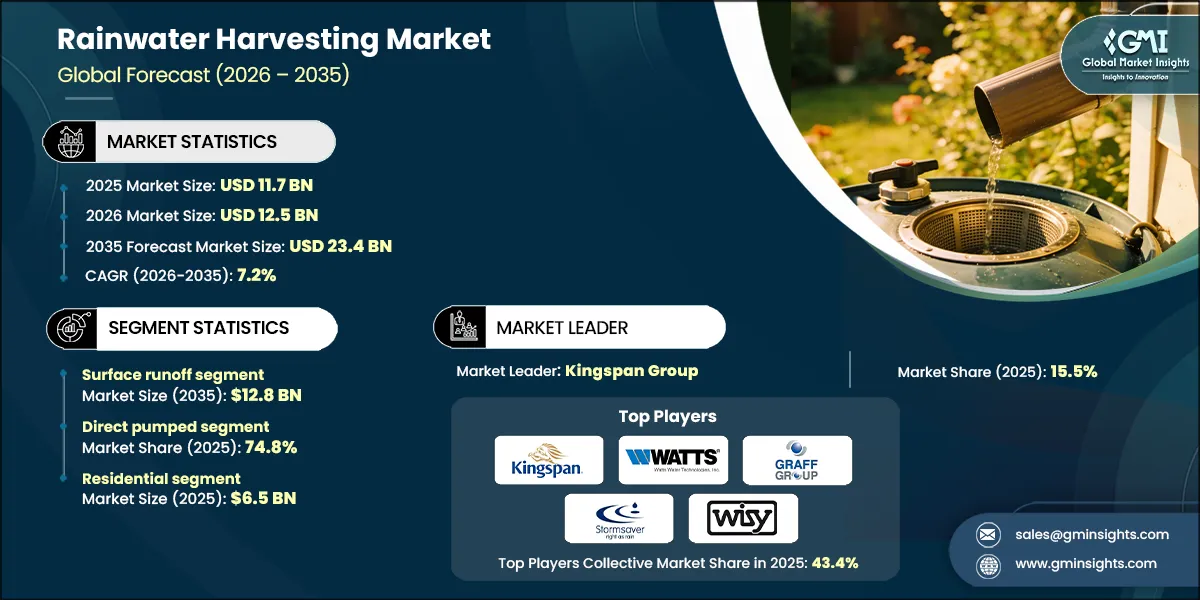
The global rainwater harvesting market was valued at USD 11.7 billion in 2025. The market is expected to grow from USD 12.5 billion in 2026 to USD 23.4 billion in 2035, at a CAGR of 7.2%, according to latest report published by Global Market Insights Inc.
Rainwater Harvesting Market Key Takeaways
Market Size & Growth
- 2025 Market Size: USD 11.7 Billion
- 2026 Market Size: USD 12.5 Billion
- 2035 Forecast Market Size: USD 23.4 Billion
- CAGR (2026–2035): 7.2%
Key Market Drivers
- Increasing demand of freshwater.
- Rising water scarcity.
- Rapid technology advancement.
Challenges
- High initial investment and intensive maintenance requirement.
- Intermittency and operational challenges.
Opportunity
- Strong demand for sustainable, low‑carbon water solutions.
- Technological advancements and cost declines.
Key Players
- Market Leader: Kingspan Group led with over 15.5% market share in 2025.
- Leading Players: Top 5 players in this market include Kingspan Group, Watts Water Technologies, Graf Group, Stormsaver Ltd, Wisy AG, which collectively held a market share of 43.4% in 2025.
Get Market Insights & Growth Opportunities
The rainwater harvesting market is growing as demand for water across all sectors is increasing. according to the food and agriculture organization, agriculture uses up to 70% of the world’s fresh water supply, which illustrates the need for the development of sustainable solutions for water. using rainwater harvesting systems will help to lessen the dependence on conventional sources of water, while also creating a solution for water scarcity issues.
The combined forces of urbanization and climate change are the two main drivers of growth within this market. according to a report produced by the united nations, by the year 2050, approximately 68% of the world’s population will be in urban areas; therefore, this will put additional pressure on the world’s freshwater supply.
Governments around the globe have responded to these issues by developing RWH policies; for example, the government of Tamil Nadu (2023) India has established that it is mandatory for all buildings within the state to have an RWH system in place. this has resulted in marked improvements in the groundwater levels within the state.
The growth of the market is also driven by the innovative solutions offered by companies. as an example, rainwater management solutions USA provides RWH systems for residential and commercial uses. Similarly, Kingspan water & energy provides advanced rainwater storage and filtration systems to serve a variety of industries. many nations, such as Singapore and Germany, have integrated RWH into their urban planning process through large-scale programs like the marina barrage in Singapore, which creates a significant amount of usable rainwater for the city of Singapore, helping meet their water sustainability goals (pub Singapore, 2023).
The continued efforts of governmental support, innovation from the corporate sector and the growing awareness of the need to conserve water will continue to lead to increased growth in the rainwater harvesting industry over the coming years, in line with the global movement toward sustainable development.
To get key market trends
Rainwater Harvesting Market Trends
Changing innovation and technology transformation are important for the growth of the rainwater harvesting market.
- There is an increase in the usage of IoT for the management of rainwater harvesting systems to make it easier to collect, clean, and use rainwater. For example, RainHarvest Systems has developed an IoT-enabled service that helps users to reduce their need to manually monitor and clean their systems, while also enhancing water quality management. The U.S. Environmental Protection Agency (EPA) estimates that the use of IoT technologies in water management will provide up to 30% additional efficiency, which is a major reason why IoT is becoming a more common aspect of rainwater harvesting.
- Rainwater harvesting systems are being included as part of green building certification programs, such as LEED and BREEAM. Developers are integrating rainwater harvesting systems, often through designed capture areas, and permeable pavements. As an example, Tata Housing includes rainwater harvesting systems in all of their green certified projects. According to the U.S. Green Building Council (USGBC), rainwater harvesting systems can reduce water consumption by upwards of 20 to 30% for certified buildings.
- Local governments are increasingly supporting decentralized rainwater harvesting systems within their respective jurisdictions such as residential properties, schools, parks, etc. For example- Singapore's ABC Waters program that has developed community-scale rainwater harvesting systems that reduce dependence on municipal water supplies. The World Bank supports the development and implementation of decentralized rainwater harvesting systems to improve climate resiliency and reduce the risk of flooding in urban areas.
- New innovations such as modular harvesting units and lightweight tanks are reducing costs. Companies such as Kingspan offer prefabricated systems to facilitate a faster installation. The International Water Association has published articles that indicate modularity can reduce installation costs by 15-20%, making them appealing for use in either residential or commercial applications.
- Governments are implementing rainwater harvesting regulations, as well as providing financial incentives for retrofitting existing buildings. For example, California provides tax credits for residential installations of rainwater systems. According to the U.N., these types of incentives are indispensable for regions experiencing drought conditions and suffering from significant groundwater depletion.
Rainwater Harvesting Market Analysis
Learn more about the key segments shaping this market
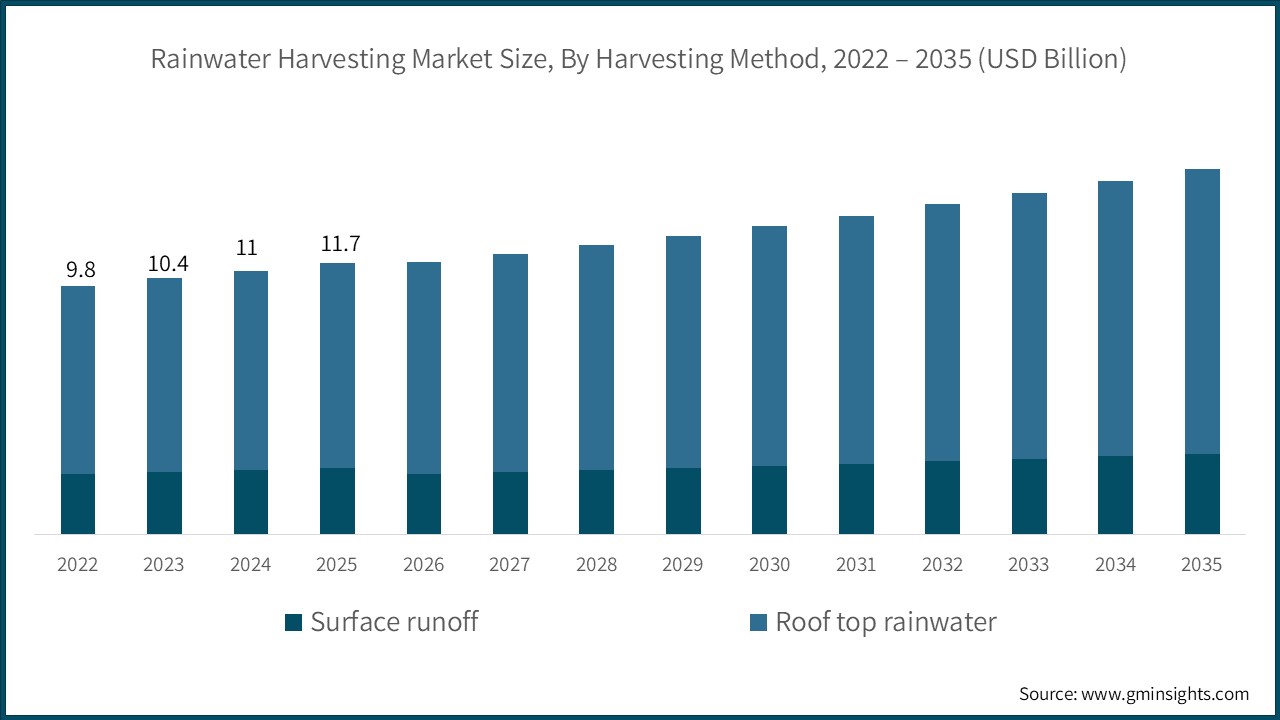
Based on harvesting process, the rainwater harvesting industry is segmented surface runoff and rooftop rainwater. The surface runoff segment accounts for revenue of around USD 6.6 billion in the year 2025 and is expected to reach USD 12.8 billion by 2035.
- The surface runoff portion is the fastest-growing segment of the rainwater harvesting industry due to its ability to gather substantial amounts of rainwater and be utilized for a multitude of uses ranging from residential, agricultural, industrial to environmental.
- The implementation of stricter regulations for controlling the quantity and runoff of stormwater in urban areas has also catalyzed growth in this industry. In the United States, the Environmental Protection Agency (EPA) mandates that all Urban Development include retention areas for stormwater, and in India, the Smart Cities Mission mandates the collection of surface runoff and its use in infrastructure development and thus accelerates the acceptance of products like recharge pits and infiltration basins and the continued expansion of the industry.
- Another major factor driving growth in this industry is the increased shortage of water. Currently, there are over 2 billion people who live in areas experiencing water stress according to the United Nations. Many companies such as Veolia and SUEZ offer large-scale surface runoff systems as a means of addressing the lack of supplies within the agricultural and industrial sectors and achieve long-term water sustainability within drought-stricken communities.
- The trend of increasing use of surface runoff systems by industries to reduce dependence on municipal water and decrease operational costs continues. For example, Coca-Cola has implemented runoff harvesting in its manufacturing facilities for sustainability objectives, aligning with their ESG goals and reducing water consumption. The surface runoff segment is anticipated to dominate the rainwater harvesting market with increased climate variability and improving regulations and is expected to experience significant growth through 2035.
Learn more about the key segments shaping this market
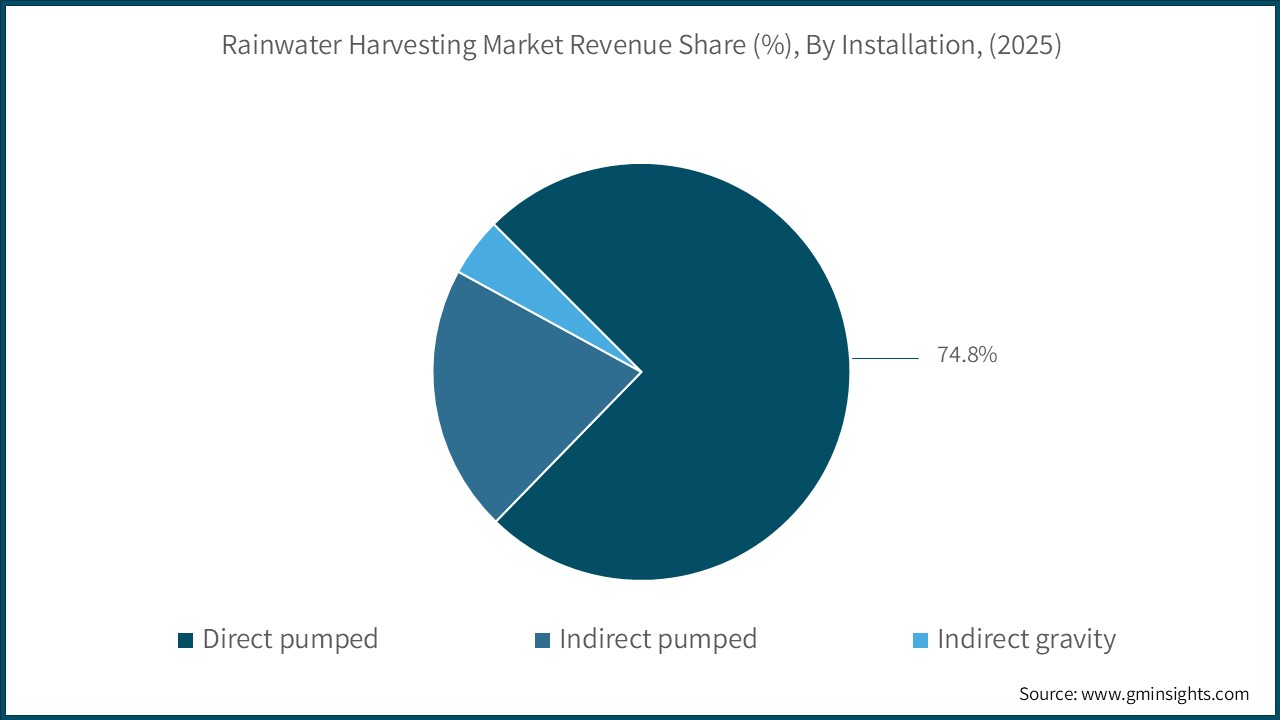
Based on the installation, the rainwater harvesting market is bifurcated into direct pumped, indirect pumped and indirect gravity. The direct pumped segments held the largest share, accounting for 74.8% of the global market in 2025.
- The ease of installation associated with the use of direct gravity systems allows these types of systems to be fitted to a wide variety of buildings such as homes, apartment complexes and businesses with minimal changes to the structure of the building. These systems have become a popular choice among homeowners and business owners in the U.S., due to their efficiency and low upfront costs as promoted through EPA (Environmental Protection Agency) initiatives like rainwater harvesting systems to reduce water use.
- Due to the impracticality of using gravity flow systems for small and medium sized buildings such as homes and small commercial businesses, direct pumped systems are an important alternative. Companies such as Kingspan and Graf Water have manufactured and released products specifically designed for this application. These products will aid the integration of direct pumped systems into the marketplace.
- The government is also involved in fostering the market for these systems by providing various types of subsidies and other incentives to the general public. For example, under the Jal Shakti Abhiyan program in India, the government has provided incentives to encourage the adoption of rainwater harvesting systems, as well as subsidies for installation of direct pumped systems. As a result of these types of programs, the adoption of these systems has increased significantly in urban areas in recent years.
- Moreover, due to the low cost and ease of use of the direct pumping systems as well as their compatibility with commonly used electrical pumps, they are appealing to buyers looking for affordable options. Since they have gained so much popularity worldwide, their dependability and ubiquity bolster their overall presence in the global marketplace.
Based on application, the rainwater harvesting market is segmented into residential, commercial, industrial and agricultural. The residential segment held the largest share, generating a revenue of USD 6.5 billion of the global market in 2025.
- The residential segment is driven by increasing water scarcity and rising domestic demand. According to the United Nations, 2.3 billion people globally face water stress, with urban households being significantly impacted. Rainwater harvesting systems help mitigate this issue by reducing reliance on municipal water supplies.
- Government policies and incentives are accelerating adoption. For example, India’s Model Building Bye-Laws mandate rainwater harvesting for all new residential projects, while Australia offers rebates of up to USD 667.7 for installing rainwater tanks. These initiatives encourage installations in homes, apartments, and gated communities, boosting market growth.
- Additionally, the shift toward sustainable living is driving demand. A 2023 survey by the National Association of Home Builders (NAHB) revealed that 77% of homebuyers prioritize eco-friendly features. Rainwater harvesting systems align with this trend by reducing water bills and increasing property value.
Companies like Kingspan and RainHarvest Systems are capitalizing on this demand by offering customized residential solutions. Kingspan’s water tanks, for instance, are designed for urban households with limited space, ensuring accessibility for a broader audience.
North America Rainwater Harvesting Market
Looking for region specific data?
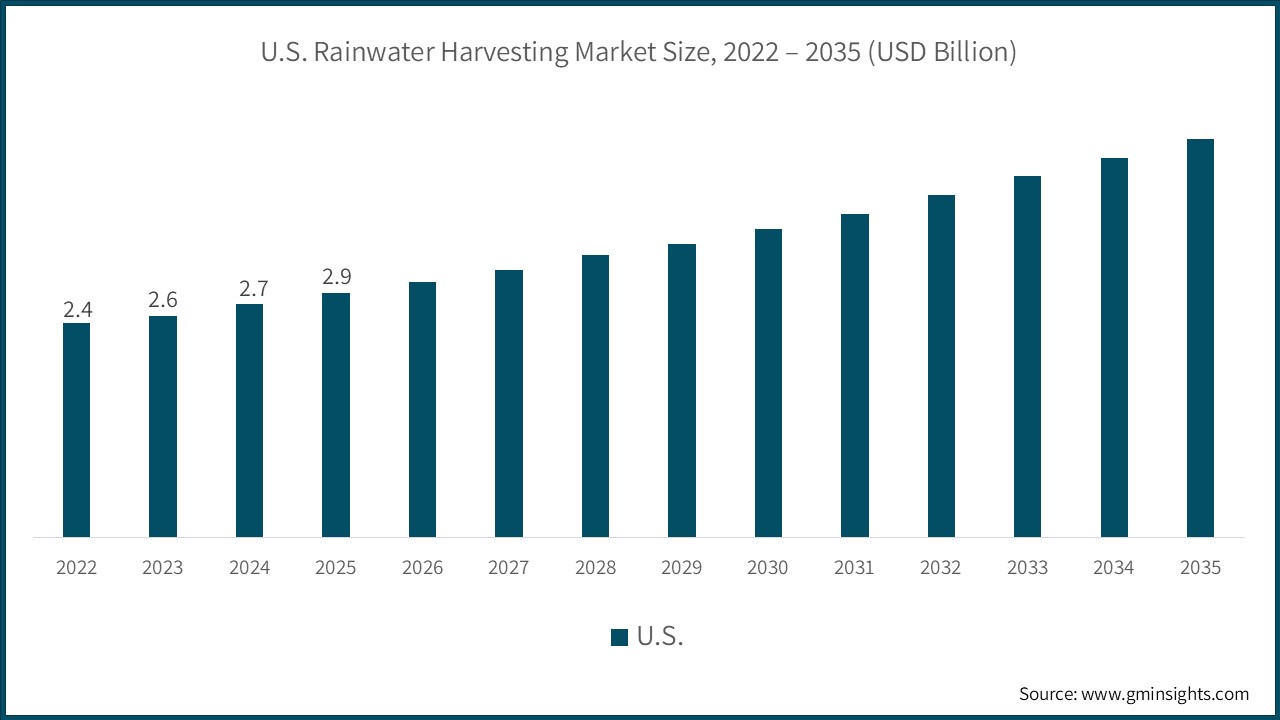
In 2025, the U.S. dominated the rainwater harvesting market growth in North America, accounting for 77.9% of the share in the region.
- The North American market is growing due to rising water scarcity in several U.S. states and increasing dependence on groundwater resources that are rapidly depleting. Strict environmental regulations around stormwater management and sustainable water reuse are accelerating adoption across residential and commercial sectors. Growing investments in green infrastructure and climate-resilient building designs further support market expansion.
- The U.S. leads the region as states such as California, Texas, Arizona, and Florida actively promote rainwater harvesting through rebates, mandates, and water?use restrictions. Rapid urbanization and recurring drought events drive adoption in households, agriculture, and industrial facilities seeking water security. Strong presence of system manufacturers and high awareness of sustainability solutions reinforces the country’s dominant market position.
Asia Pacific Rainwater Harvesting Market
Asia Pacific rainwater harvesting market is expected to grow at 7.7% during the forecast period.
- Asia Pacific growth is driven by severe water stress across India, China, and Southeast Asia, where large populations depend heavily on monsoon?influenced water supplies. Government-led initiatives, rainwater harvesting mandates in residential buildings, and investments in urban water conservation are accelerating adoption. Rapid industrialization and the expansion of agriculture in water-scarce regions further push demand for large-volume harvesting systems.
Europe Rainwater Harvesting Market
Europe market is expected to grow at 6.8% during the forecast period.
- Europe’s growth is fueled by strong sustainability policies, including EU directives promoting water reuse and reduced freshwater abstraction. Countries such as Germany, the UK, and France are implementing building codes encouraging rainwater harvesting for non-potable applications. Increasing consumer preference for green buildings and commercial facilities adopting circular water management boost market uptake.
Middle East and Africa Rainwater Harvesting Market
Middle East and Africa market is expected to grow at 6.5% during the forecast period.
- MEA growth is primarily driven by chronic water scarcity, high dependence on desalination, and escalating freshwater costs. Governments are investing in decentralized water-storage solutions to support agriculture, remote communities, and urban developments in arid regions. Rising adoption of cost-effective harvesting systems as an alternative to expensive groundwater extraction strengthens market demand.
Rainwater Harvesting Market Share
The top companies in the market include Kingspan Group, Watts Water Technologies, Graf Group, Stormsaver Ltd and Wisy AG and collectively hold a share of 43.4% of the market in 2025. These prominent players are proactively involved in strategic endeavors, such as mergers & acquisitions, facility expansions & collaborations, to expand their product portfolios, extend their reach to a broad customer base, and strengthen their market position.
Kingspan provides domestic and commercial rainwater harvesting solutions under its AquaHarvest range, offering systems for collection, storage, treatment, and reuse of rainwater. The company integrates these systems within its wider Water + Energy division to advance sustainable water management and reduce reliance on mains supply.
Watts delivers RainCycle commercial rainwater harvesting systems engineered to capture, store, filter, disinfect, and distribute rainwater for non?potable uses such as irrigation, restrooms, laundry, and cooling towers. Its modular, PLC?controlled systems support sustainability goals and reduce demand on municipal water supplies.
GRAF offers one of the industry’s broadest portfolios of rainwater harvesting products, including underground tanks, above?ground tanks, filtration systems, infiltration units, and complete harvesting packages. Their solutions support residential, commercial, and municipal water reuse, stormwater attenuation, and sustainable “sponge city” application.
Rainwater Harvesting Market Companies
Major players operating in the rainwater harvesting industry are:
- Atlantis Corporation
- Bushman USA
- Climate Inc
- DAB Pumps
- Enduramaxx
- Graf Group
- Grundfos
- Heritage Tanks
- JoJo Tanks
- Kingspan Group
- Norwesco
- Snyder Industries
- Stormsaver Ltd
- Watts Water Technologies
- Wisy AG
Stormsaver is the manufacturer of commercial rainwater harvesting, designing, and maintaining bespoke systems for large buildings and multi?sector projects. Their product line includes rainwater harvesting, greywater recycling, and active attenuation systems used widely across supermarkets, universities, and industrial facilities.
WISY AG specializes in high?performance rainwater filtration technology, offering vortex filters, downpipe filters, cistern filters, and complete rainwater units for private and commercial systems. Their patented vertical mesh design ensures self?cleaning, low?maintenance filtration, delivering high?quality water for long?term storage and reuse.
Rainwater Harvesting Market Report Attributes
| Key Takeaway | Details |
|---|---|
| Market Size & Growth | |
| Base Year | 2025 |
| Market Size in 2025 | USD 11.7 Billion |
| Market Size in 2026 | USD 12.5 Billion |
| Forecast Period 2026-2035 CAGR | 7.2% |
| Market Size in 2035 | USD 23.4 Billion |
| Key Market Trends | |
| Drivers | Impact |
| Increasing demand of freshwater | Growing pressure on conventional water sources is accelerating the adoption of rainwater harvesting as a decentralized, reliable supply solution. This shift is particularly strong in urban and industrial regions facing rising consumption needs. |
| Rising water scarcity | Escalating drought conditions and declining groundwater levels are prompting communities and governments to invest in rainwater harvesting systems. The technology offers an immediate, sustainable response to long term water stress. |
| Rapid technology advancement | Innovations in filtration, storage, and automation are making rainwater harvesting systems more efficient and user?friendly. These advancements are reducing operational complexity and expanding adoption across residential, commercial, and industrial segments. |
| Pitfalls & Challenges | Impact |
| High initial investment and intensive maintenance requirement | The upfront cost of storage tanks, filtration units, and installation can deter adoption, especially in low income regions. Ongoing maintenance needs further add to lifecycle expenses, affecting long term affordability. |
| Intermittency and operational challenges | Rain dependency leads to uneven water availability, reducing system reliability in dry seasons. Operational issues such as tank contamination and filtration clogging also impact performance if not properly managed. |
| Opportunities: | Impact |
| Strong demand for sustainable, low‑carbon water solutions | Rainwater harvesting aligns with global sustainability goals by reducing dependence on energy intensive municipal water systems. Its minimal carbon footprint positions it as an attractive solution for green buildings and eco friendly industries. |
| Technological advancements and cost declines | Improved materials, smart sensors, and modular system designs are lowering total costs and boosting efficiency. These trends are enabling broader commercial adoption and opening new market segments. |
| Market Leaders (2025) | |
| Market Leader |
15.5% market share |
| Top Players |
The collective market share in 2025 is 43.4% |
What are the growth opportunities in this market?
Rainwater Harvesting Industry News
- In July 2025, GRAF Group announced major progress in its long-term sustainable energy transition program. The update details internal technology upgrades and investments in cleaner operational practices across business units. It solidifies GRAF’s strategic commitment to greener rainwater, stormwater, and wastewater solutions.
- In June 2025, JoJo showcased its latest IoT-based water?management technologies at the NAMPO agricultural expo. Demonstrations included the JoJo Monitor radar?level system, remote pump controller, and IoT water meter. These innovations highlight JoJo’s evolution into a comprehensive water?solutions technology provide.
- In April 2025, Stormsaver endorsed Anglian Water’s new hierarchy for non-potable water reuse. The initiative promotes wider adoption of rainwater and greywater systems in new developments. Stormsaver’s participation reinforces its ongoing role in shaping national water?efficiency policy.
- In March 2025, GRAF Industries launched a new sustainability section on its official website, strengthening its ESG transparency. The update highlights three decades of environmental commitment and ongoing community and employee initiatives. It reinforces GRAF’s positioning as a sustainability?driven leader in water management technologies.
- In January 2025, Stormsaver officially announced its role as headline sponsor of the SOPHE Rainwater Technical Conference. This move reflects the company’s leadership in advancing UK rainwater harvesting standards. It also strengthens industry collaboration and technical knowledge-sharing among water engineering professionals.
The rainwater harvesting market research report includes in-depth coverage of the industry, with estimates & forecasts in terms of revenue (USD Billion) and volume (Thousand Units) (from 2022 to 2035), for the following segments:
Market, By Harvesting Process
- Surface runoff
- Rooftop rainwater
Market, By Product
- Rain barrel system
- Dry system
- Wet system
- Green roof system
- Modular tank system
- Underground storage & cistern systems
Market, By Installation
- Direct pumped
- Indirect pumped
- Indirect gravity
Market, By Application
- Residential
- Commercial
- Industrial
- Agricultural
Market, By Storage Capacity
- <1,000 liters
- 1,000–10,000 liters
- 10,000–50,000 liters
- >50,000 liters
Market, By Distribution Channel
- Online
- Offline
The above information is provided for the following regions and countries:
- North America
- U.S.
- Canada
- Europe
- Germany
- France
- UK
- Italy
- Spain
- Asia Pacific
- China
- Japan
- India
- Australia
- South Korea
- Latin America
- Brazil
- Mexico
- Argentina
- MEA
- Saudi Arabia
- UAE
- South Africa
Frequently Asked Question(FAQ) :
What was the market size of the rainwater harvesting market in 2025?
The global market was valued at USD 11.7 billion in 2025, with a CAGR of 7.2% projected through 2035, driven by technological advancements and increasing water scarcity.
What is the projected value of the rainwater harvesting market by 2035?
The market is expected to reach USD 23.4 billion by 2035, fueled by IoT integration, government incentives, and the adoption of sustainable water management practices.
What was the revenue generated by the surface runoff segment in 2025?
The surface runoff segment generated USD 6.6 billion in 2025 and is anticipated to grow significantly, reaching USD 12.8 billion by 2035.
What was the market share of the direct pumped installation segment in 2025?
The direct pumped installation segment held the largest share, accounting for 74.8% of the global market in 2025, driven by ease of installation and government incentives.
Which application segment dominated the rainwater harvesting market in 2025?
The residential segment led the market, generating USD 6.5 billion in revenue in 2025, driven by increasing water scarcity and government policies promoting adoption.
Which region dominated the rainwater harvesting market in North America in 2025?
The U.S. dominated the North American market, accounting for 77.9% of the regional share in 2025, supported by water scarcity, stringent regulations, and sustainability initiatives.
What are the key trends in the rainwater harvesting market?
Key trends include the integration of IoT for system management, adoption in green building certifications, development of modular and cost-effective systems, and government incentives for installations.
Who are the major players in the rainwater harvesting market?
Key players include Atlantis Corporation, Bushman USA, Climate Inc, DAB Pumps, Enduramaxx, Graf Group, Grundfos, Heritage Tanks, JoJo Tanks, Kingspan Group, Norwesco, Snyder Industries, Stormsaver Ltd, Watts Water Technologies, and Wisy AG.
Rainwater Harvesting Market Scope
Related Reports