Summary
Table of Content

Professional Diving and Recreational Gloves Market
Get a free sample of this report
Form submitted successfully!
Error submitting form. Please try again.
Thank you!
Your inquiry has been received. Our team will reach out to you with the required details via email. To ensure that you don't miss their response, kindly remember to check your spam folder as well!
Request Sectional Data
Thank you!
Your inquiry has been received. Our team will reach out to you with the required details via email. To ensure that you don't miss their response, kindly remember to check your spam folder as well!
Form submitted successfully!
Error submitting form. Please try again.
Professional Diving and Recreational Gloves Market Size
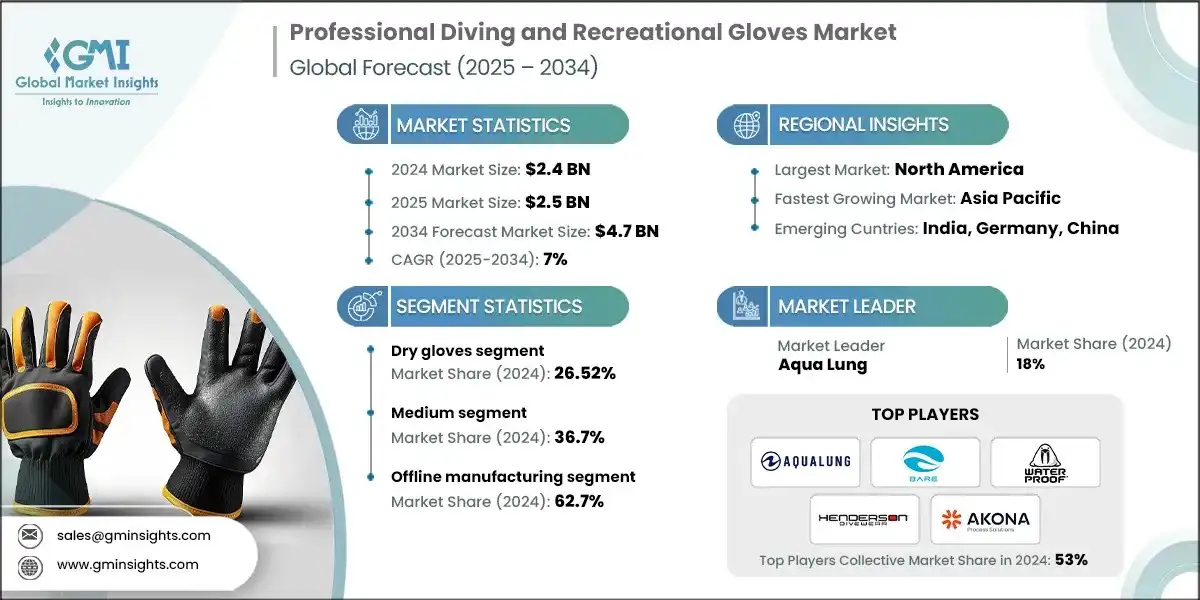
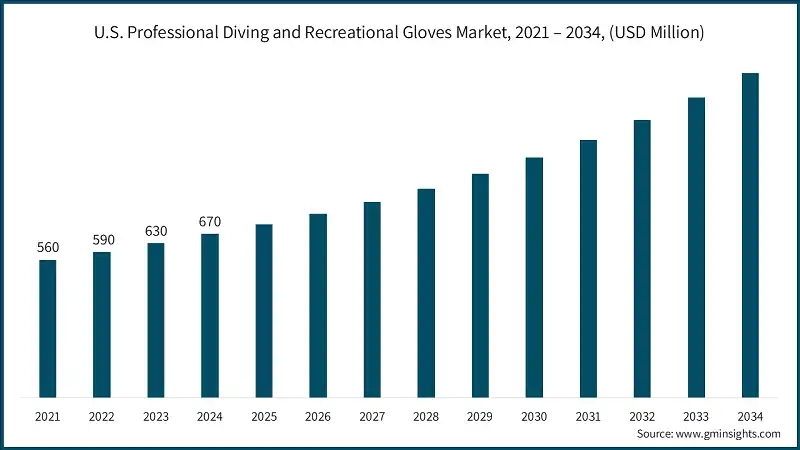
The global professional diving and recreational gloves market reached USD 2.4 billion in 2024, reflecting steady demand across recreational, professional, and technical diving segments. The market is projected to grow from USD 2.5 billion in 2025 to USD 4.7 billion by 2034, representing a compound annual growth rate of 7% over the forecast period according to Global Market Insights.
To get key market trends
- Market sizing includes revenues from manufacturers and brands supplying diving gloves to distribution channels that include, among others, specialty dive retailers, online platforms, dive resorts and training centers, rental operators, and institutional buyers such as government agencies, military programs, commercial diving contractors, and scientific research organizations.
- Neoprene wet gloves for different water temperatures range in thickness from 1.5mm to 7mm; dry glove systems that attach via wrist rings on drysuits; semi-dry gloves with either sealed or almost sealed seams; heated gloves with enclosed, battery-powered heating elements; specialized protective gloves with cut-resistant materials such as Kevlar and Dyfiber, used in spearfishing, lobstering, and handling sharp objects.
- The professional diving and recreational gloves market is a portion of the diving equipment market. According to The Business Research Company, it was valued at $4.66 billion in 2024 and is expected to reach $7.0 billion by 2029 at a CAGR of 8.6%
- Latin America and the Middle East & Africa regions. North America maintains the lead due to a large installed base of certified divers; highly developed commercial diving in offshore energy and maritime industries; strict regulatory requirements relating to professional diving operations; and high consumer expenditure on recreational diving equipment.
- Pricing analysis shows a very broad range from less than $10 for basic Lycra or thin neoprene gloves distributed through discount channels to more than $150 for high-end dry glove systems with integral wrist rings and special liners. Mid-market products, where most unit volume is sold, fall within the range of $25 to $75 for 2mm to 5mm neoprene gloves with options like reinforced palms, adjustable wrist closures, and pre-curved, ergonomic cuts.
- There are several quantitative drivers for market growth. According to The Business Research Company, more than 900 million international tourist arrivals were recorded in 2022, and a considerable portion of that travel is to coastal and marine destinations. Dive tourism remains in growth mode in established regions like the Caribbean, Mediterranean, and Red Sea, as well as emerging destinations in Southeast Asia and the South Pacific.
- However, the market faces headwinds from declining core diver participation in mature markets. Industry analysis indicates fewer open-water certifications are being issued annually, and that certified divers are diving less frequently, reducing per-capita equipment purchases according to the Business of Diving Institute. The shift to casual divers travelling light and renting heavy equipment at the destination reduces demand for personal glove ownership among recreational users.
Professional Diving and Recreational Gloves Market Report Attributes
| Key Takeaway | Details |
|---|---|
| Market Size & Growth | |
| Base Year | 2024 |
| Market Size in 2024 | USD 2.4 Billion |
| Market Size in 2025 | USD 2.5 Billion |
| Forecast Period 2025 - 2034 CAGR | 7% |
| Market Size in 2034 | USD 4.7 Billion |
| Key Market Trends | |
| Drivers | Impact |
| Growing participation in water sports and dive tourism | More people are traveling to tropical destinations and taking part in scuba diving, snorkeling, and other water sports—this increases overall demand for diving gloves and gear. |
| Regulatory and safety standards mandating equipment use | Many countries, dive agencies, and commercial diving sectors require proper protective equipment (including gloves), pushing both recreational and professional divers to purchase compliant products. |
| Expansion of technical and professional diving activities | Technical divers, military divers, rescue teams, and offshore industry workers are increasing in number and need specialized gloves for cold water, hazardous environments, and tool handling. |
| Pitfalls & Challenges | Impact |
| Declining core diver participation and market maturity | In some regions (like the US and parts of Europe), long-time diver numbers are shrinking, meaning the market isnt expanding as quickly and growth relies on tourism or new divers. |
| Commoditization and intense price competition | Many gloves look similar and use the same materials, causing brands to compete mainly on price—reducing profit margins and making it harder to differentiate. |
| Trade tariffs and supply chain disruptions | Global shipping delays, increased raw-material costs, and import/export duties can raise production costs and cause inventory shortages, affecting both manufacturers and retailers. |
| Opportunities: | Impact |
| Growth in Recreational Diving & Adventure Tourism | As more tourists try diving for the first time, there is growing demand for accessible, affordable, and comfortable gloves—especially through resorts, dive centers, and retail platforms. |
| Rising Demand for Professional-Grade Gloves | Commercial and technical diving sectors are seeking advanced gloves with better durability, thermal protection, and cut resistance—creating opportunities for premium, high-margin product lines. |
| Market Leaders (2024) | |
| Market Leaders |
Market share 18% |
| Top Players |
Collective market share in 2024 is Market share holds collectively 53% |
| Competitive Edge |
|
| Regional Insights | |
| Largest Market | North America |
| Fastest Growing Market | Asia Pacific |
| Emerging Country | India, Germany, China |
| Future Outlook |
|
What are the growth opportunities in this market?
Professional Diving and Recreational Gloves Market Trends
Transformative trends are reshaping the professional diving and recreational gloves industry, influencing product development, distribution strategies, and competitive dynamics.
Advanced Materials and Performance Engineering
- The innovations in material science are driving product differentiation in order to meet the needs for specific use cases and environmental conditions. High-stretch neoprene formulations with greatly improved compression resistance ensure thermal insulation at depth while also affording the flexibility needed for the fine motor control common in technical diving operations.
- Improvements in thermal protection are less obvious than the proliferation of multi-layer constructions and specialized coatings. Seams coated with liquid rubber provide substantial benefits in reducing water transfer as well as preventing thread fraying, which prolongs product lifespan and maintains thermal performance over many dives. Welded seam construction eliminates stitching holes that can admit water; some manufacturers further reinforce this by placing gussets behind zippers.
- Battery-powered heated glove systems are gaining acceptance for cold-water and ice diving but remain a niche premium category at present owing to cost and complexity.
- Driven by environmental concerns and resultant regulations, the diving community is seeing a surge in material innovation centered on sustainability. Plant-based YULEX foam derived from natural rubber is being introduced by manufacturers as a replacement for neoprene, which is petroleum-based, claiming a reduced carbon footprint without compromising thermal and compression performance.
- To further reduce the impact on the environment, manufacturers are using recycled polyester linings from post-consumer plastic bottles and adhesives without chemicals that are water-based. Other manufacturers have branded their product lines as "OceanPositive," and they create products made from post-consumer waste plastics recovered from the ocean and ghost fishing nets.
- Currently, such sustainable materials cost more; growing consumer awareness and likely new regulations are going to compel their wider use within all price tiers of wetsuits.
Digital Integration and Smart Glove Development
- Research into sensor-integrated diving gloves is emerging, hinting at the creation of new product categories and value propositions. Academic studies have shown waterproof electronic glove prototypes that can wirelessly transmit and, using machine learning, translate underwater hand gestures into text messages with an impressive 99.8% accuracy.
- This cutting-edge technology utilizes flexible micropillar sensor arrays, crafted on polydimethylsiloxane and coated with conductive silver. These sensors are encased in waterproof housings and strategically sewn into glove structures, particularly over knuckles and finger joints.
- While still at the prototype stage, successful commercialization could revolutionize communication in diving, especially where the visibility of hand signals is poor. Potential applications range from recreational dive safety and technical diving team coordination to commercial operations and military missions. But a number of challenges loom large around cost, durability, battery life, and regulatory approvals.
Professional Diving and Recreational Gloves Market Analysis
Learn more about the key segments shaping this market
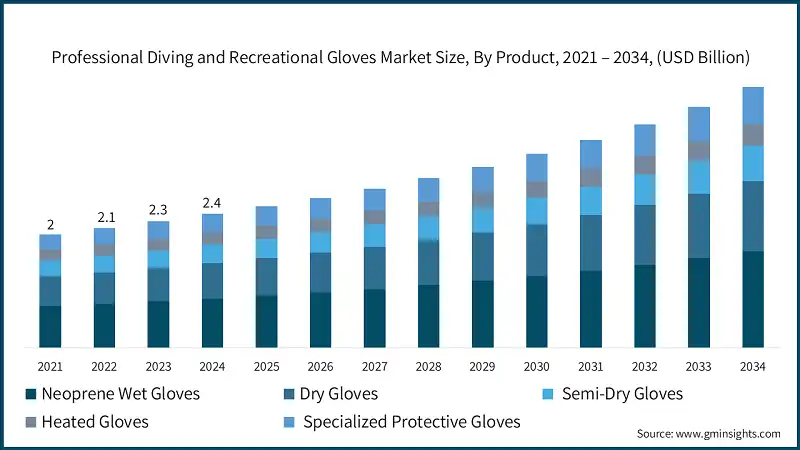
Based on product, the global professional diving and recreational gloves market is categorized into neoprene wet gloves, dry gloves, semi-dry gloves, heated gloves, and specialize protective gloves. The medium segment held around 36.7% of the total market share in 2024 and is anticipated to grow at a CAGR of 7.1% from 2025 to 2034.
- These are popular for not only recreational but also professional diving due to their commendable combination of thermal protection, flexibility, and durability at an affordable cost. The gloves trap several layers of water, warmed by body heat, for insulation through their range of thicknesses from 1.5 mm in tropical waters to 7 mm in colder waters.
- The manufacturers offer a range of Neoprene formulations: basic expanded neoprene, high-stretch neoprene for greater flexibility, and compressed neoprene for durability and reduced buoyancy. Glued and blind-stitched seams minimize water ingress while maintaining flexibility in the construction technique. Flatlock stitching allows more water transfer but can provide much-needed durability at a lower price.
- Innovations in neoprene wet gloves are all about increased grip, improved thermal performance, and durability. Textured palm coatings, with material examples such as Amara synthetic leather, Sandy Nitrile rubber, and embossed patterns, increase grip on wet equipment and marine surface. Liquid rubber-coated seams reduce water transfer and protect threads from damage by saltwater and UV.
- Pre-curved ergonomic cuts reduce hand fatigue on long dives. Adjustable wrist closures, whether Velcro straps or elastic cuffs, help to seal out water and also prevent the pulling off gloves by currents. Neoprene wet gloves can be used for recreational diving, snorkeling, free diving, spearfishing, dive training, and some professional operations in both temperate and tropical waters when dry glove systems are not required or called for.
- Dry gloves, with a market share of 26.52%, are the fastest-growing segment growing at a CAGR of 7.2%. Dry gloves, worn with drysuits, keep divers' hands dry during diving in cold or contaminated waters and provide better thermal protection. Designs include quick-disconnect, bayonet-lock, and squeeze-on systems; each has its trade-offs in usability and compatibility.
Learn more about the key segments shaping this market
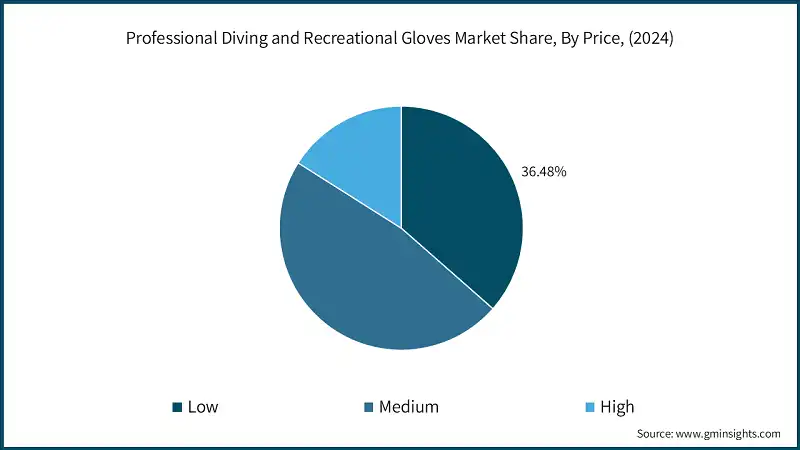
Based on price, the global professional diving and recreational gloves market is categorized as low, medium, and high. The medium segment held around 47.5% of the total market share in 2024 and is anticipated to grow at a CAGR of 6.9% from 2025 to 2034.
- The low-price segment accounts for 36.48% of the market share, with a CAGR of 6.9%, hence representing the largest price segment by volume. This would include all types of gloves whose pricing is under $30 and involves basic neoprene gloves, entry-level protective gear, and products from rental fleets.
- For low-priced gloves, common construction features involve neoprene thicknesses of anywhere from 1.5mm to 3mm, flatlock stitching for strength despite water transfer, simple texturing or coatings on the palm, and standard sizing sans gender-specific ergonomic cuts. Active companies within this category seek cost efficiency through high volume, standardized designs, and budget manufacturing regions.
- Distribution is mass-market-driven, from general sporting goods retailers, online marketplaces, and dive resort rental operations.
- Several distinct customer groups are attracted to the low-price segment. Beginning divers, in their initial equipment-purchasing stage, often select low-price gloves to minimize their initial investment while determining their commitment to diving and their preferences for features and fit.
- Emerging manufacturing hubs, with private-label and no-name brands, aggressively undercut prices, further squeezing the margins that established brands may have enjoyed as they try to hold on to their market share. Online marketplaces, which sort suppliers by price, tacitly favor the lowest-cost supplier.
- Customer reviews and purchase-frequency indicators serve as quality signals in this context, considerably making up for the effect of the lack of brand reputation. A number of established manufacturers also move into the low-price segment with value-oriented product lines, applying simpler constructions and materials than were found in their higher-priced products.
- Product differentiation in the middle price range is dependent on features, fit, comfort, durability, and reputation. Manufacturers compete based on neoprene quality, construction methods, the effectiveness of the palm grip material, ease of putting on and taking off, sizing and color selection, and customer service.
- The high-price segment consists of all premium products over $75. It captures 16.02% in market share with a 7.0% CAGR. Products to be found in this category include dry glove systems with wrist rings and liners, $100-$200+; heated gloves, $150-$300; high-end neoprene gloves with proprietary materials, $75-$120; specialized protective gloves using premium materials such as Kevlar, $80-$150.
- High-price products for serious, technical, and pro divers focus on performance and longevity, along with special capabilities, rather than cost.
Based on the distribution channel, global professional diving and recreational gloves market is categorized as online and offline. The offline manufacturing segment held around 62.7% of the total market share in 2024.
- Online distribution is the fastest-growing channel and commands a 37.26% market share, growing at 7.4% CAGR. The online channel involves a variety of online sales, ranging from manufacturers' direct-to-consumer websites and specialty diving equipment online retailers to general sporting goods online retailers and large marketplace platforms.
- Growth in online sales has been driven by consumer demand for convenience, greater selection, price transparency, competitively priced deals, detailed product information, customer reviews, and ease of delivery to the comfort of one's home.
- Offline distribution is spread out in numerous venues, including specialty dive shops, dive resorts and training centers, sporting goods retailers, and department stores, although it enjoys a market share of 62.74% with further growth at a 6.8% CAGR. The nature of diving gear requires fitting assistance and tailored recommendations for which the sales personnel need to be highly specialized.
- Dive shops thus are not only sites of personalized services but also after-sales support, including warranty processing and the facility to change products. Beyond sales, dive shops foster community by organizing group dives, training courses, and social events-cultivating loyalty that transcends mere transactions.
Looking for region specific data?
North America Professional Diving and Recreational Gloves Market In 2024, the professional diving and recreational gloves industry is dominated by five key players holding a combined market share of approximately 53%, with brand reputation, product quality, and distribution reach driving this strong concentration in a field where human safety and performance rely directly on it; another 47% of that market would be distributed among regional manufacturers, private-label suppliers, and niche specialty brands, partial avenues to differentiation. Major players operating in the professional diving and recreational gloves industry are:Asia Pacific Professional Diving and Recreational Gloves Market
Europe Professional Diving and Recreational Gloves Market
Professional Diving and Recreational Gloves Market Share
Professional Diving and Recreational Gloves Market Companies
Professional Diving and Recreational Gloves Industry News
The professional diving and recreational gloves market research report includes in-depth coverage of the industry with estimates & forecasts in terms of revenue ($ Bn/Mn) and volume (Thousand Units) from 2021 to 2034, for the following segments:
Market, By Product
- Neoprene wet gloves
- Dry gloves
- Semi-dry gloves
- Heated gloves
- Specialized protective gloves
Market, By Price
- Low
- Medium
- High
Market, By Application
- Recreational diving
- Scuba diving (open-circuit, nitrox)
- Snorkeling
- Freediving & breath-hold diving
- Professional & commercial diving
- Offshore oil & gas operations
- Underwater construction & inspection
- Underwater welding & cutting
- Salvage operations
- Technical diving
- Cave diving
- Wreck diving
- Deep diving (>130 FSW)
- Rebreather diving
- Decompression diving
- Scientific diving
- Archaeological diving
- Oceanographic research
- Government agency programs
- Contaminated water diving
- Water sports
- Surfing
- Kayaking & paddling
- Stand-up paddleboarding
- Sailing & windsurfing
Market, By End Use
- Professional / competitive users
- Amateur / enthusiast users
- Casual / recreational users
- Institutional / commercial buyers
Market, By Distribution Channel
- Online
- Offline
The above information is provided for the following regions:
- North America
- U.S.
- Canada
- Europe
- UK
- Germany
- France
- Italy
- Spain
- Russia
- Asia Pacific
- China
- India
- Japan
- Australia
- South Korea
- Latin America
- Brazil
- Mexico
- Argentina
- MEA
- UAE
- South Africa
- Saudi Arabia
Frequently Asked Question(FAQ) :
What is the market size of the professional diving and recreational gloves industry in 2024?
The market size was USD 2.4 billion in 2024, with a CAGR of 7% expected through 2034 driven by growing participation in water sports, dive tourism, and rising adoption of advanced glove materials.
What is the current professional diving and recreational gloves market size in 2025?
The market size is projected to reach USD 2.5 billion in 2025, supported by increasing recreational diving activities and expanding demand across professional and technical diving sectors.
What is the projected value of the professional diving and recreational gloves market by 2034?
The market is expected to reach USD 4.7 billion by 2034, driven by material innovation, sustainability-focused glove manufacturing, and growth in commercial and cold-water diving applications.
What was the valuation of the dry gloves segment in 2024?
The dry gloves segment accounted for 26.52% share in 2024, driven by high adoption among cold-water, contaminated-water, and technical diving operations.
What is the growth outlook for the online distribution channel from 2025 to 2034?
Online sales held 37.26% share and are projected to grow at a 7.4% CAGR through 2034, fueled by price transparency, wider product availability, and rising e-commerce penetration in dive gear categories.
Which region leads the professional diving and recreational gloves market?
North America leads the market with a 31.33% share, supported by the region’s large certified diver population, extensive coastlines across the Atlantic, Pacific, and Gulf of Mexico, and high per-capita spending on recreational equipment.
What are the upcoming trends in the professional diving and recreational gloves industry?
Key trends include adoption of advanced neoprene formulations, liquid rubber-coated seams, sustainable materials such as Yulex and recycled polyester, and early development of smart gloves with integrated sensors for underwater communication and safety.
Who are the key players in the professional diving and recreational gloves market?
Major players include Aqua Lung, Akona, Aropec, Bare Sports, Body Glove, Cressi, DeepSea Locker/Pro Diver, DUI, Fourth Element, Henderson, KFD Group, Mares, Northern Diver, SANTI Diving, and Scubapro.
Professional Diving and Recreational Gloves Market Scope
Related Reports