Summary
Table of Content

Procurement as a Service (PaaS) Market
Get a free sample of this report
Form submitted successfully!
Error submitting form. Please try again.
Thank you!
Your inquiry has been received. Our team will reach out to you with the required details via email. To ensure that you don't miss their response, kindly remember to check your spam folder as well!
Request Sectional Data
Thank you!
Your inquiry has been received. Our team will reach out to you with the required details via email. To ensure that you don't miss their response, kindly remember to check your spam folder as well!
Form submitted successfully!
Error submitting form. Please try again.
Procurement as a Service Market Size
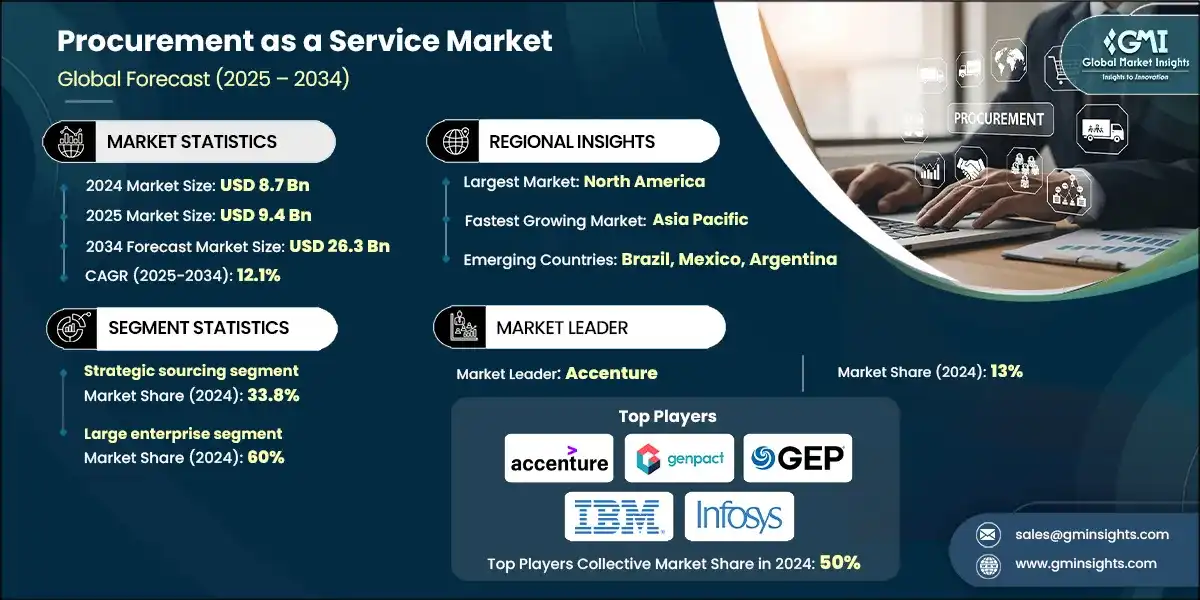
The global procurement as a service (PaaS) market size was estimated at USD 8.7 billion in 2024. The market is expected to grow from USD 9.4 billion in 2025 to USD 26.3 billion in 2034, at a CAGR of 12.1%, according to latest report published by Global Market Insights Inc.
Procurement as a Service (PaaS) Market Key Takeaways
Market Size & Growth
- 2024 Market Size: USD 8.7 Billion
- 2025 Market Size: USD 9.4 Billion
- 2034 Forecast Market Size: USD 26.3 Billion
- CAGR (2025–2034): 12.1%
Regional Dominance
- Largest Market: North America
- Fastest Growing Region: Asia Pacific
Key Market Drivers
- Digital Transformation Imperative.
- Cost Optimization Pressures.
- Supply Chain Complexity Management.
- Regulatory Compliance Requirements.
Challenges
- Data Security and Cybersecurity Risks.
- Loss of Internal Control and Visibility.
Opportunity
- Expansion of Emerging Markets.
- Sustainability and ESG Integration.
- Artificial Intelligence and Advanced Analytics Integration.
- Small and Medium Enterprise Market Penetration.
Key Players
- Market Leader: Accenture led with over 13% market share in 2024.
- Leading Players: Top 5 players in this market include Accenture, Genpact, GEP, IBM, Infosys Limited, which collectively held a market share of 50% in 2024.
Get Market Insights & Growth Opportunities
- Procurement as a Service (PaaS) market is experiencing strong growth due to the increasing integration of cloud-native procurement platforms, AI-driven spend analytics, mobile-first sourcing dashboards, and advanced data intelligence for predictive supplier risk management.
- Rising concerns over supply chain disruptions, cost overruns, and compliance risks combined with enterprise demand for lower total cost of ownership (TCO) will continue to spur adoption of automated contract lifecycle tools, digital supplier onboarding systems, IoT-enabled procurement tracking, and autonomous sourcing bots.
- PaaS is appearing more and more with movement in markets, regulations and all kinds of digital modernization and transformation around the globe. PaaS is showing up more and more with movement in markets, regulations and the many aspects of digital modernization and transformation all over the world. For example, the European Commission updated its Corporate Sustainability Reporting Directive in April 2024, which has much stricter ESG compliance within supply chains, while also offering incentive to shift to digital procurement ecosystems with real-time supplier traceability platforms.
- At first, the adoption and uptake of PaaS had negative disruptive market influences from global supply chain shocks, and IT budget freezes experienced by many organizations globally during the COVID-19 pandemic, when many companies were reluctant to change over approved and legacy-related procurement systems. However, in 2021 demand grew quickly as many organizations, especially in manufacturing, retail, and government-backed infrastructure projects, sought cloud-based procurement tools to reduce manual intervention and enhance transparency, aligning with mission-informed sustainability and resilience goals.
- Enterprises rapidly expanded their investment in PaaS solutions that offered AI-based spend categorization, predictive supplier performance alerts, and over-the-air (OTA) policy updates to proactively mitigate supply risks, reduce cycle times, and enhance centralized procurement governance.
- The PaaS market is experiencing rapid growth, particularly in the Asia-Pacific region because of fast-paced enterprise digitalization, government e-procurement mandates and the increased level of smart industry initiatives. In terms of maturity and take-off, India, Singapore and Australia are ahead of other regions and have been early adopters with their respective successful AI-powered procurement hubs, which have flourished due to localized digital innovations in addition to state-backed incentive programs across platforms for cloud-based sourcing, spend management and supplier collaboration.
To get key market trends
Procurement as a Service Market Trends
- The rise of the PaaS sector is being driven by the growth of digital procurement infrastructure. The last 1-2 years has seen considerable investment in cloud-based procurement platforms, AI-enabled spend management systems, and global sourcing centers and hubs across important regions such as North America, Europe, and Asia Pacific.
- Global organizations are investing in shared service centers and procurement capability hubs to centralize the organization's procurement operations instead of several fragmented local networks. Shared services and shared capability approaches reduce procurement and sourcing cycle times, mitigate reliance on decentralized sourcing options, and align government-led incentives to digital transformation.
- The PaaS ecosystem is evolving rapidly through digital technologies. Companies are taking advantage of Artificial Intelligence (AI), Robotic Process Automation (RPA), and Machine Learning (ML) for sourcing automation, supplier risk assessment/ prediction, and category optimization.
- AI-enabled PaaS platforms promote spend visibility and improve demand forecasting and procurement cycle time while making procurement a data-driven and strategic business process. Procurement digitalization can support organizations in building resilient global supply chains, satisfy ESG demand for compliance, and improve cost efficiencies.
- Procurement platforms that are cloud-based and modular service delivery models are fast becoming a strategic priority. Multinational enterprises and governments globally have begun investing in subscription-based procurement suites, plug-and-play sourcing platforms and API-constructed ecosystems of supplier collaboration. This increasingly scalable PaaS (service-based) offering allows organizations to bypass challenged legacy infrastructure, quicken digital adoption, and reduce the cost of procurement transformation for large multinationals all the way to small to medium sized enterprises (SME) across the world.
- In March 2025, Accenture launched an AI-enhanced and globally expanded procurement platform to clients across Europe and Asia. Accenture's procurement platform has a 'sustainability' module, advanced supplier risk monitoring, and real-time analytics capabilities. This is a marker of global commitment to sustainable procurement while digitally integrated and analytics in today's procurement ecosystem and contributes to new standards of transparency and efficiency in PaaS.
Procurement as a Service Market Analysis
Learn more about the key segments shaping this market
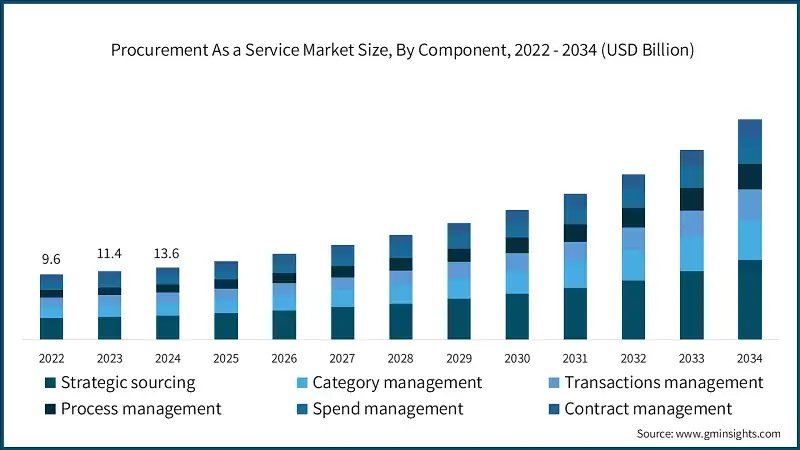
Based on component, the procurement as a service market is divided into strategic sourcing, category management, transactions management, process management, spend management and contract management. The strategic sourcing segment dominated the market, accounting for around 33.8% in 2024 and is expected to grow at a CAGR of 13% through 2034.
- Strategic sourcing is growing in popularity in the PaaS market because of its cost savings potential, supplier relationship improvements, and the opportunity to align with overall business goals. As more organizations in all industries outsource their strategic sourcing functions to PaaS providers that offer deep supplier networks, market intelligence, and sophisticated analytics capabilities, they are able to unlock their strategic sourcing potential.
- For instance, in March 2025, Accenture announced an expansion of its strategic sourcing-as-a-service portfolio that includes AI-enabled category intelligence as well as categories for supplier collaboration. This update cements its position as one of the predominant leaders in the PaaS market and demonstrates the momentum that major providers are prioritizing important high-value sourcing services that can show a measurable business impact.
- Other pieces of the PaaS market category management, transaction management, process management, spend management, contract management are also on a steady growth path. However, the strategic sourcing piece of the PaaS market is still the largest segment because it has become a vital service delivery function for organizations looking to drive cost efficiency or sustainable procurement practices and supplier innovation across their business and industry.
Learn more about the key segments shaping this market
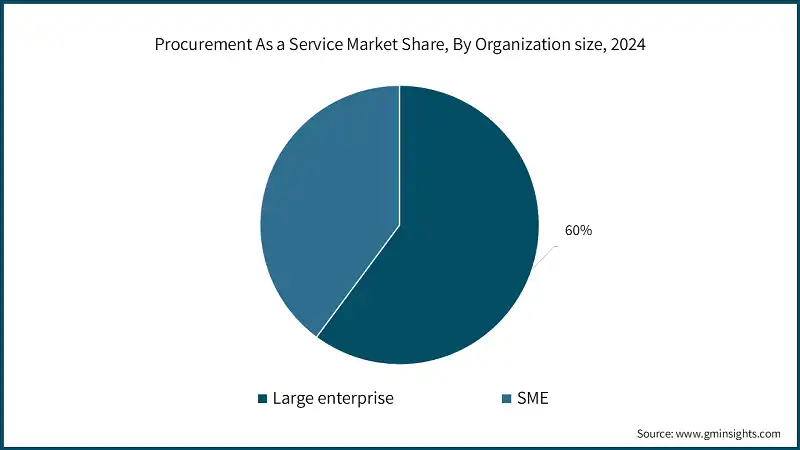
Based on organization size, the PaaS market is segmented into large enterprise and SME. The large enterprise segment dominates the market with 60% share in 2024, and the segment is expected to grow at a CAGR of over 12.8% from 2025 to 2034.
- Larger enterprises utilize PaaS, as a result of their complex supply chains, diversified supplier bases, and overall higher procurement spend. As a result, these organizations require procurement solutions that are advanced and scalable. Thus, it is relatively easier for larger organizations to adopt PaaS in order to centralize procurement operations, align with global sourcing compliance, and align with cost efficiencies across business units and geographic areas.
- The growing focus on digital transformation, ESG compliance, and supplier risk management is driving enterprise organizations to partner with several well-established PaaS vendors who can offer AI-based analytics, cloud-based procurement platforms, and integrated contract management systems. This allows enterprise organizations to gain visibility in real-time, decrease their procurement cycle times, and gain a competitive advantage in a volatile market.
- For instance, in February 2025, IBM worked with GEP to enhance Kelly's enterprise procuring outsourcing offering with AI driven supplier performance monitoring and sustainability scorecards. This example demonstrates how large enterprises are utilizing PaaS to stimulate strategic decision-making and achieve greater operational excellence at the enterprise-wide level.
- Although small and medium enterprises (SMEs) are also using PaaS for better procurement and faster time to market capabilities, the large enterprise community is the primary use case driven by their greater ability to adopt technology, larger procurement budgets and the overall demand for managed procurement services from start to finish.
Based on end use, the procurement as a service market is segmented BFSI, IT & Telecom, healthcare, retail, manufacturing, energy & utility, travel & hospitality and others. The BFSI segment is expected to dominate the market.
- BFSI segment is projected to be the leading segment in the global PaaS market because banks, financial institutions, and insurance companies are increasingly pressured to optimize procurement costs, ensure total regulatory compliance, and manage third-party risks across large networks of suppliers. The level of regulation in the BFSI sector requires transparent, auditable and compliant procurement processes-making this sector a prime candidate for PaaS platforms that deliver AI-enabled capabilities for compliance monitoring, and contract lifecycle management and supplier due-diligence.
- An increase in the pace of digital banking transformation, fintech partnerships; and expansion of global financial services are all driving demand for scalable procurement outsourcing frameworks to cope with high volumes of transactional activity and cross-border sourcing requirements. Market-leading PaaS providers are developing niche solutions for BFSI players that incorporate risk assessment, spend analytics-based intelligence on supplier performance to aid operational resilience and manage costs and predictability.
- For instance, in April 2025, Genpact incubated an AI-tethered procurement platform for a global top-tier bank that provided significant efficiencies through the vendor onboarding process, automated contract approvals, and reduced procurement cycle tails by over 30%! You can see the increased potential for BFSI institutions adopting PaaS to improve efficiencies, risks mitigation, and firm up changing regulatory compliance requirements.
- While other end-use industries, such as IT & Telecom, Healthcare, and Retail are also using PaaS as improvement steps for cost efficiencies and supplier collaboration, the BFSI industry will continue to be the largest contributing vertical category, with its ability to stay compliance focused, manage risks, and encapsulate scale-based factor for operations that are global in nature.
Looking for region specific data?
North America Procurement as a Service Market
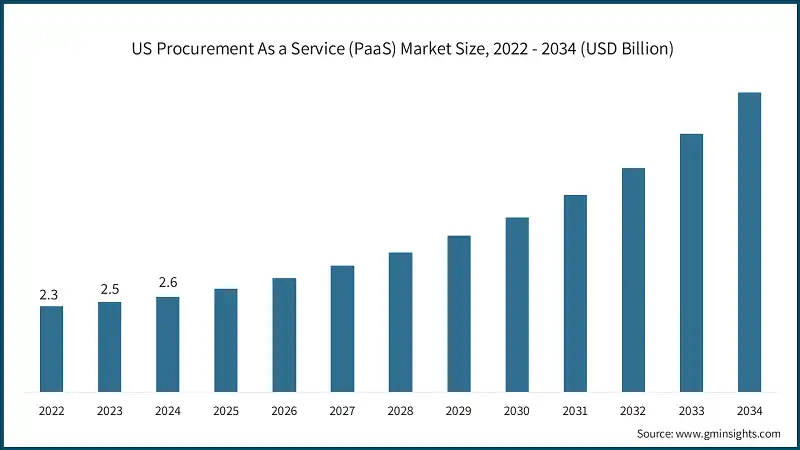
North America dominated the global procurement as a service (PaaS) industry with a market share of 34.6% in 2024. US lead in this region and generates revenue of USD 2.6 billion in 2024.
- North America leads the world in PaaS activity due to a mature enterprise landscape, a fast-tracked digital transformation agenda, and stronger emphasis on operations excellence across industries. The concentration of multinational enterprises (MNEs), sophistication of IT infrastructure, and early adoption of cloud-based procurement platforms have created a launching pad for PaaS in North America. The U.S. and Canada are taking the lead by outsourcing more strategic sourcing, contract lifecycle management, and spend analytics functions to third-party PaaS service providers.
- North America has been a relatively early adopter of integrating AI-enabled procurement tools, robotic process automation (RPA), and data-enabled supplier risk management to help enterprises improve their sourcing opportunities and compliance advantages. Some of the major PaaS players here, including Accenture, IBM, and Genpact, and others have built strong regional presence and capabilities to solve the enterprise level procurement needs across verticals including BFSI, Manufacturing, and Healthcare.
- In addition, many governmental and regulatory bodies in the region are formalizing imposing regulatory compliance frameworks, sustainability reporting obligations, and supplier diversity programs, and encouraging enterprises to transition modalities to PaaS, to comply with these standards. The unique position and influence of the stakeholders in North America are creating an ecosystem for the innovation, large-scale adoption, and future growth of the global PaaS market.
US is the largest procurement as a service market in North America, driven by rapid enterprise digitalization, advanced IT infrastructure, and a strong shift toward outcome-based procurement models.
- Growing investment in AI-enabled procurement platforms, automated sourcing workflows, and cloud-based contract lifecycle management has significantly accelerated the adoption of PaaS among large enterprises and government agencies. In March 2025, IBM introduced an AI-driven procurement intelligence suite in the U.S. market, enabling predictive supplier risk assessment, autonomous sourcing recommendations, and real-time spend optimization for enterprise clients.
- Companies significantly investing in the U.S. PaaS market include major global leaders such as Accenture, Genpact, GEP, and Infosys. They are expanding their regional delivery centres and digital procurement capabilities to meet the surging demand for scalable, analytics-driven procurement solutions across industries including BFSI, Manufacturing, and Healthcare.
- Other notable growth drivers in the U.S. PaaS market include the country’s stringent regulatory compliance landscape, strong focus on supplier diversity and ESG reporting, and increasing adoption of hybrid procurement models by both private enterprises and public-sector organizations. These trends collectively make the U.S. the core growth engine and innovation hub of the North American PaaS market.
Europe Procurement as a Service Market
The Europe Procurement as a Service (PaaS) industry is anticipated to grow at a strong CAGR of 11.8% during the analysis timeframe.
- Europe accounts for a significant share of the global PaaS market, led by major economies such as Germany, France, the United Kingdom, and the Nordic countries. Increasing investments in digital procurement transformation, green sourcing initiatives, and sustainable supply chain programs are driving demand for strategic sourcing, category management, and spending analytics services. In addition, tightening European Union regulatory frameworks and ESG compliance mandates further accelerate the adoption of outsourced procurement solutions, contributing to robust market growth.
- Europe is a hotspot for advanced procurement technology adoption, including AI-driven spend intelligence, cloud-based contract lifecycle management, and IoT-enabled supplier performance monitoring. Government incentives, corporate ESG goals, and regional digitalization strategies are encouraging widespread deployment of PaaS across manufacturing, BFSI, healthcare, and energy sectors spurring the expansion of the market throughout the region.
UK Procurement as a Service (PaaS) market is estimated to grow with a significant CAGR, in the Europe market.
- The United Kingdom PaaS industry is expected to experience strong growth, driven by increasing government-backed digital transformation programs, stricter regulatory compliance requirements, and growing adoption of cloud-based procurement solutions across public and private sectors.
- Strategic sourcing, spend analytics, and contract lifecycle management platforms are increasingly being deployed by enterprises to enhance transparency, compliance, and cost efficiency in procurement operations. For example, in February 2025, Accenture launched a UK-focused procurement innovation hub in London, offering AI-enabled supplier risk assessment, real-time spend visibility, and predictive sourcing analytics to large enterprise clients.
- Major players investing in the UK market include IBM, Genpact, GEP, and Infosys, motivated by strong demand for high-efficiency procurement operations, the expansion of shared service centers, and the growing need for ESG-aligned supplier management.
- Growth is further supported by initiatives such as the UK Government Digital Marketplace framework, government incentives for digital procurement modernization, and increasing corporate ESG reporting mandates. Enterprises and public sector agencies are adopting PaaS solutions to reduce operational costs, meet compliance standards, and accelerate procurement transformation across BFSI, healthcare, manufacturing, and energy sectors.
Asia Pacific Procurement as a Service Market
The Asia Pacific procurement as a service (PaaS) industry is anticipated to grow at a strong CAGR of 12.9% during the analysis timeframe.
- Asia-Pacific accounts for a significant share of the market, led by major economies such as China, India, Japan, and Australia. Increasing investments in enterprise digital transformation, rapid growth of e-commerce and manufacturing sectors, and rising demand for cost-efficient procurement operations are driving adoption of strategic sourcing, spend analytics, and supplier management solutions. In addition, evolving regulatory frameworks, localization mandates, and ESG compliance requirements further accelerate the shift toward cloud-based and service-driven procurement models, contributing to market growth.
- Asia-Pacific is a hotspot for advanced procurement technology adoption, including AI-powered spend intelligence, IoT-enabled supplier performance tracking, and cloud-based contract lifecycle management. Government-led digitalization initiatives, large-scale corporate procurement modernization programs, and the rising presence of global PaaS providers are encouraging widespread deployment of procurement as a service across BFSI, manufacturing, healthcare, and IT & telecom sectors—spurring rapid market expansion in the region.
China Procurement as a Service (PaaS) market is estimated to grow with a significant CAGR.
- China is driven by rapid digital transformation in enterprises, strong government initiatives promoting e-procurement, and the increasing need for cost optimization and supplier risk management. Large corporations, particularly in manufacturing, BFSI, and technology sectors, are adopting cloud-based procurement platforms to streamline sourcing, contract management, and spend analytics across multiple regions.
- Major PaaS providers investing in China include Accenture, IBM, GEP, and Infosys, offering localized solutions that integrate AI-powered supplier intelligence, robotic process automation (RPA), and predictive analytics. These platforms help enterprises reduce procurement cycle times, enhance compliance, and improve operational efficiency while supporting China’s push for digital supply chain modernization.
- Government initiatives, such as digital procurement mandates and incentives for supply chain transparency, further accelerate adoption of PaaS solutions. Enterprises are leveraging these platforms not only to cut costs but also to meet ESG reporting requirements, strengthen supplier collaboration, and drive strategic sourcing initiatives.
Latin American Procurement as a Service Market
Brazil leads the Latin American Procurement as a Service (PaaS) industry, exhibiting remarkable growth during the analysis period.
- Brazil leads the Latin American PaaS market, driven by increasing enterprise digital transformation initiatives, rapid growth of the manufacturing, BFSI, and retail sectors, and the rising need for cost-efficient and compliant procurement operations. Adoption of cloud-based procurement platforms, strategic sourcing solutions, and spend analytics is being supported by government digitalization programs, private-sector investments, and corporate modernization efforts.
- Major PaaS providers investing in Brazil include Accenture, IBM, GEP, and Infosys, motivated by strong demand for scalable, AI-enabled procurement services, integrated supplier management, and real-time spend visibility. These providers are expanding local delivery centers and platform capabilities to meet the growing requirements of large enterprises and multinational corporations in the region.
- Growth is further fueled by regulatory compliance requirements, corporate ESG commitments, and regional digital procurement initiatives. Organizations in Brazil are leveraging PaaS to reduce operational costs, improve supplier collaboration, enhance risk management, and accelerate procurement transformation across BFSI, manufacturing, retail, and energy sectors.
Middle East and Africa Procurement as a Service Market
UAE Procurement as a Service (PaaS) industry to experience substantial growth in the Middle East and Africa in 2024.
- The UAE PaaS market is witnessing rapid growth, driven by government-led digital transformation initiatives, the adoption of smart city programs, and increasing demand from sectors such as BFSI, healthcare, manufacturing, and energy. Enterprises are increasingly leveraging cloud-based procurement platforms, AI-powered spend analytics, and contract lifecycle management solutions to enhance operational efficiency and ensure regulatory compliance.
- Major PaaS providers investing in the UAE include Accenture, IBM, GEP, and Infosys, offering localized, service-driven procurement solutions that integrate predictive analytics, supplier performance monitoring, and automated sourcing workflows. These platforms enable enterprises to optimize procurement costs, strengthen supplier collaboration, and manage risks effectively across diverse supply chains.
- Growth is further supported by government initiatives such as the UAE Smart Government Program and digital procurement mandates, which encourage adoption of technology-enabled procurement solutions in both public and private sectors. Organizations are using PaaS to drive strategic sourcing, improve visibility, and ensure compliance with ESG standards and local regulations, positioning the UAE as a key hub for procurement innovation in the Middle East.
Procurement as a Service Market Share
Accenture leads the market with an estimated market share of 15% in 2024, offering a comprehensive portfolio of strategic sourcing, supplier management, spend analytics, and lifecycle management solutions. Its strength lies in AI-enabled supplier risk assessment, process automation, and cloud-based procurement platforms, enabling enterprises to optimize costs, enhance compliance, and improve operational efficiency. Accenture emphasizes sustainability, ESG-aligned procurement strategies, and digital transformation, driving adoption across BFSI, manufacturing, healthcare, and retail sectors.
GEP stands out for its expertise in unified procurement platforms, combining AI, RPA, and advanced analytics to streamline sourcing, contract management, and supplier collaboration. Its portfolio includes cloud-based procurement solutions, predictive spend analytics, and supplier performance monitoring tools. GEP’s global delivery model, focus on operational efficiency, and scalable technology solution make it a trusted partner for enterprises seeking cost-effective and transparent procurement operations.
IBM specializes in AI-powered procurement and analytics-driven spend management, offering a portfolio of cloud-based sourcing platforms, predictive supplier performance monitoring, and automated contract management solutions. Its strength lies in integrating hybrid cloud systems with advanced data analytics, enabling large enterprises to optimize procurement efficiency, strengthen supplier collaboration, and maintain compliance. IBM emphasizes technology-driven innovation and ESG-aligned practices, driving adoption across multiple sectors including BFSI, manufacturing, and energy.
- Infosys Limited: Infosys offers a comprehensive suite of Procurement as a Service (PaaS) solutions, encompassing strategic sourcing, spend management, and supplier collaboration. Leveraging advanced technologies such as AI, cloud computing, and automation, Infosys enables enterprises to streamline procurement processes, enhance supplier relationships, and ensure compliance across various industries, including manufacturing, retail, BFSI, and healthcare. The company's focus on technology-driven innovation and sustainability aligns with the growing demand for efficient and responsible procurement practices.
- Genpact: Genpact delivers intelligent procurement and finance transformation services, combining AI, robotic process automation (RPA), and analytics to streamline sourcing, supplier management, and contract lifecycle processes. Its strength lies in process excellence and industry-specific insights, enabling clients to reduce costs, enhance operational efficiency, and mitigate supply chain risks. Genpact emphasizes data-driven innovation and ESG-conscious strategies, supporting sectors including manufacturing, healthcare, and financial services.
Procurement as a Service Market Companies
Major players operating in the Procurement as a Service (PaaS) industry are:
- Accenture
- Capgemini
- Genpact
- GEP
- IBM
- Infosys
- Jaggaer
- Wipro
- WNS
- Zycus
- The Procurement as a Service (PaaS) market is shaped by a mix of established global leaders and emerging innovators, creating a dynamic and moderately consolidated competitive landscape. Key players such as Accenture plc, GEP, IBM Corporation, Infosys Limited, Genpact, Wipro Limited, and Capgemini collectively account for a significant portion of the market share, estimated at around 54%.
- These companies maintain their dominance through strategic investments in AI-driven procurement platforms, cloud-based sourcing solutions, advanced spend analytics, and global delivery capabilities, while tailoring offerings to meet the evolving needs of enterprises seeking digital, scalable, and ESG-compliant procurement operations.
- To strengthen their market positions, leading firms are adopting multi-pronged strategies including platform innovation, AI/automation integration, strategic partnerships, and regional expansion. These efforts aim to make procurement processes more efficient, transparent, and adaptable to varying industry requirements across BFSI, manufacturing, healthcare, retail, and energy sectors.
- In addition to these dominant players, other regional service providers and niche PaaS specialists are contributing to market growth through specialized spend management, supplier risk monitoring, and localized procurement services. Their presence is particularly notable in North America, Europe, and Asia-Pacific, where enterprises are increasingly adopting digital procurement models to achieve cost optimization, compliance, and operational efficiency.
- Overall, the market is witnessing intensified competition and greater diversity, as both established and emerging players continue to evolve their offerings and strategies to meet the global demand for end-to-end, technology-enabled, and strategically managed procurement services.
Procurement as a Service (PaaS) Market Report Attributes
| Key Takeaway | Details |
|---|---|
| Market Size & Growth | |
| Base Year | 2024 |
| Market Size in 2024 | USD 8.7 Billion |
| Market Size in 2025 | USD 9.4 Billion |
| Forecast Period 2025 - 2034 CAGR | 12.1% |
| Market Size in 2034 | USD 26.3 Billion |
| Key Market Trends | |
| Drivers | Impact |
| Digital Transformation Imperative | Organizations are increasingly moving away from legacy procurement systems toward cloud-native, AI-enabled procurement platforms. This digital shift allows enterprises to automate repetitive processes, improve data visibility, and enable real-time decision-making, creating a more agile and resilient procurement ecosystem. |
| Cost Optimization Pressures | Rising operational costs and shrinking margins are forcing companies to streamline sourcing and supplier management processes. PaaS solutions provide automated spend analytics, dynamic supplier negotiations, and contract lifecycle management, helping enterprises reduce procurement costs, improve ROI, and maximize working capital efficiency. |
| Supply Chain Complexity Management | Global supply chains have grown increasingly complex, with multiple suppliers, geographies, and regulatory requirements. PaaS platforms enable centralized supplier collaboration, predictive risk monitoring, and AI-driven scenario planning, allowing enterprises to mitigate disruptions, improve supplier performance, and enhance operational continuity. |
| Regulatory Compliance Requirements | Increasing regulations, such as ESG mandates and anti-corruption laws, require enterprises to maintain transparent and auditable procurement processes. PaaS solutions automate compliance reporting, monitor supplier adherence, and ensure traceability, reducing risk exposure and ensuring alignment with global and regional legal frameworks. |
| Pitfalls & Challenges | Impact |
| Data Security and Cybersecurity Risks | With procurement functions moving to cloud-based platforms, sensitive information including supplier contracts, pricing data, and strategic sourcing plans is stored and processed off-premises. Cyberattacks, data breaches, or inadequate encryption measures can compromise confidential information, creating financial, reputational, and regulatory risks for enterprises. |
| Loss of Internal Control and Visibility | Outsourcing procurement processes through PaaS can result in reduced oversight of supplier interactions, spend decisions, and operational workflows. Organizations may face challenges in maintaining full transparency, aligning with internal policies, and ensuring accountability. |
| Opportunities: | Impact |
| Expansion of Emerging Markets | While emerging markets present significant growth opportunities, enterprises face fragmented supplier bases, variable technology adoption, and inconsistent regulatory frameworks. Expanding PaaS offerings in these regions requires localized solutions, robust infrastructure, and adaptability to diverse business practices, which can slow large-scale deployment. |
| Sustainability and ESG Integration | Integrating ESG and sustainability considerations into procurement processes remains complex. PaaS platforms must track supplier compliance, monitor carbon footprints, and manage responsible sourcing metrics, which can require significant customization and ongoing monitoring, posing challenges for seamless implementation. |
| Artificial Intelligence and Advanced Analytics Integration | While AI and advanced analytics enhance procurement efficiency, deploying these technologies at scale can be resource-intensive and technically challenging. Organizations may encounter issues such as data quality gaps, system integration complexity, and a shortage of skilled talent to manage predictive sourcing and risk analytics effectively. |
| Small and Medium Enterprise Market Penetration | SMEs often have limited budgets, less digital readiness, and smaller procurement volumes, making it harder for PaaS providers to achieve rapid adoption. Tailoring solutions for SMEs without compromising scalability or cost-effectiveness remains a key challenge for market expansion. |
| Market Leaders (2024) | |
| Market Leaders |
13% market share |
| Top Players |
Collective Market Share in 2024 is 50% |
| Competitive Edge |
|
| Regional Insights | |
| Largest Market | North America |
| Fastest growing market | Asia Pacific |
| Emerging countries | Brazil, Mexico, Argentina |
| Future outlook |
|
What are the growth opportunities in this market?
Procurement as a Service Industry News
- In April 2025, Accenture launched an AI-enabled procurement platform that integrates strategic sourcing, supplier risk analytics, and cloud-based contract management. Initial deployments across North America and Europe enhanced operational efficiency, enabling enterprises to optimize spending, monitoring supplier performance in real time, and accelerate decision-making.
- In March 2025, GEP expanded its unified PaaS platform across Asia-Pacific and Europe. The upgraded solution integrates RPA-driven procurement workflows, AI-based spend analytics, and real-time supplier performance dashboards to improve operational visibility, reduce procurement cycle times, and enhance compliance.
- In February 2025, IBM Corporation introduced an advanced procurement-as-a-service suite featuring predictive supplier risk assessment, automated contract lifecycle management, and cloud-enabled analytics. Early deployments in the U.S. and Germany demonstrated improved procurement efficiency, optimized supplier collaboration, and reduced operational costs.
- In January 2025, Infosys Limited unveiled an AI-powered digital procurement solution that combines spend optimization, supplier management, and automated sourcing processes. Pilots across India and the U.K. showed enhanced process efficiency, improved contract compliance, and greater strategic sourcing effectiveness.
- In December 2024, Genpact launched a next-generation PaaS offering with integrated AI-based spend analysis, predictive supplier risk scoring, and cloud-connected procurement dashboards. Initial rollouts in Brazil and Singapore enabled enterprises to streamline procurement operations, enhance supplier visibility, and improve cost management.
- In November 2024, Wipro Limited introduced a hybrid procurement platform integrating AI-driven analytics, automated sourcing workflows, and real-time supplier monitoring. Deployments in the Middle East and Europe demonstrated higher adoption rates, improved procurement efficiency, and stronger supplier collaboration.
- In October 2024, Capgemini rolled out an end-to-end PaaS platform featuring cloud-native procurement services, predictive analytics, and ESG-aligned supplier management tools. Deployed in France and the UAE, the solution enabled real-time spend monitoring, automated compliance alerts, and improved strategic sourcing outcomes for enterprise clients.
The procurement as a service (PaaS) market research report includes in-depth coverage of the industry with estimates & forecasts in terms of revenue ($Bn) from 2021 to 2034, for the following segments:
Market, By Component
- Strategic sourcing
- Category management
- Transactions management
- Process management
- Spend management
- Contract management
Market, By Organization Size
- Large enterprise
- SME
Market, By End Use
- BFSI
- IT & Telecom
- Healthcare
- Retail
- Manufacturing
- Energy & utility
- Travel & hospitality
- Others
The above information is provided for the following regions and countries:
- North America
- US
- Canada
- Europe
- UK
- Germany
- France
- Italy
- Spain
- Russia
- Nordics
- Asia Pacific
- China
- India
- Japan
- South Korea
- Southeast Asia
- Australia and New Zealand (ANZ)
- Latin America
- Brazil
- Mexico
- Argentina
- Middle East and Africa
- UAE
- Saudi Arabia
- South Africa
- Turkey
Frequently Asked Question(FAQ) :
What is the market size of the procurement as a service (PaaS) in 2024?
The market size was estimated at USD 8.7 billion in 2024, with a CAGR of 12.1% expected through 2034. The growth is driven by the adoption of cloud-native procurement platforms, AI-driven spend analytics, and advanced supplier risk management solutions.
What is the projected value of the PaaS market by 2034?
The market is poised to reach USD 26.3 billion by 2034, fueled by digital procurement infrastructure, AI, and modular service delivery models.
What is the expected size of the procurement as a service market in 2025?
The market size is projected to reach USD 9.4 billion in 2025.
How much revenue did the strategic sourcing segment generate in 2024?
The strategic sourcing segment accounted for approximately 33.8% of the market in 2024 and is expected to witness 13% CAGR through 2034.
What was the market share of the large enterprise segment in 2024?
The large enterprise segment dominated the market with a 60% share in 2024 and is set to expand at a CAGR of over 12.8% till 2034.
Which region leads the procurement as a service (PaaS) sector?
North America leads the market with a 34.6% share in 2024. The U.S. alone generated USD 2.6 billion in revenue, led by advancements in digital procurement and cloud-based platforms.
What are the upcoming trends in the procurement as a service (PaaS) market?
Key trends include AI-driven spend visibility, modular cloud platforms, real-time analytics, sustainable solutions, and subscription-based procurement.
Who are the key players in the procurement as a service (PaaS) industry?
Major players include Accenture, Capgemini, Genpact, GEP, IBM, Infosys, Jaggaer, Wipro, WNS, and Zycus.
Procurement as a Service (PaaS) Market Scope
Related Reports