Summary
Table of Content

Process Instrumentation Market
Get a free sample of this report
Form submitted successfully!
Error submitting form. Please try again.
Thank you!
Your inquiry has been received. Our team will reach out to you with the required details via email. To ensure that you don't miss their response, kindly remember to check your spam folder as well!
Request Sectional Data
Thank you!
Your inquiry has been received. Our team will reach out to you with the required details via email. To ensure that you don't miss their response, kindly remember to check your spam folder as well!
Form submitted successfully!
Error submitting form. Please try again.
Process Instrumentation Market Size
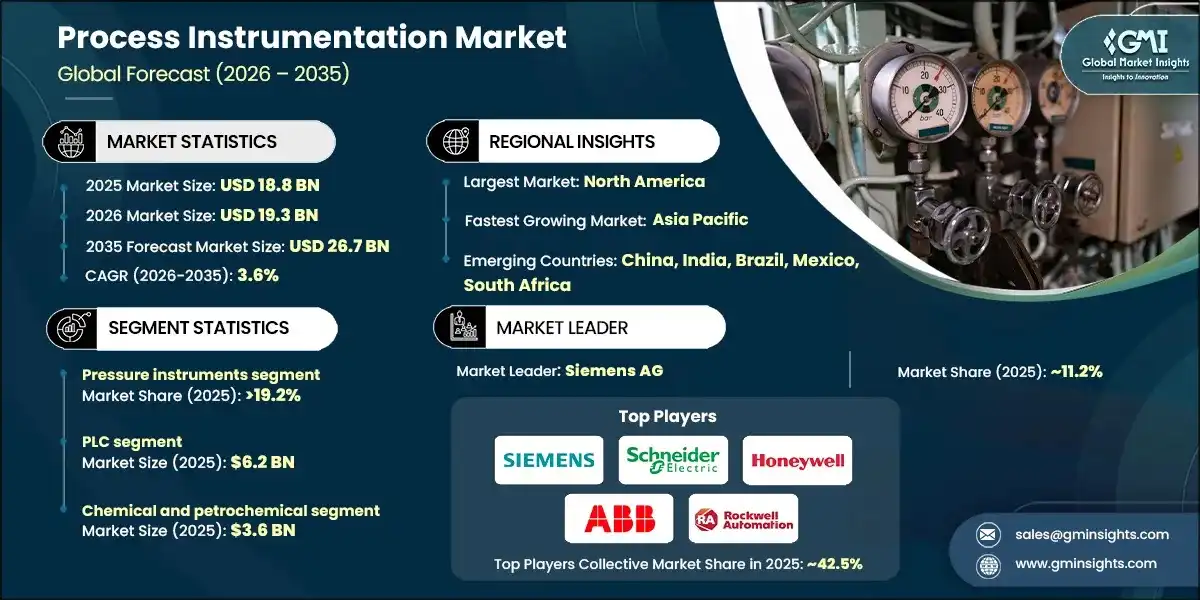
The global process instrumentation market was estimated at USD 18.8 billion in 2025. The market is expected to grow from USD 19.3 billion in 2026 to USD 22.7 billion in 2031 and USD 26.7 billion by 2035, at a CAGR of 3.6% during the forecast period of 2026–2035, according to latest report published by Global Market Insights Inc.
Process Instrumentation Market Key Takeaways
Market Size & Growth
- 2025 Market Size: USD 18.8 Billion
- 2026 Market Size: USD 19.3 Billion
- 2035 Forecast Market Size: USD 26.7 Billion
- CAGR (2026–2035): 3.6%
Regional Dominance
- Largest Market: North America
- Fastest Growing Region: Asia Pacific
Key Market Drivers
- Rapid industrial automation across manufacturing, oil & gas, chemicals, and power sectors.
- Growing demand for real-time monitoring, process control, and operational efficiency.
- Expansion of industrial IoT, smart factories, and digitalization initiatives.
- Strict safety, quality, and environmental regulations requiring accurate instrumentation.
- Rising investments in energy, utilities, and infrastructure projects.
Challenges
- High initial capital investment for advanced instrumentation systems.
- Complex integration with legacy industrial control systems..
Opportunity
- Increasing adoption of AI-enabled, smart, and predictive instrumentation.
- Growth of Industry 4.0 and smart manufacturing initiatives.
Key Players
- Market Leader: Siemens AG led with over 11.2% market share in 2025.
- Leading Players: Top 5 players in this market include Siemens AG, Schneider Electric, Honeywell International, ABB Ltd., Rockwell Automation, ~42.5% market share in 2025, which collectively held a market share of 42.5% in 2025.
Get Market Insights & Growth Opportunities
The growth of Industry 4.0 and smart factory technologies is fuelling the demand for advanced sensor technologies, transmitter technologies, and process control systems that provide highly accurate measurement and control throughout an entire manufacturing operation. There is also an increasing emphasis on improving operational efficiency, safety, and regulatory compliance across the manufacturing industry with increased investment in process instrumentation.
- As oil and gas, chemicals, power and manufacturing industries all utilise automation technologies to better utilise organisation resources, increase productivity, eliminate human error and provide greater factory process efficiencies, these advanced technologies are driving the need for advanced instrumentation such as sensor, transmitter and control systems for accurate real time monitoring and control in these processes. For instance, in November 2025, IMI launches new NEON Sonic sensor for steam trap monitoring. Neon Sonic enable to measure sound pressure levels from 15 to 80 kHz and temperatures from -40°C to 450°C, providing plant engineers and managers with status reports to determine if steam traps are healthy, leaking or blocked.
- Industry 4.0 is promoting towards extreme use of connected and smart instruments. Smart factories require real-time data, digital communication and interoperability which will increase the need for smart sensors and integrated process instruments to facilitate predictive maintenance and improved performance. For instance, in July 2025, Kulicke & Soffa partnered with Lavorro to deliver next-generation smart manufacturing solutions. The aims of this partnership is to provide customers with actionable insights, expert-guided solution advice, and scalable knowledge reuse enabling intelligent and data-driven guidance across the semiconductor value chain.
- Industry standards regarding safety, along with environmental regulations, are growing and have increased the need for reliable process instruments to measure and monitor, which allow companies to meet the regulatory guidelines, minimize the risk of accidents, reduce carbon emissions and maintain safe conditions in a high-risk environment. For instance, in July 2025, ABB launched MobileGuard gas detection solution, as oil and gas companies and natural gas utilities in Europe and North America look for ways to comply with environmental regulations and make their infrastructure safer and more resilient, detecting and measuring natural gas leaks has become vital.
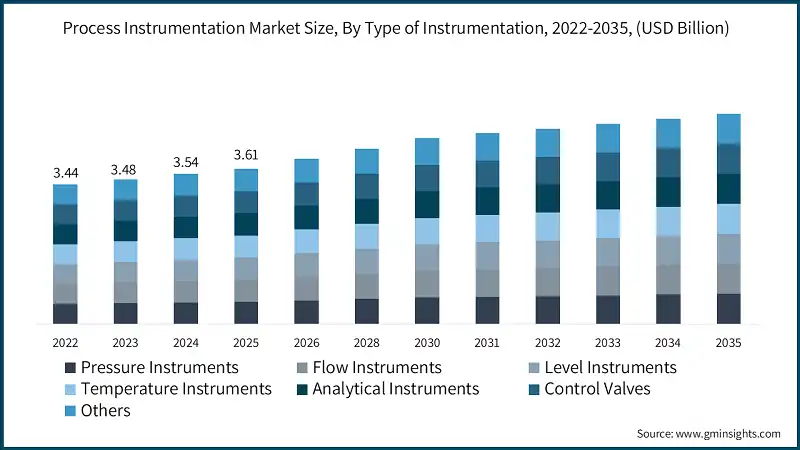
- Between 2022 and 2024, the process instrumentation market experienced significant growth, rising from USD 17.7 billion in 2022 to USD 18.3 billion in 2024. Large-scale power generation and power grid investment were also a large trend in this period, the process instruments are very important in monitoring pressure, temperature, flow and level to ensure efficient and stable operation of the power generation system.
- The integration of the Industrial Internet of Things, artificial intelligence and advanced analytics is changing the process instrumentation. The connected devices allow for the ability to monitor processes in real-time, predict failure, and make data-driven decisions that will all improve operational efficiencies and reduce machine downtime across many of the industrial processes. For instance, in December 2025, STMicroelectronics launched dual-range motion sensor for industry. Dual-range accelerometers, gyroscope, and edge AI for precise industrial IoT applications.
To get key market trends
Process Instrumentation Market Trends
- Process instrumentation industry's key trends are the increasing popularity of smart, connected & AI-enabled devices. Flow meters, analyzers and control systems provide increased efficiency and effectiveness of operations, Real-time monitoring and optimization of processes, resulting in strong growth & profit opportunities globally in the chemical, energy and manufacturing sectors.
- For instance, in March 2025, Siemens, partnered with AWS, expected to combine the Industrial Edge (edge computing) with analytics in the cloud to enable real-time monitoring of processes, predictive maintenance and facilitate data-driven operation of industrial facilities.
- Industry 4.0's rapid growth, smart manufacturing and digital twin technologies all accelerate adoption. Additionally, industries are requiring advanced process instrumentation for automation of processes, precision measurement and compliance with regulatory agencies which all create increased demand for high performance based sensors, analyzers and control systems.
- Process instrumentation's role continues to evolve as data-driven industrial operations develop into artificial intelligence, edge computing and predictive analysis as it relates to reliability and reduced downtime while providing real-time decisions which increase operational efficiency and safety within an industrial environment.
- Solution Providers are becoming more focused on the integration of IoT networks, cloud platforms and advanced analytics. Connected instrumentation allows companies to optimize their operations through remote monitoring, predictive maintenance and scalable deployment therefore creating more efficient use of resources and higher performance levels through the process globally.
- Collaborative efforts among industrial instrumentation manufacturers, software developers, and industrial partners continue to foster innovative developments and expand the global marketplace for industrial instrumentation products. By forming strategic partnerships that leverage the capabilities of their respective core strengths, industrial instrumentation companies have developed superior designs for new products, enhanced interoperability between product lines, and developed improved analytics solutions that facilitate effective implementation and user adoption of SMART instrumentation systems in industries around the world.
- Digital transformation and large-scale adoption of predictive maintenance programs will continue to create significant opportunities for growth in the process instrumentation industry. The accelerated expansion of manufacturing, energy, and chemical industries, in combination with more advanced process instrumentation solutions, will also provide an environment for the continuing development and implementation of innovative process instrumentation solutions throughout the world.
Process Instrumentation Market Analysis
Learn more about the key segments shaping this market
The process instruments industry has had an estimated total revenue in 2022 of USD 17.7 billion and an estimate revenue of USD 18 billion for the year 2023. By 2025, the expected total will have increased to USD 18.8 billion through USD 18.3 billion in 2024.
Based on types of instrumentation, the process instrumentation market is segmented into pressure instruments, flow instruments, level instruments, temperature instruments, analytical instruments, control valves, and others. The pressure instruments segment held a market share of over 19.2% of the market in 2025.
- Pressure instruments represent the largest percentage of the market based primarily upon widespread applications in the oil and gas, chemical, power and water treatment markets in tracking and controlling the pressures in pipes, reactors and vessels. These industries require precision, accuracy, reliability, safety and regulatory compliance of all instrumentation and this will continue to drive demand in these specific industries. Increasing numbers of plants that have installed industrial automation and that utilize smart controls will increase the level of demand for Pressure instruments as they will serve as critical components for the organization of process plants all over the world, providing enhanced efficiency and safety.
- Manufacturers should concentrate on producing reliable, high-quality, accurate and compliant pressure instrumentation for industries such as, oil and gas, chemic and power, and Water treatment. They also need to develop integrated smart control systems and industrial automation products that enhance the health, safety and performance of pressure instrumentation. There is a trend towards processing and development of multiple types of process plant that will create a growing demand for pressure instruments.
- Growth in the analytical instrumentation segment of the process instrumentation market is projected to expand at a CAGR of 4.7% through the forecast period due to the increasing demand for accurate measurement, monitoring and quality control in multiple industries. As smart manufacturing & industry 4.0 initiatives experience increased adoption, the integration of analytical instruments with automated systems and IoT platforms are fueled by expansion.
- Manufacturers must continue to develop advanced analytical instrumentation that enables accurate measurement, monitoring, and quality control across multiple industries and to continue to integrate their equipment with smart manufacturing, automated systems and IoT platforms to provide insights on real-time data and enhance the efficiency of processes while supporting compliance within the pharmaceutical, chemical, food & beverage, and environmental monitoring marketplace.
Based on technology, the process instrumentation market is segmented into (PLC), DCS, SCADA, MES. In 2025, PLC segment generated a market revenue of USD 6.2 billion.
- The PLC segment has a sizeable portion of the overall process instrumentation industry due to its vital role in automating the processes that occur within various industries, such as manufacturing, oil and gas, chemicals, power generation and distribution, and wastewater treatment. Through the use of PLCs, business operators are able to manage their entire operation in real-time. Therefore, PLCs help to improve streamlining of complex operations, enhancing efficiency, precision, and safety.
- Increasing use of smart factories, increasing focus on the implementation of Industry 4.0, and the continuing need for interconnectivity between IoT and advanced control systems are driving demand for PLCs and enhancing their need as the backbone of all industrial automation.
- The SCADA segment of the process instrumentation market grow at a high rate and reach USD 6.8 Billion by 2035. The SCADA segment in the market is expected to grow due to increasing demand for real-time monitoring, automation, and centralized control of industrial processes. Rising adoption of Industry 4.0, IoT-enabled sensors, and predictive maintenance strategies in sectors such as oil & gas, chemicals, and water treatment is driving the need for SCADA systems to enhance operational efficiency, safety, and data-driven decision-making.
- As a result, in order to meet the increasing demand for smart, automated and data-driven industrial process management solutions, Manufacturers will need to develop Advanced SCADA Systems that provide improved monitoring, control and analytics, real-time visualization of processes, Internet of Things (IoT) connectivity and scalable architectures, enhancing the operational efficiency, safety and reliability of the process industries globally.
Learn more about the key segments shaping this market
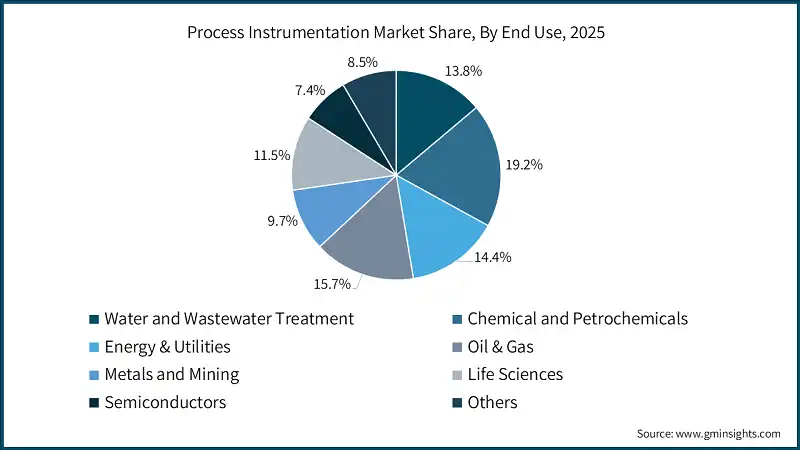
Based on end use the process instrumentation market is bifurcated into water treatment and wastewater treatment, chemical and petrochemical industries, energy and utilities industries, oil and gas industry, metals and mining industry, life sciences industries, semiconductor industries, and others. In 2025 the chemical and petrochemical segment will remain the largest in terms of revenue, with an estimated USD 3.6 billion.
- The chemical & petrochemicals segment represents the largest portion of the market. The demand for precise and efficient monitoring of chemical processes, such as pressure, temperature, flow rates, reaction conditions, and automation, is driving the need for accurate instruments and systems that will meet compliance requirements. This need is compounded by increasing trends towards the use of smart control systems and inability of operational efficiencies to benefit full production capabilities without the use of smart system technology.
- To continue reign as market leaders, manufacturers seeking to provide advanced instrumentation to chemical and petrochemical manufacturers must continue to provide high-precision instruments, while emphasising continued efforts to provide real-time monitoring capabilities, additional integration into existing processes that utilise smart technology, and create and enhance the capacity to meet increasing compliance and environmental safety requirements as they continue to expand globally.
- Life science segment in process instrumentation market is projected to experience robust growth at a CAGR of 5.1%, reaching USD 3.5 Billion by 2035 with increasing demand for accurate monitoring and control in pharma manufacturing processes, biotechnology and healthcare research, as advanced instrumentation allows manufacturers to produce products to very exacting standards, effecting total compliance with specific Regulatory standards and providing consistency throughout the manufacturing process.
- Manufacturers of advanced, high-precision instrumentation products used by the life sciences should focus on developing products that provide real time monitoring, automation, and IoT-enabled Integration. Solutions developed for use in the pharmaceutical manufacturing, biotechnology, and healthcare research sectors will provide the manufacturers supporting their operations with scalable product delivery capabilities and enable better support for Data Based Decision Making while meeting increasing market demand.
Looking for region specific data?
The North America process instrumentation market dominated with a market share of 30.8% in 2025.
- The North America market is growing significantly. This growth is due to the rapid increase in the level of industrial automation and use of smart manufacturing solutions within this region. Additional factors driving expansion within this market include the demand for precise monitoring and control of processes across many industries, including oil & gas industry, chemical industry, power generation industry, and water treatment industry.
- Manufactures operating in this area must concentrate their efforts on providing industrial automation and smart manufacturing solutions, with high-quality and precise monitoring technologies, as their competitive advantages. In addition, leveraging IoT connectivity, following compliance regulations, and embracing advanced instrumentation technologies will create long-term improvements in operational efficiency, safety, and scalability while making North America the fastest-growing global region in process instrumentation solutions.
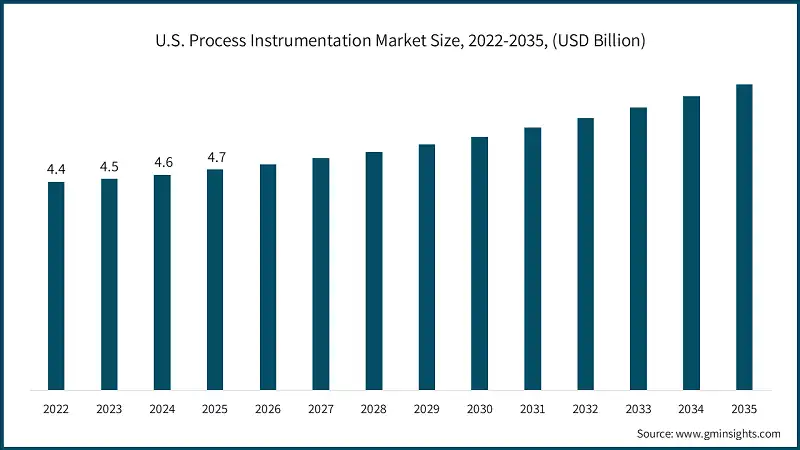
The U.S. process instrumentation market was valued at USD 4.4 billion in 2022 and USD 4.5 billion in 2023, reaching USD 4.7 billion in 2025, up from USD 4.6 billion in 2024.
- The US dominated the market based on the growing acceptance of Industry 4.0 automation across all industries, usage of advanced manufacturing technologies, and a strong need for precision instrumentation for monitoring & controlling operations across several key industries, including oil & gas, chemical, power and water. Thus far, technological innovation, the application of IoT technology, and compliance with regulatory standards are driving the market growth and expanding the process instrumentation industry.
- The US manufacturers should be developing advanced, scalable and dependable process instrumentations, including sensors, controllers, analytical devices, and focusing on the development & implementation of smart manufacturing, IoT connectivity and integration with automation to improve operational performance, achieve regulatory compliance, and maintain and grow the US's leadership position in the global market.
The Europe process instrumentation market accounted for USD 4.9 billion in 2025 and is anticipated to witness strong growth over the forecast period.
- Europe has a substantial share in the market. With an increased implementation of automation in manufacturing, improved manufacturing capabilities and technology, as well as governmental regulations, Europe has been experiencing tremendous growth in the process instrumentation sector within the chemical, pharmaceutical and energy industries.
- Manufacturers within the process instrumentation industry should develop high-precision process instrumentation solutions using artificial intelligence (AI) and integrated with Internet of Things (IoT) technology. This will enhance companies, manual operational efficiencies, game companies on compliance with European Union regulations and warranties and advance the company’s presence in manufacturing, energy and chemical industries within Europe.
Germany process instrumentation market dominates the Europe market, showcasing strong growth potential.
- Germany has a significant stake in the process instrumentation industry. Germany not only has an enormous industrial presence in the manufacturing, chemical, pharmaceutical and energy industries, but Germany has a well-developed technological infrastructure and focus on automation and buying by manufacturers to comply with governmental regulations, making Germany the leader in driving the Europe market.
- Manufacturers in the process instrumentation industry should develop high-precision process instrumentation solutions for Germany that are AI and IoT-enabled. Through leveraging Germany's industrial expertise, focus on automation, and compliance to governmental regulations, manufacturers increase their operational efficiencies, enhance their compliance with European regulations, and increase their presence in the manufacturing, chemical, pharmaceutical and energy industries in Germany.
The Asia-Pacific process instrumentation market is anticipated to grow at the highest CAGR of 4.5% during the analysis period.
- The Asia-Pacific market is expanding rapidly, driven primarily by the growth of industrial automation, increased utilization of smart manufacturing and the increased need for accurate measuring, monitoring and controlling various processes in the manufacturing, chemical, pharmaceutical, and energy sectors. With many governments investing in technology adoption and industrial infrastructure across the Asia-Pacific region, this will accelerate the overall growth of the process instrumentation industry.
- Manufacturers should be concentrating on creating high-precision, AI and IoT enhanced process instrumentation for the Asia-Pacific marketplace. By leveraging initial partnerships with local industrial entities, technology integration firms, and/or automation system providers, this help increase the operational efficiency of these companies, guarantee compliance with regulatory standards, and support the widespread acceptance of these solutions by users within the manufacturing, chemical, pharmaceutical, and energy marketplace.
The China process instrumentation market is estimated to grow at a significant CAGR of 5% from 2026 to 2035.
- China is dominating the global marketplace due to the rapid industrialization of the PRC, significant rates of adoption for smart manufacturing technologies, and the growing need for precision measuring, monitoring, and control for the chemical, pharmaceutical and energy sectors. In addition, the Government initiatives supporting Industry 4.0 and investment toward digital infrastructure have contributed to the rapid growth of the market in the Asia-Pacific region.
- Manufacturers who continue to invest in developing innovative technical solutions that are high-precision, AI- and IoT-enabled for the Chinese marketplace should be targeting this. Establishing strategic alliances with local industrial companies, automation system integrators, and technology providers, will improve the operational efficiency of their respective businesses, ensure compliance with applicable regulations, increase the acceptance of these products across the chemical, pharmaceutical, and energy industries, thus augmenting the presence and growth of these manufacturers.
The Latin America process instrumentation market is valued at USD 1.5 billion in 2025, is driven by rapid industrialization, increasing adoption of automation, and growing demand for precise monitoring and control in chemical, pharmaceutical, and energy sectors. Investments in smart manufacturing, digital infrastructure, and regulatory compliance are further boosting market adoption across the region.
The Middle East and Africa market is projected to reach USD 1.3 billion by 2035, is driven by increasing industrial automation, rising adoption of smart manufacturing, and growing demand for precise monitoring and control in oil & gas, chemicals, and power sectors. Investments in digital infrastructure, IoT-enabled systems, and regulatory compliance are further fueling market growth across the region.
In Saudi Arabia, the process instrumentation market is set to experience substantial growth in 2025.
- Saudi Arabia is positioned to become one of the growth areas in process instrumentation due to the increased industrial automation, adoption of smart manufacturing and a need for real-time monitoring and controlling of operations within oil & gas, chemicals & power industries. The growth of this market is also aided by the emergence of IoT-enabled systems, digital infrastructure and increased emphasis on regulatory compliance.
- Process instrumentation manufacturers should consider developing a business model that focuses on providing localized, scalable, reliability and advanced process instrumentation solutions to Saudi Arabia. This can be accomplished through the development of partnerships with local companies, deploying IoT and ai-enabled process instrumentation solutions and enhancing distribution using both direct and channel-based approaches.
Process Instrumentation Market Share
The process instrumentation industry continues to grow at a fast pace as the market for high-precision, AI-enabled, and IoT-enabled process instruments grows in response to supplier needs in various industries such as oil & gas, chemicals and power, and water treatment. The top five companies in the process instrumentation industry, Siemens AG, Schneider Electric, Honeywell International, ABB Ltd., and Rockwell Automation, represent a collective 42.5% market share and focus their efforts on creating innovative products by partnering with manufacturers of automation technology, IoT solution providers, and industrial integrators to provide customers with additional capacity, reliability, and scalability in order to support complicated industrial processes.
As new technologies are developed, many of the startup companies and providers of specialty solutions are also developing process instruments that are compact, smart and energy efficient, and are specifically designed for real-time monitoring, predictive maintenance, and data analytics. In addition to the benefits provided by cloud connectivity, AI, and industrial IoT platforms, these new technologies will allow improvements in productivity, safety, and compliance in industrial operations. The combined forces of innovation and collaboration with various industrial partners, research institutions, and technology providers are rapidly accelerating the technology-induced transformation and deployment of advanced process instrumentation products globally.
Process Instrumentation Market Companies
Some of the prominent market participants operating in the process instrumentation industry include:
- ABB Ltd.
- Emerson Electric Co.
- Endress+Hauser Group
- Excel Instruments
- Fuji Electric Co., Ltd.
- Honeywell International Inc.
- KROHNE Messtechnik GmbH
- NUVISION
- OMEGA Engineering Inc.
- Pepperl+Fuchs AG
- Rockwell Automation
- Schneider Electric SE
- SICK AG
- Siemens AG
- Thermo Fisher Scientific Inc.
- VEGA Grieshaber KG
- Yokogawa Electric Corporation
- Siemens AG
Siemens AG is a leading player in the process instrumentation market, holding an estimated market share of 11.2%. The company is recognized for its advanced industrial instrumentation solutions, including smart sensors, analyzers, and control devices. Collaborations with automation technology providers and IoT platform developers enhance product integration, reliability, and scalability. Strong global presence, robust distribution networks, and service capabilities reinforce its competitive position, supporting widespread adoption across industries such as oil & gas, chemicals, power, and water treatment.
ABB Ltd. holds a significant share of 8.6% in the process instrumentation market. The company is known for its high-performance instrumentation, including pressure, flow, and analytical devices for industrial applications. Strategic partnerships with industrial integrators, IoT solution providers, and automation technology firms enable seamless deployment, real-time monitoring, and predictive maintenance, driving operational efficiency, safety, and adoption across global process industries.
Schneider Electric plays a crucial role in the process instrumentation market, offering a wide range of instrumentation solutions such as sensors, controllers, and analytical devices for industrial automation. The company focuses on integrating smart and IoT-enabled systems to enhance process monitoring, control, and optimization. Its extensive global service network, combined with online and offline support, ensures accessibility, reliability, and operational efficiency, supporting adoption across chemical, pharmaceutical, power, and water treatment industries.
Process Instrumentation Market Report Attributes
| Key Takeaway | Details |
|---|---|
| Market Size & Growth | |
| Base Year | 2025 |
| Market Size in 2025 | USD 18.8 Billion |
| Market Size in 2026 | USD 19.3 Billion |
| Forecast Period 2026-2035 CAGR | 3.6% |
| Market Size in 2035 | USD 26.7 Billion |
| Key Market Trends | |
| Drivers | Impact |
| Rapid industrial automation across manufacturing, oil & gas, chemicals, and power sectors | Expansion of industrial automation and smart manufacturing drives around 35% of market demand. Industries are increasingly adopting automated production lines and smart factories, requiring precise measurement, monitoring, and control of variables such as pressure, flow, temperature, and level to improve efficiency, productivity, and process reliability. |
| Growing demand for real-time monitoring, process control, and operational efficiency | Rising demand for real-time monitoring and process optimization contributes about 30% to market growth. Process instrumentation enables continuous data collection and analysis, helping industries reduce downtime, improve product quality, minimize waste, and ensure consistent operations across oil & gas, chemicals, power, and manufacturing sectors. |
| Expansion of industrial IoT, smart factories, and digitalization initiatives | Growth of Industrial IoT and digitalization fuels roughly 20% of market expansion. Integration of sensors, transmitters, and analyzers with IIoT platforms supports remote monitoring, predictive maintenance, and data-driven decision-making, enhancing operational visibility and asset performance across industrial facilities. |
| Strict safety, quality, and environmental regulations requiring accurate instrumentation | Stringent safety, quality, and environmental regulations drive about 15% market growth. Governments and regulatory bodies mandate accurate measurement and monitoring to ensure worker safety, environmental compliance, and product quality, increasing adoption of advanced and certified process instrumentation solutions. |
| Rising investments in energy, utilities, and infrastructure projects | Increasing investments in energy, utilities, and infrastructure contribute nearly 10% of market demand. New power plants, refineries, water treatment facilities, and industrial projects require reliable instrumentation systems for efficient control, safety assurance, and long-term operational sustainability. |
| Pitfalls & Challenges | Impact |
| High initial capital investment for advanced instrumentation systems | High initial capital investment for advanced instrumentation systems hampers market demand, as small and medium-sized enterprises often face budget constraints when adopting modern sensors, analyzers, and automation equipment. The substantial upfront costs for procurement, installation, and calibration delay or limit deployment, restricting overall market penetration. |
| Complex integration with legacy industrial control systems. | Complex integration with legacy industrial control systems restricts adoption of process instrumentation solutions. Many facilities rely on older SCADA, PLC, or DCS setups, making it challenging to implement new sensors, analyzers, or digital monitoring systems. Integration difficulties, compatibility issues, and required customization increase costs and slow market growth. |
| Opportunities: | Impact |
| Increasing adoption of AI-enabled, smart, and predictive instrumentation | Increasing adoption of AI-enabled, smart, and predictive instrumentation presents significant opportunities for the process instrumentation market. Intelligent sensors, real-time analytics, and predictive maintenance capabilities enhance operational efficiency, reduce downtime, and improve process accuracy across industries, encouraging broader deployment and driving demand for advanced instrumentation solutions globally. |
| Growth of Industry 4.0 and smart manufacturing initiatives | Growth of Industry 4.0 and smart manufacturing initiatives |
| Market Leaders (2025) | |
| Market Leaders |
~11.2% market share in 2025 |
| Top Players |
|
| Competitive Edge |
|
| Regional Insights | |
| Largest Market | North America |
| Fastest growing market | Asia Pacific |
| Emerging countries | China, India, Brazil, Mexico, South Africa |
| Future outlook |
|
What are the growth opportunities in this market?
Process Instrumentation Industry News
- In September 2025, Emerson Electric Co. partnered with a leading software firm to integrate AI?driven analytics into its process instrumentation solutions, enhancing predictive maintenance and operational efficiency for industrial customers.
- In July 2025, ABB Ltd. Partnered with Royal Caribbean Group for maritime automation and instrumentation support, broadening its service footprint.
- In June 2025, Honeywell International Inc. expanded its digital transformation strategy by acquiring a cybersecurity firm specializing in industrial control systems, enhancing the security of its process instrumentation products amid rising industrial cyber threats
- In May 2025, ABB collaborated with Red Hat to integrate process automation systems with cloud?native solutions, accelerating digital transformation in industrial sectors.
The process instrumentation market research report includes in-depth coverage of the industry, with estimates & forecast in terms of revenue (USD billion) from 2022 to 2035, for the following segments:
Market, By Type of Instrument
- Pressure instruments
- Products
- Services
- Software
- Projects
- Flow instruments
- Level instruments
- Temperature instruments
- Analytical instruments
- Control valves
- Others
Market, By Technology
- Programmable Logic Controller (PLC)
- Distributed Control System (DCS)
- Supervisory Control and Data Acquisition (SCADA)
- Manufacturing Execution System (MES)
Market, By End Use
- Water and wastewater treatment
- Chemical and petrochemicals
- Energy & utilities
- Oil & gas
- Metals and mining
- Life sciences
- Semiconductors
- Others
The above information is provided for the following regions and countries:
- North America
- U.S.
- Canada
- Europe
- Germany
- UK
- France
- Italy
- Spain
- Netherlands
- Rest of Europe
- Asia-Pacific
- China
- Japan
- India
- South Korea
- ANZ
- Rest of Asia-Pacific
- Latin America
- Brazil
- Mexico
- Argentina
- Rest of Latin America
- MEA
- Saudi Arabia
- UAE
- South Africa
- Rest of MEA
Frequently Asked Question(FAQ) :
What is the market size of the process instrumentation market in 2025?
The process instrumentation market size exceeded USD 18.8 billion in 2025, driven by growing adoption of industrial automation, smart factories, and digital process monitoring solutions.
What is the projected process instrumentation market size in 2026?
The market is expected to reach USD 19.3 billion in 2026, supported by rising deployment of smart sensors, transmitters, and real-time industrial control systems.
What is the projected value of the process instrumentation market by 2035?
The process instrumentation market is expected to reach USD 26.7 billion by 2035, growing at a CAGR of 3.6% from 2026 to 2035, driven by Industry 4.0 adoption, IIoT integration, and demand for high-precision process control across manufacturing industries.
Which instrumentation type segment led the process instrumentation industry in 2025?
Pressure instruments accounted for over 19.2% market share in 2025, owing to their critical role in pressure monitoring, operational safety, and regulatory compliance in oil & gas, chemical, and power industries.
How much revenue did the PLC technology segment generate in 2025?
The PLC segment generated USD 6.2 billion in 2025, supported by increasing demand for programmable automation, real-time monitoring, and efficient industrial process control.
Which end-user segment dominated the process instrumentation market in 2025?
The chemical and petrochemical segment generated approximately USD 3.6 billion in 2025, driven by the need for precise measurement, automation, and regulatory-compliant process instrumentation solutions.
Which region leads the process instrumentation market?
The U.S. process instrumentation market reached USD 4.7 billion in 2025. Growth is driven by strong Industry 4.0 adoption, advanced manufacturing infrastructure, and high demand for precision instrumentation across oil & gas, chemical, and power industries.
Which region is expected to grow at the fastest rate in the process instrumentation industry?
Asia-Pacific is projected to grow at a CAGR of 4.5% during the forecast period, driven by rapid industrial automation, smart manufacturing investments, and expanding chemical, pharmaceutical, and energy sectors.
Who are the key players in the process instrumentation market?
Key players in the process instrumentation industry include Siemens AG, Schneider Electric, Honeywell International Inc., ABB Ltd., Rockwell Automation, Emerson Electric Co., Endress+Hauser Group, Yokogawa Electric Corporation, and Thermo Fisher Scientific Inc.
Process Instrumentation Market Scope
Related Reports