Summary
Table of Content

Pressure Washer Market
Get a free sample of this report
Form submitted successfully!
Error submitting form. Please try again.
Thank you!
Your inquiry has been received. Our team will reach out to you with the required details via email. To ensure that you don't miss their response, kindly remember to check your spam folder as well!
Request Sectional Data
Thank you!
Your inquiry has been received. Our team will reach out to you with the required details via email. To ensure that you don't miss their response, kindly remember to check your spam folder as well!
Form submitted successfully!
Error submitting form. Please try again.
Pressure Washer Market Size
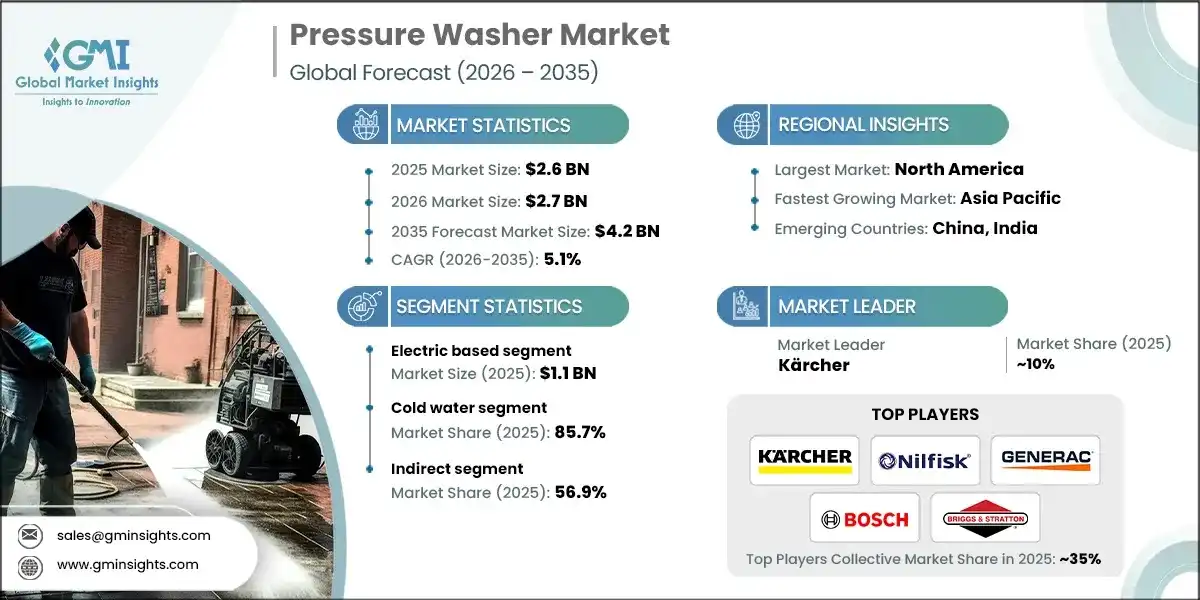
The pressure washer market was estimated at USD 2.6 billion in 2025. The market is expected to grow from USD 2.7 billion in 2026 to USD 4.2 billion in 2035, at a CAGR of 5.1% according to latest report published by Global Market Insights Inc.
To get key market trends
- Increasingly, more homeowners are choosing to perform their home repair and improvement projects themselves rather than hiring someone else to do it for them; the result of this trend toward more DIY-type projects is that demand for pressure washers has increased tremendously. They are choosing to clean their driveways, patios, automobiles, and outdoor furniture instead of having professionals do it; the primary factors driving this change include an increased desire to save money by completing these types of chores themselves, an increased ability to perform these chores independently, and the increased level of satisfaction a person experiences through being involved in maintaining their own home. Consequently, this increased interest in maintaining one’s own home has created an increase in the preference for small, easy-to-use, and economical pressure washer models among residential customers, pressure washers have become a regular part of many houses today.
- The rapid urbanization and development of infrastructure across cities are providing large amounts of opportunity to the pressure washer market in commercial and industrial uses. As cities expand their boundaries, there are many areas where regular maintenance and cleaning of public areas, streets, and construction sites are required thereby leading to an increased need for higher-capacity and more durable machines. Additionally, the rise of real estate projects and modern apartments dramatically increases the need for efficient machine-based cleaning. As a result, it is increasing the demand for pressure washers as integral and essential cleaning tools for maintaining the cleanliness and hygienic status of these spaces. Thus, there is an emergence of pressure washers as prominent and essential components of the market.
- Technological advancements are playing a pivotal role in transforming the pressure washer market. Innovations such as energy-efficient motors, smart controls, and eco-friendly water-saving systems are enhancing product performance and appeal. Battery-powered and cordless models are gaining traction due to their portability and ease of use, catering to the needs of modern consumers. Furthermore, the integration of Internet of Things technology and app-based monitoring in premium models is elevating the user experience by enabling features like remote operation and predictive maintenance. These advancements are attracting a tech-savvy customer base and expanding the market's reach, ensuring sustained growth and innovation in the industry.
Pressure Washer Market Report Attributes
| Key Takeaway | Details |
|---|---|
| Market Size & Growth | |
| Base Year | 2025 |
| Market Size in 2025 | USD 2.6 Billion |
| Market Size in 2026 | USD 2.7 Billion |
| Forecast Period 2026-2035 CAGR | 5.1% |
| Market Size in 2035 | USD 4.2 Billion |
| Key Market Trends | |
| Drivers | Impact |
| Increasing demand for DIY home improvement | The growing trend of DIY home improvement projects is significantly boosting the demand for pressure washers. |
| Rising urbanization and infrastructure development | Rapid urbanization and infrastructure development are creating a strong market for pressure washers, particularly in commercial and industrial segments. |
| Advancements in technology | Technological innovations are transforming the pressure washer market by introducing features such as energy-efficient motors, smart controls, and eco-friendly water-saving systems |
| Pitfalls & Challenges | Impact |
| High Initial Investment for Gas-Based Models | Despite their superior cleaning power, gas-powered pressure washers face a major hurdle due to high upfront costs. These models are often preferred for heavy-duty applications, but their price point limits adoption among residential users and small businesses. |
| Limited Awareness in Emerging Markets | In emerging markets, the pressure washer segment struggles with low consumer awareness and limited product penetration |
| Opportunities: | Impact |
| Expansion in emerging markets | Emerging economies present a significant growth opportunity due to rising urbanization, improving infrastructure, and increasing disposable incomes. |
| Growth of eco-friendly and energy-efficient models | With sustainability becoming a global priority, there is a strong opportunity for pressure washer brands to develop eco-friendly models that use less water and energy |
| Market Leaders (2025) | |
| Market Leaders |
Market share of ~10% |
| Top Players |
|
| Competitive Edge |
|
| Regional Insights | |
| Largest Market | North America |
| Fastest Growing Market | Asia Pacific |
| Emerging Country | China, India |
| Future Outlook |
|
What are the growth opportunities in this market?
Pressure Washer Market Trends
- The popularity and availability of electric/battery operated pressure washers continue to grow. Consumers are shifting towards this technology as it is easier to maintain than the traditional gas engine models. Additionally, manufacturers are responding to consumers by developing portable models that allow for greater ease of movement and convenience.
- The increasing population of urban dwellers and shrinking outdoor spaces have led to an increase in demand for compact, lightweight, easily stored pressure washers. As such, manufacturers have shifted their focus to creating ergonomic product designs and foldable designs to meet the needs of homeowners with limited storage options. Many of these products will likely see increased usage for quick cleaning jobs, such as patios, balconies and automobiles.
- Smart technology is quickly becoming a major distinction within the pressure washer industry. New advanced models also include smart phone app controls, live streaming performance information and predictive maintenance notifications. These added features improve overall convenience and efficiency for users, while also appealing to tech-oriented buyers for business opportunities.
- Environmental issues have caused manufacturers to create environmentally safe pressure washers. Eco-friendly pressure washers are designed to minimize water usage and energy consumption by manufacturers. There are many innovative technologies being developed to achieve this goal, including water recycling systems and low emission engines. The eco-friendly trend will help manufacturers meet the growing demand for eco-friendly products worldwide while also appealing to environmentally aware customers.
- In addition to residential applications, demand for heavy-duty pressure washers is being driven by both commercial and industrial users as a result of increasing demand for heavy-duty equipment used to clean large areas, heavy machinery and other public areas. The continued expansion of several key industries such as construction, automotive and hospitality will continue to create new opportunities for high-performance models with added safety and durability features.
Pressure Washer Market Analysis
Learn more about the key segments shaping this market
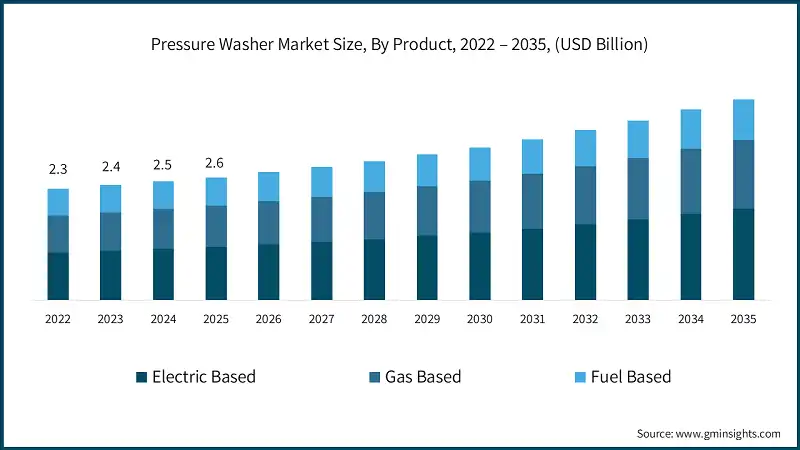
Based on product, the market is categorized into electric based, gas based, and fuel based. The electric based segment accounted for revenue of around USD 1.1 billion in 2025 and is anticipated to grow at a CAGR of 5.4% from 2026 to 2035.
- Electric pressure washers have emerged as a dominant segment in the market, driven by their affordability, ease of use, and minimal maintenance requirements compared to gas-powered models. These washers are particularly popular among residential users for a variety of light to medium-duty cleaning tasks, such as cleaning patios, vehicles, and outdoor furniture. The growing focus on environmentally friendly solutions and the need to reduce emissions have further bolstered the appeal of electric pressure washers, as they align with global sustainability goals.
- Furthermore, advancements in battery technology and the introduction of cordless models have enhanced their portability and convenience, making them an increasingly preferred choice for consumers. These factors collectively position electric pressure washers as a versatile and efficient solution for diverse cleaning applications.
Based on water operations, of pressure washer market consists of hot water and cold water. The cold water emerged as leader and held 85.7% of the total market share in 2025 and is anticipated to grow at a CAGR of 5% from 2026 to 2035.
- Cold water pressure dominates the global market, accounting for nearly 90% of total sales, primarily due to their affordability, ease of use, and suitability for everyday cleaning tasks. These models are lightweight, energy-efficient, and ideal for residential applications such as patios, vehicles, and outdoor furniture, making them the preferred choice for DIY users.
- Their lower maintenance requirements and wide availability through retail and e-commerce channels further reinforce their dominance, while hot water units remain a niche solution for heavy-duty industrial cleaning.
Learn more about the key segments shaping this market
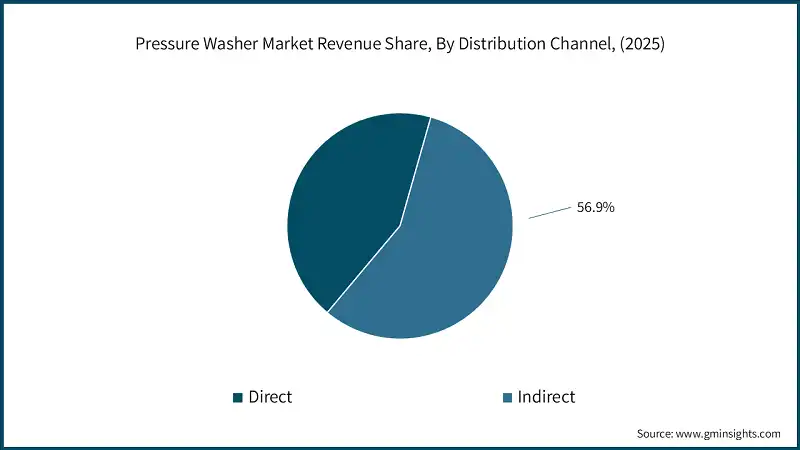
Based on distribution channel, pressure washer market consists of direct and indirect sales. The indirect segment emerged as leader and held 56.9% of the total market share in 2025 and is anticipated to grow at a CAGR of 5.4% from 2026 to 2035.
- Indirect distribution channels, including retail stores, home improvement outlets, and e-commerce platforms, hold a significant share in the pressure washer market. These channels offer consumers a wide range of product options, competitive pricing, and convenient access. The rapid expansion of online marketplaces has further accelerated this trend, allowing customers to compare product features, read reviews, and make informed purchasing decisions from the comfort of their homes.
- Manufacturers leverage these channels to expand their reach and strengthen brand visibility, often providing promotional offers and bundled accessories to attract buyers. As digital shopping habits continue to evolve globally, the dominance of indirect distribution channels is expected to persist, playing a pivotal role in shaping the market dynamics and ensuring accessibility for a broader audience.
Looking for region specific data?
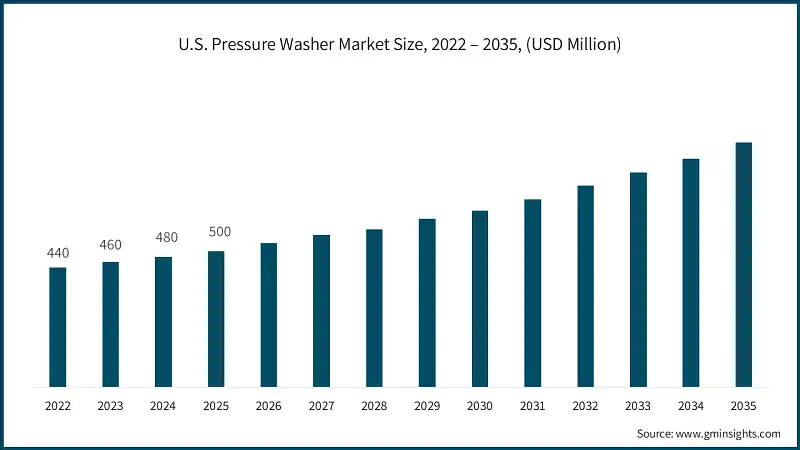
The U.S. dominates an overall North America pressure washer market and valued at USD 500 million in 2025 and is estimated to grow at a CAGR of 5.9% from 2026 to 2035.
- The U.S. market is mature and highly competitive, driven by strong demand from both residential and commercial sectors. DIY culture and home improvement trends significantly boost sales of electric pressure washers, while industrial applications in automotive, construction, and agriculture sustain demand for heavy-duty gas-powered models.
- E-commerce penetration and brand loyalty play a major role, with leading players offering advanced features and eco-friendly designs to cater to sustainability-conscious consumers.
In the European pressure washer market, Germany is expected to experience significant and promising growth from 2026 to 2035.
- Europe is a well-established market with a strong emphasis on sustainability and technological innovation. Consumers prefer compact, energy-efficient electric pressure washers, aligning with stringent environmental regulations.
- Countries like Germany, France, and the UK lead in adoption, driven by DIY trends and high standards for cleanliness. Industrial demand remains robust in sectors such as automotive and food processing, where hot water models are gaining traction for sanitization purposes.
In the Asia Pacific pressure washer market, the China held 33% market share in 2025 and is anticipated to grow at a CAGR of 5% from 2026 to 2035.
- APAC is the fastest-growing region, fueled by rapid urbanization, infrastructure development, and rising middle-class incomes. Countries like China and India present huge opportunities as awareness about pressure washers increases.
- Residential demand is expanding, while industrial applications in manufacturing and construction drive sales of heavy-duty models. E-commerce platforms play a pivotal role in product accessibility, and localized pricing strategies are critical for success in this price-sensitive market.
In the Middle East and Africa pressure washer market, UAE held 19% market share in 2025 promising growth from 2026 to 2035.
- The MEA market is still in its nascent stage but shows promising growth potential. Urban development projects, hospitality expansion, and industrial cleaning needs are creating demand for pressure washers, particularly in Gulf countries.
- However, limited awareness and high product costs remain challenges in several African nations. Manufacturers focusing on affordable models and strong distribution partnerships can tap into this emerging market effectively.
Pressure Washer Market Share
- In 2025, the prominent manufacturers in pressure washer industry are Kärcher, Nilfisk, Generac, Bosch, Briggs & Stratton collectively held the market share of ~35%.
- Kärcher holds a strong competitive edge through its global brand recognition and reputation for high-quality, innovative cleaning solutions. The company invests heavily in R&D, introducing advanced features like water-saving technology and ergonomic designs. Its wide product portfolio caters to both residential and industrial segments, and its strong distribution network across retail and e-commerce channels ensures accessibility worldwide.
- Nilfisk differentiates itself with a focus on professional-grade cleaning equipment and durability. Known for reliability and performance, Nilfisk targets commercial and industrial customers, offering robust machines designed for heavy-duty applications. Its emphasis on sustainability and energy-efficient models further strengthens its position among environmentally conscious buyers.
Pressure Washer Market Companies
Major players operating in the pressure washer industry include:
- Be Pressure
- Bosch
- Craftsman
- Generac Power Systems
- Hotsy
- Honda Power Equipment
- Karcher
- MTM Hydro
- Nilfisk
- Pressure-Pro
- Ryobi
- Simpson Cleaning
- Stanley Black & Decker
- Sun Joe
- Troy-Bilt
Generac leverages its expertise in power equipment to deliver high-performance gas-powered pressure washers, making it a preferred choice for demanding outdoor and industrial cleaning tasks. Its competitive edge lies in engineering powerful engines and durable designs, appealing to customers who prioritize strength and longevity. Generac also benefits from strong brand trust in the power solutions market.
Bosch stands out through its technological innovation and precision engineering. The brand focuses on compact, user-friendly electric pressure washers for residential use, integrating smart features and energy-efficient designs. Bosch’s reputation for quality and reliability, combined with its global presence and strong retail partnerships, gives it a solid advantage in the consumer segment.
Briggs & Stratton’s competitive edge comes from its leadership in engine technology and manufacturing expertise. The brand offers powerful gas-powered pressure washers designed for heavy-duty cleaning, appealing to professional and industrial users. Its long-standing reputation for durability and performance, coupled with a broad service network, reinforces customer confidence and loyalty.
Pressure Washer Machine Industry News
- In 2025, BE Power Equipment launched its new line of gas-powered pressure washers designed for heavy-duty cleaning across residential and commercial applications. These models emphasize high performance and durability, and all units are assembled in the U.S., reinforcing the brand’s commitment to local manufacturing and quality standards.
- In September 2025, Craftsman, under Stanley Black & Decker, gained recognition in 2025 by winning multiple Pro Tool Innovation Awards and Popular Mechanics Tool Awards for its electric pressure washers. The brand introduced brushless motor technology in its premium models, offering up to 2800 PSI for demanding residential tasks, positioning itself as a leader in durability and user-friendly design.
- In February 2025, Ryobi continued to expand its electric pressure washer lineup in 2025, introducing brushless models with improved PSI ratings and portability. The brand’s focus on affordability and user-friendly features keeps it competitive in the residential segment, supported by strong retail presence and positive reviews.
The pressure washer market research report includes in-depth coverage of the industry, with estimates & forecast in terms of revenue (USD Billion) and volume (Thousand Units) from 2022 to 2035, for the following segments:
Market, By Product Type
- Electric based
- Gas based
- Fuel based
Market, By Type
- Portable
- Non-portable
Market, By Component
- Water pump
- Electric motor/gas engine
- High pressure hose
- Nozzle
Market, By Water Operation
- Hot water
- Cold water
Market, By PSI Pressure
- 0-1500 PSI
- 1501-3000 PSI
- 3001-4000 PSI
- Above 4000 PSI
Market, By Application
- Car washer
- Garden washer
- Home exterior washer
- Industrial
- Others
Market, By Distribution Channel
- Direct
- Indirect
The above information is provided for the following regions and countries:
- North America
- U.S.
- Canada
- Europe
- Germany
- UK
- France
- Italy
- Spain
- Asia Pacific
- China
- Japan
- India
- South Korea
- Australia
- Latin America
- Brazil
- Mexico
- Argentina
- MEA
- Saudi Arabia
- UAE
- South Africa
Frequently Asked Question(FAQ) :
Who are the key players in the pressure washer market?
Key players include Kärcher, Nilfisk, Generac Power Systems, Bosch, Briggs & Stratton, Be Pressure, Craftsman, Hotsy, Honda Power Equipment, MTM Hydro, Pressure-Pro, Ryobi, Simpson Cleaning, Stanley Black & Decker, Sun Joe, and Troy-Bilt.
What are the upcoming trends in the pressure washer market?
Key trends include adoption of battery-powered cordless models, integration of IoT technology and smartphone app controls for remote operation, increasing demand for compact lightweight designs, and development of eco-friendly water-saving systems.
Which region leads the pressure washer market?
North America leads the market, with the U.S. valued at USD 500 million in 2025 and estimated to grow at a 5.9% CAGR through 2035. DIY culture and strong home improvement trends fuel the region's dominance.
What was the valuation of the cold water operation segment in 2025?
The cold water segment held 85.7% market share in 2025 and is anticipated to grow at a CAGR of 5% from 2026 to 2035.
What is the growth outlook for indirect distribution channels from 2026 to 2035?
Indirect distribution channels held 56.9% market share in 2025 and are projected to grow at a 5.4% CAGR through 2035, driven by retail expansion and e-commerce platform growth.
What is the current pressure washer market size in 2026?
The market size is projected to reach USD 2.7 billion in 2026.
What is the market size of the pressure washer in 2025?
The market size was USD 2.6 billion in 2025, with a CAGR of 5.1% expected through 2035 driven by increasing demand for DIY home improvement and rising urbanization.
How much revenue did the electric-based segment generate in 2025?
Electric-based pressure washers generated USD 1.1 billion in 2025 and are anticipated to grow at a CAGR of 5.4% from 2026 to 2035.
What is the projected value of the pressure washer market by 2035?
The pressure washer market is expected to reach USD 4.2 billion by 2035, propelled by technological advancements, smart features integration, and growing demand for eco-friendly models.
Pressure Washer Market Scope
Related Reports