Summary
Table of Content

Precision Nutrition Wearable Sensors Market
Get a free sample of this report
Form submitted successfully!
Error submitting form. Please try again.
Thank you!
Your inquiry has been received. Our team will reach out to you with the required details via email. To ensure that you don't miss their response, kindly remember to check your spam folder as well!
Request Sectional Data
Thank you!
Your inquiry has been received. Our team will reach out to you with the required details via email. To ensure that you don't miss their response, kindly remember to check your spam folder as well!
Form submitted successfully!
Error submitting form. Please try again.
Precision Nutrition Wearable Sensors Market Size
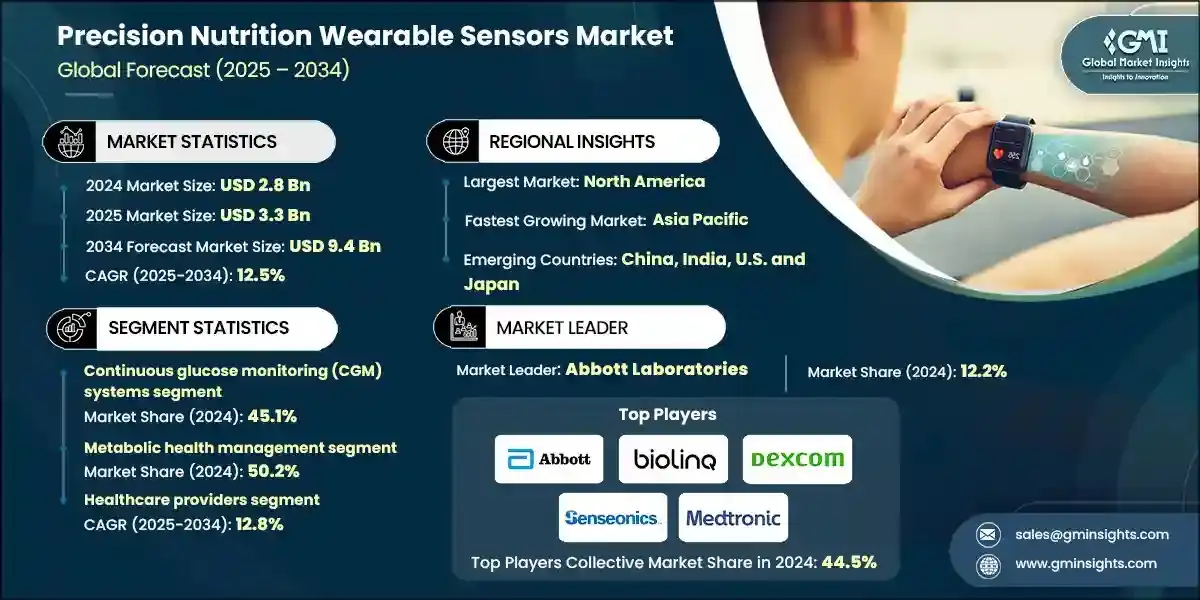
The global precision nutrition wearable sensors market was estimated at USD 2.8 billion in 2024 The market is expected to grow from USD 3.3 billion in 2025 to USD 9.4 billion in 2034, at a CAGR of 12.5% according to latest report published by Global Market Insights Inc.
To get key market trends
- The precision nutrition wearable sensor market increasingly grows nowadays because of modernization in health-monitoring technologies and advent disposition towards personalized nutrition. These sensors are immensely important in providing real time measurements of various physiological parameters like hydration level nutrient intake metabolic rate & physical activities. By enabling precise monitoring, they also empower consumers and healthcare professionals to customize dietary programs, thus improving health outcomes and preventing diet-based diseases.
- The applications for these wearable sensors are numerous, covering fitness and wellness, clinical nutrition, sports performance, and chronic disease management. For instance, while athletes may use these tools for performance enhancement healthcare providers may use wearable sensors to treat diabetes and obesity.
- There exists a considerable market opportunity given the rising health consciousness, increasing number of smart devices, and growing number of lifestyle diseases. Emerging markets enjoy untapped growth due to increasing disposable incomes and awareness of health offerings based on personalization. Market growth is expected to be further facilitated through innovative development in multi-parameter sensors, AI-based analytic functions, and seamless integration with other health devices.
- North America is the largest market for precision nutrition wearable sensors due to advancement in technology and research facilities in U.S. and Canada.
- Asia Pacific is the fastest growing region for precision nutrition wearable sensors market, due to increasing industrialization and awareness among big players, the region can enhance its performance in this market in the coming years.
Precision Nutrition Wearable Sensors Market Report Attributes
| Key Takeaway | Details |
|---|---|
| Market Size & Growth | |
| Base Year | 2024 |
| Market Size in 2024 | USD 2.8 Billion |
| Market Size in 2025 | USD 3.3 Billion |
| Forecast Period 2025 – 2034 CAGR | 12.5% |
| Market Size in 2034 | USD 9.4 Billion |
| Key Market Trends | |
| Drivers | Impact |
| Government policy support & HHS campaign | Government policies and HHS campaigns are promoting adoption of wearable sensors for personalized nutrition |
| Rising consumer wearable adoption | Increasing consumer use of wearables is expanding the market for precision nutrition monitoring. |
| AI/ML technology advancements in biosensors | Advances in AI and machine learning are enhancing biosensor accuracy and predictive capabilities. |
| Pitfalls & Challenges | Impact |
| Regulatory complexity & FDA compliance requirements | Complex regulatory and FDA compliance requirements pose hurdles for device approval and market entry. |
| High device costs & limited insurance coverage | High device costs and limited insurance coverage restrict consumer access and adoption. |
| Opportunities: | Impact |
| Clinical integration & therapeutic applications | Integrating sensors into clinical settings and therapeutic programs offers new avenues for personalized nutrition. |
| Personalized supplement & food markets | Growing markets for personalized supplements and functional foods create opportunities for wearable sensor data integration. |
| Corporate wellness & insurance integration | Collaborations with corporate wellness programs and insurance providers can expand user base and reimbursement models. |
| Market Leaders (2024) | |
| Market Leaders |
12.2% |
| Top Players |
Collective Market Share 44.5% in 2024 |
| Competitive Edge |
|
| Regional Insights | |
| Largest Market | North America |
| Fastest growing market | Asia Pacific |
| Emerging countries | China, India, U.S. and Japan |
| Future outlook |
|
What are the growth opportunities in this market?
Precision Nutrition Wearable Sensors Market Trends
- Precision nutrition wearable sensors are experiencing steady growth by the virtue of the various rapid technological developments, changing regulatory frameworks, and continuous product innovations. From the technological point of view, sensors are becoming increasingly accurate, non-invasive, and miniaturized in design for seamless integration into daily life. Innovations including real time data analytics, AI-powered insights & multi-parameter monitoring, are enhanced personalized nutrition and health management attracting consumers and healthcare service providers.
- These regulatory frameworks are also becoming progressively adaptive to innovation along with other health agencies like the FDA which provide clear routes for the approval of devices that are proven safe and effective. This regulatory clarity encourages prompt product development and commercialization. Emerging security product areas addressing increased data privacy and cybersecurity also influences how regulations are designed and build trust with consumers.
- Increasing consumer interest in preventative health and personalized nutrition steers market expansion. Overall, the market can witness significant growth, considering technological breakthroughs, molding visionary regulation, and making innovative product offerings dynamic in their momentum of personalization and proactivity in health management.
Precision Nutrition Wearable Sensors Market Analysis
Learn more about the key segments shaping this market
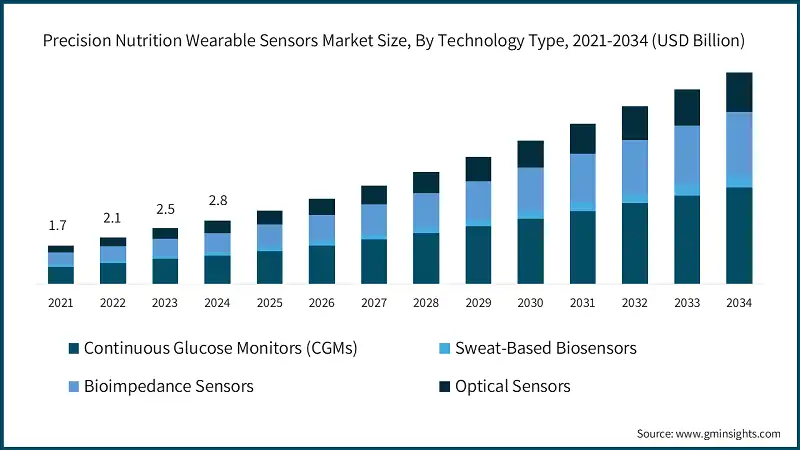
Based on technology type, the market is segmented into continuous glucose monitors (CGMS), sweat-based biosensors, bioimpedance sensors, optical sensors.
- Continuous glucose monitoring (CGM) systems accounted for the market share of 45.1% in 2024, in the wearable arena for precision nutrition since decades of development and clinical validation have shown their applicability in diabetes management and related nutritional monitoring. Manufacturing maturity, accuracy of the sensor, and developed regulatory pathways do add to the dominance of the segment.
- The sector of sweat-based biosensors faces considerable challenges of establishing blood level biomarker correlation, sensor stability, and variability of sweat production from one person to another and from one environmental condition to another. Nevertheless these limitations are actively being tackled by improving sensor materials, developing better calibration algorithms, and applying machine learning methods that accommodate individual physiological differences.
- Bioimpedance sensors with a CAGR of 12.5%, can provide a complete picture of body composition analysis and metabolic monitoring that further complement precision nutrition applications. The good position of the segment in the market results from the maturity of this technology, its cost-effectiveness, and compatibility with existing wearable device platforms.
Learn more about the key segments shaping this market
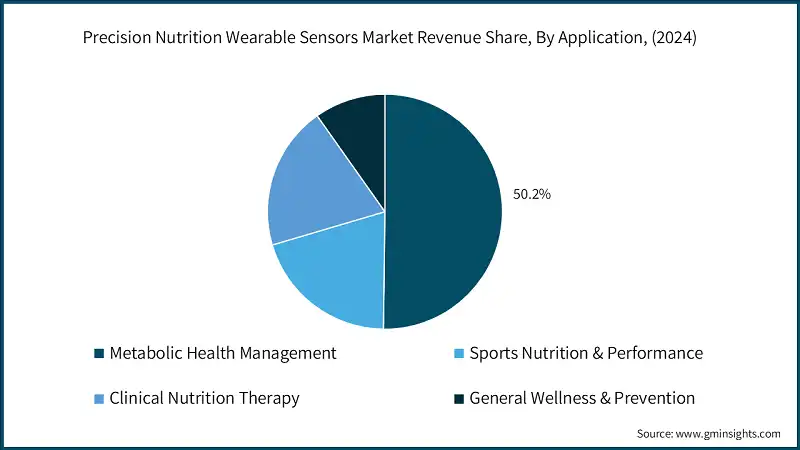
Based on applications, the precision nutrition wearable sensors market is segmented into metabolic health management, sports nutrition & performance, clinical nutrition therapy, general wellness & prevention.
- Metabolic health management is the greatest application segment which constituting the market share by 50.2%. Metabolic conditions management includes diseases like diabetes, obesity, metabolic syndrome treatment, and just rationalizing or optimizing metabolism. This segment predominates as it illustrates the continuous clinical need for metabolic monitoring and physiological proof to support results with sensor-based interventions in health improvement. Consequently, healthcare providers are now realizing the worth of current metabolic data in prescribing therapy regimens, treating medication dosages and avoiding the side effects or progression of metabolic complications.
- The sports nutrition and performance sector having the CAGR of 12.9% deals with precision nutrition sensors, enabling methods of fueling, recovery monitoring, and performance enhancement to give them competitive advantages. Nowadays, professional athletes and fitness enthusiasts increasingly rely on real-time metabolic data to realize their goals. With that, the segment's growth is because of the established benefits in performance from semantics-guided nutrition strategies and also the acceptance by sports organizations and fitness professionals.
- Applications for clinical nutrition therapy include specialized medical nutrition tailored for eating disorders, malnutrition, gastrointestinal disorders, and recovery from surgery. Precision nutrition sensors monitor the patient's nutritional status, assess intervention efficacy, and change treatment protocols based on real-time physiological responses.
Based on end user, the precision nutrition wearable sensors market is segmented into healthcare providers, direct-to-consumer, corporate wellness programs, research institutions.
- Healthcare providers are the largest consumer end-user segment, with market size of USD 1.1 billion, with a CAGR of 12.8%. Hospitals, clinics, physician practices, and specialized nutrition centers use precision nutrition sensors for the healthcare domain's patient care and clinical decision-making. The segment's leadership is representative of the established clinical need for objective metabolic monitoring tools, as well as the increasingly recognized role nutrition has in health outcomes. Sensor data are used by healthcare providers to optimize treatment protocols, track the effectiveness of interventions, and provide evidence-based nutritional guidance to patients.
- Directly from consumers include individual consumers who purchase precision nutrition sensors for personal health monitoring, fitness optimization, and wellness management. The increasing consciousness of health among consumers, the need for personalized health solutions, and improved access to sensor technologies drive the growth of this segment. Directly from consumers varies from very minimal glucose monitoring for metabolic awareness to very sophisticated multi-parameter monitoring for the optimization of diet, exercise, and lifestyle factors.
- Corporate wellness programs represent one of the fastest-growing end-user sectors where employers invest resources into precision nutrition sensors as part of an extensive employee health initiative. Sensor-based wellness programs from the leading corporations include personalized nutritional guidance, health coaching on follows-it-up basis, and incentive programs to encourage healthy behaviors.
Looking for region specific data?
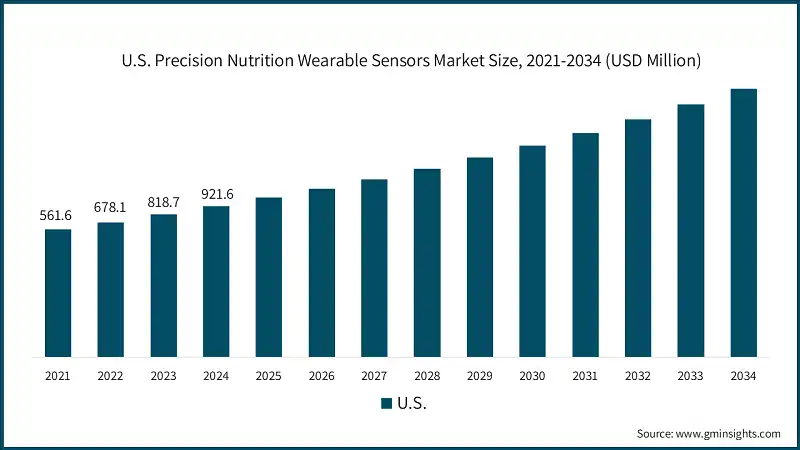
North America accounts for a decent chunk of the regional precision nutrition wearable sensors market with 42.2% of the share and 12.6% CAGR with US having market size of 921.6 million in 2024.
- North America continues to be a leading market share region due to advanced healthcare infrastructure, favorable regulatory environment, and high consumer adoption of health technologies. With the FDA taking the lead in establishing clear regulatory pathways for wearable biosensors, the region benefits from this recent approval as a clear demonstration of the agency's commitment to facilitating innovation while maintaining safety and effectiveness.
- The North America market is characterized by strong collaboration between technology companies and healthcare providers with research institutions that accelerate innovation and adoption of the marketplace. Leading global manufacturers deal with medical device systems such as Medtronic, Abbott, and Dexcom and have huge investments in this area. Thus, producing manufacturing capabilities, clinical knowledge, and regulatory understanding to initiate market development.
Europe precision nutrition wearable sensors market accounted for USD 777.6 million in 2024 and is anticipated to show lucrative growth over the forecast period.
- Europe is the second regional market with strong healthcare systems and complete regulatory frameworks, dominant trends focus increasingly on preventive medicine approaches. Germany pushes market developments in Europe due to advanced manufacturing capabilities, a strong basis of excellent research institutions, and an extensive healthcare network thus allowing more technology acceptance. Industry 4.0 principles and transformation of digital health provide Germany much potential for developing and applying technology for precision nutrition sensors. France and the UK significantly contribute to growth through established medical device industries, clinical research capacities, and innovative healthcare delivery.
The Asia Pacific precision nutrition wearable sensors market are anticipated to grow at the CAGR of 12.7% during the analysis timeframe.
- Asia Pacific region has great future potential. It is the fastest-growing regional market due to the expanding healthcare infrastructure, rising consumer wealth, and increasing digital health technology adoption. Governments also invest heavily in modernizing healthcare systems, while public-private partnerships are facilitating the adoption of technology into everyday life. There are also large populations in the area or sub-region whose people have become increasingly health aware and richer with disposable income. The three largest markets are China, India, and Japan, which combine to form the major engine driving growth while each market has its own differentiated characteristics and opportunities.
Latin America precision nutrition wearable sensors market accounted for 5% in 2024 and is anticipated to show lucrative growth over the forecast period.
- There is an increasing buzz about metabolic health and fitness, which is growing as consumers from Latin America seek personalized health insights-through-the-means of a new tool in their wellness application, precision nutrition wearable sensors. The expansion ranges from awareness-extended to growing disposable incomes, developing healthcare infrastructure, and a burgeoning fitness culture around the region. Furthermore, collaborations between local healthcare providers and global technology companies boost the acquisition of the cutting-edge wearable sensor solutions in countries such as Brazil, Mexico, and Argentina.
Middle East & Africa precision nutrition wearable sensors market accounted for 3% in 2024 and is anticipated to show lucrative growth over the forecast period.
- The continuing trends in precision nutrition from the wearable sensor market in the Middle East and Africa region expand into preventive health care and diseases linked to lifestyle, such as obesity and diabetes. The Middle East and Africa is one of the regions that have invested large amounts of money in health technology initiatives that fuse wearables into fitness and clinical practices, like the UAE, Saudi Arabia.
Precision Nutrition Wearable Sensors Market Share
The top 5 companies in the precision nutrition wearable sensors industry include Abbott Laboratories, Biolinq Inc, Dexcom Inc, Senseonics, Inc., Medtronic plc. These are prominent companies operating in their respective regions covering 44.5% of the market share. These companies hold strong positions globally due to their experience in precision nutrition wearable sensors industry. Their diverse product portfolios, backed by robust production capabilities and distribution networks, enable them to meet the rising demand across various regions.
- Abbott Laboratories has a strong ability in its FreeStyle Libre CGM platform. The scale of production, regulatory know-how, and established distribution channels give Abbott significant competitive benefits. Some of these strategic efforts include widening the distribution of FreeStyle Libre in consumer markets as well future development of generation sensors promising higher accuracy with extended wearing periods.
- Biolinq has grown into a new-age technology leader for the development of advanced biosensor platforms for continuous health monitoring. Their innovation proposes microneedle technology combined with multiplexed biosensor capabilities in a system that can monitor many biomarkers required for precision nutrition in real time. Research partnerships with top academic institutions and government agencies support the development of Biolinq's technologies while clinical validation was also performed for sensor platforms.
- Dexcom enjoys the competitive edge of having the CGM systems, known for the excellent accuracy and customer experience they guarantee. The key area of sensor innovation and integration capabilities and end-user applications make it a reason for channel expansion into the precision nutrition market.
- Medtronic leads the arena of precision nutrition wearable sensors with integrated diabetes care management and clinical partnership avenues. The latest launch of the Simplera CGM signifies a commitment to developing simple consumer-friendly sensor technologies that apply well beyond diabetes management.
- Senseonics, Inc. presents a disruptive offering in precision nutrition through therapeutic and clinically validated paradigms. The company advances sensor-guided nutrition interventions for certain medical conditions to show that precision nutrition technology can address specific clinical needs and thus be eligible for reimbursement coverage.
Precision Nutrition Wearable Sensors Market Companies
Major players operating in the precision nutrition wearable sensors industry include:
- Abbott Laboratories
- Biolinq Inc
- DayTwo Inc
- Dexcom Inc
- Epicore Biosystems
- Genesis Healthcare Co.
- Medtronic plc
- Nutrisense Inc
- Prenetics Global Limited
- Senseonics Holdings Inc
Precision Nutrition Wearable Sensors Industry News
- In September 2024, The FDA approved the Eversense 365 CGM System by Senseonic Holdings Inc. This device revolutionizes biosensor technology for a longer lifespan and shows potential for sensors being capable of use for precision nutrition.
- In August 2024, The FDA approved the company Medtronic plc to launch the Simplera CGM System which relies on a disposable design as well as a simplified insertion process addressing major user-convenience issues.
- In July 2024, Abbott Laboratories and Medtronic announced a broadening of the partnership to increase CGM sensor supply, with Abbott being able to retain its status as a major sensor manufacturer and thereby allow Medtronic to concentrate on integrated system development.
This precision nutrition wearable sensors market research report includes in-depth coverage of the industry, with estimates & forecasts in terms of revenue (USD Million) and volume (Units) from 2025 to 2034, for the following segments:
Market, By Technology Type
- Continuous glucose monitors (CGMs)
- Sweat-based biosensors
- Bioimpedance sensors
- Optical sensors
Market By Application
- Metabolic health management
- Glucose monitoring & diabetes management
- Ketosis tracking applications
- Metabolic flexibility assessment
- Sports nutrition & performance
- Hydration monitoring systems
- Electrolyte balance tracking
- Lactate measurement
- Clinical nutrition therapy
- Disease management applications
- Therapeutic monitoring systems
- Medication adherence tracking
- General wellness & prevention
- Lifestyle optimization platforms
- Dietary compliance monitoring
- Preventive health applications
Market, By End Use
- Healthcare providers
- Hospital integration systems
- Clinic-based monitoring programs
- Telehealth platform integration
- Direct-to-consumer
- Individual consumer adoption
- Fitness enthusiast
- Health-conscious user demographics
- Corporate wellness programs
- Employer-sponsored health initiatives
- Insurance company partnerships
- Occupational health applications
- Research institutions
- Clinical trial applications
- Academic research programs
- Pharmaceutical development support
The above information is provided for the following regions and countries:
- North America
- U.S.
- Canada
- Europe
- Germany
- UK
- France
- Spain
- Italy
- Rest of Europe
- Asia Pacific
- China
- India
- Japan
- Australia
- South Korea
- Rest of Asia Pacific
- Latin America
- Brazil
- Mexico
- Argentina
- Rest of Latin America
- Middle East and Africa
- Saudi Arabia
- South Africa
- UAE
- Rest of Middle East and Africa
Frequently Asked Question(FAQ) :
Who are the key players in the precision nutrition wearable sensors market?
Key players include Abbott Laboratories, Biolinq Inc, DayTwo Inc, Dexcom Inc, Epicore Biosystems, Genesis Healthcare Co., Medtronic plc, Nutrisense Inc, and Prenetics Global Limited.
How much revenue did the healthcare providers segment generate?
The healthcare providers segment generated USD 1.1 billion in 2024, leading the market with a CAGR of 12.8%.
What was the market share of the metabolic health management application segment?
The metabolic health management segment held a 50.2% market share in 2024, driven by the need for monitoring conditions like diabetes, obesity, and metabolic syndrome.
What are the upcoming trends in the precision nutrition wearable sensors market?
Key trends include advancements in non-invasive sensor technology, AI-driven personalized insights, real-time data analytics, and increasing focus on data privacy and cybersecurity.
Which region leads the precision nutrition wearable sensors market?
North America held a 42.2% market share with USD 921.6 million in 2024. The region's dominance is attributed to advanced healthcare infrastructure and high adoption of wearable technologies.
What is the market size of the precision nutrition wearable sensors in 2024?
The market size was USD 2.8 billion in 2024, with a CAGR of 12.5% expected through 2034, driven by advancements in sensor technology, regulatory clarity, and increasing consumer demand for personalized health solutions.
What is the projected size of the precision nutrition wearable sensors market in 2025?
The market is expected to reach USD 3.3 billion in 2025.
What is the projected value of the precision nutrition wearable sensors market by 2034?
The market is expected to reach USD 9.4 billion by 2034, fueled by innovations in AI-powered insights, real-time data analytics, and multi-parameter monitoring.
Precision Nutrition Wearable Sensors Market Scope
Related Reports