Summary
Table of Content

Precision Agriculture Drone Market
Get a free sample of this report
Form submitted successfully!
Error submitting form. Please try again.
Thank you!
Your inquiry has been received. Our team will reach out to you with the required details via email. To ensure that you don't miss their response, kindly remember to check your spam folder as well!
Request Sectional Data
Thank you!
Your inquiry has been received. Our team will reach out to you with the required details via email. To ensure that you don't miss their response, kindly remember to check your spam folder as well!
Form submitted successfully!
Error submitting form. Please try again.
Precision Agriculture Drone Market Size
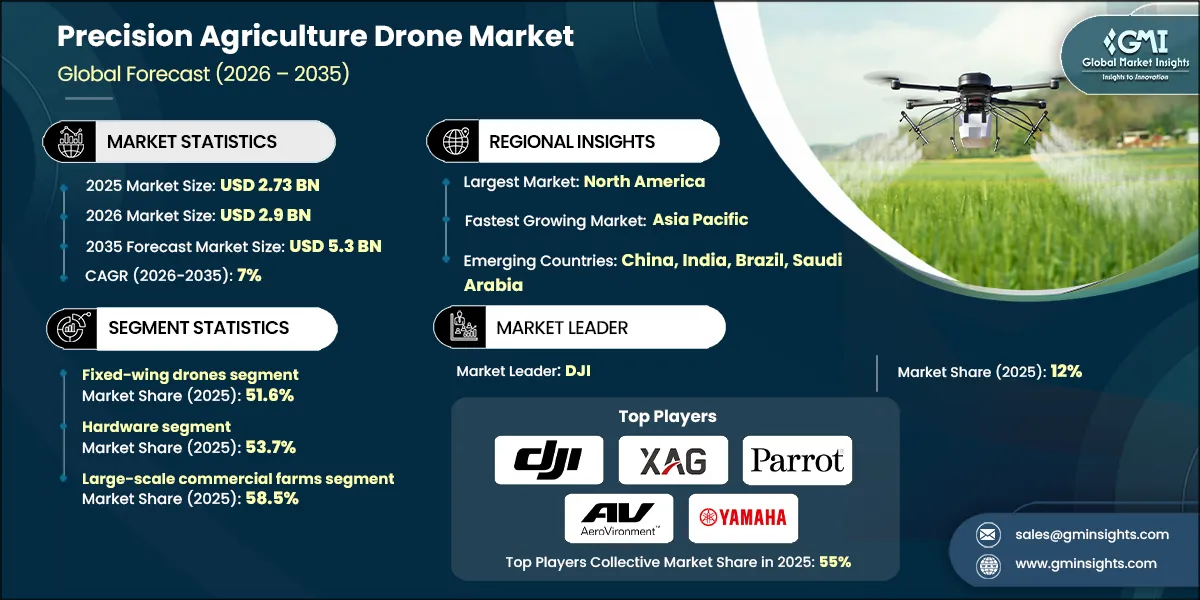
The precision agriculture drone market was estimated at USD 2.73 billion in 2025. The market is expected to grow from USD 2.9 billion in 2026 to USD 5.3 billion in 2035, at a CAGR of 7% according to latest report published by Global Market Insights Inc.
Precision Agriculture Drone Market Key Takeaways
Market Size & Growth
- 2025 Market Size: USD 2.73 Billion
- 2026 Market Size: USD 2.9 Billion
- 2035 Forecast Market Size: USD 5.3 Billion
- CAGR (2026–2035): 7%
Regional Dominance
- Largest Market: North America
- Fastest Growing Region: Asia Pacific
Key Market Drivers
- Shift from manual to automated crop scouting.
- Proliferation of AI & Edge Computing.
- Government Subsidies & "Drone Shakti".
Challenges
- High initial CAPEX for advanced payloads.
- Shortage of certified drone pilots.
Opportunity
- AI-Powered prescriptive analytics.
- Subscription-based "Data-as-a-Service".
Key Players
- Market Leader: DJI led with over 12% market share in 2025.
- Leading Players: Top 5 players in this market include DJI, XAG Co., Ltd., Parrot Drone SAS, AeroVironment, Inc., Yamaha Motor Co., Ltd., which collectively held a market share of 55% in 2025.
Get Market Insights & Growth Opportunities
The awareness regarding the longevity of crop cycles and operational yield, which is part of the market trends largely stressed, has contributed to an increasing demand for sophisticated aerial scouting and spraying systems. The increasing number of strategic partnerships as well as acquisitions of industry leaders has been reported as being at the core of this development. The combined strength of the key industry leaders like DJI, XAG, and Trimble, including their combinations with companies like Hylio and PrecisionHawk, has led to an increase in the level of innovations, an increase in the level of portfolios, as well as an intensification of presence within the heavyweight agricultural intelligence industry.
At the same time, traditional practices for crop inspection like manual scouting as well as periodic ground checks, as part of traditional practices, prove less effective for large acreage as well as fail the economic feasibility requirements for high throughput production lines working 24/7. Rising technological advancements in the agricultural industries have led to more advanced precision drone technologies, as they utilize wireless 5G connectivity, artificial intelligence-based crop diagnosis algorithms, and cloud-integrated NDVI analysis, which has the potential to reduce unplanned crop reduction by a staggering 25-40% and further limit water and chemical waste.
Increasing sectors such as large-scale commercial farming, grape cultivation (vineyards), and forestry adopting Industry 4.0 (Agriculture 4.0) and hence becoming one of the leading factors driving the expansion of this market. The requirement for automatic and real-time monitoring of crop health is increasing very aggressively in North America, particularly for VRT (Variable Rate Technology)-based crop protection in relation to protecting high-value recurring assets like orchards, grapeyards, and wide-acre row crops. Moreover, it has been noticed that there has been an increase in spending related to smart farm clusters and green food infrastructure in Europe and Asia-Pacific. Agricultural experts and food & beverage professionals and practitioners have shifted toward effective and continuous multispectral analysis for assets identified as high throughput.
Agronomists and food and beverage professionals and practitioners have been adopting and moving towards efficient and continuous multispectral analysis for high-throughput assets. They have been shifting away from obsolete and inefficient methods such as reactive “scout to treat” maintenance and visual inspections.
Hence, the ability to track the health of the crop online has been more accurate compared to the existing traditional systems that involve the monitoring of the plant regions from time to time. Moreover, the entities operating within the sector are looking for quicker approaches to determine the health of the produce. The drones for spraying automatically, therefore, stand out as a preferred choice based on the well-known advantages that include the prevention of soil compaction by ground equipment to avoid high expenses and reducing the risks associated with chemical handling within a critical setting.
This sector is being driven by a steadily developing understanding of predictive agronomy value and is therefore leading to a comprehensive acceptability for this highly capable diagnosis tool. In other respects, moreover, a continuously advancing trend in multispectral sensor technology for more enhanced sensor designs is bound to help improve their efficacy and user-friendly application quality. The symbiosis factor is therefore working.
The precision agricultural drone technology market is basically an intelligent machinery market that is likely to be severely impacted by the significant automation expected to happen in the future years due to the pandemic. In the professional sectors, there is going to be a demand for errorless agronomic data spaces with high resolutions for which the status of the field must be depicted. Besides that, the generation of insights for data that can be used for yield model generation is also a very apt effect of such efficiency, which makes sure that the time consumed for harvest as well as treatment is optimized. Such efficiency has been adopted by large agricultural co-operatives as well as companies dealing with ago-chemicals that require a consistent flow of the product line.
The hardware, which comprises the frames, propulsion, and spraying payloads, has constantly been at the top in terms of revenue share, hence proving to be a major contributing factor in the total market revenue due to their feasibility, durability, and adaptability to match the need for ruggedness in the modern-day field.
Hence, some aspects such as edge analytics & machine Learning provide a highly customized, precise, & in-depth plant-by-plant diagnosis procedure. Carbon-fiber reinforced frames & highly designed IP67-rated seals are slowly emerging as the demand in many sectors & services where less invasive & fast approaches for obtaining operational up-time & yield longevity are required.
To get key market trends
Precision Agriculture Drone Market Trends
The drone industry related to precision agriculture is undergoing a paradigm shift in trend because of a plethora of innovative solutions being created and developed by the stalwarts in the ag-tech domain. The crème de la crème in this industry is launching solutions with alluring properties like multispectral MEMS sensors, AI-powered algorithms for predictive yields, edge-AI analytics, and wireless transmitters with 5G capabilities in the form of autonomous scouting solutions and aerial application solutions for agriculture in the marketplace.
The trend being exhibited by the market in relation to the trends is typical of the industry's emphasis on innovation and, hence, the provision of enhanced tools for the users that boost the level of agronomic performance, the time for pest diagnosis and the deployment of the drone swarm, and the management of the farm.
- Technological advancement and product development: Technologically, the hardware used in the monitoring function of the aerial monitoring system is becoming more advanced and effective, which is reflected in the use of remote fleet management technologies that employ the use of the Internet of Things (IoT) in the crop health sector. Emphasis is being placed on the advancement of more powerful and more energy-efficient solid state batteries, apart from the advancement of highly sensitive hyperspectral sensors that will ensure more data is created for prescription mapping.
- Development of Smart Farming & Automated Agricultural Services: The HighValue Crop market as well as the third-party Drone-as-a-Service market was a flourishing one and had a significant effect on the development of the market. The Row Crop & Specialty Crop market together is a necessary segment of the market and is contributing almost 48% of the total agricultural drone market share. There is a continuous increasing demand for efficient AI-based data sortation & diagnosis systems to streamline the whole farm reliability.
- Sustainable resource management: The monitoring process of crop conditions by analyzing aerial perspectives is one of the leading factors impacting a rising level of resource savings and avoiding bottlenecks in operations, particularly because of unforeseen pest infestations, playing a pivotal role in creating a sustainable working environment in addition to developing green agriculture and carbon sequestration projects. The development process combined with swarming drones to avoid soil compaction and the avoidable waste of chemicals, thus working in alignment with ESG initiatives related to carbon neutrality and regenerative agriculture, is one such practice.
- Increased numbers of the disruption of the globe to the industry of the globe: The issue of food security for the globe is an aspect that forms the basis of the disruption of the globe and its related industry, and thus the primary targeting for the treatment will be based on the concept of resistance and adaptability.
- Agriculture 4.0 and smart maintenance with more emphasis: Farm managers and agronomists are showing more interest in the reliability of automated spraying lines for safety and throughput due to proactive scouting work to ensure that plants are healthy enough to prevent expensive harvest-time losses due to equipment or biological failure. Demand for optimized nutrient flow regularly creates an equal and consistent demand throughout the year for commercial-grade precision drone solutions.
Precision Agriculture Drone Market Analysis
Learn more about the key segments shaping this market
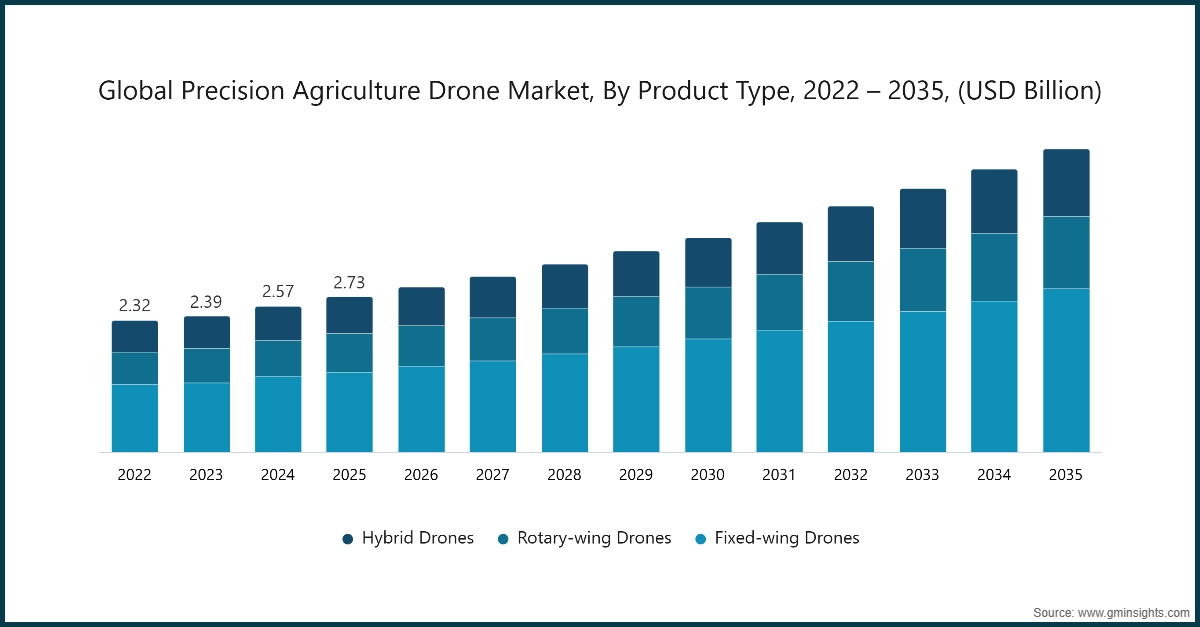
Based on the product type, the precision agriculture drone market is segmented into fixed-wing, rotary-wing, and hybrid drones. In 2025, fixed-wing drones are expected to lead the market with a share of 51.6%, valued at USD 1.4 billion.
- Fixed-wing drones dominate the market due to their ability to cover vast areas on a single flight, making them ideal for large-scale crop monitoring and topographic mapping. Their aerodynamic efficiency allows for longer endurance compared to multi-rotor alternatives.
- Rotary-wing drones accounted for USD 0.7 billion in 2025. This segment remains essential for precision tasks such as targeted pesticide spraying and "spot-check" scouting where the ability to hover and maneuver in confined spaces is mandatory.
Hybrid drones are growing at a steady 6.3% CAGR. This reflects an increasing preference for VTOL (Vertical Take-Off and Landing) capabilities combined with the long-range efficiency of fixed-wing flights, offering a "best-of-both-worlds" solution for complex terrains.
Learn more about the key segments shaping this market
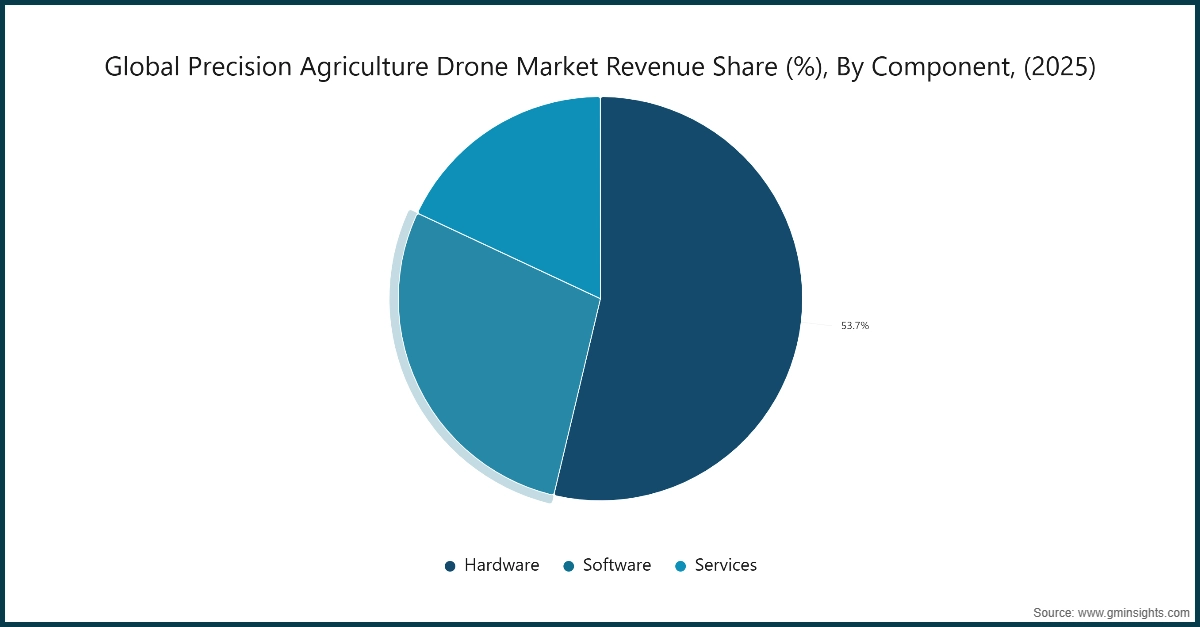
Based on the component, the precision agriculture drone market is segmented into hardware, software, and services. In 2025, the hardware segment is projected to hold the largest market share of 53.7%, generating a revenue of USD 1.5 billion.
- Hardware components like multispectral sensors, high-capacity batteries, and carbon-fibre airframes offer the foundational data and lift capacity required for farm operations. The integration of RTK (Real-Time Kinematic) GPS further bolsters their sub-centimetre navigation accuracy.
- The hardware segment represents the largest portion of the market, reflecting the industry's critical need for physical spraying and mapping infrastructure to enable "Agriculture 4.0" and data-driven field diagnostics.
- Software solutions maintain a consistent market share of 28.2% in 2025, providing the analytical power for growers to interpret complex imagery into actionable prescription maps and yield forecasts.
- The services segment shows a steady valuation of USD 0.5 billion in 2025, as large-scale farm operators increasingly rely on professional flight contractors and third-party data processing to supplement their internal teams.
- The services segment shows a steady growth rate, with a revenue of USD 172.3 billion in 2025, as industries increasingly rely on expert consultation and remote monitoring services to supplement their internal maintenance teams
Based on the application, the precision agriculture drone market is segmented into large-scale commercial farms and small and medium farms. In 2025, large-scale commercial farms held the major market share of 58.5%, reflecting the industry’s heavy reliance on high-efficiency automation.
- Large-scale commercial farms are fueled by the need to manage massive acreage with minimal manual labor. End users in this sector prioritize drones for rapid, automated scouting and uniform chemical application across contiguous fields.
- Small and medium farms generated USD 1.1 billion in 2025. This segment is growing as drone technology becomes more affordable, and "Drone-as-a-Service" (DaaS) models allow smaller growers to access precision tools without high upfront capital expenditure.
- The large-scale segment is also growing at a strong 7.2% CAGR, reflecting a global shift toward "mega-farms" that utilize drone swarms for simultaneous mapping and spraying operations
North America Precision Agriculture Drone Market
Looking for region specific data?
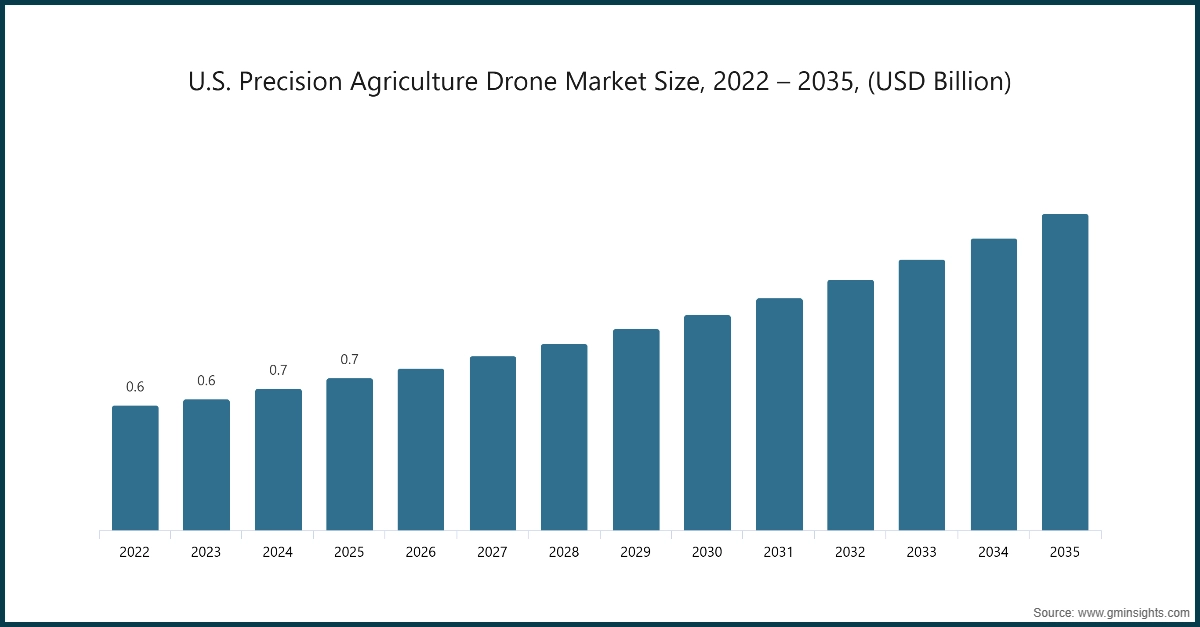
In 2025, North America is the leading regional market with an estimated value of USD 0.7 billion and a projected growth rate of 7.7% through 2035.
- The U.S. leads the region, holding a dominant 75.6% of the North American precision agriculture drone market share in 2025. This is driven by the early adoption of advanced UAV technologies, favorable FAA regulatory frameworks (such as Part 107), and widespread use of GPS-enabled drones for large-scale crop monitoring.
- The demand in this region is further fueled by a focus on automated farm management and variable rate application (VRA), as large-scale corporate farms look to reduce labor costs and optimize the use of fertilizers and pesticides.
- Canada shows steady growth at a 7.5% CAGR, representing a significant market as the country integrates drone-based multispectral imaging to manage its vast cereal and oilseed acreage.
Europe Precision Agriculture Drone Market
European growth is increasingly influenced by sustainability initiatives, encouraging the adoption of precision spraying and soil analysis drones that align with regional environmental standards like the EU Green Deal.
- Europe is a significant market estimated at USD 0.5 billion in 2025 with a projected growth rate of 6.1%. Germany leads the region with the highest market share, supported by its leadership in "Agriculture 4.0" and high-precision manufacturing.
- The German market’s strength is attributed to the integration of continuous data analysis for quality control and nutrient delivery, particularly in its advanced vineyard and orchard management sectors.
- The UK follows with a 6.9% CAGR, driven by the modernization of agricultural facilities and the rapid adoption of smart sensors to address labor shortages in the post-Brexit landscape.
- Growth is further fueled by stringent regulatory frameworks that mandate the reduction of chemical runoff, making the precision-targeting capabilities of drones essential for compliance.
Asia Pacific Precision Agriculture Drone Market
Asia Pacific is the fastest-growing regional market with a projected growth rate of 7.8% from 2026 to 2035 and expected to show healthy growth owing to high agricultural production and global exports of agricultural products.
- China holds the largest market share with the highest growth rate of 8.5%, driven by massive government subsidies, domestic manufacturing giants like DJI, and the rapid consolidation of small farms into larger, tech-driven cooperatives.
- India is a key player with a 7.9% CAGR, as the government’s "Drone Shakti" initiative and PLI schemes encourage manufacturers to provide affordable "Drone-as-a-Service" models to smallholder farmers.
- Countries like Japan and South Korea are critical for high-tech electronics integration, where autonomous drones are used to manage aging farmer populations and steep-terrain rice paddies where ground machinery cannot reach.
Latin America Precision Agriculture Drone Market
Latin America represents a developing segment with a market value of USD 0.1 billion (estimated to reach USD 0.2 billion by 2028), growing at a rate of 5% through 2035.
- Overall growth is steady as increasing industrialization of the soy and corn sectors in Brazil and Argentina boosts the demand for large payload spraying drones and field mapping.
- Brazil leads the region, accounting for nearly 48.3% of the share in 2025, benefiting from its role as a global leader in sugarcane and coffee production where aerial monitoring is vital for yield prediction.
- Mexico shows a steady growth rate of 5.2%, benefiting from its proximity to North American tech providers and increasing investments in high-value fruit and vegetable exports.
Precision Agriculture Drone Market Report Attributes
| Key Takeaway | Details |
|---|---|
| Market Size & Growth | |
| Base Year | 2025 |
| Market Size in 2025 | USD 2.73 Billion |
| Market Size in 2026 | USD 2.9 Billion |
| Forecast Period 2026-2035 CAGR | 7% |
| Market Size in 2035 | USD 5.3 Billion |
| Key Market Trends | |
| Drivers | Impact |
| Shift from manual to automated crop scouting | Farmers are moving from visual inspections to multispectral drone imaging, reducing labor costs by up to 50% and improving early pest detection by 30%. |
| Proliferation of AI & Edge Computing | The rise of "Agriculture 4.0" necessitates real-time data processing on the drone itself, enabling immediate variable-rate spraying and reducing chemical waste by 47%. |
| Government Subsidies & "Drone Shakti" | Increasing government support (e.g., India's subsidies and FAA Part 107 in the US) is accelerating the adoption of spraying drones to ensure food security. |
| Pitfalls & Challenges | Impact |
| High initial CAPEX for advanced payloads | The upfront cost for LiDAR and multispectral sensors remains a barrier for smallholders, leading to a rise in Drone-as-a-Service (DaaS) models. |
| Shortage of certified drone pilots | The complexity of operating heavy-payload spraying drones (like the DJI Agras series) requires specialized certification, often delaying regional deployment. |
| Opportunities: | Impact |
| AI-Powered prescriptive analytics | Integrating Machine Learning to not just map but "prescribe" specific nitrogen or pesticide levels reduces input costs and enhances overall yield stability. |
| Subscription-based "Data-as-a-Service" | New revenue streams are emerging where players like DroneDeploy offer monthly cloud-based processing, allowing farmers to access high-res maps without local hardware. |
| Market Leaders (2025) | |
| Market Leader |
12% Market Share |
| Top Players |
55% Collective Market Share |
| Competitive Edge |
|
| Regional Insights | |
| Largest Market | North America |
| Fastest growing market | Asia Pacific |
| Emerging countries | China, India, Brazil, Saudi Arabia |
| Future outlook |
|
What are the growth opportunities in this market?
Precision Agriculture Drone Market Share
DJI is leading with approximately 12% market share. DJI, XAG, Yamaha Motor, Parrot, and AeroVironment collectively hold around 55%, indicating a moderately fragmented market concentration with a strong tier of dominant global players. These prominent players are proactively involved in strategic endeavors, such as AI-driven software acquisitions, facility expansions, and IIoT collaborations, to expand their product portfolios, extend their reach to a broad customer base, and strengthen their market position
- DJI Agriculture recently enhanced its market footprint by unveiling the Agras T100, T70P, and T25P series in late 2025. This strategic move allows for higher payload capacities (up to 100L) and introduces specialized "lifting" capabilities alongside spraying and spreading. By integrating Penta-Vision safety systems and LiDAR, DJI reinforces its commitment to fully automated, high-precision farming through its "DJI Academy" training initiatives.
- XAG Co., Ltd. unveiled its flagship P150 Max Agricultural Drone at Agritechnica 2025, catering to large-scale demanding field conditions with an 80kg payload and a 20 m/s flight speed. The addition of the R Series Agricultural Rovers alongside the drones provides an integrated "Ground-to-Air" autonomous ecosystem. This technology features the RevoSpray 5 system, allowing for flow rates of up to 46 liters per minute to penetrate even the densest crop canopies.
Precision Agriculture Drone Market Companies
Major players operating in the precision agriculture drone Industry are:
- 3D Robotics
- AeroVironment, Inc.
- AGCO Corporation
- AgEagle Aerial Systems
- Agribotix
- Delair
- DJI
- DroneDeploy
- Parrot
- PrecisionHawk
- Quantum Systems
- senseFly
- Sentera
- Skeycatch
- Yamaha Motor Co., Ltd.
Yamaha Motor Co., Ltd. expanded its precision agriculture reach in early 2025 by acquiring New Zealand-based Robotics Plus and assets from The Yield. This series of strategic moves led to the establishment of Yamaha Agriculture, Inc. in the U.S., focusing on integrating AI-driven yield prediction with their heavy-duty unmanned helicopters. This design's advantage lies in providing "ready-to-use" spray services in regulated markets like California, eliminating the equipment overhead for individual growers.
Precision Agriculture Drone Market News
- In November 2025, DroneDeploy hosted its Horizons 2025 summit, announcing a unified platform that integrates aerial, ground, and robotic data into a single source of truth. They introduced Aerial Pro, which enables non-expert pilots to capture survey-grade maps with 4x finer detail, directly addressing the labor shortage in professional drone piloting.
- In May 2025, AgEagle Aerial Systems (dba EagleNXT) launched the RedEdge-P Triple, a next-generation multispectral sensor designed for advanced crop scouting and environmental monitoring. This follows their late 2024 strategy to pivot toward "full-stack" solutions, strengthening their balance sheet through preferred stock issuances to support 2026 defense and agricultural procurement cycles.
- In July 2025, AeroVironment showcased the Quantix Recon and its new P550 autonomous UAV at global trade shows. While maintaining a strong defense presence, the company is leveraging its vertical takeoff and landing (VTOL) expertise to provide "plug-and-play" scouting solutions for broad-acre estates, focusing on endurance and 400-acre coverage per flight.
- In August 2025, Terra Drone Corporation (partnered with PrecisionHawk technology) entered a significant distribution agreement with PT. Yanmar Diesel Indonesia. This partnership focuses on deploying the G20 and E16 drones to rice farmers across Southeast Asia, shortening lead times for diagnostic solutions in the APAC region.
- In late 2024, Parrot continued to emphasize its ANAFI USA and specialized thermal imaging series, which uses open-source software architectures to meet strict international data security standards. This focus provides the flexibility required for governmental agricultural departments that require high-performance data encryption during large-scale soil and resource mapping.
The precision agriculture drone market research report includes in-depth coverage of the industry with estimates & forecasts in terms of revenue (USD Billion) and volume (Thousand Units) from 2022 to 2035, for the following segments:
Market, By Product
- Fixed-wing drones
- Rotary-wing drones
- Hybrid drones
Market, By Component
- Hardware
- Software
- Services
Market, By Farm Size
- Large-scale commercial farms
- Small and medium farms
Market, By Application
- Field mapping
- Variable rate application
- Crop Scouting
- Others
The above information is provided for the following regions and countries:
- North America
- U.S.
- Canada
- Europe
- Germany
- UK
- France
- Italy
- Spain
- Asia Pacific
- China
- India
- Japan
- Australia
- South Korea
- Latin America
- Brazil
- Mexico
- Argentina
- Middle East and Africa
- South Africa
- Saudi Arabia
- UAE
Frequently Asked Question(FAQ) :
What is the market size of the precision agriculture drone in 2025?
The market size was USD 2.73 billion in 2025, with a CAGR of 7% expected through 2035. Increasing awareness of crop cycle longevity and operational yield, along with advancements in aerial scouting and spraying systems, is driving market growth.
What is the projected value of the precision agriculture drone market by 2035?
The market is poised to reach USD 5.3 billion by 2035, driven by technological innovations, strategic partnerships, and the adoption of AI-powered solutions.
What is the expected size of the precision agriculture drone industry in 2026?
The market size is projected to reach USD 2.9 billion in 2026.
How much revenue did the hardware segment generate in 2025?
The hardware segment generated approximately USD 1.5 billion, dominating the market with a 53.7% share in 2025.
What was the valuation of the fixed-wing drone segment in 2025?
Fixed-wing drones accounted for USD 1.4 billion in 2025, holding a 51.6% market share due to their ability to cover large areas and their aerodynamic efficiency.
What is the growth outlook for the North American precision agriculture drone sector through 2035?
North America is projected to grow at a rate of 7.7% through 2035, with an estimated market value of USD 0.7 billion in 2025.
What are the upcoming trends in the precision agriculture drone market?
AI-powered yield prediction, edge-AI analytics, 5G connectivity, hyperspectral sensing, and sustainable practices like carbon sequestration and regenerative agriculture.
Who are the key players in the precision agriculture drone industry?
Key players include DJI, XAG, Trimble, Hylio, PrecisionHawk, 3D Robotics, AeroVironment, Inc., AGCO Corporation, AgEagle Aerial Systems, Agribotix, Delair, DroneDeploy, Parrot, Quantum Systems, and senseFly.
Precision Agriculture Drone Market Scope
Related Reports