Summary
Table of Content

Power to Gas Market
Get a free sample of this report
Form submitted successfully!
Error submitting form. Please try again.
Thank you!
Your inquiry has been received. Our team will reach out to you with the required details via email. To ensure that you don't miss their response, kindly remember to check your spam folder as well!
Request Sectional Data
Thank you!
Your inquiry has been received. Our team will reach out to you with the required details via email. To ensure that you don't miss their response, kindly remember to check your spam folder as well!
Form submitted successfully!
Error submitting form. Please try again.
Power to Gas Market Size
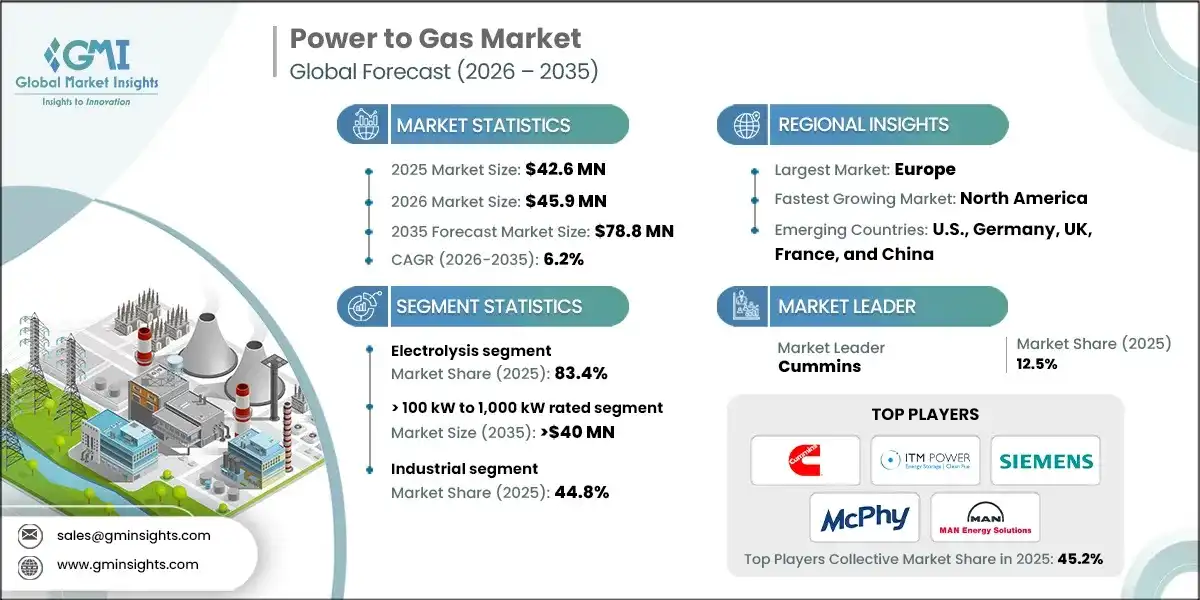
According to a recent study by Global Market Insights Inc., the power to gas market was estimated at USD 42.6 million in 2025. The market is expected to grow from USD 45.9 million in 2026 to USD 78.8 million by 2035, at a CAGR of 6.2%.
Power to Gas Market Key Takeaways
Market Size & Growth
- 2025 Market Size: USD 42.6 Million
- 2026 Market Size: USD 45.9 Million
- 2035 Forecast Market Size: USD 78.8 Million
- CAGR (2026–2035): 6.2%
Regional Dominance
- Largest Market: Europe
- Fastest Growing Region: North America
Key Market Drivers
- Integration of renewable energy.
- Supportive government policies.
- Rapid urbanization and industrialization.
Opportunity
- Expansion of green hydrogen demand.
- Utilization of existing gas infrastructure.
- Development of hydrogen trading corridors.
- Advancement in electrolyzer and methanation technologies.
Key Players
- Market Leader: Cummins led with over 12.5% market share in 2025.
- Leading Players: Top 5 players in this market include Cummins, ITM Power, Siemens, Mcphy Energy, MAN Energy Solutions, which collectively held a market share of 45.2% in 2025.
Get Market Insights & Growth Opportunities
- Rising renewable electricity generation coupled with expanding grid integration of variable resources will boost the industry landscape. Digital forecasting and dispatch optimization along with realtime electrolyzer controls will fortify the business scenario. Offshore wind buildouts in association with coastal hydrogen corridors will drive the business landscape.
- PowertoGas (PtG) is a technology that converts surplus or renewable electricity into gaseous fuels mainly hydrogen through electrolysis, or synthetic methane via methanation. This allows excess renewable energy to be stored longterm, injected into existing gas networks, or used across industry, mobility, and power sectors.
- For citation, in September 2024, Plug Power entered into an agreement with H2DRIVEN an initiative led by Dourogás and CapWatt to support the Front-End Engineering Design stage of their green methanol project in Portugal. As part of this engagement, the company will provide Technical Evaluation Phase services covering 25 MW of its PEM electrolyzer technology.
- Utility decarbonization roadmaps in conjunction with hydrogen blending standards will accelerate infrastructure readiness crosssector gas integration. Carbon capture availability in tandem with methanation scaleup will enable synthetic methane pathways circularcarbon schemes thereby bolstering the product landscape.
- Intermittency management needs coupled with curtailment reduction targets will strengthen the industry scenario. Industrial electrification trajectories along with lowcarbon feedstock mandates will fuel the business trend. Fertilizer, steel, and chemicals demand in conjunction with burner retrofits will penetrate the industry landscape.
- Microgrid and island systems in tandem with diesel displacement programs will sway the business scenario. Rural grid extensions in association with decentralized renewable assets will boost the industry trend. Advancements in PEM, alkaline, and solidoxide stacks coupled with manufacturing scale economies will strengthen the product landscape.
- Sector coupling strategies in conjunction with multivector energy hubs will fortify the business landscape. Gridservices revenue streams in tandem with gasmarket sales will bolster the industry trend. Hydrogen mobility rollouts in association with heavyduty refueling networks will drive the business scenario.
- For instance, in February 2025, TotalEnergies has advanced its 2030 objective to reduce the carbon footprint of hydrogen used in its European refining operations by partnering with Air Liquide on two green hydrogen initiatives in the Netherlands.
- In addition, through these projects, the companies plan to produce and supply approximately 45,000 tons of renewable hydrogen annually, powered largely by electricity from the OranjeWind offshore wind farm jointly developed by TotalEnergies and RWE.
- The power to gas market was valued at USD 32.8 million in 2022 and grew at a CAGR of approximately 5.0% through 2025. Public transit decarbonization coupled with municipal procurement will sway the industry landscape. Storage cavern utilization along with pipeline repurposing will fuel the product landscape.
- Gas quality monitoring in conjunction with safety and blending protocols will boost the industry scenario. Datadriven plant optimization coupled with AIenabled forecasting will bolster the product landscape. Advanced heat recovery along with cogeneration and district energy links will fortify the industry scenario.
- Financing innovations in conjunction with offtake guarantees will drive the business landscape. Insurance frameworks and standardized EPC contracts along with international hydrogen standards will boost the industry trend. Logistics for compressed and liquefied gases coupled with containerized distribution will augment the industry landscape.
To get key market trends
Power to Gas Market Trends
- The increasing integration of renewable energy sources such as wind and solar into national power systems is emerging as one of the most significant growth drivers for the PowertoGas market. As renewable penetration deepens, grid operators face growing challenges related to intermittency, seasonal mismatches between generation and demand, and periods of excessive electricity production that risk curtailment.
- PowertoGas technologies provide a flexible pathway to convert this surplus electricity into hydrogen or synthetic methane, thereby transforming a variable and sometimes unpredictable energy stream into a storable, dispatchable, and versatile fuel. This capability becomes especially valuable in regions where renewables frequently exceed realtime grid absorption capacity, enabling longduration storage that complements shortterm battery systems.
- For reference, in October 2025, Plug Power delivered its first 10megawatt GenEco electrolyzer unit to Galp, Portugal’s main integrated energy company. The system has been installed at Galp’s Sines Refinery, which is currently developing what is considered Europe’s largest ongoing PEM-based hydrogen electrolyzer project.
- Supportive government policies form a powerful catalyst for the expansion of the PowertoGas market by creating a regulatory and financial environment that encourages investment, accelerates innovation, and derisks earlystage deployments. Many countries are implementing cleanenergy mandates, hydrogen roadmaps, and gasdecarbonization targets that directly elevate the importance of PtG as an enabling technology.
- These policy frameworks often include incentives for renewable hydrogen production, including tax credits, capital subsidies, carbon pricing mechanisms, and guaranteed offtake arrangements, all of which improve project bankability. Governments are also introducing blending regulations that allow hydrogen to be mixed with natural gas in existing pipelines, reducing emissions without major infrastructure modifications.
- For citation, in May 2025, Cetna Energy engaged MAN Energy Solutions to carry out the detailed engineering work for a new methanation facility. Designed to produce nearly 1 million MMBtu of synthetic methane, the plant will rely on carbon dioxide and hydrogen sourced from woody biomass.
- Rapid urbanization and industrialization are driving a structural shift in energy demand patterns, making PowertoGas an increasingly essential technology for modern energy systems. As cities expand and industrial hubs grow, electricity consumption rises sharply, placing pressure on existing grid infrastructure.
- PtG offers a practical solution by converting surplus electricity into hydrogen or synthetic methane, supporting reliable energy supply during periods of high demand and enabling distributed storage in densely populated areas. Urban mobility systems, including buses, delivery fleets, and public transportation, are increasingly exploring hydrogen as a clean alternative, making PtG an attractive option.
Power to Gas Market Analysis
Learn more about the key segments shaping this market
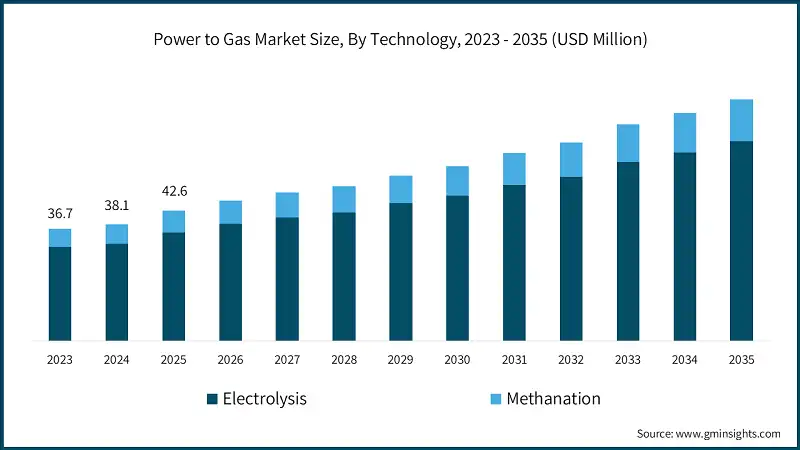
- Based on technology, the industry is segmented into electrolysis and methanation. The electrolysis power to gas market holds a share of 83.4% in 2025. Rising renewable electricity availability coupled with surplus generation from largescale solar PV and wind farms will expand electrolyzer deployment, stimulating the business landscape.
- Growing commitments toward green hydrogen production along with national decarbonization pathways will enhance the adoption of advanced electrolysis systems. Falling renewable electricity prices in conjunction with improvements in electrolyzer energy efficiency will strengthen the industry trend.
- For illustration, in June 2025, Plug Power broadened its collaboration with Allied Green Ammonia (AGA) through a new 2gigawatt electrolyzer initiative supporting a sustainable fuels development in Uzbekistan.
- The methanation power to gas market is set to exceed USD 13 million by 2035. Increasing interest in renewable synthetic methane coupled with the need to utilize existing gas infrastructure will accelerate the industry landscape. Rising CO utilization opportunities along with growing carboncapture integration will fortify the business scenario.
- Expansion of gas grid decarbonization programs in conjunction with rising hydrogen blending limits will sway the industry trend. Surplus renewable electricity availability in tandem with seasonal storage requirements will promote methanation as a longduration storage technology.
Learn more about the key segments shaping this market
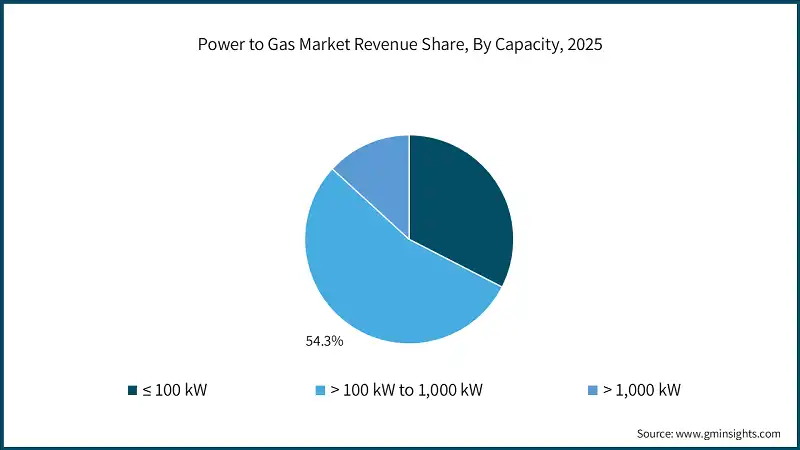
- Based on capacity, the power to gas market is divided into ≤ 100 kW, > 100 kW to 1,000 kW, and > 1,000 kW. The > 100 kW to 1,000 kW rated segment holds a share of 54.3% in 2025 and is set to exceed USD 40 million by 2035. Commercial and industrial renewable integration programs coupled with expanding onsite solar and wind adoption will bolster the business landscape.
- Manufacturing facilities requiring lowcarbon process fuels along with corporate emissionreduction targets will accelerate adoption of these systems, augmenting the industry scenario. Increasing hydrogen needs for district energy systems in conjunction with urban cleanheat strategies will expand midrange PtG installations.
- For citation, in December 2025, TES and TotalEnergies have brought in Osaka Gas, ITOCHU, and Toho Gas as partners through a Joint Development and Operating Agreement, giving the three Japanese companies a combined 33.3% ownership in the Live Oak project an industrialscale enatural gas (eNG/emethane) facility being developed in Nebraska.
- The ≤ 100 kW rated power to gas market was valued at USD 13.8 million in 2025. Growing adoption of decentralized renewable systems coupled with smallcommunity power generation will expand demand this range of PtG units, stimulating the business landscape.
- Rising focus on selfsufficient microgrids along with localized hydrogen production for residential clusters will elevate the industry scenario. Increasing rooftop solar surplus in conjunction with flexible householdscale storage needs will promote compact electrolyzers, boosting the business trend.
- The > 1,000 kW rated power to gas market will witness a CAGR of over 5.5% by 2035. Utilityscale renewable expansion coupled with rising curtailment levels in solar and wind farms will accelerate deployment of these rated units. National hydrogen roadmaps and greengas strategies along with largeindustrial decarbonization commitments will fortify the industry scenario.
- Steel, ammonia, chemical, and refinery sectors seeking highvolume hydrogen in conjunction with strict carbonneutral mandates will boost the industry trend. Expansion of pipelinegrade synthetic methane production in tandem with largescale methanation hubs will reinforce adoption of highcapacity PtG plants.
- Based on application, the industry is divided into commercial, utility, and industrial. The industrial segment holds a share of 44.8% in 2025 and is set to exceed USD 35 million by 2035. Processheat decarbonization agendas coupled with lowcarbon feedstock mandates will catalyze adoption of PtG for hydrogen supply in steel, ammonia, and chemicals.
- Continuous operations requirements along with dedicated storage and compression solutions will favor onpremises electrolyzers sized to baseload industrial demand profiles. CO utilization pathways in conjunction with methanation reactors will deliver synthetic methane compatible with existing burners, minimizing retrofit complexity for hightemperature processes.
- For instance, in February 2024, P2X Solutions is investing in a 100 MW hydrogen plant in Oulu, supporting Finland’s privatesector shift into PowertoGas and renewable fuel production, including ammonia, synthetic methane, and hydrogen derivatives.
- The commercial power to gas market will witness a CAGR of over 5.5% by 2035. Growth in distributed energy resources in conjunction with dynamic tariff structures will favor load shifting via electrolyzers, improving economics for retail, hospitality, and mixeduse facilities.
- Building electrification programs in tandem with heat pump integration will encourage hybrid solutions where PtG provides seasonal storage and peakshaving for HVAC and emergency power. Expansion of fleet electrification in association with lightcommercial hydrogen refueling will create anchor customers for smalltomid PtG units at logistics depots and corporate hubs.
- For reference, in January 2024, Gasum, a major Nordic private energy company, has invested in securing renewable emethane supply from Nordic RenGas, enabling the commercialization of synthetic methane for heavy transport and maritime segments beginning in 2026.
- The utility power to gas market was valued at USD 9 million in 2025. Increasing variable renewable penetration coupled with curtailment reduction goals will make PtG a strategic asset for longduration storage and grid balancing at transmission level. Integrated resource planning updates along with cleangas targets will drive multimegawatt electrolyzer and methanation investments for pipeline injection and capacity markets.
- Seasonal energy strategies in tandem with cavern and reservoir storage will promote hydrogen and synthetic methane buffers, supporting winter reliability and peak demand coverage. Expansion of crossborder energy corridors in association with hydrogen backbone initiatives will create utilityscale PtG hubs feeding regional pipelines and interconnectors.
Looking for region specific data?
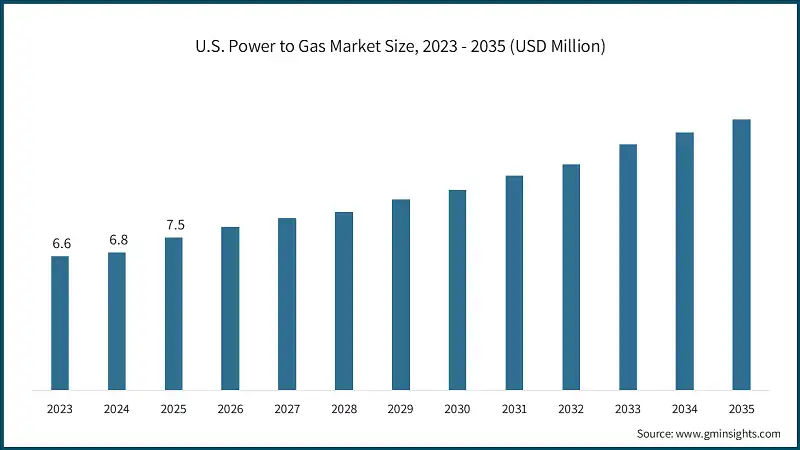
- The U.S. dominated the power to gas market in North America with around 74.9% share in 2025 and generated USD 7.5 million in revenue. Rising penetration of solar and wind resources coupled with increasing curtailment mitigation needs will accelerate PtG deployment, strengthening the business landscape.
- Growing cleanhydrogen incentives along with statelevel decarbonization mandates will stimulate investment in largescale electrolyzer projects. Expansion of renewable energy hubs in Texas, California, and Midwest regions in conjunction with gridbalancing requirements will promote PtG integration, further boosting the business scenario.
- For reference, in July 2024, the U.S. government has committed USD 8 billion under the Bipartisan Infrastructure Law to fund Regional Clean Hydrogen Hubs, providing up to 50% public costshare for large hydrogen production, storage, and transport projects across 18 states.
- The North America power to gas market is projected to surge over USD 15 million by 2035. National hydrogen strategies in Canada along with emissionsreduction goals will accelerate the industry scenario. Expansion of LNG export infrastructure in tandem with interest in synthetic methane production will stimulate industry growth.
- The Europe power to gas market is set to grow at a rate of over 6% by 2035. Ambitious EUwide climate commitments coupled with rapid expansion of wind and solar will intensify the need for largescale PtG installations, strengthening the business landscape. Strong hydrogen economy policies along with carbonneutral industrial goals will drive early commercial adoption of PtG across member states, augmenting the industry scenario.
- For illustration, in July 2025, Air Liquide has moved ahead with its European decarbonization strategy by approving the launch of ELYgator, a 200 MW electrolyzer to be built in Maasvlakte at the Port of Rotterdam.
- The Asia Pacific power to gas market holds a share of 46.8% in 2025. Industrial decarbonization priorities in conjunction with rising cleanfuel demand from steel, ammonia, and transport sectors will enhance PtG relevance across APAC economies, swaying market growth. Gridstability challenges in highrenewable zones in tandem with longduration storage needs will boost the product landscape.
Power to Gas Market Share
- The top 5 players in power to gas industry are Cummins, ITM Power, Siemens, Mcphy Energy, and MAN Energy Solutions contribute around 45.2% of the market share in 2025. The market is shaped by a mix of established energy technology providers and emerging hydrogenfocused innovators competing to scale electrolysis and methanation solutions.
- Cummins is strengthening its position in the PtG market through its expanding electrolyzer manufacturing capabilities and integration expertise in hydrogen systems. The company leverages its global footprint and engineering depth to support largescale hydrogen production projects. Its focus on scalable PEM and alkaline technologies positions it well for utility and industrial PtG deployments. Cummins’ strategy emphasizes reliability, system efficiency, and modular solutions tailored for gridsupport applications.
- ITM Power focuses strongly on PEM electrolyzer technology, giving it a competitive edge in fastresponse PtG applications linked to variable renewable energy. Its modular system designs cater to commercial, industrial, and utility hydrogen production needs. The company benefits from established partnerships with energy developers and gas utilities. ITM continues to emphasize cost reduction, manufacturing scaleup, and deployment of highcapacity hydrogen hubs.
- Siemens brings wide systemintegration capabilities and a broad portfolio in electrolysis, automation, and grid solutions, allowing it to support large PtG installations. Its electrolysis technology, combined with digitalized plant controls, positions the company as a preferred partner for multisector hydrogen projects. Siemens Energy leverages deep experience across power, gas, and industrial value chains. It is strongly aligned with decarbonization initiatives and crosssector coupling strategies.
- McPhy Energy specializes in both alkaline and highcapacity electrolyzer systems, targeting industrial and utilityscale PtG applications. The company differentiates through flexible hydrogen production and storage solutions suited for renewablerich regions. McPhy’s focus on European hydrogen infrastructure development enhances its project pipeline. Its competitive strategy centers on manufacturing expansion, technology optimization, and integration with local cleanenergy ecosystems.
- MAN Energy Solutions is a key participant in PtG through its methanation technologies and integration of syntheticgas production systems. The company leverages its expertise in turbomachinery and industrial process engineering to support largescale PtG plants. MAN positions itself strongly in sectors requiring synthetic methane for grid injection and industrial use. Its competitive advantage lies in highefficiency reactor designs, system durability, and compatibility with existing gas networks.
Power to Gas Market Companies
Major players operating in the power to gas industry are:
- AquaHydrex
- Baker Hughes
- Cummins
- Electrochaea
- Engie
- GRTgaz
- Hitachi Zosen Inova Schmack
- ITM Power
- John Cockerill
- Kanadevia Inova
- Krajete
- KROHNE
- Linde
- MAN Energy Solutions
- McPhy Energy
- NEL
- Phoenix Contact
- Power-to-Gas Hungary
- Ren-Gas
- Siemens Energy
- Terega
- Thyssenkrupp
- During the first nine months of 2025, Cummins reported USD 25.1 billion in revenue, reflecting strong operational momentum across its portfolio. The company delivered a gross margin of USD 6.6 billion, supported by consistent demand within its engine and powergeneration segments. R&D spending reached USD 1 billion, underscoring its ongoing investment in innovation and product development. Cummins also posted operating income of USD 3.2 billion, highlighting solid profitability and disciplined execution across its core business lines.
- In the first nine months of 2025, Linde reported USD 25.2 billion in sales, reflecting steady performance across its global operations. The company invested USD 112 million in research and development, reinforcing its focus on innovation and advanced process technologies. Linde delivered an operating profit of USD 6.9 billion, supported by strong execution and cost discipline, while net income reached USD 5.4 billion, underscoring the company’s solid financial position and robust profitability.
- In the third quarter of 2025, Baker Hughes generated USD 7,010 million in revenue, marking a USD 100 million (1%) sequential increase and a USD 102 million (1%) rise compared to the prior year. The yearoveryear improvement reflects stronger contributions from the IET segment, partially offset by softer activity in OFSE. Adjusted EBITDA for the quarter totaled USD 1,238 million, excluding USD 79 million in adjustments as outlined in the “Reconciliation of GAAP to nonGAAP Financial Measures” section.
Power to Gas Market Report Attributes
| Key Takeaway | Details |
|---|---|
| Market Size & Growth | |
| Base Year | 2025 |
| Market Size in 2025 | USD 42.6 Million |
| Market Size in 2026 | USD 45.9 Million |
| Forecast Period 2026 to 2035 CAGR | 6.2% |
| Market Size in 2035 | USD 78.8 Million |
| Key Market Trends | |
| Drivers | Impact |
| Integration of renewable energy | Increasing renewablepower availability drives the need for PowertoGas as a flexible pathway to store surplus electricity and stabilize the grid. |
| Supportive government policies | Policy incentives and national hydrogen strategies accelerate investment in PowertoGas infrastructure and commercial adoption. |
| Rapid urbanization and industrialization | Expanding energy demand from cities and industries boosts the role of PowertoGas in supplying clean fuels and longduration storage. |
| Pitfalls & Challenges |
|
| Opportunities: | Impact |
| Expansion of green hydrogen demand | Growing interest in clean fuels across industry and mobility creates strong opportunities for Power‑to‑Gas–based hydrogen production. |
| Utilization of existing gas infrastructure | The ability to inject hydrogen or synthetic methane into current pipeline networks opens cost‑efficient pathways for large‑scale deployment. |
| Development of hydrogen trading corridors | Emerging international hydrogen supply chains and export hubs offer long‑term market expansion for Power‑to‑Gas technologies. |
| Advancement in electrolyzer and methanation technologies | Ongoing improvements in efficiency and modular design enhance commercial viability and widen application potential. |
| Market Leaders (2025) | |
| Market Leaders |
12.5% market share |
| Top Players |
|
| Competitive Edge |
|
| Regional Insights | |
| Largest Market | Europe |
| Fastest Growing Market | North America |
| Emerging Country | U.S., Germany, UK, France, and China |
| Future outlook |
|
What are the growth opportunities in this market?
Power to Gas Industry News
- In September 2025, Accelera by Cummins, the zeroemissions division of Cummins delivered its largest 35MW PEM electrolyzer system to date for Linde’s new hydrogen facility in Niagara Falls, New York. The installation, powered entirely by renewable hydroelectric resources, will enable the production of green hydrogen to support the decarbonization of industrial users and advance the broader cleanenergy transition across the U.S.
- In March 2025, MAN Energy Solutions along with MAN Energy Solutions has taken a major step in the PowertoGas sector by being commissioned to deliver the preFEED design for the methanation reactor at the StormFisher Hydrogen’s upcoming 200MW PowertoX facility in North America. Through this assignment, MAN will define the technical foundation for a largescale plant that will convert green hydrogen and locally sourced biogenic CO into renewable emethane.
- In February 2025, Electrochaea announced a major advancement in its partnership with Baker Hughes as the two companies have completed the Basic Engineering Design Package (BEDP) for Electrochaea’s proprietary biocatalytic methanation process integrated with Baker Hughes’ carboncapture capabilities. This engineering milestone establishes the technical framework for deploying large, industrialscale biomethanation facilities to meet rising demand for commercial emethane production.
- In January 2025, Nordic Ren-Gas chosen MAN Energy Solutions (MAN ES) of Germany to supply key technology for its emethane facility planned in Tampere, Finland. Under the agreement, MAN ES will deliver a catalytic methanation reactor with a capacity of about 50MWel. This system will enable the plant to produce renewable emethane by combining green hydrogen with biogenic CO captured on-site. MAN ES will be responsible for the full scope of the equipment supply, including engineering, fabrication, pre-assembly, testing, shipment, onsite installation supervision, commissioning, and performance validation.
The power to gas market research report includes in-depth coverage of the industry with estimates & forecast in terms of revenue (USD Million) and volume (kW) from 2022 to 2035, for the following segments:
Market, By Technology
- Electrolysis
- Methanation
Market, By Capacity
- ≤ 100 kW
- > 100 kW to 1,000 kW
- > 1,000 kW
Market, By Application
- Commercial
- Utility
- Industrial
The above information has been provided for the following regions & countries:
- North America
- U.S.
- Canada
- Europe
- Germany
- UK
- France
- Denmark
- Netherlands
- Switzerland
- Asia Pacific
- China
- Japan
- Australia
Frequently Asked Question(FAQ) :
What is the market size of the power to gas in 2025?
The market size was USD 42.6 million in 2025, with a CAGR of 6.2% expected through 2035 driven by rising renewable electricity generation and expanding grid integration of variable resources.
What is the projected value of the power to gas market by 2035?
The global market for power to gas is expected to reach USD 78.8 million by 2035, propelled by utility decarbonization roadmaps, hydrogen blending standards, and industrial electrification trajectories.
What is the current power to gas industry size in 2026?
The market size is projected to reach USD 45.9 million in 2026.
How much revenue did the electrolysis segment generate in 2025?
Electrolysis held 83.4% market share in 2025, driven by rising renewable electricity availability and growing commitments toward green hydrogen production.
What was the valuation of the > 100 kW to 1,000 kW capacity segment in 2025?
The > 100 kW to 1,000 kW segment held 54.3% market share in 2025 and is set to exceed USD 40 million by 2035.
What is the growth outlook for the methanation segment from 2026 to 2035?
Methanation solutions are projected to exceed USD 13 million by 2035, driven by increasing interest in renewable synthetic methane and CO₂ utilization opportunities.
Which region leads the power to gas market?
The U.S. dominated North America with 74.9% share and USD 7.5 million revenue in 2025.
What are the upcoming trends in the power to gas market?
Key trends include integration of renewable energy sources, supportive government policies with hydrogen roadmaps, digital forecasting and dispatch optimization, and advancement in PEM, alkaline, and solid-oxide electrolyzer technologies.
Who are the key players in the power to gas market?
Key players include Cummins, ITM Power, Siemens Energy, McPhy Energy, MAN Energy Solutions, NEL, Linde, Baker Hughes, John Cockerill, Thyssenkrupp, Engie, Electrochaea, AquaHydrex, GRTgaz, Hitachi Zosen Inova Schmack, Kanadevia Inova, Krajete, KROHNE, Phoenix Contact, Power-to-Gas Hungary, Ren-Gas, and Terega.
Power to Gas Market Scope
Related Reports