Summary
Table of Content

Power Sports Market
Get a free sample of this report
Form submitted successfully!
Error submitting form. Please try again.
Thank you!
Your inquiry has been received. Our team will reach out to you with the required details via email. To ensure that you don't miss their response, kindly remember to check your spam folder as well!
Request Sectional Data
Thank you!
Your inquiry has been received. Our team will reach out to you with the required details via email. To ensure that you don't miss their response, kindly remember to check your spam folder as well!
Form submitted successfully!
Error submitting form. Please try again.
Power Sports Market Size
Power sport vehicle demand globally is driven primarily by adventure tourism and recreation-based activities outdoors. More people are participating in off road riding, exploring new trails and taking part in water-based recreation. According to the Outdoor Industry Association in 2023, there were 168 million people in the United States that participated in outdoor recreation which has created an increased demand for recreation mobility products.
Power Sports Market Key Takeaways
Market Size & Growth
- 2025 Market Size: USD 29 Billion
- 2026 Market Size: USD 29.8 Billion
- 2035 Forecast Market Size: USD 44.5 Billion
- CAGR (2026–2035): 4.6%
Regional Dominance
- Largest Market: North America
- Fastest Growing Region: Asia Pacific
Key Market Drivers
- Growth in outdoor recreation participation.
- Expansion of adventure tourism.
- Product innovation and vehicle performance improvements.
- Rising recreational vehicle ownership.
Challenges
- High purchase and maintenance costs.
- Safety concerns and accident risks.
Opportunity
- Growth of electric power sports vehicles.
- Expansion of recreational tourism parks.
- Development of connected and smart vehicles.
Key Players
- Market Leader: Polaris led with over 21.1% market share in 2025.
- Leading Players: Top 5 players in this market include BRP, Harley Davidson, Honda Motor, Polaris Industries, Yamaha Motor, which collectively held a market share of 69% in 2025.
Get Market Insights & Growth Opportunities
The increase in recreation mobility adoption is supported by the improvement of the efficiency of engine technology, upgrading of suspensions and development of new safety technologies by manufacturers. In addition, manufacturers are continually improving their drivetrains and creating electronic control systems to maximize the performance of power sport vehicles for rough terrains and waterborne environments. Increasing the attractiveness of power sport vehicles as a result of manufacturers adopting these technological advancements is supporting their growth again with respect to both recreational riders and professional riders.
The presence of new adventure tourism markets and expansion of recreation parks will create an environment where the potential for growth in this market is unprecedented. Countries that have the ability to take advantage of existing tourism infrastructure have seen a dramatic increase in demand for snowmobiles, atvs and pwc's. In 2023 according to the World Tourism Organization of the United Nations, 1.3 billion international tourist arrivals are consistent with an increase in demand for recreation mobility equipment.
Consumers' participation is also influenced by the ability to increase disposable income and their willingness to spend more money on recreation type of products. The increasing number of consumers who are purchasing recreation vehicles for weekend travel and outdoor activities has contributed to the ability of the outdoor recreation economy to generate USD 639 billion in economic value added in 2023 according to the Bureau of Economic Analysis, which continues to support increased spending.
The global power sports market was estimated at USD 29 billion in 2025. The market is expected to grow from USD 29.8 billion in 2026 to USD 44.5 billion in 2035, at a CAGR of 4.6% according to latest report published by Global Market Insights Inc.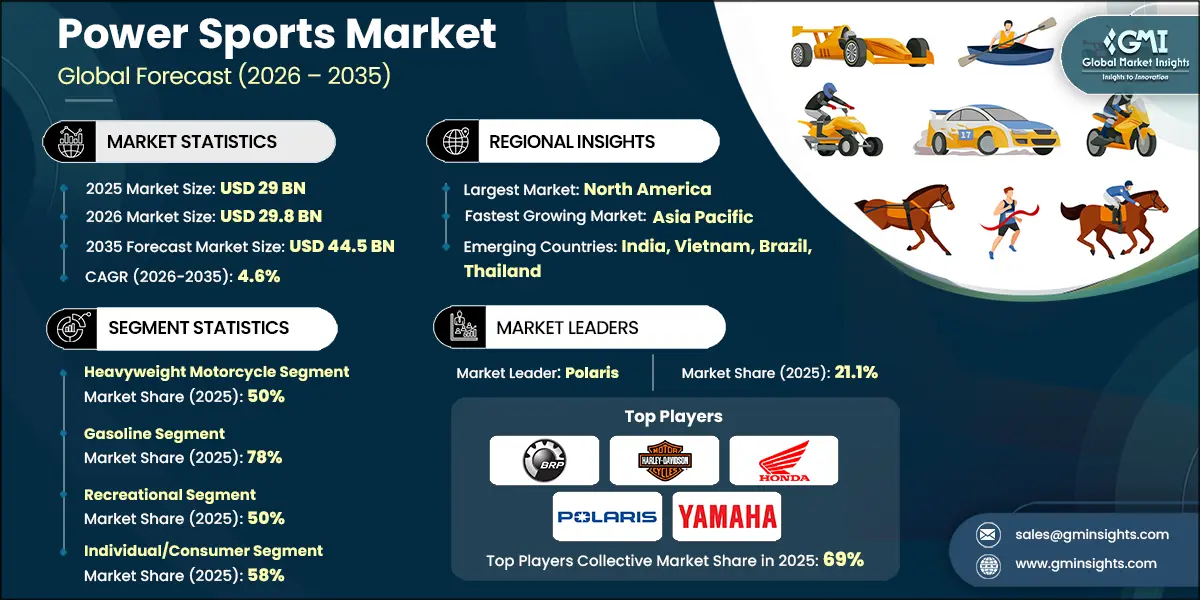
To get key market trends
Power Sports Market Trends
Consumer interest in outdoors is resulting in a growing demand for power sports vehicles around the globe. The Outdoor Industry Association states that in 2023, approximately 168 million Americans took part in outdoor recreation, which has stimulated the sale of all terrain, side by side and recreational motorcycles.
Due to concerns about the environment and regulatory requirements, manufacturers are paying more attention to electric power sports vehicles. As a result, they are releasing additional electric off-road motorcycles along with personal electric watercraft. The International Energy Agency has reported sales of over 14 million electric vehicles globally in 2023, assisting with the acceleration of electrification throughout the recreational vehicle segment.
Connected technology is an emerging trend regarding power sports vehicles. Features like GPS tracking, ride analysis, and mobile connectivity improve the safety of riders and monitor the performance of their vehicles. Remote diagnostics, route tracking and vehicle management for both recreational riders and fleet operators can be provided by these technologies.
Adventure tourism is increasing the commercial usage of power sports vehicles through guided scenic tours and recreation in parks. With approximately 1.3 billion total international tourist arrivals in 2023 according to United Nations World Tourism Organization, snowmobiles, personal watercraft and off-road recreational vehicles are in demand.
Power Sports Market Analysis
Learn more about the key segments shaping this market
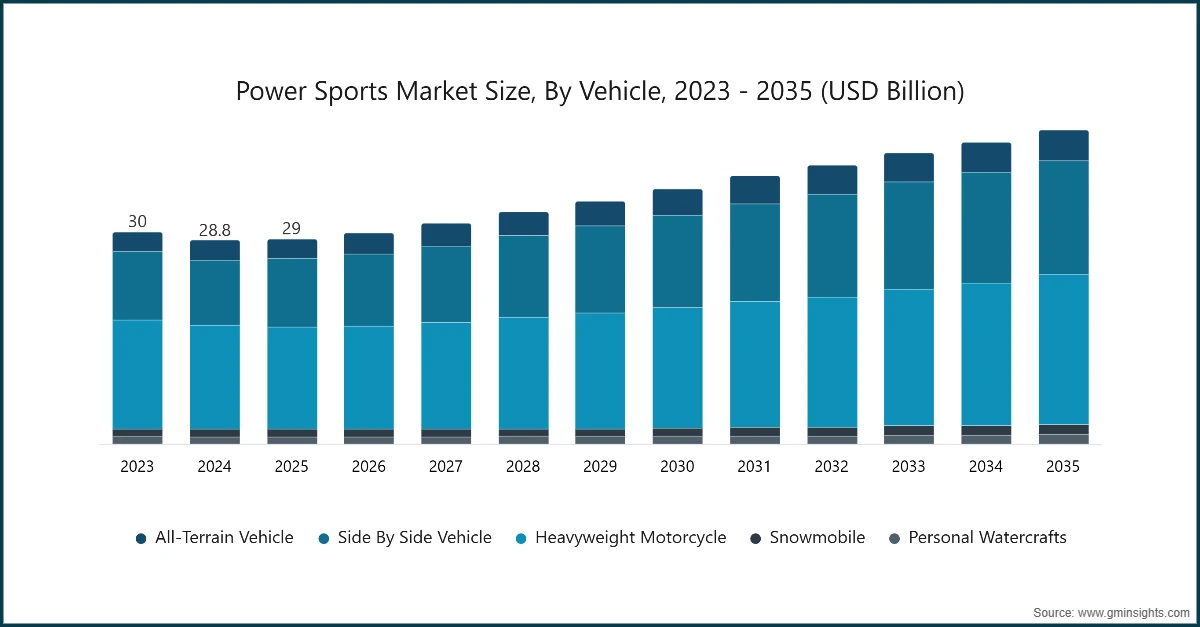
Based on vehicle, the market is segmented into all-terrain vehicle, side by side vehicle, heavyweight motorcycle, snowmobile, personal watercrafts. The heavyweight motorcycle segment dominates the market with 50% share in 2025, and the segment is expected to grow at a CAGR of 4.2% from 2026 to 2035.
- There are many different uses for Side-By-Side Vehicles including off-road recreation, agriculture and adventure tourism. The higher amount of seating, cargo capacity and safety features available on these types of vehicles have made them popular with recreational groups as well as utility users utilising outdoor spaces.
- All-Terrain Vehicles are continuing to be an important component of the powersports marketplace due to their extensive versatility within farming, forestry, and recreational trail riding applications. All-Terrain Vehicles are compactly designed for maximum maneuverability on rugged surfaces and have been widely used by both individual and small groups of users participating in outdoor recreation.
- Also known as Heavyweight motorcycles are major contributors to overall powersports sales because of tourism based recreational riding, with Heavyweight motorcycles over 600cc representing over 45% of the value of all motorcycles sold in the United States’ recreational motorcycle market according to data published by Motorcycle Industry Council.
- Demand for Personal Watercrafts continues to be strong primarily from water dependent tourism and water related recreation activities like boating. With over 80,000 of them sold during 2023, Personal Watercrafts continue to be well positioned for growth due to the recreational boating and water-based tourism industries.
Learn more about the key segments shaping this market
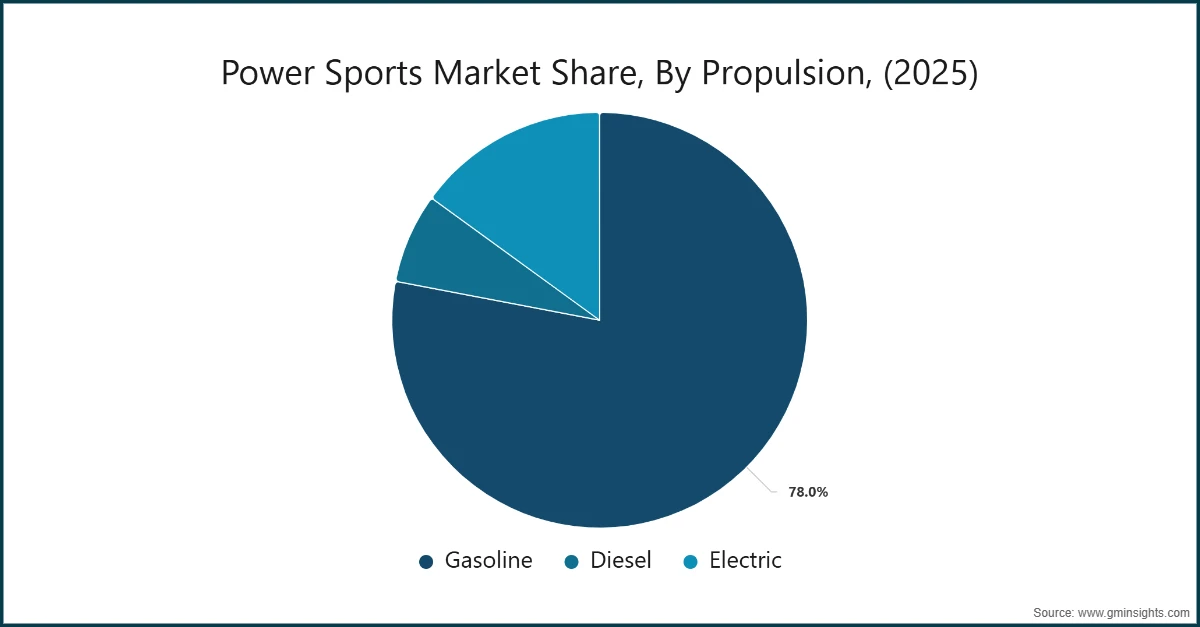
Based on propulsion, the power sports market is divided into gasoline, diesel and electric. The gasoline segment dominates with 78% market share in 2025 and is growing at a CAGR of 3.4% from 2026 to 2035.
- Gasoline has become the fuel of choice for most off-highway vehicles including all-terrain vehicles, side by side vehicles, snowmobiles, and personal watercraft. Gas engine vehicles have more powerful engines and faster acceleration than other fuels, which are essential for off-road travel, aquatic recreation, and high-performance recreational motorcycles.
- Manufacturers are continuing with gasoline powered vehicles because of their proven reliability and long-range capabilities. Recreational vehicle users also prefer gasoline powered vehicles because gasoline powered vehicles perform better on rugged terrains, in snowy areas, and on water where long rides are common.
- Diesel powered vehicles make up a small percentage of recreational vehicle manufacturers, but they are mainly utility-based vehicles. Diesel powered vehicles produce greater torque and durability than gasoline powered vehicles and are built for heavy-duty applications such as farming, forestry, and industrial transport over rough terrain.
- The electric vehicle segment is emerging as manufacturers are developing off-road electric motorcycles and electric PWC's. The advancement of battery technology and electric propulsion is allowing for the development of quieter, low-emission recreational vehicles suitable for use in environmentally sensitive areas.
Based on application, the power sports market is segmented into recreational, utility, commercial, sports, construction and defense. The recreational segment dominates with 50% market share in 2025.
- Recreational use comprises various types of riding on trails, on water, on snow, and off-road touring. The power sports vehicle industry is predominantly comprised of consumer use through vehicles being purchased for personal recreation, weekend travel opportunities, and for exploring all different types of outdoor environments, such as mountain ranges, desert areas, wooded forests, and coastal waters.
- Many adventure tourism operators and recreational parks utilize these types of vehicles to provide both guided tours and various outdoor activity opportunities; thus increasing the overall demand for all types of terrain vehicles, side by side vehicles, snowmobiles, and personal watercraft, at destinations offering tourism opportunities.
- In addition to recreational purposes, the utility sector also has a huge share of the overall power sports vehicle industry. Many agricultural, forestry, and land management operations utilize power sports vehicles, due to their ability to traverse mountainous terrain, to transport tools, equipment, and materials in remote areas.
- The power sports vehicle industry is also divided into commercial use of power sports vehicles, such as power sports vehicle rental operations, adventure tourism operators, and recreational activities to provide adventure tourism, and recreational activities. Many commercial tourist destinations operate fleets of power sports vehicles for providing guided tours of desert areas, for exploring mountains, and for participating in water recreation activities.
- The power sports vehicle industry also has a sports division, which consists of participation in competitive racing, to offer organized motorsport-type races, which require the use of high-performance off-road motorcycles and power sports vehicles. Professional racing events and competitive off-road events create demand for high-performance models.
Based on end-user, the power sports market is divided into Individual/Consumer, Commercial, Government/Military, Rental/Tour Operators and Others. Individual/Consumer dominates with 58% market share in 2025.
- Individual buyers buy power sports vehicles for trail riding, fishing, water sports, snow activities, and off-road riding. With an increase in outdoor recreational activities and outdoor travel, individuals are able to buy all-terrain vehicles, side by sides, and personal watercraft.
- Most recreational riders would rather have their own vehicle to ride on off-road trails, lakes, deserts and mountains. Increasing disposable income and an increase in spending on leisure activities has resulted in an increase in the number of recreational motorcycles and other power sports vehicles being purchased.
- The Commercial segment includes the use of power sports vehicles by businesses for tourism, event planning, and outdoor recreation. Examples of commercial use include tour operators and recreational parks using power sports vehicles to provide adventure experiences.
- Government and military users use power sports vehicles for patrol work, search-and-rescue work and travel in areas that have difficult terrain. Government users can be effective in their search for missing persons in remote or harsh locations by using compact-sized sports vehicles and their strong off-road capabilities.
- The growing market for short-term rentals of power sports vehicles represents a growing segment of the recreational segment. Several tour companies and other businesses that provide outdoor activities complete their fleets with power sports vehicles to meet the demands of tourists seeking adventure-type experiences.
Looking for region specific data?
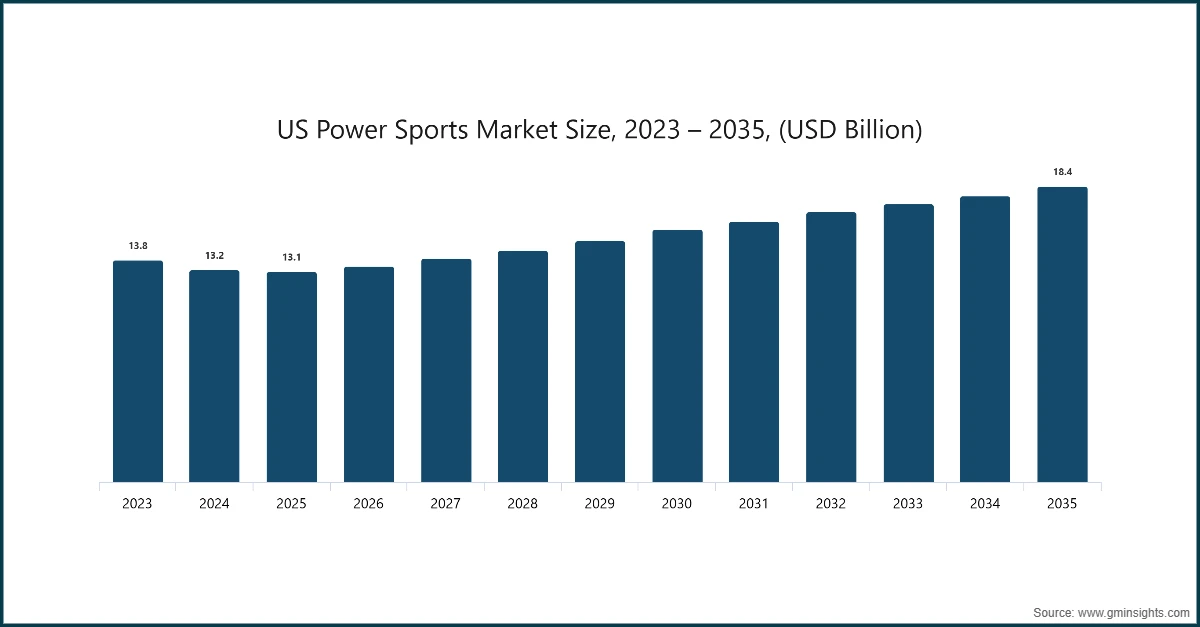
U.S. dominates the North America power sports market accounting for 85% share and generating USD 13.1 billion in 2025.
- The U.S. power sports industry is primarily influenced by the increasing number of people participating in outdoor recreation and adventure activities. The U.S. has an established culture of recreational riding on off road trails, lakes, desert areas, and mountain regions, resulting in the consistent demand for power sports vehicles.
- Market growth is aided by an extensive dealership network and strong representation from leading manufacturers. This means consumers will be able to access an expansive selection of power sport vehicles such as All-Terrain Vehicles (ATVs), Side by-side Vehicles (SxS), Recreational Motorcycles (RVs), and Personal Watercraft (PWCs).
- The expansion of the power sports market is also significantly affected by recreational tourism. Many tourist attractions in states with desert, forest, and coastal locations provide guided tours and outdoor activity programs centered around power sports.
- Government agencies responsible for managing land use have designated off-road riding areas and managed recreational parks to promote participation by consumers in off-road riding on trails and motorsports. These designated areas provide a safe environment for riders and promote the recreational use of power sports.
- Demand in the power sports industry continues to grow as a result of enhanced innovation in product design and a strong brand loyalty among consumers. Power sports manufacturers are developing new innovations in suspension systems, performance-enhancing engines, and safety features most recently available to power sports riders to improve the performance of their vehicles and the overall user experience.
Germany dominates Europe power sports market which is growing with a CAGR of 4.2% from 2026 to 2035.
- The interest among consumers in Germany in Outdoor Recreation and Motor Sport Culture. It is evident through the high volume of individuals who are actively riding Off-Road motorcycles, Touring motorcycles, and participating in Water-based recreational activities at Lakes or areas designated for riding.
- Germany also has a mature Automotive and Motorcycle manufacturing ecosystem which is conducive to technological advancements and product availability of recreational vehicles. In addition, the engineering capabilities of manufacturers continue to advance as they introduce new, leading-edge performance and safety characteristics in their vehicles.
- The increase in demand for Adventure Tourism and Recreational Travel also impacts this market. Both Tourists and Local Riders can be seen participating in Recreational Riding of Trailways, Touring and water recreation.
- Regulatory frameworks and designated riding zones are two key factors influencing how the Germany market operates. Typically, Off-road Riding takes place on approved Trails and at Organized Events. Therefore, The off-road market will continue to increase with the development of more Structured Motor Sport Facilities and Recreational Parks.
- The demand from individuals for Premium and High-Performance Recreational Vehicles also supports this market. Numerous Riders currently ride Touring and Performance type motorcycles for enjoyment when travelling for leisure and or competing in Multi-Sport Events.
China dominates the Asia Pacific power sports market, showcasing strong growth potential, with a CAGR of 9.1% from 2026 to 2035.
- Outdoor recreation and adventure tourism are reason for the growth of China power sports industry. Urban populations are expanding and there are more people involved in leisure travel and outdoor activity, which is creating demand for recreational motorcycles, all-terrain vehicles, and personal watercraft throughout various tourism markets.
- Domestic tourism has driven an increase in demand for power sports vehicles for use in recreational parks and adventure tourism facilities. A number of tourism operators offer off-road rides and water-based recreation that utilize all-terrain vehicles and personal watercraft.
- Additionally, China manufactures motorcycles and recreational vehicles, and there are numerous domestic manufacturers in this space. Domestic manufacturers provide product accessibility in both the domestic and export market, leading to increased adoption of recreational motorcycles and off-road vehicles.
- Investment by the government into tourism infrastructure and recreational parks provides incentive for more outdoor leisure. Adventure tourism zones designated by the government and outdoor recreation zones provide opportunities for commercial deployment of power sports vehicles.
- Increasing discretionary spending on leisure products is also adding to support for market development. Increased numbers of younger consumers and adventure-seeking consumers are participating in weekend recreational riding and organized motorsports on recreational motorcycles and off-road vehicles.
Brazil leads the Latin American power sports market, exhibiting remarkable growth of 6.3% during the forecast period of 2026 to 2035.
- The growth in participation in outdoor recreation and adventure tourism supports the Brazil power sports industry. The country’s diverse natural landscapes of forests, beaches and mountains lend themselves to outdoor recreational activities such as trail riding, water recreational activities and off-road exploration.
- A growing number of adventure tourism operators are using power sports vehicles to provide guided tours and outdoor recreation experiences. These include off-road vehicles and personal watercrafts that are popular in many tourism destinations where visitors enjoy exploring remote areas and beautiful landscapes.
- Agriculture and rural operations also contribute to the demand for power sports vehicles within the market. Power sports vehicles are utilized for transportation and moving equipment on farms or remote areas across rugged terrain, where typical vehicles have limitations as they operate.
- The motorsport culture and the recreational riding community further support the growth in the number of power sports vehicles purchased and used. The demand for high-performance motorcycles and off-road vehicles is driven by individuals who participate in off-road competitions or recreational event riding.
- The continued development of tourism infrastructure and the growth of the domestic travel market will continue to provide opportunities for the use of recreational vehicles in tourism activities. More and more tourism-based businesses and power sports rental operators will be expanding their power sports vehicle fleets to accommodate adventure-seeking travellers.
UAE witnessed substantial growth in the Middle East and Africa power sports market in 2025.
- The growth of UAE market can mainly be attributed to the combined impact of an increase in demand for adventure tourism and desert-based recreation, which in turn has created a need for Off Roading activities throughout the UAE.
- Adventure Tour Providers regularly provide guided adventure tours throughout the desert that utilize Off Road Vehicles for utilization in either exploring or enjoyment purposes. Many Tourists, who are coming from abroad as well as Residents who are looking for adventure opportunities, all find that they will be able to utilize Off Roading as a means to fulfill their Adventure desires.
- High levels of spending by consumers on Luxurious Travel and the increase of Disposable Income for Leisure Activities will continue to promote the use of Premium Vehicles in UAE power sports. Through this, many Enthusiasts are purchasing Performance Off Roads and Recreational Motorcycles for their own use as well as purchasing Performance Off Roads for participation in Organized Desert Racing Events.
- Recreational Parks and Resort Facilities will continue to contribute to the growth in demand for Power Sport vehicles throughout the UAE by providing Outdoor Adventure Programs All Facilities usually have a Fleet of Off-Road Vehicles to provide Structured Recreation Activities for Visitors and Tourists.
- Through Organized Racing and Off-Road Competitions in the Desert, power sports Interest continues to grow which supports the utilization of Performance Vehicles within all Areas of the Recreational and Professional Riding Community.
Power Sports Market Share
- The top 7 companies in the power sports industry are Polaris, BRP, Harley-Davidson, Honda Motor, Yamaha Motor, Kawasaki Heavy Industries, and Textron, contributed around 82% of the market in 2025.
- Polaris is a leading manufacturer of all-terrain vehicles, side by side vehicles, snowmobiles, and recreational motorcycles. The company focuses on continuous product development and strong dealer networks to maintain a competitive position in recreational and utility power sports vehicles.
- BRP offers a broad portfolio of power sports products including personal watercraft, snowmobiles, and off-road vehicles. The company is known for its strong recreational vehicle brands and continuous investment in product innovation and performance technology.
- Harley-Davidson is recognized globally for heavyweight recreational motorcycles. The company leverages its strong brand reputation, loyal customer community, and premium touring motorcycles to maintain a significant presence in the recreational motorcycle segment.
- Honda Motor provides a diverse portfolio of motorcycles and off-road vehicles across global markets. The company benefits from large scale manufacturing capabilities and advanced engineering expertise which support reliability and product performance.
- Yamaha Motor is a major manufacturer of recreational motorcycles, all-terrain vehicles, personal watercraft, and snowmobiles. The company focuses on high performance engines, durable vehicle platforms, and a wide international distribution network.
- Kawasaki Heavy Industries has a strong presence in performance motorcycles and off-road vehicles. The company emphasizes engineering innovation and high-performance vehicle design to serve recreational riders and motorsport enthusiasts.
- Textron participates in the market through its specialized off-road vehicle brands and utility vehicles. The company focuses on durable vehicles designed for recreational riding as well as utility operations in agriculture, construction, and outdoor environments.
Power Sports Market Companies
Major players operating in the power sports industry are:
- BRP
- CFMOTO
- Harley Davidson
- Honda Motor
- Kawasaki Heavy
- KYMCO
- Polaris
- Suzuki Motor
- Textron
- Yamaha Motor
- The power sports market has been growing continually due to the increased number of people participating in outdoor recreation and adventure tourism. The increase in interest in off-road riding, water-based recreation, and recreational touring has inspired many to purchase power sports vehicles (all-terrain vehicles, side by sides, motorcycles, snowmobiles, and personal watercraft).
- Manufacturers of power sports vehicles are innovating their products, developing better performing products and providing greater safety technology to improve the overall riding experience. Additionally, continued development of tourism infrastructure, recreational parks and organized motorsport activities will continue to catalyze the demand for power sports vehicles for recreational, commercial and utility use globally.
Power Sports Market Report Attributes
| Key Takeaway | Details |
|---|---|
| Market Size & Growth | |
| Base Year | 2025 |
| Market Size in 2025 | USD 29 Billion |
| Market Size in 2026 | USD 29.8 Billion |
| Forecast Period 2026-2035 CAGR | 4.6% |
| Market Size in 2035 | USD 44.5 Billion |
| Key Market Trends | |
| Drivers | Impact |
| Growth in outdoor recreation participation | Increasing consumer participation in recreational riding, trail exploration, and water-based activities support demand for all terrain vehicles, side by side vehicles, snowmobiles, and personal watercraft. |
| Expansion of adventure tourism | Adventure tourism activities including off road excursions, desert tours, and snow-based recreation increase utilization of power sports vehicles across tourism operators and rental fleets. |
| Product innovation and vehicle performance improvements | Advancements in suspension systems, engine performance, lightweight materials, and electronic ride control enhance vehicle capability and attract experienced riders and new consumers. |
| Rising recreational vehicle ownership | Increasing consumer spending on leisure equipment and outdoor vehicles encourages adoption of power sports vehicles for personal recreation and weekend travel activities. |
| Pitfalls & Challenges | Impact |
| High purchase and maintenance costs | Power sports vehicles involve high purchase prices and maintenance costs which can limit adoption among first time buyers and price sensitive consumers. |
| Safety concerns and accident risks | Off road riding conditions and high-speed recreational activities increase accident risk, prompting stricter safety regulations and training requirements. |
| Opportunities: | Impact |
| Growth of electric power sports vehicles | Manufacturers are introducing electric off-road motorcycles and electric personal watercraft which reduce emissions and attract environmentally conscious consumers. |
| Expansion of recreational tourism parks | Increasing investments in adventure parks, desert tourism circuits, and mountain recreation facilities create new demand for power sports vehicle fleets. |
| Development of connected and smart vehicles | Integration of GPS tracking, ride analytics, and mobile connectivity improve rider safety and enhance ownership experience. |
| Market Leaders (2025) | |
| Market Leader |
21.1% Market Share |
| Top Players |
Collective Market Share is 69% |
| Competitive Edge |
|
| Regional Insights | |
| Largest Market | North America |
| Fastest growing market | Asia Pacific |
| Emerging countries | India, Vietnam, Brazil, Thailand |
| Future outlook |
|
What are the growth opportunities in this market?
Power Sports Industry News
- In January 2026, Harley-Davidson launched the 2026 Pan America 1250 Limited with features like an Adaptive Ride Height system, a Screamin' Eagle quickshifter, and the Skyline OS interface, along with factory-installed aluminum luggage to upgrade the adventure touring experience.
- In October 2025, Polaris announced the 2026 RZR Pro R with features like an industry-leading 10.4-inch touchscreen display, Dynamix Active Suspension, and geared reverse, along with RIDE COMMAND software integration to elevate the off-road rider experience.
- In August 2025, BRP launched the 2026 Can-Am Outlander Electric ATV with features like a whisper-quiet Rotax E-Power powerpack, selectable ride modes, and fast Level 2 charging capabilities, along with 1,830 lbs of towing capacity to redefine utility and outdoor adventure.
- In June 2025, Yamaha announced the 2026 YZ450FX Cross Country motorcycle with features like an industry-first ECU lock function, updated KYB suspension, and a new four-mode Traction Control, along with smartphone integration via the Power Tuner app to enhance off-road racing performance.
The power sports market research report includes in-depth coverage of the industry with estimates & forecasts in terms of revenue (USD Mn) and volume (Units) from 2022 to 2035, for the following segments:
Market, By Vehicle
- Side By Side Vehicle
- All-Terrain Vehicle
- Heavyweight Motorcycle
- Personal Watercrafts
- Snowmobile
Market, By Propulsion
- Gasoline
- Diesel
- Electric
Market, By Application
- Recreational
- Utility
- Commercial
- Sports
- Construction
- Defense
Market, By End-User
- Individual/Consumer
- Commercial
- Government/Military
- Rental/Tour Operators
- Others
The above information is provided for the following regions and countries:
- North America
- US
- Canada
- Europe
- Germany
- UK
- France
- Italy
- Spain
- Russia
- Norway
- Netherlands
- Sweden
- Asia Pacific
- China
- India
- Japan
- Australia
- South Korea
- Singapore
- Thailand
- Indonesia
- Vietnam
- Latin America
- Brazil
- Mexico
- Argentina
- MEA
- South Africa
- Saudi Arabia
- UAE
- Turkey
Frequently Asked Question(FAQ) :
What is the market size of the power sports in 2025?
The market was USD 29 billion in 2025, with CAGR of 4.6% expected through 2026 to 2035, driven by rising outdoor recreation participation and adventure tourism demand.
What is the projected value of the power sports industry by 2035?
The power sports market is expected to reach USD 44.5 billion by 2035, propelled by continuous product innovation, and growing adoption of electric power sports vehicles.
What is the current power sports industry size in 2026?
The market size is projected to reach USD 29.8 billion in 2026, supported by increasing consumer spending on leisure activities and recreation-based outdoor participation.
Which vehicle segment dominates the power sports market?
The heavyweight motorcycle segment held 50% share in 2025 and is expected to grow at a CAGR of 4.2% till 2035.
What was the market share of the gasoline propulsion segment in 2025?
The gasoline segment held 78% market share in 2025, growing at a CAGR of 3.4% from 2026 to 2035.
Which region leads the power sports market?
The U.S. alone accounting for 85% of the regional share and generating USD 13.1 billion in 2025, influenced by the increasing number of people participating in outdoor recreation and adventure activities.
What are the upcoming trends in the power sports market?
Key trends include the rise of electric power sports vehicles, integration of connected technologies such as GPS tracking and ride analytics, and growing demand for lightweight high-performance vehicles.
Who are the key players in the power sports market?
Key players include Polaris, BRP, Harley-Davidson, Honda Motor, Yamaha Motor, Kawasaki Heavy Industries, and Textron.
Power Sports Market Scope
Related Reports