Summary
Table of Content

Power Relays Market
Get a free sample of this report
Form submitted successfully!
Error submitting form. Please try again.
Thank you!
Your inquiry has been received. Our team will reach out to you with the required details via email. To ensure that you don't miss their response, kindly remember to check your spam folder as well!
Request Sectional Data
Thank you!
Your inquiry has been received. Our team will reach out to you with the required details via email. To ensure that you don't miss their response, kindly remember to check your spam folder as well!
Form submitted successfully!
Error submitting form. Please try again.
Power Relays Market Size
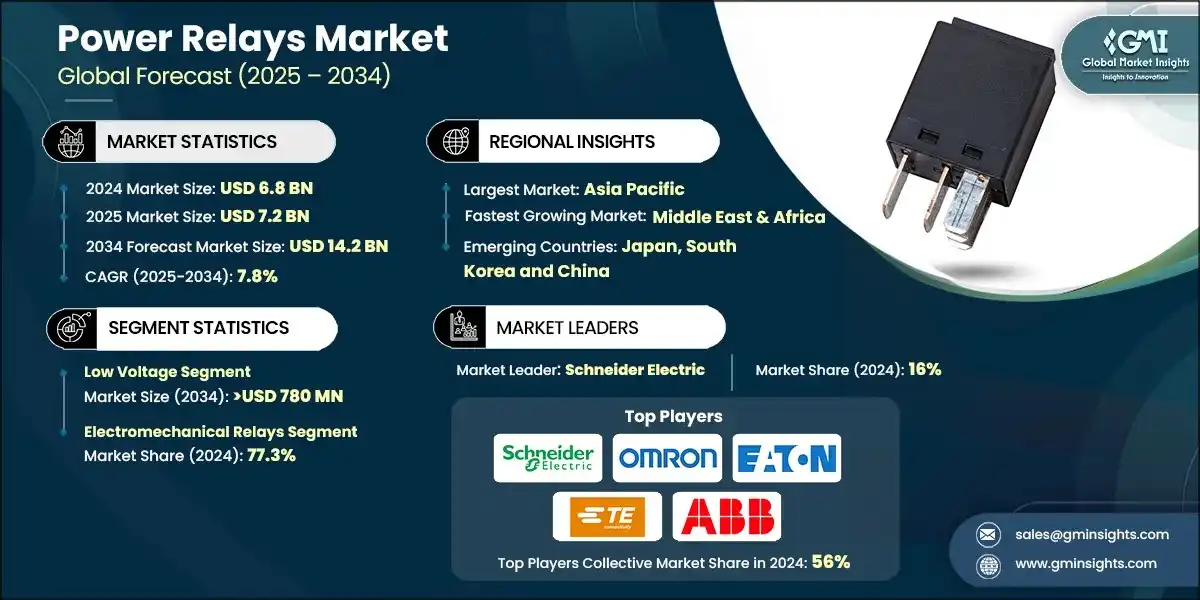
The power relays market size was valued at more than USD 6.8 billion in 2024. The market is expected to grow from USD 7.2 billion in 2025 to USD 14.2 billion by 2034, at a CAGR of 7.8%, according to Global Market Insights, Inc.
To get key market trends
- Power relays are witnessing significant transformation on account of growing electrification, automation and demand for reliable switching components across key industries. The product is essential for controlling high voltages and current circuits, thereby experiencing broader adoption in sectors including energy distribution, industrial automation and consumer electronics.
- They play a crucial role in numerous electrical and electronic systems by enabling the management of high-power circuits through a low-power signal. This capability is essential in scenarios where directly handling a high-power circuit is either impractical or unsafe. The product also enhances safety and operational efficiency by isolating the control circuit from the high-power circuit, thereby enhancing the product adoption.
- Growing deployment of smart grid infrastructure, requiring advanced relay technologies for protection, control and load management, is set to influence the product adoption. Additionally, the increasing shift towards digital substations and grid modernization, utilities are integrating intelligent relays that offer remote monitoring, diagnostics and fault isolation. This is increasing the demand for high voltage and medium voltage relays that ensure operational continuity and grid safety, leading to business growth.
- Rising emphasis on predictive maintenance and process control in the industrial automation sector is encouraging the use of power relays with enhanced switching speeds, thermal stability and durability. The rise of Industry 4.0 and the adoption of programmable logic controllers (PLCs) are boosting demand for compact and energy-efficient relays that can seamlessly integrate into automated systems.
- Increasing miniaturization of devices in consumer electronics, coupled with demand for energy efficient appliances, is pushing manufacturers to adopt low-profile, low-power relays with high reliability. Furthermore, high reliance of smart home systems, HVAC units and white goods on devices that can provide safe and efficient operations will drive the industry outlook.
- Ongoing technological advancements leading to a shift towards solid-state relays further improve the product's popularity. SSRs hold the potential to offer noise-free operation, longer life cycles and high reliability in harsh environments, thus making it a preferred choice. Moreover, the increased demand for high-reliability components in mission-critical applications, including smart grid and renewable energy systems, will improve the business scenario.
- Many governments are offering direct subsidies, tax incentives, grants, and regulatory support specific to hydrogen and fuel cell vehicle adoption. In addition, R&D funding, pilot projects, and collaboration between vehicle manufacturers, energy companies, and infrastructure providers are helping reduce cost, mitigate risk, and build early market momentum.
- Rising infrastructure modernization creates demand for modern power relays equipped with digital communication capabilities, including IEC 61850 or Modbus, essential in smart grids to support remote diagnostics and automation, leading to business growth. The product’s ability to work in association with sensors and SCADA systems enhances grid responsiveness and operational efficiency. Moreover, increasing DERs, including rooftop solar, wind turbines and energy storage integration with grid, escalates relays demand to manage bidirectional power flow and islanding protection, leading to industry expansion.
Power Relays Market Report Attributes
| Key Takeaway | Details |
|---|---|
| Market Size & Growth | |
| Base Year | 2024 |
| Market Size in 2024 | USD 6.8 Billion |
| Market Size in 2025 | USD 7.2 Billion |
| Forecast Period 2025 to 2034 CAGR | 7.8% |
| Market Size in 2034 | USD 14.2 Billion |
| Key Market Trends | |
| Drivers | Impact |
| Growth of smart grids and energy infrastructure modernization | The global transition towards smart grids is a potential driver for the power relay market. As utilities upgrade legacy electrical networks with intelligent, real-time monitoring and control systems, the requirement for advanced power relays has surged. |
| Expansion of industrial automation and Industry 4.0 | The global push for automation across manufacturing, mining, oil & gas and process industries creates demand for power relay products. In industrial automation, the products are essential for enabling safety interlocks, controlling electrical loads, protecting circuits and switching power in pumps, motors and automated production lines. |
| Proliferation of renewable energy microgrids | Rising renewable energy proliferation creates demand for power relays, particularly in off-grid, hybrid and distributed energy systems. Increasing deployment of microgrids, a localized energy network capable of operating independently or in connection with the main, necessitates demand for complex switching, protection and a reliable mechanism to ensure safe and vital power delivery, leading to product growth. |
| Pitfalls & Challenges | Impact |
| Evolving safety and environmental standards | Increasing pressure on companies to comply with stringent safety, quality and environmental regulations across the globe is hampering product growth. As government and industries push for greener, safer and more energy-efficient systems, relay manufacturers are under pressure to upgrade designs and manufacturing processes to meet these evolving standards, leading to challenge the business prospects. |
| Integration with advanced control systems | The transition toward digitalization, smart grids, and IoT enabled control systems demands relays with higher intelligence, communication interfaces, and real-time monitoring posing design and cost challenges for traditional manufacturers. |
| Opportunities: | Impact |
| Transition Toward Solid-State and Hybrid Relay Technologies | The market is witnessing a strong shift from traditional electromechanical relays toward solid-state and hybrid designs, driven by their longer operational life, faster switching speed, and resistance to mechanical wear. Solid-state relays, in particular, are finding growing applications in EVs, automation equipment, and renewable energy systems, creating a promising frontier for technological innovation and higher-value offerings. |
| Rising Adoption of Decentralized and Renewable Energy Systems | Distributed energy systems, microgrids, and off-grid renewable installations require relays that can handle variable load conditions while maintaining safety and reliability. This decentralized energy transition is expected to open new markets for relay manufacturers catering to rural electrification, energy storage, and hybrid renewable setups. |
| Expanding demand in emerging economies | Increasing focus on developing countries with growing transportation needs and increasing environmental awareness to establish early market presence and capture long-term growth opportunities. |
| Market Leaders (2024) | |
| Market Leaders |
16% market share |
| Top Players |
Collective market share in 2024 is 56% |
| Competitive Edge |
|
| Regional Insights | |
| Largest Market | Asia Pacific |
| Fastest Growing Market | Middle East & Africa |
| Emerging Countries | Japan, South Korea and China |
| Future outlook |
|
What are the growth opportunities in this market?
Power Relays Market Trends
- Grid digitalization, the integration of digital technologies into electricity grids, is happening at varying paces across the globe, with key regions such as China, North America, and Europe leading the charge. These regions are investing in smart grid infrastructure, including smart meters and advanced distribution management systems, to improve efficiency, reliability, and integration of renewable energy sources.
- For instance, launched in July 2021 as part of the Revamped Distribution Sector Scheme, the Indian government has allocated approximately USD 11,700 million for prepaid smart meters and about USD 21,600 million to improve distribution infrastructure. The initiative aims to bring down AT&C losses across the country to 12 15%.
- Additionally, rising countries such as Germany, China, Japan and the U.S. are making heavy investments in smart factories and an intelligent manufacturing ecosystem, requiring reliable switching components at every level. This expands the demand for industrial grade power relays, especially medium voltage and communication-enabled types, leading to market growth.
- Increasing deployment of hybrid microgrids that integrate diesel generators with renewables and storage creates growth prospects for relays in coordinating fuel-based and clean energy inputs efficiently. They help in prioritizing renewable sources, thereby optimizing energy use and reducing fuel dependency. Additionally, the rising need for fast-acting, durable and compact relays, especially in remote or harsh environments where reliability is non-negotiable, creates growth prospects for the product.
- Increasing demand for power relays in microgrids powered by solar PV, wind turbines and battery energy storage systems to make an easy switch between multiple power sources, protect against overload and faults, and isolate against subsystems during maintenance or failure is driving the business outlook. Additionally, the product provides dynamic load management, automatically connecting or disconnecting energy sources based on availability and consumption patterns, leading to business expansion.
Power Relays Market Analysis
Learn more about the key segments shaping this market
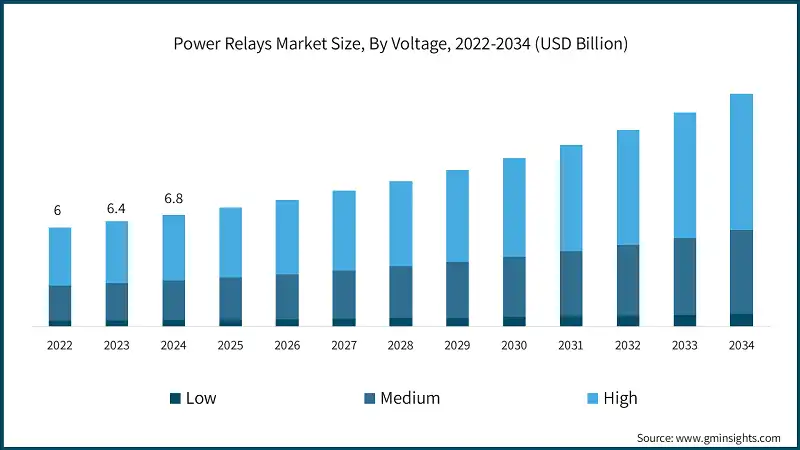
- Based on voltage, the market is segmented into low, medium and high. The low voltage segment is set to reach more than USD 780 million by 2034, on account of rising demand and popularity of energy-efficient systems in residential, commercial, and industrial settings are set to influence the adoption of low-voltage power relays. The product offers efficient switching capabilities with minimal power loss in low voltage settings, making it a preferred choice for smart homes, building automation and HVAC systems where power optimization is of great importance.
- Rising digitalization and automation across key industries, including manufacturing and processing, which are highly dependent on low voltage control systems for machinery and robotics, will stimulate product growth. Ongoing advancements in solid state relay technology, offering superior switching speeds, silent operation and longer lifespan compared to electromechanical relays are improving the product demand.
- Medium voltage power relays market will grow more than 9.5% CAGR by 2034, owing to increasing application in serving critical infrastructure such as hospitals, data centers and transportation hubs, where downtime can be costly and even life-threatening in some cases is strengthening the product growth. Moreover, rising industrial automation and electrification, especially across oil & gas, manufacturing and transportation sectors, will boost medium voltage relays adoption to protect motors, transformers and other critical equipment from overcurrent, undervoltage and phase imbalance.
- High power relays market hold 58.6% share in 2024, owing to increasing popularity of high-voltage power relays in utility-scale renewable energy projects, transmission infrastructure upgrades and HVAC systems are set to augment the industry scenario. These relays play a crucial role in substation automation, fault isolation and grid reliability. Rising decentralization of global power grids creates demand for high-speed, arc-resistant relays with enhanced thermal stability, stimulating the business outlook.
Learn more about the key segments shaping this market
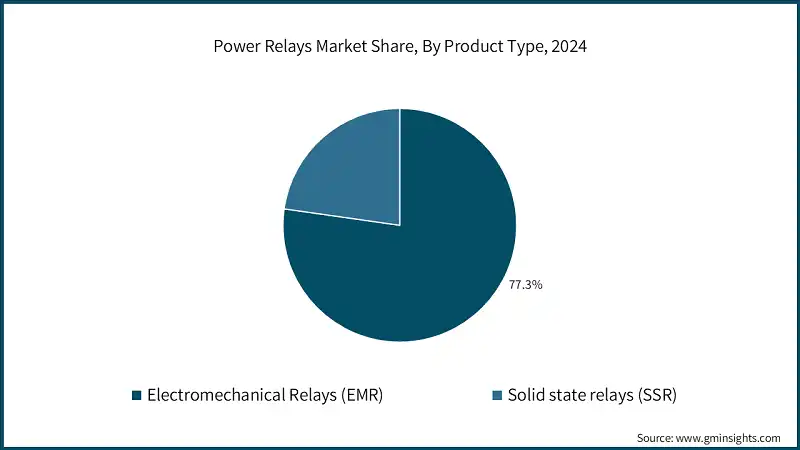
- Based on product type, the power relays market is segmented into electromechanical and solid state relays. The electromechanical relays dominate with 77.3% market share and are anticipated to reach over 7% CAGR through 2034, driven by the surging demand for products that offer excellent electrical isolation between control and load circuits, coupled with simplicity and robustness, will augment EMR’s adoption.
- Key factors including their cost-effectiveness, ease of maintenance, and ability to operate in harsh environments will contribute to market growth. EMRs continue to evolve with innovations aimed at increasing switching speed, reducing size, and improving lifespan. Rising popularity of sustainable electronics is set to accelerate the product adoption, which is often constructed using environmentally friendly materials and offers reduced energy consumption over traditional relay types, leading to business expansion.
- The solid state relays holds 22.7% market share and is anticipated to grow over 8.5% CAGR up to 2034, as various key players are providing advanced SSR solutions, leading to augment the business trend. For instance, TE's solid-state relays are designed for dependable switching of AC, DC, or bi-directional loads. They are built for fast switching and extended durability, ensuring low noise and reliable performance in various switching applications. Additionally, their superior resistance to vibration, shock and environmental contamination further drive the product demand.
Looking for region specific data?
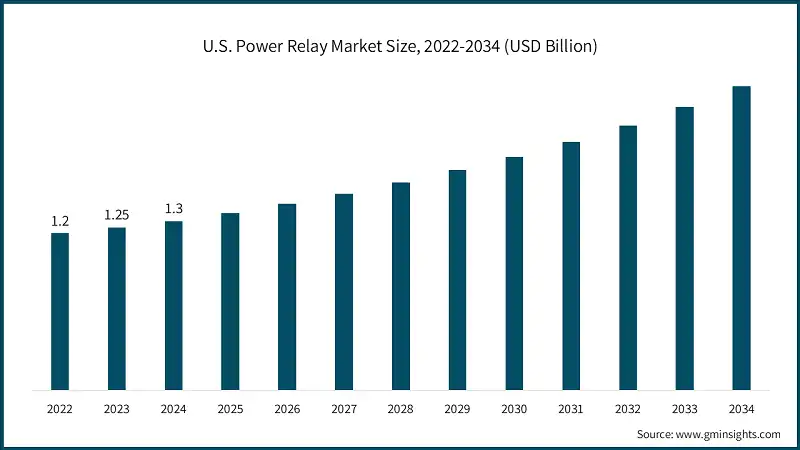
- The U.S. power relays market recorded a valuation of USD 1.2 billion in 2022, reached USD 1.25 billion in 2023 and will reach to USD 1.3 billion by 2024. North America accounted for 33% of the global market share in 2024 on account of rising focus on energy efficiency, safety regulations, and technological innovation drives demand for high-quality, reliable relay solutions.
- In the U.S., increasing large scale modernization of power infrastructure and growing investments in grid automation escalate demand for power relays. Ongoing industrial automation and the tremendous expansion of data centers fuel the need for high-performance compact relays, leading to business growth.
- Europe power relays market is anticipated to reach over USD 3.5 billion in 2034, supported by strong push for renewable energy integration, electrification of transport and grid modernization. Rising industrial automation and the implementation of smart grids increase the demand for reliable switching solutions, thereby escalating the business trend. Additionally, stringent EU regulations on energy efficiency and carbon emissions encourage the deployment of advanced relay systems.
- For instance, the European Union has established several regulations to enhance energy efficiency, primarily through the Energy Efficiency Directive (EED) and the Energy Performance of Buildings Directive (EPBD).
- Asia Pacific region dominates the global power relays market with 30.2% share in 2024 and will grow more than 7.5% CAGR through 2034. Rising upgradation of aging infrastructure in countries including China, India and South Korea, coupled with deploying smart grid systems to enhance creates product demand to enhance efficiency and energy reliability. Additionally, the region’s large-scale solar and wind projects require robust relay systems for load management and fault isolation, leading strengthen the business scenario.
- In China, the power relay market is propelled by large-scale infrastructure energy expansion and rapid growth in industrial automation. The country aims to achieve carbon neutrality by 2060, thereby investing heavily in solar, wind and ultra-high voltage transmission systems, requiring relay-based control and protection. Additionally, China’s continuous efforts to electrify remote and rural regions to ensure universal energy access further escalates the need for cost-effective and durable relay systems in local distribution.
- Middle East & Africa power relays market is anticipated to grow over 8.5% CAGR by 2034. Rapid urbanization and population growth in countries including UAE, Saudi Arabia and Egypt are fueling the expansion of power transmission and protection systems such as power relays. Moreover, the industrial sector, including oil & gas, mining, and manufacturing, is increasingly adopting power relays to enhance energy efficiency and safeguard electrical systems from overloads and faults. Increasing deployment of decentralized power systems, including diesel gensets and hybrid microgrids, particularly in remote and off grid areas of Sub-Saharan Africa further improves the product demand.
Power Relays Market Share
- The top five players operating in the industry include Schneider Electric, Omron Corporation, Eaton, TE Connectivity and ABB that have attained major market share in the Power Relays industry. The market is moderately concentrated by revenue around a set of large industrial electronics and components groups.
- Strategic buyers use acquisitions to move up the value chain, while private-equity investors may consolidate fragmented niches to create platform businesses and exit at scale. Shifting focus of larger industrial buyers acquiring complementary businesses in utilities and grid tech will complement the business landscape.
- Schneider Electric is a French multinational focused on energy management, automation, and digital infrastructure, operating in more than 100 countries. The company recorded a revenue of USD 44.1 billion in 2024. The company is a major supplier of switchgear, electrical distribution, protection, and automation systems, Schneider’s scale and integration can give it advantages in supplying relays/protective devices as part of system bundles.
Power Relays Market Companies
Eminent players operating in the power relays industry are:
- ABB
- Durakool
- Eaton
- Fuji Electric
- Fujitsu Electric
- Kura Electronics & Electricals
- Leone Relay
- Ningbo Huaguan Electronics
- Omron
- Panasonic
- Schneider Electric
- Sensata Technologies
- Shenler Relay
- Siemens
- TE Connectivity
- Omron Corporation emphasize on operational efficiency and margin improvement along with continued improvement in automation, control and smart device integration. The company’s 2023 revenue amounted to USD 5.74 billion. Further, the company’s strategy is focused on embedding intelligence, integration with automation systems, and strong brand in factory automation.
- Eaton Corporation is a power management company serving diverse end markets. The company has an overall revenue of USD 24.9 billion in 2024. The company is a major supplier of protective relays, switchgear components, and electrical protection systems. Further, its scale, broad product portfolio, and strong cash flows give it capacity to invest in R&D, acquisitions, and to compete across geographies.
- TE Connectivity is a global technology company producing connectors, sensors, electronic components, and interconnect systems. The company recorded USD 15.8 billion in revenue in 2024. Additionally, Its strong cash flows and repurchase programs give it flexibility to invest in adjacent relay / protection / switching solutions.
- ABB has deep capabilities in power equipment, grid technologies, control systems, robotics and industrial automation. In 2024, the company recorded revenue of USD 32.9 billion. It is a major player in protective relays, substation automation, grid control, power switching equipment. Moreover, its strong footprint in utilities and industrial power systems gives it a competitive edge in integrated power systems that include relays and control equipment.
Power Relays Industry News
- In May 2025, ABB introduced the Relion REC615, a compact and flexible medium-voltage protection relay designed to unify the functions of earlier devices like REC615, RER615, and RER620. It provides protection, control, fault indication, power quality analysis, and supports rapid fault isolation and service restoration. With IEC 61850 support, advanced cybersecurity, and modular scalability, the relay is ideal for smart grid applications in secondary distribution networks.
- In December 2024, ABB announced the acquisition of the power electronics business of Gamesa Electric in Spain to strengthen its position in the renewable power conversion market. This strategic move will expand ABB’s offerings, including wind converters, battery energy storage systems, and solar power inverters, while adding approximately 400 employees globally, including specialized engineers and two factories in Spain.
- In July 2024, ABB Electrification partnered with Steel Dynamics Heartland Division (SDI Heartland) to modernize its aging substation equipment and support its operational expansion. This collaboration involved the installation of medium-voltage switchgear doors and Relion 615 series protection relays, which integrate protection, control, monitoring, and supervision capabilities.
- In February 2023, ABB introduced its Relay Retrofit Program to replace select SPACOM protection relays with the advanced REX610 technology, aiming to modernize power protection systems and enhance reliability. This program, covering engineering, installation, and testing, ensures a seamless transition while minimizing downtime.
This power relays market research report includes an in-depth coverage of the industry with estimates & forecast in terms of revenue in “USD Million” from 2021 to 2034, for the following segments:
Market, By Voltage
- Low
- Medium
- High
Market, By Product Type
- Electromechanical relays
- Solid state relays
Market, By Contact Configuration
- Single pole single throw (SPST)
- Single pole double throw (SPDT)
- Three pole double throw (3PDT)
- Single pole three throw (SP3T)
Market, By Application
- Industrial automation
- Energy distribution
- Consumer electronics
- Protection and isolation
The above information has been provided for the following regions and countries:
- North America
- U.S.
- Canada
- Europe
- Germany
- UK
- France
- Italy
- Russia
- Asia Pacific
- Japan
- South Korea
- China
- India
- Australia
- Middle East & Africa
- Saudi Arabia
- UAE
- Qatar
- Oman
- South Africa
- Latin America
- Brazil
- Chile
Frequently Asked Question(FAQ) :
What is the market size of the power relays in 2024?
The market size was USD 6.8 billion in 2024, with a CAGR of 7.8% expected through 2034 driven by growing electrification, automation, and smart grid infrastructure deployment.
What is the projected value of the power relays market by 2034?
The power relays market is expected to reach USD 14.2 billion by 2034, propelled by industrial automation expansion, renewable energy integration, and grid modernization initiatives.
What is the current power relays market size in 2025?
The market size is projected to reach USD 7.2 billion in 2025.
How much revenue did the electromechanical relays segment generate in 2024?
Electromechanical relays dominated with 77.3% market share in 2024, leading due to excellent electrical isolation, cost-effectiveness, and ability to operate in harsh environments.
What was the valuation of high voltage power relays segment in 2024?
High voltage power relays held 58.6% market share in 2024, supported by utility-scale renewable energy projects, transmission infrastructure upgrades, and substation automation applications.
What is the growth outlook for medium voltage power relays from 2025 to 2034?
Medium voltage power relays are projected to grow at over 9.5% CAGR till 2034, driven by critical infrastructure applications in hospitals, data centers, and industrial automation across oil & gas and manufacturing sectors.
Which region leads the power relays market?
Asia Pacific leads with 30.2% market share in 2024. Infrastructure upgrades in China, India, and South Korea, along with smart grid deployment and large-scale renewable projects fuel the region's dominance.
What are the upcoming trends in the power relays market?
Key trends include transition toward solid-state and hybrid relay technologies, integration with IoT-enabled control systems, adoption of IEC 61850 communication protocols, and deployment in decentralized renewable energy microgrids.
Who are the key players in the power relays market?
Key players include Schneider Electric, Omron Corporation, Eaton, TE Connectivity, ABB, Durakool, Fuji Electric, Fujitsu Electric, Kura Electronics & Electricals, Leone Relay, Ningbo Huaguan Electronics, Panasonic, Sensata Technologies, Shenler Relay, and Siemens.
Power Relays Market Scope
Related Reports