Summary
Table of Content

Power Generation Steam Turbine Market
Get a free sample of this report
Form submitted successfully!
Error submitting form. Please try again.
Thank you!
Your inquiry has been received. Our team will reach out to you with the required details via email. To ensure that you don't miss their response, kindly remember to check your spam folder as well!
Request Sectional Data
Thank you!
Your inquiry has been received. Our team will reach out to you with the required details via email. To ensure that you don't miss their response, kindly remember to check your spam folder as well!
Form submitted successfully!
Error submitting form. Please try again.
Power Generation Steam Turbine Market Size
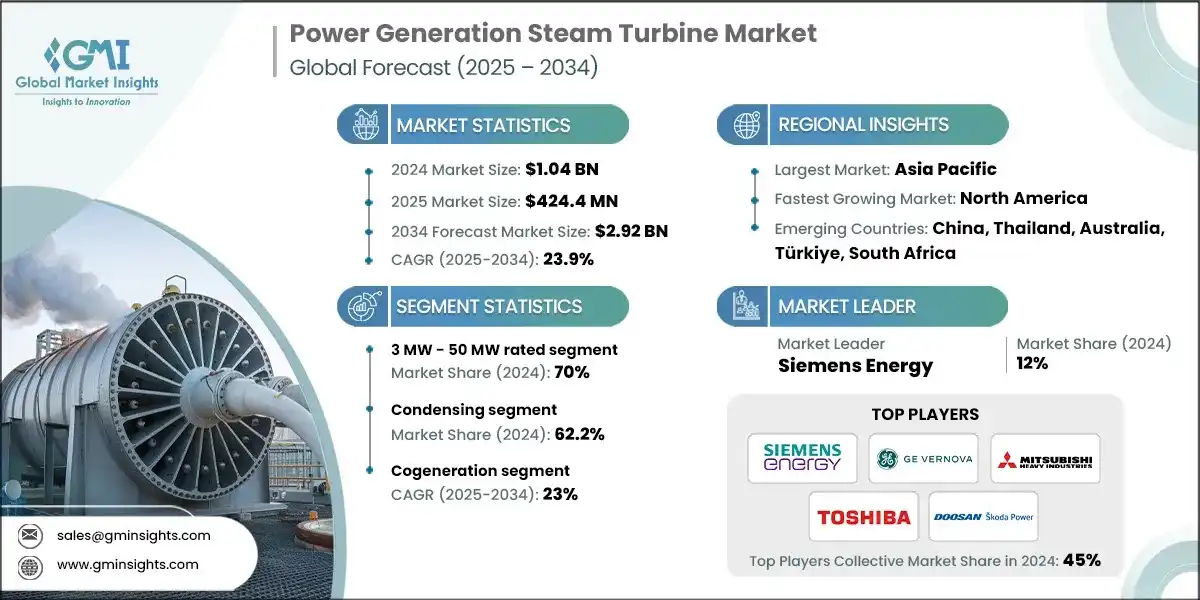
According to a recent study by Global Market Insights Inc., the power generation steam turbine market was estimated at USD 1.04 billion in 2024. The market is expected to grow from USD 424.4 million in 2025 to USD 2.92 billion by 2034, at a CAGR of 23.9%.
Power Generation Steam Turbine Market Key Takeaways
Market Size & Growth
- 2024 Market Size: USD 1.04 Billion
- 2025 Market Size: USD 424.4 Million
- 2034 Forecast Market Size: USD 2.92 Billion
- CAGR (2025–2034): 23.9%
Key Market Drivers
- Rising utilization of cogeneration technology to meet energy demand.
- Growing investment toward generating capacity expansion.
- Robust development across industrial sector.
Challenges
- High initial investment.
Opportunity
- Adoption of renewable-integrated turbines.
- Expansion in emerging economies.
- Retrofit and modernization projects.
- Technological innovations.
Key Players
- Market Leader: Siemens Energy led with over 12% market share in 2024.
- Leading Players: Top 5 players in this market include Siemens Energy, GE Vernova, Mitsubishi Heavy Industries, Toshiba Energy Systems & Solutions, Doosan Škoda Power, which collectively held a market share of 45% in 2024.
Get Market Insights & Growth Opportunities
- Rising industrialization coupled with the increasing need for dependable electricity is expected to drive demand for captive power plants, thereby boosting market growth. Additionally, a favorable shift toward adopting combined cycle technology, along with the gradual phase-out of conventional thermal units, will further strengthen the industry landscape.
- Power generation steam turbines are mechanical devices that convert thermal energy from steam into mechanical energy, which is then used to generate electricity. In these turbines, high-pressure steam produced in boilers expands through a series of blades mounted on a rotor, causing it to spin.
- Supportive regulatory policies aimed at reducing carbon emissions, along with rising investments in cogeneration and combined cycle technologies, are set to propel the industry growth. Additionally, the expansion of industrial infrastructure in line with ongoing efforts to address the electricity supply-demand gap will further enhance the business outlook.
- Moreover, developing nations are increasingly transitioning to gas-fired and other renewable energy-based power generation. For instance, despite the U.S. withdrawing from the Paris Climate Agreement, few new coal-fired projects are being planned. This restrained demand from key regions has negatively affected overall scenario.
- The power generation steam turbine market was valued at USD 282.7 million in 2021 and grew at a CAGR of approximately 10% through 2024. Favorable government policies in emerging economies, along with increased public investment in infrastructure, have fueled the growth of Energy-Intensive Industries (EIIs). Key sectors such as cement, pulp and paper, fertilizers and petrochemicals, iron and steel, and textiles are major consumers of electricity.
- Rising concerns over environmental pollution, coupled with initiatives to reduce carbon emissions, are expected to boost demand for cogeneration plants. Substantial investments in ultra-supercritical and supercritical thermal plants, along with the increasing adoption of geothermal energy, have fostered a favorable business environment for these turbines.
- For instance, In September 2025, Ghogha Dairy inaugurated a state-of-the-art CBG plant with an integrated CBG-CNG pump. This facility processes 100 tons of wet organic waste daily, producing approximately 4 tons of CNG per day. The plant is fully automated and represents a significant step towards decentralized waste processing and renewable energy generation.
- Efforts focused on energy conservation, combined with the increasing adoption of energy-efficient power generation units, are expected to propel growth in the steam turbine market by enhancing operational efficiency and supporting sustainable, low-emission electricity production across industries.
To get key market trends
Power Generation Steam Turbine Market Trends
- The steam turbine market is experiencing steady growth owing to increasing energy demand and the shift toward low-emission power sources. These turbines remain crucial for electricity generation in thermal and combined-cycle power plants, offering reliability, efficiency, and long operational lifespans compared to other turbine technologies.
- The emerging economies are investing heavily in power infrastructure to meet growing electricity needs. The countries are expanding in coal, gas, and biomass-based power plants, driving demand for advanced steam turbines. These regions seek turbines with high efficiency, flexible operation, and compatibility with clean energy technologies.
- Technological advancements, such as supercritical and ultra-supercritical steam turbines, are enhancing plant efficiency and reducing emissions. The manufacturers focus on compact designs, improved materials, and digital monitoring systems. These innovations help power plants optimize performance, reduce maintenance costs, and comply with stricter environmental regulations, making the market more competitive and technologically driven.
- For citation, in December 2024, China inaugurated a 660 MW ultra-supercritical circulating fluidized bed (CFB) power generation unit at the Shaanxi Binchang Power Plant. Developed by Harbin Electric Corporation, this plant boasts the highest specifications and largest single-unit capacity in its category.
- The transition toward renewable energy integration is shaping turbine applications. Steam turbines are increasingly paired with waste-to-energy and biomass projects, creating hybrid systems that combine traditional and renewable generation. This diversification expands market opportunities, especially in regions aiming to reduce carbon footprints while maintaining stable baseload power supply.
- The industry growth is supported by government initiatives promoting energy efficiency and sustainable generation. Incentives for retrofitting older plants with modern turbines and adopting cogeneration systems are encouraging investments. Rising electricity consumption, coupled with the need for low-emission and high-efficiency power plants, will continue to drive the global steam turbine market forward in the near terms.
Power Generation Steam Turbine Market Analysis
Learn more about the key segments shaping this market
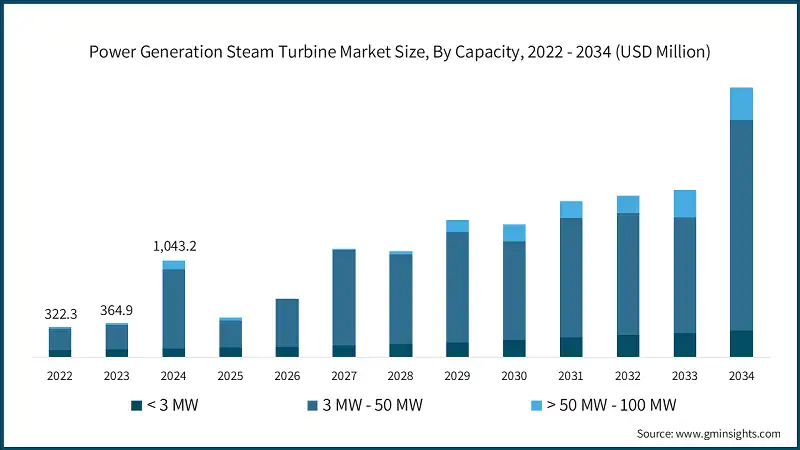
- Based on capacity, the industry is segmented into < 3 MW, 3 MW - 50 MW and > 50 MW - 100 MW. The 3 MW - 50 MW rated power generation steam turbine market holds a share of about 70% in 2024 and is projected to grow at a CAGR of over 25% through 2034.
- The expansion of industry is driven by rising energy decentralization and rapid industrialization. Medium-capacity turbines offer economical options for manufacturing facilities, district heating systems, and municipal power generation. Their balanced output suits areas with limited grid connectivity or unstable supply. Increasing focus on sustainable, distributed energy is set to support consistent global adoption of this segment.
- For instance, the U.S. Environmental Protection Agency (EPA) has established New Source Performance Standards for fossil-fuel powered electric utility generating units (EGUs). These standards are codified in the Code of Federal Regulations under 40 CFR Part 60, Subpart Da.
- The < 3 MW capacity segment is set to exceed USD 280 million by 2034. These compact steam turbines are well-suited for factories, rural electrification projects, and combined heat and power (CHP) applications. Producers are emphasizing modular configurations that enable simpler installation, reduce operational challenges, and lower maintenance needs, enhancing their appeal in emerging markets and remote locations
- The > 50 MW - 100 MW rating power generation steam industry was valued at over USD 94.2 million in 2024. In this capacity range, technological improvements emphasize efficiency, reliability, and operational adaptability. The use of superior materials, refined blade aerodynamics, and advanced control systems deliver strong performance under high-pressure and high-temperature environments.
- Rising integrating of these turbines with renewable sources such as biomass and waste heat recovery not only enhances plant sustainability but also optimizes resource utilization, improves overall efficiency, and ensures compliance with environmental regulations, while significantly reducing greenhouse gas emissions and long-term operational costs.
- For citation, the EPA implemented more stringent standards aimed at reducing greenhouse gas emissions from power plants. Under these regulations, new baseload coal and natural gas facilities must capture over 90% of CO2 emissions using technologies. Furthermore, limits on mercury, arsenic, and other toxic pollutants have been strengthened to reflect improvements in environmental control technologies.
Learn more about the key segments shaping this market
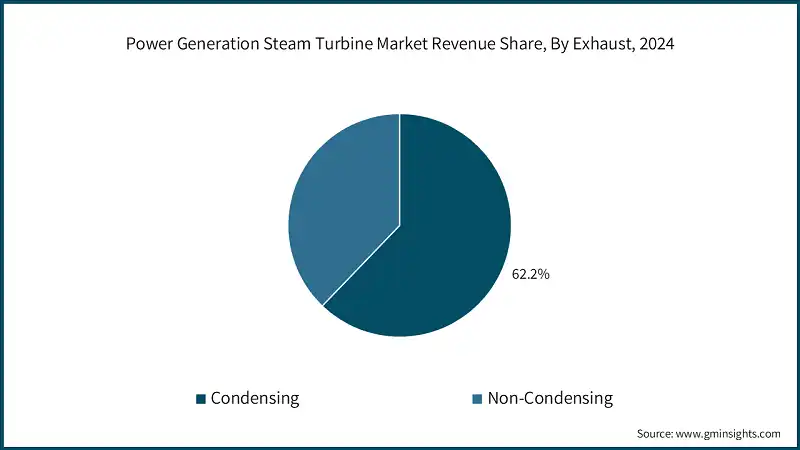
- Based on exhaust, the industry is divided into condensing and non-condensing. The condensing power generation steam turbine market holds a share of 62.2% in 2024 and is set to reach over USD 1.2 billion by 2034.
- These turbines are preferred for their superior efficiency in large-scale power plants, as they can effectively manage fluctuating loads. Their performance makes them well-suited for base-load generation, ensuring a steady and reliable electricity supply. With rising energy needs, condensing steam turbine adoption is steadily increasing worldwide.
- Non-condensing power generation steam market was estimated at USD 648.7 million in 2024. Continued industrial modernization, coupled with government-led energy efficiency initiatives, is set to drive market growth. Both public and private sectors are promoting turbines that minimize energy losses while fulfilling process steam needs.
- These turbines are vital in combined heat and power systems, delivering electricity and process heating simultaneously, which strengthens their adoption across energy-intensive industries. The use of advanced materials, refined blade engineering, and enhanced thermodynamic cycles results in reduced maintenance needs and extended operational lifespans.
- Based on technology, the industry is bifurcated into steam cycle, combined cycle and cogeneration. The cogeneration power generation steam turbine industry will witness a CAGR of 23% from 2025 to 2034.
- Steam turbine-based cogeneration, or combined heat and power (CHP), is an efficient energy system that generates both electricity and useful thermal energy from a single fuel source. Instead of discarding excess heat including conventional plants, it recovers and utilizes it for industrial processes, heating, or cooling, thereby maximizing fuel efficiency and lowering energy costs.
- Combined cycle power generation links gas turbines with steam turbines to achieve higher efficiency. The gas turbine generates electricity while releasing hot exhaust gases, which are then captured by a heat recovery steam generator (HRSG) to produce steam. This steam drives a steam turbine, enabling maximum energy extraction from a single fuel source.
- Steam cycle power generation with steam turbines remains a cornerstone of conventional electricity production. In this method, high-pressure steam from boilers expands through turbines, transforming thermal energy into mechanical power. The turbine shaft drives a generator to produce electricity, with the Rankine cycle ensuring efficient energy conversion across numerous power plants.
Looking for region specific data?
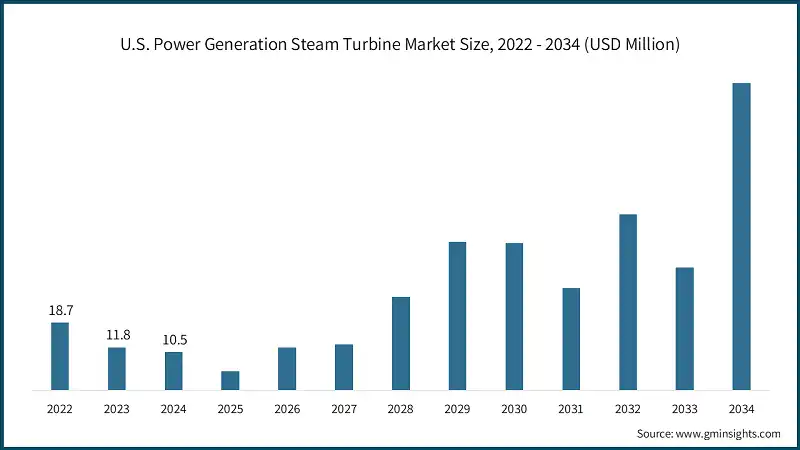
- The U.S. dominated the power generation steam turbine market in North America with 65.9% share in 2024 and generated USD 10.5 million in revenue. A flourishing manufacturing sector outlook has driven higher demand for steam turbines in power generation. Additionally, the growing adoption of cogeneration technology is expected to strengthen the industry landscape.
- For instance, IEA study revealed that global electricity consumption surged significantly in 2024, increasing by 1,080 TWh. This growth is nearly double the average annual increase recorded over the previous decade, reflecting rising energy demand driven by industrialization and electrification worldwide.
- The North America power generation steam turbine market is projected to hit USD 165 million by 2034. The rising adoption of cogeneration technology is expected to boost market opportunities. However, steam turbine installations in thermal power generation are likely to experience limited growth, as several major countries have announced plans to phase out coal-based power plants during the forecast period.
- The Europe steam turbine market was estimated at USD 63.9 million in 2024. The industry is poised for growth, driven by rising cogeneration adoption and steady industrial sector expansion. Additionally, the increasing deployment of combined cycle gas-fired power plants, fueled by robust industrial growth, will support broader turbine adoption.
- For instance, the Powering Past Coal Alliance, launched by the UK and other nations and now comprising 28 member countries, illustrates how strong governmental policies supporting clean and renewable energy adoption could restrict the growth and demand for traditional steam turbines in Europe’s utilities.
- The Asia Pacific power generation steam turbine industry is set to grow at a CAGR of over 20% through 2034. The industry is set to benefit from the expansion of large-scale thermal power projects, a growing industrial sector, and a favorable outlook on geothermal energy utilization. Ambitious regional plans to increase power generation capacity are set to energize the business dynamics.
- The Middle East & Africa accounts for about 6% of the power generation steam turbine market share in 2024. The industry is largely fueled by rapid industrialization and expanding power generation capacity. Rising electricity needs, driven by domestic manufacturing growth, are expected to increase power plant installations.
- For illustration, the African Development Bank Group (AfDB) introduced the Industrialization Strategy to drive the continent’s economic transformation. The initiative focuses on industrial sector development, establishing supportive policy frameworks, boosting trade, and integrating Africa into both domestic and global value chains.
- The region’s large agricultural output provides biomass fuels comprising of bagasse, utilized in cogeneration facilities with steam turbines will favor the Latin America industry. These systems support decentralized power generation, reduce dependence on fossil fuels, and efficiently convert heat into mechanical energy for electricity supply across wide tandem of areas.
- For illustration, The CNE works in coordination with other regulatory agencies, including the Superintendence of Electricity and Fuels (SEC) and the National Electrical Coordinator, to ensure steam turbines meet operational and safety requirements throughout the energy grid. It also collaborates with the Instituto Nacional de Normalización (INN) to align national standards with international frameworks such as ISO and IEC.
Power Generation Steam Turbine Market Share
- The top 5 players in power generation steam turbine industry are Siemens Energy, GE Vernova, Mitsubishi Heavy Industries, Toshiba Energy Systems & Solutions and Doosan Škoda Power contribute around 45% of the market share in 2024.
- The market is characterized by a highly competitive and technologically advanced landscape, driven by the growing global demand for electricity and the transition toward cleaner, more efficient energy sources. It is dominated by large multinational manufacturers, but opportunities exist for specialized and regional players offering customized solutions.
- Siemens Energy is one of the global leaders in the turbine industry, specializing in steam and gas turbines for power generation. The company offers a comprehensive range of steam turbines, catering to various applications including conventional, nuclear, and renewable hybrid power plants. It emphasizes high efficiency, reliability, and environmental sustainability in its turbine designs.
- GE Vernova specializes in both steam and gas turbines for power generation. The company also offers comprehensive services, including modernization and upgrades, to enhance turbine performance and extend operational life. Their commitment to innovation and sustainability positions it as a key player in the global energy landscape.
- Mitsubishi Heavy Industries is one of the leading global manufacturers of steam turbines, providing high-efficiency solutions for thermal, nuclear, and combined-cycle power plants. Known for ultra-supercritical technology and reliable performance, MHI focuses on enhancing efficiency, reducing emissions, and offering modernization services, making it a key player in the global turbine market.
- Toshiba Energy Systems & Solutions is one of the global leaders in steam turbine manufacturing, delivering high-capacity units for thermal and nuclear power plants. The company focuses on advanced designs, high efficiency, and reliability, while providing modernization and maintenance services to extend turbine life and optimize performance in diverse energy applications.
- Doosan Škoda Power is one of the prominent manufacturers of steam turbines, offering custom solutions for diverse applications, including nuclear, cogeneration, and renewable energy plants. Known for reliability and advanced technology, the company offers modernization and maintenance services, helping extend turbine life, improve performance, and support sustainable energy generation worldwide.
Power Generation Steam Turbine Market Companies
- In Q1 FY 2025, Siemens Energy reported revenue of USD 9.4 billion, profit before special items of USD 505 million, net income of USD 266 million, and free cash flow of USD 1.6 billion. Strong order backlog of USD 143 billion and strategic asset sales highlight operational strength and ability to meet growing energy demand.
- In 2024, GE Vernova reported revenue of approximately USD 34.9 billion and net income of USD 1.6 billion, reflecting a net income margin of 4.5%. The company achieved an adjusted EBITDA margin of 10.2%, demonstrating strong operational performance. The company remains focused on driving innovation and enhancing operational efficiency to support the long-term, sustainable growth across its energy divisions.
- In 2024, Mitsubishi Heavy Industries reported revenue of approximately USD 33.8 billion, with order intake reaching around USD 47.5 billion, a 5.8% year-on-year increase. Business profit rose 35.6% to USD 2.6 billion, with an EBITDA margin of 10.8%, and net income increased 10.6% to USD 1.7 billion, reflecting strong operational performance and efficiency. The company continues to focus on growth across its Energy Systems, Plants & Infrastructure, and Aircraft, Defense & Space segments, while expanding technological capabilities, enhancing global presence, and maintaining financial resilience to strengthen long-term shareholder value.
Major players operating in the power generation steam turbine market are:
- Ansaldo Energia
- Bharat Heavy Electricals
- Chart Industries
- Chola Turbo
- Doosan Škoda Power
- EBARA CORPORATION
- Fuji Electric
- GE Vernova
- Hangzhou Turbine Power Group
- Kawasaki Heavy Industries
- MAN Energy Solutions
- Mitsubishi Heavy Industries
- NCON Turbo Tech
- Shin Nippon Machinery
- Siemens Energy
- Sumitomo Heavy Industries
- Toshiba Energy Systems & Solutions Corporation
- Trillium Flow Technologies
- Triveni Turbine
- Turbotech Precision Engineering
Power Generation Steam Turbine Market Report Attributes
| Key Takeaway | Details |
|---|---|
| Market Size & Growth | |
| Base Year | 2024 |
| Market Size in 2024 | USD 1.04 Billion |
| Market Size in 2025 | USD 424.4 Million |
| Forecast Period 2025 - 2034 CAGR | 23.9% |
| Market Size in 2034 | USD 2.92 Billion |
| Key Market Trends | |
| Drivers | Impact |
| Rising utilization of cogeneration technology to meet energy demand | Increasing adoption of cogeneration enhances efficiency by simultaneously producing electricity and heat, reducing energy costs and meeting growing industrial and commercial energy demands. |
| Growing investment toward generating capacity expansion | Investments in new power plants and turbine upgrades increase generation capacity, ensuring reliable electricity supply and supporting rising energy consumption. |
| Robust development across industrial sector | Expanding industries such as steel, cement, and chemicals drive higher electricity demand, boosting steam turbine installations to meet continuous and large-scale power requirements. |
| Pitfalls & Challenges | Impact |
| High initial investment | Steam turbines require substantial capital for manufacturing, installation, and infrastructure, limiting adoption, especially for small-scale projects, and slowing market growth despite long-term efficiency benefits. |
| Opportunities: | Impact |
| Adoption of renewable-integrated turbines | Integrating steam turbines with solar and biomass systems enables efficient hybrid power generation, reducing carbon footprint and operational costs. |
| Expansion in emerging economies | Growing industrialization and urbanization in developing countries increase electricity demand, creating opportunities for new steam turbine installations. |
| Retrofit and modernization projects | Upgrading existing turbines with advanced technologies improves efficiency, reduces emissions, and extends operational lifespan, attracting significant investments. |
| Technological innovations | Development of high-efficiency turbines enhances performance, fuel flexibility, and reliability, and driving demand in both conventional and sustainable power plants. |
| Market Leaders (2024) | |
| Market Leaders |
12% market share |
| Top Players |
Collective market share in 2024 is 45% |
| Competitive Edge |
|
| Regional Insights | |
| Largest Market | Asia Pacific |
| Fastest Growing Market | North America |
| Emerging Country | China, Thailand, Australia, Türkiye, South Africa |
| Future Outlook |
|
What are the growth opportunities in this market?
Power Generation Steam Turbine Industry News
- In September 2025, Doosan Škoda Power has been awarded a USD 147 million contract by ORLEN Group to supply two 55 MW DST-S10 back-pressure steam turbines and a generator for the Plock heat-and-power plant in Poland. The project involves modernizing turbine units TG4 and TG5, with phased execution while existing systems remain operational. The new turbines will deliver a 9% efficiency improvement over previous systems, contributing to reduced operating costs and environmental impact.
- In June 2025, Kawasaki has secured an order from Hanwha Impact Corporation for an 8 MW steam turbine generator set to be installed at the Ulsan recovery plant in South Korea. The new unit will replace a turbine delivered and will support captive power generation while enhancing energy efficiency and reducing CO2 emissions. Moreover, manufacturing will take place at Kawasaki’s Kobe Works, with installation and commissioning support provided onsite.
- In February 2025, Siemens Energy will supply steam turbines for Rolls-Royce SMR’s Generation 3+ modular power plants under a global partnership agreement. The turbines, with outputs ranging from 20 MW to 1,900 MW, will be part of a complete turbine systems package including design, manufacturing, installation, and commissioning. These systems will support the deployment of factory-built SMRs, which aim to deliver low-emission, scalable nuclear energy solutions across multiple international markets.
- In March 2023, Chart Industries completed the acquisition of Howden in a USD 4.4 billion deal, expanding its portfolio across stationery and rotating equipment for applications in industrial gas, hydrogen, LNG, water treatment, and carbon capture. The acquisition includes 750 engineers and extends Chart’s operational footprint to over 35 countries. This strategic move enhances regional project execution capabilities and strengthens aftermarket services, which will represent approximately 30% of the combined business. Furthermore, it plans to integrate Howden’s digital platforms, Uptime and Ventsim, into its offerings.
The power generation steam turbine market research report includes in-depth coverage of the industry with estimates & forecast in terms of revenue (USD Million) & volume (MW) from 2021 to 2034, for the following segments:
Market, By Design
- Reaction
- Impulse
Market, By Exhaust
- Condensing
- Non-condensing
Market, By Fuel
- Oil & Gas
- Waste-to-energy plants
- Biomass
Market, By Capacity
- < 3 MW
- 3 MW - 50 MW
- > 50 MW - 100 MW
Market, By Technology
- Steam cycle
- Combined cycle
- Cogeneration
The above information has been provided for the following regions & countries:
- North America
- U.S.
- Canada
- Mexico
- Europe
- UK
- France
- Russia
- Germany
- Spain
- Italy
- Asia Pacific
- China
- Japan
- South Korea
- India
- Australia
- Indonesia
- Malaysia
- Thailand
- Middle East & Africa
- Saudi Arabia
- UAE
- Iran
- Egypt
- South Africa
- Nigeria
- Turkiye
- Morocco
- Latin America
- Brazil
- Argentina
- Chile
Frequently Asked Question(FAQ) :
What is the market size of the power generation steam turbine in 2024?
The market size was USD 1.04 billion in 2024, with a CAGR of 23.9% expected through 2034 driven by industrialization and rising demand for reliable captive power.
What is the projected value of the power generation steam turbine market by 2034?
The power generation steam turbine market is expected to reach USD 2.92 billion by 2034, propelled by cogeneration technology adoption, combined cycle integration, and industrial sector expansion.
What is the current power generation steam turbine market size in 2025?
The market size is projected to reach USD 424.4 million in 2025.
How much revenue did the 3 MW - 50 MW capacity segment generate in 2024?
The 3 MW - 50 MW rated power generation steam turbine market holds a share of about 70% in 2024, supported by rising energy decentralization and rapid industrialization
What was the valuation of condensing exhaust segment in 2024?
Condensing exhaust held 62.2% market share in 2024.
What is the growth outlook for cogeneration technology from 2025 to 2034?
Cogeneration power generation steam turbines are projected to grow at a 23% CAGR till 2034, due to efficient combined heat and power systems and rising industrial energy efficiency needs.
Which region leads the power generation steam turbine market?
Asia Pacific power generation steam turbine market is set to grow at over 20% CAGR through 2034. Rapid industrialization, large-scale thermal projects, and ambitious power capacity expansion drive the region's dominance.
What are the upcoming trends in the power generation steam turbine market?
Key trends include adoption of ultra-supercritical and advanced turbine technologies, integration with renewable energy sources like biomass and waste-to-energy, expansion of cogeneration systems, and retrofit and modernization of existing plants for improved efficiency.
Who are the key players in the power generation steam turbine market?
Key players include Ansaldo Energia, Bharat Heavy Electricals, Chart Industries, Chola Turbo, Doosan Škoda Power, EBARA CORPORATION, Fuji Electric, GE Vernova, Hangzhou Turbine Power Group, Kawasaki Heavy Industries, MAN Energy Solutions, Mitsubishi Heavy Industries, NCON Turbo Tech, Shin Nippon Machinery, Siemens Energy, Sumitomo Heavy Industries, Toshiba Energy Systems & Solutions Corporation, Trillium Flow Technologies, Triveni Turbine, and Turbotech Precision Engineering.
Power Generation Steam Turbine Market Scope
Related Reports