Summary
Table of Content

Power Conditioner Market
Get a free sample of this report
Form submitted successfully!
Error submitting form. Please try again.
Thank you!
Your inquiry has been received. Our team will reach out to you with the required details via email. To ensure that you don't miss their response, kindly remember to check your spam folder as well!
Request Sectional Data
Thank you!
Your inquiry has been received. Our team will reach out to you with the required details via email. To ensure that you don't miss their response, kindly remember to check your spam folder as well!
Form submitted successfully!
Error submitting form. Please try again.
Power Conditioner Market Size
The growing use of sensitive electronic gadgets coupled with the growing need for clean and dependable power will have a positive effect on the development of the industry. It will have a strong industrial sector that is in tandem with the growing infrastructure investments that will lead to product adoption. Moreover, increasing grid instability in the emerging economies and the growth of industrial IoT will bring the business environment to a new level.
Power Conditioner Market Key Takeaways
Market Size & Growth
- 2025 Market Size: USD 17.6 Billion
- 2026 Market Size: USD 18.4 Billion
- 2035 Forecast Market Size: USD 29.2 Billion
- CAGR (2026–2035): 5.3%
Regional Dominance
- Largest Market: Asia Pacific
- Fastest Growing Region: Latin America
Key Market Drivers
- Robust expansion of data centers.
- Advancements in IoT & smart grids.
- Increasing focus on energy efficiency.
Challenges
- High initial cost.
Opportunity
- Expansion of smart power and grid modernization initiatives.
- Growth in demand for high‑quality power across industries.
- Modernization of legacy electrical infrastructure.
- Integration with digital and intelligent power management platforms.
Key Players
- Market Leader: ABB led with over 9.5% market share in 2025.
- Leading Players: Top 5 players in this market include ABB, Delta Electronics, Eaton, Fuji Electric, Hubbell, which collectively held a market share of 38.5% in 2025.
Get Market Insights & Growth Opportunities
A power conditioner is electric equipment that is designed to improve the quality and stability of the electricity supplied to the electronic and other sensitive equipment. Its operation consists in controlling the voltage levels to minimize electrical noise and interference, as well as safeguard against power disturbances like surged and fluctuated power. Industrial applications, data centers, audio and video production, and sensitive electronics are some of the common applications of power conditioners.
For instance, in April 2025, the government of the U.S. signed an executive order to improve reliability and security of the power grid. The order requires the Department of Energy to come up with a standard framework to assess areas that have high risk of reliability. It offers explicit guidance on how to organize federal interventions to counter grid vulnerabilities. Additionally, the EO permits the employment of emergency powers in accordance with Section 202(c) of the Federal Power Act to avert or solve any possible power violations.
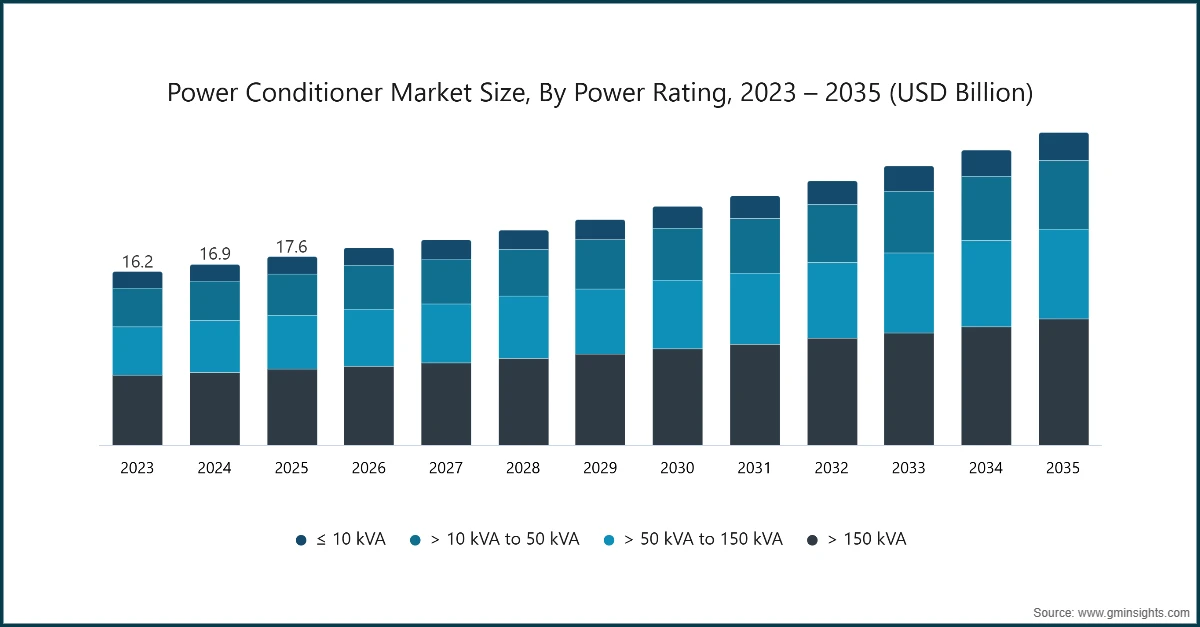
The power conditioner market was estimated at USD 17.6 billion in 2025. The market is expected to grow from USD 18.4 billion in 2026 to USD 29.2 billion by 2035, at a CAGR of 5.3%, according to a recent study by Global Market Insights Inc.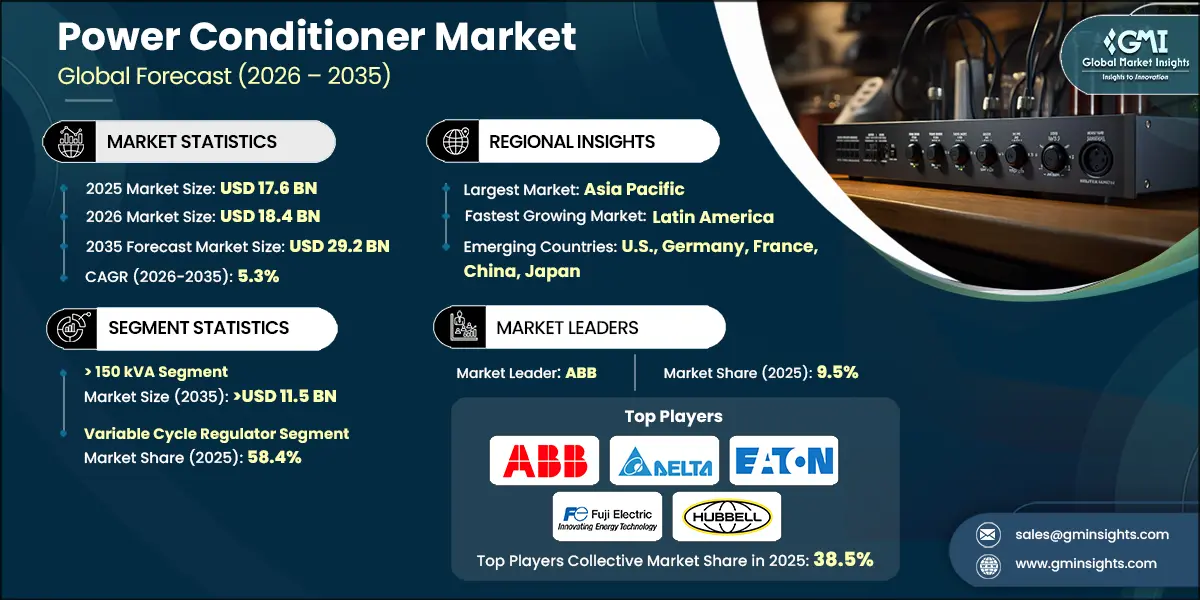
To get key market trends
Power Conditioner Market Trends
The proliferation of power conditioners in business and manufacturing industries will drive business growth. The continued improvements in power electronics and digital control technologies are now providing the opportunity to create more efficient effective reliable and intelligent power conditioning systems, which is facilitated by new innovations such as high-tech semiconductors and high-tech control algorithms. Moreover, increasing environmental consciousness of the effects of power production and consumption are creating a need to find power conditioning solutions that are energy saving and sustainable.
Power Conditioner Market Analysis
Learn more about the key segments shaping this market
Learn more about the key segments shaping this market
For instance, in October 2024, Natural Resources Canada launched specific funding programs to make industrial facilities more energy efficient throughout the country. The program is aimed at the modernization of the electrical infrastructure and the implementation of high-tech energy management solutions. These investments aim at minimizing the industrial emissions besides enhancing reliability of power and performance.
Looking for region specific data?
The demand of power conditioners in Europe will witness growth owing to the growing use of smart grid technologies and the growing investments in renewable energy sources. The future of the industry is set to be influenced by the evolving regulations and standards pertaining to the quality of power, efficiency in energy consumption and grid stability. Moreover, the development of intelligent commercial buildings, as well as the increased attention to the quality of power regulation in the renewable microgrids, will foster the product deployment.
Power Conditioner Market Share
The companies in the market are undertaking various strategic initiatives to enhance their positioning and strategize with the changing customer needs. Innovation has been an essential point of focus, where companies have been investing in new innovative technologies including IoT-based solutions, digital control architecture, and energy-efficient product designs among others, to improve performance, reliability and operational value. Simultaneously, the trend of strategic partnership and cooperation with renewable energy suppliers and smart grids developers is increasing, contributing to the movement of the industry to become sustainable, smart, and future-oriented in terms of power.
Power Conditioner Market Companies
Major players operating in the power conditioner industry are:
ABB
AMETEK
Delta Electronics
Eaton
Emerson Electric
Farmax Technologies
Fuji Electric
Hitachi Energy
Hubbell
Legrand
Mitsubishi Electric Corporation
Panasonic Industry
Schneider Electric
SERVOMAX
Sharp Corporation
SOLAHD
Sollatek
SPECTRUMSTAB INDIA
Static Power
Superior Electric
Unico
Vishay
Power Conditioner Market Report Attributes
| Key Takeaway | Details |
|---|---|
| Market Size & Growth | |
| Base Year | 2025 |
| Market Size in 2025 | USD 17.6 Billion |
| Market Size in 2026 | USD 18.4 Billion |
| Forecast Period 2026-2035 CAGR | 5.3% |
| Market Size in 2035 | USD 29.2 Billion |
| Key Market Trends | |
| Drivers | Impact |
| Robust expansion of data centers | The rapid growth of cloud computing, AI workloads, and digital services is driving large‑scale expansion of data center infrastructure globally. This surge is increasing demand for reliable power management solutions to ensure uninterrupted operations, minimize downtime, and protect mission‑critical IT assets. |
| Advancements in IoT & smart grids | Widespread adoption of IoT-enabled systems and smart grid technologies is enhancing real‑time monitoring, predictive maintenance, and dynamic power control capabilities. These advancements are supporting more resilient, responsive, and optimized power distribution across commercial and industrial networks. |
| Increasing focus on energy efficiency | Rising energy costs and sustainability commitments are intensifying the focus on energy‑efficient electrical infrastructure. Organizations are increasingly investing in advanced power management and conditioning solutions to reduce losses, optimize consumption, and meet regulatory and ESG objectives. |
| Pitfalls & Challenges | Impact |
| High initial cost | Power conditioning systems often involve significant upfront capital investment, particularly for advanced or large‑scale installations. This high initial cost can act as a barrier to adoption for small and medium‑sized enterprises with constrained budgets. |
| Opportunities: | Impact |
| Expansion of smart power and grid modernization initiatives | Ongoing investments in smart grids and intelligent power networks are accelerating the adoption of power conditioners for voltage regulation and disturbance mitigation. These systems play a critical role in supporting grid resilience and seamless integration of distributed energy resources. |
| Growth in demand for high‑quality power across industries | Rising deployment of sensitive electronic equipment across industrial, commercial, and digital infrastructure is driving demand for advanced power conditioning solutions. This trend creates opportunities for manufacturers to deliver systems that ensure voltage stability, equipment protection, and operational continuity. |
| Modernization of legacy electrical infrastructure | Aging electrical systems across facilities are being upgraded to meet current performance and reliability standards. Power conditioners are increasingly deployed to replace outdated solutions, improving power quality while aligning with modern compliance and efficiency requirements. |
| Integration with digital and intelligent power management platforms | Growing emphasis on digitally enabled power management is positioning power conditioners as core components of integrated electrical architecture. Advanced monitoring and control capabilities allow operators to optimize energy usage, reduce downtime, and lower overall operating costs. |
| Market Leaders (2025) | |
| Market Leader |
Market Share of 9.5% |
| Top Players |
Collective Market Share of 38.5% |
| Competitive Edge |
|
| Regional Insights | |
| Largest Market | Asia Pacific |
| Fastest Growing Market | Latin America |
| Emerging Country | U.S., Germany, France, China, Japan |
| Future Outlook |
|
What are the growth opportunities in this market?
Power Conditioner Industry News
In January 2026, DELTA Electronics entered into a contract with Prostarm Info Systems to deliver 110 MW of its 1.1 MW dual directional Power Conditioning Systems to its projects in projects of the Battery Energy Storage System across India. The deployment will assist in the deployment of important installations in Bihar State Power Generation Company and Adani Electricity. This collaboration bolsters the functions of Delta in facilitating the stability of the grid and integration of renewable energy.
In April 2025, Hitachi Industrial Equipment Systems introduced a future generation GFM power conditioner at Narashino Works, in Chiba, a milestone to more stable and resilient power grids. The new system promotes grid stability because it emulates the inertia that used to be offered by the large traditional power plants. The GFM is meant to deal with the growing levels of renewable energy penetration to control the supply and demand changes.
The power conditioner market research report includes in-depth coverage of the industry with estimates & forecast in terms of volume (Units) & revenue (USD Million) from 2022 to 2035, for the following segments:
Market, By Power Rating
≤ 10 kVA
> 10 kVA - 50 kVA
> 50 kVA - 150 kVA
> 150 kVA
Market, By Product
Fixed cycle regulator
Variable cycle regulator
Market, By Phase
Single phase
Three phase
Market, By Application
Residential
Commercial
Industrial
The above information has been provided for the following regions and countries:
North America
U.S.
Canada
Mexico
Europe
Germany
France
Russia
UK
Italy
Spain
Netherlands
Austria
Asia Pacific
China
Japan
South Korea
India
Australia
New Zealand
Malaysia
Indonesia
Middle East & Africa
Saudi Arabia
UAE
Qatar
Egypt
South Africa
Nigeria
Kuwait
Oman
Latin America
Brazil
Peru
Argentina
Frequently Asked Question(FAQ) :
What is the market size of the power conditioner in 2025?
The market size was USD 17.6 billion in 2025, with a CAGR of 5.3% expected through 2035. The increasing use of sensitive electronic devices and the demand for clean, reliable power are driving market growth.
What is the projected value of the power conditioner market by 2035?
The market is poised to reach USD 29.2 billion by 2035, driven by advancements in power electronics, digital control technologies, and the adoption of IoT and data analytics.
What is the expected size of the power conditioner industry in 2026?
The market size is projected to reach USD 18.4 billion in 2026.
How much revenue will the >150 kVA rated power conditioner segment generate by 2035?
The >150 kVA rated power conditioner segment is expected to surpass USD 11.5 billion by 2035, supported by the adoption of smart grid technologies and the need for stable, high-quality power supply.
What was the market share of the variable cycle regulator product segment in 2025?
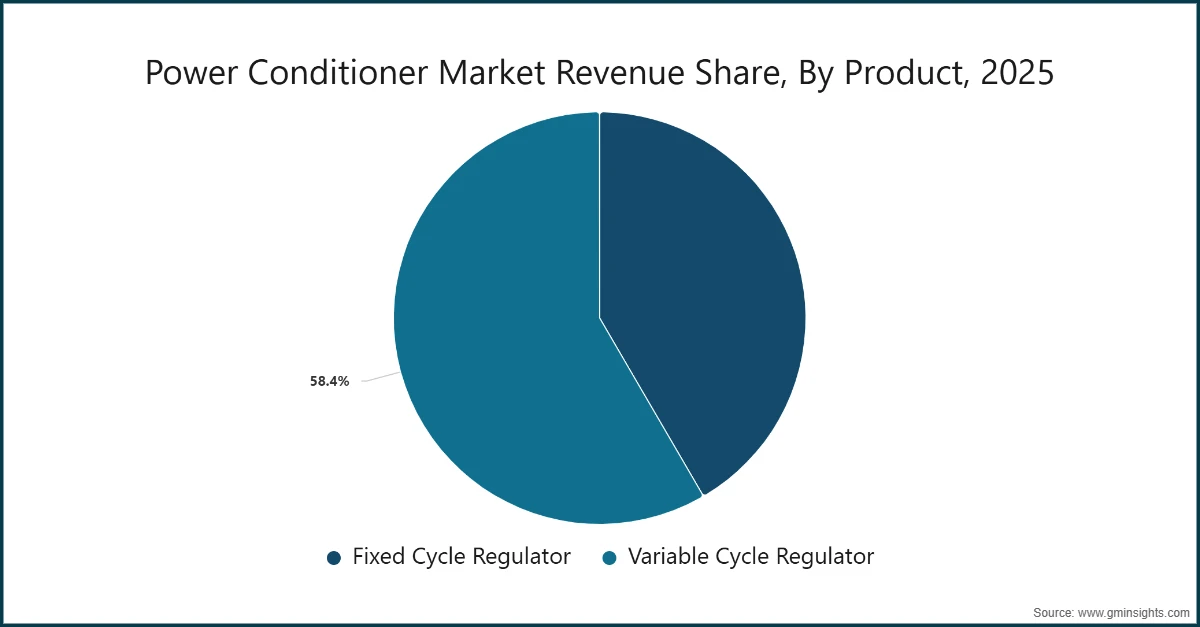
The variable cycle regulator product segment held a 58.4% market share in 2025, propelled by the growth of data centers and advancements in the IT and telecommunications sectors.
What was the valuation of the U.S. power conditioner sector in 2025?
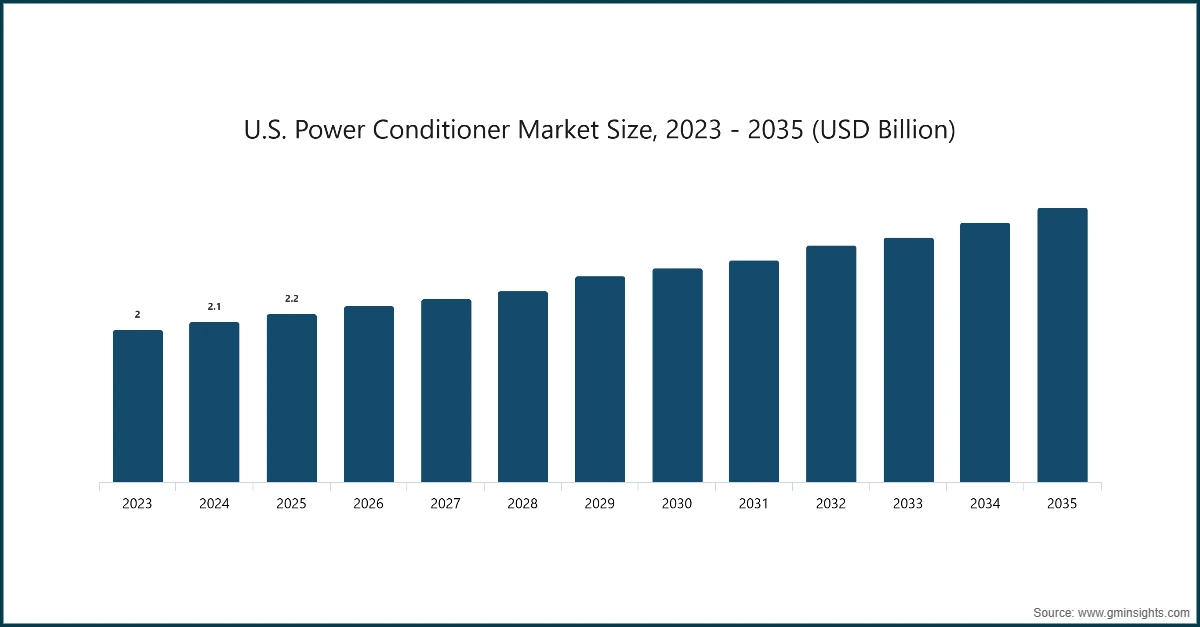
The U.S. market was valued at USD 2.2 billion in 2025, led by the need for reliable, high-quality power in industrial and commercial sectors.
What are the upcoming trends in the power conditioner market?
Trends include advancements in power electronics, digital control technologies, IoT integration, data analytics for enhanced efficiency, and the growing focus on energy-saving and sustainable solutions.
Who are the key players in the power conditioner industry?
Key players include ABB, AMETEK, Delta Electronics, Eaton, Emerson Electric, Farmax Technologies, Fuji Electric, Hitachi Energy, Hubbell, and Legrand.
Power Conditioner Market Scope
Related Reports