Summary
Table of Content

Porcelain Tableware Market
Get a free sample of this report
Form submitted successfully!
Error submitting form. Please try again.
Thank you!
Your inquiry has been received. Our team will reach out to you with the required details via email. To ensure that you don't miss their response, kindly remember to check your spam folder as well!
Request Sectional Data
Thank you!
Your inquiry has been received. Our team will reach out to you with the required details via email. To ensure that you don't miss their response, kindly remember to check your spam folder as well!
Form submitted successfully!
Error submitting form. Please try again.
Porcelain Tableware Market Size
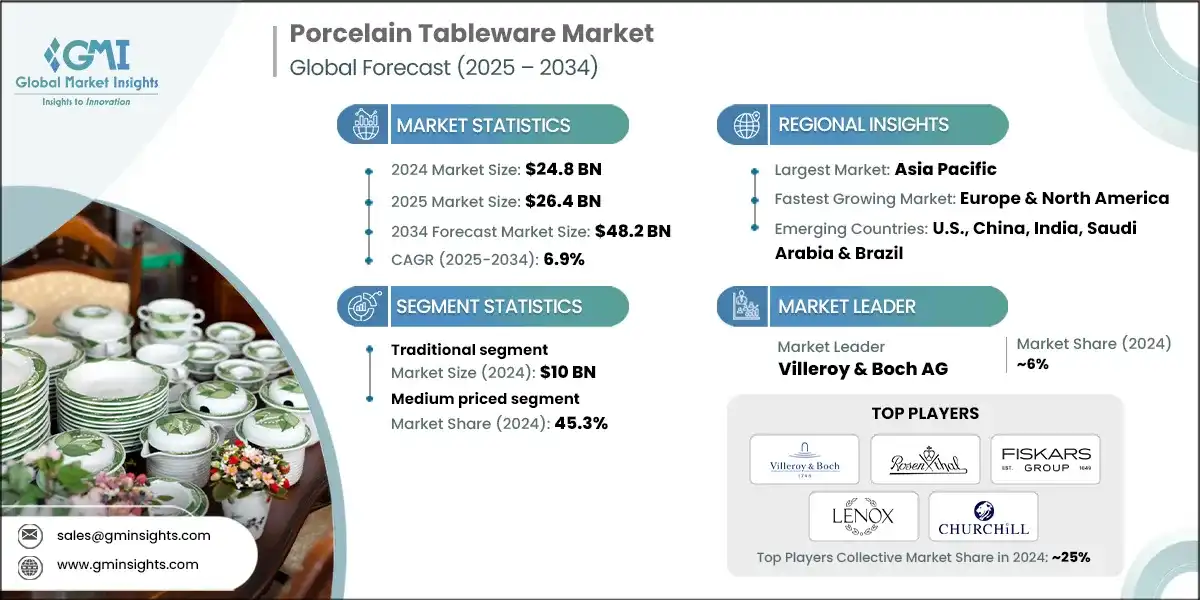
The global porcelain tableware market was estimated at USD 24.8 billion in 2024. The market is expected to grow from USD 26.4 billion in 2025 to USD 48.2 billion in 2034, at a CAGR of 6.9%, according to latest report published by Global Market Insights Inc.
Porcelain Tableware Market Key Takeaways
Market Size & Growth
- 2024 Market Size: USD 24.8 billion
- 2025 Market Size: USD 26.4 billion
- 2034 Forecast Market Size: USD 48.2 billion
- CAGR (2025–2034): 6.9%
Regional Dominance
- Largest Market: Asia Pacific
- Fastest Growing Region: Europe & North America
Key Market Drivers
- Growth in hospitality and foodservice industry.
- Premiumization and gifting trends.
- Cultural and ceremonial significance.
- Innovations in design and customization.
Challenges
- High competition and market fragmentation.
- Rising raw material and energy costs.
Opportunity
- Growth of e-commerce and direct-to-consumer channels.
- Sustainability and eco-friendly innovation.
Key Players
- Market Leader: Villeroy & Boch AG led with over 6% market share in 2024.
- Leading Players: Top 5 players in this market include Villeroy & Boch AG, Rosenthal GmbH, Fiskars Group, Lenox Corporation, Churchill China plc, which collectively held a market share of 25% in 2024.
Get Market Insights & Growth Opportunities
- The market for porcelain tableware is growing, mainly because of the growth of the hospitality and food service sectors. Global tourism is rebounding. The United Nations World Tourism Organization (UNWTO) reported in 2023 a recovery of 70% of international tourist arrivals compared to before the pandemic. This has greatly increased the demand for beautiful, durable, and brand-building Service ware. Hotels, restaurants, and cafes are actively sourcing and investing in high-quality porcelain to enhance the dining experience and strengthen their brand. This is especially true in the luxury and boutique spaces, where the tableware's visual experience is just as important as the quality of the food.
- Another significant factor for growth is the premiumization of consumer preferences, particularly within urban, affluent demographics. Consumers view porcelain dinnerware as a refined choice for occasions and often choose it as a premium gift for weddings, religious festivals, and corporate events. According to a National Retail Federation (NRF) report, gift spending for special occasions is experiencing 8% growth annually, in part due to a shift away from simple utilitarian gifts to high-value products that are beautiful. In addition, the trend of curated dining experiences at home has been ongoing, especially with social media platforms, such as Instagram and Pinterest, has escalated the demand for luxury tableware. Consumers have demonstrated a willingness to pay a premium for products that offer functionality, combined with artistic and innovative designs, which align with trends of modern lifestyles.
- Cultural and ceremonial significance is also a key driver of demand, particularly in Asia and the Middle East markets. In several countries like China, India, and Japan, porcelain is deeply ingrained with cultural rituals, family gatherings, and religious ceremonies. For example, in China, porcelain is a traditional gift in weddings and festivals which continues to contribute to demand. Similarly, in the Middle East, porcelain tableware is often used in religious festivals, which again generates demand. Based on this cultural insight, manufacturers are responding to this nuance by offering culturally inspired designs and customized tableware- that continue to cater to the local market. Therefore, customizing products based on cultural value drives demand for porcelain tableware, whether through daily use or during ceremonial events.
To get key market trends
Porcelain Tableware Market Trends
The porcelain tableware industry is experiencing a trend toward customization & personalization and focus on sustainability and a minimalist approach. As consumers seek products that are both environmentally responsible and visually distinctive, manufacturers that embrace innovation in design, sustainability, and customization are well-positioned to lead the market forward.
- Consumers, age groups in the premium and luxury segments, are becoming more interested in owning special, unique, artisanal, and artistic pieces that represent their personal style or cultural perspective. This trend is especially strong in the gifting and hospitality sectors, where custom tableware enriches the dining experience and brand identity. Producers are responding with very limited collections of products, artist collaborations, and even customized monogrammed or themed sets for special occasions.
- At the same time, a focus on sustainability and a minimalist approach to design are gaining momentum. Eco-friendly consumers prefer porcelain products with lead-free glazes, made from recyclable materials, and produced using energy-efficient methods. At the same time, new generation buyers, particularly millennials and Gen Z, lean toward clean, minimalist designs that balance function with aestheticism. The dual focus on environmental responsibility and contemporary aesthetics is changing product development strategies across the industry.
Porcelain Tableware Market Analysis
Learn more about the key segments shaping this market
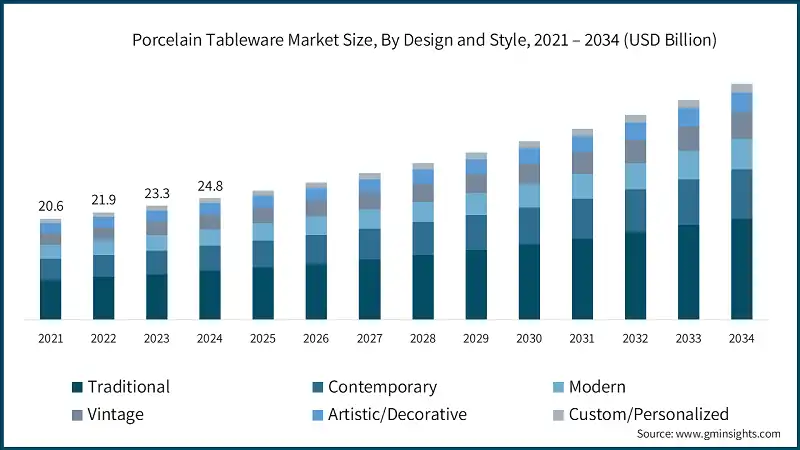
Based on design and style, the porcelain tableware market is categorized into traditional, contemporary, modern, vintage, artistic/decorative and custom/personalized. The traditional accounted for revenue of around USD 10 billion in 2024 and is anticipated to grow at a CAGR of 7.5% from 2025 to 2034.
- Traditional porcelain designs often feature intricate patterns, floral motifs, and classic color palettes such as blue and white, which resonate strongly with consumers who value timeless aesthetics and cultural continuity. In many regions, particularly in Asia, Europe, and the Middle East, traditional porcelain is deeply embedded in ceremonial, religious, and family dining practices, making it a preferred choice for formal occasions, weddings, and festive gatherings.
- Additionally, the resurgence of interest in vintage and heritage home décor styles has further fueled demand for traditional tableware, as consumers seek to recreate nostalgic or culturally rich dining experiences. Luxury hospitality brands and fine dining establishments also favor traditional porcelain for its ability to convey sophistication and authenticity, reinforcing its market position.
Learn more about the key segments shaping this market
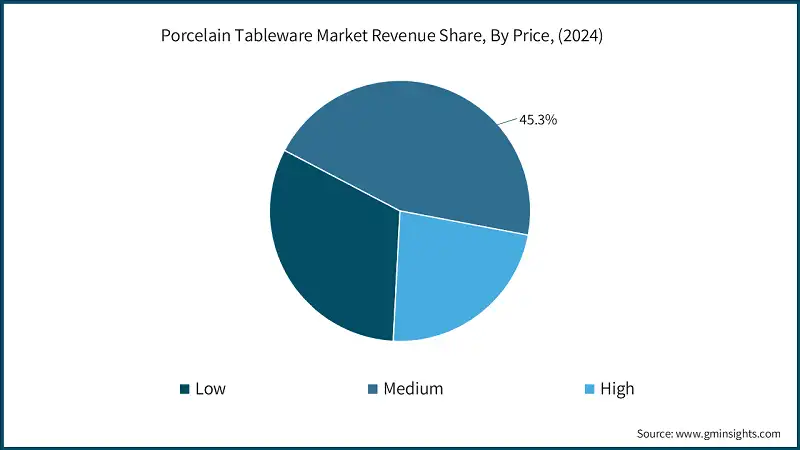
Based on price of porcelain tableware market consists of low, medium and high. The medium priced emerged as leader and held 45.3% of the total market share in 2024 and is anticipated to grow at a CAGR of 6.9% from 2025 to 2034.
- This category appeals to a broad consumer base, including middle-income households, casual dining restaurants, and boutique hotels that seek durable and stylish tableware without the premium price tag. Medium-priced porcelain products often offer a blend of traditional craftsmanship and modern design, making them attractive for both everyday use and special occasions.
- Additionally, advancements in manufacturing technologies have enabled producers to offer high-quality finishes, intricate designs, and improved durability at competitive prices, further boosting the appeal of this segment.
Looking for region specific data?
North America Porcelain Tableware Market
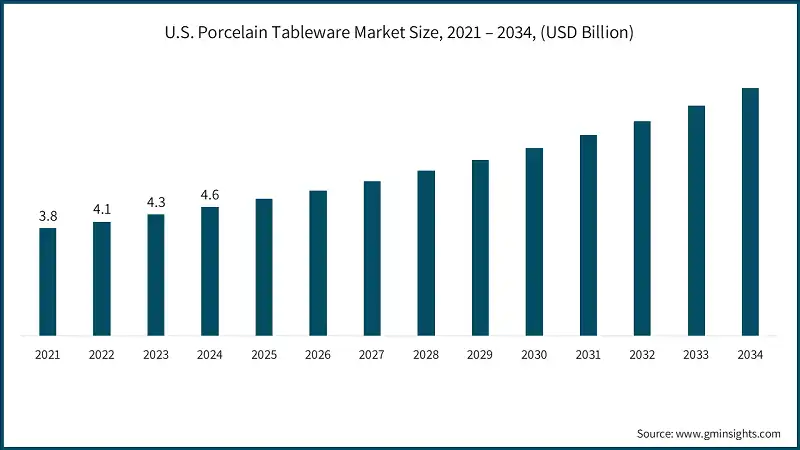
The U.S. dominates an overall North America market and valued at USD 4.6 billion in 2024 and is estimated to grow at a CAGR of 6.8% from 2025 to 2034.
- American consumers place significant value on quality and design in homeware, and porcelain tableware is often seen as a symbol of sophistication and lifestyle enhancement. The growing trend of hosting homes, influenced by social media and lifestyle influences, has further fueled demand for stylish and functional tableware.
- Additionally, the U.S. is home to many premium restaurants, boutique hotels, and catering services that consistently invest in elegant tableware to enhance customer experience and brand image.
Europe Porcelain Tableware Market
In the European market, Germany is expected to experience significant and promising growth from 2025 to 2034.
- As one of Europe’s leading producers of high-quality ceramics and porcelain, Germany benefits from a well-established industrial base, skilled craftsmanship, and globally recognized brands such as Rosenthal and Villeroy & Boch. These companies continue to innovate in both design and sustainability, aligning with evolving consumer preferences for eco-friendly and aesthetically refined tableware.
- Additionally, the German market is experiencing a resurgence in home dining culture, influenced by lifestyle trends that emphasize quality, presentation, and sustainability. Consumers are increasingly investing in durable and elegant porcelain products for both everyday use and special occasions.
Asia Pacific Porcelain Tableware Market
In the Asia Pacific market, the China held 37.4% market share in 2024 and is anticipated to grow at a CAGR of 6.9% from 2025 to 2034.
- As the birthplace of porcelain, China has a long-standing tradition of craftsmanship and artistry in ceramic production, which continues to influence both domestic and global design trends. The country is home to some of the world’s largest and most advanced porcelain manufacturing hubs, enabling it to produce a wide range of products from mass-market to high-end artisanal pieces at competitive prices.
- In addition to its export strength, China’s growing middle class and urbanization are fueling domestic demand for aesthetically pleasing and durable tableware. The rise of modern dining habits, home décor trends, and gifting culture especially during festivals and weddings has further boosted the popularity of porcelain products.
Middle East and Africa Porcelain Tableware Market
In the Middle East and Africa market, Saudi Arabia held 29.3% market share in 2024 promising growth from 2025 to 2034.
- In Saudi culture, hosting and entertaining guests is deeply valued, and porcelain tableware plays a central role in formal dining settings, weddings, and religious celebrations. This cultural importance, combined with a growing preference for premium and aesthetically refined products, is fueling demand for high-quality porcelain.
- Additionally, the rise of modern retail formats and e-commerce platforms has made international and local porcelain brands more accessible to a wider consumer base. As Saudi consumers become more design-conscious and brand-aware, the market is shifting toward elegant, durable, and culturally resonant tableware, positioning the country as a key growth hub in the MEA region over the next decade.
Porcelain Tableware Market Share
- In 2024, the prominent manufacturers in market are Villeroy & Boch AG, Rosenthal GmbH, Fiskars Group, Lenox Corporation and Churchill China plc collectively held the market share of ~25%.
- In 2024, Villeroy & Boch significantly strengthened its global presence and product portfolio by integrating Ideal Standard. Renowned for its robust culture of innovation, strategic acquisitions, and digital transformation, the company is making substantial investments in modernizing production facilities, automating processes, and advancing sustainability initiatives. Villeroy & Boch emphasizes user-centric design, seamlessly blending premium aesthetics with practical functionality. Its Dining & Lifestyle division continues to thrive, driven by e-commerce expansion and project-based sales to hotels and restaurants. Additionally, the brand's flagship showrooms and retail modernization efforts further reinforce its global market leadership.
- Rosenthal GmbH, a distinguished member of the Arcturus Group, masterfully combines heritage craftsmanship with cutting-edge design innovation. The company is committed to sustainable and resource-efficient production at its German facilities, holding ISO certifications for quality and environmental management. By collaborating with world-renowned designers and artists, Rosenthal creates avant-garde porcelain masterpieces, including its iconic "Rosenthal meets Versace" collection. Expanding its focus to interior décor and lifestyle collections, Rosenthal is strategically positioning itself beyond traditional tableware, targeting the global luxury home market with precision.
Porcelain Tableware Market Companies
Major players operating in the porcelain tableware industry include:
- Bernardaud
- BHS Tabletop AG
- Churchill China plc
- Degrenne Paris
- Fiskars Group
- Haviland & Cie
- Herend Porcelain Manufactory
- Lenox Corporation
- Meissen Porcelain
- Noritake Co., Limited
- Raynaud Limoges
- Rosenthal GmbH
- Royal Copenhagen
- Villeroy & Boch AG
- Vista Alegre Atlantis
Fiskars Group drives its competitive edge through a "brands-first" strategy, focusing on premium and luxury segments under its Vita division, which includes Wedgwood and Royal Doulton. Operating over 500 stores and 60 e-commerce platforms worldwide, the company prioritizes direct-to-consumer (DTC) channels. Fiskars is heavily investing in digital transformation, sustainability, and design innovation, with 29% of its net sales projected to come from circular products by 2025. The company tailors its regional strategies, accelerating growth in China, optimizing operations in the U.S., and expanding its luxury portfolio through strategic acquisitions such as Georg Jensen.
Lenox, deeply rooted in its American heritage, is enhancing its domestic manufacturing capabilities by establishing new fulfilment hubs and advancing silversmithing technologies. Specializing in premium porcelain and bone China, Lenox caters to both traditional and modern American preferences. The company is strengthening its design innovation efforts by expanding its in-house creative team and forming strategic partnerships with global manufacturers. Its strong presence in wedding registries, holiday collections, and prestigious institutions like the White House underscores Lenox's cultural significance and enduring brand loyalty within the U.S. market.
Porcelain Tableware Market Report Attributes
| Key Takeaway | Details |
|---|---|
| Market Size & Growth | |
| Base Year | 2024 |
| Market Size in 2024 | USD 24.8 billion |
| Market Size in 2025 | USD 26.4 billion |
| Forecast Period 2025 - 2034 CAGR | 6.9% |
| Market Size in 2034 | USD 48.2 billion |
| Key Market Trends | |
| Drivers | Impact |
| Growth in hospitality and foodservice industry | Expanding hotels and restaurants are boosting demand for elegant, durable porcelain tableware to enhance dining experiences and brand image. |
| Premiumization and gifting trends | Rising consumer interest in luxury dining and gifting is driving sales of high-end, artistically designed porcelain products. |
| Cultural and ceremonial significance | In many regions, porcelain is deeply tied to traditions and rituals, ensuring consistent demand for formal and festive occasions. |
| Innovations in design and customization | Personalized, modern, and culturally inspired designs are attracting new consumer segments and increasing brand differentiation. |
| Pitfalls & Challenges | Impact |
| High competition and market fragmentation | A crowded market with many players leads to pricing pressure and makes brand differentiation more difficult. |
| Rising raw material and energy costs | Volatile input costs are squeezing profit margins and forcing manufacturers to optimize production or raise prices. |
| Opportunities: | Impact |
| Growth of e-commerce and direct-to-consumer channels | Online platforms are expanding brand reach, enabling personalized marketing, and improving access in emerging markets. |
| Sustainability and eco-friendly innovation | Growing demand for environmentally responsible products is opening new avenues for brands investing in green materials and processes. |
| Market Leaders (2024) | |
| Market Leaders |
Market share of ~6% |
| Top Players |
Collective market share of ~25% |
| Competitive Edge |
|
| Regional Insights | |
| Largest Market | Asia Pacific |
| Fastest growing market | Europe & North America |
| Emerging countries | U.S., China, India, Saudi Arabia & Brazil |
| Future outlook |
|
What are the growth opportunities in this market?
Porcelain Tableware Industry News
- In 2025, Rosenthal introduced the Sonetto Collection, an artistic blend of porcelain, stoneware, and glass. This collection earned the prestigious German Design Award 2025 for "Excellent Product Design – Tabletop" and was prominently showcased at the Ambiente trade fair, solidifying its impact in the tabletop market.
- In June 2025, Italian luxury porcelain brand Ginori 1735 collaborated with British artist Luke Edward Hall to introduce the "Il Viaggio di Nettuno – A New Chapter" collection. This collection, inspired by Greco-Roman pottery and the Bloomsbury Group, highlights exquisite hand-drawn designs, reflecting a blend of historical and artistic influences.
- In April 2025, during Milan Design Week, Japanese ceramics brand Noritake partnered with renowned designer Faye Toogood to debut the "Rose" porcelain collection. The collection comprises 14 meticulously hand-painted pieces and 111 exclusive limited-edition platters, showcasing a harmonious fusion of craftsmanship and contemporary design.
- In 2024, Villeroy & Boch strategically acquired Ideal Standard, significantly enhancing its global market presence and diversifying its product portfolio. This acquisition drove an impressive revenue growth in Q1 2025. The Dining & Lifestyle division also recorded substantial growth, fuelled by innovative product launches presented at the Ambiente and ISH trade fairs.
The porcelain tableware market research report includes in-depth coverage of the industry, with estimates & forecast in terms of revenue (USD Billion) and volume (Million Units) from 2021 to 2034, for the following segments:
Market, By Product Type
- Plates
- Bowls
- Cups and saucers
- Mugs
- Serving dishes
- Others
Market, By Design and Style
- Traditional
- Contemporary
- Modern
- Vintage
- Artistic/decorative
- Custom/personalized
Market, By Shape
- Round
- Square
- Rectangular
Market, By Price
- Low
- Medium
- High
Market By Application
- Household
- Commercial
- Hotels
- Restaurants
- Catering services
- Cafés
Market, By Distribution Channel
- Online
- E-commerce website
- Company website
- Offline
- Hypermarket/ supermarkets
- Mega retail stores
- Specialty stores
- Others
The above information is provided for the following regions and countries:
- North America
- U.S.
- Canada
- Europe
- Germany
- UK
- France
- Italy
- Spain
- Asia Pacific
- China
- Japan
- India
- South Korea
- Australia
- Indonesia
- Malaysia
- Latin America
- Brazil
- Mexico
- Argentina
- MEA
- Saudi Arabia
- UAE
- South Africa
Frequently Asked Question(FAQ) :
What is the market size of the porcelain tableware in 2024?
The market size was USD 24.8 billion in 2024, with a CAGR of 6.9% expected through 2034, driven by increasing demand for customization, sustainability, and premium tableware products.
What is the projected value of the porcelain tableware market by 2034?
The market is expected to reach USD 48.2 billion by 2034, fueled by trends such as personalization, artisanal designs, and eco-friendly production practices.
What is the projected size of the porcelain tableware market in 2025?
The market is expected to reach USD 26.4 billion in 2025.
How much revenue did the traditional design segment generate?
The traditional design segment generated approximately USD 10 billion in 2024 and is anticipated to grow at a CAGR of 7.5% from 2025 to 2034.
What was the market share of the medium-priced segment?
The medium-priced segment held 45.3% of the total market share in 2024 and is projected to grow at a CAGR of 6.9% from 2025 to 2034.
Which region leads the porcelain tableware market?
The U.S. leads the North American market, valued at USD 4.6 billion in 2024, and is estimated to grow at a CAGR of 6.8% from 2025 to 2034.
What are the upcoming trends in the porcelain tableware industry?
Key trends include a focus on customization and personalization, sustainability, and minimalist designs. Manufacturers are responding with limited collections, artist collaborations, and bespoke tableware for special occasions.
Who are the key players in the porcelain tableware market?
Key players include Bernardaud, BHS Tabletop AG, Churchill China plc, Degrenne Paris, Fiskars Group, Haviland & Cie, Herend Porcelain Manufactory, Lenox Corporation, Meissen Porcelain, and Noritake Co., Limited.
Porcelain Tableware Market Scope
Related Reports