Summary
Table of Content

Polyimide Films for Electronics Market
Get a free sample of this report
Form submitted successfully!
Error submitting form. Please try again.
Thank you!
Your inquiry has been received. Our team will reach out to you with the required details via email. To ensure that you don't miss their response, kindly remember to check your spam folder as well!
Request Sectional Data
Thank you!
Your inquiry has been received. Our team will reach out to you with the required details via email. To ensure that you don't miss their response, kindly remember to check your spam folder as well!
Form submitted successfully!
Error submitting form. Please try again.
Polyimide Films for Electronics Market Size
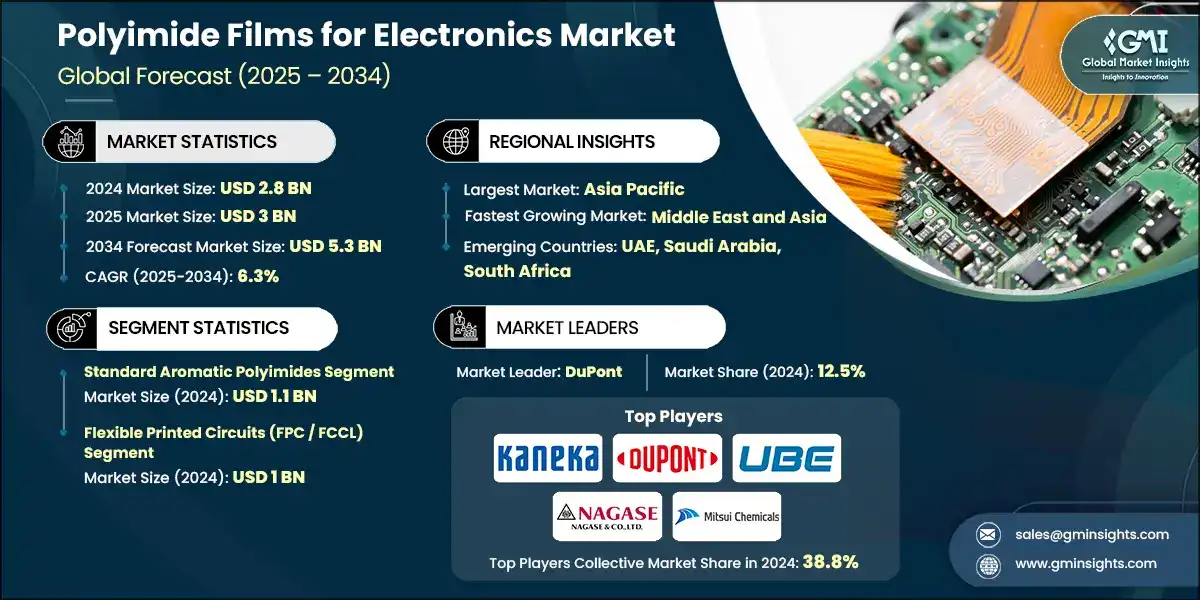
The global polyimide films for electronics market was valued at USD 2.8 billion in 2024. The market is expected to grow from USD 3 billion in 2025 to USD 5.3 billion in 2034, at a CAGR of 6.3%, according to the latest report published by Global Market Insights Inc.
To get key market trends
- Polyimide films are superior polymer material which are known for their consistency even in temperature extremes, resistance to chemicals, and mechanical strength. They are widely used in electronics because of their property of withstanding extreme temperature conditions to keep the electrical insulation intact. During the production of polyimide films, these are chains resulting from polymerization of dianhydrides and diamines. The most valuable features of this kind of polymeric film are dimensional stability and flexibility, which recommend it specifically for flexible printed circuits, insulation tapes, and display components.
- The electronics segment of the polyimide films market is showing continuous technological changes cater by improvements in electronic devices, particularly flexible and wearable ones. Thin film manufacturing innovations, miniaturization of devices, and the advancement of 5G technology increasing the demand and usage of polyimide films in flexible displays, foldable smartphones, and advanced printed circuit boards. The rise in emerging trend of flexible hybrid electronics (FHE) is leading manufacturers to develop next-generation polyimide films with very high-performance properties.
- The steadily increasing global demand for polyimide films in electronics shows a strong growth due to diverse applications such as flexible printed circuits, insulation materials for cables, and high-performance sensors. Electromechanical components continue to expand because of its lightweight, compact, and highly durable properties to consumers through the development of new electronic devices. Major segments contributing to the market are consumer electronics, automotive electronics, and aerospace systems.
Polyimide Films for Electronics Market Report Attributes
| Key Takeaway | Details |
|---|---|
| Market Size & Growth | |
| Base Year | 2024 |
| Market Size in 2024 | USD 2.8 Billion |
| Market Size in 2025 | USD 3 Billion |
| Forecast Period 2025 - 2034 CAGR | 6.3% |
| Market Size in 2034 | USD 5.3 Billion |
| Key Market Trends | |
| Drivers | Impact |
| Rising demand for flexible and wearable electronics | The growing popularity of flexible displays, foldable smartphones, smartwatches, and wearable medical devices is significantly driving demand for polyimide films due to their superior flexibility, heat resistance, and electrical insulation properties. |
| Expansion of 5G and high-frequency electronics | With the rapid rollout of 5G networks, there is an increasing need for high-performance materials that can withstand higher frequencies and temperatures. Polyimide films are ideal for use in antennas, flexible printed circuits, and other 5G infrastructure components. |
| Technological advancements in material science | Continuous innovation in polyimide film manufacturing such as the development of transparent, colorless, and low-dielectric variants is expanding their applicability in next-generation technologies, including flexible OLED displays and photovoltaic devices. |
| Pitfalls & Challenges | Impact |
| High manufacturing and processing complexity | The production of electronic-grade polyimide films requires precise polymerization and curing processes to ensure uniform thickness, dielectric strength, and thermal resistance. This complexity leads to high manufacturing costs and limits large-scale, low-cost production for electronic applications such as flexible PCBs and displays. |
| Challenges in recyclability and sustainability | The electronics industry faces growing environmental regulations and demand for sustainable materials, the lack of eco-friendly alternatives or recycling solutions poses a long-term challenge for the market. |
| Opportunities: | Impact |
| Expansion of electric vehicles (EVs) and advanced automotive electronics | The increasing use of electronics in EVs such as battery management systems, sensors, and control modules creates strong demand for high-performance insulation and flexible circuit materials. |
| Emergence of advanced display technologies | With the rise of OLED, micro-LED, and transparent display technologies, polyimide films especially colorless and optically clear variants are finding increasing use as flexible substrates, enabling lightweight and durable screen designs. |
| Integration into emerging semiconductor packaging technologies | As semiconductor devices become smaller and more powerful, there is a growing need for materials that can provide superior insulation, heat resistance, and dimensional stability in advanced packaging solutions like chip-on-film (COF) and fan-out wafer-level packaging (FOWLP). |
| Market Leaders (2024) | |
| Market Leaders |
12.5% market share |
| Top Players |
Collective market share of 38.8% in 2024 |
| Competitive Edge |
|
| Regional Insights | |
| Largest Market | Asia Pacific |
| Fastest growing market | Middle East and Asia |
| Emerging country | UAE, Saudi Arabia, South Africa |
| Future outlook |
|
What are the growth opportunities in this market?
Polyimide Films for Electronics Market Trends
- Key trends driving the polyimide films market include the rising acceptance of flexible and wearable electronic devices. With their flexibility, thermal stability, and excellent electrical insulation, polyimide films find extensive applications in foldable smartphones, smartwatches, and medical wearable devices. This trend is increasing the demand for thin, durable, and transparent polyimide films that meet the mechanical and optical requirements of advanced devices.
- Polyimide films with low dielectric constants and high signal integrity are in demand due to 5G technology and high-frequency electronics. They are used in antennas, flexible printed circuits, and connectors for the stiff delivery of high-speed data with reliable operation under high-frequency conditions. The manufacturers are interested in developing specialty films specifically designed for the needs of these advanced communication systems.
- Demand for Polyimide films is increased in applications such as advanced power electronics, flexible solar panels, energy storage systems, and high-efficiency inverters all of which are part of the renewable energy spectrum. Their excellent properties like retention of thermal, chemical, and electrical insulation make them suitable for outdoor as well as high-voltage applications.
- Sustainability is being considered as a key trend in the electronics materials industry. Manufacturers of polyimide films are investing in eco-friendly methods, recyclable films, and low-emission chemical applications to the extent that they both satisfy environmental regulations and consumer expectations. Green electronics are promoting bio-based and colorless polyimide films, thus broadening the areas of application for these bio-based polyimide films toward energy-efficient and environmentally friendly electronic devices.
- With the rising demand for sustainable energy solutions, more applications for polyimide films are being developed beyond their use in the electronics and display markets, where they traditionally find their applications.
Polyimide Films for Electronics Market Analysis
Learn more about the key segments shaping this market
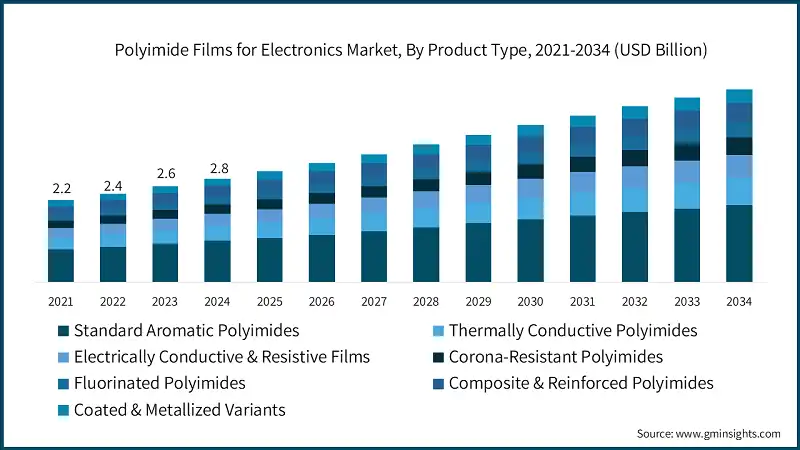
The polyimide films for electronics industry by product type are segmented into standard aromatic polyimides, thermally conductive polyimides, electrically conductive & resistive films, corona-resistant polyimides, fluorinated polyimides, composite & reinforced polyimides and coated & metallized variants. Standard aromatic polyimides hold the largest market value of USD 1.1 billion in 2024.
- The market is dominated by standard aromatic polyimides dominate due to diverse electronic applications, such as flexible circuits, wire insulations, and display substrates. Thermally conductive polyimides are growing with the increasing demand of efficient heat-dissipation materials for high-power electronics, electric vehicle batteries, and miniaturized semiconductor devices. Electrically conductive & resistive films and corona-resistant polyimides are on a slow but steady growth towards specialized applications where electrical properties or enhanced resistance to high-voltage stress are needed, mainly in automotive, aerospace, and industrial electronics.
- On the other hand, fluorinated polyimides are demanding for high-frequency electronics, flexible displays, and aerospace applications wherein they combine excellent dielectric properties with chemical resistance and stability to extreme conditions. Composite & reinforced polyimides are used in areas requiring mechanical reinforcement or specialized performance. Coated & metallized variants are growing into niche applications, which demand additional surface functionalities such as EMI shielding, reflective coatings, or protective layers that reflect, as a general trend, the growing approach of application-specific high-performance solutions in the electronics industry.
Learn more about the key segments shaping this market
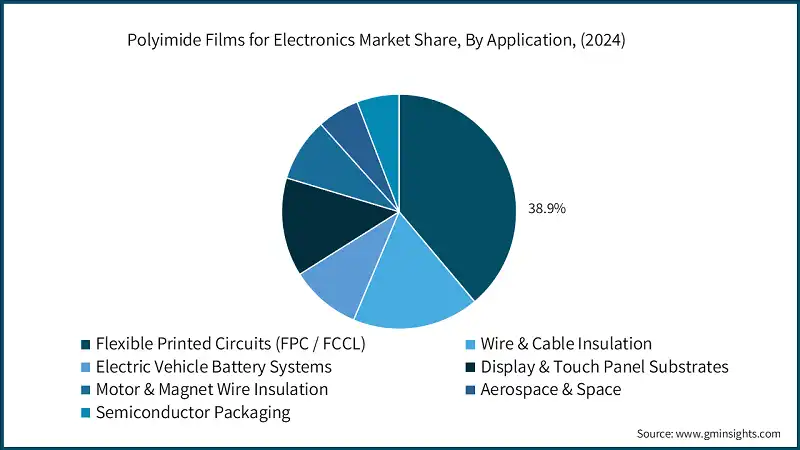
The polyimide films for electronics market by application is segmented into flexible printed circuits (FPC / FCCL), wire & cable insulation, electric vehicle battery systems, display & touch panel substrates, motor & magnet wire insulation, aerospace & space and semiconductor packaging. Flexible printed circuits (FPC / FCCL) hold the largest market value of USD 1 billion in 2024.
- Flexible Printed Circuits (FPC/FCCL) are the largest and most dynamic applications of polyimide films. The increase in demand from smartphones to wearables and components used in flexible electronics further fuels this growth. The features of flexibility, heat resistance, and electrical insulation make them indispensable in a compact, high-density design. Wire & Cable Insulation and Motor & Magnet Wire Insulation uses additional segments that are always promising as their use continues to be driven by the positive trend toward high-temperature resistant materials in electric vehicles, industrial motors, and automation systems.
- Electric Vehicle Battery Systems are also growing due to global trends towards electrification and the demand for lightweight heat-stable materials in battery modules. Display & Touch Panel Substrates continue to grow with OLED and foldable displays, while Miniaturization and demand in performance of advanced electronics push Semiconductor Packaging. The Aerospace & Space segment are smaller in the overall market revenue, but it holds a significant promise for development owing to the reliability, radiation resistance, and mechanical stability required under extreme operational environments.
Looking for region specific data?
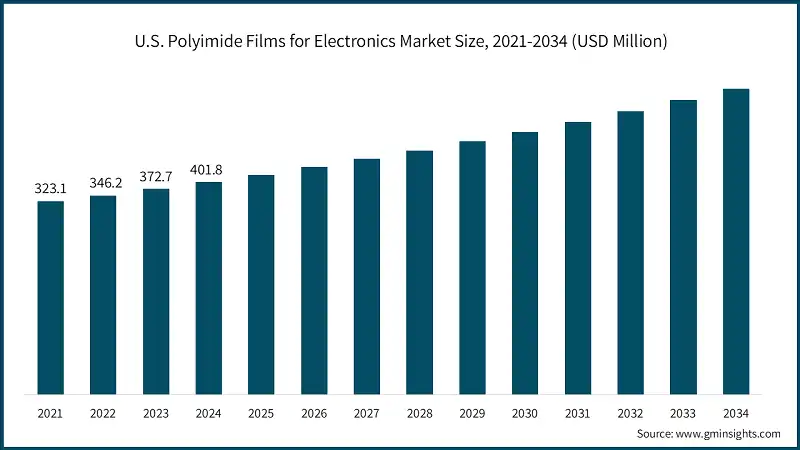
The U.S. polyimide films for electronics market accounted for USD 401.8 million in 2024.
- In North America, market for polyimide films for electronics is growing due to flexible electronics, advancement in semiconductors, aerospace, and automotive applications. Demand in the U.S. is from sectors like consumer electronics, electric vehicles, and defense, which further innovate for high-performance, low-dielectric, and colorless polyimide films. The R&D thrust, existence of leading electronic manufacturers in the region, and efforts into sustainable and eco-friendly materials further solidify the region as a prime place for advanced technology applications in polyimide films.
The market in the Germany is expected to experience significant and promising growth from 2025 to 2034.
- The development of the polyimide films for electronics market in Germany is growing demand from automotive, aerospace, and industrial electronics. It is also aided by the country's advanced manufacturing capabilities and innovation in high-performance materials. Increasing installations of renewable energy, electric vehicles, and next-generation semiconductor technologies in Europe have been driving demand for these valuable, flexible, and greener polyimide films. Also, stringent regulatory standards encourage sustainable production practices across the region.
The polyimide films for electronics market in China is expected to experience significant and promising growth from 2025 to 2034.
- The APAC market expansion is rapidly being propelled with the region's position of being a global manufacturing hub for electronics and of high-volume consumer devices. Production of smartphone and tablet with flexible displays and electronic components results in growth in China which is driven by competitive labor cost and strong government incentives for advanced manufacturing. Increased exports to global markets and investments in smart factories, IoT devices, and electronics used in electric vehicles are creating lucrative opportunities for manufacturers of polyimide films. All these factors together are establishing APAC as a key driver of global market growth and scaling production with rising technology and quality standards.
UAE market is expected to experience significant and promising growth from 2025 to 2034.
- In the MEA region, polyimide films for electronics market is growing because of increasing investments in electronics manufacturing, renewable energy, and smart infrastructure projects. UAE is focusing on the adoption of advanced technologies in aerospace, defense, and energy storage systems, which in turn caters demand for high-performance, thermally stable, and durable polyimide films. In MEA region, efforts by governments across the region to promote industrialization and digitalization along with sustainable energy solutions, flexible and eco-friendly alternatives are beginning to be integrated into electronic components made with polyimide films, creating a new market platform for advanced electronic materials in the region.
Brazil polyimide films for electronics market is expected to experience significant and promising growth from 2025 to 2034.
- Polyimide films for electronics in Latin America, include Brazil, is considered a niche but promising market, expected to witness gradual growth. Smaller and medium-sized electronics manufacturers, research into local semiconductor and flexible electronics applications, and an increased interest in lightweight and high-performance materials in industrial automation caters growth within Latin America market. Brazil, as the largest economy in the region, made new advances in utilizing these innovative materials in automotive electronics, energy storage, and infrastructure projects.
Polyimide Films for Electronics Market Share
Polyimide Films for Electronics markets are moderately consolidated with players like DuPont, Kaneka Corporation, UBE Industries Ltd., NAGASE & Co. Ltd., Mitsui Chemicals Inc., holding 38.8% market share and Kaneka Corporation being the market leader holding the market share of 12.5% in 2024.
- The leading firms in the polyimide films for electronics industry gain and maintain competitive advantage by investing in R&D. The aims of these firms are to manufacture high-performance thermally stable and flexible polyimide films for various advanced applications besides traditional semiconductor applications flexible displays, electric vehicle components, aerospace electronics, and energy storage systems.
- Competitive strategy among polyimide films companies is now being increasingly impacted by sustainability and eco-friendly manufacturing. These companies are developing more sustainable ways to produce their products, increase their resource efficiency, and minimize waste and the accompanying carbon footprints. Such sustainable practices have positioned them as more-preferred partners among electronic manufacturers looking for dependable quality materials that, at the same time, meet the environmental and corporate sustainability requirements.
- Compliance with rigorous environmental, health, and safety regulations gives firm competitive advantage. These standards for the safety, handling, and labelling of chemicals thereby further enhances the trust of clients and consumers and the facilitation of access to international markets and supply chains as transparent.
Polyimide Films for Electronics Market Companies
Major players operating in the polyimide films for electronics industry are:
- Apical Film Solutions
- Arakawa Chemical Industries Ltd.
- CAPLINQ Corporation
- CS Hyde Company
- DuPont
- Dunmore Corporation
- Hony Engineering Plastics Limited
- Kaneka Corporation
- Mitsui Chemicals Inc.
- NAGASE & Co. Ltd.
- Polyonics Inc.
- Qnity Electronics
- Rogers Corporation
- Saint-Gobain Performance Plastics
- Sheldahl Flexible Technologies Inc.
- SKC Kolon PI Inc.
- Taimide Tech Inc.
- UBE Industries Ltd.
- Wuhan China Star Optoelectronics
- Yousan Technology Co. Ltd.
- 3M Company
Kaneka Corporation is a producer of high-performance polyimide films widely used in the electronics industry. Mainly characterized by their innovation in flexible electronics, Kaneka's polyimide films offer excellent performance regarding thermal stability and electrical insulation, as well as mechanical strength. Products produced by Kaneka serve a variety of applications such as flexible printed circuits, displays, and semiconductor packaging, making them a trusted supplier in the global electronics industry.
DuPont. is a company that deals in advanced materials, including polyimide films for electronic applications. These films are known for their excellent heat resistance, dimensional stability, and chemical durability. The polyimide solutions offered by DuPont are highly utilized in flexible circuitry, wire insulation, and semiconductor packaging, contributing to the making of high-performance and reliable electronic devices globally.
UBE Industries Ltd. is one of the key player in the market. It offers films having excellent electrical and thermal properties. These products widely meet critical electronic applications, such as flexible circuits and automotive electronics. Today, there is continuous evolution of miniaturization in the electronics industry, and these films are built for operational high temperatures.
NAGASE & Co. Ltd. is a major polyimides developer for the electronics segment. They have mainly focused on high-quality polyimide solutions to meet the most demanding requirements for flexibility, heat resistance, and electrical insulation in flexible printed circuits and advanced display technologies-all highly important categories now contributing towards innovating electronic materials.
Mitsui Chemicals Inc. is known for possessing of polyimide films specifically used for the electronics. Their films are comparatively superior regarding thermal endurance, electrical performance, and mechanical resilience entailing them for inclusion in many applications, like wire & cable insulation, display substrates, and semiconductor packaging. Mitsui Chemicals focused on continuous innovation to meet the demands of next-generation electronics.
Polyimide Films for Electronics Industry News
- In January 2025, Launch of Smart Effects, a business line that evolved from strategically merging Evonik's Silica and Silanes units in the Smart Materials division. This merger augments the company´s proficiency in molecular silane chemistry and silica particle design to deliver innovative solutions across electronics, automotive, tires, consumer health, and building protection. Smart Effects is concentrated on sustainable and circular solutions based on high-purity materials for lithium-ion batteries, semiconductors, and green tires, and employs a global asset network and regional technology centres to bolster customer relations and drive innovation across industries.
- In October 2023, - FUJIFILM Corporation consolidated its strong position in the global polyimide films for electronics market by acquiring Entegris' polyimide films for electronics business, now renamed FUJIFILM Electronic Materials Process Chemicals. This move enhances Fujifilm's technological platform, increases its scope in global manufacturing, and expands its product portfolio in high-purity process chemicals. As such, the acquisition complements the company's strategic focus on innovation, supply chain resilience, and sustainable growth in the manufacture of advanced semiconductor materials.
The polyimide films for electronics market research report includes an in-depth coverage of the industry with estimates and forecast in terms of revenue in USD Billion and volume in terms of million meters from 2021–2034 for the following segments:
Market, By Product Type
- Standard aromatic polyimides
- PMDA/ODA-based systems
- Thermally conductive polyimides
- Enhanced thermal conductivity variants
- Electrically conductive & resistive films
- Controlled surface resistivity
- Anti-static & EMI shielding
- Corona-resistant polyimides
- High-voltage ac
- Power electronics
- Fluorinated polyimides
- Low dielectric constant
- 5G & high-frequency communication systems
- Composite & reinforced polyimides
- Nanoparticle-enhanced variants
- Mechanical property enhancement
- Coated & metallized variants
- FEP-coated films
- Aluminum & ITO metallized films
- Specialty coatings & surface treatments
Market, By Application
- Flexible printed circuits (FPC / FCCL)
- Wire & cable insulation
- High-temperature electrical insulation
- Aerospace & defense
- Industrial motor
- Electric vehicle battery systems
- Battery pack insulation & thermal management
- Display & touch panel substrates
- OLED & flexible display
- Touch sensor panel
- Motor & magnet wire insulation
- High-temperature motor
- Industrial & automotive motor
- Aerospace & space
- Multilayer insulation systems
- Satellite & spacecraft electronics
- Thermal control & protection systems
- Semiconductor packaging
- Die attach & encapsulation
- Advanced packaging technologies
- Moisture sensitivity & reliability
The above information is provided for the following regions and countries:
- North America
- U.S.
- Canada
- Europe
- Germany
- UK
- France
- Spain
- Italy
- Rest of Europe
- Asia Pacific
- China
- India
- Japan
- Australia
- South Korea
- Rest of Asia Pacific
- Latin America
- Brazil
- Mexico
- Argentina
- Rest of Latin America
- Middle East and Africa
- Saudi Arabia
- South Africa
- UAE
- Rest of Middle East & Africa
Frequently Asked Question(FAQ) :
Who are the key players in the polyimide films for electronics market?
Key players include DuPont, Kaneka Corporation, UBE Industries Ltd., NAGASE & Co. Ltd., Mitsui Chemicals Inc., SKC Kolon PI Inc., Saint-Gobain Performance Plastics, and Taimide Tech Inc.
What are the upcoming trends in the polyimide films for electronics industry?
Key trends include development of transparent and colorless polyimide films, adoption of eco-friendly and recyclable materials, and increasing use in electric vehicles, flexible OLED displays, and 5G communication systems.
Which region leads the polyimide films for electronics market?
The U.S. market was valued at USD 401.8 million in 2024, leading North America’s dominance. Growth is driven by innovation in flexible electronics, semiconductors, and defense systems supported by advanced R&D capabilities and sustainability initiatives.
What was the valuation of the flexible printed circuits (FPC/FCCL) application segment in 2024?
The flexible printed circuits segment held the largest market value of USD 1 billion in 2024.
What is the market size of the polyimide films for electronics industry in 2024?
The market size was USD 2.8 billion in 2024, with a CAGR of 6.3% expected through 2034, driven by rising demand for flexible, high-performance, and thermally stable films in advanced electronic applications.
How much revenue did the standard aromatic polyimides segment generate in 2024?
The standard aromatic polyimides segment generated USD 1.1 billion in 2024, leading the market due to its widespread use in flexible circuits, wire insulation, and display substrates.
What is the projected value of the polyimide films for electronics market by 2034?
The market size for polyimide films for electronics is expected to reach USD 5.3 billion by 2034, fueled by technological advancements in 5G, electric vehicles, and next-generation display technologies.
What is the current polyimide films for electronics market size in 2025?
The market size is projected to reach USD 3 billion in 2025.
Polyimide Films for Electronics Market Scope
Related Reports